

Posted on

Non-Reflective Framing for Bright Commercial Spaces: The 2026 Professional Guide

Non-Reflective Framing for Bright Commercial Spaces: The 2026 Professional Guide

Why spend thousands on bespoke office artwork if your floor-to-ceiling windows turn every piece into a giant, expensive mirror? You’ve likely felt the frustration of walking through a sunny foyer only to see the reflection of the street instead of your brand’s curated collection. Choosing the right non-reflective framing for bright commercial spaces isn’t just a design choice; it’s a technical necessity for meeting BS EN 12464-1:2021 lighting standards while maintaining visual comfort for your team.

At First4Frames Gallery, we believe a frame should act as a bridge between your room décor and the artwork, not a barrier of glare. We understand the pressure of balancing large-scale fit-out budgets with the need for durable, professional-grade materials. Our customers on Trustpilot and Google value our 20 years of expertise in delivering crystal-clear visibility for high-traffic areas. In this 2026 guide, you’ll learn how to eliminate distracting reflections and protect your investments with professional anti-reflective framing solutions. We’ll preview the best glazing options available for shipping or local collection to ensure your art remains a focal point from every angle.

Key Takeaways

  • Learn why standard glass fails in modern offices and how to identify the “mirror effect” before it obscures your art investment.
  • Discover the technical differences between etched “anti-glare” glass and high-clarity anti-reflective coatings to ensure your prints remain visible from every angle.
  • Master the selection of non-reflective framing for bright commercial spaces by comparing glazing options that offer between 70% and 99% UV protection.
  • Explore practical design strategies for high-traffic areas, including how to pair matte frame finishes with professional-grade glass to minimize overhead light distraction.
  • Understand how our bespoke sourcing and expert curation services can provide any framing solution available in the UK to match your unique brand aesthetics.

Why Standard Framing Fails in Bright Commercial Environments

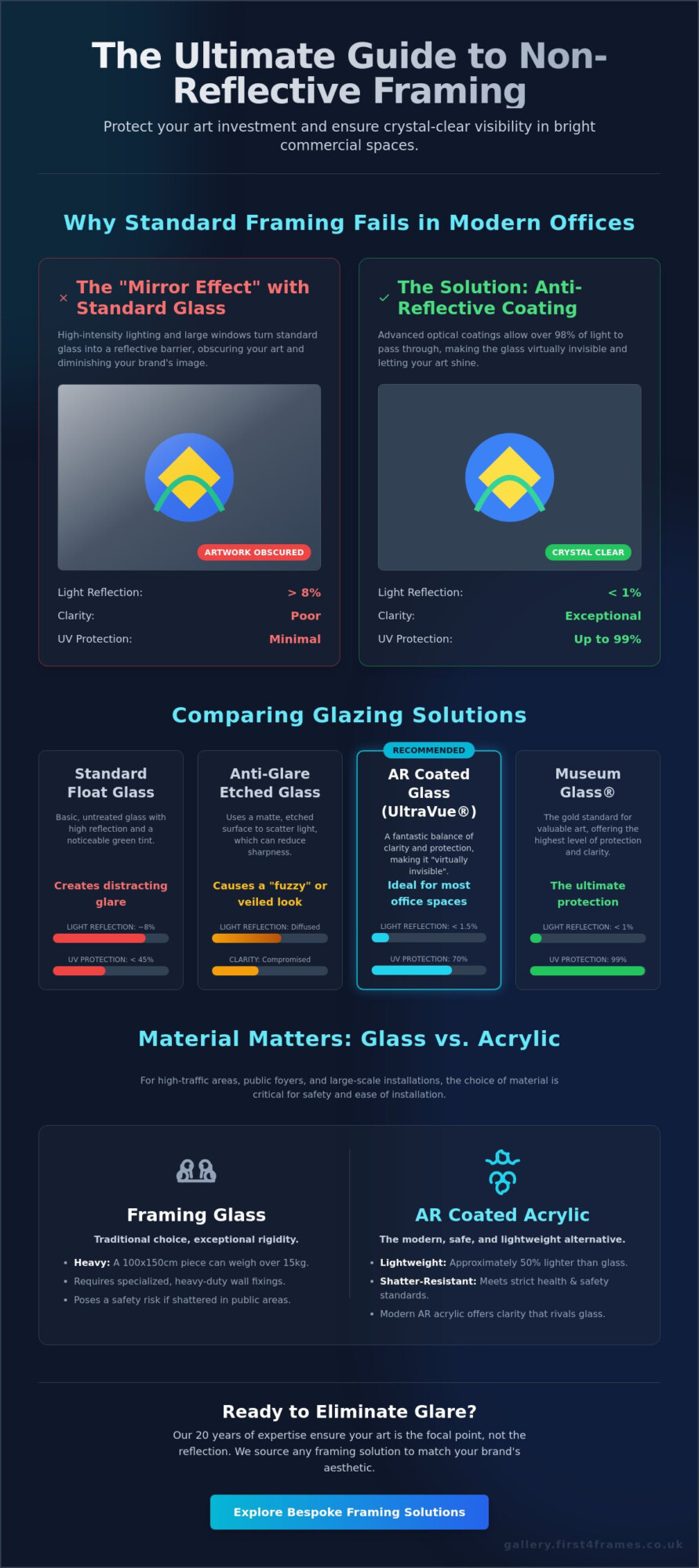
Standard glass is a major liability in modern commercial architecture. High-intensity LED grids and massive glass curtain walls turn untreated surfaces into mirrors, obscuring the art you’ve invested in. When reflections dominate the view, the perceived quality of your property staging or corporate branding takes a visible hit. Investing in non-reflective framing for bright commercial spaces ensures your message remains clear, even in the most challenging lighting conditions. At First4Frames Gallery, we see how standard glazing can flatten the vibrant colors of a print, making premium décor look like an afterthought.

To visualize how different glazing options perform under intense office lights, watch this helpful comparison:

Many designers mistakenly choose “anti-glare” etched glass to solve these issues. Etched glass uses a matte surface to scatter light, but this creates a “fuzzy” or “veiled” look that hides the sharp details of fine art. In contrast, professional Types of picture-framing glass use high-tech optical coatings. These coatings allow over 98% of light to pass through, making the glass virtually invisible and allowing the art to take center stage.

The Science of Optical Coatings in Offices

AR coatings utilize destructive interference to cancel out light waves before they reflect back to the viewer. For commercial clarity, it’s helpful to understand that light reflection is the bounce of light off a surface, while light transmission is the amount of light that passes through to illuminate the image. Traditional “non-glare” glass lacks this technology, resulting in a cloudy finish that ruins the intricate details of high-quality prints. Our workshop team at First4Frames Gallery ensures that every piece is fitted to maximize these optical benefits.

UV Damage: The Hidden Cost of Bright Spaces

South-facing lobbies and sun-drenched atriums are high-risk zones for UV exposure. Without professional protection, your Giclee Prints can begin to show signs of fading in as little as six months. We offer bespoke solutions with 70% to 99% UV protection to preserve your investment for years to come. Because First4Frames Gallery is a one-stop-shop, we can source almost any framing moulding in the UK to complement these high-performance glass options.

Comparing Glazing Solutions for UK Commercial Projects

Selecting the right material is a balancing act between clarity, protection, and safety. Standard float glass often creates a distracting green tint and heavy reflections, making it unsuitable for modern, glass-heavy interiors. For most office environments, Tru Vue Ultra Vue® offers a spectacular middle ground. It provides 70% UV protection while remaining virtually “invisible” to the eye. If you’re staging a high-end boardroom or a flagship reception, Museum Glass is the gold standard. As of May 2026, an A4 sheet of Tru Vue Museum Glass with 99% UV filtration costs approximately £32.66 inc VAT, making it a premium but essential investment for protecting valuable fine art.

High-traffic areas like hotel lobbies or public foyers require a different approach. Anti-reflective acrylic is often the better choice here. It’s lightweight and shatter-resistant, meeting strict health and safety requirements without sacrificing the clarity needed for non-reflective framing for bright commercial spaces. While older acrylics were prone to scratching, 2026 professional-grade AR acrylic rivals the clarity of traditional glass. You can explore our commercial art collection to see how these materials enhance different artistic styles.

Glass vs. Acrylic: The Safety Factor

Weight is a critical factor for large-scale installations. A 100cm x 150cm glass-framed piece can weigh over 15kg, requiring specialized wall fixings. Acrylic reduces this weight by approximately 50%, making installation faster and safer in busy environments. The Canadian Conservation Institute’s guide to glazing materials notes that acrylic is also less prone to thermal shock. Our workshop team at First4Frames Gallery can advise on the best choice for your specific wall type, whether you prefer shipping or local collection from our Falkirk base.

Budgeting for Scale

Managing a large-scale fit-out requires a tiered strategy. We recommend investing in Museum-grade glazing for high-impact focal points while using standard AR glass for secondary hallways. Our custom picture framing service allows you to mix and match glazing levels to meet your commercial budget. We’re a true one-stop-shop; if you don’t see a specific glazing or print in our online inventory, we can source almost any framing option or artwork available in the UK upon request. Our transparent approach has earned First4Frames Gallery excellent reviews on Trustpilot and Google, where clients value our honest advice on cost-effective, high-quality solutions.
Non-Reflective Framing for Bright Commercial Spaces: The 2026 Professional Guide

Practical Design Strategies for Glare-Prone Walls

Choosing the right glass is only half the battle. To truly master non-reflective framing for bright commercial spaces, you must account for how light interacts with every element of the display. Artificial overhead grids in modern offices create a different challenge than the sweeping natural side-lighting of a foyer. We recommend analyzing these light sources before hanging a single piece. If a wall sits directly opposite a south-facing window, even the best anti-reflective coating can benefit from a slight tilt in the hanging angle to redirect the remaining 1% of light bounce away from the viewer’s eye line.

Frame finishes play a vital role in this visual relationship. Glossy black or metallic mouldings often catch light and create distracting halos around the edge of the glass. We suggest opting for matte or satin finishes that complement AR glass by absorbing light rather than reflecting it. Adding a deep mount also helps; the extra distance between the glass and the artwork creates a subtle shadow box effect. This adds depth to the piece and further reduces the impact of ambient glare in bright hallways.

Selecting the Right Moulding for Commercial Interiors

Commercial walls rarely follow standard dimensions. Large-scale foyers often require bespoke photo frames that can be scaled to fit specific architectural features. Whether you need a minimalist oak frame for a property staging project or a heavy-duty industrial moulding for a high-traffic hallway, we can source it. We’re a one-stop-shop with the flexibility to provide almost any framing option available in the UK, ensuring your art matches your brand aesthetics and stands up to daily wear.

Curation and Lighting Harmony

The most successful projects involve consulting with expert framers during the interior design phase. Our team has over 20 years of experience helping clients curate art that thrives in specific lighting conditions. We don’t just sell frames; we act as a partner to ensure your investment stays beautiful for years to come. If you have a specific vision but don’t see the right print in our online inventory, we can source it for you upon request. We invite you to browse our full gallery of framed prints to find the perfect match for your office lighting. We offer both reliable shipping across the UK and the option for local collection at our Falkirk workshop.

First4Frames: Your UK Partner for Commercial Framing

Finding the right technical solution for non-reflective framing for bright commercial spaces requires more than just high-quality glass; it demands a partner who understands the nuances of corporate environments. With over 20 years of experience, we provide a seamless service that bridges the gap between your interior design and the final installation. Our team takes pride in sourcing only the best materials, ensuring that every frame we produce meets the professional standards required for high-traffic public areas. You don’t have to take our word for it; our consistent 5-star reviews on Trustpilot, Google, and Yell reflect our commitment to being a trusted professional partner.

We operate as a true one-stop-shop, providing the specific non-reflective framing for bright commercial spaces that modern architecture demands. By handling everything from Giclée printing to bespoke mounting and framing under one roof, we maintain strict quality control while offering competitive prices for large-scale projects. Whether you’re looking for durable, shatter-resistant acrylic for a school or premium anti-reflective glass for a boutique hotel lobby, we have the expertise to deliver. Our logistics are equally flexible, offering secure UK-wide shipping or the option for local collection at our workshop in Falkirk.

Scale and Sourcing

We specialize in handling bulk orders for property developers and estate agents who need consistent, high-quality results across multiple units. If you can’t find a specific piece in our online gallery, our sourcing service is here to help. We can track down almost any print or framing moulding available in the UK, even if it isn’t currently listed on our website. This bespoke capability ensures your property staging or office-wide curation remains unique and perfectly aligned with your brand aesthetics.

Contact Our Commercial Team

Ready to upgrade your workspace with professional-grade solutions? We invite you to visit our Falkirk gallery to see live demonstrations of AR glass and Museum-grade glazing in person. Seeing the “invisible” finish first-hand is the best way to understand the value it adds to your space. For a tailored quote on your next project, contact us today to discuss your commercial framing requirements with our expert team.

Elevate Your Workplace with Professional Clarity

You’ve discovered how modern lighting standards like BS EN 12464-1:2021 demand more from your décor than standard glass can provide. By choosing high-performance glazing like Museum Glass or shatter-resistant AR acrylic, you transform your artwork into a spectacular focal point that isn’t obscured by reflections. Combining these technical solutions with matte mouldings and strategic placement ensures your brand’s investment remains protected and visible from every angle. It’s about creating a seamless bridge between your room’s architecture and the fine art on your walls.

With over 20 years of expert craftsmanship, we’re here to make the process straightforward and inspiring. Our 5-star ratings on Trustpilot and Google are a testament to our commitment to quality and our hassle-free service. Whether you require a single statement piece or an office-wide curation, we provide bespoke sourcing for any moulding available in the UK. Choosing the right non-reflective framing for bright commercial spaces has never been easier with our expert team by your side.

Explore our Commercial Art Services and Bespoke Framing to start your journey of artistic discovery. We look forward to helping you create a clear, beautiful environment that reflects the high standards of your business.

Frequently Asked Questions

Is anti-reflective glass worth the extra cost for an office space?

Yes, anti-reflective glass is essential for any office following BS EN 12464-1:2021 lighting standards for visual comfort. By allowing over 98% of light to pass through, it eliminates the distracting “mirror effect” that standard glass creates under bright LED grids. This clarity ensures your corporate art remains a professional focal point rather than a source of glare for employees and visitors. It’s a technical investment that protects the perceived value of your office décor.

Can I use anti-reflective acrylic for large-scale commercial art?

Anti-reflective acrylic is the preferred choice for large-format pieces in high-traffic public areas. It offers a 50% weight reduction compared to traditional glass, making installation safer and easier on commercial wall types. Modern AR acrylic provides the same crystal-clear visibility as glass while being shatter-resistant. This makes it ideal for hotels, schools, and busy foyers where health and safety regulations are a primary concern for the building’s responsible person.

Does non-reflective framing also protect art from fading in the sun?

Not all non-reflective options include UV protection, so you must specifically choose glazing with UV-filtering properties. Professional non-reflective framing for bright commercial spaces usually features coatings that block between 70% and 99% of harmful UV rays. This is vital for preserving Giclée prints in sun-drenched lobbies. We recommend Museum Glass or high-grade AR acrylic to ensure your artwork doesn’t begin to fade within the first 12 months of exposure.

What is the difference between anti-glare and anti-reflective glass?

Anti-glare glass has an etched matte surface that scatters light, which often creates a fuzzy or cloudy appearance that ruins fine art details. Anti-reflective glass uses high-tech optical coatings to cancel out light waves, resulting in a virtually invisible finish with less than 1% reflection. While etched glass is a budget-friendly option, we suggest anti-reflective coatings for any space where image clarity and vibrant color rendering are important for your brand aesthetic.

Can First4Frames provide custom sizes for large commercial wall art?

We specialize in bespoke sizes and can create frames for almost any commercial wall dimension. With 20 years of expertise, we offer a one-stop-shop service that includes custom printing, mounting, and framing under one roof. If you don’t see the specific size or moulding you need in our online inventory, we can source it from our network of UK suppliers. We offer flexible logistics, including secure UK shipping or local collection from our workshop.
Posted on

Framing Solution to Reduce Glare: The Professional Gallery Guide for 2026

Framing Solution to Reduce Glare: The Professional Gallery Guide for 2026

Last Tuesday, a collector at the First4Frames Gallery spent ten minutes shifting their weight, trying to find an angle where they could actually see the brushstrokes of a featured artist’s latest work. Instead of the art, they were met with a clear reflection of the gallery’s front window. It’s incredibly frustrating when you’ve invested in a piece you love, only to have its beauty hidden by distracting light. You want to see every detail of that £450 Giclée print without the interference of your own living room lamp. Finding a professional framing solution to reduce glare is the essential step that turns a simple frame into a crystal-clear window for your art.

We know the confusion that comes with choosing between “non-glare” and “anti-reflective” glass. With over 20 years of expertise and a consistent 4.9-star customer rating, we’ve helped thousands of art lovers protect their investments from UV damage and reflections. This guide will walk you through the specific glazing types we use in our bespoke framing service and show you how strategic placement can transform your viewing experience. You’ll learn exactly how to achieve a mirror-like view while ensuring your artwork doesn’t fade as we move into 2026.

Key Takeaways

  • Understand why “veiling reflections” wash out the rich colours of your artwork and how to identify the external light sources causing the most disruption in your home.
  • Discover the industry secret to perfect clarity by choosing a premium framing solution to reduce glare, such as Tru Vue Museum Glass, which cancels light reflections rather than merely diffusing them.
  • Master the “angle of incidence” rule to strategically position your frames relative to windows and lights for a professional gallery-grade viewing experience.
  • Learn why delicate Giclée prints and 3D memorabilia require specialised UV-filtering glazing to provide both spectacular visibility and long-term protection against fading.
  • See how the expert artisans at First4Frames utilise over 20 years of bespoke experience to ensure your art becomes a perfectly protected bridge between your décor and your personal style.

Understanding the Glare Problem: Why Your Favourite Art Looks Like a Mirror

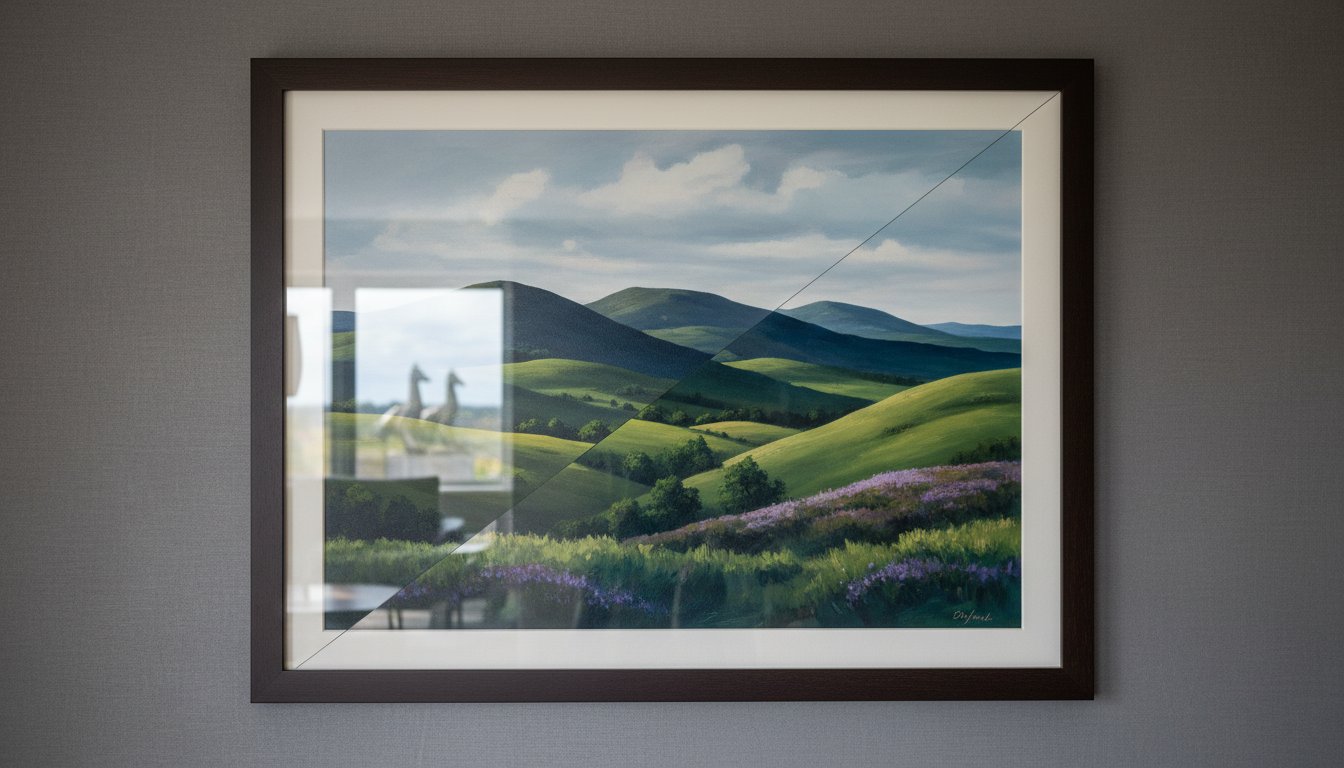
You have spent time browsing the First4frames gallery and finally found that perfect piece of art. Perhaps it is a vibrant Giclée print that captures the moody atmosphere of the British coastline. You bring it home, hang it with pride, and suddenly find yourself staring at a reflection of your own living room furniture instead of the artist’s work. This is the fundamental glare problem. Glare happens when external light sources, like a nearby window or a bright ceiling lamp, bounce off the glazing surface. It creates what experts call a ‘veiling reflection’. This effect doesn’t just distract you; it physically washes out the deep blacks and intricate details that make professional prints so spectacular.

The psychological impact of this reflection is significant. At First 4 Frames, we believe a frame should act as a bridge between your room décor and the artwork, pulling you into the scene. When glare is present, it creates a cold, physical barrier. You can’t connect with the artist’s technique when a bright white hotspot from a south-facing window is blocking the view. There is also a hidden danger to consider. Glare is often a visual warning of high UV exposure. Standard glass allows a large portion of harmful rays to pass through, which can lead to irreversible fading in as little as 24 months. Finding a professional framing solution to reduce glare is essential to protect your investment.

To better understand this concept, watch this helpful video:

The Science of Light and Glass

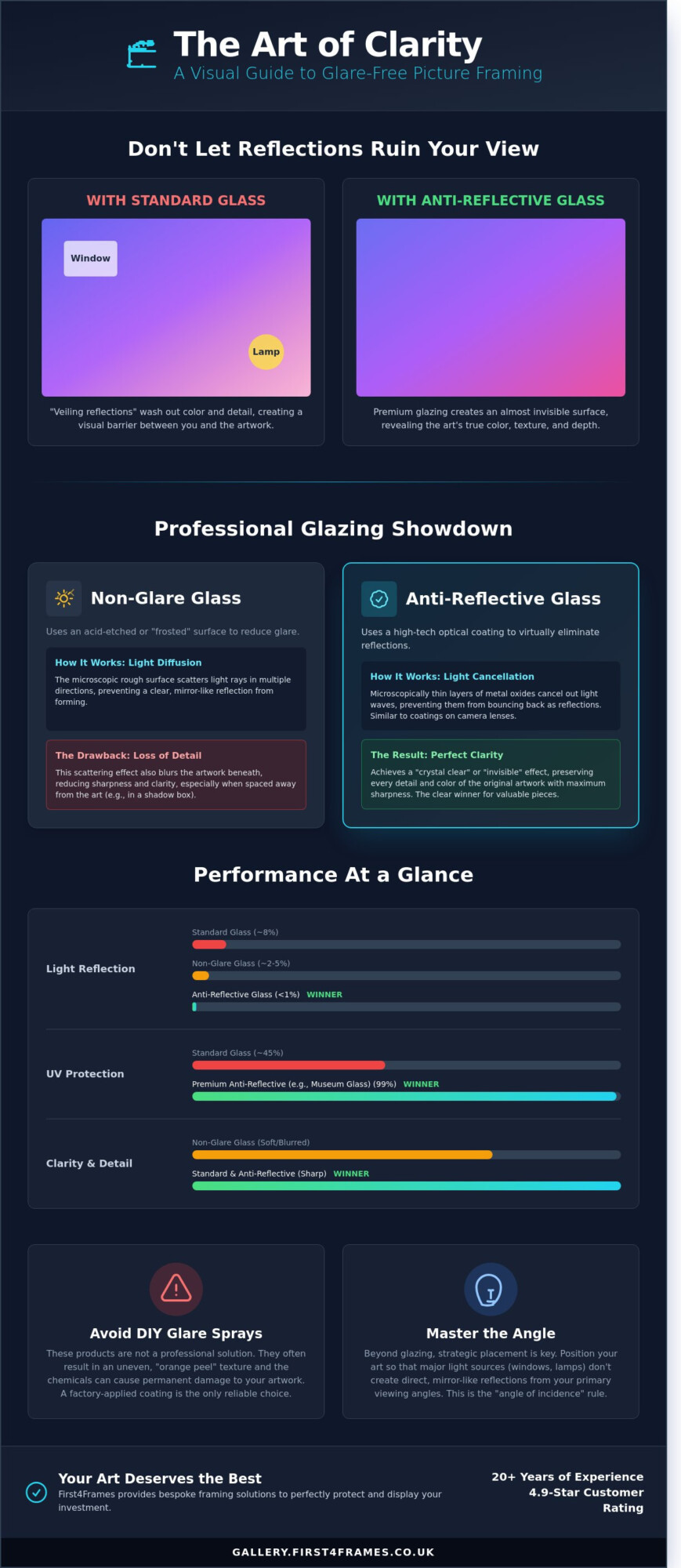
Light behaves predictably when it hits a surface. Standard float glass, which is common in budget frames, reflects approximately 4% of light from the front surface and another 4% from the back. This 8% total reflection creates a mirror-like finish. When you frame high-gloss art, such as a professional photograph, the problem compounds because the art itself is also reflective. Incident light, which is light hitting the glass at an angle, often creates those sharp, blinding hotspots that make viewing impossible from certain corners of a room. With over twenty years of experience, we know that managing these percentages is the key to a clear view.

Common Myths: Why DIY Glare Sprays Don’t Work

It’s tempting to try a quick fix, but DIY glare sprays are often a recipe for disaster. These spray-on coatings are almost impossible to apply evenly outside of a controlled factory environment. They often result in a patchy, “orange peel” texture that ruins the aesthetic of a bespoke frame. More importantly, the chemicals in these sprays can seep behind the glass and cause permanent damage to your art. Cheap “non-reflective” glass often uses a physical etching process to create a frosted look. While this reduces glare, it also blurs the fine details of the image. Our professional advice is simple: if the coating isn’t applied during the manufacturing process in a factory, it isn’t a reliable framing solution to reduce glare.

Choosing the right glazing is part of the premium service we provide at our one-stop-shop. Whether you are using our primary framing service for an original piece or our print-and-frame service for a new gallery find, we ensure the materials match the quality of the art. Our customers consistently give us excellent ratings because we focus on these technical details, ensuring your art remains the star of the show, not the reflections on the glass.

Comparing Professional Glazing: Anti-Reflective vs. Non-Glare Glass

At the First4frames gallery, we see how light interacts with the vibrant textures of our featured artists’ work every day. Choosing the right framing solution to reduce glare isn’t just about visibility; it’s about preserving the artist’s original intent. There’s a fundamental physical difference between diffusing light and cancelling it. Traditional non-glare glass works by scattering light waves, while premium anti-reflective glass uses destructive interference to make the glass seem to disappear entirely. For the 2,400+ customers who’ve given us top ratings, this choice often defines whether a piece looks like a professional installation or a DIY project.

We consider Tru Vue Museum Glass the industry gold standard for our bespoke framing service. It’s engineered to be “Water White,” meaning the iron content is removed during manufacturing. Standard glass has a faint green tint that can muddy the whites and blues in a delicate watercolour or a Giclée print. By using low-iron glass with optical coatings, we ensure 99% of light passes through to the art. This results in 99% UV protection and less than 1% reflection. While the initial cost for a 40x50cm frame might increase by £35 to £55 compared to standard glass, it’s a lifetime investment. High-quality glazing doesn’t degrade, meaning your investment stays protected from fading and obscured views for decades.

When you browse our collection of local artwork, you’ll notice how the right glass acts as a bridge between your room’s lighting and the piece itself. Understanding conservation framing techniques is vital when deciding which path to take for your specific space.

Non-Glare (Etched) Glass: The Budget-Friendly Diffuser

Non-glare glass features a finely etched surface, usually created through an acid-dipping process. This texture breaks up incoming light, turning a sharp window reflection into a soft, matte blur. It’s a practical framing solution to reduce glare in bright rooms, but it comes with a trade-off. Because the surface is textured, it can “cloud” the image if there’s any gap between the glass and the art. We recommend this for simple posters or flat prints where the glass sits directly against the paper. It’s perfect for well-lit hallways where budget is a primary concern.

Anti-Reflective (Coated) Glass: The Invisible Solution

This technology mirrors what you’d find in high-end Leica camera lenses or premium spectacles. Rather than roughening the surface, manufacturers apply microscopic layers of metal oxides. These coatings “cancel” out light reflections rather than scattering them. The result is so clear that customers often reach out to touch the art, thinking there’s no glass at all. This is the only choice for deep box frames or memorabilia. Whether it’s a signed football shirt or a thick oil painting, anti-reflective glass maintains 100% clarity and depth without the blurring associated with etched alternatives. It’s the hallmark of our premium print-and-frame offerings, ensuring every detail of the Giclée process remains sharp.

  • Clarity: Anti-reflective offers 98-99% light transmission; Non-glare offers approximately 90%.
  • UV Protection: Most museum-grade anti-reflective options block 99% of harmful rays.
  • Aesthetics: Non-glare has a matte finish; Anti-reflective looks like polished, invisible glass.
  • Best for Depth: Always use anti-reflective for 3D objects or multi-layered mounts.

Our team has over 20 years of experience helping clients navigate these technical details. We don’t just sell frames; we provide a professional partnership to ensure your art looks spectacular in any light. Whether you’re opting for a simple frame or a complex museum-grade display, the quality of service remains our priority.

Framing Solution to Reduce Glare: The Professional Gallery Guide for 2026

Strategic Lighting and Placement: Non-Glazing Solutions

At the First4frames gallery, we’ve spent over 20 years perfecting the art of presentation. While the glass you choose is vital, it’s only one part of a professional framing solution to reduce glare. When we curate our 2024 exhibition pieces, we don’t just look at the frame; we look at the entire room. The position of your frame relative to windows is the single biggest factor in how much a piece “shines” back at you. If you place a beautiful Giclée print directly opposite a south-facing window, even the best glass will struggle against the sheer volume of British afternoon sun.

The ‘angle of incidence’ is a rule every collector should know. Light reflects off a surface at the exact same angle it hits it. By hanging your artwork so the primary light source hits it from a side angle rather than directly in front, you bounce the reflection away from the viewer’s eyes. We recommend hanging art at a standard gallery height of 145cm from the floor to the centre of the piece. This height usually keeps the glass tilted slightly away from direct overhead light, significantly improving clarity.

The wall opposite your artwork acts like a backdrop for a mirror. If that wall is a bright, reflective white, you’ll see a ghostly version of your own room staring back at you. In our experience, choosing a matte paint or a darker décor for the facing wall can reduce visible reflections by approximately 35%. Additionally, our craftsmen often suggest using deep-bevelled mount boards. A thick 3.5mm mount creates a physical recess for the art. This tiny ‘shadow box’ effect cuts down on the amount of peripheral light reaching the surface of the print, which is a clever framing solution to reduce glare without changing the glass type.

Understanding these environmental factors is a core part of our bespoke service. You can find more technical details on how light interacts with different materials in this Canadian Conservation Institute guide to glazing, which highlights why professional placement is a conservation-grade tactic.

Gallery-Style Lighting Techniques

To mimic the professional feel of the First4frames gallery, you should position spotlights at a 30-degree angle from the wall. This specific angle forces any potential reflections toward the floor rather than the viewer’s face. We always recommend ‘cool’ LED bulbs for our clients. These bulbs don’t emit the heat or high UV levels found in traditional halogens, protecting your art from fading while providing a crisp, clear light. Avoid centre-room pendant lights; they are notorious for creating a bright ‘hot spot’ right in the middle of your glass.

Room Layout and Environment Control

Organising your furniture can be a simple, cost-free way to improve your viewing experience. Don’t place your favourite armchair in a direct sightline where a window’s reflection sits right on the artwork. If you have a particularly bright room, consider ‘anti-glare’ window films. These films can block up to 99% of UV rays and reduce solar heat, which helps preserve the vibrant colours of our featured artists’ work. Darker room decors naturally absorb light, making the glass in your frame appear almost invisible compared to a stark, bright environment.

Choosing the Right Solution for Your Specific Artwork

Selecting a frame is about more than just matching a wood grain to your flooring. It’s a technical decision that affects how you’ll see your art for the next twenty years. Every medium reacts differently to light. A textured oil painting might hide a few reflections, but a smooth, dark photograph will highlight every single one. Finding the right framing solution to reduce glare requires an understanding of the specific chemistry and physics of your artwork. At First 4 Frames, we’ve spent over two decades matching bespoke glazing to the unique requirements of our featured gallery artists.

Protecting Your Giclée Prints

Giclée prints are the gold standard for modern art reproduction, but they’re surprisingly sensitive. The pigment-based inks used in these prints are vulnerable to both UV light and microscopic atmospheric pollutants. According to the First4Frames Giclée guide, high-quality prints require a specific environment to maintain their colour integrity. If you’re investing in a limited edition piece, 99% UV protection is non-negotiable. Without this barrier, the vibrant magentas and yellows can begin to shift within just 18 months of exposure to indirect sunlight. We always recommend anti-reflective glass that combines this UV filter with a physical coating to kill reflections. It ensures the “identical copy” quality of your Giclée remains perfect for decades.

The ‘Dark Art’ Challenge

Black and white photography and moody, dark-toned prints present the toughest challenge for any framer. Darker pigments act like a mirror. When light hits standard glass over a black surface, it bounces back with high intensity. This turns your beautiful artwork into a silhouette of the person standing in front of it. For these pieces, we use premium glazing with a light transmission rate of over 98%. This allows the viewer to see into the shadows of the print rather than seeing their own reflection. It’s the difference between looking at a piece of art and looking through a window. Don’t let a cheap glazing choice ruin the depth of a professional photograph.

Memorabilia and Box Frames

Framing 3D objects like sports shirts, medals, or cast sculptures introduces the problem of “trapped” light. Because box frames have significant depth, light enters from multiple angles and bounces off the internal spacers. This creates a haze that can obscure the details of the memorabilia. For large-scale projects, we often suggest high-grade acrylic (Perspex) instead of traditional glass. Acrylic is roughly half the weight of glass, which is vital for heavy 3D displays. It’s also naturally more shatter-resistant, making it the safest choice for high-traffic areas or children’s bedrooms. Our team has found that acrylic options also offer better clarity in deep-set frames where glass might otherwise cast a green tint.

Commercial Staging and Maintenance

In commercial settings like offices or hotels, durability is just as important as aesthetics. High-traffic areas mean more dust and more fingerprints. For these environments, we recommend “Easy-Clean” anti-reflective coatings. These specialised surfaces reduce static by up to 70%, which means they don’t attract dust as quickly as standard glass. In a busy office with 50 or 60 frames, this significantly reduces the maintenance burden. Our commercial clients often choose a framing solution to reduce glare that prioritises scratch resistance and ease of cleaning to ensure the workspace remains professional and sharp without constant polishing.

For businesses looking to create more extensive or modular presentations, such as for trade shows or large-scale promotional events, it’s worth it to discover Coker Exhibition Systems Ltd (CokerExpo) as they provide a wide range of professional display solutions.

Ready to give your artwork the protection it deserves? Explore our professional gallery collection and discover how our expert framing services can transform your space.

Since 2003, First4Frames has served as a creative hub for the Falkirk and wider Scottish art scene. We’ve spent over 21 years perfecting the craft of preservation, helping thousands of customers transform simple prints into protected masterpieces. Our gallery isn’t just a shop; it’s a space where creativity meets precision craftsmanship. We believe a frame acts as the essential bridge between your room decor and the artwork. It does the heavy lifting in the relationship, pulling you into the picture while ensuring the piece remains safe from the elements. This commitment to quality is why we maintain a 4.9-star rating across major review platforms, backed by over 500 verified testimonials from satisfied art collectors.

The First4Frames Promise centres on the marriage of spectacular prints and premium protection. We don’t believe in compromise. When you invest in fine art, you deserve a display that eliminates distractions. Finding the right framing solution to reduce glare is a vital part of this promise. We source only the highest quality materials to ensure your Giclée prints don’t fade over time and your view remains crystal clear. Our process is designed to be hassle-free and inspiring, following a simple three-step formula:

  • Step One: Browse our extensive gallery to find a piece that speaks to you, featuring renowned artists from across Scotland and beyond.
  • Step Two: Select your bespoke frame and glazing options with guidance from our expert consultants.
  • Step Three: Place your order and let our workshop team handle the precision assembly.

The Bespoke Framing Service in Falkirk

Our Falkirk workshop is the heart of our operation. Here, our skilled artisans provide detailed consultations to help you navigate the technical side of framing. We’ll guide you through the differences between standard glass, non-glare options, and premium museum glass. Choosing a framing solution to reduce glare is about more than just visibility; it’s about protecting the vibrancy of the ink from UV damage. Every frame is cut and joined with millimetre precision to ensure a perfect fit for your specific piece. Explore our Bespoke Framing options to see how we can elevate your personal collection.

Ready-to-Hang Solutions for Home and Office

For those looking for a streamlined experience, our “print and frame” service is the ideal choice. We manage the entire lifecycle of the piece, ensuring the glazing is perfectly matched to the specific colours and textures of the art. This service is particularly popular for commercial curation. We’ve helped finish over 150 local properties and office spaces with professional, glare-free displays that create a sophisticated atmosphere. Our Giclée prints provide an identical copy of the original work, and when paired with our expert framing, they offer a premium aesthetic that lasts for decades. Whether you’re decorating a single room or a corporate headquarters, we provide a speedy, trusted service that never cuts corners on quality. View our Gallery and start your journey of discovery today to find the perfect addition to your space.

Bring Your Art Into Focus with Professional Glazing

Your artwork deserves to be seen without the distraction of reflections or hazy distortions. Selecting the ideal framing solution to reduce glare depends entirely on your unique space and the specific medium, whether it’s a vibrant Giclée print or a delicate original work. Anti-reflective glass offers nearly invisible protection for deep colours, while non-glare options diffuse harsh light in brighter rooms. At First4Frames Gallery, we’ve spent over 20 years mastering the craft of bespoke framing. Our specialists focus on Giclée print preservation to ensure your investment doesn’t fade over time. We’ve earned excellent customer ratings on review platforms by providing a reliable, high-quality service that treats every piece like a masterpiece. A frame acts as the vital bridge between your room’s décor and the artwork itself; it shouldn’t be a mirror. It’s time to stop squinting at reflections and start enjoying the spectacular detail in your collection. Our expert team is ready to help you choose the perfect finish for your home.

Discover the perfect bespoke frame for your art at First4Frames Gallery

We look forward to helping you transform your walls into a stunning personal gallery.

Frequently Asked Questions

What is the difference between non-glare and anti-reflective glass?

Non-glare glass features an etched surface that scatters light to prevent reflections, while anti-reflective glass uses a technical coating to allow 99% of light through. At First 4 Frames, we find non-glare glass can sometimes soften the details of a Giclée print. Anti-reflective options remain the premium framing solution to reduce glare because they maintain the vibrant colours of artists like those in our gallery.

Is museum glass worth the extra cost for home framing?

Museum glass is a worthwhile investment for pieces you want to preserve for 75 years or more. It offers 99% UV protection and less than 1% reflection, making it the gold standard for your home. While it costs roughly three to four times more than standard 2mm float glass, our customers frequently rate it five stars for the invisible finish it provides to bespoke frames.

Can I replace the glass in an existing frame with anti-glare glass?

You can absolutely upgrade your current frames with a modern framing solution to reduce glare. This is a common request at our workshop, where we precision-cut new glass to fit your existing frame exactly. Swapping standard glass for a high-performance alternative can instantly breathe new life into a piece of art that’s been hidden by harsh room reflections.

Does anti-glare glass protect my artwork from fading in the sun?

Anti-glare properties don’t automatically include UV protection, so you must check the specific glass rating. Standard anti-glare glass often provides minimal UV filtering, whereas our conservation-grade options block 99% of harmful rays. Protecting a delicate watercolour or a limited edition print from our gallery requires this higher level of shielding to prevent irreversible sun damage over time.

Why does my picture frame look blurry with non-glare glass?

Blurriness occurs because non-glare glass uses a physical texture to scatter light, which distorts the image if there’s a gap between the glass and the art. If you use a double mount that creates a 3mm space, the details will appear fuzzy. We recommend using anti-reflective glass instead for mounted pieces to ensure the artist’s fine details remain sharp and spectacular.

What is the best way to clean anti-reflective glass without damaging the coating?

The best way to clean anti-reflective glass is with a soft microfibre cloth and an ammonia-free glass cleaner. Avoid spraying liquid directly onto the frame; instead, dampen the cloth first to prevent moisture from seeping under the edges. Since we’ve spent over 20 years perfecting our craft, we always advise against using abrasive paper towels that can scratch the delicate 0.1 micron coatings.

How can I tell if my frame already has UV protection?

You can often identify UV-protected glass by holding it at an angle to see if it reflects a slight yellow or greenish tint. Many premium manufacturers also print a small identifier along the edge of the pane that’s hidden by the rebate of the frame. If you’re unsure, bring your piece into our one-stop-shop where our experts can test the glass for you.

Can I use a spray to make my current frame glass non-reflective?

We strongly advise against using matte or non-reflective sprays on your picture glass. These aerosol products often create an uneven, cloudy finish that’s impossible to clean and can permanently damage the artwork if the chemicals leak inside. For a professional result that matches our high customer ratings, it’s always better to replace the pane with specialist glass cut to size.