
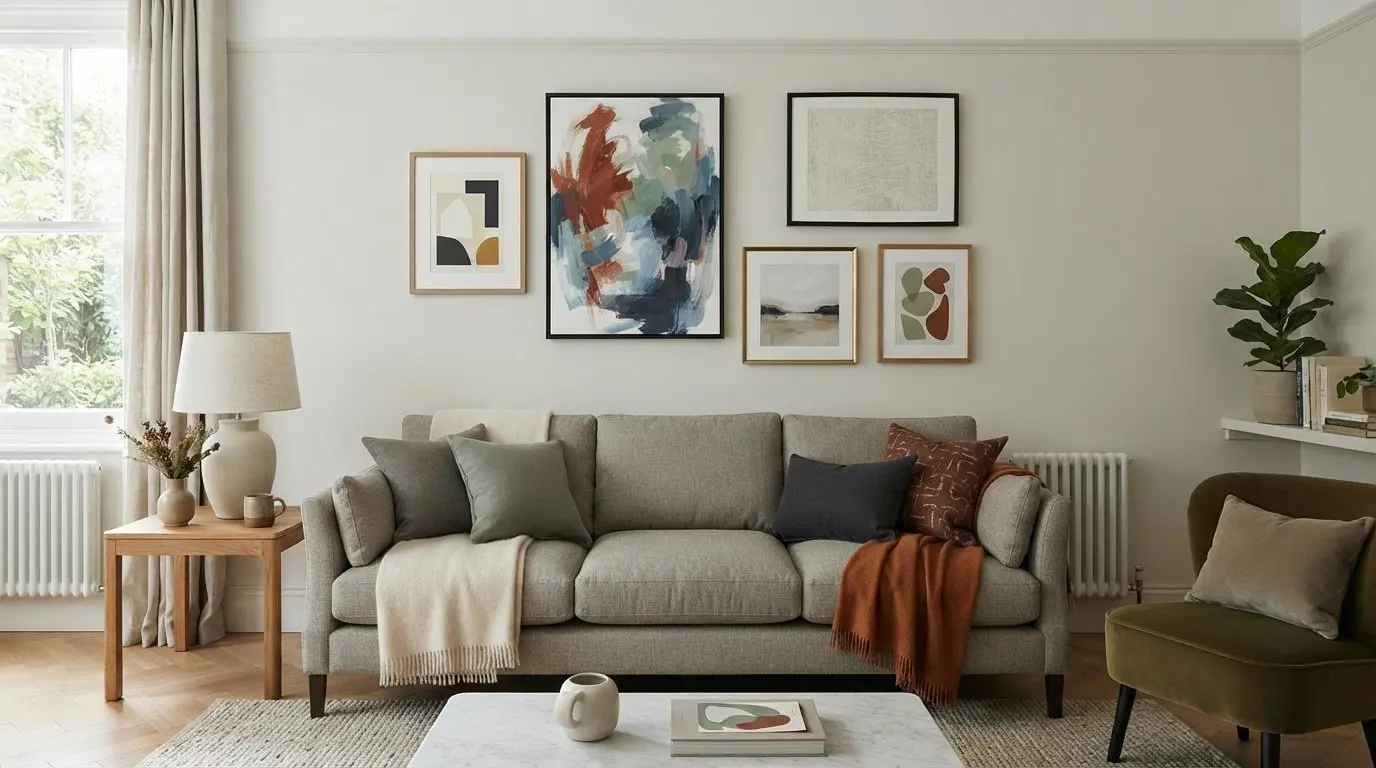
The artwork above your sofa shouldn’t feel like an afterthought. Knowing how to choose art for above a sofa starts with scale: aim for a piece or arrangement around two-thirds to three-quarters of the sofa’s width, then leave roughly 15 to 25 cm between the sofa back and the frame’s bottom edge. These proportions help the art feel connected to the furniture without overwhelming it.
It’s easy to focus on a favourite image and overlook how it will sit on the wall. When considering how to choose art for above a sofa, think about the room’s focal point, the sofa’s shape and the balance you want to create.
This guide covers four practical decisions: measuring the available space, setting a comfortable hanging height, choosing a single print or a group, and selecting a focal point that brings the room together. You’ll also find simple ways to preview the arrangement before committing, so the art feels considered and at home above your sofa.
Key Takeaways
- Aim for artwork or an arrangement around two-thirds to three-quarters of your sofa’s width, and centre it over the seating.
- Leave roughly 15 to 25 cm between the sofa back and the frame’s bottom edge, adjusting the layout to suit nearby windows and the room.
- Choose a statement print, a coordinated set or a gallery wall to suit the wall’s proportions and the look you want.
- Build the display around a piece you love, then use its colours and framing to create a focal point that feels at home in the room.
1. Artwork placement for sectionals and window-adjacent sofas
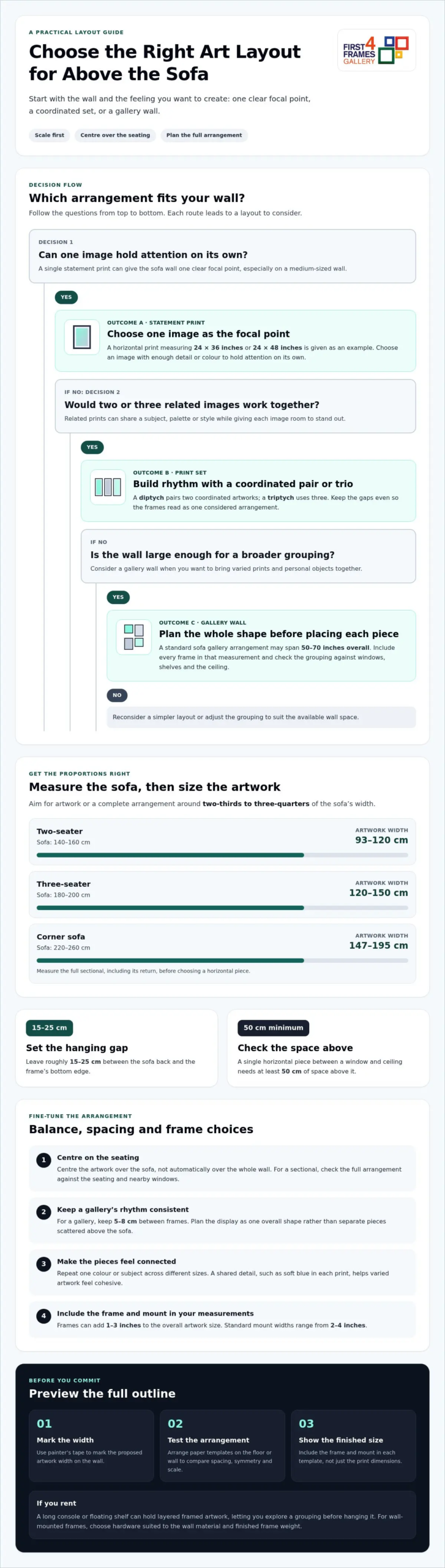
For balanced proportion, choose artwork or a complete arrangement around two-thirds to three-quarters of your sofa’s width. A 140-160 cm two-seater suits artwork 93-120 cm wide; a 180-200 cm three-seater suits 120-150 cm. For a 220-260 cm corner sofa, aim for 147-195 cm. Measure the full sectional, including its return, before choosing a horizontal piece.
Above a sofa, position the frame’s bottom edge 15-25 cm above the back. Centre the artwork over the seating, not automatically over the whole wall. If a window sits beside the sofa, keep the artwork visually balanced with the window rather than squeezing it into a narrow strip. A single horizontal piece between a window and ceiling needs at least 50 cm of space above it.
For a visual guide to scale and balance, watch this short video:
Artwork costs in the UK vary by image, size and framing. Decide on your preferred format and the space available first, then compare pieces that suit both your room and budget.
Coordinate the artwork with your sofa without matching every colour exactly. A neutral sofa can anchor a vivid abstract print, while a patterned sofa may work better with art that picks up one subtle shade. Consider visual weight too: a dark, detailed image can feel heavier than a pale landscape of the same size.
Common mistakes include choosing a print that looks too small, hanging it too close to the sofa, or letting its colours compete with the room. Use painter’s tape to mark the proposed artwork’s width on the wall. For a sectional sofa, outline the full arrangement and check how its horizontal shape relates to the seating and nearby windows.
Using symmetry, frames and cohesive themes
Symmetry gives a sofa wall a composed feel, especially when the room already has strong patterns. Try a pair of prints with matching outer dimensions, or arrange four pieces in a 2-by-2 grid. For a more relaxed gallery, repeat one colour or subject across different sizes. A shared detail, such as soft blue in each print, helps varied artwork feel connected.
Plan the gallery as one visual shape, rather than separate frames scattered above the sofa. Keep 5-8 cm between frames for a consistent rhythm, then check the arrangement’s full outline against the seating. A 2-by-3 grid creates a clear rectangular layout, while a looser cluster can suit an informal living interior. Leave enough space between the arrangement and the ceiling.
Choose frames that echo the room’s existing materials. A slim, simple frame can complement a contemporary interior; a more decorative profile can suit traditional furnishings. Matching every frame creates order, while mixing profiles works best when another detail, such as colour or finish, ties them together. Remember that frames can add 1-3 inches to the overall artwork size.
Framed prints and canvas create different visual effects. A framed print gives the image a defined edge, and a mount can add breathing space around the artwork. Standard mount widths range from 2-4 inches. Canvas presents the image without a separate frame, creating a more continuous surface. Choose the format that supports the image and the balance you want above the sofa.
Before committing, arrange paper templates on the floor or wall to compare spacing, symmetry and overall scale. Include the frame and mount in each template, not just the print dimensions. This makes it easier to see whether a balanced grid or varied gallery suits the room. Explore framed artwork and print options for ideas that could bring your chosen theme together.
3. Selecting a statement print, print set or gallery wall
A single statement print gives the sofa wall one clear focal point. It suits a medium-sized wall, especially when the image has enough detail or colour to hold attention on its own. Examples include a horizontal print measuring 24 × 36 inches or 24 × 48 inches. Part of how to choose art for above a sofa is deciding whether one image can carry the room’s visual story.
A set of prints creates rhythm across the wall. Two or three related pieces can share a subject, palette or style while giving each image room to stand out. A diptych pairs two coordinated artworks; a triptych uses three. Keep the gaps even so the frames read as one considered arrangement rather than competing pieces.
For a larger wall, a gallery wall can bring together varied prints and personal objects. Plan the full outline first: arrange templates on the floor, then test the shape above the sofa. A standard sofa gallery arrangement may span 50-70 inches overall. Include each frame in that measurement, and consider how the grouping relates to nearby windows, shelves and the ceiling.
Renters can lean framed artwork on a long console or floating shelf, layering smaller pieces in front of a larger print. If you’re weighing how to choose art for above a sofa, this flexible approach lets you explore a grouping before hanging it. For wall-mounted frames, choose hardware suited to the wall material and finished frame weight. Plasterboard and masonry need different fixings. Adhesive strips offer another option for lightweight artwork, with heavy-duty strips described as supporting prints up to around 3 kg. Follow the strip maker’s stated limits for the surface and load.
Compare the visual impact of one large image with several smaller frames. A bold abstract can anchor a simple interior, while a gallery wall adds personality. Choose the arrangement that gives the sofa a focal point without crowding the wall.
4. Choosing a focal point above the sofa
Abstract art, landscapes and photographic prints can all work above a sofa. Choose a style that suits your living room, then let one artwork lead the arrangement. A vivid abstract, a calm coastal scene or a diptych can each create a focal point, in a different way.
First decide what should catch the eye. If your sofa has a distinctive shape or colour, choose art that complements it without copying every detail. In a neutral room, a clear subject or rich colour can become the anchor. In a patterned room, a quieter image may keep the wall from feeling crowded.
Think about how the image connects with the rest of the room. Pick one or two colours from a rug, cushion or nearby wall, then look for artwork that repeats them naturally. A blue landscape, for example, can link a pale sofa with a patterned rug. This creates a visual connection without making the art feel like a matching accessory.
Scale affects whether the focal point feels connected to the sofa. A single framed print measuring 70 × 100 cm can suit a standard three-seater; a panoramic artwork measuring 150 cm wide offers another option. Artwork that feels too small can look detached, so consider the full composition and its frame against the furniture before choosing.
Choose the image because you want to live with it, not simply because it matches the sofa. Then decide whether surrounding objects support its role or distract from it. A clear focal point gives the room a visual centre, while carefully chosen colours and subject matter help the artwork feel beautifully connected to its setting. Explore artwork for your living room and find a piece that could anchor your space.
First4Frames Gallery: Ready-to-Hang Framed Art
First4Frames Gallery offers Ready-to-Hang Framed Art, Custom Picture Framing and Giclée Fine Art Prints. Its artwork can inspire choices from coastal wall art and landscape wall art to Scottish landscape art, contemporary art prints and fine art by best-selling artists or famous artists. For a personal image, photography prints can be paired with framing to create custom framed art prints and bespoke framed wall art.
With online picture framing, you can choose your frame online and design your framed artwork to suit your room. Before deciding, visualise art on your wall or use a wall art visualiser to see artwork before you buy. Consider the art print framing service when selecting a finished piece of framed wall art for above your sofa.
Choose a piece you’ll love living with
Before settling on a design, imagine seeing it every day. When deciding how to choose art for above a sofa, look beyond matching colours and ask whether the image means something to you. It might recall a favourite landscape, bring energy to a quiet room or simply make you pause and look again.
Give yourself time to compare subjects and moods. Notice which artwork feels right alongside your furniture and suits the atmosphere you want to create. The strongest choice isn’t necessarily the most dramatic; it’s the one that feels at home and continues to speak to you.
Let your preferred image guide the next decision, then explore the available styles and subjects at First4Frames Gallery. Browse artwork and find your favourite, and take the next step towards a wall that feels distinctly yours.
Frequently Asked Questions
How big should wall art be above a sofa?
A useful starting point is artwork around two-thirds to three-quarters of the sofa’s width. Measure the complete framed piece or arrangement, not just the image, so its visual footprint feels proportionate. For instance, a 200 cm sofa can suit a composition around 130-150 cm wide. The room’s layout and the artwork’s visual weight can help you refine that starting size.
Single Painting or Diptych?
Choose a single painting for an uninterrupted image and a clear, simple focal point. A diptych, or pair of coordinated artworks, can suit a wide landscape or abstract composition. Consider the wall’s shape and the image itself: splitting a scene can create rhythm, while one piece keeps the subject visually whole.
What Size Art Should I Get for My Wall?
Start with the wall’s usable area, then consider nearby furniture, doors and windows. A large, open wall can take artwork measuring 36 × 48 inches or larger, while a small nook may call for a more modest scale. In rooms with ceilings under 2.4 m, horizontal artwork can preserve a sense of space. Include the frame in your measurements.
What size should art be above a sofa?
For a 200 cm sofa, a composition about 130-150 cm wide is a practical reference. That composition could be one piece or several arranged together, with gaps included in its total width. Check the artwork’s height as well as its width: a tall image can feel imposing above low seating, while a very shallow one may seem visually slight.
How wide should artwork be compared with the sofa?
Aim for artwork or a grouped display roughly two-thirds to three-quarters as wide as the sofa. Measure from the outside edge of the leftmost frame to the outside edge of the rightmost. This is more accurate than adding print dimensions alone, especially when the arrangement includes several pieces and gaps.
Should you choose one large artwork or a gallery wall above a sofa?
Choose one large artwork for a clean, simple display or when a single image deserves attention. A gallery wall suits a broader space or a collection of personally meaningful images. Consider how much detail is already in the room: a quieter interior can support a varied collection, while patterned furnishings may work better with one focused image.