
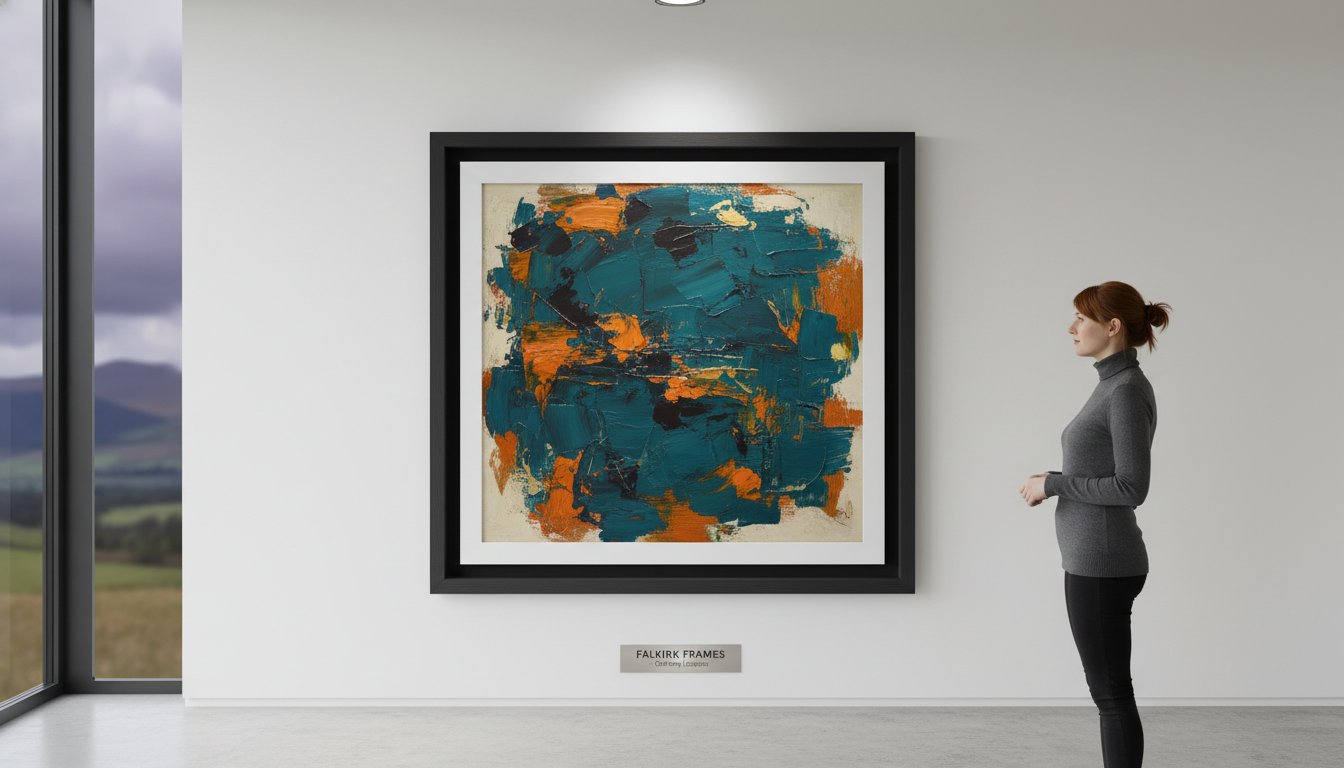
What if the most impactful frame for your canvas was the one that barely seemed to touch it? It’s a common concern for art lovers. You’ve invested in a beautiful piece, perhaps a vibrant abstract by Toni Thornton from our own First4Frames Gallery, and the last thing you want is to hide its unique, textured edges behind a traditional frame. That feeling of wanting to honour the entire artwork, right down to the wrapped corners, is completely understandable and a sign of a true art enthusiast.
This guide will show you exactly how premium, bespoke tray frames for canvas art can solve this problem. We’ll demystify the entire process, from achieving that perfect ‘floating’ gap to understanding how the canvas is securely mounted, giving you the confidence to achieve a spectacular, gallery-quality finish in your own home. We’ll walk you through the simple steps of measuring your canvas, selecting the perfect style to act as a bridge between your art and décor, and introduce you to our trusted UK framing service, backed by over 1,200 five-star customer reviews.
Key Takeaways
- Understand the ‘floating’ illusion created by a tray frame’s shadow gap to give your art a contemporary, gallery-style finish.
- Learn why tray frames for canvas art offer a minimalist, modern alternative to traditional frames and provide excellent edge protection without glass.
- Discover how to select the perfect frame depth and finish to complement your specific canvas, from standard wraps to textured Giclée prints.
- Master the professional technique for measuring your canvas accurately, including our expert tip for handling ‘out of square’ art for a flawless fit.
What are Tray Frames for Canvas Art?
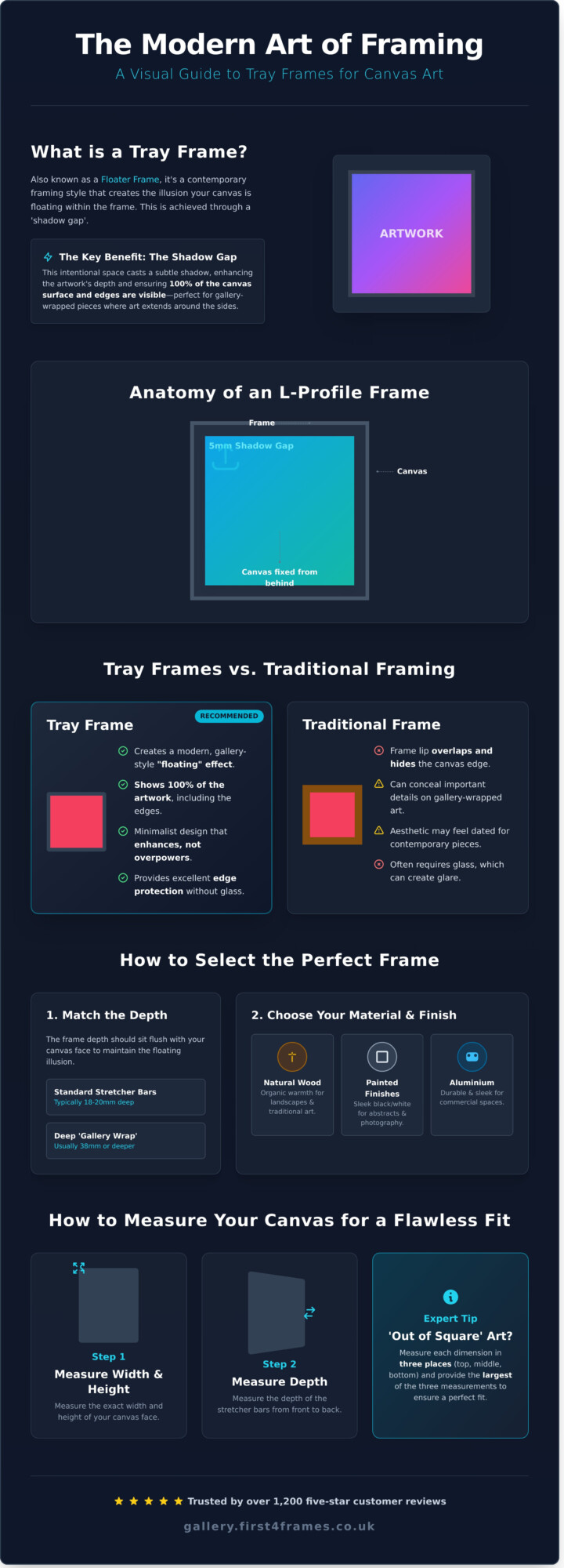
Imagine your canvas art suspended in mid-air, held by a frame that enhances without ever intruding. That is the magic of a tray frame. Also known as a floater frame, this beautifully simple design is the modern standard for presenting canvas paintings and prints. Instead of a traditional frame that overlaps the front of the artwork, the canvas sits comfortably inside a ‘tray’, leaving a small, deliberate gap between the canvas edge and the inside of the frame. This creates a stunning three-dimensional effect, giving the art room to breathe.
The secret lies in the ‘shadow gap’. This small space casts a subtle shadow, creating a sophisticated illusion that the canvas is floating freely within its enclosure. It’s a technique that artists and galleries adore because it honours the integrity of the artwork. Every brushstroke, every detail right up to the very edge of the canvas, remains 100% visible. This is particularly crucial for gallery-wrapped canvases where the artist has continued the painting around the sides. Traditional framing, with its long and varied history of picture frames, often concealed these important details. The tray frame, however, celebrates them.
This framing style first gained popularity in the minimalist art galleries of the 1960s, a perfect match for the clean lines of abstract and modern art. Today, its journey is complete. By 2026, it has become the gold standard for contemporary homes and galleries, offering a polished, professional finish that feels both timeless and completely current. Our bespoke tray frames for canvas art are crafted with this legacy in mind, ensuring a perfect, gallery-quality presentation for every piece, a standard reflected in our 5-star customer ratings for exceptional craftsmanship.
Tray Frames vs. Floater Frames: Is there a difference?
In short, there is no difference. ‘Tray frame’ and ‘floater frame’ are two names for the exact same L-shaped profile design. The terminology simply changes with location; ‘tray frame’ is the preferred term here in the UK, while ‘floater frame’ is more common in the US. We find the name ‘tray’ perfectly describes how the frame provides a secure, protective enclosure that cradles your beautiful artwork without ever overpowering it.
The Anatomy of an L-Profile Frame
The design’s genius is its L-shaped profile. Your canvas is fixed from the back onto the base of the ‘L’, allowing it to sit on the inner ledge without any part of the frame covering the front. Our bespoke framing service offers a choice of premium materials, from the warm, natural grain of solid wood to sleek black or white painted finishes perfect for a modern aesthetic. The shadow gap is the intentional 5mm space between the canvas and the frame, which creates the signature floating effect.
Choosing the Right Depth and Material for Your Canvas
Selecting the perfect frame is a journey of both technical precision and artistic intuition. The material, depth, and finish of your frame do the heavy lifting in the relationship between the art and its environment. It’s a decision that honours the artist’s work and ensures its beauty endures for years to come. With over 20 years of craftsmanship behind us, we guide you through these crucial choices to find the perfect match for your piece.
The first step is a practical one: matching the frame’s depth to your canvas. Most canvases fall into two categories:
- Standard Stretcher Bars: Typically around 18mm to 20mm deep, these are common for many paintings and prints.
- Deep ‘Gallery Wrap’ Canvases: These have a more substantial profile, usually 38mm or deeper, and are designed to be displayed with or without a frame.
Our bespoke tray frames for canvas art are crafted to sit flush with the face of your canvas, creating that signature ‘floating’ effect. A frame that’s too shallow or too deep disrupts this illusion. For large-scale commercial pieces, weight is also a critical factor. A heavy, oversized canvas requires a robust frame made from solid wood or reinforced aluminium to provide structural integrity and prevent bowing over time. We source only premium, kiln-dried timbers because, as professional conservation standards outlined in the Canadian Conservation Institute guide to framing detail, material stability is paramount to protecting artwork for decades.
Wood vs. Metal Tray Frames
The material of your frame sets the foundational tone. Natural woods like Oak and Ash bring an organic warmth that beautifully complements the earthy, atmospheric tones of traditional Scottish landscapes, such as those by artist Allan J. Robertson in our gallery. Conversely, the crisp, clean lines of a sleek black or white aluminium frame are the ultimate choice for enhancing the impact of monochrome photography or bold abstract pieces; the striking drone photography of Australian salt lakes from eamonwyss.com is a fantastic example of this. For high-traffic commercial environments like hotels or offices, aluminium offers superior durability and resistance to knocks.
Selecting the Perfect Finish
Your frame’s finish is the final, crucial detail. A hand-painted bespoke finish allows for perfect colour-matching to your artwork or décor, a service we pride ourselves on providing. A smooth, spray-painted finish is ideal for our high-quality Giclée prints, as it doesn’t compete with the fine detail and rich texture of the print itself. The frame acts as the perfect ‘bridge’ between your room décor and the artwork, tying the entire space together. A matte black finish, for example, can echo other black accents in a room, creating a cohesive and professionally styled interior. This thoughtful approach is a cornerstone of our service, something our excellent customer ratings consistently highlight.
Finally, consider your lighting. A matte or satin finish is highly effective at preventing unwanted reflections and glare in well-lit rooms, ensuring your art can be appreciated from any angle. To see how these principles create stunning results, we invite you to explore the curated collection in our gallery and discover the perfect presentation for your next piece.
Tray Frames vs. Traditional Framing: Which is Better?
Choosing the right frame is like casting the perfect supporting actor for your artwork’s leading role. It should enhance, not overshadow. While traditional frames have their place, the clean, contemporary aesthetic of tray frames for canvas art offers a unique presentation that many artists and collectors now prefer. The decision often comes down to the artwork itself and the statement you want to make.
A traditional frame creates a distinct border, a window into the piece. It can be ornate and classical, adding a layer of historical context. In contrast, a tray frame, also known as a floater frame, creates a subtle recess, making the canvas appear to float within its boundaries. This minimalist approach puts 100% of the focus on the art, allowing the piece to breathe and command the space. It’s a modern, gallery-ready finish that feels both intentional and effortless.
The Protection Misconception
One of the first questions we hear is, “Will my art get dusty without glass?” It’s a valid concern, but for canvas art, glass can be more of a hindrance than a help. Most original paintings on canvas are finished with a protective varnish, which seals the surface from dust and UV damage. More importantly, canvas is a natural material that needs to breathe. Sealing it behind glass, especially in a climate like the UK’s, can trap microscopic amounts of moisture, potentially leading to mould growth over time. A tray frame’s raised edges offer robust physical protection from knocks and bumps without suffocating the art.
Visual Breadth and Impact
A standard traditional frame has a ‘rebate’ or lip that overlaps the artwork, typically covering at least 5mm of the canvas on all sides. For a detailed piece, this can mean losing crucial elements of the composition. Tray frames are different. They cradle the artwork without covering a single millimetre of its face. The small space between the canvas edge and the frame, known as the shadow gap, creates a powerful psychological effect. It elevates the artwork, making it feel more like a precious object on display. This is precisely why property stagers and commercial galleries in cities like London and Manchester overwhelmingly choose tray frames for canvas art; they create a high-end, uncluttered look that lets the art speak for itself.
The cost of a bespoke tray frame is a direct investment in the long-term value and impact of your art. For an original piece you’ve invested in, a professionally crafted frame from a trusted service like ours ensures an archival-quality, perfect fit. The installation is a testament to its thoughtful design. The canvas rests inside the frame and is secured from the back, a clean and stable system. For those curious about the mechanics, Jackson’s Art Supplies provides a fantastic overview of how to mount artwork in a tray frame, explaining the role of the shadow gap and fixings. It’s this professional craftsmanship, backed by our excellent customer ratings, that turns a simple canvas into a spectacular centrepiece.
How to Measure for a Bespoke Tray Frame
Creating a truly professional finish for your artwork begins with precision. A bespoke frame is crafted to the millimetre, and providing accurate measurements is the most critical step in the process. It’s the difference between a frame that simply contains your art and one that truly elevates it. Follow our simple, four-step guide, trusted by artists and collectors alike, to ensure a perfect fit for your tray frames for canvas art.
Step 1: Measure Width, Height, and Depth
Lay your stretched canvas on a clean, flat surface. Using a steel tape measure for maximum accuracy, measure the exact width and height. Then, turn the canvas on its side and measure its depth, from the back of the stretcher bar to the very front face of the canvas. This depth measurement is essential for a tray frame, as it determines how your canvas will sit inside its ‘tray’.
Step 2: Check for ‘Out of Square’
Here’s a secret from our 20+ years of framing experience: almost no stretched canvas is perfectly square. Tension and humidity can cause slight variations. To account for this, measure the width in three places (top, middle, and bottom) and the height in three places (left, middle, and right). Provide us with the largest of the three measurements for both width and height. This guarantees your canvas will fit comfortably without being squeezed or damaged.
Step 3: Decide on Your Shadow Gap
The shadow gap is the elegant space between the edge of your canvas and the inside of the frame. This is a crucial design choice. A standard 5mm gap is our most popular option, while a wider 10mm gap can create a more dramatic, contemporary look. Consider the size of your art and the statement you wish to make.
Step 4: Get Your Instant Quote
With your three precise measurements (the largest width, largest height, and depth) and your chosen shadow gap, you have everything you need. Enter these details into our online tool to receive a transparent, instant quote for your beautiful bespoke frame.
The 5mm Shadow Gap Rule
Think of the 5mm shadow gap as the ‘Goldilocks’ zone. It’s the industry standard chosen for over 90% of our projects because it creates a crisp, defined border that gives the artwork breathing space without being distracting. For oversized commercial or gallery pieces (typically over 150cm wide), a wider 10mm gap adds a powerful, deliberate void, pulling the viewer’s eye directly to the art. A gap that is too small, like 2mm, can often look like a fitting error rather than an intentional design feature.
Measuring for Deep Canvases
The internal depth of the frame, known as the ‘rabbet’, is vital. For a classic float-frame effect, the rabbet depth should be greater than your canvas depth. For example, a standard 38mm deep canvas pairs perfectly with a 42mm deep frame, ensuring the art sits flush or slightly recessed. If your canvas is deeper than the frame, it will sit ‘proud’, protruding from the front. While this can be a bold stylistic choice, it’s important to plan for it. Finally, always consider weight. A deep canvas combined with a solid wood frame can exceed 8kg; ensure your wall fixings are rated to support the total weight securely.
With these principles in mind, you can see the spectacular results of perfect measurement on the pieces in our online art gallery.
Elevate Your Art with First4Frames Gallery
Choosing the right frame is the final, crucial step in showcasing your artwork. At First4Frames, we bring over 20 years of dedicated craftsmanship to this process, hand-building every frame in our Falkirk workshop. Our passion for art and precision has made us the trusted framer for some of Scotland’s most iconic artists, including the vibrant landscapes of John Lowrie Morrison (Jolomo) and the evocative scenes of Jack Vettriano. We believe that exceptional art deserves an exceptional finish.
That’s why we’ve perfected our ‘one-stop-shop’ approach. You don’t just buy a print; you invest in a complete piece of art, ready to hang. Simply select a stunning piece from our gallery, and our artisans will pair it with the perfect bespoke tray frame, creating a seamless, gallery-quality presentation for your home. This hassle-free service is built on a foundation of trust, reflected in thousands of excellent customer ratings from art lovers across the UK.
The Perfect Pair: Giclée Prints and Tray Frames
Our gallery is home to a spectacular collection of premium Giclée prints. Their archival inks and rich colour fidelity capture every nuance of the original artwork. To protect and enhance this quality, a gallery-standard finish is essential. Our tray frames for canvas art provide that clean, floating effect that lets the image speak for itself. With a wide range of bespoke colours, you can create a perfect bridge between the artwork and your room’s unique palette. To understand what makes this print quality so special, you can read our guide: What Are Giclée Prints?
Bespoke Service for Home and Business
Our expertise extends from personal projects to large-scale commercial installations. Whether you’re framing a single treasured family photo on canvas or staging an entire commercial property with curated art, we provide the same level of artisan care. The First4Frames promise is simple: a hassle-free, speedy service without compromising on the handcrafted quality that defines our work. We manage every detail, ensuring your vision is brought to life beautifully and efficiently.
Ready to transform your space? Let our passion for art and framing elevate your collection.
Elevate Your Art: The Final Step to a Gallery Finish
You now have the professional knowledge to choose the perfect frame. You understand that the modern, floating effect enhances your artwork, and that selecting the correct depth and material is crucial for a flawless presentation. Getting these details right is what transforms a simple canvas into a stunning centrepiece, and the right tray frames for canvas art are the key to achieving this.
At First4Frames, our passion is turning that knowledge into a tangible reality. We bring over 20 years of expert framing experience to every project, a commitment to craftsmanship reflected in our excellent ratings across independent review platforms. As specialists in Scottish fine art and Giclée prints, we know precisely how to make your artwork the hero of any room.
Ready to give your canvas the professional finish it deserves? Start your artistic journey with a bespoke tray frame from First4Frames and let’s create something beautiful together.
Frequently Asked Questions
Do tray frames have glass?
No, tray frames are not glazed and do not have glass. They are specifically designed to showcase the unique texture and surface of a canvas painting, allowing the artwork to be seen without any reflection or barrier. This creates an immediate connection between the viewer and the art. For artists in our gallery who work with rich textures, like Louise Luton, this presentation style is essential for honouring the original piece’s integrity and depth.
How do you secure a canvas into a tray frame?
A canvas is expertly secured into a tray frame from the back using specialised hardware like offset clips or screws. Our professional framing service, backed by over 20 years of craftsmanship, ensures your canvas is perfectly positioned within the frame. We maintain a precise, even gap before fixing it securely. This method provides a robust hold that is completely invisible from the front, resulting in a flawless, gallery-ready finish for your beautiful artwork.
Can I use a tray frame for a canvas that isn’t stretched?
No, a tray frame is designed exclusively for a canvas that has already been stretched over a wooden support, known as a stretcher bar. The frame itself attaches directly to this wooden structure, not to the loose fabric. If you have an un-stretched canvas, it must first be professionally stretched before it can be mounted. Our bespoke picture framing service can handle both the stretching and framing, ensuring your art is displayed perfectly.
What is a shadow gap in framing?
A shadow gap is the small, intentional space between the outer edge of the canvas and the inner edge of the tray frame. This gap, typically between 5-10mm, creates a subtle shadow that gives the illusion of the canvas floating within its frame. It’s a defining feature of tray frames for canvas art, adding depth and sophistication while beautifully separating the artwork from its surroundings without creating a hard border.
Are tray frames more expensive than traditional frames?
The cost of a tray frame is often comparable to a good quality traditional frame, though this depends entirely on the materials, size, and finish. For a medium-sized canvas, a bespoke wooden tray frame from our workshop could range from £60 to £150. While some simple, mass-produced traditional frames may be cheaper, ornate or glazed options can be significantly more expensive. We find they offer fantastic value for their modern, professional aesthetic.
What is the best colour for a tray frame?
The best colour for a tray frame is one that enhances your artwork without competing with it. Classic, neutral choices are almost always the most effective. A black frame provides a strong, defined edge; a white frame offers a clean, contemporary feel; and a natural wood finish adds warmth and texture. We advise selecting a colour that complements the tones within your artwork and acts as a perfect bridge to your room’s decor.
Can I buy tray frames in standard sizes like A3 or A4?
While you might find some standard sizes available, tray frames are most successful when they are made bespoke to fit your canvas perfectly. Canvases, particularly their depths, can vary slightly, so an off-the-shelf frame may not provide the ideal fit or the perfect shadow gap. Our framing service is entirely bespoke, meaning every frame is crafted to the exact millimetre for your artwork, a commitment to quality our excellent customer ratings reflect.
How do I hang a heavy tray-framed canvas safely?
To hang a heavy tray-framed canvas safely, it’s vital to use the correct fittings for both the frame and your wall type. For any piece weighing over 10kg, we recommend attaching two D-rings to the back of the frame, about a third of the way down from the top. Instead of using wire between them, hang each D-ring directly onto a separate, heavy-duty wall hook or screw that is secured with an appropriate wall plug.