
The culmination of months, even years, of creative work is finally ready for the gallery wall. But between your finished canvas and a spectacular exhibition lies a crucial, often daunting, step. Choosing the right custom frames for artists exhibitions can feel overwhelming, with concerns about spiralling costs, gallery expectations, and the fear that a poor choice could detract from your art. It’s a challenge we understand deeply, having worked with countless artists featured in the First4Frames Gallery to present their work with the professional polish it deserves.
This professional guide for 2026 is designed to transform that uncertainty into confidence. We will walk you through every step, from selecting premium, bespoke materials that protect and elevate your artwork to creating a cohesive visual narrative for your show. You’ll learn how to budget effectively for an entire collection and manage the logistics without the stress. Consider this your trusted partner in turning a body of beautiful work into an unforgettable exhibition that captivates your audience and makes a lasting impact.
Key Takeaways
- Understand how professional framing elevates your artwork’s perceived value and creates a powerful first impression in a gallery setting.
- Learn to select the right moulding, mount, and glazing to build a cohesive visual narrative across your entire collection.
- Develop a clear budget for your custom frames for artists exhibitions by understanding the key factors that influence cost and planning effectively.
- Discover what to prepare for your consultation to partner successfully with your framer and ensure your creative vision is perfectly realised.
Beyond the Living Room: Why Exhibition Framing Demands a Professional Approach
When preparing artwork for public display, the frame’s role shifts dramatically. It’s no longer a simple decorative accent for a living room wall; it becomes a crucial element of your professional presentation, speaking volumes about you as an artist before a single viewer has truly studied your work. Exhibition framing is about presenting your art to a critical audience-curators, collectors, and critics-in a way that enhances its perceived value and demonstrates your commitment to quality. While the history and purpose of picture frames has deep roots in both decoration and preservation, in a gallery, the primary goal is to serve and elevate the art without distraction.
Achieving this level of polish requires an understanding of professional standards. For a closer look at the techniques involved, this video offers an excellent guide:
The Role of the Frame in a Gallery Setting
Think of an exhibition frame as the artwork’s silent, supportive partner. Its purpose is to create a visual pause, giving the piece essential breathing room from the stark gallery wall and focusing the viewer’s gaze. This is why choosing the right bespoke frame is so important. For a solo show or a series, using consistent, high-quality framing unifies your body of work, transforming individual pieces into a single, cohesive, and powerful statement. Beyond aesthetics, a professionally built frame provides robust protection against the rigours of a public space, from accidental bumps and handling to damaging UV light.
First Impressions: Meeting Curatorial Standards
Galleries, curators, and buyers expect a standard of presentation that off-the-shelf frames rarely meet. First impressions are everything, and a flimsy, poorly finished frame can undermine the perceived quality of the art it holds. Professional venues require:
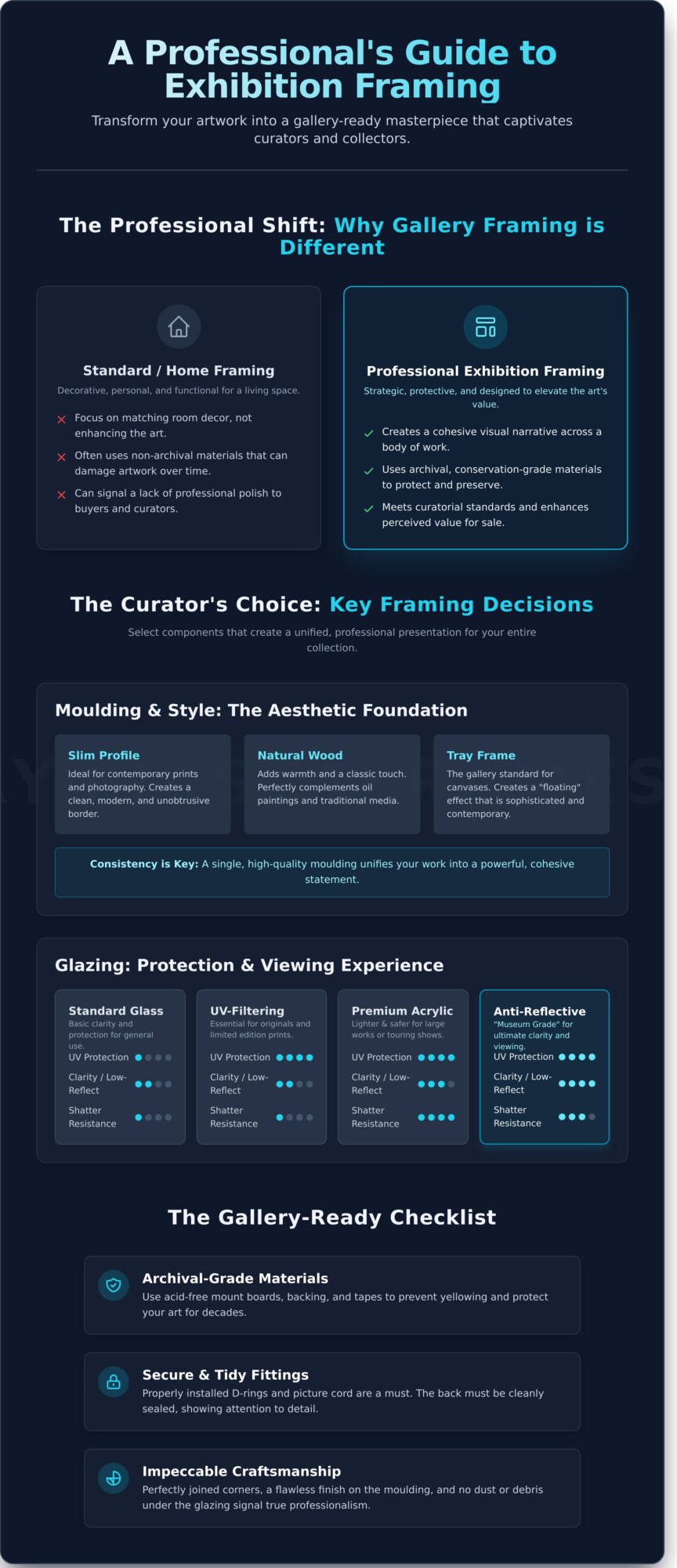
- Archival-Grade Materials: Acid-free mount boards and conservation-grade glazing to protect your work for decades.
- Secure and Tidy Fittings: Properly installed D-rings and cord, with the back of the frame sealed cleanly with tape.
- Impeccable Craftsmanship: Perfectly joined corners and a flawless finish that signals professionalism.
This is why so many artists rely on specialists for custom frames for artists exhibitions. A professionally crafted frame is an investment in your art’s future, ensuring it is durable enough for a touring exhibition and presented perfectly for a potential sale, reflecting the care and quality inherent in your work.
The Curator’s Choice: Key Decisions in Framing for Gallery Walls
An exhibition is a visual conversation, and the frames are the common language that unites each piece. The curator’s goal isn’t just to hang art, but to present a cohesive vision where the whole is greater than the sum of its parts. Achieving this harmony requires careful consideration of every component, transforming a collection of individual works into a singular, powerful statement. The right custom frames for artists exhibitions don’t just protect the art; they elevate the entire viewing experience, a principle that guides our approach to bespoke framing.
Moulding & Style: Creating a Consistent Narrative
The frame profile, or moulding, is the foundation of your exhibition’s aesthetic. For a powerful, unified look, many artists and curators opt for a single, consistent profile-a slim black wood for a photography series, for instance. Alternatively, a limited palette of two or three complementary frames can add subtle variation without losing cohesion. Natural wood finishes can add warmth to oil paintings, while clean, painted finishes suit contemporary prints. For modern canvases, a tray frame offers a sophisticated, gallery-ready finish that lets the artwork appear to float.
Glazing Options: Protecting Your Work & Enhancing Viewing
Glazing does more than keep dust off; it protects your art from irreversible damage and controls how the viewer sees it. For any original work or limited edition print destined for sale, UV-filtering glazing is non-negotiable to prevent fading. For larger pieces or touring shows, premium acrylic is often a safer and lighter alternative to glass. Here’s a simple breakdown:
.framing-table { width: 100%; border-collapse: collapse; margin: 1em 0; }
.framing-table th, .framing-table td { border: 1px solid #ddd; padding: 8px; text-align: left; }
.framing-table th { background-color: #f2f2f2; }
| Glazing Type | Pros | Best For |
|---|---|---|
| Standard Glass | Cost-effective, clear | Personal display in rooms without direct sunlight. |
| UV-Filtering Glass | Blocks ~99% of harmful UV rays | Essential for selling original art, limited editions, and conservation. |
| Anti-Reflective Art Glass | UV protection with near-invisibility | Premium exhibitions where clarity and colour accuracy are paramount. |
Mounts & Spacing: Giving Your Art Room to Breathe
The mount, or matboard, provides crucial breathing space between the artwork and the glazing, preventing potential damage from condensation. It is absolutely vital to use only acid-free, conservation-grade mountboard to prevent discolouration-a standard we uphold in all our bespoke framing services and which aligns with professional conservation framing guidelines. A traditional window mount draws the eye inward, while float mounting-where the art is raised on a foam core-creates a beautiful shadow effect, perfect for pieces with deckled or unique edges. The width and colour of the mount can dramatically alter perception; a generous, soft white mount can make a small, delicate watercolour feel monumental.
Budgeting & Logistics: Planning Your Exhibition Framing Project
Embarking on the journey of framing an entire show is a significant step, and we understand that the primary concern for many artists is the cost. Viewing framing not as an expense, but as a crucial investment in your professional presentation, can shift the perspective. A beautifully executed frame does more than just protect your work; it’s the bridge between your art and the viewer. Let’s break down the practical steps to planning your custom frames for artists exhibitions project, making it a seamless and rewarding experience.
Thinking about your professional presentation holistically is key. While frames are crucial inside the gallery, consider how you promote your work outside of it. For artists looking to make a big local impact, professional branding extends to all aspects of their business; some even use their transport for promotion with high-quality vehicle graphics Walsall to build buzz around a show.
How to Budget for Framing an Entire Show
The cost of framing is influenced by several key factors. Creating a simple spreadsheet to list each piece, its dimensions, and your desired materials is an excellent first step. This will help you, and us, build an accurate quote. Remember to ask about discounts for larger orders-many professional framers offer reduced rates for a full exhibition.
- Size: Larger pieces require more materials and labour, which is reflected in the price.
- Materials: A simple, slim black wood moulding will be more budget-friendly than a bespoke, hand-finished oak frame. Premium materials not only look spectacular but also meet archival framing standards, protecting your art for years to come.
- Glazing: This is a major cost variable. While standard acrylic is a great option, upgrading to anti-reflective or UV-protective glass can significantly increase the cost per frame, but offers unparalleled clarity and preservation.
Creating a Realistic Project Timeline
To ensure a stress-free process and the highest quality craftsmanship, avoid leaving framing to the last minute. We recommend contacting your framer at least 4-6 weeks before your exhibition deadline. Rushing the process can lead to mistakes or compromise on material choices. A typical timeline for custom frames for artists exhibitions includes:
- Consultation: Discussing your vision, artwork, and material options.
- Material Ordering: Sourcing the specific premium mouldings and glazing for your project.
- Production: Our experts perform the bespoke craftsmanship in our workshop.
- Finishing & Delivery: Final quality checks and arranging for collection or specialist delivery.
Once your pieces are professionally framed, the final step is transportation. We can advise on the best practices for wrapping and transporting your work or recommend trusted local art couriers to ensure every piece arrives at the gallery in perfect, ready-to-hang condition.
Your Pre-Framing Checklist: How to Partner with Your Framer for Success
Choosing the perfect custom frames for artists exhibitions is more than a simple purchase; it’s a creative collaboration. A successful partnership with your framer begins long before you walk through their door. By preparing in advance, you empower yourself to communicate your vision clearly, ensuring the final result not only protects your work but elevates it for the gallery wall. This simple checklist will help you gather everything you need for a productive and inspiring consultation.
Step 1: Gather Your Artwork Information
Your framer’s expertise is most effective when they have precise details. Before your meeting, compile a clear inventory of the pieces requiring bespoke framing. This foundation of information ensures every recommendation is perfectly tailored to your art.
- Create a list of all artworks with their exact dimensions (height, width, and the depth of any canvases).
- Note the medium of each piece (e.g., oil on canvas, watercolour on paper, Giclée print, or mixed media).
- Take clear photographs of the works to share during the consultation, helping to discuss colour and style.
Step 2: Define Your Vision & Budget
With the practical details sorted, it’s time to focus on the aesthetic. Thinking about the overall look you want to achieve, alongside a clear financial plan, will guide the creative process and keep the project on track.
- Bring inspiration: Collect images of framed art or exhibitions you admire—browsing the online collections of galleries like Aleph Contemporary is a great place to start. Describe the atmosphere you want to create-minimalist, traditional, or bold?
- Set a realistic budget: Have a clear idea of your total framing budget. A professional framer can offer beautiful solutions at different price points.
- Know your deadlines: Note your exhibition dates and any specific hanging requirements from the gallery.
Step 3: Questions to Ask Your Framer
A consultation is a two-way conversation. Asking the right questions builds confidence and clarifies expectations. As a trusted professional with excellent customer ratings, we believe in complete transparency throughout the craftsmanship process.
- What conservation-grade materials (e.g., acid-free mountboard, UV-protective glazing) do you use as standard?
- Can you provide a detailed quote and a clear timeline for a project of this scale?
- Do you have experience providing custom frames for artists exhibitions?
By following these steps, you transform the framing process from a task into an exciting part of your exhibition journey. For inspiration on how different styles can come together, explore the beautifully presented works in the First 4 Frames gallery.
Partnering with First4Frames: Bespoke Framing for Scottish Artists
Choosing the right partner for your exhibition framing is as crucial as the art itself. At First4Frames, based in our Falkirk gallery and workshop, we combine a deep passion for art with over two decades of framing expertise. We are proud to be the trusted choice for many Scottish artists, helping them present their work with the professional finish it deserves. Our commitment to quality is evident in every project, from using archival-grade materials to our meticulous craftsmanship, a standard reflected in our excellent customer reviews.
A One-Stop-Shop for Your Exhibition Needs
We understand that preparing for a show involves many moving parts. To streamline your process, we offer a comprehensive Giclée printing service, allowing you to create stunning, gallery-quality reproductions of your work. We can then professionally frame these prints, providing a seamless solution from digital file to finished piece. Our own Falkirk gallery, which showcases work from leading Scottish artists, stands as a testament to our understanding of the art world and what it takes to create a spectacular display.
Our Collaborative Process
Your artistic vision is our starting point. We begin every project with a detailed consultation to understand your unique style, the story behind your work, and your specific exhibition goals. Our experts provide tailored advice on everything from moulding profiles to glazing options, ensuring the final frame perfectly complements your art and fits your budget. In our workshop, we merge time-honoured traditional skills with modern technology to deliver flawless, bespoke custom frames for artists exhibitions.
Start Your Exhibition Journey with Us
Whether you need a single, show-stopping frame or a cohesive set for an entire collection, we provide bespoke solutions tailored to your needs. Our extensive experience working with artists and commercial clients means we understand the importance of deadlines and specifications, delivering exceptional results on time, every time. Let us help you make your next exhibition a resounding success. Contact our team today to discuss your upcoming exhibition.
Frame Your Success: The Final Step to an Unforgettable Exhibition
As we’ve explored, preparing for a gallery show goes far beyond the canvas. Professional exhibition framing is a critical art form in itself, requiring meticulous planning, a curator’s eye, and a strong collaborative relationship with your framer. The right custom frames for artists exhibitions are not just accessories; they are the final brushstroke that completes your artistic statement and captivates your audience.
This is where true craftsmanship makes all the difference. At First4Frames, we bring over 20 years of bespoke framing experience to every project. We are proud to be the trusted partner for artists and galleries across Scotland, a reputation built on premium quality and exceptional service, as reflected in our excellent customer ratings. We believe every piece of art deserves a frame that enhances its story.
Your collection is ready for the spotlight. Let us help you ensure it is presented with the professional finish it commands. Book a consultation to discuss your exhibition framing needs today, and let’s create a spectacular showcase for your work together.
Frequently Asked Questions
How much does it cost to frame art for an exhibition?
The cost of framing for an exhibition can vary significantly based on your specific needs. Factors include the size of the artwork, the choice of moulding, the type of mount, and the glazing selected. A simple, smaller frame might start from around £40, while a large, bespoke piece with conservation-grade materials and anti-reflective glass could cost £150 or more. We provide a detailed quote for every project to ensure complete transparency and help you budget effectively for your show.
Should all the frames in an art exhibition be the same?
Consistency is key to a professional and cohesive exhibition. Using the same frame profile and colour across all pieces allows the artwork itself to be the star of the show. This creates a unified viewing experience for your audience. However, a curated mix of frames can work if it’s a deliberate artistic choice. For a balanced approach, consider using the same frame profile in a limited palette of two or three complementary colours that suit the collection.
What is museum-quality or conservation framing?
Conservation framing is a method designed to protect your artwork for the long term. It involves using premium, acid-free materials, including mount boards and backing, to prevent yellowing and deterioration over time. Crucially, it also uses glazing that filters out up to 99% of harmful UV rays, which are a primary cause of fading. This standard of craftsmanship ensures your art remains as vibrant as the day it was created, which is essential for any professional artist.
How do I choose the right colour frame for my artwork?
The perfect frame should act as a bridge between the art and the wall, enhancing the piece without overpowering it. Instead of matching the frame to a dominant colour in your art, try complementing a subtle, secondary tone. Classic neutral choices like black, white, or natural wood are incredibly versatile and lend a sophisticated gallery feel; you can learn more about Essex Board & Timber to see the variety of high-quality materials available. Our experts are always on hand to offer bespoke advice, ensuring you find the perfect partner for your masterpiece.
How far in advance should I get my art framed before a show?
To ensure a seamless and stress-free experience, we recommend starting the framing process at least 4-6 weeks before your exhibition opens. This timeframe allows for a thorough consultation, sourcing the best materials, and dedicating the time needed for our meticulous craftsmanship. Planning ahead is crucial when ordering custom frames for artists exhibitions, as it guarantees your work is presented beautifully and professionally, just as you envisioned, and ready for opening night without any last-minute rushes.
What is the best type of glass for picture frames in a gallery?
For a gallery setting, we highly recommend specialist anti-reflective glass. While standard glazing can create distracting reflections under bright gallery lighting, anti-reflective options are designed to be almost invisible, offering a crystal-clear view of your artwork from any angle. Many of these premium glazing options also provide excellent UV protection, combining superb clarity with conservation-grade quality. It’s a worthwhile investment to ensure your art is seen at its absolute best.
Can you frame canvases and works on paper for the same exhibition?
Absolutely. It is very common to display different media in a single show, and we can create a cohesive look across all pieces. Works on paper typically require a mount and glazing for protection, while canvases are often set in floater frames to showcase their texture. By selecting a consistent moulding profile or colour palette for both types of frames, you can unify the exhibition beautifully. Our expertise in custom frames for artists exhibitions ensures every piece is presented perfectly.