
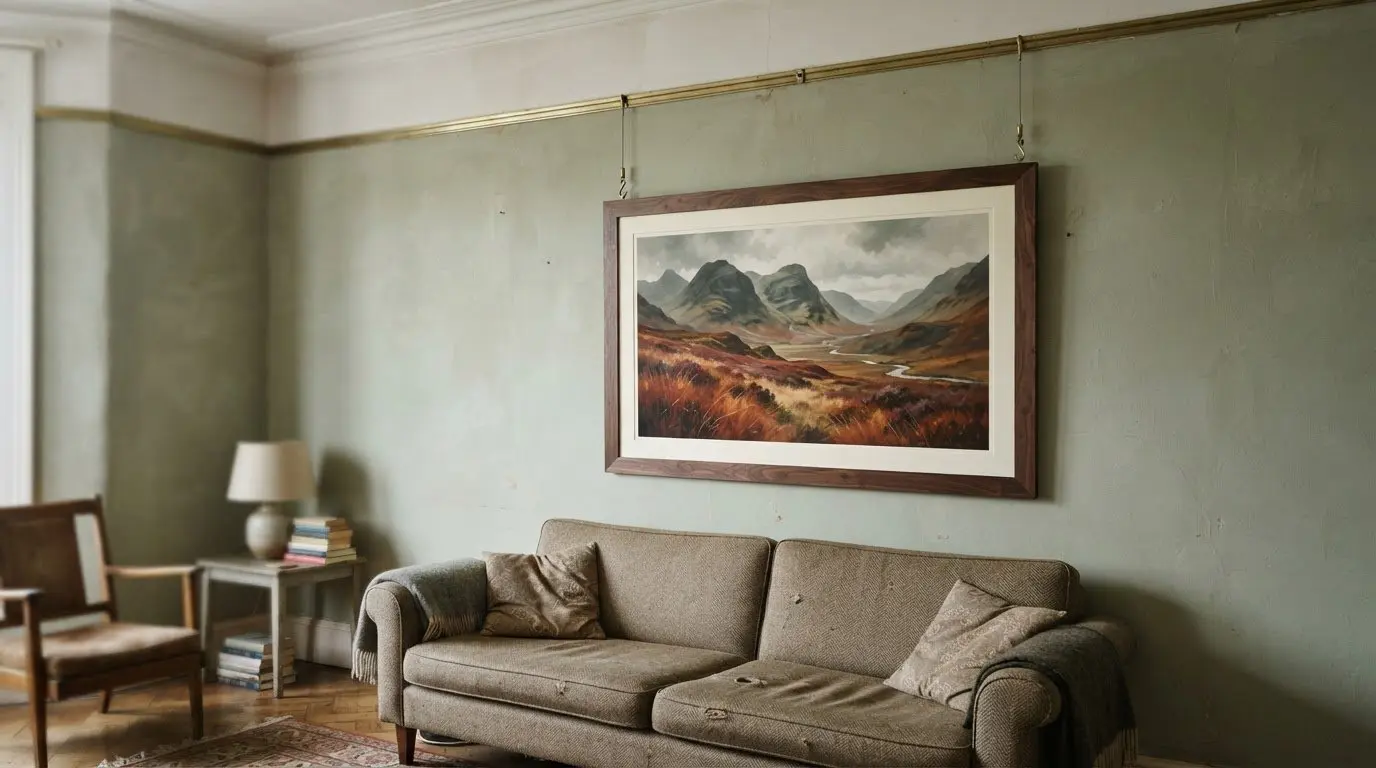
Is it safe to hang a heavy frame over a sofa? It can be, provided the fixings suit both the frame’s weight and the wall. Before hanging it, check the support behind the wall and plan the artwork’s position in the room.
Planning the display can be part of the pleasure. A wall art visualiser can help you Visualise art on your wall and See artwork before you buy. Consider Coastal wall art, Landscape wall art or Scottish landscape art, alongside Contemporary art prints, Photography prints, Fine art and pieces by Best-selling artists or Famous artists. Choose your frame online to Design your framed artwork and create Bespoke framed wall art that feels at home above the sofa.
Whether you’re exploring online picture framing, custom-framed art prints or an art print framing service, think about how the finished piece will sit in the room. Framed wall art should complement the sofa without crowding the wall. The steps below explain how to assess plasterboard, find studs, choose a rail or hooks, and plan clearance for a balanced display.
Key Takeaways
- Match the hanging system to both the frame’s weight and the wall construction before you begin.
- Learn when a rail offers a practical alternative to individual hooks for a heavy frame.
- Find suitable fixing points and prepare the wall to help keep the artwork securely supported.
- Set the frame’s position above the sofa for a considered balance between safe hanging and visual appeal.
How to choose between a rail system and individual hooks for my picture above the sofa?
First check the frame’s weight and the wall material, then choose suitable fixings. Next, plan the artwork’s width and height in relation to the sofa.
-
Assess artwork weight and wall material
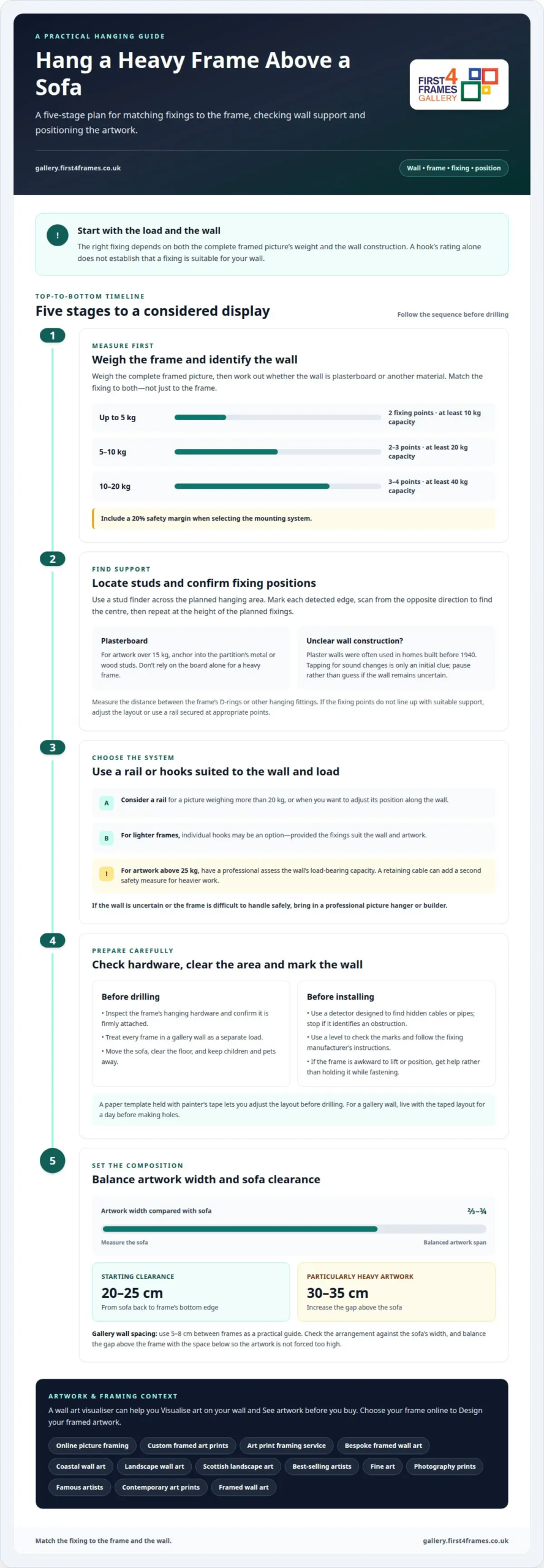
Weigh the complete framed picture, then identify whether the wall is plasterboard or another material. For a picture up to 5 kg, use two fixing points with a minimum expected load capacity of 10 kg. For 5-10 kg, use 2-3 points rated for at least 20 kg; for 10-20 kg, use 3-4 points rated for at least 40 kg. Choose fixings compatible with the wall, not just the frame.
-
Choose a rail or suitable hooks
Consider a rail for a picture weighing more than 20 kg, or when you want to adjust its position along the wall. Above 15 kg on plasterboard, anchor into the partition’s metal or wood studs; a retaining cable can add a second safety measure for heavier work. For lighter frames, individual hooks may be an option, but choose fixings suited to the wall and artwork. Include a 20% safety margin when selecting the mounting system.
-
Consider falling-frame risks and safety standards
Secure fixings carefully above a sofa, where a falling frame could strike someone sitting below or a child or pet nearby. The appropriate fixing depends on the wall and load; a hook’s rating is not itself a statement about UK building regulations. For artwork above 25 kg, have a professional assess the wall’s load-bearing capacity. Bring in a professional picture hanger or builder if the wall is uncertain or the frame is difficult to handle safely.
-
Plan the width, height and clearance
Measure the sofa before positioning the frame: artwork spanning two-thirds to three-quarters of its width usually creates a balanced arrangement. Leave 20-25 cm between the sofa back and frame as a starting point, increasing this to 30-35 cm for particularly heavy artwork. Check the ceiling too; the gap above the frame should look balanced with the space below, rather than forcing the artwork too high.
Can a heavy picture be fixed to a plasterboard partition above a sofa?
Yes, if the fixings engage suitable support and are rated for the artwork’s load. Is it safe to hang a heavy frame over a sofa when the wall is plasterboard? It depends on the wall’s construction, the frame’s weight and where the fixings can be secured.
-
Prepare framed artwork for secure hanging
Measure the complete frame and inspect its hanging hardware before lifting it above the sofa. Check that the fittings are firmly attached and positioned to keep the artwork level. Treat every frame in a gallery wall as a separate load; don’t assume one fixing will support neighbouring pieces. A paper template held in place with painter’s tape lets you adjust the layout before drilling.
-
Choose a safe plasterboard hanging approach
Locate the partition’s metal or wood studs before choosing fixings. For artwork weighing more than 15 kg on plasterboard, anchor directly into those studs. Don’t rely on the board alone for a heavy frame; both wall material and fixing position affect support. If the planned fixing points don’t align with suitable support, adjust the layout or use a suitable rail system.
- Lay out a gallery wall with space for each frame and its fixings. Keep gaps consistent, using 5-8 cm between frames as a practical guide, and check the arrangement against the sofa’s width. Tape paper templates to the wall and live with the layout for a day before making holes. This gives you time to adjust height and spacing without moving fixings repeatedly.
Before drilling, ask yourself: is it safe to hang a heavy frame over a sofa with this wall and these fixings? Check that each fixing is secure and the frame sits level. If the frame is awkward to lift or position, get help rather than trying to hold it steady while fastening the fittings.
Finding studs and preparing the wall
- Identify the wall construction before choosing where to drill. Plaster walls were often used in homes built before 1940, so don’t assume every wall is plasterboard. Check the surface and listen for changes in sound as you tap gently, but treat this only as an initial clue. A stud finder can help distinguish framing from the spaces between supports.
- Use a stud finder across the planned hanging area, following the device instructions and moving steadily. Mark each detected edge, then scan from the opposite direction to narrow down the stud’s centre. Repeat at the height of the planned fixings. A second scan can help identify inconsistent readings before you install anything.
- Check the fixing positions against the frame’s hardware. Measure the distance between the D-rings or other hanging fittings, then transfer those positions to the wall, aligning them with the stud centres you marked. If the frame’s fixing points don’t line up with suitable support, adjust the layout or use a hanging rail secured at appropriate points.
- Prepare the area before drilling: move the sofa, clear the floor, and keep children and pets away. Use a detector designed to find hidden cables or pipes before making holes, and stop if it identifies an obstruction. Choose a drill bit and fixings suited to the wall, and follow the fixing manufacturer’s instructions.
- Check the alignment before installing the fixings. Use a level to make sure the marks are even, then check the frame’s planned height above the sofa. Keep the marked stud locations visible as you work, and don’t enlarge a hole if doing so would go against the fixing instructions. If the wall’s construction is unclear, pause rather than guess.
Recommended clearance between the sofa and frame
- Measure from the sofa back to the frame’s bottom edge, not from the seat cushion. Aim for 20-25 cm as a general clearance; particularly heavy artwork benefits from 30-35 cm. Mark the proposed lower edge with masking tape, then view it from the usual seat before drilling. This lets you assess the height in the room rather than relying on a measurement alone.
- Size the artwork against the sofa’s total width. A balanced arrangement usually spans between two-thirds and three-quarters of the sofa. For a 2-metre-wide sofa, artwork around 1.6 metres wide leaves about 20 cm on each side. Measure the complete frame, including its outer edges, so the finished pieces fit the furniture rather than just the wall.
- Check the space between the frame and ceiling before setting the final height. As a visual guide, the gap above the artwork should be about double the gap between the frame and sofa. If the lower gap is under 15 centimetres and the ceiling gap is the same or smaller, the artwork may look oversized for that wall. Adjust the height or choose a narrower piece.
- Plan multiple pieces as one arrangement, measuring the outside edges and the gaps between frames. A spacing of 5-8 cm helps a gallery wall read as a connected display; gaps wider than about 20 cm between two pieces can make them feel undersized above the sofa. Tape paper templates in place, then review the layout from across the room. Browse framed artwork for your sofa wall to explore options at different scales.
First4Frames Gallery: Ready-to-Hang Framed Art
First4Frames Gallery offers Ready-to-Hang Framed Art for a finished look above your sofa. Each frame is handmade to order using quality materials, with 2 mm float glass glazing. For a particular wall or artwork size, Custom Picture Framing lets you select a bespoke frame suited to the piece.
Choose artwork with the sofa’s width and the planned clearance in mind, and make sure the fixings suit the complete framed weight. A ready-to-hang frame still needs secure fixings matched to your wall. Giclée fine art prints offer another way to bring art into the room, with a frame selected to complement the print.
If you’d like help choosing a framed artwork or framing option, contact First4Frames Gallery.
Give your sofa wall a considered finishing touch
Knowing whether it’s safe to hang a heavy frame over a sofa is just one part of shaping a room you’ll enjoy living in. Artwork can set the mood, tie together colours already in the space or become a focal point. Let the wall’s proportions guide your choice, then consider which subject and finish suit your furniture.
Picture the finished arrangement before choosing. A calm landscape creates a different atmosphere from a bold contemporary print, while a carefully selected frame helps connect the artwork to the room. The right piece does more than fill empty wall space: it can make the seating area feel more personal and complete.
Explore the artwork collection and find a piece for your sofa wall. With a clear plan for the wall and an artwork that feels right for your home, you’re ready to create a display you’ll love seeing every day.
Frequently Asked Questions
How heavy can a picture be to hang on drywall?
There’s no single safe weight limit for plasterboard; the fixing method and support determine what it can hold. As a guide, a picture up to 5 kg calls for two fixing points rated for at least 10 kg in total. For 5-10 kg, use 2-3 points rated for at least 20 kg. These figures are minimum expected load capacities, not a substitute for suitable wall support.
How often should the fixings of a picture installed above a sofa be checked?
Visually inspect the fixings monthly, looking for movement, looseness or a frame that has begun to tilt. Carry out a more thorough check every 6 months. Check the wall around each fixing as well as the frame hardware, since movement or damage can affect how securely the picture hangs. If you notice a change, take the picture down carefully before inspecting or replacing the fixing.
How to find a stud?
Use a stud finder across the planned hanging area, following its instructions and marking where it detects a stud. Scan from both directions to identify the edges and centre, then repeat at the height of the planned fixings. A second reading helps you avoid relying on one uncertain mark. Before drilling, use a suitable detector to check for hidden cables or pipes, and stop if it indicates an obstruction.
What is the minimum distance that should be maintained between a sofa and a heavy picture?
For particularly heavy artwork, leave 30-35 cm between the sofa back and the frame’s bottom edge. Measure from the top of the sofa back, not the seat cushion, and check the clearance from the usual sitting position. This larger gap gives the arrangement breathing room, but the frame still needs to sit at a height that works with the wall and ceiling.
How heavy can a picture frame be hung safely above a sofa?
There’s no universal maximum weight that applies to every wall. Above 20 kg, a rail system is recommended; above 25 kg, have a professional assess the wall’s load-bearing capacity. The frame’s weight, wall construction, fixing points and rated capacity all matter. A secure arrangement depends on the whole installation, not simply the frame weight or the number printed on one fixing.
What wall fixings are suitable for a heavy frame on plasterboard, brick or plaster walls in the UK?
Choose fixings designed for the specific wall material and frame load. For artwork over 15 kg on plasterboard, anchor directly into the partition’s metal or wood studs. Brick and plaster walls also require fixings suited to their construction; don’t assume plasterboard anchors are interchangeable. Check the fixing’s rated capacity and installation instructions, and seek a professional assessment for artwork over 25 kg.