

The safest fixing matters more than the frame alone. Knowing how to hang pictures securely above a bed starts with identifying the wall type and choosing hardware that can support the artwork’s weight. Plasterboard alone can support only 2-3 kilos, so a heavier frame needs a suitable fixing into a stud or a wall anchor designed for the wall.
It’s natural to want artwork to feel secure as well as beautifully placed. Hanging pictures securely above a bed takes care: the wall, fixings and frame all affect how stable the display will be.
This guide explains how to assess wall strength, reduce the risk of a frame falling and choose suitable anchors for plasterboard, brick or concrete. You’ll also learn what to consider before drilling, so you can plan a balanced, secure display above your bed.
Key Takeaways
- Position artwork about 6-8 inches above a headboard to create a considered gap without separating the picture from the bed.
- Choose fixings for the wall material and the frame’s weight; plasterboard alone supports only 2-3 kilos.
- Reduce the chance of a frame shifting by using secure fixing points and checking its stability after installation.
- Locate studs and check for hidden pipes or cables before drilling, so you can choose a safer, stronger fixing position.
1. What precautions should you take before hanging a heavy artwork above your bed?
Before choosing a position, weigh the framed artwork and identify the wall material. With a headboard, place the artwork’s bottom edge about 6-8 inches above it. A tall or upholstered headboard may look better with a 4-6-inch gap. Without a headboard, position the bottom edge around 8-10 inches above the pillows. A clear plan for how to hang pictures securely above a bed starts with checking the intended position from where you’ll view it.
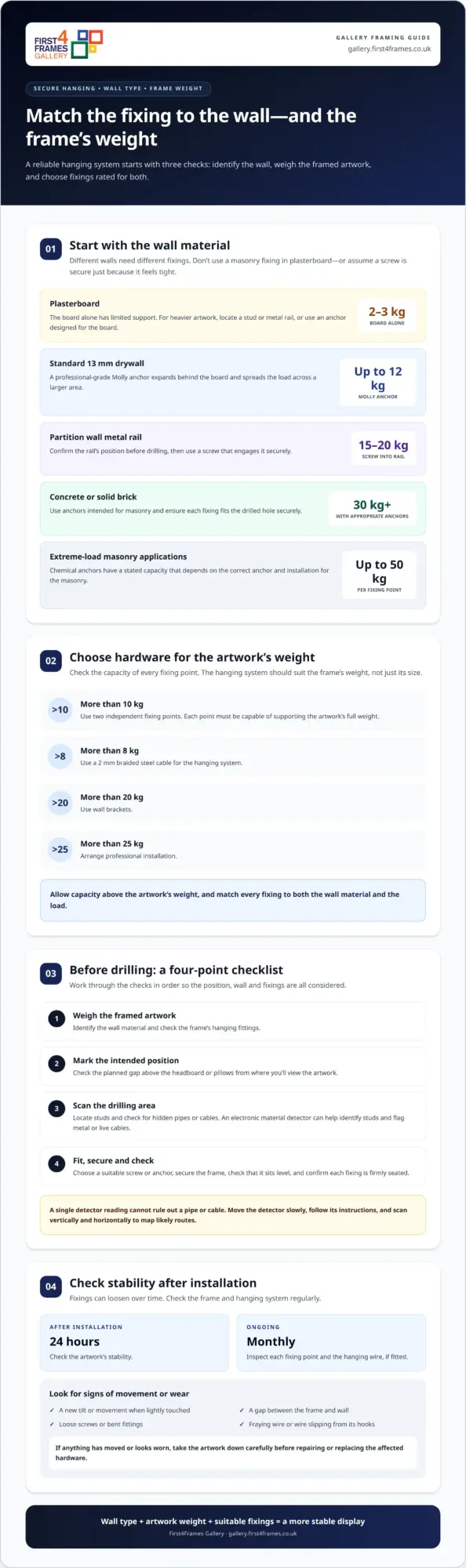
Choose fixings for both the wall and the frame’s weight. Plasterboard alone supports only 2-3 kilos, while a professional-grade Molly anchor can support up to 12 kilos in standard 13 mm drywall. For artwork weighing more than 10 kilos, use two independent fixing points, each capable of supporting the full weight. Select hardware rated well above the artwork’s weight. Knowing how to hang pictures securely above a bed also means matching every part of the hanging system to the load.
If you’d rather not hang artwork above the bed, display it on another wall or place it on a stable surface away from the sleeping area. Avoid leaning a heavy frame somewhere it could slide or topple.
UK prices for picture hooks, wall anchors and hanging kits vary according to the fixing type, materials and contents. Compare their stated weight capacities and suitability for your wall, not price alone. Before drilling, gather a tape measure, pencil, level, drill and wall detector. Then follow these steps:
- Weigh the framed artwork and identify the wall material.
- Mark the position and check the gap above the headboard or pillows.
- Scan for studs, pipes and cables, then fit a suitable screw or anchor.
- Secure the frame, check it sits level, and confirm each fixing is firmly seated.
2. Reducing the risk of frames falling above a bed
Fixings can loosen over time, so include the frame in your bedroom checks. Look for a new tilt, movement when lightly touched or a gap between the frame and wall. These signs may indicate shifting hardware or a fixing that no longer sits firmly. Inspect the frame before it looks visibly crooked.
Check the artwork 24 hours after installation, then make stability checks monthly. Look at each fixing point and the frame’s hanging wire, if fitted. Check for loose screws, bent fittings, fraying or a wire that has slipped from its hooks. If anything has moved or looks worn, take the artwork down carefully before repairing or replacing the affected hardware.
The hanging system should match the frame’s weight, not just its size. For artwork weighing more than 8 kilograms, use a 2 mm braided steel cable. Artwork weighing more than 20 kilograms calls for wall brackets. For artwork weighing more than 25 kilograms, arrange professional installation. These choices reduce strain on a single fixing and help keep a heavy frame stable above the bed.
- Keep the frame’s weight within the capacity of every fixing point.
- Check that a wire sits securely on its hooks and isn’t frayed.
- Reassess the hanging if the frame shifts after cleaning or decorating.
Also consider what sits beneath the picture. A headboard can provide some separation from pillows, while a lower or unstable display may place artwork closer to someone in bed. If the position feels exposed, move the frame to another wall instead of relying on extra hardware alone. Browse the framed artwork gallery while planning a display that suits your bedroom layout.
3. Selecting wall anchors and hardware for different wall types
Choose fixings to suit both the wall material and the framed artwork’s weight. A screw that holds firmly in solid brick may fail in plasterboard, so identify the wall before selecting hardware. Weigh the frame, note its hanging points, then match each fixing to the wall and load. For a gallery arrangement, assess every frame separately rather than assuming the weight is shared.
Concrete and solid brick can support artwork weighing 30 kilograms or more with appropriate anchors. Use anchors intended for masonry, and ensure the fixing fits the drilled hole securely. For extreme-load applications, chemical anchors can support up to 50 kilograms per fixing point. That capacity depends on using the right anchor and installation for the masonry, not simply choosing a strong-looking product.
Plasterboard alone may offer limited support, so choose a fixing suited to the board and the frame’s weight. A professional-grade Molly anchor can support up to 12 kilograms in standard 13 mm drywall. A Molly anchor expands behind the board as it tightens, spreading the load across a larger area. For a heavier frame, locate a stud or metal rail rather than relying on the board alone.
In a partition wall, a screw anchored directly into a metal rail can support 15 to 20 kilograms. Confirm the rail’s position before drilling, then choose a screw that engages it securely. Don’t confuse a hollow wall with masonry: each needs a different fixing, and the visual finish of a gallery won’t compensate for an unsuitable anchor.
Use this sequence to select hardware:
- Identify whether the wall is concrete, solid brick or a partition.
- Measure the artwork’s weight and check its hanging fittings.
- Choose an anchor rated for that wall and load, allowing capacity above the frame’s weight.
- For a heavy frame, use fixing points that support its weight independently.
4. How do I find wall studs or avoid hidden pipes and cables before drilling?
First identify the wall construction where the picture will hang. An electronic material detector can help locate studs and flag metal or live cables behind the surface. Move it slowly across the proposed drilling area, following the manufacturer’s instructions. Mark detected edges, then scan vertically and horizontally to map likely routes. One reading cannot rule out a pipe or cable.
Look for clues before scanning. Electrical cables may run vertically or horizontally from sockets and switches, while pipes may lead towards radiators, taps or other plumbing. These patterns are warnings, not a guarantee of what lies inside the wall. Check both sides of the wall where accessible, and avoid drilling near a signal or route you can’t confidently identify.
For a partition wall, finding a stud or metal rail helps place a fixing into solid support. Scan beyond the exact hanging point, since a frame’s fixing positions may need to align with the support. If you’re considering a test hole, first scan the area for services. A discreet 6 mm test hole can help identify wall material, but it cannot establish that the surrounding area is clear.
- Mark the planned frame position and fixing points.
- Scan each point with a detector, then check nearby sockets, switches and plumbing.
- Mark any signal or likely service route, and move the fixing position if needed.
- Stop if readings conflict or the wall remains unclear; don’t drill through uncertainty.
Recheck the final fixing points immediately before drilling, especially if they differ from your first marks. For a bedroom gallery, repeat the scan for every frame, since separate fixings may cross different parts of the wall. Once the wall positions are planned, explore framed artwork for your bedroom and consider how its size and placement will work with the available supports.
First4Frames Gallery: Ready-to-Hang Framed Art
First4Frames Gallery offers Ready-to-Hang Framed Art for a considered bedroom display. Explore Scottish landscape art, coastal wall art, landscape wall art and contemporary art prints to find a subject that suits your room. Take time to see artwork before you buy, and visualise art on your wall by considering its colours, scale and relationship to your bed.
For a personal piece, Custom Picture Framing and Giclée Fine Art Prints can help shape bespoke framed wall art or custom framed art prints. With online picture framing, you can choose your frame online and design your framed artwork around the print. Fine art and photography prints offer further directions to explore.
Whether you’re planning with a wall art visualiser or simply imagining the finished display, contact First4Frames Gallery to discuss your framing requirements and art print framing service.
Choose a piece that makes the room feel yours
Knowing how to hang pictures securely above a bed is one part of creating a bedroom you’ll enjoy returning to. Next, choose artwork that feels at home in the space, whether it echoes your colours, brings a favourite landscape into view or adds a personal touch to a calm corner.
Consider the atmosphere you want the artwork to create. A gentle image can soften the room, while a vivid composition can become its focal point. Let the frame and artwork work together, and plan their position around the bed and the room’s existing details. A thoughtful choice makes the display feel considered, not simply like a way to fill an empty wall.
If you’d like advice as you choose artwork for your bedroom, contact First4Frames Gallery. Take the next step towards a space that reflects your taste and makes your chosen artwork feel at home.
Frequently Asked Questions
How do I know if my wall is strong enough to support a heavy artwork?
Match the fixing to the wall material and the frame’s weight, then check where the fixing will grip. The support a wall can provide depends on its material, condition and the fixing used, so match the anchor to the wall and frame and seek advice if you’re unsure. A stud or metal rail provides a firmer fixing point in a partition. If the wall’s construction remains unclear, don’t rely on a guess.
How often should I check the stability of my installation?
Check the frame 24 hours after hanging, then inspect its stability monthly. A quick visual check can reveal a changed angle, a gap behind the frame, or a fixing that has shifted. Look closely at the wire and attachment points too. If the frame moves, take it down carefully before using the bed, then address the loose or damaged hardware.
Is it safe to hang art over the bed?
It can be made more secure by matching the fixings to the wall and frame, but any frame above a bed needs careful placement and regular checks. For artwork weighing more than 25 kilograms, professional installation is recommended. If the wall cannot provide a suitable fixing point, choose another wall instead. A clear space above the bed is a sensible alternative to uncertain support.
What if my bed doesn’t have a headboard?
Use the pillows as your visual reference: position the artwork’s bottom edge around 8-10 inches above them. Check the composition from the bed before marking the wall, since the picture should feel connected to the bed rather than floating near the ceiling. Keep the artwork centred over the mattress, and make sure the chosen fixing position suits the wall construction.
What should I use to hang my artwork?
Use hardware designed for the wall type and frame weight, with a capacity comfortably above the artwork’s weight. For heavy frames, use independent fixing points rather than relying on a single attachment. Check the frame’s fittings too: hooks, D-rings or hanging wire should be firmly attached and appropriate for the wall fixings before you lift the frame into place.
What precautions should you take before hanging a heavy artwork above your bed?
Before drilling, weigh the framed artwork, identify the wall material and scan the intended fixing area for studs, pipes and cables. Mark the artwork’s position and check its alignment from the bed. For a headboard, a gap of about 6-8 inches is a useful guide. Have someone support a heavy frame during installation, and stop if the wall or fixing point remains uncertain.