
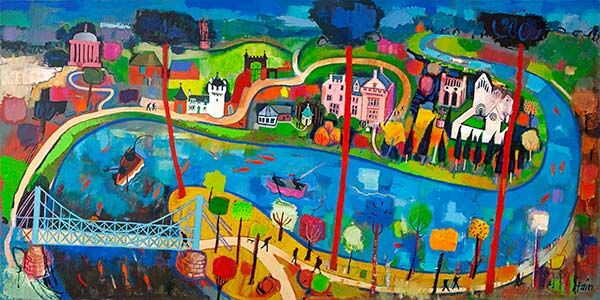
Scottish Borders wall art for a riverside cottage can establish a strong sense of place without filling the room with fishing equipment or generic country motifs. Fishing the Tweed by Rob Hain takes a broader view. The River Tweed winds through a colourful Borders settlement, crossed by a suspension bridge and surrounded by trees, paths, buildings and small figures. Anglers are part of the scene, but they belong to a living landscape rather than acting as a single decorative symbol.
What Scottish Borders wall art for a riverside cottage should add
A cottage near a river already has a convincing setting. Artwork does not need to manufacture rustic character with rods, flies, signs or tartan on every surface. It can instead reflect how the landscape is experienced: water curving past houses, paths linking neighbours, trees changing with the seasons and people using the river in different ways.
Fishing the Tweed captures that wider life. The bridge creates a clear crossing in the foreground. Bright houses and public buildings give the opposite bank structure. Small figures, boats and anglers reward a closer look, while the broad blue river remains legible from across the room. The result feels local and sociable rather than narrowly sporting.
Use the panoramic shape to open a compact room
The long horizontal composition can be useful in a cottage where ceiling height is modest or wall sections sit below beams. It creates breadth without pushing the eye upwards. Above a sofa, sideboard or dining bench, the river’s curve can extend the visual line of the furniture and make a shorter wall feel more generous.
- Above a sofa, centre the complete frame on the seating rather than the full wall.
- Over a dining bench, leave enough clearance for people to sit without touching the lower edge.
- In a hallway, make sure the frame does not project into a narrow route.
- Below a beam, preserve a strip of visible wall so the artwork does not feel trapped.
- Opposite a window, check that reflected water does not obscure the painted river.
Make a paper template using the finished framed dimensions. View it from the entrance, the main chair and any adjacent doorway. The bridge and village should read as one landscape. If furniture or a beam cuts too close to the frame, a different wall may give the panorama more room to travel.
Connect to cottage materials without becoming rustic
The picture contains strong colour, yet it can sit comfortably with traditional materials. Warm timber relates to the red, orange and ochre trees. Dark iron can echo the fine lines of the bridge. Wool and linen provide quieter texture beside the energetic painted surface. These connections feel more natural than adding literal angling accessories around the frame.
| Existing cottage feature | Response from the artwork | What to keep simple |
|---|---|---|
| Stone fireplace | Bright river colour lifts the heavier texture | The mantel display |
| Warm timber furniture | Autumn trees repeat red and ochre notes | Patterned upholstery beside the print |
| Painted panelling | The panorama adds width and movement | Additional pictures on the same wall |
| Black iron details | Fine bridge lines create a light connection | Heavy dark framing on every object |
A pale neutral wall will allow the saturated blue, green and pink to remain clear. Deeper paint can also work, but the frame and mount need enough contrast to hold the edge. The aim is to let the cottage feel collected and personal, not to make every finish imitate the artwork.
Let the river provide movement, not a colour formula
The Tweed occupies much of the composition, but its blue is broken by red marks, green banks, dark boats and reflected colour. A room can follow the same principle. One blue textile may establish a connection, while warmer timber and a small red or rust detail prevent the scheme from becoming cold. There is no need to match the exact painted blue.
Keep larger furniture relatively quiet if the print is intended to lead. The landscape contains many houses, trees and figures, so busy upholstery directly below it may compete with the details. Plain fabric, a restrained rug and an uncluttered surface will give the eye space to explore the scene.
Choose a frame for a hard-working cottage
A riverside home may receive wet coats, muddy boots and regular visitors. Position the picture away from the splash zone near an entrance and clear of door swings. In a dining area, leave distance from steam and direct heat. A secure fixing and a frame proportionate to the long image will make the artwork feel settled rather than delicate.
A simple dark moulding can connect with the bridge and tree trunks. A warm timber option can sit naturally with cottage joinery. A light mount may help the dense colour breathe. Because the image is unusually wide, compare the whole assembly rather than choosing a frame from a small corner sample alone.
Keep the sense of place authentic
Rob Hain works from the Scottish Borders and is known for colourful depictions of cities, towns and villages in which people bring the setting to life. That approach suits the Tweed because the river is shown as part of a community, not as an empty scenic backdrop. See more at Rob Hain’s official website, or browse the Rob Hain collection at First 4 Frames.
First 4 Frames produces colour-managed Giclée prints and completes bespoke framing in-house at its Falkirk workshop. Careful reproduction preserves the small figures and bridge lines while keeping the larger areas of river, foliage and sky distinct. The hand-finished presentation gives the lively panorama a precise edge suited to everyday cottage life.
Thoughtful Scottish Borders wall art for a riverside cottage can celebrate the river as landscape, livelihood and shared place without reducing the room to an angling theme. View the framed Fishing the Tweed print for a vivid panoramic scene that brings the Tweed and its surrounding community indoors.