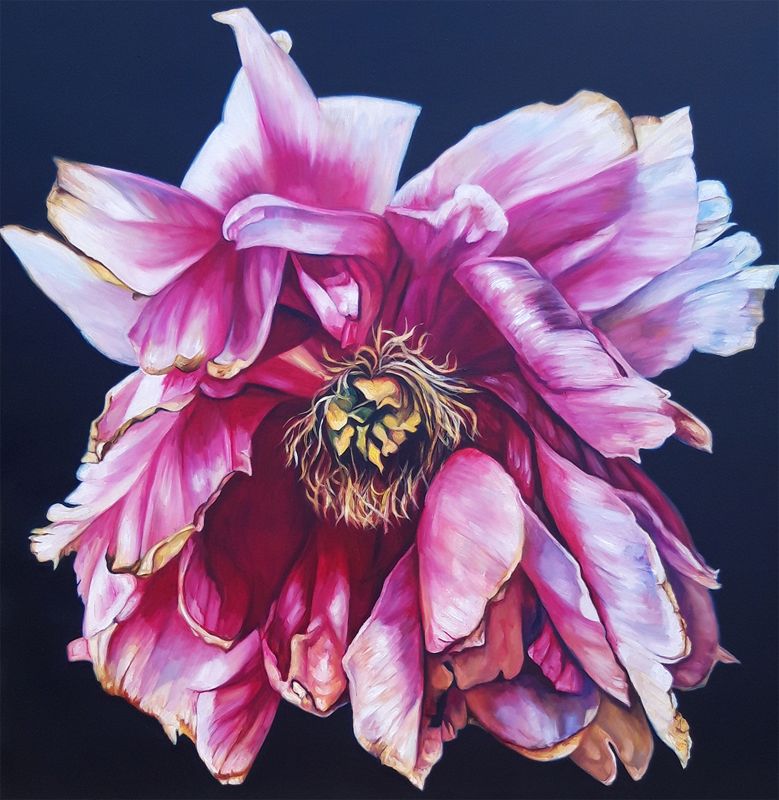
Floral wall art for dark painted walls works best when the flower has enough scale and contrast to meet the depth of the colour behind it. Final Flourish/ Peony by Greer Ralston focuses closely on lush pink peony petals edged with gold against a dark ground. It introduces light from within the image rather than asking the whole room to become pale.
Use floral wall art for dark painted walls as controlled illumination
Deep green, navy, charcoal, and plum walls absorb more light than pale paint. A close floral study can create a luminous focal point, but only if its placement avoids the darkest corner. Try the picture beside a lamp, opposite a window, or above furniture with a lighter top surface. Check both daytime and evening views before fixing it.
Build tonal depth
Let the dark ground of the image connect with the wall while the pink petals move forward. A narrow mount can provide separation if the two dark tones are very close.
Repeat gold sparingly
One warm lamp base or small brass detail can acknowledge the petal edges. Too many metallic objects would compete with their delicacy.
This is a strong option above a console, dressing table, or compact sofa where the flower can be seen at close enough range to appreciate its structure. Avoid surrounding it with several small botanical prints. The enlarged bloom already has the authority of a complete statement piece.
Retain the distinction between velvet shadow and petal edge
Close botanical work depends on nuanced transitions. Colour-managed Giclée printing preserves the separation between pink, gold, and deep shadow. A carefully selected bespoke frame then prevents the image from disappearing into the painted wall. The hand-finished, in-house result has presence without losing softness.
As floral wall art for dark painted walls, Final Flourish/ Peony brings sculptural colour and a measured glow while allowing a rich interior scheme to remain confidently dark.
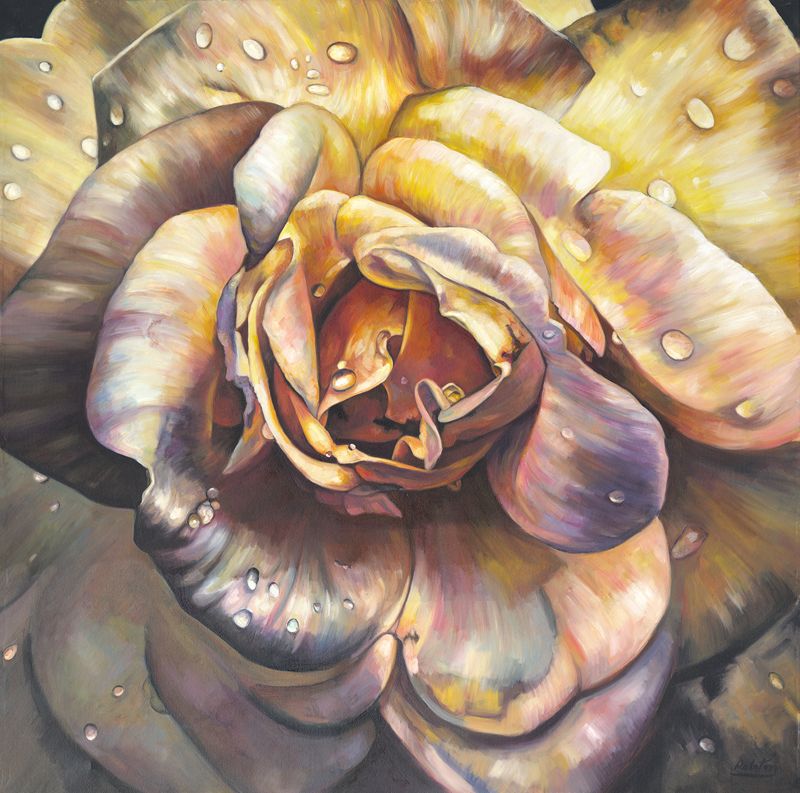
Floral wall art for a bathroom can bring softness to hard surfaces without relying on familiar spa signs or seaside motifs. After The Rain/ Wet Rose treats one rain-covered rose almost as a portrait. Yellow, pink, and purple petals unfold around bright droplets, giving the compact subject real depth.
Choose floral wall art for a bathroom with sculptural detail
Bathroom element
What the artwork adds
White tile
Warm petal colour stops the surface feeling clinical.
Brushed brass
Yellow highlights create a gentle visual link.
Plum or blush towels
Deeper petals support colour without exact matching.
Stone and grey
The rose introduces softness and a clear focal point.
Choose the wall carefully
Hang framed art away from direct splashes and persistent condensation. A well-ventilated cloakroom, larger bathroom, or dressing area offers a safer setting than the wall immediately beside a shower.
Keep accessories simple. One botanical subject with painterly depth feels more considered than repeating flowers across towels, bottles, and decorative objects.
First 4 Frames uses colour-managed Giclée production to preserve the glazed depth and delicate transitions in Greer Ralston’s painted petals. Bespoke framing is completed in-house in Falkirk, with personal advice available for choosing a finish suited to the intended room.
Greer Ralston, a distinguished contemporary artist, has left an indelible mark on the art world with her captivating creations. Her journey from the halls of Glasgow School of Art to prestigious galleries around the globe is a testament to her talent and dedication.
Early Life and Education
In the vibrant art scene of the 1980s, Greer Ralston graduated from the esteemed Glasgow School of Art. During this time, her work predominantly focused on portrait and figurative painting, mirroring the prevailing trends at GSA. Her early achievements included exhibitions at the National Portrait Gallery in London and being awarded the prestigious Greenshields International Scholarship for her figurative painting.
Evolution of Artistic Style
In recent years, Greer Ralston’s artistic interests have shifted towards nature, with a particular fascination for flowers, especially peonies. Viewing these flowers as individual portraits, she approaches them in a sculptural manner, transcending their domestic context. This departure from figurative works to nature-inspired pieces reflects a profound evolution in Ralston’s artistic expression.
Themes in Ralston’s Work
While her figurative works delved into difficult and complex themes such as sexuality, loss, and illness, Ralston’s flower and still-life compositions offer a lighter and more aesthetic perspective on the world. Despite the thematic shift, her commitment to exploring the human experience remains a central tenet of her artistry.
Artistic Process
Central to Greer Ralston’s creative process is the meticulous technique she employs in her works. Beginning with drawing and working exclusively in oils, she meticulously outlines shapes on a tonal background before layering thin glazes to achieve depth and texture. This technique, honed under the tutelage of the late Alberto Morroco, imbues her pieces with a sense of richness and complexity.
Influences and Inspirations
Greer Ralston’s artistic vision is deeply influenced by her study of art history, particularly women’s art history. Drawing inspiration from luminaries such as Artemisia Gentileschi, Kathe Kollwitz, Gluck, and Georgia O’Keeffe, she pays homage to her predecessors while forging her own distinct path. Additionally, her rural roots and connection to nature serve as a wellspring of inspiration for her future endeavours.
Notable Exhibitions and Awards
Ralston’s artistic prowess has been recognized on both national and international stages. Her exhibitions at the National Portrait Gallery in London and her receipt of the Greenshields International Scholarship underscore her standing in the contemporary art world.
Impact and Legacy
As Greer Ralston continues to push the boundaries of her creativity, her impact on contemporary art remains profound. Her ability to seamlessly blend tradition with innovation ensures her legacy will endure for generations to come, inspiring artists to explore new artistic horizons.
Conclusion
Greer Ralston’s artistic journey is a testament to the transformative power of creativity and perseverance. From her humble beginnings at Glasgow School of Art to her current status as a revered contemporary artist, Ralston’s dedication to her craft serves as an inspiration to aspiring artists everywhere
FAQs
Who is Greer Ralston? Greer Ralston is a distinguished contemporary artist known for her captivating creations that explore themes of nature, identity, and the human experience.
What are some notable aspects of Ralston’s early career? In the 1980s, Greer Ralston graduated from Glasgow School of Art and gained recognition for her portrait and figurative paintings. She exhibited at the National Portrait Gallery in London and received the Greenshields International Scholarship for her figurative painting.
What themes does Ralston’s artwork explore? Greer Ralston’s artwork often delves into complex themes such as sexuality, loss, and illness, while her recent works focus on nature and flowers, offering a lighter and more aesthetic perspective on the world.
What is Greer Ralston’s artistic process? Greer Ralston’s artistic process involves meticulous drawing and working exclusively in oils. She employs techniques learned from Alberto Morroco, including outlining shapes on a tonal background and layering thin glazes to achieve depth and texture in her compositions.
What is the legacy of Greer Ralston’s work? Greer Ralston’s work has left a lasting impact on the contemporary art world, blending tradition with innovation and inspiring artists to explore new artistic horizons.