
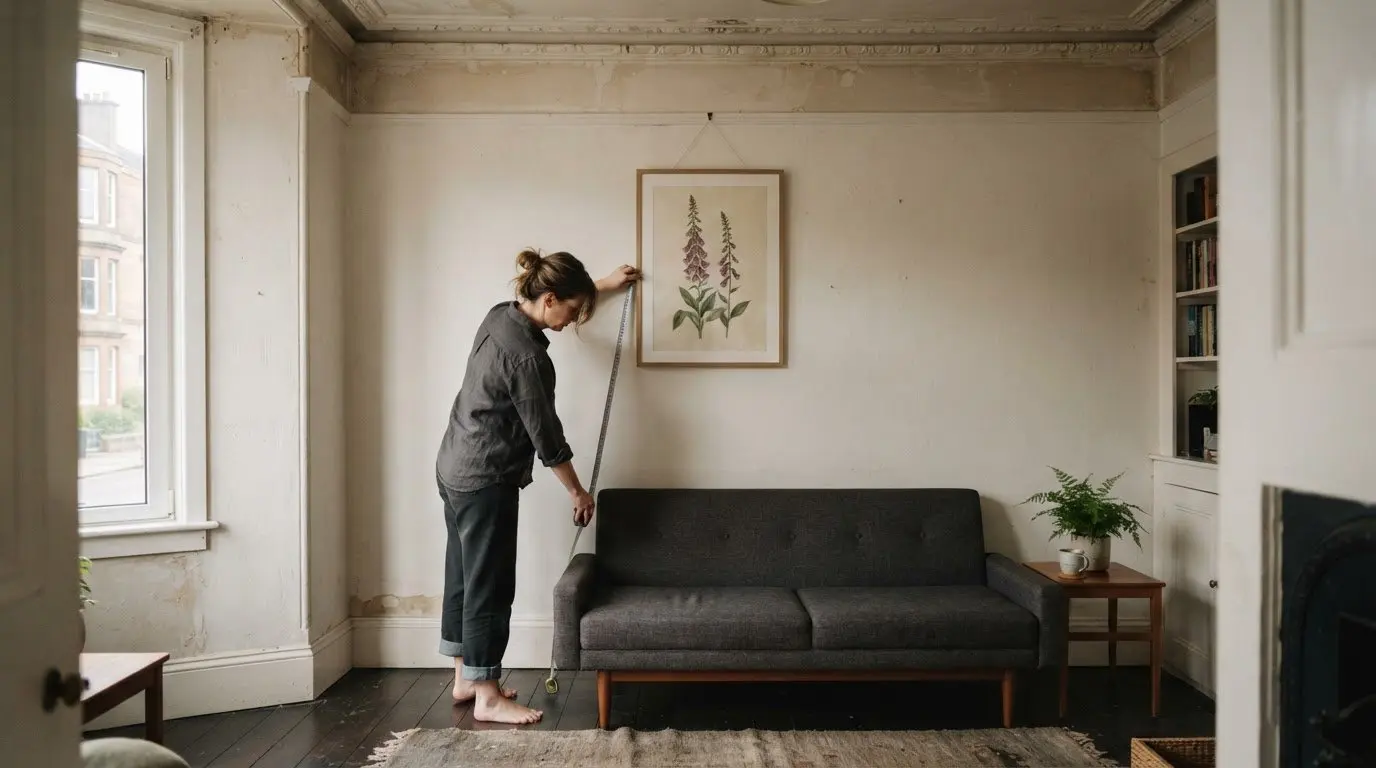
The usual eye-level rule isn’t the whole answer to how high to hang pictures in a room with low ceilings. A useful starting point is to place the centre of the picture about 57 to 60 inches above the floor, but centring it vertically on the wall can look more balanced. Before hanging, visualise art on your wall and consider how the frame relates to the room.
It’s easy to worry that artwork hung below eye level will look awkward. A wall art visualiser can help you See artwork before you buy, and compare styles, from Coastal wall art and Landscape wall art to Scottish landscape art, contemporary art prints and Photography prints by Best-selling artists and Famous artists. Choose a framed fine-art print that complements the room and gives the wall a clear focal point.
This guide explains how ceiling height affects placement, where to hang art in common rooms, and how to calculate hook position. You’ll also find practical pointers for planning framed wall art, custom framed art prints and bespoke framed wall art. Whether you’re considering an art print framing service or exploring online picture framing, learn how to design your framed artwork and choose your frame online with the wall’s proportions in mind.
Key Takeaways
- Use the room’s proportions to guide picture height; in a low-ceiling room, centring art on the wall can feel more balanced than following eye level alone.
- Position artwork in relation to the furniture beneath it, keeping a considered gap and choosing a frame or grouping that suits its width.
- Adjust placement for the room: living areas, hallways and dining spaces can each benefit from a slightly different approach.
- Find the hook position by measuring from the artwork’s centre to its wire or hook, then adding that distance to your chosen centre height.
Does ceiling height change the rule?
Yes. Let the wall and nearby furniture guide the placement instead of following eye level rigidly. A vertical arrangement can draw the eye upwards, but leave visible space between the artwork and ceiling.
-
Assess Ceiling Height and Furniture
Measure the wall and relate the picture to the furniture below before choosing its position. Above a sofa, leave 6 to 10 inches between the furniture and the picture’s bottom edge; above a console or dresser, about 6 inches can work. In rooms with 10 ft ceilings or higher, artwork can sit higher, with its centre about 60 to 62 inches above the floor. Keep the arrangement cohesive rather than awkwardly isolated.
-
Set an Eye-Level Hanging Height
Use 57 to 60 inches from the floor to the artwork’s centre as a general eye-level range. In a smaller room or one with low ceilings, keep the centre near 57 inches, or centre the picture vertically on the wall if that looks more balanced. Above furniture, its relationship to the piece below matters more than a fixed eye-level position. For an open wall beneath very high ceilings, keep the centre around 60 to 62 inches.
-
Measure and Mark the Artwork Position
Choose the intended centre height, then measure the framed artwork’s full height and divide it in half to find its top and bottom edges. Mark the centre lightly and check the position against nearby furniture before fixing the frame. To locate the nail, measure from the artwork’s centre to its wire or hook, then add that distance above the chosen centre height. For plasterboard, use a hollow-wall fixing suited to the picture’s weight, or fix into a timber stud.
-
Leave Space Above the Picture
Leave visible wall space above the frame instead of pushing it close to the ceiling. In a low-ceiling room, a picture hung too high can make the space feel cramped. Step back and assess the frame in relation to the ceiling line and furniture. A vertical group can lead the eye upwards, while a horizontal row often feels calmer. If a high picture rail creates an awkward position, hanging the artwork on the wall below it may work better.
Picture height in living rooms, hallways and dining areas
Choose a height that suits each room’s purpose and proportions. Living rooms, hallways and dining areas can share a visual rhythm without having every picture at exactly the same height.
-
Adjust Picture Height for Each Room
Set dining-area artwork with its centre 55-57 inches above the floor, so seated viewers can enjoy it comfortably. In a hallway, consider the view while walking through, and align several pieces along a shared centre-line. For a living-room gallery, treat the full arrangement as one large piece and plan its overall position before hanging individual frames. This helps the group feel cohesive rather than scattered across the wall.
-
Adapt the Height to Low Ceilings
In a smaller room, lower the visual centre if standard placement leaves too little wall space above the artwork. A horizontal row or compact grid can suit a low ceiling, while a vertical arrangement draws the eye upwards. Keep the layout in proportion: several small pieces can form one considered display, but spreading them too widely may make the wall feel busy. For a gallery wall, position its central piece first, then build outwards.
-
Keep Picture Heights Consistent
Align the centres of pictures that viewers see together, such as pieces along a hallway or across connected living and dining areas. Consistency gives the eye a clear path, even when frame sizes differ. For a group of smaller works, plan the complete arrangement on the floor first, then transfer its overall centre and spacing to the wall. Explore artwork for your rooms as you consider which pieces will create the right visual flow.
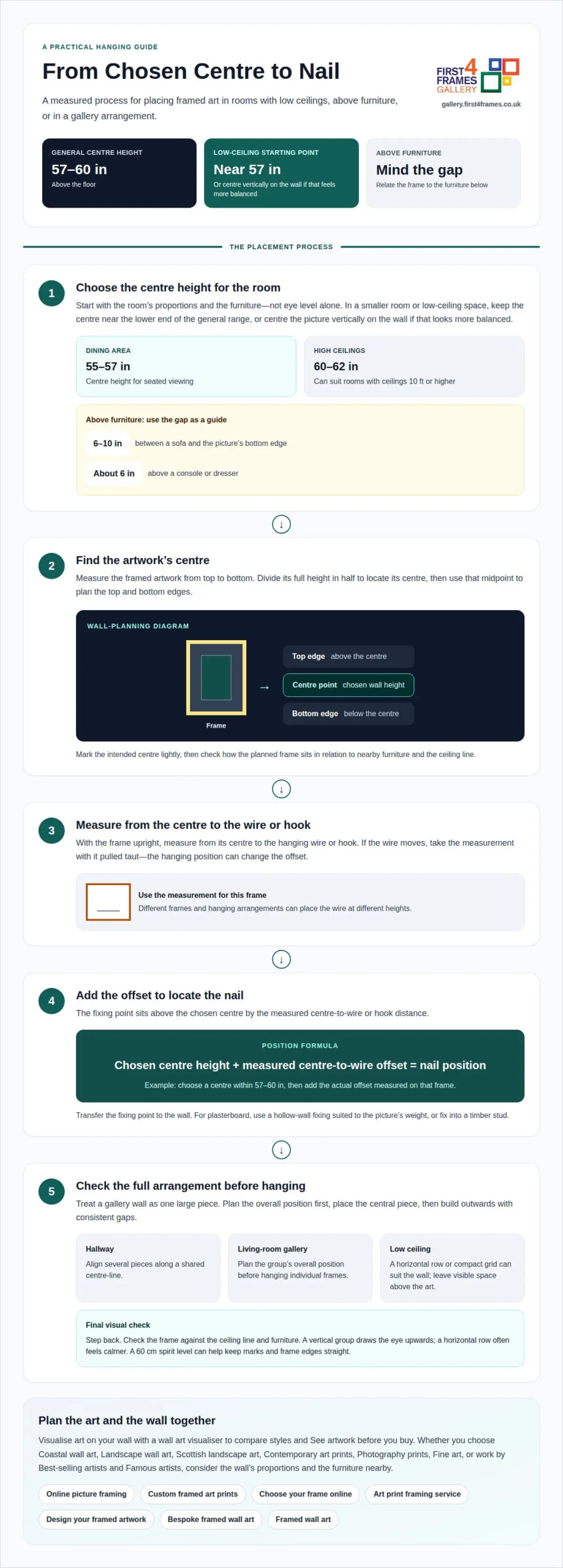
Calculating picture-hook position
Calculate from the artwork’s centre, not its top edge. This helps align a single frame or gallery wall with the height you’ve chosen.
- Choose the centre height for the display. For a low-ceiling room, a grouping can be treated as one large piece, with its centre 57-60 inches above the floor. Mark that centre point on the wall. For rooms with 9-10-foot ceilings, artwork can be centred 59 to 60 inches above the floor. Use the planned position for the whole arrangement, not just its largest frame.
- Measure the framed artwork from top to bottom and find its centre. With the frame upright, measure from its centre to the hanging wire or hook. The wire may sit differently when pulled taut, so take the measurement in that position. This distance connects your chosen centre height with the wall fixing position.
- Add the centre-to-wire or hook measurement to your chosen centre height to locate the nail. For example, if your marked centre is within the 57-60-inch range, add the actual measured offset from that frame. Avoid using a measurement from another picture: different frames and hanging arrangements can place the wire at different heights.
- Transfer the fixing point to the wall and check the artwork’s position before hanging it. For prints in a gallery wall, calculate the group as one balanced shape, then mark the central piece first and work outwards. Measure the gaps between frames consistently so the arrangement stays even. A 60 cm spirit level can help keep the marks and frame edges straight, especially across several pieces.
How much space should be left between a picture and the ceiling?
- Assess the whole wall instead of relying on a standard gap below the ceiling. In a low-ceiling room, pictures hung too close to the ceiling can make the space feel cramped. First choose a balanced position for the artwork, then check how its top edge sits against the ceiling line. Leave enough visible wall above the frame to separate it visually from the ceiling.
- Use the artwork’s centre and height to assess its top edge. For a general eye-level position, a centre around 57 to 60 inches above the floor is a useful reference. A taller frame will naturally sit nearer the ceiling than a smaller one at the same centre height. Compare the frame’s proportions with the available wall space before marking its final position.
- Keep the picture below a high picture rail if the rail forces it too close to the ceiling. A picture hung from a rail can have its centre about 57 to 60 inches above the floor; if the rail is very high, hanging the picture on the wall below it may look more balanced. Check the frame against the rail and nearby furniture before fixing it in place.
- Step back and assess the wall from the room’s usual viewing position. In a low room, a horizontal row or compact group can preserve breathing space above the frames, while a tall arrangement may feel crowded if its upper edge approaches the ceiling. Adjust the group as a whole, keeping its centre and spacing visually coherent. Explore framed artwork to consider pieces that suit your wall’s proportions.
First4Frames Gallery: Ready-to-Hang Framed Art
First4Frames Gallery offers Ready-to-Hang Framed Art for a considered finish, alongside Custom Picture Framing when you want a frame made for a particular piece. Frames are handmade to order using high-quality materials, helping the frame suit the artwork and its intended place on your wall.
Each frame comes glazed with 2 mm float glass. Choose from a broad range of frames to complement a print, photograph or existing artwork, then use the placement principles above to plan where it will sit. Giclée Fine Art Prints are another option when you’re choosing art and framing together.
If you’d like advice on framing a piece for a low-ceiling room, contact First4Frames Gallery.
Make the Wall Feel Complete
Choosing how high to hang pictures in a room with low ceilings is also a way to shape its character. Consider the mood you want the wall to create, then choose artwork that suits the colours and furnishings around it. A thoughtfully selected framed fine-art Giclée print can create a focal point without overwhelming the room’s proportions.
Before settling on a piece, picture how it will sit in the room and what you want to notice first when you enter. Let that guide your choice, so the finished wall feels personal rather than simply filled.
Contact First4Frames Gallery to discuss your next artwork choice. Give your walls room to tell a story that feels distinctly yours.
Frequently Asked Questions
Can art be hung too high?
Yes, art can feel too high when it sits apart from the room’s main viewing area. To decide how high to hang pictures in a room with low ceilings, compare the frame’s centre with nearby furniture and the open wall. If the picture seems detached from a sofa or crowded against the ceiling, adjust its position before fixing it permanently.
How do you get gallery wall height and spacing right?
Plan the gallery wall as one overall shape, then set its centre at a comfortable viewing height. Leave 2 to 3 inches between frames for a standard arrangement, keeping the gaps consistent even when the frames differ in size. In a narrow space, a tighter layout may suit the wall better. Begin with the central piece, then position the surrounding works around it.
How high should art hang above sofas, beds, and consoles?
Use the furniture as the visual anchor. Above a sofa, artwork can span about two-thirds of its length, with the frame’s bottom edge 6 to 10 inches above it. Above a bed, aim for artwork around two-thirds the bed’s width and leave 8 to 10 inches above the headboard. Above a console, a gap of about 6 inches can keep the grouping connected.
How to place the hanging point precisely?
Measure the hanging hardware with the wire pulled taut, then use that offset to locate the fixing point. First mark the intended centre of the picture on the wall. Measure from the frame’s centre to the wire’s highest point, then mark the same distance above the centre mark. This places the fixing where the frame will hang, rather than where the wire rests when loose.
What’s the standard height to hang art on a wall?
A useful general guide is to place the centre of the artwork 57 to 60 inches above the floor. Measure to the centre of the complete framed piece, not its top edge. This gives a consistent starting point for an open wall; the picture’s proportions and nearby furniture can guide small adjustments. In dining areas, a slightly lower centre may suit seated viewing.
What is the standard height to hang pictures in a room?
For most open walls, use the artwork’s centre as your reference, rather than hanging every frame at the same top-edge height. Rooms with low ceilings may benefit from a lower centre, while dining-area art can sit around 55-57 inches above the floor. If several rooms connect visually, align selected picture centres to create a gentle flow between spaces.