
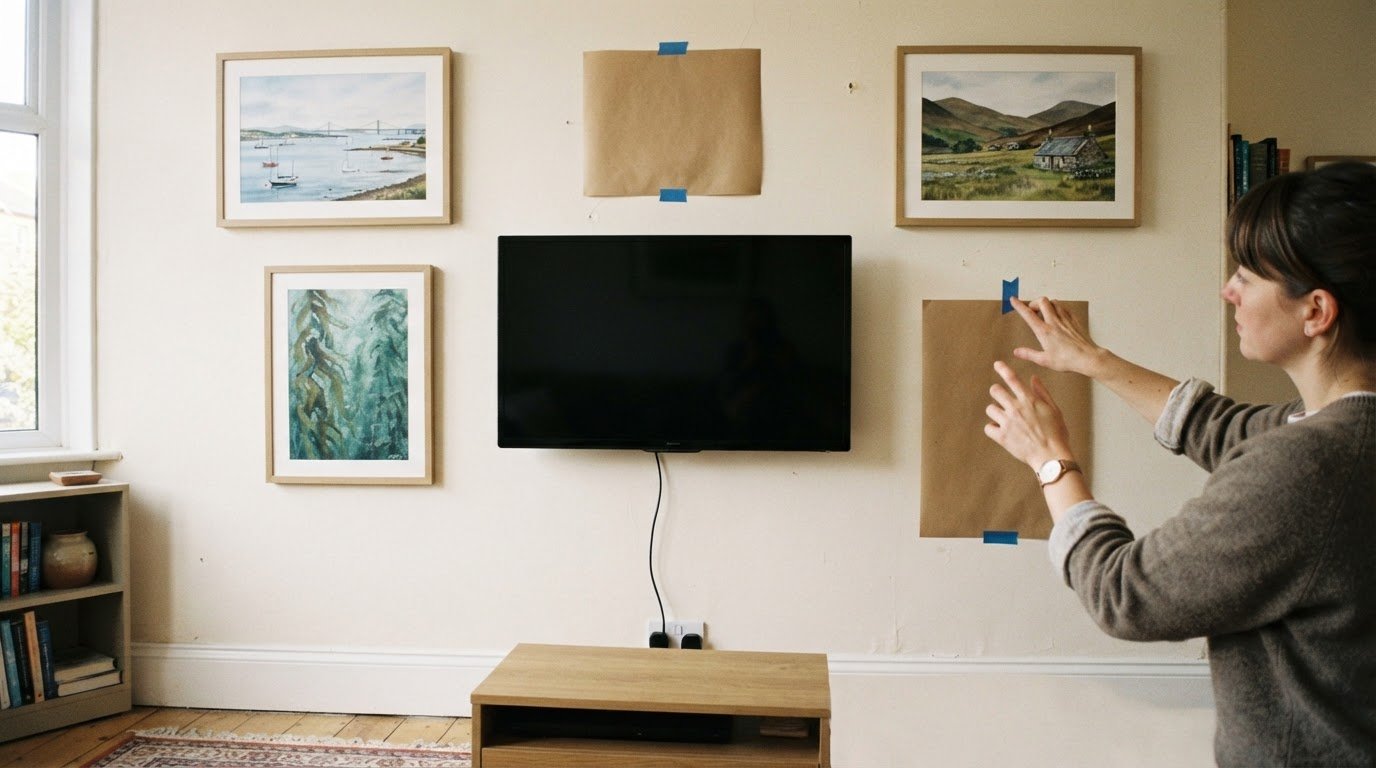
A TV doesn’t have to be the only focal point on your living-room wall. To work out how to create a gallery wall around a TV, place the largest frames near it, build the arrangement outwards and leave a 4-6-inch buffer around the screen. Visible cables can stay accessible by shaping the layout around them rather than trying to hide them behind artwork.
It’s understandable to worry that frames and cables will make a wall feel cluttered. A balanced layout can help the TV sit naturally among the room’s other details. This guide explains how to create a gallery wall around a TV, from choosing artwork and a layout to testing positions with paper templates and marking hanging points with painter’s tape. You’ll also learn how to adapt the arrangement for a smaller room, balance the display and leave space for cables, so you can plan before making holes in the wall.
Key Takeaways
- Keep visible cables accessible by planning the arrangement around them, with framed art, shelves and decorative objects working together.
- For a calmer display, consider using 5-7 frames and arrange pieces around the TV rather than placing them only above it.
- Test the composition on the floor first, balancing smaller pieces higher up and larger artwork lower down.
- Use painter’s tape to transfer a frame’s hanging-point spacing to the wall before making holes.
Can I do a gallery wall around a wall-mounted TV with cables showing?
Yes. Arrange art and objects around the screen while keeping visible cables accessible. Leave a 4-6-inch buffer around the TV, then plan the display to work with the wall’s practical details.
-
Combine Art, Shelves, and Decorative Objects
Start with larger framed pieces, then add a shelf or smaller objects where they won’t obstruct the screen or cables. Keep the cable route visible and accessible instead of trapping it behind a frame or shelf. For example, place a shelf to one side of the TV, with a small vase or ornament balancing framed art on the other. This gives each element its own place without crowding the screen.
If you display personal photos on a Samsung Frame TV, choose surrounding pictures or objects that complement the images on screen. The digital display can become part of the collection, while physical frames add depth.
-
Choose a Unifying Palette or Frame Style
Choose a shared colour or frame finish to bring different artworks together. Matching frames create a streamlined look; mixing wood, metal or colours can also feel considered when a tone is repeated. For example, echo a colour in a landscape print with a nearby decorative object. Keep the TV’s dark screen in mind, and avoid so many competing finishes that the artwork loses visual balance.
Choose images with a related mood, subject, or palette to make the collection feel cohesive. Browse the artwork gallery for ideas such as landscapes, then consider how each print will sit beside the television.
-
Test Placement with Paper Templates
Cut paper to match each frame’s outer dimensions and label each template with its artwork. Arrange the templates around the TV, moving them until larger pieces anchor the layout and smaller ones fill the gaps. Keep the cable path clear and leave breathing room around the screen. Step back and view the plan from the main seating area before settling on positions.
Use the templates to compare different frame sizes without lifting or shifting the artwork. If the arrangement feels crowded, move a template outward or remove an object, then review the balance.
Planning the wall layout and overall arrangement
- Set the TV at a comfortable viewing height before arranging art. Check its position from the main seating area, where seated eye level helps you judge the screen’s placement. Measure the wall’s width and height, including the TV console, and note any switches or sockets. Leave a 4-6-inch buffer around the screen, then use that clear space as the layout’s starting boundary.
- Plan the composition around the TV, rather than placing every frame above it. A gallery wall can span roughly two-thirds of the wall’s width, with art beside and above the screen. Aim for 5-7 frames for a composed display, or 4-6 smaller pieces in a small living room. A symmetrical arrangement can make the TV and console feel connected, while an asymmetrical layout may suit a varied collection.
- Choose a visual anchor before adding supporting pieces. The largest artwork should be at least half the TV’s width, so it holds visual weight beside the screen. One or two canvases measuring 24×36 inches or bigger can anchor the display, with smaller frames supporting them. A Scottish landscape art print, for example, could set the palette for custom framed art prints nearby. Keep larger pieces lower and smaller frames higher to avoid a top-heavy effect.
- Test the layout on the floor before hanging anything. Mark the TV’s outline with tape, then arrange paper templates or frames around it. Step back and compare the composition with the wall and console. A wall art visualiser can help you see how art might look on your wall, while a floor plan lets you move pieces by hand. Consider how bespoke framed wall art will balance with the room’s furnishings before choosing positions.
For an online picture framing plan, browse the artwork gallery and consider how each piece might fit your TV-wall arrangement.
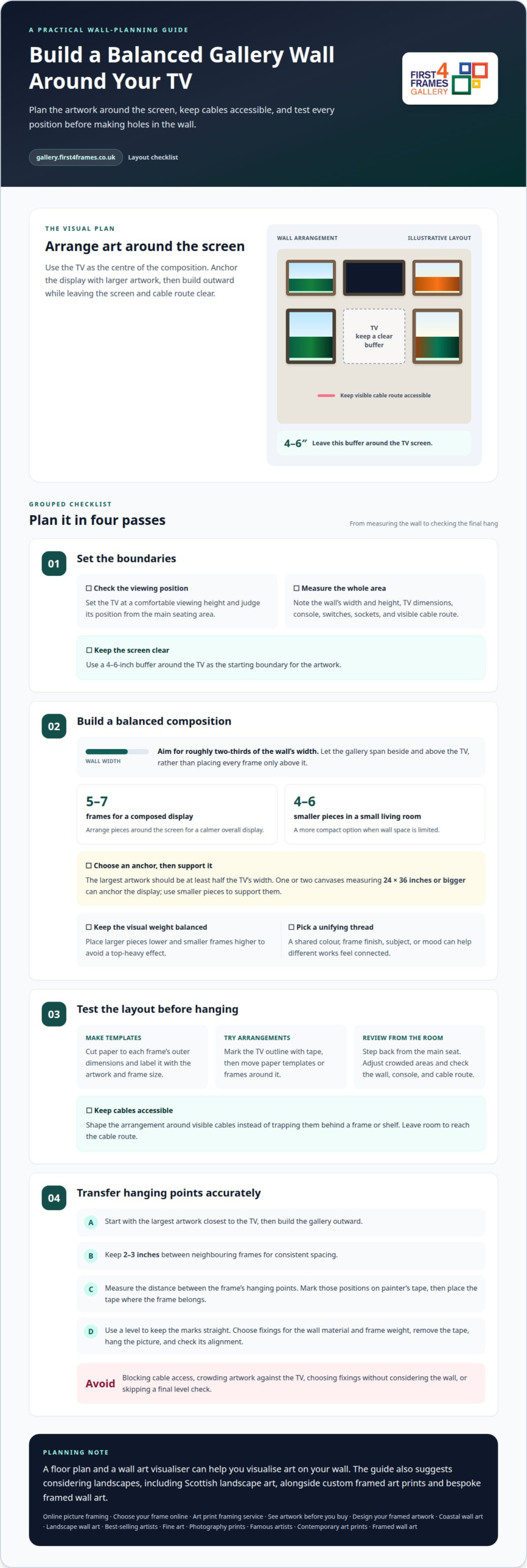
Using painter’s tape to mark hanging points
Before marking the wall, measure its width and height, the TV’s dimensions and the screen’s height above the floor. Note the console’s dimensions and visible cable route too. These details show where artwork can fit without blocking access.
For plasterboard, brick or plaster walls, choose fixings to suit both the wall material and the frame’s weight. Heavier pieces may need wall anchors and screws, while lighter frames can use a sturdy nail. Common mistakes include choosing fixings without considering the wall, crowding artwork against the TV and skipping a final level check.
- Dry-run the arrangement with paper templates before making holes. Label each template with its picture and frame dimensions, then place them around the TV. Check the composition from the main seat and adjust any template that clashes with the console or cable route.
- Start with the largest artwork closest to the TV, then build the gallery outward. Keep 2-3 inches between neighbouring frames for consistent spacing. Use the same gap around smaller pictures, and step back after placing each template to spot uneven clusters.
- Measure the distance between the frame’s hanging points, then mark those positions on painter’s tape. Place the tape on the wall where the frame belongs, using a level to keep the marks straight. This transfers the frame’s actual fixing points without estimating from its outer edges.
- Hammer a nail or drill for a screw through the marked points in the tape, then remove the tape before hanging the picture. Match the fixing to the wall and frame weight. Once the frame is hung, check its alignment with a level and adjust it before moving on to the next piece.
Keep the TV’s dimensions and wall measurements beside your layout as you work. This simple reference helps prevent a common mistake: planning attractive spacing on paper that doesn’t fit the actual wall.
Reasons to create a gallery wall around a TV
- Use artwork to give a broad living-room wall more presence. A 55-65-inch TV is usually too small to anchor a large wall on its own, so the surrounding space can feel bare. A considered arrangement gives the screen visual company and makes it part of a wider display. For example, place prints around the TV to connect its position with the rest of the room.
- Make the wall feel intentional, even when the television is off. The dark screen can dominate a living room, but framed artwork nearby adds colour, subject matter and detail. Choose pieces that reflect what you enjoy, such as a landscape that recalls a favourite place or a striking contemporary print. The display can then feel personal, rather than centred only on a device.
- Use the gallery to connect separate elements in the room. Artwork can link the TV wall, furniture and other details without requiring everything to match. For example, a print featuring a colour already found in a rug can help the two areas feel connected. Choose images for their meaning as well as their appearance, so the arrangement adds character to everyday viewing.
- Let the display evolve as your tastes change. A gallery wall can bring together different subjects, such as a favourite landscape, an abstract composition and a meaningful print, while the TV remains in place. Start with pieces you genuinely want to live with, then leave room for a future addition. Explore artwork for your living room to find prints that could give the screen a more considered setting.
First4Frames Gallery: Ready-to-Hang Framed Art
First4Frames Gallery can help bring a planned TV-wall arrangement together with Ready-to-Hang Framed Art. Choose a print and frame to suit your palette, or use Custom Picture Framing for artwork that needs a bespoke fit. Frames are handmade for each order using high-quality materials, with 2 mm float glass glazing.
For a more personal display, Giclée Fine Art Prints offer another way to select artwork for your wall. Consider how each image’s colours and frame will sit beside the television before choosing pieces for your arrangement.
If you’d like guidance on framed art for your layout, contact First4Frames Gallery.
Let Your TV Wall Reflect Your Style
To create a gallery wall around a TV, treat the screen as part of the living space, not as an obstacle to decorating. Begin with artwork that feels meaningful to you, then let its colours and character guide future choices. Your display can grow over time, bringing together pieces that reflect places, memories and subjects you love.
Before choosing your next print, picture how it might sit alongside the room’s existing textures and furnishings. A considered addition can refresh the wall without replacing the entire arrangement. Follow your own taste and let the collection take shape at a comfortable pace.
Explore artwork for your TV wall and find a piece to inspire your next design choice. Your living room can become a more personal space, one artwork at a time.
Frequently Asked Questions
How much space should be between the TV and the artwork?
Leave a 4-6-inch buffer between the TV and the nearest frame, measuring from the screen’s edge to the frame’s outer edge. This gives the display breathing room and keeps artwork from feeling pressed against the screen. If the TV sits above a console, consider that furniture’s outline too, so the nearest pictures don’t appear squeezed between the screen and the console.
Is a gallery wall around the TV a good idea in a small living room?
Yes, a gallery wall can suit a small living room when its scale matches the available wall space. Try 4-6 smaller pieces rather than filling every gap with oversized frames. A compact arrangement can add personality without overwhelming the TV or seating area. Keep the composition focused, and choose artwork that works together so the eye can move naturally between each piece.
Should the frames match my TV?
Frames don’t have to match the TV exactly. A consistent finish, such as black frames echoing a dark screen, can create a unified look, while wood or metal frames add contrast. For a mixed collection, repeat one colour or material across several pieces. This shared detail helps different frames feel intentional beside the screen.
What size art works best around a TV?
Choose artwork in proportion to both the TV and the wall. The largest piece should be at least half the TV’s width to hold visual weight beside the screen. One or two canvases measuring 24×36 inches or bigger can anchor the arrangement, with smaller pictures supporting them. In a tighter space, use smaller works so the composition stays balanced.
How much space should you leave between a TV and framed pictures?
Keep the closest framed picture 4-6 inches from the TV’s edge, measuring to the outside of the frame rather than the artwork inside. That distinction matters with wide frames, which can reduce the visible gap. Use the same measurement on both sides if you want a symmetrical arrangement, or adjust each side to suit the wall’s shape and nearby furnishings.
How to hide TV cables within a gallery wall
Keep the cable route accessible by arranging artwork and shelves around it, rather than trapping cables behind them.