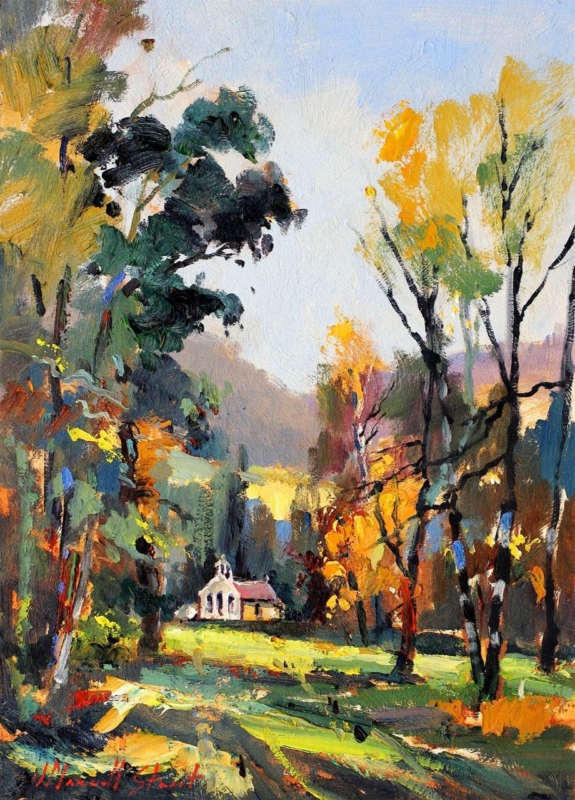
art for limestone flooring becomes more useful when the picture solves a real placement question. Autumn Light offers a clear starting point because its vertical format and warm seasonal idea can counter a broad, cool floor without covering the stone or forcing the whole room into an autumn palette.
Balance art for limestone flooring from the ground up
Limestone usually contributes pale tone, quiet variation and a strong horizontal plane. A portrait artwork answers that structure by drawing the eye upwards. Mark both available print sizes—230 x 320 mm and 400 x 550 mm—then add allowances for mount and moulding.
Use warmth selectively
Repeat one russet, amber or soft brown in a textile or ceramic. Leave other surfaces quieter so the artwork remains the source of warmth.
Keep the stone visible
Avoid several heavy rugs and dark objects merely to correct a cool floor. Texture and one framed focal point can be enough.
Check the picture in the light that reaches the room. Limestone can bounce daylight upwards, while evening lamps may introduce warm glare. View the proposed glazing from seated and standing positions before finalising the hanging point.
Photograph the room in morning and evening light.
Template the complete frame above the main furniture group.
Choose one colour connection instead of a fully matched palette.
Keep the lower wall clear enough for floor and picture to read together.
Separate warm colour from pale stone
Subtle seasonal colour needs accurate relationships, not simply extra saturation. Colour-managed Giclée production helps preserve that balance. A hand-finished frame creates a measured transition between the artwork, wall and limestone below.
Art for limestone flooring should add warmth while respecting the material already in the room. Autumn Light offers upward movement and seasonal colour, allowing the floor to remain calm rather than cold.
portrait landscape art for a cottage hallway has to bring atmosphere into a compact route without making the walls feel tighter. Autumn Light by Joseph Maxwell Stuart is well suited to that balance. Its upright composition follows the height of a narrow wall, while a pale sky and sunlit clearing create distance. The small white cottage gives the eye a destination beyond the foreground trees, so the hallway gains a view rather than another layer of decoration.
Why portrait landscape art for a cottage hallway works vertically
Cottage hallways often contain several interruptions: door frames, radiators, switches, coat storage and turns in the plan. A broad horizontal picture may need more uninterrupted wall than the room can offer. A portrait piece uses height instead. It can occupy a clear section beside a doorway or above a slim console while leaving the walking route visually open.
Autumn Light reinforces that vertical movement through tree trunks rising on both sides of the scene. The darker trees frame the lighter centre rather than forming a solid wall. That structure matters in a small interior. It creates the impression of looking through the woodland towards open ground, distant hills and the cottage beyond.
Use the painting to create a destination
The strongest place for this print may be the wall seen at the end of the hall, not the largest empty surface. From the entrance, the white cottage acts as a small focal point. The bands of green, yellow and shadow lead towards it. That visual journey can make a short passage feel more intentional and can draw attention away from practical storage nearer the door.
Stand at the threshold. Check that the pale cottage remains visible from the normal entrance position.
Mark the finished size. Include the mount and frame when making a paper template.
Open every nearby door. Make sure handles and door leaves cannot strike the frame.
View it under evening light. A hallway is often used with lamps on, so check for glare before fixing the position.
Avoid hanging the centre automatically at standard gallery height. The right level depends on the ceiling, nearby joinery and the main viewing distance. In a narrow hall, the picture may be seen from several metres away and then at close range. Test both views before drilling.
Balance autumn colour with cottage materials
The painting combines bright yellow and orange with deep evergreen, blue-green, charcoal and a broad area of pale blue sky. This makes it easier to place than an image built entirely from russet tones. The cooler greens prevent the autumn palette from feeling too heavy, while the white building can connect with painted woodwork or a light wall.
Hallway feature
Connection to make
Useful restraint
Flagstone or slate floor
Relate it to the charcoal trunks and cool shadows
Keep the frame slim enough to avoid a heavy dark block
Natural timber doors
Pick up the warm ochre and orange passages
Do not force the moulding to match the timber exactly
Warm white walls
Let the pale sky and cottage create breathing room
Use a mount edge if the image needs clearer separation
Green painted bench
Repeat one muted woodland green
Avoid adding several more botanical patterns nearby
Keep practical clutter separate from the focal point
A hallway needs to cope with coats, shoes, keys and bags. Artwork works best when it is not asked to hide that storage. Group practical items on one side and preserve a calmer section of wall for the print. If the frame sits above a console, keep the surface arrangement low and simple. One bowl or lamp is enough; tall objects can obscure the cottage and the central light.
Allow a sensible gap from a busy coat rack. Sleeves, damp outerwear and bag straps should not brush the glazing or moulding. Direct sunlight from a glazed front door should also be considered. A position slightly around a corner may offer a better view with less exposure and fewer reflections.
Frame the woodland with clarity
The loose brushwork contains small changes of yellow, red, green, blue and near-black. First 4 Frames uses colour-managed Giclée production and completes bespoke framing in-house at its Falkirk workshop. That care helps the bright clearing remain distinct from the deeper woodland marks and preserves the fine contrast around the distant building.
A restrained dark moulding can connect with the tree trunks and stone flooring. A warm timber option can make the arrangement softer beside painted walls. A measured mount gives the energetic brushwork a calm boundary, which is especially useful where the hallway already contains several doors and architectural lines.
Well-positioned portrait landscape art for a cottage hallway can turn a practical route into a warmer arrival without consuming valuable floor space. View the framed Autumn Light print for a tall, light-filled woodland scene that rewards both the first glance and a closer look.