
An artist’s proof isn’t automatically more valuable than a signed, numbered print. If you’re asking what an artist’s proof print is, it’s a copy set apart from the main numbered edition, traditionally kept by the artist and often marked AP or A/P. The label signals its place in the edition, not a guarantee of greater quality or value.
It’s easy to assume that a rarer-sounding label means a better investment, but collectibility depends on more than the proof mark. This guide explains what an artist’s proof print is, how it differs from a limited edition, and how factors such as rarity, condition and the artist’s reputation can influence value. You’ll also see why a proof and a signed, numbered print may appeal to collectors for different reasons, helping you assess the artwork as well as the notation on its margin.
Key Takeaways
- Compare an artist’s proof with the main edition by its numbering and how it was issued, not by the label alone.
- Learn to distinguish AP or A/P marks from printer’s proofs, hors commerce proofs and a bon à tirer proof.
- Look beyond rarity when assessing collectibility: condition, edition size and the artist’s work all matter.
- Weigh a proof against signed, numbered prints on its own merits; neither the proof status nor a low edition number guarantees higher value.
What is the difference between a Limited Edition Print and an Artist’s Proof?
A limited edition print belongs to a fixed quantity, while an artist’s proof sits outside its numbered edition. For UK buyers and sellers, clear descriptions should distinguish AP or A/P marks from edition numbering and match any certificate or edition record to the print.
Differences from Limited-Edition Prints
A limited edition print is one of a set quantity, while an artist’s proof is a separate copy associated with that edition. An edition print marked 25/150 is number 25 in a 150-print edition; an artist’s proof is not counted as one of those 150. Proofs were traditionally retained by artists to assess colour and quality, but modern proofs are generally produced alongside the main edition. The distinction matters because the proof mark describes its status, not a different image.
Choosing Between Proofs and Editions
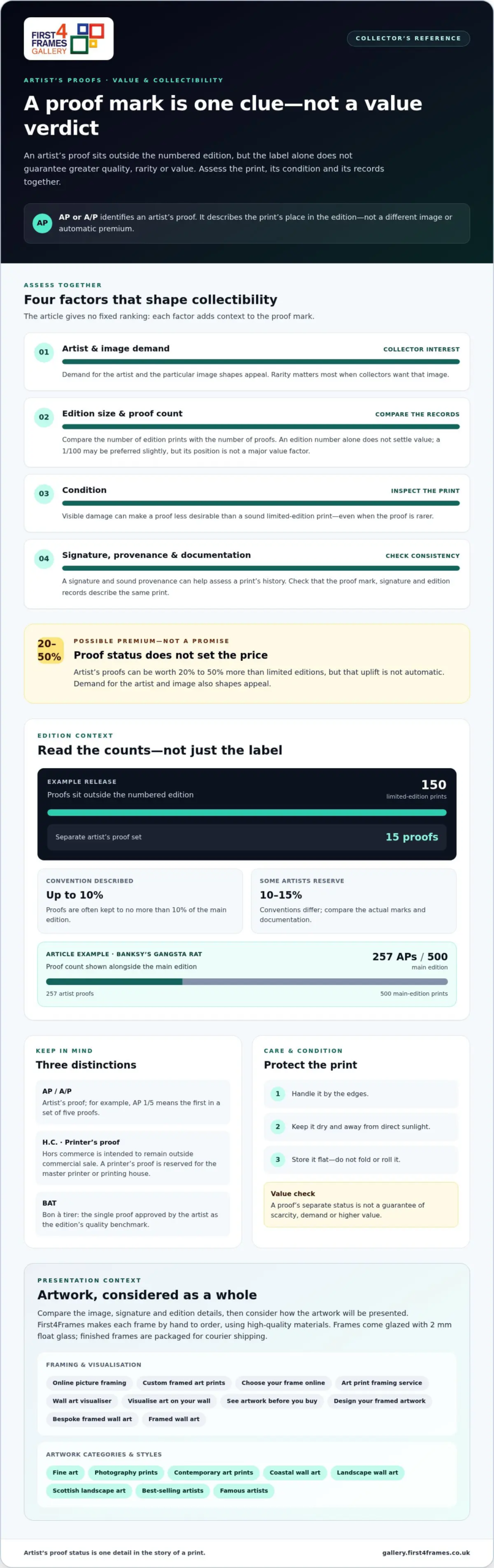
Choose by considering the artwork, the edition information and what you value as a collector, rather than assuming a proof is automatically superior. For example, a release could have 150 limited-edition prints and 15 artist’s proofs, with the proofs remaining outside the numbered edition. Conventions differ: proofs are often kept to no more than 10% of the main edition, while some artists reserve 10-15%. Compare the actual marks and documentation, then decide whether the proof’s separate status matters to you.
Print Quality and Edition Documentation
An artist’s proof is not necessarily higher in image or print quality than other impressions. Digital printing can produce proofs identical to other impressions, while traditional techniques may involve proofs used to assess colour before approval. Check that the label, signature and edition records describe the same print. A certificate of authenticity may accompany a proof, depending on when and how it was published, so treat it as supporting documentation rather than evidence of higher quality or value.
Factors affecting print value and collectibility
An artist’s proof can be sold or resold; its proof status alone neither prevents a sale nor sets a price. To care for one, handle it by the edges, keep it dry and away from direct sunlight, and store it flat rather than folding or rolling it.
Proof Value and Collector Demand
An artist’s proof may attract a premium, but demand for the artist and particular image also shapes its appeal. Proofs can be worth 20% to 50% more than limited editions, though that isn’t an automatic uplift. A signature and sound provenance can help collectors assess the print’s history.
Rarity and Collectibility
Rarity matters when collectors want a particular image, but an edition number alone doesn’t settle value. A numbered 1/100 may be preferred slightly, yet its position isn’t a major value factor. Compare the edition size and proof count: an edition of 30 prints may hold higher value than one of 200. A French term such as hors commerce describes a proof intended to remain outside commercial sale, not a guarantee of scarcity or demand.
Check for visible damage before judging collectibility. A damaged artist’s proof may be less desirable than a sound limited edition print, even if the proof is rarer. Also consider whether the image was reissued after an edition sold out; some artists have marked later prints as proofs, such as “Artist’s Proof no.8 of 50.” Banksy’s Gangsta Rat has 257 artist proofs against a main edition of 500, showing why proof counts matter alongside condition and edition records.
Compare the image, signature and edition details before choosing a print to live with. Explore fine art prints to consider how the artwork itself speaks to you.
Artist proof definitions and abbreviations
Proof marks identify a print’s role in an edition, but similar abbreviations can describe different roles. Read the letters alongside the artwork, signature and edition information.
Meaning of an Artist’s Proof
An artist’s proof is an impression set aside from an edition, traditionally for the artist’s personal use. It sits outside the numbered edition total, although it may show the same artwork as the edition prints. The label describes the print’s status, not a different image or an automatic change in quality.
A proof can be used to assess a print’s colour and quality before the main edition is approved. Today, they’re generally produced alongside it. Some are altered or hand-finished, but that isn’t true of every proof. Look closely at the print and its accompanying records to establish whether it’s identical to the edition or has a distinct finish.
Artist’s Proof Abbreviations
AP and A/P are common marks for an artist’s proof. Numbering may clarify the proof’s position: AP 1/5 means the first print in a set of five proofs. Some artists use Roman numerals to distinguish proof numbering from the main edition’s numbering, so read the notation as a whole.
Other marks point to different roles. A printer’s proof is reserved for the master printer or printing house. H.C., short for hors commerce, identifies a proof intended to remain outside commercial sale. A BAT, or bon à tirer, is the single proof approved by the artist as the edition’s quality benchmark. These distinctions matter: an AP is not interchangeable with a printer’s proof, H.C. print or BAT.
When reading a label, separate its letters from its numbers, then compare both with the signature and edition record. For instance, AP 1/5 describes a proof within a group of five, not the first print in the main edition. That small distinction helps collectors interpret what was produced and how the proof relates to the artwork.
Artist’s proofs compared with signed and numbered prints
A signature and an edition number describe different details from an artist’s proof mark. Limited-edition prints may be individually signed and numbered, while an artist’s proof is identified separately from the main edition. A proof may also be signed, so the artist’s signature alone doesn’t establish whether a print is an edition copy or a proof.
Consider two separate details when buying: what the number records and what the proof label identifies. A print marked 1/99 is the first print in an edition of 99; one marked 99/99 is the last. Neither position is inherently more valuable. By comparison, an AP mark identifies an artist’s proof, and some artists number proofs separately, such as AP 1/5.
Price and collectibility aren’t determined by proof status alone. Artist’s proofs may be more expensive than signed and numbered counterparts, but they’re not inherently more valuable. The artwork, condition, artist’s reputation and collector demand all contribute. For example, a damaged proof may be less desirable than a well-kept edition print. A low edition number can appeal to a buyer, yet it doesn’t automatically make that print more valuable.
Before choosing, compare the signature, edition number, proof notation and any accompanying documentation. Check that the description matches the marks on the print, then weigh the artwork’s condition and your own interest in the image. If you value a clearly defined place within the edition, a signed, numbered print may suit you. If a separately marked impression appeals more, consider its records and condition alongside the proof label.
Explore fine art prints and compare the images that speak to your collection.
First4Frames Gallery: Ready-to-Hang Framed Art
First4Frames Gallery offers Ready-to-Hang Framed Art, Custom Picture Framing and Giclée Fine Art Prints for artwork you’re ready to display. With online picture framing, you can choose your frame online from a wide selection and design framed artwork to suit your space. Frames are handmade for each individual order from high-quality materials, and come glazed with 2 mm float glass.
Choose bespoke framed wall art to complement fine art, coastal wall art, landscape wall art or Scottish landscape art. The gallery’s artwork range also includes contemporary art prints and photography prints. As you browse work from famous and best-selling artists, consider how to visualise art on your wall and see artwork before you buy. A wall art visualiser can help you picture the finished display; the art print framing service lets your chosen print take shape in a frame selected for it.
Finished frames are carefully packaged and shipped by courier. Browse fine art prints to explore artwork and framing choices.
Choose a Print That Belongs in Your Space
Understanding what an artist’s proof print represents can inform your choice, but the artwork’s connection to your space matters too. Think about the mood you want to create, the colours already in the room and the image you’ll enjoy seeing each day. A thoughtful choice can make a wall feel more personal and give your collection a natural next chapter.
Take time to explore images that hold your attention rather than choosing by a label alone. Notice which subjects you return to and how each print might sit within the room. That personal response can guide you towards a piece that feels at home in your space.
As you consider what belongs on your walls, browse the gallery’s fine art prints and let a favourite image shape your next step. The right print is one you’ll be glad to live with.
Frequently Asked Questions
How do I know how many versions of S/N’s or A/P’s there are?
Use the edition details and supporting records to distinguish the numbered run from artist’s proofs. The denominator in a mark such as 12/80 indicates an edition of 80 prints, while proof notation may show a separate proof count. Compare the print’s margin marks with its certificate, catalogue entry or publisher’s documentation. If records describe different totals, treat that mismatch as a reason to examine the print’s history more closely.
What Does This Mean When You’re Buying Art?
It means you can assess the print’s status separately from its appearance and personal appeal. Before buying, read the description alongside the marks on the print, then consider its condition, signature and accompanying paperwork. If you’re choosing between two impressions of the same artwork, for example, a proof label may matter to your collecting interests, but it doesn’t by itself establish better quality or greater desirability.
Which is Rarer?
Neither an artist’s proof nor a signed, numbered print is automatically rarer; compare the documented quantities for that specific artwork. Proof totals vary between artists and editions, and some artists produce only one proof. A small proof group can be scarcer than the main run, but rarity alone doesn’t establish collector demand. Consider how many were produced, whether the edition was reissued, and the condition of the individual print.
Will my Artist’s Proof be signed and numbered too?
An artist’s proof may be signed, but its numbering is usually separate from the main edition’s sequence. Look for a signature and a distinct proof mark rather than expecting a standard edition fraction beside it. For instance, an artist may identify a proof with Roman numerals while numbering edition prints with Arabic numerals. The exact format depends on the artist’s practice, so read the notation alongside its documentation.
What is an artist’s proof print?
An artist’s proof print is an impression set aside from the main numbered edition, often for the artist’s personal use. The term describes its relationship to the edition, not necessarily a change to the image. For a collector, the key is to interpret the proof mark alongside the artwork’s signature and records. That helps distinguish an artist’s proof from other specially marked prints.
How is an artist’s proof marked and numbered?
An artist’s proof is commonly marked AP or A/P, sometimes with its own proof sequence. A notation such as AP 1/5 indicates a position within a group of proofs, not the main edition. Some artists use Roman numerals instead. Check the front and margins for marks, then compare them with the accompanying paperwork, since abbreviations can identify different print roles.