Posted on

How to Start an Affordable Art Collection with Prints

How to Start an Affordable Art Collection with Prints

You don’t need to spend a lot to build a meaningful print collection. To learn how to start an affordable art collection, begin with work you genuinely enjoy, set a budget you can stick to and keep any certificate of authenticity or purchase documents you receive. These records can help preserve information about a print’s origins if you later sell or donate it.

Signed limited-edition prints can feel special because they belong to a defined print run, but edition size and a signature don’t determine whether a work deserves a place on your wall. An open-edition print can be just as personal. The right choice is the one that suits your taste and budget.

This guide will help you choose affordable prints, understand edition numbers and decide which paperwork to keep. You’ll also find practical ways to build a collection gradually, care for works on paper and consider framing, so each piece can become part of your home and your story.

Key Takeaways

  • Set a comfortable budget and choose prints for the connection you feel with the artwork, not just their potential future value.
  • Learn how open and limited editions differ, and what an edition number can tell you about a print.
  • Explore local galleries, open studios and degree shows to discover artists whose work could make your collection personal.
  • Keep certificates of authenticity and purchase records with the artwork, especially for signed limited-edition prints.

What is the difference between a limited edition and an open edition print?

  1. Know what you’re buying. An original is a unique artwork made by the artist; a print reproduces an image. A limited edition has a fixed print run, while an open edition has no set limit. For anyone learning how to start an affordable art collection, this distinction helps compare options without assuming one type is automatically better.
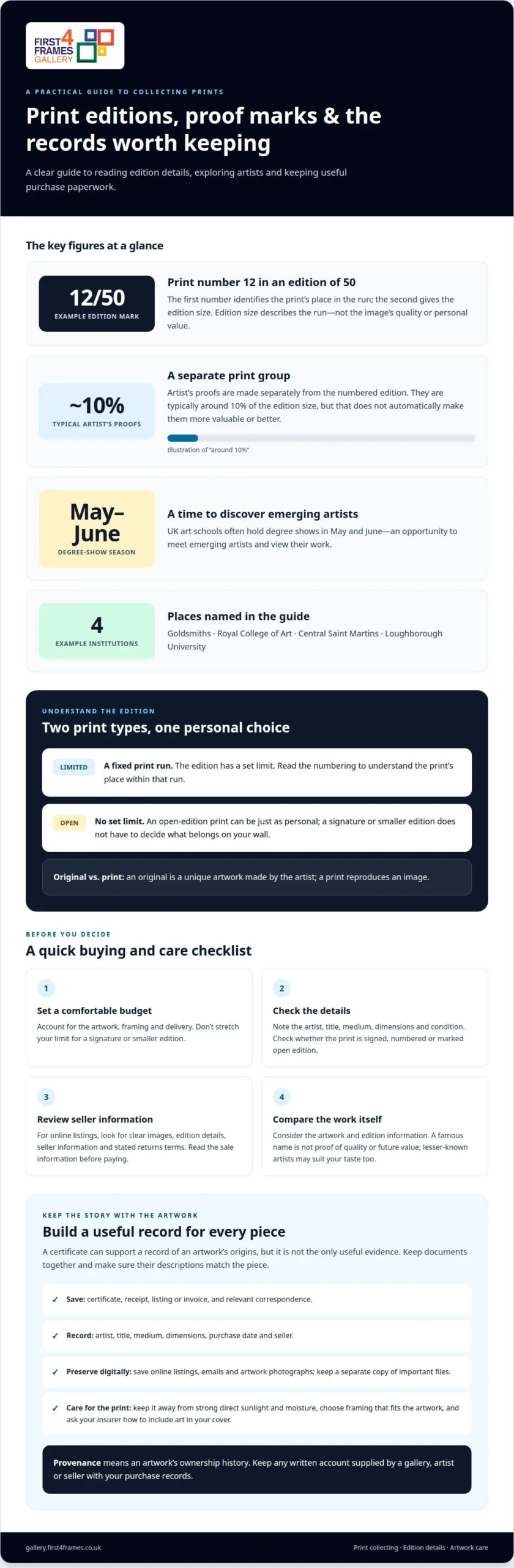
  2. Read the edition marking. A number such as 12/50 means the print is number twelve in an edition of fifty. Edition size describes the run, not the quality or personal value of the image. Ask what a listing’s numbering means if it’s unclear.
  3. Set a firm budget. Decide what you can comfortably spend before browsing, and account for framing and delivery as well as the artwork. Prints and editions can offer a more accessible route than original works, but don’t stretch your limit for a signature or smaller edition.
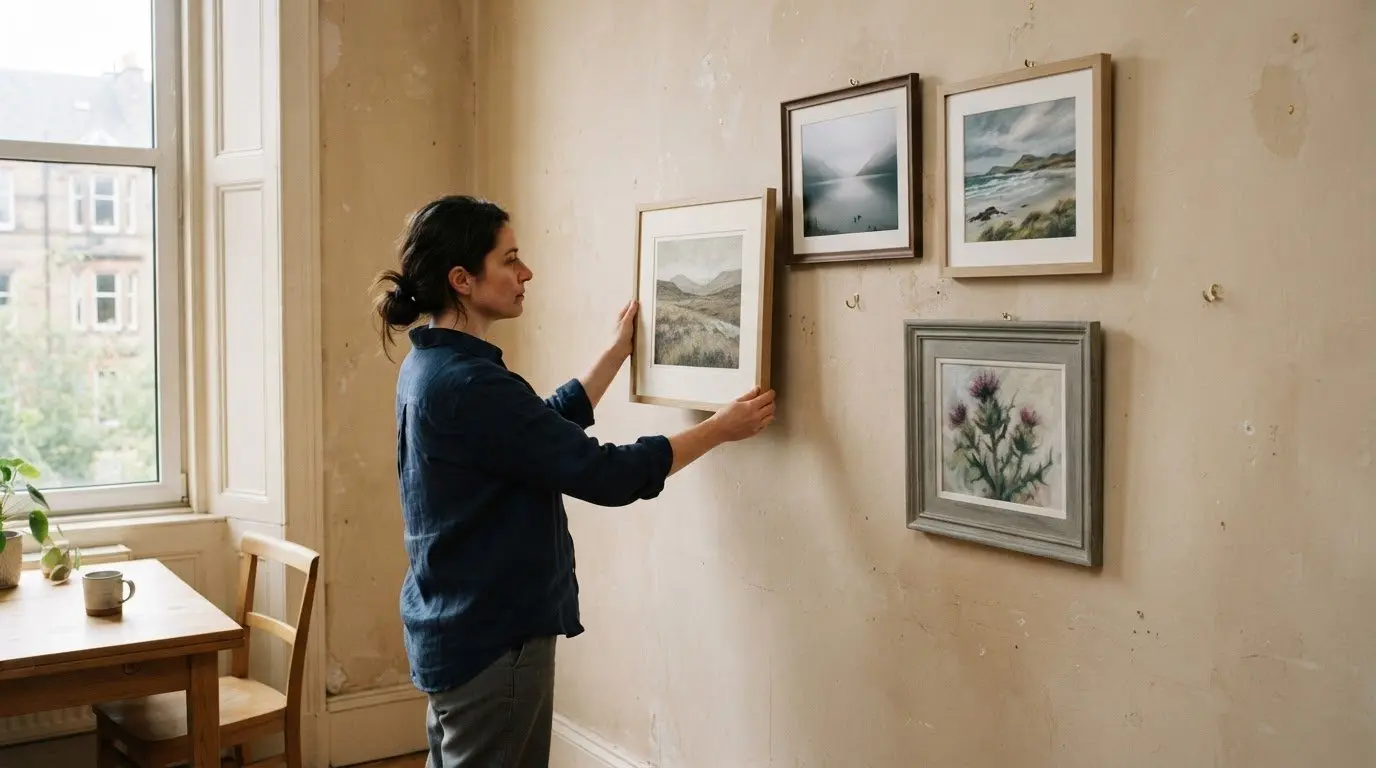
  4. Explore local galleries and art while travelling. Visit a nearby gallery to view a print in person and learn about its artist and edition. Artwork bought during a trip can become a memento of that place. Keep its receipt and any details supplied about the work.
  5. Consider prints by major artists. A larger-run print by a famous artist may be more accessible because more copies are produced. Compare the edition information and the work itself rather than treating a well-known name as proof of quality or future value. Contemporary art by lesser-known artists may also suit your taste.
  6. Assess online marketplaces. Look for clear images, named artists, edition details, seller information and stated returns terms. For UK purchases, the total may include applicable taxes, delivery or buyer fees; terms and consumer rights can depend on whether you buy from a trader or private seller. Read the sale information before paying.
  7. Plan for care and framing. Keep prints away from strong direct sunlight and moisture. Choose framing that fits the artwork, retain purchase records and ask your insurer how to include art in your cover. These practical steps support a collection as it grows.

A thoughtful approach to how to start an affordable art collection means weighing the print, seller and full purchase terms together before you decide.

Do I need a certificate of authenticity for an inexpensive print?

A certificate isn’t the only evidence of an inexpensive print’s origins. If one comes with the artwork, keep it with your receipt and any details identifying the artist, edition and seller.

  1. Check the artwork’s details. Before buying, note the artist’s name, title, medium, dimensions and condition. For a print, check whether it’s signed, numbered or marked as open edition. These details help distinguish one piece from another and make your purchase records more useful.
  2. Explore styles, not just famous names. Search for subjects, colours or techniques you enjoy, such as abstract landscapes or botanical works on paper. This can introduce you to an emerging artist whose pieces suit your home, without making reputation or current trends your only guide.
  3. Visit open studios and graduate shows. UK art schools often hold degree shows in May and June, giving visitors a chance to meet emerging artists and view their work. Graduate exhibitions at Goldsmiths, the Royal College of Art, Central Saint Martins and Loughborough University are useful places to discover new artwork.
  4. Understand print marks. An artist’s proof is a print made separately from the numbered edition; it isn’t automatically more valuable or better. Artist’s proofs are typically around 10% of the edition size. A blindstamp is an embossed mark pressed into the paper, which may identify an artist, publisher or print workshop.
  5. Keep a simple record. Store the certificate, receipt and any written description together, noting the purchase date and seller. If a print has no certificate, retain the information supplied with it instead. This record can help explain the artwork’s provenance if you later sell or donate it. Browse prints by artists to explore different styles as you shape your collection.
How to Start an Affordable Art Collection with Prints

Keeping certificates of authenticity

To reduce the risk of scams or overpaying, compare the artwork’s details, condition and price with similar works before buying. Ask for a clear description of its provenance, meaning its ownership history, and keep the seller’s written account with your purchase records.

  1. Keep each document with its artwork. Store the certificate, receipt, listing or invoice, and any correspondence together. Record the artist, title, medium, dimensions, purchase date and seller. For a painting, note any condition details included in the sale description.
  2. Read what the certificate actually says. A certificate may identify the artist, title, medium, edition or date. Check that its description matches the piece you bought. Treat it as supporting documentation, not a substitute for a clear purchase record or the artwork itself.
  3. Build a provenance trail. Keep earlier ownership information supplied by a gallery, artist or seller. For contemporary art, an exhibition history or gallery invoice can add useful context. If you later donate or sell a work, this paperwork helps explain its origins to the next owner.
  4. Preserve digital records. Save online listings, emails and photographs of the artwork in a folder named with the artist and title. Keep a separate copy of important files. This gives you a record if a marketplace listing disappears or your printed paperwork becomes separated from the piece.
  5. Compare before committing. Review works by the same artist with similar medium, size, edition and condition. At auctions, account for the stated sale terms and any charges shown before bidding. A low opening bid alone doesn’t establish an artwork’s fair value.
  6. Store paper documents carefully. Keep certificates and receipts flat, dry and away from direct sunlight. Place them separately from the artwork to avoid accidental marks or damage. For works on paper, retain any notes about framing or condition alongside the record, not against the print.

Collecting signed limited-edition prints

  1. Choose the image before the signature. A signature can add interest, but it doesn’t make a print meaningful by itself. Start with the subject, technique and colours you want to live with. A collection built around personal taste can include contrasting styles rather than following one narrow theme.
  2. Read the edition information closely. Check the edition size, print medium and whether the artist signed the print. Ask whether the signature appears directly on the sheet or within the printed image. Those details describe the specific work; they don’t guarantee future demand or value.
  3. Look at how the print was made. Techniques give prints different qualities. Bruce McLean’s Monica’s Walnut Sponge Cake is a 66 x 68 cm hand-painted silkscreen with collaged elements and glazes. Tracey Emin’s So I Left You is a 31 x 36 cm etching. Compare the medium and scale with your available display space.
  4. Buy for enjoyment, not investment alone. The future value of affordable art over ten years is highly uncertain. A limited edition may be more accessible than an original, but rarity doesn’t promise appreciation. Consider whether you would still value the print if its resale price never increased.
  5. Protect the work on paper. Prints can be fragile, so keep them away from direct light. Plan suitable framing and careful display before choosing where the artwork will hang. A well-considered presentation lets the print remain the focus while helping you enjoy it in your space.
  6. Make each purchase part of a considered collection. Compare the print’s subject, medium and edition details with works you already own. Choose quality and connection over accumulating pieces quickly. Explore Giclée fine art prints to discover artwork that could bring a new style or story into your collection.

First4Frames Gallery helps you shape a collection around the images and styles you enjoy. Explore Giclée Fine Art Prints and Ready-to-Hang Framed Art, from contemporary art prints to artwork inspired by coastal wall art, landscape wall art and Scottish landscape art. Whether you’re drawn to famous artists, best-selling artists or a distinctive new find, let your own taste lead.

Visualise art on your wall before choosing a piece, or use a wall art visualiser as a planning aid. For photography prints or other artwork you already own, Custom Picture Framing can help you design your framed artwork. Browse online picture framing options and choose your frame online to create custom framed art prints or bespoke framed wall art. An art print framing service can bring a considered finish to a piece, helping you see artwork before you buy it framed.

For ideas to begin or add to your collection, explore First4Frames Gallery’s selection of framed wall art and prints. Contact First4Frames Gallery for guidance with your choices.

Give your collection room to grow

Let your next print reflect how you want a room to feel. A single image can be the starting point for a personal collection, leaving room for new artists, subjects and styles to find their place over time. There’s no need to settle on a grand theme before you begin.

If you’re considering how to start an affordable art collection, make your next step simple: choose one piece you’d be glad to see every day. First4Frames Gallery brings together Giclée Fine Art Prints, Ready-to-Hang Framed Art and Custom Picture Framing, so you can explore artwork or consider a finish for a print you already own.

Contact First4Frames Gallery for print advice as you explore what could suit your space and collection.

Follow your curiosity, take your time and let each chosen work tell its own story.

Frequently Asked Questions

How is budget collecting different from art investing?

Budget collecting prioritises the pleasure and meaning you find in a work; art investing focuses on potential financial returns. Before buying, decide which purpose matters most to you. If you’re collecting for enjoyment, a print can earn its place through the memories, colours or ideas it brings to your home, regardless of its resale prospects.

How much money do I need to start collecting art?

There’s no fixed minimum: you can start with an amount that fits your finances. Set a limit before browsing, then consider the full cost of owning and displaying a piece, including framing and delivery where applicable. Starting with one work lets you discover what you enjoy before deciding whether to add more.

Need help investing in art?

First decide whether you want investment guidance or help choosing art for your home. First4Frames Gallery sells Giclée Fine Art Prints and offers Ready-to-Hang Framed Art and Custom Picture Framing, but these are not investment-advisory services. If financial returns are your main aim, research the risks independently and don’t rely on a print’s signature or edition size as a promise of future value.

Will the art I buy on a budget go up in value?

It might, but appreciation isn’t predictable. The future value of budget art over ten years is highly uncertain, and a famous name or limited edition doesn’t guarantee a higher resale price. Buy only what you can afford to keep and enjoy. Treat any future increase as a possibility, not the reason for your purchase.

How much does it cost to start an art collection in the UK?

The total depends on what you buy and how you choose to display it. An unframed print has different associated costs from an original painting or a ready-to-hang piece. Include framing, delivery and any auction charges listed in the sale terms when planning. A clear spending limit helps you compare the full outlay, not just the artwork.

Where can beginners buy affordable original art in the UK?

Look at local art fairs, open studios and galleries that show work by emerging artists. Buying directly from an artist can also give you the chance to hear how a piece was made and what inspired it. Ask for a receipt and a written description of the artwork, then keep them with your collection records.
Posted on

How to Protect and Clean a Limited Edition Art Print

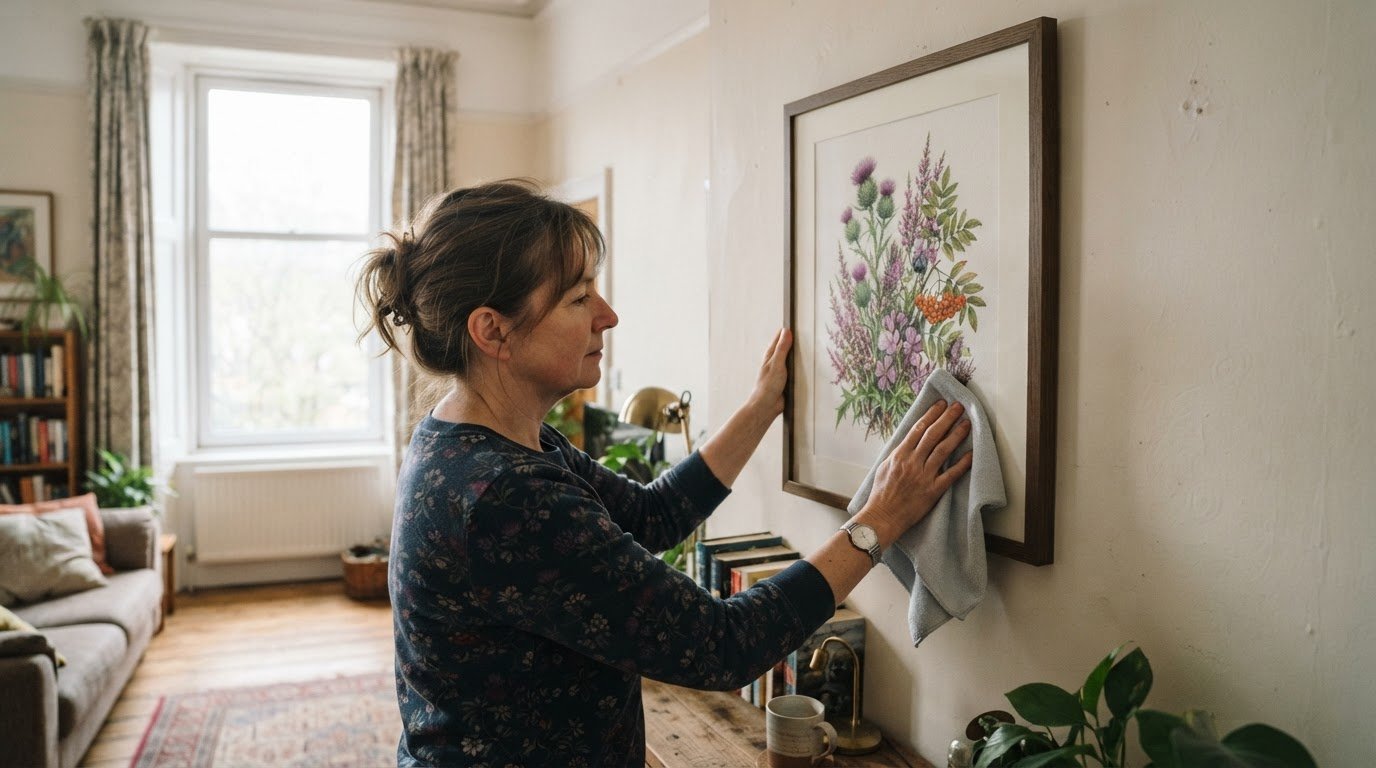
A homeowner gently cleans the glazing of a framed Scottish botanical Giclée print.

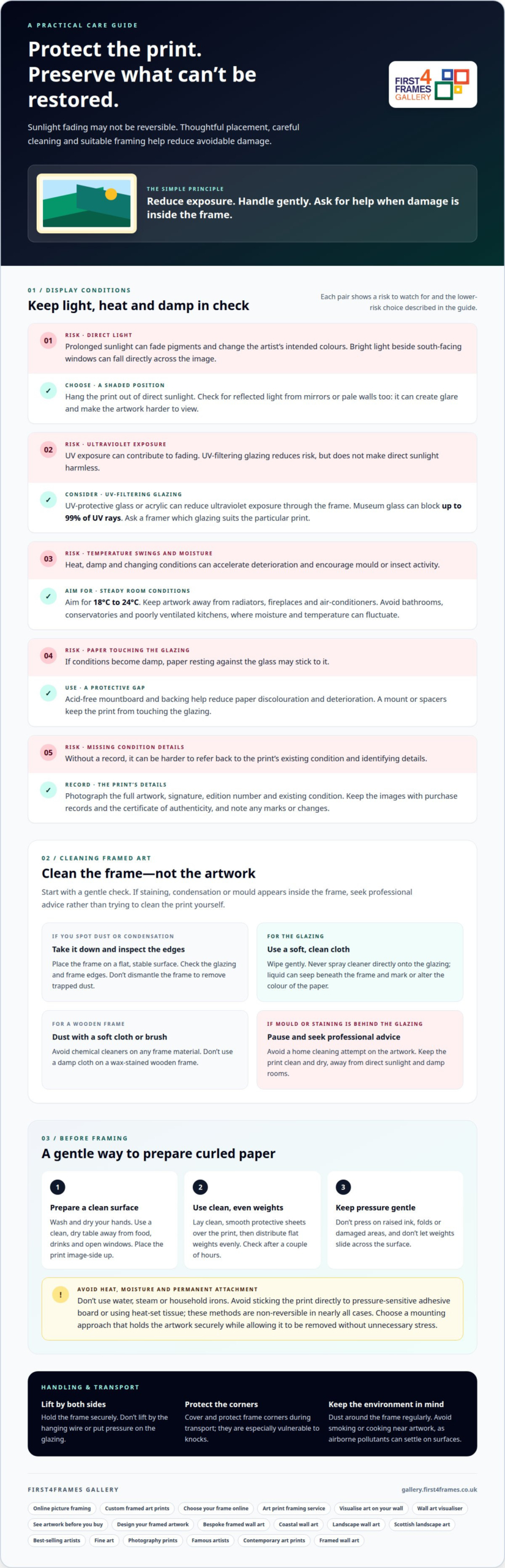
Once sunlight has faded a limited edition print, the change may not be restorable, so prevention matters. Caring for a limited edition art print means limiting direct sun and UV exposure, cleaning framed art gently, and handling the paper carefully before framing. A damaged print may not be recoverable, but thoughtful care can help reduce the risk of further harm.

It’s natural to want to keep a treasured print looking as close as possible to the day you bought it. A few careful choices make everyday care straightforward: position the artwork away from direct sunlight and heat, avoid spraying cleaner onto the glazing, and use clean weights to help flatten a print before framing. This guide explains how to protect your print from light, clean its frame and glazing safely, choose suitable glazing, and prepare curled paper for framing. It also explains when a mark or change inside the frame calls for professional advice rather than a home cleaning attempt.

Key Takeaways

  • Choose a display position away from direct sunlight and heat to help reduce fading and environmental damage.
  • Clean framed artwork carefully, using a gentle approach that protects both the glazing and the print.
  • Consider how glazing can help limit UV exposure, and keep the print from resting against it.
  • Handle curled paper gently and prepare it for framing with a simple, low-risk flattening method.

Protecting prints from sunlight and UV exposure

Sunlight, damp, heat and airborne pollutants can damage a print, while prolonged exposure to sunlight may cause fading that cannot be reversed. Reduce these risks by considering the artwork’s position, surroundings and framing materials.

  1. Choose a shaded position. Keep framed prints out of direct sunlight, especially beside south-facing windows where bright light falls across the image. Sunlight can gradually fade pigments and change the artist’s intended colours. Also check for reflected light from mirrors or pale walls, which can cause glare and make the print harder to view.
  2. Consider UV-filtering glazing. UV-protective glass or acrylic can reduce ultraviolet exposure through the frame. Museum glass can block up to 99% of UV rays. Ask your framer about glazing options for the particular print, and remember that UV-filtering glazing reduces risk rather than making direct sunlight harmless.
  3. Keep the print away from heat and damp. Aim for a steady room temperature of 18°C to 24°C. Hang artwork away from radiators, fireplaces and air-conditioners, where temperature changes or warm, moist air can accelerate deterioration and encourage mould or insect activity. Avoid bathrooms, conservatories and poorly ventilated kitchens, where moisture and temperature can fluctuate.
  4. Use suitable framing materials. Acid-free mountboard and backing help reduce paper discolouration and deterioration over time. A mount or spacers should keep the print from touching the glazing. This gap helps prevent the paper from sticking to the glass if conditions become damp.
  5. Record the print’s details for insurance. Photograph the artwork, signature, edition number and existing condition, then store the images with its purchase records and certificate of authenticity. Capture the full print as well as close-ups of the signature and numbering. Keep a separate written note of any marks or changes to provide a clear reference for future condition comparisons.

How do I clean framed art?

To help prevent foxing, mould and fading, keep prints clean and dry, away from direct sunlight and damp rooms. If you notice staining, condensation or mould inside a frame, seek professional advice promptly.

  1. Check for Dust, Condensation, and Mould

    Take the framed print down and place it on a flat, stable surface. Check the glazing and frame edges for dust or condensation, and look for signs of mould inside. Don’t dismantle the frame to remove trapped dust, as handling the print can cause damage. If you see staining or mould behind the glazing, get professional advice rather than trying to clean the artwork yourself.

  2. Clean Framed Prints with Glazing

    Wipe the glazing gently with a soft, clean cloth, and never spray cleaning products directly onto it. Liquid can seep beneath the frame and mark the paper or alter its colour. Dust a wooden frame with a soft cloth or brush, and avoid chemical cleaners on any frame material. For example, don’t use a damp cloth on a wax-stained wooden frame.

  3. Handle Prints to Avoid Damage

    Lift a framed piece by holding both sides securely, rather than gripping the hanging wire or placing pressure on the glazing. For transport, cover and protect the corners, which are especially vulnerable to knocks. If you’re checking a print’s size before choosing a frame, standard paper formats include A4 at 21 x 29.7 cm, A3 at 29.7 x 42 cm, and A2 at 42 x 59.4 cm.

  4. Prevent Foxing, Mould, and Fading

    Keep framed prints out of bathrooms and other damp spaces, where changing moisture and temperature can encourage deterioration. Dust around the frame regularly, and avoid smoking or cooking near artwork, as airborne pollutants can settle on surfaces. If you’re selecting artwork for a carefully planned display, browse prints for your space and consider how their position will protect them from dust and strong light.

How to Protect and Clean a Limited Edition Art Print

Flattening a print before framing

Before framing, let a curled print settle flat without adding moisture or forcing creases. Careful preparation and suitable materials help protect its surface over time.

  1. Prepare a clean, dry surface. Wash and dry your hands, then clear a flat table away from food, drinks and open windows. Place the print image-side up and check its edges and corners. Don’t use water, steam or household irons to relax the paper; moisture and heat can mark the image or change its shape.
  2. Flatten it gently with clean weights. Place clean, smooth protective sheets over the print, then lay flat, evenly distributed weights on top. Leave it for a couple of hours before checking whether it sits more evenly. Don’t press hard on raised ink, folds or damaged areas, and never let weights slide across the surface.
  3. Choose acid-free framing materials. Acid-free mountboard and backing help prevent paper discolouration and deterioration over time. A mount also creates space between the print and the glazing, so the image isn’t pressed directly against the glass. Choose a mount opening that supports the composition without covering important details or the artist’s signature.
  4. Avoid permanent attachment. Don’t stick a print directly onto pressure-sensitive adhesive board or use heat-set tissue. These methods are non-reversible in nearly all cases, which can complicate future framing or conservation. Instead, use a mounting approach that holds the artwork securely while allowing it to be removed without unnecessary stress.
  5. Plan archival or conservation-quality framing. For a print you value as an investment, consider the paper, mount, backing and glazing as one system. Archival materials and careful assembly help limit avoidable deterioration, but the right choices depend on the print’s condition and display environment. A professional framer can assess the paper and recommend a suitable, conservation-minded setup.

How should you handle a limited edition art print to avoid damage?

Careful handling reduces the chance of creases, scuffs and pressure marks. Follow these steps whenever you unwrap, move or store an unframed print.

  1. Prepare a clean workspace. Clear a flat surface before opening the packaging, and keep drinks, food and sharp objects away. Unwrap the artwork slowly, without dragging paper across the table or pulling at its edges. Keep the original packaging nearby to help protect the print during temporary storage or moving.
  2. Lift the print by its edges. Make sure your hands are clean and dry, then support the paper evenly rather than pinching one corner. Avoid touching the printed image, especially where ink may be vulnerable to friction. If you need to turn the sheet, support its full width to prevent it bending under its own weight.
  3. Transport it flat and protected. Place an unframed print between smooth card and acid-free tissue, then carry it in a portfolio or print-browser sleeve. Keep the package flat, and don’t put books or other objects on top. This protects the surface from rubbing and reduces the chance of creasing during a journey.
  4. Store it carefully between moves. Keep an unframed limited edition print flat whenever possible, in a dry place away from spills and damp. If rolling is unavoidable, store it horizontally in a dry environment, and avoid repeated rolling or prolonged tight-tube storage. These stresses can damage the surface, particularly silkscreen ink, by increasing the risk of micro-cracking.
  5. Protect framed artwork in transit. Keep framed works upright in storage, and don’t place them directly on concrete floors. During transport, cover the corners well because they’re especially vulnerable to knocks. Keep any certificate of authenticity in a polyester sleeve or separate file, not taped to the frame backing or placed behind the print. For a new piece, browse fine art prints and plan how you’ll handle it from unwrapping to display.

First4Frames Gallery offers Ready-to-Hang Framed Art, Custom Picture Framing and Giclée Fine Art Prints. Its handmade, bespoke framing gives custom framed art prints a considered finish, with frames made to order and glazed with 2 mm float glass. Explore Scottish landscape art, coastal wall art, contemporary art prints and more, then choose your frame online to create bespoke framed wall art that suits your space. For online picture framing, browse the collection to see artwork before you buy and design your framed artwork around a print you love.

Make space for your print to be enjoyed

A limited edition print deserves more than careful storage; it should also feel part of the room you’ve made your own. Think about the atmosphere you want it to create, the colours around it, and how you’ll enjoy seeing it each day. Caring for a limited edition art print can become a thoughtful habit, connecting its place in your home with the story that drew you to it.

As your collection grows, choose pieces that complement one another without losing their individual character. A landscape might bring a quieter mood to a reading corner, while a bold contemporary image can become the centre of a living space. Let your eye lead, and give each print room to be appreciated.

Ready to find a piece that feels right for your walls? Explore artwork and framing options, and take the next step towards making art part of your everyday surroundings. A little care helps your chosen print keep its place in the story of your home.

Frequently Asked Questions

Can a Damaged Print Be Restored?

Some print damage can be improved, but fading from prolonged sunlight may not be reversible. Caring for a limited edition art print means avoiding home remedies such as rubbing, erasers, water or household cleaners, which can lift ink or alter paper. If you notice a crease, stain or flaking area, stop handling the print and photograph it under even light for a paper conservator to assess.

Should You Store Prints Flat or Rolled?

Store unframed prints flat whenever possible, with clean, smooth protective sheets between them. Flat storage avoids repeated bending and pressure along a rolled edge. If rolling is necessary, keep the print horizontal in a dry environment and avoid tight, long-term tube storage. Repeated rolling can stress the surface and increase the risk of micro-cracking in silkscreen ink. Let a rolled print uncoil gradually before framing.

What If Dust Appears Inside the Frame?

Don’t open the frame just to remove trapped dust. Dismantling it can expose the print to handling damage and disturb its mount. Check the glazing for condensation, spots or visible mould without pressing against it. If you see staining, mould or condensation inside, seek professional advice promptly. Gently remove surface dust without taking the frame apart.

What Temperature and Humidity Are Best for Storing Art Prints?

Aim for 18°C to 24°C and relative humidity between 40% and 55% for art prints. Keep readings steady, rather than allowing conditions to swing between cold, damp air and warmth. A hygrometer near the storage area can help you spot recurring changes. If condensation regularly forms on nearby windows, move the prints to a more stable storage location.

How Should You Frame a Limited Edition Print Using Archival Materials?

Use acid-free mountboard and backing to help limit paper discolouration, and keep the print from touching the glazing with a mount or spacers. Choose a window opening that leaves the image, signature and edition number visible. Avoid pressure-sensitive adhesive boards and heat-set tissue, which are non-reversible in nearly all cases. Store the certificate of authenticity separately in a polyester sleeve or file.

Should Art Prints Be Displayed Behind UV-Protective Glass or Acrylic?

Yes. UV-filtering glass or acrylic helps reduce ultraviolet exposure; museum glass can block up to 99% of UV rays. Good habits for caring for a limited edition art print also include choosing a display position away from direct sunlight. Treat UV-protective glazing as one layer of protection, since it doesn’t make bright conditions harmless. Consider nearby windows and reflections when selecting the spot.

Posted on

4 Reasons Collectors Choose Limited Edition Prints

4 Reasons Collectors Choose Limited Edition Prints

A limited edition isn’t automatically a sound investment. Collecting limited edition prints as an investment can be a more accessible way to own an artist’s work, and a smaller edition may appeal to collectors. But rarity alone doesn’t ensure a rise in value. Weigh the artist’s appeal, edition details and the print’s long-term relevance.

It’s understandable to be drawn to a work you love while wondering whether it could also hold value. This guide explains how limited-edition prints compare with unique artworks, what affects their collectibility and investment potential, and why edition size is only part of the picture. It also considers affordability and long-term value, helping you judge a print not only by its prospects, but by whether you’ll still be glad to live with it years from now.

Key Takeaways

  • Consider prints as a more accessible way to collect art, while remembering that affordability alone doesn’t make a work a sound investment.
  • Look beyond edition size: an artist’s appeal, buyer interest and the print’s quality all help shape its collectibility.
  • Let personal connection guide your choices, and think about whether you’ll value the work over the long term.
  • Understand how limited and open editions differ from unique artworks before deciding what kind of piece belongs in your collection.

1. Affordability and diversification through prints

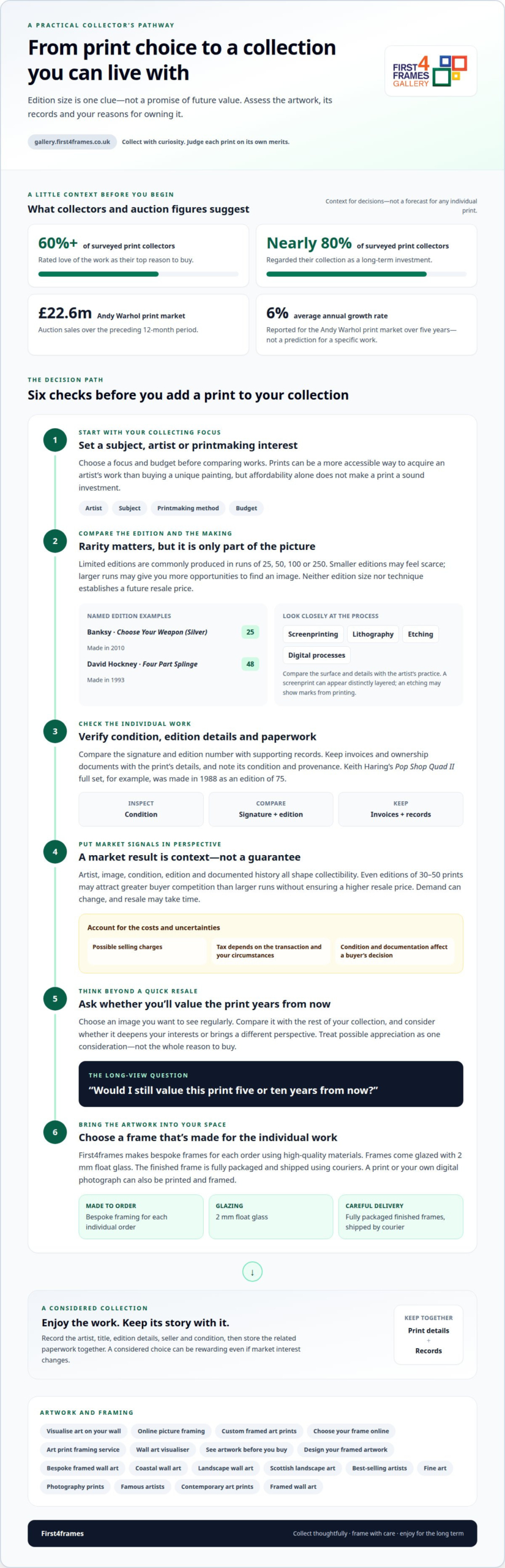
Prints can give collectors a way to acquire an artist’s work without buying a unique painting. Limited editions are commonly produced in runs of 25, 50, 100 or 250 copies. A smaller edition can feel scarce, while a larger run may offer more opportunities to find a particular image. The edition size helps you compare works, but it doesn’t establish a future resale price.

Technique also shapes what you’re buying. Limited-edition prints may be made using screenprinting, lithography, etching or high-quality digital processes. These methods produce different surfaces and details, so compare the image closely with the artist’s practice. A screenprint, for example, can have a distinctly layered appearance; an etching may reveal marks from the printing process. Choose a work for its qualities, not just its format.

Named examples show how editions differ. Banksy’s Choose Your Weapon (Silver) was made in 2010 as an edition of 25. David Hockney’s Four Part Splinge was made in 1993 as an edition of 48. These figures describe each work’s edition, not a guarantee of affordability or investment performance. Compare the artist, image, condition and edition together before deciding.

In the UK, auction purchases may include a buyer’s premium, while fees for private sales depend on the agreement. Tax on a later gain depends on the transaction and the collector’s circumstances. When estimating net proceeds, include possible selling charges and tax rather than comparing a resale figure with the original purchase price alone.

For diversification, consider how each print would sit alongside the rest of your collection. For example, a collector focused on landscape art might add a print by another artist or choose a different technique. This broadens the collection across subjects and creative approaches without assuming every work will rise in value. Set a budget, compare specific editions and prioritise pieces you’ll enjoy owning. That keeps affordability tied to a clear collecting plan, not the hope of a quick return.

2. Collectible value and investment potential

Recent UK auction results vary by print, condition, provenance and bidding. The Andy Warhol print market recorded £22.6 million in auction sales over the preceding 12-month period, with an average annual growth rate of 6% over five years. These figures provide market context, not a price prediction for an individual work.

To assess authenticity, compare the signature and edition number with supporting paperwork. Keep invoices and ownership records alongside the print’s details. Keith Haring’s Pop Shop Quad II full set, for example, was made in 1988 as an edition of 75. Clear documentation helps a buyer understand what the work is and where it came from.

Screenprinting, lithography, etching and digital processes can all produce collectible prints. Technique alone doesn’t determine value; the artist, image, condition, edition and documented history also matter. Keith Haring and Jean-Michel Basquiat, for example, made limited-edition prints, but a famous name alone doesn’t establish future demand. Assess the individual work, not just its creator.

Resale can take time because finding a buyer depends on demand for that particular artist and image. There’s no fixed timetable. Condition and documentation also affect a buyer’s decision, so don’t plan around an immediate sale. Anyone collecting limited edition prints as an investment should consider how long they can comfortably hold a work.

Risks include changing demand, speculative buying, condition problems and false claims about signatures or edition numbers. Editions of 30-50 prints may attract greater buyer competition than larger runs, but that doesn’t ensure a higher resale price. Approach collecting limited edition prints as an investment with close attention to the specific artwork, its records and your reasons for buying.

Begin with a collecting focus, such as an artist, subject or printmaking method. Set a budget, compare the work’s documentation and record its condition and purchase details. Ask yourself whether you’d still value the print five or ten years later. To explore artists and styles as you shape your collection, browse the art print gallery.

4 Reasons Collectors Choose Limited Edition Prints

3. Collector motivations and long-term investment

More than 60% of surveyed print collectors rated love of the work as their top reason to buy. That finding puts enjoyment at the centre of a durable collection, rather than treating each print as a short-term trade. Choose an image you want to see regularly, such as a coastal scene or bold abstract composition. Its place in your home also shapes its value.

Nearly 80% of surveyed print collectors regarded their collection as a long-term investment. That outlook suits patient ownership, where attention shifts from rapid resale to lasting relevance. Before buying, ask whether the artwork will still speak to you five or ten years from now. A print that fits your interests has meaning beyond a future sale.

A clear collecting focus can help turn individual purchases into a considered collection. For example, you might follow a particular subject, printmaking technique or period in an artist’s work. Compare each new piece with what you already own. Does it deepen that interest, introduce a different perspective or simply repeat an existing choice? This makes your selection more deliberate.

Keep a record for every print. Note the artist, title, edition details, purchase date, seller and condition, then store related paperwork together. These details help you understand what you own and provide useful context if you later review or sell the work. Consistent records also make it easier to compare new purchases with your original collecting aims.

Long-term ownership means paying attention to both the artwork and your reasons for choosing it. Revisit your collection periodically and consider whether each print still suits your tastes, space and collecting focus. A work that continues to engage you can remain rewarding even if market interest changes. Treat potential appreciation as one consideration, not the sole measure of a print’s worth.

4. How prints and editions differ from unique artworks as investments

A unique painting has no identical edition copies, while a print is part of a process that can produce multiple impressions. That difference affects scarcity, but doesn’t automatically determine market value. A print’s appeal still depends on its artist, image, condition, documentation and buyer demand. Compare these qualities before treating a print as equivalent to a one-off work.

A limited edition has a defined number of impressions. Once it sells out, no more prints can be made to that exact specification. An open edition, by contrast, can be reproduced without a set limit. This distinction can shape collectibility: a numbered edition offers a clearer boundary, while an open edition prioritises continued availability. Neither format guarantees future appreciation.

UK collectors can buy through established galleries, artists’ own sales channels and auction houses. For a specific print, favour a seller who provides a clear invoice and information about the artist, edition and provenance. Keep these records with the artwork. A signature or edition number matters most when it matches reliable documentation and the print’s known details.

Preservation affects a print’s condition, an important consideration for any future sale. Store unframed works flat in a clean, dry place, away from direct sunlight and damp. For display, choose a frame that fits the print properly and suitable glazing. Avoid placing framed art near heat or strong sunlight. Keep photographs, purchase records and condition notes together.

Insurance needs the same careful record-keeping. Retain purchase documents and current photographs, then review your home policy’s limits and requirements for valuable artwork. A print differs from a unique painting in scarcity, yet both need thoughtful care and clear ownership records. If you’re comparing editions and artists, explore the available art prints and consider which work suits your collection as well as your walls.

First4Frames Gallery offers Ready-to-Hang Framed Art, Custom Picture Framing and Giclée Fine Art Prints. Its frames are handmade for each order, use high-quality materials and come glazed with 2 mm float glass. For a print you already own, bespoke framing helps create a considered finish; for a new piece, choose from fine art and contemporary art prints.

Explore coastal wall art, landscape wall art and Scottish landscape art, or look for photography prints and works by best-selling artists and famous artists. As you choose, think about how to visualise art on your wall and design your framed artwork to suit your room. A wall art visualiser may help you see artwork before you buy. Online picture framing can make it easier to choose your frame online and consider custom framed art prints, bespoke framed wall art and framed wall art. Explore the art print framing service through the gallery.

Let your next choice reflect your taste

A thoughtful approach to collecting limited edition prints as an investment starts with a personal collecting principle. Decide what you want your collection to express, whether that’s a connection to a place, a distinctive visual style or an artist’s evolving practice. Let that principle guide your next choice instead of reacting to a trend or buying simply because an edition seems scarce.

Give the artwork room to become part of your everyday life. Consider where you’d display it, what you want to notice each time you see it and how it might sit alongside pieces you already value. Investment potential can inform your decision, but it shouldn’t replace your own judgement or enjoyment. Market interest can change, so think carefully before treating any print as a financial plan.

Ready to find a work that feels right for your collection? Explore the First4Frames Gallery and discover artwork that could bring a fresh perspective to your space. Choose with care, collect with curiosity, and let the art continue to reward your attention.

Frequently Asked Questions

Is it Worth Buying Limited Edition Prints in 2026?

Yes, a limited edition print can be worthwhile if you value the artwork and understand the uncertainty of resale. Treat it as a collectible you’re happy to own, not a dependable source of profit. Before buying, compare the artist’s work, the print’s condition and its supporting records, then decide whether the piece fits your budget and collecting interests.

How do limited edition prints compare with other art investments?

Prints offer a different balance of access and scarcity from unique paintings: an edition contains multiple impressions, while a unique work has no edition counterparts. Unlike financial assets, a print doesn’t generate income simply by being held. Selling also depends on finding a buyer for that particular artist and image, so weigh the enjoyment of ownership alongside resale prospects.

What factors determine the value of a limited edition print?

Value reflects the artist’s reputation, demand for the image, edition details, condition and documented ownership. A print with intact margins and clear records may be easier for a buyer to assess than one with damage or gaps in its history. Compare the exact title and edition, not just similar works by the same artist, before judging its appeal.

Which printmaking techniques and artists tend to retain value?

No printmaking technique or artist is guaranteed to retain value. Value depends on the specific artist and image, condition, edition, documentation and buyer demand. Technique alone and a famous name aren’t enough.

Posted on

Limited Edition Prints: Choose Duns, Stary Night for Connection, Not Scarcity

A whimsical night street scene inspired by "Duns, Stary Night," featuring vibrant blue and pink patterned houses, tall trees, cobblestone pavement, and a crescent moon in a dark, star-studded sky.

limited edition prints should answer a specific need in the room or for the buyer. Duns, Stary Night is a useful example because its stylised Scottish place, night-time character and Nikki Monaghan’s colour-led approach offer reasons to enjoy the work before edition scarcity is considered.

limited edition prints - Duns, Stary Night

Assess limited edition prints in the right order

  1. Start with the image. Would the place, mood and colour still appeal if the edition were not mentioned?
  2. Look at the artist. Read about Nikki Monaghan’s Scottish landscapes and layered materials.
  3. Confirm the product details. Check the edition information shown with the exact product before ordering.
  4. Plan the wall. Use the stated print dimensions and add the proposed mount and frame.
  5. Choose presentation for the artwork. Avoid a frame selected merely to make the piece look collectible.

Duns gives the work a particular Scottish identity, while the night setting shifts attention towards light and atmosphere. That can suit a snug, study or evening sitting room. Keep nearby lamps from reflecting directly in the glazing, and avoid surrounding the print with several unrelated limited editions simply to form a collection.

Does limited edition mean the artwork will rise in value?

No future value should be assumed. Buy the picture because the artist, subject and finished presentation deserve a place in your home. Treat scarcity as supporting information, not an investment promise.

If the piece is intended as a gift, explain the connection to Duns or to the artist in a separate card. That story will often matter more to the recipient than edition terminology on its own.

Protect the qualities that made the image matter

Limited status does not reduce the need for sound production. Colour-managed Giclée output supports Nikki Monaghan’s expressive colour, while accurate mounting and bespoke framing protect the physical print and give it a resolved place on the wall.

To understand the artist’s wider practice and Scottish inspirations, visit Nikki Monaghan’s official website. You can also browse the Nikki Monaghan collection or see the exact framed product.

Limited edition prints are most rewarding when scarcity follows genuine connection. Duns, Stary Night offers place, colour and artist identity first; verified edition details and a carefully made frame complete the decision.

Posted on

Artist’s Proof Prints: How They Differ and What Affects Value

Artist's Proof Prints: How They Differ and What Affects Value

An artist’s proof isn’t automatically more valuable than a signed, numbered print. If you’re asking what an artist’s proof print is, it’s a copy set apart from the main numbered edition, traditionally kept by the artist and often marked AP or A/P. The label signals its place in the edition, not a guarantee of greater quality or value.

It’s easy to assume that a rarer-sounding label means a better investment, but collectibility depends on more than the proof mark. This guide explains what an artist’s proof print is, how it differs from a limited edition, and how factors such as rarity, condition and the artist’s reputation can influence value. You’ll also see why a proof and a signed, numbered print may appeal to collectors for different reasons, helping you assess the artwork as well as the notation on its margin.

Key Takeaways

  • Compare an artist’s proof with the main edition by its numbering and how it was issued, not by the label alone.
  • Learn to distinguish AP or A/P marks from printer’s proofs, hors commerce proofs and a bon à tirer proof.
  • Look beyond rarity when assessing collectibility: condition, edition size and the artist’s work all matter.
  • Weigh a proof against signed, numbered prints on its own merits; neither the proof status nor a low edition number guarantees higher value.

What is the difference between a Limited Edition Print and an Artist’s Proof?

A limited edition print belongs to a fixed quantity, while an artist’s proof sits outside its numbered edition. For UK buyers and sellers, clear descriptions should distinguish AP or A/P marks from edition numbering and match any certificate or edition record to the print.

Differences from Limited-Edition Prints

A limited edition print is one of a set quantity, while an artist’s proof is a separate copy associated with that edition. An edition print marked 25/150 is number 25 in a 150-print edition; an artist’s proof is not counted as one of those 150. Proofs were traditionally retained by artists to assess colour and quality, but modern proofs are generally produced alongside the main edition. The distinction matters because the proof mark describes its status, not a different image.

Choosing Between Proofs and Editions

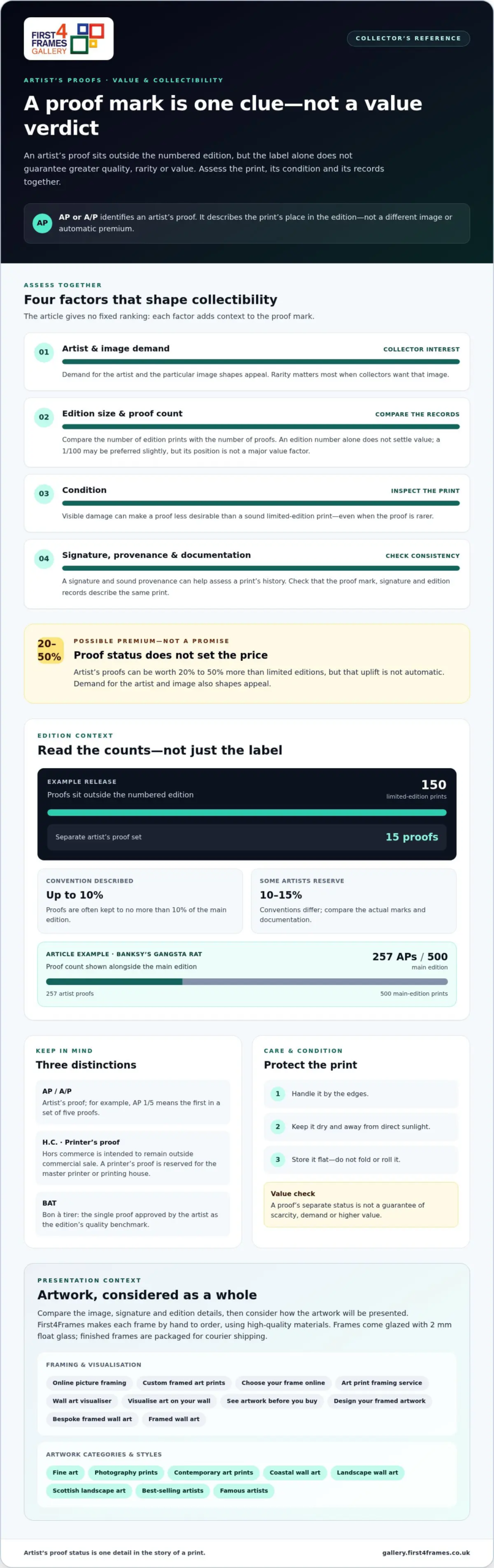
Choose by considering the artwork, the edition information and what you value as a collector, rather than assuming a proof is automatically superior. For example, a release could have 150 limited-edition prints and 15 artist’s proofs, with the proofs remaining outside the numbered edition. Conventions differ: proofs are often kept to no more than 10% of the main edition, while some artists reserve 10-15%. Compare the actual marks and documentation, then decide whether the proof’s separate status matters to you.

Print Quality and Edition Documentation

An artist’s proof is not necessarily higher in image or print quality than other impressions. Digital printing can produce proofs identical to other impressions, while traditional techniques may involve proofs used to assess colour before approval. Check that the label, signature and edition records describe the same print. A certificate of authenticity may accompany a proof, depending on when and how it was published, so treat it as supporting documentation rather than evidence of higher quality or value.

Factors affecting print value and collectibility

An artist’s proof can be sold or resold; its proof status alone neither prevents a sale nor sets a price. To care for one, handle it by the edges, keep it dry and away from direct sunlight, and store it flat rather than folding or rolling it.

Proof Value and Collector Demand

An artist’s proof may attract a premium, but demand for the artist and particular image also shapes its appeal. Proofs can be worth 20% to 50% more than limited editions, though that isn’t an automatic uplift. A signature and sound provenance can help collectors assess the print’s history.

Rarity and Collectibility

Rarity matters when collectors want a particular image, but an edition number alone doesn’t settle value. A numbered 1/100 may be preferred slightly, yet its position isn’t a major value factor. Compare the edition size and proof count: an edition of 30 prints may hold higher value than one of 200. A French term such as hors commerce describes a proof intended to remain outside commercial sale, not a guarantee of scarcity or demand.

Check for visible damage before judging collectibility. A damaged artist’s proof may be less desirable than a sound limited edition print, even if the proof is rarer. Also consider whether the image was reissued after an edition sold out; some artists have marked later prints as proofs, such as “Artist’s Proof no.8 of 50.” Banksy’s Gangsta Rat has 257 artist proofs against a main edition of 500, showing why proof counts matter alongside condition and edition records.

Compare the image, signature and edition details before choosing a print to live with. Explore fine art prints to consider how the artwork itself speaks to you.

Artist proof definitions and abbreviations

Proof marks identify a print’s role in an edition, but similar abbreviations can describe different roles. Read the letters alongside the artwork, signature and edition information.

Meaning of an Artist’s Proof

An artist’s proof is an impression set aside from an edition, traditionally for the artist’s personal use. It sits outside the numbered edition total, although it may show the same artwork as the edition prints. The label describes the print’s status, not a different image or an automatic change in quality.

A proof can be used to assess a print’s colour and quality before the main edition is approved. Today, they’re generally produced alongside it. Some are altered or hand-finished, but that isn’t true of every proof. Look closely at the print and its accompanying records to establish whether it’s identical to the edition or has a distinct finish.

Artist’s Proof Abbreviations

AP and A/P are common marks for an artist’s proof. Numbering may clarify the proof’s position: AP 1/5 means the first print in a set of five proofs. Some artists use Roman numerals to distinguish proof numbering from the main edition’s numbering, so read the notation as a whole.

Other marks point to different roles. A printer’s proof is reserved for the master printer or printing house. H.C., short for hors commerce, identifies a proof intended to remain outside commercial sale. A BAT, or bon à tirer, is the single proof approved by the artist as the edition’s quality benchmark. These distinctions matter: an AP is not interchangeable with a printer’s proof, H.C. print or BAT.

When reading a label, separate its letters from its numbers, then compare both with the signature and edition record. For instance, AP 1/5 describes a proof within a group of five, not the first print in the main edition. That small distinction helps collectors interpret what was produced and how the proof relates to the artwork.

Artist's Proof Prints: How They Differ and What Affects Value

Artist’s proofs compared with signed and numbered prints

A signature and an edition number describe different details from an artist’s proof mark. Limited-edition prints may be individually signed and numbered, while an artist’s proof is identified separately from the main edition. A proof may also be signed, so the artist’s signature alone doesn’t establish whether a print is an edition copy or a proof.

Consider two separate details when buying: what the number records and what the proof label identifies. A print marked 1/99 is the first print in an edition of 99; one marked 99/99 is the last. Neither position is inherently more valuable. By comparison, an AP mark identifies an artist’s proof, and some artists number proofs separately, such as AP 1/5.

Price and collectibility aren’t determined by proof status alone. Artist’s proofs may be more expensive than signed and numbered counterparts, but they’re not inherently more valuable. The artwork, condition, artist’s reputation and collector demand all contribute. For example, a damaged proof may be less desirable than a well-kept edition print. A low edition number can appeal to a buyer, yet it doesn’t automatically make that print more valuable.

Before choosing, compare the signature, edition number, proof notation and any accompanying documentation. Check that the description matches the marks on the print, then weigh the artwork’s condition and your own interest in the image. If you value a clearly defined place within the edition, a signed, numbered print may suit you. If a separately marked impression appeals more, consider its records and condition alongside the proof label.

Explore fine art prints and compare the images that speak to your collection.

First4Frames Gallery offers Ready-to-Hang Framed Art, Custom Picture Framing and Giclée Fine Art Prints for artwork you’re ready to display. With online picture framing, you can choose your frame online from a wide selection and design framed artwork to suit your space. Frames are handmade for each individual order from high-quality materials, and come glazed with 2 mm float glass.

Choose bespoke framed wall art to complement fine art, coastal wall art, landscape wall art or Scottish landscape art. The gallery’s artwork range also includes contemporary art prints and photography prints. As you browse work from famous and best-selling artists, consider how to visualise art on your wall and see artwork before you buy. A wall art visualiser can help you picture the finished display; the art print framing service lets your chosen print take shape in a frame selected for it.

Finished frames are carefully packaged and shipped by courier. Browse fine art prints to explore artwork and framing choices.

Choose a Print That Belongs in Your Space

Understanding what an artist’s proof print represents can inform your choice, but the artwork’s connection to your space matters too. Think about the mood you want to create, the colours already in the room and the image you’ll enjoy seeing each day. A thoughtful choice can make a wall feel more personal and give your collection a natural next chapter.

Take time to explore images that hold your attention rather than choosing by a label alone. Notice which subjects you return to and how each print might sit within the room. That personal response can guide you towards a piece that feels at home in your space.

As you consider what belongs on your walls, browse the gallery’s fine art prints and let a favourite image shape your next step. The right print is one you’ll be glad to live with.

Frequently Asked Questions

How do I know how many versions of S/N’s or A/P’s there are?

Use the edition details and supporting records to distinguish the numbered run from artist’s proofs. The denominator in a mark such as 12/80 indicates an edition of 80 prints, while proof notation may show a separate proof count. Compare the print’s margin marks with its certificate, catalogue entry or publisher’s documentation. If records describe different totals, treat that mismatch as a reason to examine the print’s history more closely.

What Does This Mean When You’re Buying Art?

It means you can assess the print’s status separately from its appearance and personal appeal. Before buying, read the description alongside the marks on the print, then consider its condition, signature and accompanying paperwork. If you’re choosing between two impressions of the same artwork, for example, a proof label may matter to your collecting interests, but it doesn’t by itself establish better quality or greater desirability.

Which is Rarer?

Neither an artist’s proof nor a signed, numbered print is automatically rarer; compare the documented quantities for that specific artwork. Proof totals vary between artists and editions, and some artists produce only one proof. A small proof group can be scarcer than the main run, but rarity alone doesn’t establish collector demand. Consider how many were produced, whether the edition was reissued, and the condition of the individual print.

Will my Artist’s Proof be signed and numbered too?

An artist’s proof may be signed, but its numbering is usually separate from the main edition’s sequence. Look for a signature and a distinct proof mark rather than expecting a standard edition fraction beside it. For instance, an artist may identify a proof with Roman numerals while numbering edition prints with Arabic numerals. The exact format depends on the artist’s practice, so read the notation alongside its documentation.

What is an artist’s proof print?

An artist’s proof print is an impression set aside from the main numbered edition, often for the artist’s personal use. The term describes its relationship to the edition, not necessarily a change to the image. For a collector, the key is to interpret the proof mark alongside the artwork’s signature and records. That helps distinguish an artist’s proof from other specially marked prints.

How is an artist’s proof marked and numbered?

An artist’s proof is commonly marked AP or A/P, sometimes with its own proof sequence. A notation such as AP 1/5 indicates a position within a group of proofs, not the main edition. Some artists use Roman numerals instead. Check the front and margins for marks, then compare them with the accompanying paperwork, since abbreviations can identify different print roles.

Posted on

Understanding Art Print Edition Numbers: A Clear, Practical Guide

Understanding Art Print Edition Numbers: A Clear, Practical Guide

A lower number on an art print doesn’t automatically make it better or more valuable. If you’ve looked at a mark such as 7/50 and wondered what the two numbers mean, you’re not alone. Understanding art print edition numbers starts with separating what the mark records from what it can’t tell you: the first number usually identifies the print’s place in the edition, while the second gives the edition’s stated size. Practices vary, so the surrounding artwork information matters too.

This guide explains how to read the numerator and denominator, what edition size tells you, and how limited editions differ from open editions. You’ll also learn why a number alone can’t establish a print’s quality or value, and which other details to consider when choosing artwork. With a clearer picture of the edition, you can explore fine art prints with more confidence and plan how the artwork will look in your home.

Key Takeaways

  • Understanding art print edition numbers helps you interpret edition details, but the number isn’t a measure of quality or value.
  • Distinguish limited editions from open editions, and remember that different sizes or print processes may have separate edition counts.
  • Read edition numbers alongside other artwork details. Signatures and proof marks provide different information, and conventions can vary.
  • Choose artwork that speaks to you, then use edition details as context while exploring themes such as Scottish landscape art, coastal wall art and contemporary art prints.

What Do Art Print Edition Numbers Mean? Read the Mark at a Glance

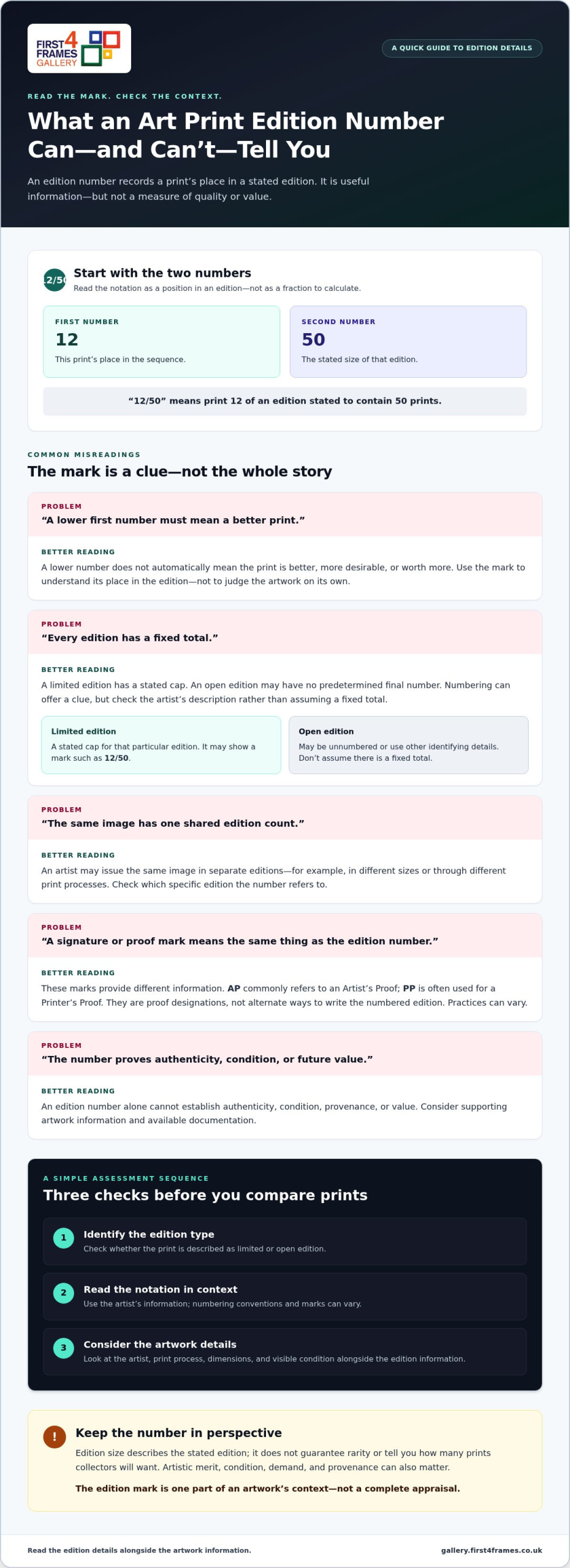
Edition numbers identify a print’s position within a stated edition. A mark such as 12/50 commonly means that the print is number 12 in an edition of 50. The first number identifies its place in the sequence; the second gives the stated edition size.

Edition size is the total number of prints stated as belonging to a particular edition. It describes the edition, but doesn’t guarantee rarity or tell you how many prints collectors will want. A lower first number doesn’t automatically mean the print is better, more desirable or worth more. Understanding art print edition numbers helps you read the notation, not judge the artwork by the mark alone.

How to read a number such as 12/50

If a print is numbered 12/50, read it as “print 12 of an edition stated to contain 50 prints”, not as a fraction to calculate. The artist’s information provides the best context for interpreting the number. If the mark is unclear or uses a different format, look for the accompanying artwork details rather than assuming the usual convention applies.

Where edition details may appear

Numbering is often written in the print’s margin, the unprinted border around the image. Edition information may also appear on an accompanying label, certificate or artwork description. Signatures and other marks are separate details. For example, an Artist’s Proof is a distinct printmaking designation, not another way of writing the edition fraction.

Artists and printmaking practices vary, so the placement, wording and marks aren’t universal. Read the number alongside the artist’s description to understand what the stated edition covers. This provides useful context, while print quality and personal appeal should be considered on their own merits.

Limited Edition vs Open Edition Prints: What the Number Tells You

A limited edition has a stated cap for that particular edition. An open edition may have no predetermined final number, so it can be produced without the same declared limit. Numbering can offer a clue, but the artist’s description is important because practices and ways of presenting edition details vary.

Edition type
Numbering clue
Sensible interpretation
Limited edition
May show a fraction such as 12/50
The stated edition has a defined cap
Open edition
May be unnumbered, or use other identifying details
Don’t assume there’s a fixed total

Does a smaller edition mean a more valuable print?

Not by itself. A smaller edition may mean fewer prints were made in that particular run, but scarcity is only one part of a print’s context. Artistic merit, condition, demand and provenance can all matter. No edition number guarantees authenticity or future resale value. Christie’s collecting guide offers further context on prints and multiples, including the idea of an original print. Treat the edition mark as useful information, not a promise of price.

Can one artwork have more than one edition?

Yes. An artist may issue the same image in separate editions, for example in different sizes or through different print processes. Don’t assume that the numbers belong to one shared count. Check the details for the specific print to see which edition its number refers to.

Once you understand what an edition label can tell you, explore artwork that suits your space and taste in the online art print gallery.

Understanding Art Print Edition Numbers: A Clear, Practical Guide

How to Assess Art Print Edition Details Before You Choose

Use this sequence to assess edition information without reading too much into the number:

  • Identify the edition type. Check whether the print is described as limited or open edition.
  • Read the notation. Interpret the number using the artist’s information, rather than assuming every mark follows the same convention.
  • Check the artwork details. Consider the artist, print process, dimensions and visible condition alongside the edition information.

Signatures, proof marks and edition numbers are different details. A signature may identify or be attributed to the artist, while a proof mark describes a print’s relationship to the edition or production process. Their use can vary between artists and printmaking practices. Christie’s collecting guide offers further background on limited editions and how prints are made.

What do AP, PP or other proof marks mean?

AP commonly refers to an Artist’s Proof, while PP is often used for a Printer’s Proof. These are proof designations, not alternative ways of writing the numbered edition. Interpret them alongside the specific artwork information. Their meanings, use and numbering practices can differ, so don’t assume a universal quantity or significance from the letters alone.

What edition numbers cannot prove on their own

An edition number by itself doesn’t establish authenticity, condition, provenance or value. It tells you something about a print’s place in a stated edition, but it can’t provide a complete account of the artwork. Look for supporting information that identifies the artist, process and edition, and consider any available documentation. This broader context makes understanding art print edition numbers more useful when comparing prints.

An edition number is one part of an artwork’s context, not a complete appraisal. Keep that in mind as you browse the art print and framed art gallery, weighing the edition details alongside the image that feels right for your space.

Choose and Display an Art Print with Confidence

Choose a print because you enjoy looking at it, then use its edition details as context. Understanding the number can inform your decision, but it needn’t outweigh the image or how it will look in your home. Explore fine art, Scottish landscape art, coastal wall art, photography prints and contemporary art prints. A wall art visualiser can help you visualise art on your wall and see artwork before you buy.

Pair a print with a considered frame

A well-chosen frame completes an artwork’s presentation without changing what its edition number means. First4Frames Gallery creates bespoke framed wall art, with each frame individually crafted to order from high-quality materials. Unlike cheap, standard frames that may not fit artwork properly, a bespoke frame is made for the individual order. With Online picture framing, you can Choose your frame online and Design your framed artwork to suit the print and your space. The Art print framing service uses 2mm float glass, offering superior clarity to the perspex used by many competitors.

Explore artwork and plan the finished display

Browse an extensive online selection of artwork and frames, including framed wall art featuring works by best-selling artists and famous artists. Find Custom framed art prints and consider how the frame will complement the image. For digital photographs, the online photo printing and framing service combines high-quality printing with bespoke framing. Finished framed orders are fully packaged to help prevent damage and shipped via professional couriers.

Explore the framed art and print gallery to find an image that feels right for your space.

Choose a Print That Feels Right for Your Space

Understanding art print edition numbers gives you a useful starting point: the first figure commonly shows a print’s position, while the second indicates the stated edition size. The mark alone doesn’t prove a print’s quality, authenticity or future value. Read it alongside the artwork information, and remember that edition practices can vary.

Use those details as context, then let the image, artist and the way it will look in your home guide your choice. First4Frames Gallery offers Giclée fine art prints from a range of artists, primarily from Scotland, with bespoke frames individually crafted for each order using high-quality materials. Thoughtful framing helps the chosen artwork feel at home on your wall.

Ready to find an image that speaks to you? Explore framed art prints in the gallery and discover artwork you’ll be glad to display.

Frequently Asked Questions

What does 12/50 mean on an art print?

12/50 commonly means print number 12 in a stated edition of 50. The first number identifies the print’s place in the edition, and the second gives the edition size. Read the notation alongside the artist’s description because numbering practices can vary. The mark provides edition context, but it doesn’t by itself tell you about the print’s quality or value.

Is a lower-numbered art print more valuable?

No. A lower number doesn’t automatically make a print more valuable. A number such as 2/50 records its position in the edition, not its quality or desirability compared with 28/50. Value can depend on factors such as the artist, demand, condition and provenance. Treat the number as one piece of information, not a guarantee of a particular price or future resale value.

What is the difference between a limited edition and an open edition print?

A limited edition has a stated cap for that particular edition. An open edition may not have a predetermined total, so it can be produced without the same declared limit. The artwork’s description should clarify which type it is. Artists may also issue separate editions for different sizes or print processes, so don’t assume all versions share one edition count.

Do all art prints have edition numbers?

No, not all art prints are numbered. Open editions may be unnumbered, and artists or printmaking practices can use different ways to identify a work. You may find information in an artwork description or accompanying documentation instead. If a print has no edition number, that alone doesn’t establish its quality, authenticity or value. Consider the artwork details as a whole.

What does AP mean beside an art print edition number?

AP commonly stands for Artist’s Proof, a proof designation associated with the artist and distinct from the numbered edition. It may appear beside a print rather than as a fraction such as 12/50. Proof practices and meanings can vary by artist and print process, so interpret the mark using the accompanying artwork information. An AP mark alone doesn’t prove greater quality or value.

Posted on

Limited Edition Prints Feel More Liveable With Boats at Tobermory

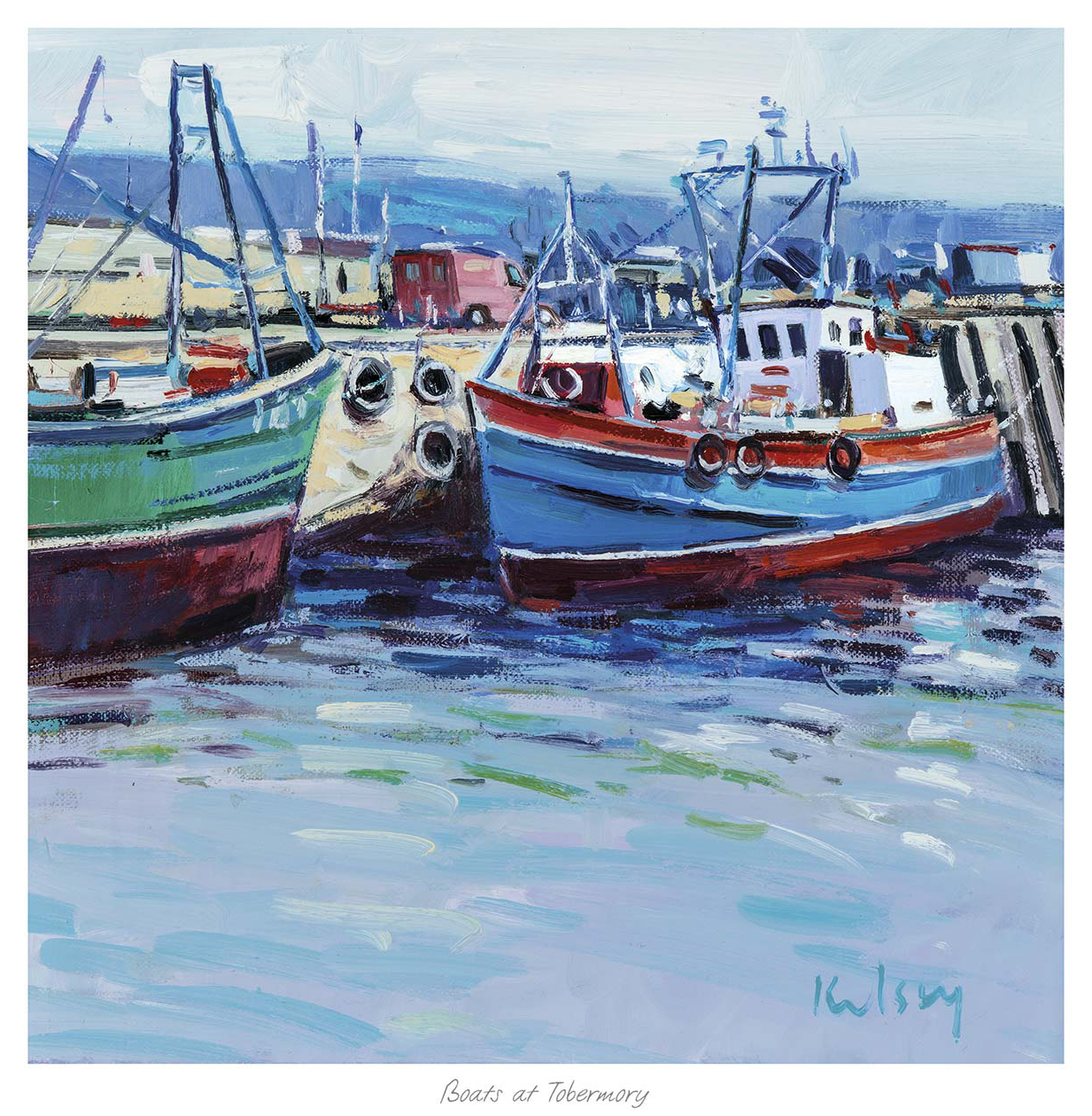
Boats at Tobermory captures colorful boats docked in a harbor with calm blue water, a pier, and buildings in the background, all depicted in a vibrant, impressionistic style.

Many buyers want limited edition prints that feel special without becoming intimidating to live with. Boats at Tobermory is a strong example, bringing collectable appeal together with colour, warmth, and a more welcoming everyday character.

limited edition prints - Boats at Tobermory

Why Boats at Tobermory makes limited edition prints feel easier to place

Some limited edition work can feel too formal for relaxed family spaces. Boats at Tobermory takes a friendlier route. The harbour setting is lively and recognisable, while the composition still feels measured enough for kitchens, dining rooms, home offices, or living rooms that need a little more colour and local character.

  • It offers collectable quality without losing warmth.
  • It works particularly well where a room needs brighter colour and structure.
  • It makes a good choice for buyers who want a piece to feel both special and welcoming.

At First 4 Frames, the print and framing are completed in-house with bespoke craftsmanship and colour-managed Giclee production. That finish matters for limited edition work, because customers expect both the image and the presentation to feel carefully judged, superior in quality, and ready to hang with confidence.

For more on the colourful harbour town behind the scene, VisitScotland on Tobermory is a useful resource. You can also browse more work by Robert Kelsey and view the exact framed product here.

If you are comparing limited edition prints and want something more welcoming than stern, Boats at Tobermory is an excellent place to start.

Posted on

Why Blue Romance Stands Out Among Limited Edition Prints

Blue Romance is an impressionistic painting of a couple dancing closely—a woman in a flowing blue dress and a man in a black suit—surrounded by swirling brushstrokes that create a dreamy, romantic atmosphere.

People drawn to limited edition prints are often looking for more than colour on a wall. Blue Romance is a very good example of why, because it brings individuality and presence without losing its sense of grace.

limited edition prints - Blue Romance

That matters in a calmer interior where one artwork may need to carry more of the room’s personality. A more distinctive piece can make the whole space feel less generic.

Why Limited Edition Prints Often Feel More Intentional

A work like this has enough poise to stand alone. It does not need a lot of surrounding decoration to justify itself, which is often what makes a room feel more settled and more grown up.

  • It gives the wall a stronger sense of identity.
  • It feels collected rather than simply chosen to fill space.
  • It works especially well where quieter rooms need one poised focal piece.

Where Blue Romance Can Work Best

Blue Romance would suit a sitting room, dressing room, bedroom, or stair landing where a piece with a little more poise can change the feel of the whole wall. It works especially well with pale neutrals, dusky blues, charcoal details, and softer metallic accents.

Why The Presentation Matters Here

A print with this kind of elegance depends on a finish that feels deliberate. First 4 Frames completes bespoke framing and colour-managed Giclee production in-house, helping the final piece feel worthy of the space around it. You can view the exact framed product here, and browse more from Janet McCrorie if you enjoy figurative work with the same poised, expressive quality.

For buyers exploring limited edition prints that feel personal and display-worthy, Blue Romance is a very strong choice.

Posted on

Why Flat Iron Building, New York Stands Out Among Limited Edition Prints

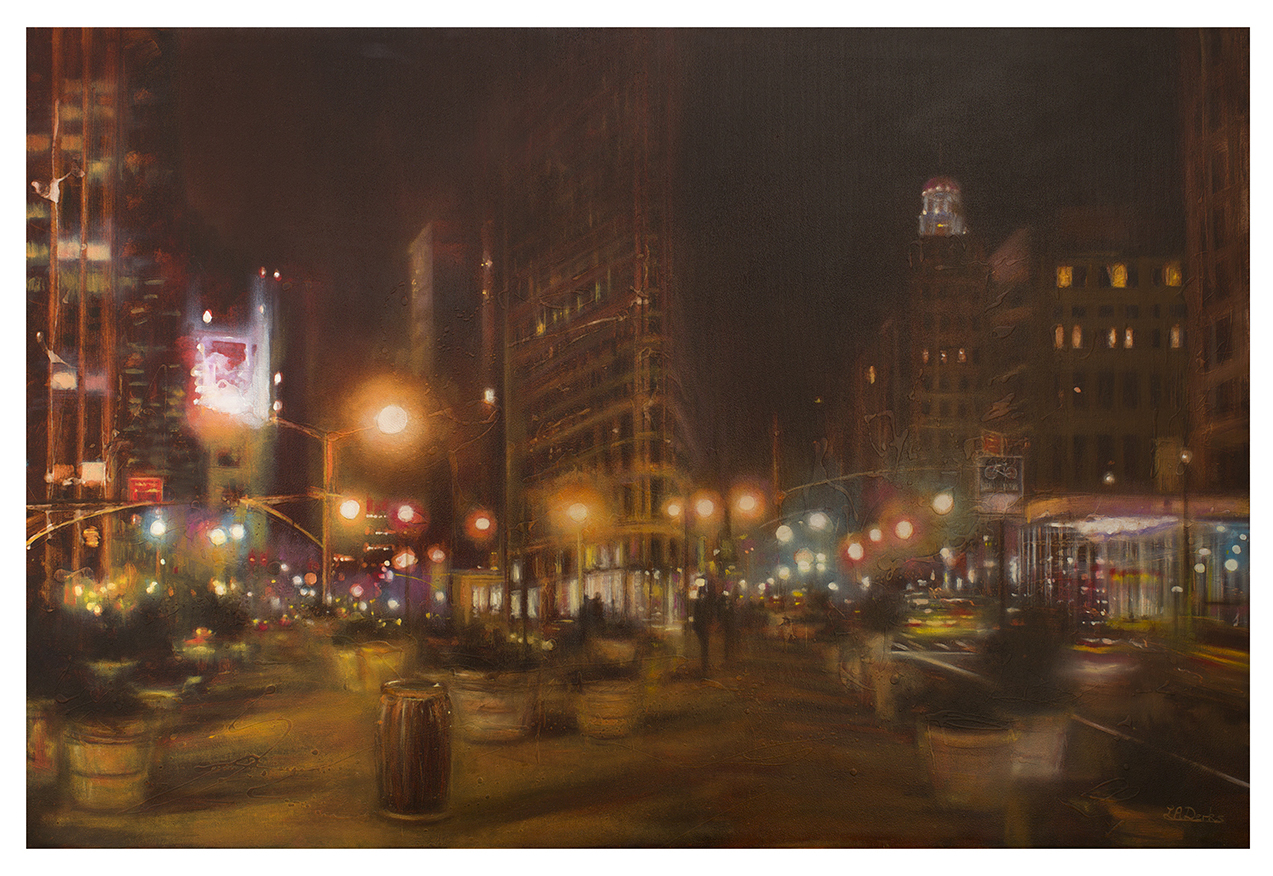
A city street at night glows with bright lights and neon signs, while the Flat Iron Building, New York stands in the background, surrounded by blurred light trails that create a dreamy urban atmosphere.

People often look at limited edition prints because they want something that feels more intentional than a generic decorative print. The image still needs to suit the room, but the decision is usually also about character, scarcity, and lasting appeal. Flat Iron Building, New York answers that well with a city subject that feels alive, polished, and worth returning to.

What makes a limited edition piece feel worth choosing

A limited edition print should feel as though it brings more than surface decoration. It should carry stronger identity and a clearer sense of why that image belongs in the room. Flat Iron Building, New York does this especially well because its evening city mood adds movement and atmosphere without looking generic.

  • It gives a room more personality than a flatter, off-the-shelf city image.
  • It feels suitable for spaces that want energy but still need refinement.
  • It offers a more deliberate choice for buyers who care about presentation.

This can work particularly well in apartments, contemporary sitting rooms, and offices where a city-led print needs to feel sharp enough for the setting without becoming brash. The limited edition aspect strengthens that sense of care and selection.

First 4 Frames completes each piece in-house in Falkirk with bespoke framing, colour-managed Giclee printing, and hand-finished craftsmanship. That superior finish supports the idea of a limited edition work by giving the presentation the same sense of intention as the image itself.

You can browse more from Lesley Anne Derks and view the exact framed product here.

If you are comparing limited edition prints and want something with more mood, movement, and individuality, Flat Iron Building, New York is well worth a closer look.

Posted on

Limited Edition Prints Scotland: A Collector’s Guide to Fine Art & Framing

Limited Edition Prints Scotland: A Collector’s Guide to Fine Art & Framing

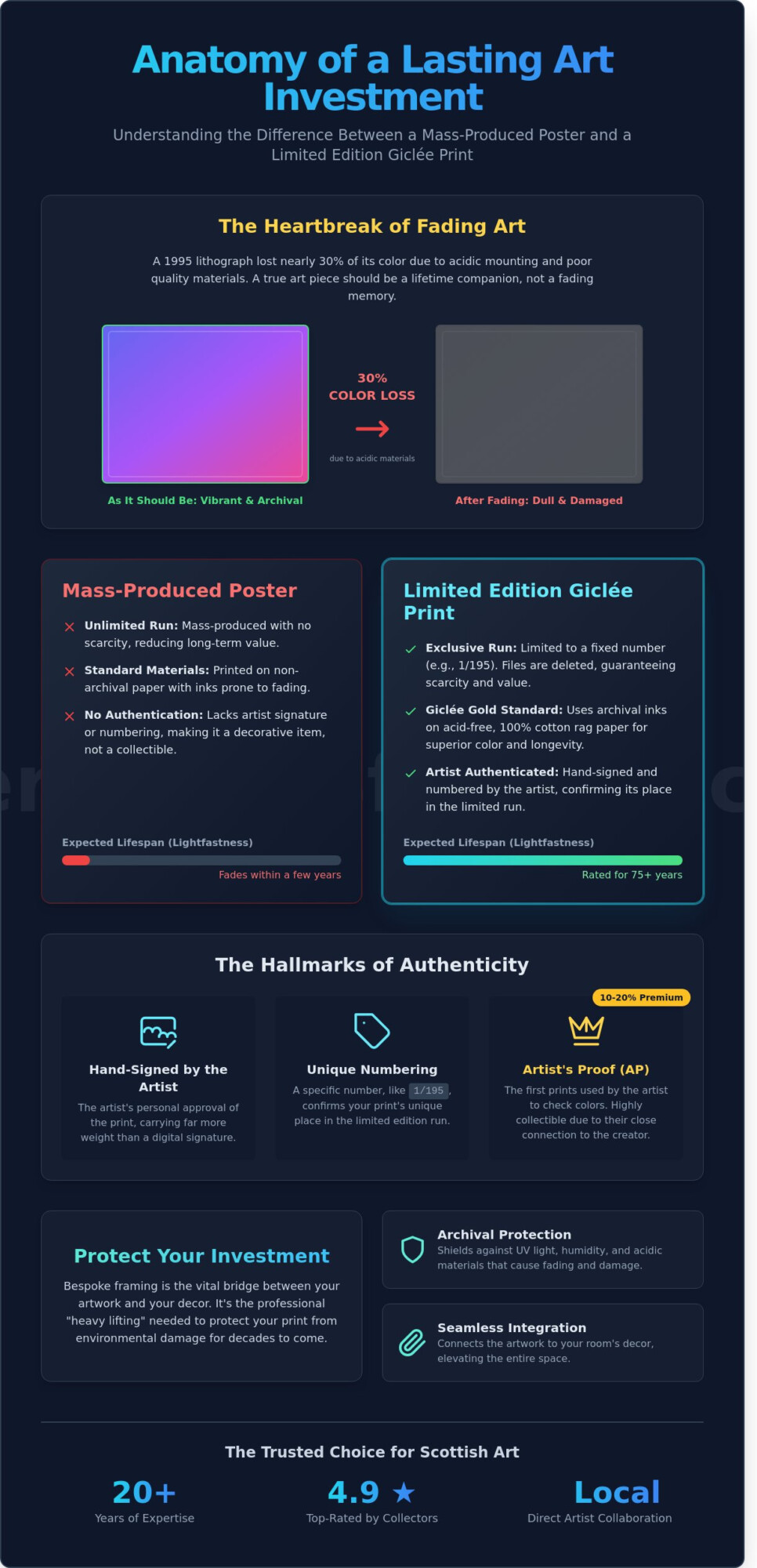
Last October, a collector visited our workshop with a 1995 lithograph that had lost nearly 30% of its original colour due to acidic mounting. It’s a heartbreaking sight, especially when you’re searching for limited edition prints Scotland to serve as a lasting piece of heritage in your home. You likely believe that a fine art purchase should be a lifetime companion, not a fading memory. We agree that the technical jargon around Giclée and print runs shouldn’t get in the way of owning a beautiful, professional piece.

In this guide, you’ll learn how to source and authenticate high-quality prints that stand the test of time. We’ll introduce you to the featured artists at First4Frames Gallery and explain how our bespoke framing service protects your investment from environmental damage. You’ll also see how our print-and-frame service provides a hassle-free way to get art on your walls. We’re going to show you why our 20 years of expertise and top-rated customer reviews make us the trusted choice to bridge the gap between your décor and your new artwork.

Key Takeaways

  • Explore the curated selection of local artistic talent at First4Frames Gallery and learn why collaborating directly with artists ensures the highest standard of authenticity.
  • Master the art of collecting by understanding the exclusivity and numbering behind limited edition prints Scotland, ensuring your investment captures the true spirit of our spectacular landscapes.
  • Discover why Giclée printing is the gold standard for fine art reproduction, using archival inks and acid-free papers to ensure your artwork never fades over time.
  • Understand why bespoke framing is the vital bridge between your artwork and your room’s décor, providing the professional “heavy lifting” needed to protect your investment.
  • Learn how to navigate our simple three-step online ordering process for a hassle-free experience, backed by our reputation as a trusted, highly-rated UK professional.

What Defines Limited Edition Prints in the Scottish Art Market?

Choosing the right piece of art for your home involves more than just picking a pleasing image. At First4frames gallery, we’ve spent over 20 years helping collectors find the perfect limited edition prints scotland has to offer, focusing on quality that lasts for generations. A limited edition print isn’t a mass-produced poster; it’s a high-quality reproduction of an original work, restricted to a specific number of copies. Once that number is reached, the artist destroys the plates or deletes the digital files, ensuring no more will ever be made. This creates a sense of exclusivity that mass-market retail simply cannot match.

A true limited edition print is a restricted run of a specific image, often produced using professional Giclée methods on 100% cotton rag paper. By understanding limited edition prints, you can see why these pieces hold their value better than standard shop-bought prints. While a poster might fade within a few years, our archival-quality prints are rated for 75 years of lightfastness. This technical superiority is why we maintain a 4.9-star rating on major review platforms; we don’t compromise on the materials that protect your investment.

To better understand this concept, watch this helpful video:

The Significance of the Signature and Numbering

Every piece in the First4frames gallery features a specific numbering system, such as 1/195, which tells you exactly where your print sits in the run. A hand-signed print carries far more weight than a digital signature because it represents the artist’s personal approval of that specific sheet. You might also see “AP” on some works, which stands for Artist Proof. These were traditionally the first prints off the press used by the artist to check colours, and they often command a 10% to 20% price premium due to their closer connection to the creator. A limited edition status serves as a formal guarantee of scarcity, ensuring that only a fixed number of impressions will ever exist.

Why Scottish Art is a Favourite for Home Decor

The demand for limited edition prints scotland stems from a deep emotional connection to the landscape. Local artists at our gallery specialise in capturing the unique, ethereal light of the Highlands and the gritty, vibrant energy of urban centres like Glasgow or Edinburgh. These works act as a bridge between your room décor and the artwork, bringing the outside in through professional framing that highlights the moody indigos and mossy greens of the Scottish climate. Whether it’s a misty glen or a bustling Royal Mile scene, these prints celebrate a personal history and heritage that speaks to the soul of the collector. Our customers often choose these pieces to anchor a room, relying on our bespoke framing service to provide the perfect finishing touch that protects the work for decades.

Finding the perfect piece of art often feels like an inspiring journey of discovery. At First4Frames, we’ve spent more than 22 years building a curated collection that celebrates the very best of Scottish creative talent. Our gallery isn’t just a retail space; it’s a dedicated environment where we collaborate directly with artists to bring their unique visions into your home. By choosing a local gallery, you’re supporting a sustainable creative ecosystem that ensures artists are fairly represented and collectors receive authentic, high-quality pieces. Our collection of limited edition prints scotland provides a direct gateway to the country’s rich visual heritage, from the rugged Highlands to the atmospheric cityscapes of Edinburgh and Glasgow.

We pride ourselves on being a genuine one-stop-shop for art lovers across the United Kingdom. Whether you’re searching for a household name or a rising star, our gallery simplifies the entire acquisition process. We handle the sourcing, the authentication, and the professional presentation. Our commitment to excellence is reflected in our 4.9-star customer rating, built on hundreds of reviews from clients who value our professional, hassle-free approach. We don’t just sell art; we provide a bridge between the artist’s studio and your room décor, ensuring every piece resonates with your personal style. With over 1,500 pieces curated over the last two decades, we offer a depth of choice that few can match.

When you explore our selection of limited edition prints scotland, you’ll see why these pieces are so highly sought after by modern collectors. Each print is produced to exacting standards, often using Giclée techniques that ensure colours remain vibrant for decades without fading. This level of quality means your investment is protected, and the artwork will look as spectacular in twenty years as it does today. While our gallery focuses on the art itself, we also offer a separate, bespoke picture framing service to complete your purchase, alongside a distinct print-and-frame option for those who want a ready-to-hang solution delivered to their door.

The Vibrant Colours of Jolomo (John Lowrie Morrison)

John Lowrie Morrison, known widely as Jolomo, captures the raw beauty of the Scottish West Coast like no other artist. His spectacular use of high-key colour and expressive brushwork has made his work a staple in modern Scottish homes since his first solo exhibition in 1976. These pieces bring an immediate warmth and energy to any room. You can explore our curated range of Jolomo prints to find the perfect landscape for your space.

Iconic Moods by Jack Vettriano

Jack Vettriano’s work offers a completely different, yet equally compelling, perspective on Scottish artistry. His narrative-driven, cinematic style evokes a sense of nostalgia and mystery that has captivated global audiences for over 30 years. While his original paintings often fetch six-figure sums at auction, his Jack Vettriano prints make these world-renowned scenes accessible for your own home. Each piece tells a story, acting as a sophisticated focal point in any interior design scheme.

Our knowledgeable team is always on hand to help you find a piece that truly speaks to you. If you’re ready to embark on your own journey of artistic discovery, you can browse our full artist portfolio today to see our newest arrivals and best-selling editions.

The Technical Standard: Giclée Quality and Authentication

Investing in limited edition prints scotland requires an understanding of the technical processes that transform a digital file or original painting into a museum-quality masterpiece. The gold standard for this process is Giclée printing. Unlike standard commercial printing that uses dye-based inks, Giclée employs high-precision inkjet technology with pigment-based inks. These pigments are microscopic particles of colour that sit on the surface of the paper rather than soaking in, which results in a depth of colour and level of detail that is virtually identical to the artist’s original work. At First4frames gallery, we utilise a 12-colour pigment system to ensure every subtle gradient and brushstroke is captured with absolute fidelity.

The choice of substrate is just as vital as the ink itself. Standard papers contain acids that cause yellowing and brittleness within a few decades. Fine art Giclée prints use acid-free, 100% cotton rag or alpha-cellulose papers. These materials are chemically stable and provide a tactile, heavy-weight feel that exudes quality. Giclée prints at First4Frames are designed to last a lifetime, ensuring your investment remains as vibrant as the day you bought it. This commitment to professional-grade materials is why our gallery maintains such high ratings on independent review platforms; customers recognise the tangible difference in the physical product they receive.

Certificates of Authenticity (COA)

A Certificate of Authenticity acts as the legal “birth certificate” for your artwork. Every legitimate limited edition print must be accompanied by this document to hold its value in the secondary market. A valid COA from First4frames gallery includes the artist’s name, the specific edition number (such as 5 of 50), the total edition size, and the production date. We ensure every piece is properly documented so you have a permanent record for insurance and future valuation. Keep this document in a safe place; it is the bridge between a simple decorative item and a verified piece of fine art.

Longevity: Why Quality Materials Matter

The science of lightfastness is central to the longevity of your art. While we often joke about the lack of light, the Scottish sun still emits UV rays that can devastate low-quality prints. Pigment inks are rated to resist fading for 75 to 100 years under normal indoor lighting conditions. This is a massive leap forward from standard posters that may show visible degradation in less than five years. By choosing museum-grade cotton rag over standard wood-pulp paper, you are preventing the chemical “burn” that turns cheap prints brown over time.

Buying from a pre-vetted gallery like First4frames removes the guesswork from the process. We have spent over twenty years sourcing the best materials and building relationships with artists who share our obsession with quality. This makes the entire experience hassle-free. You don’t need to be a chemist or a printing expert to own a beautiful piece of art; you just need to trust the professionals who handle the technical heavy lifting for you. Whether you are looking for a landscape or a contemporary abstract, the technical foundation of the print ensures it will remain a focal point in your home for generations.

An infographic compares mass-produced posters to limited edition giclée prints, highlighting their differences in colour longevity, uniqueness, archival protection, investment value, and authenticity.

Bespoke Framing: The Bridge Between Art and Decor

A frame does the heavy lifting in the relationship between your art and your home. It isn’t just a border. It’s the essential bridge that pulls you into the picture. When you invest in limited edition prints scotland, the frame transforms a piece of paper into a permanent feature of your interior design. At First4Frames, we’ve spent 21 years perfecting this craft. Our workshop has handled over 50,000 individual framing projects since we opened in 2003, ensuring every piece of art receives the professional respect it deserves.

Bespoke framing is your first line of defence. Cheap, mass-produced frames often use acidic backings that yellow your print within 18 to 24 months. We use only conservation-grade, acid-free materials to preserve the value of your investment. This is vital for high-quality Giclée prints where the ink and paper chemistry must remain stable for decades. A professional frame ensures the artwork doesn’t touch the glass, preventing the “cockling” or rippling that ruins the flat profile of the paper over time.

Choosing a frame colour is about more than matching your sofa. It’s about finding a tone that highlights the subtle details within the print itself. A dark, moody frame can ground a bright coastal scene, while a natural wood finish can warm up a stark, modern abstract. Our artisans help you pick a style that doesn’t compete with the art but complements the specific textures of our featured artists’ work. It’s why our customers consistently rate our service 4.9 out of 5 stars on independent review platforms.

Choosing the Right Mount and Glass

A mount provides more than just a visual breather. It creates a physical gap between the artwork and the glass, preventing moisture trap and ink transfer. For a busy Highland landscape, a wide, neutral mount organises the viewer’s focus. It draws the eye toward the horizon line rather than the wall behind it. We offer 99% UV-protective glass as an upgrade to our standard 2mm float glass. This prevents the vibrant colours of your limited edition prints scotland from fading when hung in bright, south-facing rooms. This simple choice can double the life of your print’s vibrancy.

Steps to Creating a Ready-to-Hang Masterpiece

Our process starts with a professional consultation to match your frame style to your specific decor. Whether it’s a sleek black aluminium finish or a traditional hand-stained wood grain, we ensure the aesthetic is cohesive. Next, our artisans use precision-cutting technology to ensure every corner is seamless and structurally sound. Finally, we perform a 10-point inspection. We check for microscopic dust under the glass and ensure the print is perfectly centred before sealing the back with moisture-resistant tape. This “one-stop-shop” approach means your art arrives home ready to be enjoyed immediately without any extra hassle.

How to Buy Limited Edition Prints Online with Confidence

Purchasing fine art online doesn’t have to be a daunting task. At First4Frames, we’ve spent more than 20 years perfecting a system that brings the gallery experience directly to your screen. We understand that a piece of art is an investment in your home’s soul. That’s why we’ve streamlined the journey into a simple, three-step process designed for clarity and ease. You can start by browsing our curated collection of limited edition prints scotland collectors frequently seek out, featuring renowned local artists. Once you’ve found a piece that resonates, you move to step two: selecting the perfect frame. We view the frame as the essential bridge between your new artwork and your existing room décor. Finally, place your order through our secure checkout. It’s a hassle-free way to bring professional-grade art into your living space without the stress of traditional gallery hopping.

Our commitment to excellence extends far beyond the point of sale. We provide a speedy, professional delivery service that covers the entire UK. Unlike standard couriers who might mishandle delicate items, we use specialist packaging protocols developed over two decades to ensure your framed art arrives in pristine condition. Most of our customers receive their bespoke orders within 5 to 7 working days. We take pride in the fact that our service is backed by a 4.9-star rating on independent review platforms, reflecting our dedication to craftsmanship and customer satisfaction. Whether you’re in the Highlands or the heart of London, your art is handled with the same level of artisan care we apply in our workshop.

The Convenience of a One-Stop-Shop

One of the biggest hurdles in art buying is the gap between purchasing a print and getting it onto the wall. Many collectors buy a beautiful piece only to have it sit in a cardboard tube for months. We’ve eliminated this problem by acting as a true one-stop-shop. By combining our gallery sales with our expert in-house framing service, we save you an average of four hours in travel and consultation time. You don’t need to make a second trip to a framer or worry about measurements. Our experts ensure the frame fits the print perfectly the first time. This integrated approach guarantees that the materials used are chemically compatible with your Giclée print, preserving its vibrant colours for decades to come.

Commercial Curation and Staging

First4Frames doesn’t just work with individual collectors; we’re a key partner for the commercial sector. We’ve collaborated with over 150 property developers and hoteliers across the UK to finish rooms with a sophisticated touch. High-quality Scottish art does more than just fill a blank wall; it defines the atmosphere of a professional environment. Research in the hospitality industry suggests that thoughtfully curated art can increase the perceived value of a space by up to 15%. From boutique hotels in Edinburgh to modern office hubs in Glasgow, our commercial curation services help businesses create spectacular, memorable environments that leave a lasting impression on clients and guests alike.

Choosing First4Frames means choosing a partner who values your art as much as you do. Our blend of traditional craftsmanship and modern convenience makes us the trusted choice for art lovers who demand quality without compromise. We invite you to begin your own journey of artistic discovery with a team that treats every print like a masterpiece.

Explore our full gallery of limited edition prints today

Start Your Scottish Art Journey Today

Owning a piece of the Highlands or a vibrant Edinburgh cityscape is simpler than you think. When you explore the First4Frames gallery, you’re investing in more than just paper and ink; you’re securing Giclée-standard quality that stays vibrant for decades. Our dedicated team brings over 20 years of bespoke framing expertise to every single order, ensuring your chosen piece acts as the perfect bridge between your room’s décor and the artwork itself. We’ve simplified the entire process into three easy steps so you can shop from home with total confidence. Our excellent customer ratings on major review platforms reflect our commitment to being your trusted one-stop-shop for fine art and professional framing. Whether you’re a seasoned collector or buying your first piece, our curated selection of limited edition prints scotland offers something truly spectacular for every wall. Every print we host is a testament to the incredible talent of our featured artists. It’s time to transform your living space with a professional finish that lasts a lifetime.

Browse our spectacular collection of limited edition Scottish prints

We’re excited to help you find that perfect piece that speaks to your personal style and brings your walls to life.

Frequently Asked Questions

What is the difference between a limited edition and an open edition print?

A limited edition print has a strictly fixed number of copies, whereas an open edition can be produced indefinitely. Once the final piece in a run of 195 or 500 is sold, no more will ever be printed. This scarcity makes them far more collectable than open editions. At First4Frames, we find our customers prefer this exclusivity because it ensures their chosen artwork remains a rare and special find.

How many prints are usually in a limited edition run?

A typical limited edition run usually contains between 50 and 850 individual prints. Smaller runs of 25 or 75 are common for high end boutique releases, while 195 or 495 are standard for popular contemporary artists. Lower numbers often command higher prices because of their rarity. You can see the specific edition size clearly marked on every piece in our gallery to help you make an informed choice.

Do limited edition prints increase in value over time?

Yes, limited edition prints scotland can appreciate in value, especially when the artist’s reputation grows or the edition sells out. For instance, a print originally sold for £250 might reach £1,200 on the secondary market if demand outstrips the fixed supply. While no investment is guaranteed, our 20 years of experience shows that sought-after Scottish artists often see their work rise in price as they become more established.

How should I clean the glass on my framed limited edition print?

You should clean the glass by spraying a small amount of ammonia-free glass cleaner onto a soft microfibre cloth first. Never spray liquid directly onto the frame because it can seep under the glass and damage the artwork or the mount. Use gentle, circular motions to remove dust. This simple maintenance keeps your beautiful artwork looking spectacular for decades without risking moisture damage or staining the delicate paper.

Can I choose a custom frame for a print I already own?

You can certainly use our bespoke framing service to create a perfect bridge between your room décor and any artwork you already own. We offer over 500 different moulding options at our workshop to suit every possible style. Our expert team uses their 20 years of craftsmanship to ensure your print is professionally framed and protected. It’s a simple, high-quality way to refresh a piece you love and ensure it stays safe.

What is a Giclée print and why is it better for limited editions?

A Giclée print is a high-quality reproduction using pigment-based inks that won’t fade for at least 75 years. This method uses a 12-colour inkjet process to create an identical copy of the original painting with incredible detail. It’s the gold standard for limited edition prints scotland because it captures the exact texture and vibrancy that artists demand. This ensures your investment remains as beautiful as the day you bought it.

Does First4Frames deliver framed prints safely to my home?

We deliver all our framed prints across the UK using a specialist courier network to ensure they arrive in perfect condition. Every order is packed with custom-fit shock-absorbent materials and heavy-duty cardboard. Our high customer ratings on review platforms reflect our commitment to a hassle-free, speedy service. You can track your delivery from our workshop right to your front door, knowing your new artwork is in safe, professional hands.

Why is a certificate of authenticity important for Scottish art?

A certificate of authenticity acts as a legal guarantee that your artwork is a genuine product of the artist’s studio. It records vital details like the edition number, the date of publication, and the artist’s signature. This document is essential if you ever decide to sell or insure your piece. Every limited edition we sell at First4Frames includes this vital paperwork to protect your investment and prove its provenance for the future.