Posted on

Gallery Wall Layout Ideas: 10 Inspiring Trends for 2026

Gallery Wall Layout Ideas: 10 Inspiring Trends for 2026

That vast, empty wall in your living room holds so much potential, but where do you even begin? If the thought of mixing different frames, choosing art that works together, and committing to nail holes fills you with more dread than delight, you’re in the right place. We believe creating a spectacular gallery wall should be a journey of artistic discovery, not a stressful puzzle. That’s why we’ve delved into the future of interior design to bring you the definitive guide to gallery wall layout ideas 2026.

Prepare to be inspired. In this article, you’ll explore ten of the most exciting trends, from the beauty of minimalist grids to the charm of eclectic clusters. We’ll share our expert advice on how to confidently plan and hang your artwork, ensuring you can create a display that not only fits your space perfectly but also tells your personal story. It’s time to transform that blank canvas into a beautiful, professional-looking feature you’ll love for years to come.

Before you hammer a single nail, the journey to a spectacular gallery wall begins with a thoughtful plan. A truly beautiful collection of art is more than just a way to fill a blank space; it’s a personal narrative, a reflection of your style and story. This practice of curating and showing art has a rich past, and understanding the history of displaying art can inspire us to create displays with meaning. Good planning is the secret to saving time, preventing misplaced holes, and achieving that perfectly polished, professional result you envision.

To help you visualise the latest trends and possibilities, take a look at this inspiring video:

Start with a Story: Defining Your Theme & Palette

Every great gallery wall tells a story. What will yours be? Decide on a unifying element that ties each piece together. This could be a consistent colour palette, a shared subject matter, or a specific feeling you want to evoke. Consider popular themes like travel memories, family portraits, botanical prints, or abstract forms. We recommend choosing two or three dominant colours to guide your art and frame selection, creating a cohesive and harmonious look.

Measure Twice, Hang Once: Mapping Your Layout

This timeless advice is the golden rule of gallery walls. To perfect your arrangement before making any permanent marks, use paper. Trace each of your frames onto craft paper or newspaper, cut them out, and use painter’s tape to test different layouts directly on your wall. This allows you to visualise the spacing and balance. As a rule of thumb, aim to hang your collection so that the centre point is at eye level, which is roughly 145cm from the floor. This step is crucial for executing the best gallery wall layout ideas 2026 without regret.

Finding Your Anchor: The Centrepiece of Your Wall

Most successful gallery walls have an ‘anchor’ piece. This is typically your largest, boldest, or most meaningful piece of art. It acts as the natural focal point and gives the entire arrangement structure. Begin by placing this piece first. For a more dynamic, modern feel, position it slightly off-centre. From there, you can build the rest of your layout outwards, balancing smaller pieces around it. This creates a gravitational pull for the viewer’s eye, making the collection feel intentional and expertly curated.

As we look towards 2026, interior design is embracing personal expression and curated comfort like never before. The classic gallery wall is evolving, moving beyond simple, rigid grids to become a more organic, story-driven feature of our homes. The best gallery wall layout ideas 2026 are less about perfection and more about personality. Let’s explore the key trends shaping how we display art, helping you find a style that truly reflects who you are and elevates your home’s aesthetic.

Trend 1: The Biophilic Flow – Organic & Asymmetrical

Inspired by the untamed beauty of nature, this layout shuns hard lines and perfect symmetry. The goal is to create a sense of movement and life on your wall. Arrange a mix of frame sizes in a flowing, almost cloud-like cluster that feels intuitive rather than planned. This style is the perfect home for botanical prints, spectacular landscape photography, and pieces with natural textures. Think of the sweeping, vibrant colours in the work of an artist like John Lowrie Morrison (Jolomo) to capture this spirit.

To fully embrace this trend, you can complement your botanical prints with a living feature wall or an indoor garden. For the specialist supplies needed to create this, you can visit Discount Hydro.

  • Best for: Living rooms, hallways, or any space needing a touch of natural calm.
  • Key elements: Varied frame sizes, curved lines, and nature-themed art.

Trend 2: Quiet Luxury – The Refined Grid

For those who find beauty in order and elegance, the Quiet Luxury trend is a masterclass in understatement. This layout focuses on premium materials and impeccable craftsmanship. It uses a precise, symmetrical grid with identical, high-quality frames to create a powerful sense of cohesion and calm. The focus isn’t on the layout itself, but on the quality of the art and framing. This approach provides a perfect, professional gallery feel for a series of black-and-white photographs or minimalist abstract prints.

  • Best for: Studies, dining rooms, and minimalist spaces.
  • Key elements: Identical premium frames, perfect symmetry, and a cohesive art collection.

Trend 3: Dopamine Decor – The Eclectic Storyteller

Embrace joy with a ‘more-is-more’ approach that tells your unique story. This layout is a vibrant, personal collection of art, photographs, and treasured objects. Don’t be afraid to mix different frame styles, colours, materials, and eras for a beautifully collected-over-time look. You can even incorporate small floating shelves, antique mirrors, or personal memorabilia among the frames. This is the most personal of all gallery wall layouts, one that grows and evolves with you.

This is the perfect trend for showcasing your unique hobbies and passions. For example, enthusiasts of classic video games can create a visually stunning feature wall with vintage game posters, framed cartridges, or console art. Sourcing these nostalgic pieces from a specialist like RetroFix can add an authentic and personal touch to your eclectic display.

  • Best for: Creative spaces, bedrooms, and anywhere you want to inject personality.
  • Key elements: A mix of frames and objects, bold colours, and personal significance.

Some gallery wall layouts are classics for a simple reason: they create immediate harmony and impact. These tried-and-tested arrangements provide a beautiful structure for any art collection, from family photographs to fine art prints. They are the reliable foundations of interior design. While new trends emerge, mastering these foundational templates is the secret to creating stunning displays in any room. We’ll show you how to give these enduring styles a fresh, modern update, ensuring they remain essential gallery wall layout ideas 2026 that feel both timeless and completely current.

The Symmetrical Grid: For Order and Impact

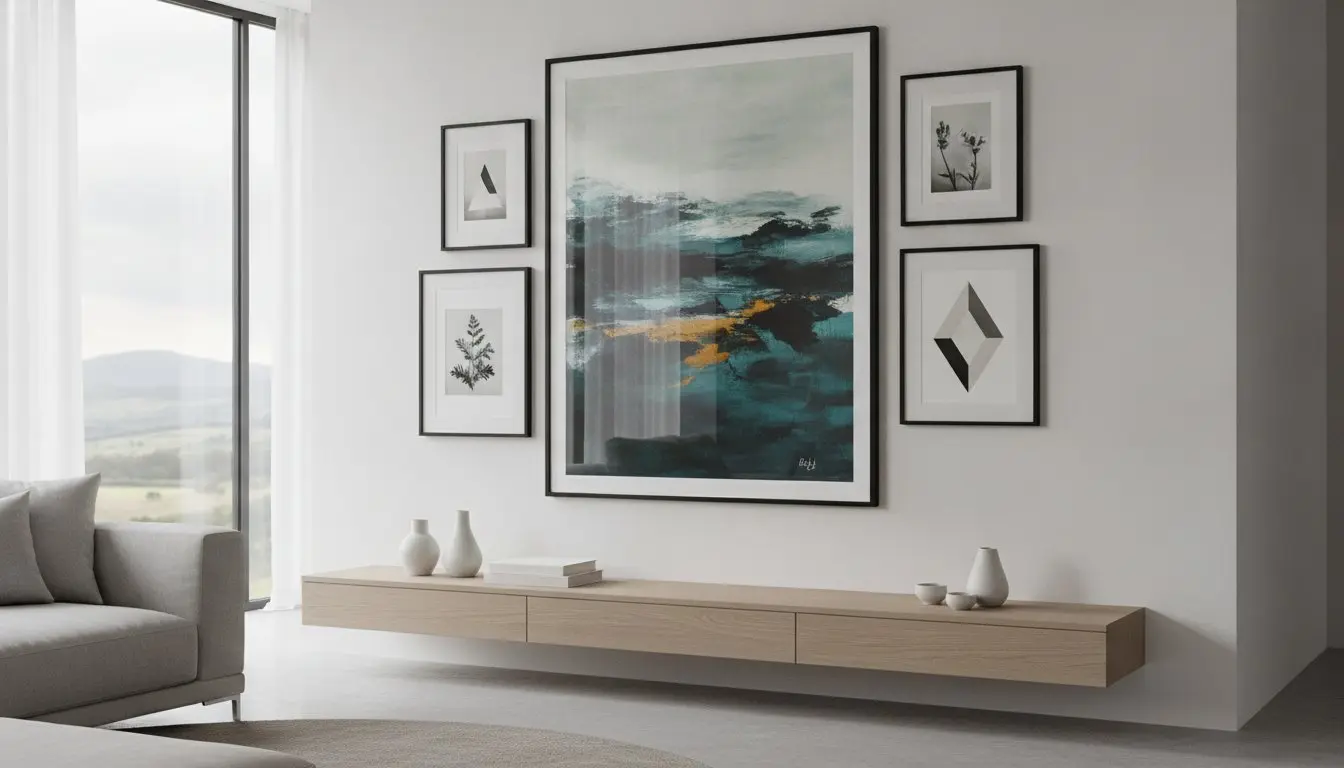
The grid is the epitome of clean, organised design, delivering a high-impact statement with its satisfying sense of order. It’s the perfect layout for showcasing a series of prints of the same size and orientation, creating a powerful, unified focal point above a sofa or bed. For flawless, professional execution, maintain equal spacing-typically 2-3 inches-between each frame.

  • The 2026 Twist: Elevate this classic look with oversized, crisp white mats and ultra-slim, minimalist frames in black or natural wood. This technique draws the eye inward, giving your art a true gallery-quality feel and allowing each beautiful piece to breathe.

The Staircase Gallery: Elevate Your Ascent

Transform a functional space into a personal journey with a staircase gallery wall. This layout beautifully follows the diagonal line of your ascent, telling a story as you move. A simple way to achieve this is the ‘step’ method: align the centre of each frame with the rise of the stairs, creating a natural, flowing line. It’s a wonderful way to display a timeline of cherished family photos, turning a simple walk upstairs into a trip down memory lane.

  • The 2026 Twist: Break up the linear arrangement by mixing in a few circular or oval frames. This small change adds a dynamic, contemporary rhythm, softening the hard angles of the staircase and adding unexpected visual interest.

The Centred Cluster: Above Furniture

Creating a balanced arrangement above a key piece of furniture-like a console table, fireplace, or headboard-anchors the entire room. The key is to treat your collection as one single, cohesive unit. The overall shape of the cluster should feel grounded, typically wider than it is tall, with the bottom edge of the lowest frames sitting 6-8 inches above the furniture. This ensures your art connects to the furniture without feeling cramped. If you’re searching for an inspiring piece to build your display around, you can find the perfect centrepiece in our ready-to-hang art collection.

Of course, the furniture itself sets the stage for your art. For a fantastic selection of console tables, sideboards, and other pieces that provide the perfect foundation for a gallery wall, you can check out Womacks Of Bawtry.

Infographic titled Gallery Wall Layout Trends 2026 spotlights top gallery wall layout ideas 2026: Biophilic Flow (organic, asymmetrical), Quiet Luxury (refined grid), and Dopamine Décor (eclectic, colourful), each with icons and descriptions.

Creative Solutions for Tricky Spaces

In the real world, few of us have vast, empty walls just waiting for art. More often, we face architectural quirks: tight corners, narrow hallways, or walls dominated by a television. But what if these challenges were actually opportunities? These expert tips are central to the most innovative gallery wall layout ideas 2026, designed to turn challenging spots into the highlight of your home.

With over twenty years of craftsmanship under our belts, we’ve learned that a thoughtful layout can conquer any space. It’s about seeing potential where others see problems and using beautiful, professionally framed art to redefine a room’s architecture.

The Corner Wrap: Thinking in Three Dimensions

Extend your collection beyond a single plane by wrapping it around an inside or outside corner. This creates a wonderfully immersive effect, drawing the eye around the bend and making the entire room feel more dynamic and spacious. We recommend placing a larger, statement piece on the main wall, with a series of smaller, complementary frames flowing onto the adjacent one for a surprising and sophisticated look.

The Vertical Stack: For Narrow Walls & High Ceilings

Perfect for those slender sections of wall between doorways or windows, the vertical stack is a simple yet powerful solution. This layout uses a single column of frames to create a strong vertical line that draws the eye upward, giving an illusion of greater height. For a polished, intentional aesthetic, use frames of the same width but play with varying heights. This maintains cohesion while adding beautiful visual interest.

Framing the Tech: Integrating a TV

Don’t let a black screen dictate your décor. By surrounding your television with a curated collection of art, you integrate it seamlessly into your room’s design. The key is connection. Use premium black frames that echo the screen, or choose artwork with deep tones to create a visual bridge. Suddenly, the TV is no longer just an appliance, but another considered piece in your beautiful gallery wall.

These forward-thinking gallery wall layout ideas 2026 prove that every space, no matter how awkward, has artistic potential. Ready to conquer your tricky corners? Explore our bespoke collection and find the perfect, professionally framed pieces to begin your masterpiece.

From Idea to Reality: Choosing Your Art & Frames

You’ve mapped out your grid, measured your wall, and planned your layout. Now for the truly creative part: selecting the art and frames that will transform your concept into a spectacular reality. Choosing the right pieces is what breathes life and personality into your design. We’ll guide you through curating your collection like a professional, ensuring every element works in beautiful harmony for a polished, cohesive finish.

The Art of the Mix: Combining Prints, Photos & Paintings

Don’t be afraid to create a rich narrative by mixing professional art with personal memories. A beautiful Giclée print can hang proudly next to a cherished family photograph or a child’s first painting. To create a sense of unity, consider converting all your photos to classic black and white or using the same style of mount for every piece. This blend of high and low, public and private, is what tells a richer story and makes a gallery wall uniquely yours.

Frame Game: How to Choose the Perfect Frames

The frame is the bridge between your artwork and your room’s décor, so choosing wisely is key. For many of the leading gallery wall layout ideas 2026, a thoughtful framing strategy is crucial to success. Consider these tips:

  • For a Cohesive Look: Stick to one or two frame colours and materials, like all-black or a mix of natural oak and white. This creates a calm, unified aesthetic.
  • For an Eclectic Look: Mix different frame styles, but keep one element consistent-such as the material (all wood) or the colour family (all metallics)-to avoid a chaotic feel.
  • Consider the Artwork: Let the art guide you. Modern, minimalist prints shine in slim, clean-lined frames, while classic portraits may call for something more ornate.
  • Perfect the Fit: For those non-standard sizes that are essential to your layout, bespoke framing is the perfect solution, ensuring every piece fits its designated space flawlessly.

Sourcing Your Collection: Finding Art You Love

Building a collection is a journey, not a race. Start by looking around your own home for treasures-sentimental postcards, favourite photographs, or your children’s drawings can become the heart of your wall. To supplement these, explore online galleries for premium Giclée prints from talented artists. Supporting local makers at art fairs is another wonderful way to find unique pieces that no one else has. Once you’ve gathered your favourites, let us frame your treasures with our bespoke framing service and bring your vision to life.

As we’ve explored, creating a stunning feature wall is about more than just hanging pictures. The best gallery wall layout ideas 2026 are a beautiful blend of personal expression and thoughtful composition, whether you’re embracing the understated elegance of ‘Quiet Luxury’ or the joyful energy of ‘Dopamine Decor’. By planning your layout and choosing pieces that tell your story, you can transform any space-even a tricky staircase or narrow hallway-into a true reflection of your style.

The final, crucial step is selecting beautiful art and the perfect frames to bring your vision to life. At First 4 Frames, we make this part simple and inspiring. With over 20 years of bespoke framing experience, we are trusted by homeowners and commercial clients across the UK to deliver exceptional craftsmanship. Our collection of premium Giclée prints from talented artists provides the perfect starting point for your masterpiece.

Ready to build your dream gallery wall? Explore our collection of art prints!

Embark on your creative journey today and curate a wall that you will love for years to come.

Frequently Asked Questions

How far apart should pictures be in a gallery wall?

As a general rule, we recommend spacing your frames 2 to 5 inches (about 5-12 cm) apart. The most crucial element is consistency across the entire arrangement. Maintaining a uniform gap creates a clean, professional look that allows each piece of art to breathe while still feeling connected to the collection. For more formal, grid-style layouts, a smaller, precise gap works best, whereas eclectic layouts can handle slightly more space between frames.

Is it okay to mix different frame colours and styles in one layout?

Absolutely! Mixing frame colours, materials, and styles is a spectacular way to add depth, personality, and a curated feel to your gallery wall. To create a cohesive look, find a common element to tie them together. This could be a consistent matting colour, a metallic finish that appears in multiple frames, or a single colour that is present in each piece of artwork. This thoughtful approach ensures the collection looks beautifully harmonious rather than chaotic.

Should all the pictures in a gallery wall have the same theme?

Not at all. While a single theme can be very impactful, many of the most personal and interesting gallery walls feature a diverse mix of art. You can unite different subjects-like abstract prints, family photos, and line drawings-by establishing a consistent colour palette throughout the collection. Alternatively, using the same style of bespoke frame for every piece can create a powerful sense of unity, turning varied images into a single, stunning feature.

What’s the best height to hang pictures for a gallery wall?

To achieve a professional, gallery-quality display, the centre of your entire arrangement should be at average eye level, which is typically 57-60 inches (145-152 cm) from the floor. This ensures the collection is viewed comfortably and feels perfectly balanced in the room. If you are hanging your gallery wall above a piece of furniture like a sofa or console table, a good rule is to leave a gap of 6-8 inches above the furniture.

How do I start building a gallery wall on a budget?

Creating a beautiful gallery wall doesn’t require a huge investment. Start by printing your own favourite photographs and mixing them with affordable art prints you can find online. Scour local charity shops and car boot sales for unique, pre-loved frames that you can often find for just a few pounds. This approach allows you to build a deeply personal collection over time, adding premium, professionally framed pieces as your budget allows to elevate the display.

Can I create a gallery wall without using nails?

Yes, you can easily create a beautiful display without making a single hole in your wall. Adhesive picture-hanging strips are an excellent damage-free option, perfect for renters. Just be sure to check the weight capacity of the strips against the weight of your framed art. Another stylish alternative is a picture ledge. This allows you to layer frames and easily update your gallery wall layout ideas 2026 without any commitment.

Posted on

Contemporary Scottish Artists to Watch: The Rising Stars of 2026

Contemporary Scottish Artists to Watch: The Rising Stars of 2026

Contemporary Scottish Artists to Watch: The Rising Stars of 2025

Embarking on a journey to find the perfect piece of art for your home is thrilling, but it can also feel overwhelming. With so much talent out there, how do you discover the artists who are truly making waves? Scotland’s art scene is bursting with creativity, a vibrant landscape of bold new voices and spectacular vision. That’s why we’ve done the heavy lifting for you, curating a definitive guide to the most exciting contemporary scottish artists to watch in 2025.

Forget endless scrolling and gallery guesswork. In this article, we’ll introduce you to the emerging and mid-career talents shaping the future of Scottish art. From evocative painters to groundbreaking sculptors, you’ll not only discover beautiful, collectable work but also gain insight into the trends defining the scene today. Consider this your personal introduction to the names you’ll be hearing everywhere next year, and perhaps, the perfect starting point for finding a unique piece of fine art that will transform your space.

The New Wave of Scottish Landscape Painters

The Scottish landscape has long been a profound source of inspiration for artists, but a new generation is moving beyond traditional, romanticised depictions of the Highlands. They are trading muted heather tones for vibrant, expressive palettes and swapping sweeping glens for intimate, emotionally charged scenes. These contemporary scottish artists to watch are forging a new identity for the genre, one that reflects a more complex, modern Scotland through spectacular new techniques and perspectives.

To see how one such artist, Scott Naismith, uses bold colour and technique to build his dynamic landscapes, watch this fantastic tutorial:

This evolution is part of a long, celebrated tradition, which you can explore further in Wikipedia’s comprehensive List of Scottish Artists, but the current movement is distinctly forward-looking. Many of these artists are blending urban and natural environments, exploring the tension and harmony between man-made structures and the wild landscapes they inhabit. Their work is less about documenting a place and more about capturing a feeling-the energy of the city, the solitude of the coast, or the mood of a specific moment.

Artist Spotlight: Andrew McIntosh

Andrew McIntosh is a name gaining significant international attention for his surreal, meticulously detailed architectural landscapes. His work is instantly recognisable for its clean lines and cinematic lighting, which he uses to craft scenes that feel both nostalgic and unsettling. By placing isolated, often abandoned structures within stark, empty landscapes, McIntosh explores profound themes of memory and human presence in a compelling and truly unique vision.

Artist Spotlight: Joy Bain

In powerful contrast, Joy Bain channels the raw, untamed energy of the Scottish coastline. Her paintings are an expressive storm of colour and texture, focusing on the abstract qualities of the sea and sky. Bain masterfully layers thick applications of paint to build a spectacular sense of depth and movement, capturing the powerful, ever-changing nature of the weather. Her work is a visceral experience, pulling you directly into the heart of the elements.

Abstract Voices: Pushing the Boundaries of Form and Colour

Scotland has long been a powerhouse of abstract art, and today’s rising stars are carrying that torch with spectacular innovation. Moving beyond literal representation, these artists use colour, texture, and form to explore complex emotions and ideas. The unique, ever-changing Scottish light and the deep-rooted sense of history often inform their palettes and compositions, creating works that feel both universal and intensely personal. The scene is incredibly diverse, spanning from expressive, vibrant canvases to quiet, minimalist forms. This vibrant legacy, which was celebrated in the landmark GENERATION exhibition, continues to produce some of the most exciting contemporary scottish artists to watch.

Artist Spotlight: Rabiya Choudhry

A 2024 Turner Prize nominee, Glasgow-based Rabiya Choudhry creates deeply personal and symbolic works that are impossible to ignore. Her art is a powerful fusion of bold, often clashing colours and autobiographical signs, exploring themes of identity, faith, and cultural belonging. Working across diverse media from painting to textiles, she crafts a unique visual language that is both intimate and universally resonant, making her a vital voice in Scottish art.

Artist Spotlight: James Lumsden

James Lumsden is a master of process, creating complex abstract paintings with incredible depth and history. His signature technique involves meticulously building up dozens of layers of paint before scraping, sanding, and dissolving them back to reveal subtle traces of the colours beneath. This patient, archaeological approach results in works that feel like captured time, with nuanced palettes and a quiet, contemplative power that rewards sustained viewing.

Both Choudhry and Lumsden represent the incredible breadth of Scotland’s abstract scene. Whether through explosive narrative symbolism or quiet, layered introspection, they demonstrate how non-representational art can communicate profound truths about history, identity, and the human experience. Their dedication to pushing creative boundaries secures their place among the key figures shaping the future of Scottish art.

The Figure & Portrait: Capturing Modern Scottish Identity

The human form has been a central subject in art for millennia, but today’s Scottish artists are reimagining its potential. Moving far beyond traditional portraiture, they use the figure to explore the complex tapestry of modern identity, social commentary, and psychological depth. This new wave of figurative art is less about capturing a perfect likeness and more about telling a story-of a person, a community, or a moment in time. This evolution is part of a broader, dynamic shift that has defined contemporary art in Scotland over the past few decades, producing works that are both deeply personal and universally resonant.

Artist Spotlight: Sekai Machache

A rising star on the international stage, Sekai Machache is a visual artist and curator whose work is essential for anyone following contemporary scottish artists to watch. After representing Scotland at the prestigious Venice Biennale, her profile has soared. Working primarily with photography and performance, Machache creates spectacular, dreamlike images that delve into the histories and legacies of colonialism. Her art is a powerful exploration of the notion of self, weaving together themes of memory, healing, and the Black experience in Scotland. Each piece is a beautifully crafted narrative, inviting the viewer to question their own perceptions of identity.

Artist Spotlight: Ken Currie

While Ken Currie is a more established figure, his continued relevance and unflinching artistic vision make him a vital voice in Scottish art. Known for his dark, haunting, and deeply empathetic paintings, Currie confronts the human condition head-on. His work is not for the faint of heart; it explores challenging themes of illness, aging, conflict, and social decay with a raw, visceral power. Yet, within the darkness, there is profound humanity. Currie’s masterful craftsmanship and his ability to capture the psychological weight of his subjects make his portraits timeless and unforgettable. He reminds us that figurative art can be a powerful tool for empathy and reflection.

Both Machache and Currie demonstrate the incredible power of the figure in contemporary art. They prove that a portrait can be a bridge to understanding history, society, and the deepest parts of ourselves. To bring such powerful storytelling into your own space, explore our curated collections at gallery.first4frames.co.uk and find a piece that speaks to you.

Infographic titled Contemporary Scottish Artists to Watch: The Rising Stars of 2025 spotlights contemporary Scottish artists to watch, featuring names, styles, and summaries under New Wave Landscapes, Abstract Voices, and Portrait categories on a dark background.

How to Start Collecting Contemporary Scottish Art

Embarking on the journey to collect art from contemporary scottish artists to watch is a rewarding experience, connecting you directly to the vibrant creative pulse of the nation. It’s more accessible than you might think and starts with one simple rule: discovering what you love. This guide will demystify the process and help you bring beautiful, meaningful art into your home.

Finding Art You Love

The first step is pure discovery. Immerse yourself in Scotland’s dynamic art scene to find work that truly resonates with you. Here are a few great places to start:

  • Visit Graduate Shows: Art schools like the Glasgow School of Art (GSA) and Edinburgh College of Art (ECA) are treasure troves of emerging talent. Their degree shows are the perfect opportunity to spot the next big names before they hit the mainstream.
  • Follow on Social Media: Instagram is a powerful tool for art lovers. Follow Scottish galleries and individual artists to see their latest work, studio processes, and exhibition news in real-time.
  • Explore Online: Many online galleries now specialise in curating exceptional work from Scottish artists, making it easy to browse and buy from the comfort of your home.
  • Trust Your Taste: Ultimately, the most important piece of advice is to buy what speaks to you. A piece of art should evoke an emotional response and be something you will cherish for years to come.

Originals vs. Giclée Prints: What’s the Difference?

While an original painting is a one-of-a-kind investment, high-quality prints offer a wonderfully accessible entry point into the art world. Giclée prints are not ordinary posters; they are premium, archival-quality reproductions made using specialist pigment inks on fine art paper. The level of detail and colour accuracy is so high that they capture the essence and beauty of the original piece.

Many artists release limited-edition, signed Giclée prints of their most popular works, allowing you to own a piece of their vision at a more affordable price. It’s a fantastic way to start your collection with work from an artist you admire. Explore our collection of fine art Giclée prints to find your perfect piece.

The Finishing Touch: Why Professional Framing Matters

Once you’ve found your artwork, the frame is the final, crucial step. A great frame does more than just look good; it protects your investment and elevates the art itself. Professional framing uses conservation-grade materials to shield your piece from dust, humidity, and the damaging effects of UV light, preventing fading and ensuring its longevity.

Beyond protection, a bespoke frame is a bridge between the artwork and your room’s decor. Our expert framers can help you choose the perfect combination of mount, glazing, and frame style to enhance the artwork’s colours and composition, making it a spectacular focal point in your home. Let our experts help you with bespoke framing to give your new art the flawless finish it deserves.

Your Journey into Scottish Art Begins Here

From the dramatic reimagining of landscapes to the bold new frontiers of abstract art and the intimate portrayal of modern identity, Scotland’s art scene is more vibrant than ever. The talent is undeniable, and these are truly the contemporary scottish artists to watch as we look towards the future. This new wave of creators is shaping a powerful and exciting narrative for Scottish art.

Feeling inspired to start your own collection? At First 4 Frames, we make it simple to bring this beauty into your home. We offer a carefully curated selection of Scotland’s finest artists, presented as premium, archival-quality Giclée prints. Backed by over 20 years of bespoke framing expertise, we ensure every piece of art is perfectly preserved and ready to become a cherished part of your space.

Ready to embark on your own journey of artistic discovery? Discover your next favourite artist in our curated collection of Scottish prints.

Frequently Asked Questions

Where can I see and buy contemporary Scottish art?

Embark on a journey of artistic discovery by visiting commercial galleries in cities like Edinburgh and Glasgow, which are hubs for new talent. University degree shows are also a fantastic place to spot rising stars. For convenience, many artists and online galleries offer beautiful collections on their websites, and broader UK-based marketplaces for small businesses can also feature unique creative works. You can learn more about Anglia Market to see an example of such a platform. Attending art fairs, such as the Edinburgh Art Fair, allows you to see a diverse range of work from multiple artists and galleries all under one roof, making it a perfect day out for any art lover.

How much does it cost to start collecting art from emerging artists?

Starting your art collection is more accessible than you might think. For emerging artists, prices for smaller original works on paper or canvas can begin around £300 to £800. High-quality, limited edition prints offer a wonderful entry point, often available for between £100 and £250. This allows you to own a beautiful piece of art you love and support a new artist’s career without a huge initial investment. It’s about finding a piece that speaks to you.

Is buying art from a new artist a good investment?

While some art from new artists can increase in value significantly, it’s best to view it as an investment in your own enjoyment and cultural enrichment first. The primary reason to buy a piece should be because you love it. That said, supporting the contemporary scottish artists to watch on our list means you are acquiring work at the very beginning of their careers, which holds the potential for future financial appreciation. It’s a wonderful way to grow with an artist on their journey.

What is the difference between an original painting and a limited edition print?

An original painting is a unique, one-of-a-kind piece created directly by the artist’s hand. No two are ever the same. A limited edition print, such as a premium Giclée print, is a high-quality reproduction of an original artwork, produced in a specific, numbered quantity. Once the edition is sold out, no more are made. Prints make an artist’s work accessible to a wider audience and are a fantastic way to begin collecting art from your favourite creators.

How do I choose the right frame for a contemporary piece of art?

For contemporary art, a simple, elegant frame often works best, allowing the artwork itself to be the main focus. Consider clean-lined frames in neutral colours like black, white, or natural oak. The frame should act as a bridge between the artwork and your room’s décor. Our bespoke framing service uses only the best materials to create the perfect, professionally crafted finish that protects and enhances your spectacular new piece for years to come.

Do you sell prints by any of the artists mentioned in this article?

We are passionate about championing new talent and are proud to partner with many of the UK’s most exciting creators. Our gallery is constantly evolving as we discover new contemporary scottish artists to watch and add their work to our collection. We encourage you to browse our online gallery to see our current selection of beautiful, professionally framed fine art prints. You might just find the perfect piece you’ve been looking for.

Posted on

Framing Antique Maps & Documents: A Complete Preservation Guide

That beautiful antique map or fragile family document holds a piece of history in its very fibres. You know it deserves to be displayed with pride, not hidden away, but the thought of getting it wrong can be daunting. What if you cause irreparable damage? The world of ‘archival mounts’ and ‘UV-protective glass’ can feel like a foreign language, and the potential cost of professional work is a genuine worry. But the art of framing antique maps and documents is a craft built on care and precision, and it’s more accessible than you might think.

This complete guide is your trusted partner on this preservation journey. We’ll demystify the entire process, translating the technical jargon into simple, clear choices. You will learn how to select the perfect bespoke frame that honours your heirloom and the premium materials that will safeguard its monetary and sentimental value for generations. By the end, you’ll have the confidence to protect your investment and transform your precious item into a spectacular display, ensuring its story can be enjoyed for many years to come.

Why Professional Framing is Crucial for Antique Maps & Documents

An antique map or document is more than just a beautiful decoration; it’s a tangible piece of history. The paper, ink, and colours have survived for generations, but they are incredibly fragile. Entrusting such a treasure to a standard, off-the-shelf frame can unfortunately do more harm than good, which is why professional, bespoke framing is not a luxury—it’s an essential act of preservation.

To see why the right materials and techniques are so important, this short video offers some excellent tips:

The Hidden Dangers of DIY & Standard Frames

The biggest threat to your antique item often comes from the very materials meant to display it. Standard frames frequently contain silent destroyers that cause irreversible damage over time. These include:

  • Acidic Materials: Low-quality mount boards and backings can leach acid into the paper, causing the tell-tale brown staining known as ‘mat burn’ and overall yellowing.
  • Damaging Adhesives: Standard tapes and glues become brittle, stain the paper, and are often impossible to remove without tearing the delicate fibres of the document.
  • UV Radiation: Without specialist UV-protective glazing, sunlight will cause the vibrant inks and delicate paper of your map to fade and degrade rapidly.
  • Trapped Moisture: An improperly sealed frame can trap humidity, creating the perfect environment for mould growth and ‘foxing’—those unsightly brown spots.

What is Conservation Framing?

Conservation framing is the professional standard for protecting valuable and fragile items. It’s a specialised approach, rooted in the established principles of document conservation, where every material and technique is chosen with preservation as the primary goal. This meticulous process ensures that everything touching your artwork is acid-free and archival-grade. Crucially, all methods used are completely reversible, meaning your map can be safely removed from its frame in the future, in the exact same condition it went in.

Protecting Your Investment and Your History

Proper framing of antique maps and documents is a direct investment in their future. For a collector, it maintains or even increases the item’s monetary value, ensuring a piece worth hundreds or thousands of pounds isn’t devalued by preventable damage. For a family, it preserves a priceless heirloom, safeguarding a piece of your personal history for your children and grandchildren to cherish. Ultimately, a bespoke conservation frame does more than just decorate a wall; it honours the item’s story and presents it with the care and respect it deserves.

The Anatomy of a Conservation Frame: Key Materials Explained

Choosing a frame is about more than aesthetics; it’s about creating a safe, stable environment for your treasured piece. Understanding the anatomy of a professional conservation frame empowers you to make informed choices. Each component, from the glass to the backing board, plays a vital role. We’ll break down the technical terms into simple concepts, so you know exactly what to ask your framer to ensure your history is preserved for generations.

Glazing: Your Shield Against Damaging Light

The glazing is your map’s first line of defence against the environment. While standard glass offers basic physical protection, it does little to stop the invisible threat of ultraviolet (UV) light, which causes fading and paper degradation. For any valuable document, you should consider:

  • UV-Filtering Glass: This specialist glass blocks up to 99% of harmful UV rays, acting as a crucial sunscreen for your map.
  • Anti-Reflective Glass: For crystal-clear viewing without distracting reflections, this option offers superb clarity, making you feel closer to the artwork.
  • Acrylic (Perspex): A lightweight and shatterproof alternative to glass, UV-filtering acrylic is ideal for very large frames or pieces displayed in high-traffic areas or children’s rooms.

Mounts & Backing Boards: The Acid-Free Barrier

The materials that touch your map are critically important. Standard mount board contains acid and lignin, which can leach into the paper over time, causing yellowing and brittleness. When framing antique maps and documents, insist on acid-free and lignin-free materials. The window mount (or mat) not only provides a beautiful visual border but also creates a vital air gap, preventing the map from touching the glazing. For ultimate protection, nothing surpasses 100% cotton rag museum board. This is the gold standard and a cornerstone of the best practices for framing antique maps, ensuring no harmful chemicals compromise your piece. Remember, the backing board is just as crucial as the front mount.

Mounting Techniques: How the Map is Held in Place

Never allow an antique document to be permanently glued or dry mounted. This causes irreversible damage and destroys its value. Professional conservation framing relies on the principle of reversibility—any process used should be completely undoable without harming the document. The two most trusted methods are:

  • Japanese Paper Hinges: Small tabs of high-quality, acid-free Japanese paper are attached to the back of the map with a purified, pH-neutral wheat starch paste. These hinges are strong yet easily removable with a touch of water.
  • Photo Corners: Archival-quality polyester corners can be used to securely hold the document in place without applying any adhesive to the map itself.

Design & Aesthetics: Choosing a Frame to Honour Your Antique Map

The perfect frame does more than just protect your antique map; it acts as a bridge between the historical world captured on paper and the decor of your room. The goal is to choose a frame that enhances the map’s character and story without overpowering it. This is a delicate balance between honouring the document’s origins and complementing your personal style. When framing antique maps and documents, every detail matters—from the colour of the ink to the texture of the paper.

At First 4 Frames, our passionate experts are here to guide you through this creative process, ensuring the final piece feels both authentic and perfectly at home on your wall.

Matching the Frame Style to the Map’s Era

A frame should feel historically appropriate. For older, more traditional maps from the 17th or 18th centuries, classic dark woods like walnut and mahogany, or frames with an ornate, gilded finish, often work beautifully. In contrast, simpler documents from the 20th century, such as vintage Ordnance Survey maps, are better suited to clean-lined oak or minimalist black frames. We generally advise avoiding overly modern or artificially distressed finishes, as they can clash with the genuine age of your piece.

The Role of the Window Mount in Presentation

The window mount (or mat board) is a crucial element that creates visual space between the map and the frame. Its colour and size significantly impact the final presentation.

  • Colour: We recommend using conservation-grade, acid-free mounts in off-white or cream tones. These soft colours complement the aged patina of old paper far better than a stark, brilliant white.
  • Width: A generous mount width gives the map “breathing room,” drawing the eye inward and lending the piece a more significant, gallery-quality feel.
  • Depth: For added sophistication, consider a double or even triple mount. This layering technique can be used to pick out a subtle colour from the map, adding depth and a truly bespoke finish.

Float Mounting: Showcasing the Entire Document

Float mounting is a beautiful technique where the map is positioned on a raised, hidden platform so it appears to “float” above the backing board, casting a soft shadow. This method is ideal for maps and documents with unique deckled, uneven, or interesting edges that you want to keep visible. It celebrates the entire document as a physical object, creating a stunning sense of depth and turning your piece into a true focal point. Explore our gallery for framing inspiration.

Preparing Your Document For Framing: A Simple Checklist

Your treasured map or document is a piece of history, and its journey into a beautiful bespoke frame deserves the utmost care. Proper handling before you even visit our workshop is essential to preserve its integrity and value. Following these simple steps ensures your item arrives safely, ready for the final step in its preservation. The most important rule? When in doubt, handle it as little as possible and never attempt repairs on your own.

Handling and Storing Your Antique Document

The delicate nature of old paper means that even the natural oils on your skin can cause damage over time. To protect your document before bringing it in for framing, always follow these guidelines:

  • Handle with care: Always use clean, dry hands to handle the item, preferably by the edges. For very fragile or valuable pieces, wearing clean cotton gloves is the safest option.
  • Store it flat: Never fold or roll an antique document. Store it flat, ideally between two sheets of acid-free paper or in an archival-quality folder. This prevents permanent creases and stress on the paper fibres.
  • Control the environment: Keep your document away from direct sunlight, high humidity, and extreme temperature changes, as these conditions can accelerate deterioration, cause fading, and encourage mould growth.

To Clean or Not To Clean?

The temptation to clean a dusty or stained document can be strong, but this is where caution is paramount. Aggressive cleaning can cause irreversible damage. Never use erasers, water, or any household cleaning fluids on old paper. If there is light surface dust, you can gently sweep it away with a very soft, clean artist’s brush. For any significant tears, stains, or foxing, we strongly recommend consulting a professional paper conservator. Please note that while we are experts in conservation framing, we do not offer restoration services.

Transporting Your Item Safely to the Framer

Getting your piece to our workshop safely is the final and most critical step. The process of framing antique maps and documents requires the item to be in the best possible condition. To avoid any mishaps on the way, place the document flat on a rigid, clean board (like foam core or heavy card) that is larger than the item itself. Place another sheet of acid-free paper on top to protect the surface from scuffing. Carry the entire package flat, ensuring it cannot bend or fold. This simple preparation makes all the difference in preserving your history for generations to come.

Once your piece is safely prepared, you can begin to imagine its future. We invite you to explore our gallery to see how our premium craftsmanship can create the perfect home for your document.

Our Bespoke Framing Process: A Partnership in Preservation

An antique map or document is more than just paper and ink; it’s a tangible piece of history. We believe the process of preserving it should be a partnership—a collaborative journey to a perfect result. At First4Frames, we combine decades of bespoke craftsmanship with proven conservation best practices. We treat every piece with the reverence it deserves, ensuring it is protected and beautifully presented for generations to come.

Here’s what you can expect when you entrust us with the specialist task of framing antique maps and documents.

Step 1: The Personal Consultation

Your journey begins when you bring your treasured item to our Falkirk gallery. During this initial, no-obligation consultation, we will carefully assess its condition—noting its age, fragility, and any unique characteristics. Most importantly, we listen to your vision. We want to understand how you see the piece fitting into your home, allowing us to provide expert advice tailored to both your style and the document’s preservation needs.

Step 2: Designing Your Perfect Frame

This is where your vision truly comes to life. We will guide you through our extensive collection of premium mouldings, from classic hardwoods to ornate traditional styles. You can explore our wide range of archival-quality mount colours and discuss the best glazing options, including UV-protective glass to prevent fading. We ensure complete transparency by providing a detailed, itemised quote before any work begins, so you can make your decision with confidence.

Step 3: Expert Craftsmanship in Our Workshop

Once you are happy with the design, our skilled framers get to work in our on-site workshop. Every frame is meticulously constructed by hand using only conservation-grade, acid-free materials that will not damage your document over time. Your piece is handled with the utmost care throughout the entire process, employing reversible techniques that protect its integrity and value. The result is a spectacular, professionally framed piece of history, ready to be admired for a lifetime.

A Frame for the Ages: Preserving Your Past

Your antique map or document is more than just paper and ink; it’s a tangible connection to history. As we’ve seen, professional framing is not merely about decoration—it is the single most important step you can take to preserve its integrity and beauty for future generations. From UV-protective glazing to acid-free mounting, every component of a conservation frame works together to create a safe and stable environment. The true art of framing antique maps and documents lies in this perfect marriage of protective science and bespoke craftsmanship.

Choosing the right partner for this crucial task is essential. With over 20 years of bespoke framing experience, our passionate, Falkirk-based team is dedicated to this craft. We use only the best conservation-grade materials and offer friendly, expert advice to guide you through every decision, ensuring the final result both protects and beautifully complements your treasured piece.

Your history is worth protecting. Let us help you display it with the care and respect it deserves. Protect your history. Get a bespoke framing quote from our experts.

Frequently Asked Questions About Framing Antique Maps

How much does it cost to frame an antique map?

The cost of bespoke framing is unique to each project. Prices depend on the map’s size, your choice of frame moulding, the mount, and the type of glazing selected. As a guide, a smaller, simple frame might start from around £80, while a larger map with a premium wood frame and museum glass could be £300 or more. We provide a transparent, no-obligation quote upfront, ensuring you find the perfect solution for your piece and your budget.

Can you frame a document that is folded or creased?

Absolutely. We have extensive experience with delicate and time-worn pieces. Our skilled framers use specialised conservation techniques to carefully relax and flatten creases without causing stress to the paper fibres. Using reversible, acid-free mounting methods, we can securely present your map, ensuring its history is preserved beautifully. This careful approach is central to our process for framing antique maps and documents, giving you complete peace of mind that your treasured item is in expert hands.

How long does the bespoke framing process take?

Our passion is craftsmanship, and quality takes a little time. For most bespoke framing projects, our typical turnaround time is between 10 to 14 working days from when we receive your artwork. If your project requires specially sourced materials or is particularly complex, it may take a little longer. We believe in clear communication and will always provide you with an estimated completion date and keep you updated throughout the creative process, ensuring a smooth and hassle-free experience.

What is the difference between museum glass and standard glass?

Choosing the right glass is vital for preserving your antique map. Standard glass offers basic protection from dust but can have a noticeable glare and provides minimal defence against fading. Museum glass, however, is the ultimate choice for conservation. It blocks up to 99% of harmful UV rays to prevent fading and features an anti-reflective coating for crystal-clear viewing. It’s a worthwhile investment to protect your precious piece of history and enjoy it without distraction.

Is it better to use a wood or metal frame for an antique print?

Both wood and metal frames can be spectacular choices, and the decision often comes down to personal taste and your interior décor. Traditional wood frames, with their natural warmth and classic profiles, beautifully complement the historical character of an antique map. Sleek metal frames can offer a striking, contemporary contrast that makes the map a modern focal point. Whichever you choose, we ensure all materials are of conservation quality to protect your print for generations to come.

Can I take my map out of the frame later if I need to?

Yes, and this is a key principle of our professional conservation framing. We use fully reversible methods, meaning your map or document can be safely removed from its frame in the future without any damage. We employ techniques such as using acid-free materials and Japanese paper hinges, which don’t use permanent adhesives on the artwork itself. This ensures the integrity and value of your antique piece is maintained, whether it’s in the frame or out.

Do you offer framing services for the whole of the UK?

We are delighted to offer our bespoke framing services to clients across the entire UK. We have a simple and secure process for this, using a trusted, fully insured courier service to handle your precious artwork with the utmost care. Simply package your map securely and send it to our workshop. Once our craftspeople have worked their magic, we will send your beautifully framed piece straight back to your door, ready to hang and admire. It’s a truly hassle-free service.

Posted on

Framing Antique Maps & Documents: A Complete Preservation Guide

That beautiful antique map or fragile family document holds a piece of history in its very fibres. You know it deserves to be displayed with pride, not hidden away, but the thought of getting it wrong can be daunting. What if you cause irreparable damage? The world of ‘archival mounts’ and ‘UV-protective glass’ can feel like a foreign language, and the potential cost of professional work is a genuine worry. But the art of framing antique maps and documents is a craft built on care and precision, and it’s more accessible than you might think.

This complete guide is your trusted partner on this preservation journey. We’ll demystify the entire process, translating the technical jargon into simple, clear choices. You will learn how to select the perfect bespoke frame that honours your heirloom and the premium materials that will safeguard its monetary and sentimental value for generations. By the end, you’ll have the confidence to protect your investment and transform your precious item into a spectacular display, ensuring its story can be enjoyed for many years to come.

Why Professional Framing is Crucial for Antique Maps & Documents

An antique map or document is more than just a beautiful decoration; it’s a tangible piece of history. The paper, ink, and colours have survived for generations, but they are incredibly fragile. Entrusting such a treasure to a standard, off-the-shelf frame can unfortunately do more harm than good, which is why professional, bespoke framing is not a luxury—it’s an essential act of preservation.

To see why the right materials and techniques are so important, this short video offers some excellent tips:

The Hidden Dangers of DIY & Standard Frames

The biggest threat to your antique item often comes from the very materials meant to display it. Standard frames frequently contain silent destroyers that cause irreversible damage over time. These include:

  • Acidic Materials: Low-quality mount boards and backings can leach acid into the paper, causing the tell-tale brown staining known as ‘mat burn’ and overall yellowing.
  • Damaging Adhesives: Standard tapes and glues become brittle, stain the paper, and are often impossible to remove without tearing the delicate fibres of the document.
  • UV Radiation: Without specialist UV-protective glazing, sunlight will cause the vibrant inks and delicate paper of your map to fade and degrade rapidly.
  • Trapped Moisture: An improperly sealed frame can trap humidity, creating the perfect environment for mould growth and ‘foxing’—those unsightly brown spots.

What is Conservation Framing?

Conservation framing is the professional standard for protecting valuable and fragile items. It’s a specialised approach, rooted in the established principles of document conservation, where every material and technique is chosen with preservation as the primary goal. This meticulous process ensures that everything touching your artwork is acid-free and archival-grade. Crucially, all methods used are completely reversible, meaning your map can be safely removed from its frame in the future, in the exact same condition it went in.

Protecting Your Investment and Your History

Proper framing of antique maps and documents is a direct investment in their future. For a collector, it maintains or even increases the item’s monetary value, ensuring a piece worth hundreds or thousands of pounds isn’t devalued by preventable damage. For a family, it preserves a priceless heirloom, safeguarding a piece of your personal history for your children and grandchildren to cherish. Ultimately, a bespoke conservation frame does more than just decorate a wall; it honours the item’s story and presents it with the care and respect it deserves.

The Anatomy of a Conservation Frame: Key Materials Explained

Choosing a frame is about more than aesthetics; it’s about creating a safe, stable environment for your treasured piece. Understanding the anatomy of a professional conservation frame empowers you to make informed choices. Each component, from the glass to the backing board, plays a vital role. We’ll break down the technical terms into simple concepts, so you know exactly what to ask your framer to ensure your history is preserved for generations.

Glazing: Your Shield Against Damaging Light

The glazing is your map’s first line of defence against the environment. While standard glass offers basic physical protection, it does little to stop the invisible threat of ultraviolet (UV) light, which causes fading and paper degradation. For any valuable document, you should consider:

  • UV-Filtering Glass: This specialist glass blocks up to 99% of harmful UV rays, acting as a crucial sunscreen for your map.
  • Anti-Reflective Glass: For crystal-clear viewing without distracting reflections, this option offers superb clarity, making you feel closer to the artwork.
  • Acrylic (Perspex): A lightweight and shatterproof alternative to glass, UV-filtering acrylic is ideal for very large frames or pieces displayed in high-traffic areas or children’s rooms.

Mounts & Backing Boards: The Acid-Free Barrier

The materials that touch your map are critically important. Standard mount board contains acid and lignin, which can leach into the paper over time, causing yellowing and brittleness. When framing antique maps and documents, insist on acid-free and lignin-free materials. The window mount (or mat) not only provides a beautiful visual border but also creates a vital air gap, preventing the map from touching the glazing. For ultimate protection, nothing surpasses 100% cotton rag museum board. This is the gold standard and a cornerstone of the best practices for framing antique maps, ensuring no harmful chemicals compromise your piece. Remember, the backing board is just as crucial as the front mount.

Mounting Techniques: How the Map is Held in Place

Never allow an antique document to be permanently glued or dry mounted. This causes irreversible damage and destroys its value. Professional conservation framing relies on the principle of reversibility—any process used should be completely undoable without harming the document. The two most trusted methods are:

  • Japanese Paper Hinges: Small tabs of high-quality, acid-free Japanese paper are attached to the back of the map with a purified, pH-neutral wheat starch paste. These hinges are strong yet easily removable with a touch of water.
  • Photo Corners: Archival-quality polyester corners can be used to securely hold the document in place without applying any adhesive to the map itself.

Design & Aesthetics: Choosing a Frame to Honour Your Antique Map

The perfect frame does more than just protect your antique map; it acts as a bridge between the historical world captured on paper and the decor of your room. The goal is to choose a frame that enhances the map’s character and story without overpowering it. This is a delicate balance between honouring the document’s origins and complementing your personal style. When framing antique maps and documents, every detail matters—from the colour of the ink to the texture of the paper.

At First 4 Frames, our passionate experts are here to guide you through this creative process, ensuring the final piece feels both authentic and perfectly at home on your wall.

Matching the Frame Style to the Map’s Era

A frame should feel historically appropriate. For older, more traditional maps from the 17th or 18th centuries, classic dark woods like walnut and mahogany, or frames with an ornate, gilded finish, often work beautifully. In contrast, simpler documents from the 20th century, such as vintage Ordnance Survey maps, are better suited to clean-lined oak or minimalist black frames. We generally advise avoiding overly modern or artificially distressed finishes, as they can clash with the genuine age of your piece.

The Role of the Window Mount in Presentation

The window mount (or mat board) is a crucial element that creates visual space between the map and the frame. Its colour and size significantly impact the final presentation.

  • Colour: We recommend using conservation-grade, acid-free mounts in off-white or cream tones. These soft colours complement the aged patina of old paper far better than a stark, brilliant white.
  • Width: A generous mount width gives the map “breathing room,” drawing the eye inward and lending the piece a more significant, gallery-quality feel.
  • Depth: For added sophistication, consider a double or even triple mount. This layering technique can be used to pick out a subtle colour from the map, adding depth and a truly bespoke finish.

Float Mounting: Showcasing the Entire Document

Float mounting is a beautiful technique where the map is positioned on a raised, hidden platform so it appears to “float” above the backing board, casting a soft shadow. This method is ideal for maps and documents with unique deckled, uneven, or interesting edges that you want to keep visible. It celebrates the entire document as a physical object, creating a stunning sense of depth and turning your piece into a true focal point. Explore our gallery for framing inspiration.

Preparing Your Document For Framing: A Simple Checklist

Your treasured map or document is a piece of history, and its journey into a beautiful bespoke frame deserves the utmost care. Proper handling before you even visit our workshop is essential to preserve its integrity and value. Following these simple steps ensures your item arrives safely, ready for the final step in its preservation. The most important rule? When in doubt, handle it as little as possible and never attempt repairs on your own.

Handling and Storing Your Antique Document

The delicate nature of old paper means that even the natural oils on your skin can cause damage over time. To protect your document before bringing it in for framing, always follow these guidelines:

  • Handle with care: Always use clean, dry hands to handle the item, preferably by the edges. For very fragile or valuable pieces, wearing clean cotton gloves is the safest option.
  • Store it flat: Never fold or roll an antique document. Store it flat, ideally between two sheets of acid-free paper or in an archival-quality folder. This prevents permanent creases and stress on the paper fibres.
  • Control the environment: Keep your document away from direct sunlight, high humidity, and extreme temperature changes, as these conditions can accelerate deterioration, cause fading, and encourage mould growth.

To Clean or Not To Clean?

The temptation to clean a dusty or stained document can be strong, but this is where caution is paramount. Aggressive cleaning can cause irreversible damage. Never use erasers, water, or any household cleaning fluids on old paper. If there is light surface dust, you can gently sweep it away with a very soft, clean artist’s brush. For any significant tears, stains, or foxing, we strongly recommend consulting a professional paper conservator. Please note that while we are experts in conservation framing, we do not offer restoration services.

Transporting Your Item Safely to the Framer

Getting your piece to our workshop safely is the final and most critical step. The process of framing antique maps and documents requires the item to be in the best possible condition. To avoid any mishaps on the way, place the document flat on a rigid, clean board (like foam core or heavy card) that is larger than the item itself. Place another sheet of acid-free paper on top to protect the surface from scuffing. Carry the entire package flat, ensuring it cannot bend or fold. This simple preparation makes all the difference in preserving your history for generations to come.

Once your piece is safely prepared, you can begin to imagine its future. We invite you to explore our gallery to see how our premium craftsmanship can create the perfect home for your document.

Our Bespoke Framing Process: A Partnership in Preservation

An antique map or document is more than just paper and ink; it’s a tangible piece of history. We believe the process of preserving it should be a partnership—a collaborative journey to a perfect result. At First4Frames, we combine decades of bespoke craftsmanship with proven conservation best practices. We treat every piece with the reverence it deserves, ensuring it is protected and beautifully presented for generations to come.

Here’s what you can expect when you entrust us with the specialist task of framing antique maps and documents.

Step 1: The Personal Consultation

Your journey begins when you bring your treasured item to our Falkirk gallery. During this initial, no-obligation consultation, we will carefully assess its condition—noting its age, fragility, and any unique characteristics. Most importantly, we listen to your vision. We want to understand how you see the piece fitting into your home, allowing us to provide expert advice tailored to both your style and the document’s preservation needs.

Step 2: Designing Your Perfect Frame

This is where your vision truly comes to life. We will guide you through our extensive collection of premium mouldings, from classic hardwoods to ornate traditional styles. You can explore our wide range of archival-quality mount colours and discuss the best glazing options, including UV-protective glass to prevent fading. We ensure complete transparency by providing a detailed, itemised quote before any work begins, so you can make your decision with confidence.

Step 3: Expert Craftsmanship in Our Workshop

Once you are happy with the design, our skilled framers get to work in our on-site workshop. Every frame is meticulously constructed by hand using only conservation-grade, acid-free materials that will not damage your document over time. Your piece is handled with the utmost care throughout the entire process, employing reversible techniques that protect its integrity and value. The result is a spectacular, professionally framed piece of history, ready to be admired for a lifetime.

A Frame for the Ages: Preserving Your Past

Your antique map or document is more than just paper and ink; it’s a tangible connection to history. As we’ve seen, professional framing is not merely about decoration—it is the single most important step you can take to preserve its integrity and beauty for future generations. From UV-protective glazing to acid-free mounting, every component of a conservation frame works together to create a safe and stable environment. The true art of framing antique maps and documents lies in this perfect marriage of protective science and bespoke craftsmanship.

Choosing the right partner for this crucial task is essential. With over 20 years of bespoke framing experience, our passionate, Falkirk-based team is dedicated to this craft. We use only the best conservation-grade materials and offer friendly, expert advice to guide you through every decision, ensuring the final result both protects and beautifully complements your treasured piece.

Your history is worth protecting. Let us help you display it with the care and respect it deserves. Protect your history. Get a bespoke framing quote from our experts.

Frequently Asked Questions About Framing Antique Maps

How much does it cost to frame an antique map?

The cost of bespoke framing is unique to each project. Prices depend on the map’s size, your choice of frame moulding, the mount, and the type of glazing selected. As a guide, a smaller, simple frame might start from around £80, while a larger map with a premium wood frame and museum glass could be £300 or more. We provide a transparent, no-obligation quote upfront, ensuring you find the perfect solution for your piece and your budget.

Can you frame a document that is folded or creased?

Absolutely. We have extensive experience with delicate and time-worn pieces. Our skilled framers use specialised conservation techniques to carefully relax and flatten creases without causing stress to the paper fibres. Using reversible, acid-free mounting methods, we can securely present your map, ensuring its history is preserved beautifully. This careful approach is central to our process for framing antique maps and documents, giving you complete peace of mind that your treasured item is in expert hands.

How long does the bespoke framing process take?

Our passion is craftsmanship, and quality takes a little time. For most bespoke framing projects, our typical turnaround time is between 10 to 14 working days from when we receive your artwork. If your project requires specially sourced materials or is particularly complex, it may take a little longer. We believe in clear communication and will always provide you with an estimated completion date and keep you updated throughout the creative process, ensuring a smooth and hassle-free experience.

What is the difference between museum glass and standard glass?

Choosing the right glass is vital for preserving your antique map. Standard glass offers basic protection from dust but can have a noticeable glare and provides minimal defence against fading. Museum glass, however, is the ultimate choice for conservation. It blocks up to 99% of harmful UV rays to prevent fading and features an anti-reflective coating for crystal-clear viewing. It’s a worthwhile investment to protect your precious piece of history and enjoy it without distraction.

Is it better to use a wood or metal frame for an antique print?

Both wood and metal frames can be spectacular choices, and the decision often comes down to personal taste and your interior décor. Traditional wood frames, with their natural warmth and classic profiles, beautifully complement the historical character of an antique map. Sleek metal frames can offer a striking, contemporary contrast that makes the map a modern focal point. Whichever you choose, we ensure all materials are of conservation quality to protect your print for generations to come.

Can I take my map out of the frame later if I need to?

Yes, and this is a key principle of our professional conservation framing. We use fully reversible methods, meaning your map or document can be safely removed from its frame in the future without any damage. We employ techniques such as using acid-free materials and Japanese paper hinges, which don’t use permanent adhesives on the artwork itself. This ensures the integrity and value of your antique piece is maintained, whether it’s in the frame or out.

Do you offer framing services for the whole of the UK?

We are delighted to offer our bespoke framing services to clients across the entire UK. We have a simple and secure process for this, using a trusted, fully insured courier service to handle your precious artwork with the utmost care. Simply package your map securely and send it to our workshop. Once our craftspeople have worked their magic, we will send your beautifully framed piece straight back to your door, ready to hang and admire. It’s a truly hassle-free service.

Posted on

Framing Antique Maps & Documents: A Complete Preservation Guide

That beautiful antique map or fragile family document holds a piece of history in its very fibres. You know it deserves to be displayed with pride, not hidden away, but the thought of getting it wrong can be daunting. What if you cause irreparable damage? The world of ‘archival mounts’ and ‘UV-protective glass’ can feel like a foreign language, and the potential cost of professional work is a genuine worry. But the art of framing antique maps and documents is a craft built on care and precision, and it’s more accessible than you might think.

This complete guide is your trusted partner on this preservation journey. We’ll demystify the entire process, translating the technical jargon into simple, clear choices. You will learn how to select the perfect bespoke frame that honours your heirloom and the premium materials that will safeguard its monetary and sentimental value for generations. By the end, you’ll have the confidence to protect your investment and transform your precious item into a spectacular display, ensuring its story can be enjoyed for many years to come.

Why Professional Framing is Crucial for Antique Maps & Documents

An antique map or document is more than just a beautiful decoration; it’s a tangible piece of history. The paper, ink, and colours have survived for generations, but they are incredibly fragile. Entrusting such a treasure to a standard, off-the-shelf frame can unfortunately do more harm than good, which is why professional, bespoke framing is not a luxury—it’s an essential act of preservation.

To see why the right materials and techniques are so important, this short video offers some excellent tips:

The Hidden Dangers of DIY & Standard Frames

The biggest threat to your antique item often comes from the very materials meant to display it. Standard frames frequently contain silent destroyers that cause irreversible damage over time. These include:

  • Acidic Materials: Low-quality mount boards and backings can leach acid into the paper, causing the tell-tale brown staining known as ‘mat burn’ and overall yellowing.
  • Damaging Adhesives: Standard tapes and glues become brittle, stain the paper, and are often impossible to remove without tearing the delicate fibres of the document.
  • UV Radiation: Without specialist UV-protective glazing, sunlight will cause the vibrant inks and delicate paper of your map to fade and degrade rapidly.
  • Trapped Moisture: An improperly sealed frame can trap humidity, creating the perfect environment for mould growth and ‘foxing’—those unsightly brown spots.

What is Conservation Framing?

Conservation framing is the professional standard for protecting valuable and fragile items. It’s a specialised approach, rooted in the established principles of document conservation, where every material and technique is chosen with preservation as the primary goal. This meticulous process ensures that everything touching your artwork is acid-free and archival-grade. Crucially, all methods used are completely reversible, meaning your map can be safely removed from its frame in the future, in the exact same condition it went in.

Protecting Your Investment and Your History

Proper framing of antique maps and documents is a direct investment in their future. For a collector, it maintains or even increases the item’s monetary value, ensuring a piece worth hundreds or thousands of pounds isn’t devalued by preventable damage. For a family, it preserves a priceless heirloom, safeguarding a piece of your personal history for your children and grandchildren to cherish. Ultimately, a bespoke conservation frame does more than just decorate a wall; it honours the item’s story and presents it with the care and respect it deserves.

The Anatomy of a Conservation Frame: Key Materials Explained

Choosing a frame is about more than aesthetics; it’s about creating a safe, stable environment for your treasured piece. Understanding the anatomy of a professional conservation frame empowers you to make informed choices. Each component, from the glass to the backing board, plays a vital role. We’ll break down the technical terms into simple concepts, so you know exactly what to ask your framer to ensure your history is preserved for generations.

Glazing: Your Shield Against Damaging Light

The glazing is your map’s first line of defence against the environment. While standard glass offers basic physical protection, it does little to stop the invisible threat of ultraviolet (UV) light, which causes fading and paper degradation. For any valuable document, you should consider:

  • UV-Filtering Glass: This specialist glass blocks up to 99% of harmful UV rays, acting as a crucial sunscreen for your map.
  • Anti-Reflective Glass: For crystal-clear viewing without distracting reflections, this option offers superb clarity, making you feel closer to the artwork.
  • Acrylic (Perspex): A lightweight and shatterproof alternative to glass, UV-filtering acrylic is ideal for very large frames or pieces displayed in high-traffic areas or children’s rooms.

Mounts & Backing Boards: The Acid-Free Barrier

The materials that touch your map are critically important. Standard mount board contains acid and lignin, which can leach into the paper over time, causing yellowing and brittleness. When framing antique maps and documents, insist on acid-free and lignin-free materials. The window mount (or mat) not only provides a beautiful visual border but also creates a vital air gap, preventing the map from touching the glazing. For ultimate protection, nothing surpasses 100% cotton rag museum board. This is the gold standard and a cornerstone of the best practices for framing antique maps, ensuring no harmful chemicals compromise your piece. Remember, the backing board is just as crucial as the front mount.

Mounting Techniques: How the Map is Held in Place

Never allow an antique document to be permanently glued or dry mounted. This causes irreversible damage and destroys its value. Professional conservation framing relies on the principle of reversibility—any process used should be completely undoable without harming the document. The two most trusted methods are:

  • Japanese Paper Hinges: Small tabs of high-quality, acid-free Japanese paper are attached to the back of the map with a purified, pH-neutral wheat starch paste. These hinges are strong yet easily removable with a touch of water.
  • Photo Corners: Archival-quality polyester corners can be used to securely hold the document in place without applying any adhesive to the map itself.

Design & Aesthetics: Choosing a Frame to Honour Your Antique Map

The perfect frame does more than just protect your antique map; it acts as a bridge between the historical world captured on paper and the decor of your room. The goal is to choose a frame that enhances the map’s character and story without overpowering it. This is a delicate balance between honouring the document’s origins and complementing your personal style. When framing antique maps and documents, every detail matters—from the colour of the ink to the texture of the paper.

At First 4 Frames, our passionate experts are here to guide you through this creative process, ensuring the final piece feels both authentic and perfectly at home on your wall.

Matching the Frame Style to the Map’s Era

A frame should feel historically appropriate. For older, more traditional maps from the 17th or 18th centuries, classic dark woods like walnut and mahogany, or frames with an ornate, gilded finish, often work beautifully. In contrast, simpler documents from the 20th century, such as vintage Ordnance Survey maps, are better suited to clean-lined oak or minimalist black frames. We generally advise avoiding overly modern or artificially distressed finishes, as they can clash with the genuine age of your piece.

The Role of the Window Mount in Presentation

The window mount (or mat board) is a crucial element that creates visual space between the map and the frame. Its colour and size significantly impact the final presentation.

  • Colour: We recommend using conservation-grade, acid-free mounts in off-white or cream tones. These soft colours complement the aged patina of old paper far better than a stark, brilliant white.
  • Width: A generous mount width gives the map “breathing room,” drawing the eye inward and lending the piece a more significant, gallery-quality feel.
  • Depth: For added sophistication, consider a double or even triple mount. This layering technique can be used to pick out a subtle colour from the map, adding depth and a truly bespoke finish.

Float Mounting: Showcasing the Entire Document

Float mounting is a beautiful technique where the map is positioned on a raised, hidden platform so it appears to “float” above the backing board, casting a soft shadow. This method is ideal for maps and documents with unique deckled, uneven, or interesting edges that you want to keep visible. It celebrates the entire document as a physical object, creating a stunning sense of depth and turning your piece into a true focal point. Explore our gallery for framing inspiration.

Preparing Your Document For Framing: A Simple Checklist

Your treasured map or document is a piece of history, and its journey into a beautiful bespoke frame deserves the utmost care. Proper handling before you even visit our workshop is essential to preserve its integrity and value. Following these simple steps ensures your item arrives safely, ready for the final step in its preservation. The most important rule? When in doubt, handle it as little as possible and never attempt repairs on your own.

Handling and Storing Your Antique Document

The delicate nature of old paper means that even the natural oils on your skin can cause damage over time. To protect your document before bringing it in for framing, always follow these guidelines:

  • Handle with care: Always use clean, dry hands to handle the item, preferably by the edges. For very fragile or valuable pieces, wearing clean cotton gloves is the safest option.
  • Store it flat: Never fold or roll an antique document. Store it flat, ideally between two sheets of acid-free paper or in an archival-quality folder. This prevents permanent creases and stress on the paper fibres.
  • Control the environment: Keep your document away from direct sunlight, high humidity, and extreme temperature changes, as these conditions can accelerate deterioration, cause fading, and encourage mould growth.

To Clean or Not To Clean?

The temptation to clean a dusty or stained document can be strong, but this is where caution is paramount. Aggressive cleaning can cause irreversible damage. Never use erasers, water, or any household cleaning fluids on old paper. If there is light surface dust, you can gently sweep it away with a very soft, clean artist’s brush. For any significant tears, stains, or foxing, we strongly recommend consulting a professional paper conservator. Please note that while we are experts in conservation framing, we do not offer restoration services.

Transporting Your Item Safely to the Framer

Getting your piece to our workshop safely is the final and most critical step. The process of framing antique maps and documents requires the item to be in the best possible condition. To avoid any mishaps on the way, place the document flat on a rigid, clean board (like foam core or heavy card) that is larger than the item itself. Place another sheet of acid-free paper on top to protect the surface from scuffing. Carry the entire package flat, ensuring it cannot bend or fold. This simple preparation makes all the difference in preserving your history for generations to come.

Once your piece is safely prepared, you can begin to imagine its future. We invite you to explore our gallery to see how our premium craftsmanship can create the perfect home for your document.

Our Bespoke Framing Process: A Partnership in Preservation

An antique map or document is more than just paper and ink; it’s a tangible piece of history. We believe the process of preserving it should be a partnership—a collaborative journey to a perfect result. At First4Frames, we combine decades of bespoke craftsmanship with proven conservation best practices. We treat every piece with the reverence it deserves, ensuring it is protected and beautifully presented for generations to come.

Here’s what you can expect when you entrust us with the specialist task of framing antique maps and documents.

Step 1: The Personal Consultation

Your journey begins when you bring your treasured item to our Falkirk gallery. During this initial, no-obligation consultation, we will carefully assess its condition—noting its age, fragility, and any unique characteristics. Most importantly, we listen to your vision. We want to understand how you see the piece fitting into your home, allowing us to provide expert advice tailored to both your style and the document’s preservation needs.

Step 2: Designing Your Perfect Frame

This is where your vision truly comes to life. We will guide you through our extensive collection of premium mouldings, from classic hardwoods to ornate traditional styles. You can explore our wide range of archival-quality mount colours and discuss the best glazing options, including UV-protective glass to prevent fading. We ensure complete transparency by providing a detailed, itemised quote before any work begins, so you can make your decision with confidence.

Step 3: Expert Craftsmanship in Our Workshop

Once you are happy with the design, our skilled framers get to work in our on-site workshop. Every frame is meticulously constructed by hand using only conservation-grade, acid-free materials that will not damage your document over time. Your piece is handled with the utmost care throughout the entire process, employing reversible techniques that protect its integrity and value. The result is a spectacular, professionally framed piece of history, ready to be admired for a lifetime.

A Frame for the Ages: Preserving Your Past

Your antique map or document is more than just paper and ink; it’s a tangible connection to history. As we’ve seen, professional framing is not merely about decoration—it is the single most important step you can take to preserve its integrity and beauty for future generations. From UV-protective glazing to acid-free mounting, every component of a conservation frame works together to create a safe and stable environment. The true art of framing antique maps and documents lies in this perfect marriage of protective science and bespoke craftsmanship.

Choosing the right partner for this crucial task is essential. With over 20 years of bespoke framing experience, our passionate, Falkirk-based team is dedicated to this craft. We use only the best conservation-grade materials and offer friendly, expert advice to guide you through every decision, ensuring the final result both protects and beautifully complements your treasured piece.

Your history is worth protecting. Let us help you display it with the care and respect it deserves. Protect your history. Get a bespoke framing quote from our experts.

Frequently Asked Questions About Framing Antique Maps

How much does it cost to frame an antique map?

The cost of bespoke framing is unique to each project. Prices depend on the map’s size, your choice of frame moulding, the mount, and the type of glazing selected. As a guide, a smaller, simple frame might start from around £80, while a larger map with a premium wood frame and museum glass could be £300 or more. We provide a transparent, no-obligation quote upfront, ensuring you find the perfect solution for your piece and your budget.

Can you frame a document that is folded or creased?

Absolutely. We have extensive experience with delicate and time-worn pieces. Our skilled framers use specialised conservation techniques to carefully relax and flatten creases without causing stress to the paper fibres. Using reversible, acid-free mounting methods, we can securely present your map, ensuring its history is preserved beautifully. This careful approach is central to our process for framing antique maps and documents, giving you complete peace of mind that your treasured item is in expert hands.

How long does the bespoke framing process take?

Our passion is craftsmanship, and quality takes a little time. For most bespoke framing projects, our typical turnaround time is between 10 to 14 working days from when we receive your artwork. If your project requires specially sourced materials or is particularly complex, it may take a little longer. We believe in clear communication and will always provide you with an estimated completion date and keep you updated throughout the creative process, ensuring a smooth and hassle-free experience.

What is the difference between museum glass and standard glass?

Choosing the right glass is vital for preserving your antique map. Standard glass offers basic protection from dust but can have a noticeable glare and provides minimal defence against fading. Museum glass, however, is the ultimate choice for conservation. It blocks up to 99% of harmful UV rays to prevent fading and features an anti-reflective coating for crystal-clear viewing. It’s a worthwhile investment to protect your precious piece of history and enjoy it without distraction.

Is it better to use a wood or metal frame for an antique print?

Both wood and metal frames can be spectacular choices, and the decision often comes down to personal taste and your interior décor. Traditional wood frames, with their natural warmth and classic profiles, beautifully complement the historical character of an antique map. Sleek metal frames can offer a striking, contemporary contrast that makes the map a modern focal point. Whichever you choose, we ensure all materials are of conservation quality to protect your print for generations to come.

Can I take my map out of the frame later if I need to?

Yes, and this is a key principle of our professional conservation framing. We use fully reversible methods, meaning your map or document can be safely removed from its frame in the future without any damage. We employ techniques such as using acid-free materials and Japanese paper hinges, which don’t use permanent adhesives on the artwork itself. This ensures the integrity and value of your antique piece is maintained, whether it’s in the frame or out.

Do you offer framing services for the whole of the UK?

We are delighted to offer our bespoke framing services to clients across the entire UK. We have a simple and secure process for this, using a trusted, fully insured courier service to handle your precious artwork with the utmost care. Simply package your map securely and send it to our workshop. Once our craftspeople have worked their magic, we will send your beautifully framed piece straight back to your door, ready to hang and admire. It’s a truly hassle-free service.

Posted on

Framing Antique Maps & Documents: A Complete Preservation Guide

That beautiful antique map or fragile family document holds a piece of history in its very fibres. You know it deserves to be displayed with pride, not hidden away, but the thought of getting it wrong can be daunting. What if you cause irreparable damage? The world of ‘archival mounts’ and ‘UV-protective glass’ can feel like a foreign language, and the potential cost of professional work is a genuine worry. But the art of framing antique maps and documents is a craft built on care and precision, and it’s more accessible than you might think.

This complete guide is your trusted partner on this preservation journey. We’ll demystify the entire process, translating the technical jargon into simple, clear choices. You will learn how to select the perfect bespoke frame that honours your heirloom and the premium materials that will safeguard its monetary and sentimental value for generations. By the end, you’ll have the confidence to protect your investment and transform your precious item into a spectacular display, ensuring its story can be enjoyed for many years to come.

Why Professional Framing is Crucial for Antique Maps & Documents

An antique map or document is more than just a beautiful decoration; it’s a tangible piece of history. The paper, ink, and colours have survived for generations, but they are incredibly fragile. Entrusting such a treasure to a standard, off-the-shelf frame can unfortunately do more harm than good, which is why professional, bespoke framing is not a luxury—it’s an essential act of preservation.

To see why the right materials and techniques are so important, this short video offers some excellent tips:

The Hidden Dangers of DIY & Standard Frames

The biggest threat to your antique item often comes from the very materials meant to display it. Standard frames frequently contain silent destroyers that cause irreversible damage over time. These include:

  • Acidic Materials: Low-quality mount boards and backings can leach acid into the paper, causing the tell-tale brown staining known as ‘mat burn’ and overall yellowing.
  • Damaging Adhesives: Standard tapes and glues become brittle, stain the paper, and are often impossible to remove without tearing the delicate fibres of the document.
  • UV Radiation: Without specialist UV-protective glazing, sunlight will cause the vibrant inks and delicate paper of your map to fade and degrade rapidly.
  • Trapped Moisture: An improperly sealed frame can trap humidity, creating the perfect environment for mould growth and ‘foxing’—those unsightly brown spots.

What is Conservation Framing?

Conservation framing is the professional standard for protecting valuable and fragile items. It’s a specialised approach, rooted in the established principles of document conservation, where every material and technique is chosen with preservation as the primary goal. This meticulous process ensures that everything touching your artwork is acid-free and archival-grade. Crucially, all methods used are completely reversible, meaning your map can be safely removed from its frame in the future, in the exact same condition it went in.

Protecting Your Investment and Your History

Proper framing of antique maps and documents is a direct investment in their future. For a collector, it maintains or even increases the item’s monetary value, ensuring a piece worth hundreds or thousands of pounds isn’t devalued by preventable damage. For a family, it preserves a priceless heirloom, safeguarding a piece of your personal history for your children and grandchildren to cherish. Ultimately, a bespoke conservation frame does more than just decorate a wall; it honours the item’s story and presents it with the care and respect it deserves.

The Anatomy of a Conservation Frame: Key Materials Explained

Choosing a frame is about more than aesthetics; it’s about creating a safe, stable environment for your treasured piece. Understanding the anatomy of a professional conservation frame empowers you to make informed choices. Each component, from the glass to the backing board, plays a vital role. We’ll break down the technical terms into simple concepts, so you know exactly what to ask your framer to ensure your history is preserved for generations.

Glazing: Your Shield Against Damaging Light

The glazing is your map’s first line of defence against the environment. While standard glass offers basic physical protection, it does little to stop the invisible threat of ultraviolet (UV) light, which causes fading and paper degradation. For any valuable document, you should consider:

  • UV-Filtering Glass: This specialist glass blocks up to 99% of harmful UV rays, acting as a crucial sunscreen for your map.
  • Anti-Reflective Glass: For crystal-clear viewing without distracting reflections, this option offers superb clarity, making you feel closer to the artwork.
  • Acrylic (Perspex): A lightweight and shatterproof alternative to glass, UV-filtering acrylic is ideal for very large frames or pieces displayed in high-traffic areas or children’s rooms.

Mounts & Backing Boards: The Acid-Free Barrier

The materials that touch your map are critically important. Standard mount board contains acid and lignin, which can leach into the paper over time, causing yellowing and brittleness. When framing antique maps and documents, insist on acid-free and lignin-free materials. The window mount (or mat) not only provides a beautiful visual border but also creates a vital air gap, preventing the map from touching the glazing. For ultimate protection, nothing surpasses 100% cotton rag museum board. This is the gold standard and a cornerstone of the best practices for framing antique maps, ensuring no harmful chemicals compromise your piece. Remember, the backing board is just as crucial as the front mount.

Mounting Techniques: How the Map is Held in Place

Never allow an antique document to be permanently glued or dry mounted. This causes irreversible damage and destroys its value. Professional conservation framing relies on the principle of reversibility—any process used should be completely undoable without harming the document. The two most trusted methods are:

  • Japanese Paper Hinges: Small tabs of high-quality, acid-free Japanese paper are attached to the back of the map with a purified, pH-neutral wheat starch paste. These hinges are strong yet easily removable with a touch of water.
  • Photo Corners: Archival-quality polyester corners can be used to securely hold the document in place without applying any adhesive to the map itself.

Design & Aesthetics: Choosing a Frame to Honour Your Antique Map

The perfect frame does more than just protect your antique map; it acts as a bridge between the historical world captured on paper and the decor of your room. The goal is to choose a frame that enhances the map’s character and story without overpowering it. This is a delicate balance between honouring the document’s origins and complementing your personal style. When framing antique maps and documents, every detail matters—from the colour of the ink to the texture of the paper.

At First 4 Frames, our passionate experts are here to guide you through this creative process, ensuring the final piece feels both authentic and perfectly at home on your wall.

Matching the Frame Style to the Map’s Era

A frame should feel historically appropriate. For older, more traditional maps from the 17th or 18th centuries, classic dark woods like walnut and mahogany, or frames with an ornate, gilded finish, often work beautifully. In contrast, simpler documents from the 20th century, such as vintage Ordnance Survey maps, are better suited to clean-lined oak or minimalist black frames. We generally advise avoiding overly modern or artificially distressed finishes, as they can clash with the genuine age of your piece.

The Role of the Window Mount in Presentation

The window mount (or mat board) is a crucial element that creates visual space between the map and the frame. Its colour and size significantly impact the final presentation.

  • Colour: We recommend using conservation-grade, acid-free mounts in off-white or cream tones. These soft colours complement the aged patina of old paper far better than a stark, brilliant white.
  • Width: A generous mount width gives the map “breathing room,” drawing the eye inward and lending the piece a more significant, gallery-quality feel.
  • Depth: For added sophistication, consider a double or even triple mount. This layering technique can be used to pick out a subtle colour from the map, adding depth and a truly bespoke finish.

Float Mounting: Showcasing the Entire Document

Float mounting is a beautiful technique where the map is positioned on a raised, hidden platform so it appears to “float” above the backing board, casting a soft shadow. This method is ideal for maps and documents with unique deckled, uneven, or interesting edges that you want to keep visible. It celebrates the entire document as a physical object, creating a stunning sense of depth and turning your piece into a true focal point. Explore our gallery for framing inspiration.

Preparing Your Document For Framing: A Simple Checklist

Your treasured map or document is a piece of history, and its journey into a beautiful bespoke frame deserves the utmost care. Proper handling before you even visit our workshop is essential to preserve its integrity and value. Following these simple steps ensures your item arrives safely, ready for the final step in its preservation. The most important rule? When in doubt, handle it as little as possible and never attempt repairs on your own.

Handling and Storing Your Antique Document

The delicate nature of old paper means that even the natural oils on your skin can cause damage over time. To protect your document before bringing it in for framing, always follow these guidelines:

  • Handle with care: Always use clean, dry hands to handle the item, preferably by the edges. For very fragile or valuable pieces, wearing clean cotton gloves is the safest option.
  • Store it flat: Never fold or roll an antique document. Store it flat, ideally between two sheets of acid-free paper or in an archival-quality folder. This prevents permanent creases and stress on the paper fibres.
  • Control the environment: Keep your document away from direct sunlight, high humidity, and extreme temperature changes, as these conditions can accelerate deterioration, cause fading, and encourage mould growth.

To Clean or Not To Clean?

The temptation to clean a dusty or stained document can be strong, but this is where caution is paramount. Aggressive cleaning can cause irreversible damage. Never use erasers, water, or any household cleaning fluids on old paper. If there is light surface dust, you can gently sweep it away with a very soft, clean artist’s brush. For any significant tears, stains, or foxing, we strongly recommend consulting a professional paper conservator. Please note that while we are experts in conservation framing, we do not offer restoration services.

Transporting Your Item Safely to the Framer

Getting your piece to our workshop safely is the final and most critical step. The process of framing antique maps and documents requires the item to be in the best possible condition. To avoid any mishaps on the way, place the document flat on a rigid, clean board (like foam core or heavy card) that is larger than the item itself. Place another sheet of acid-free paper on top to protect the surface from scuffing. Carry the entire package flat, ensuring it cannot bend or fold. This simple preparation makes all the difference in preserving your history for generations to come.

Once your piece is safely prepared, you can begin to imagine its future. We invite you to explore our gallery to see how our premium craftsmanship can create the perfect home for your document.

Our Bespoke Framing Process: A Partnership in Preservation

An antique map or document is more than just paper and ink; it’s a tangible piece of history. We believe the process of preserving it should be a partnership—a collaborative journey to a perfect result. At First4Frames, we combine decades of bespoke craftsmanship with proven conservation best practices. We treat every piece with the reverence it deserves, ensuring it is protected and beautifully presented for generations to come.

Here’s what you can expect when you entrust us with the specialist task of framing antique maps and documents.

Step 1: The Personal Consultation

Your journey begins when you bring your treasured item to our Falkirk gallery. During this initial, no-obligation consultation, we will carefully assess its condition—noting its age, fragility, and any unique characteristics. Most importantly, we listen to your vision. We want to understand how you see the piece fitting into your home, allowing us to provide expert advice tailored to both your style and the document’s preservation needs.

Step 2: Designing Your Perfect Frame

This is where your vision truly comes to life. We will guide you through our extensive collection of premium mouldings, from classic hardwoods to ornate traditional styles. You can explore our wide range of archival-quality mount colours and discuss the best glazing options, including UV-protective glass to prevent fading. We ensure complete transparency by providing a detailed, itemised quote before any work begins, so you can make your decision with confidence.

Step 3: Expert Craftsmanship in Our Workshop

Once you are happy with the design, our skilled framers get to work in our on-site workshop. Every frame is meticulously constructed by hand using only conservation-grade, acid-free materials that will not damage your document over time. Your piece is handled with the utmost care throughout the entire process, employing reversible techniques that protect its integrity and value. The result is a spectacular, professionally framed piece of history, ready to be admired for a lifetime.

A Frame for the Ages: Preserving Your Past

Your antique map or document is more than just paper and ink; it’s a tangible connection to history. As we’ve seen, professional framing is not merely about decoration—it is the single most important step you can take to preserve its integrity and beauty for future generations. From UV-protective glazing to acid-free mounting, every component of a conservation frame works together to create a safe and stable environment. The true art of framing antique maps and documents lies in this perfect marriage of protective science and bespoke craftsmanship.

Choosing the right partner for this crucial task is essential. With over 20 years of bespoke framing experience, our passionate, Falkirk-based team is dedicated to this craft. We use only the best conservation-grade materials and offer friendly, expert advice to guide you through every decision, ensuring the final result both protects and beautifully complements your treasured piece.

Your history is worth protecting. Let us help you display it with the care and respect it deserves. Protect your history. Get a bespoke framing quote from our experts.

Frequently Asked Questions About Framing Antique Maps

How much does it cost to frame an antique map?

The cost of bespoke framing is unique to each project. Prices depend on the map’s size, your choice of frame moulding, the mount, and the type of glazing selected. As a guide, a smaller, simple frame might start from around £80, while a larger map with a premium wood frame and museum glass could be £300 or more. We provide a transparent, no-obligation quote upfront, ensuring you find the perfect solution for your piece and your budget.

Can you frame a document that is folded or creased?

Absolutely. We have extensive experience with delicate and time-worn pieces. Our skilled framers use specialised conservation techniques to carefully relax and flatten creases without causing stress to the paper fibres. Using reversible, acid-free mounting methods, we can securely present your map, ensuring its history is preserved beautifully. This careful approach is central to our process for framing antique maps and documents, giving you complete peace of mind that your treasured item is in expert hands.

How long does the bespoke framing process take?

Our passion is craftsmanship, and quality takes a little time. For most bespoke framing projects, our typical turnaround time is between 10 to 14 working days from when we receive your artwork. If your project requires specially sourced materials or is particularly complex, it may take a little longer. We believe in clear communication and will always provide you with an estimated completion date and keep you updated throughout the creative process, ensuring a smooth and hassle-free experience.

What is the difference between museum glass and standard glass?

Choosing the right glass is vital for preserving your antique map. Standard glass offers basic protection from dust but can have a noticeable glare and provides minimal defence against fading. Museum glass, however, is the ultimate choice for conservation. It blocks up to 99% of harmful UV rays to prevent fading and features an anti-reflective coating for crystal-clear viewing. It’s a worthwhile investment to protect your precious piece of history and enjoy it without distraction.

Is it better to use a wood or metal frame for an antique print?

Both wood and metal frames can be spectacular choices, and the decision often comes down to personal taste and your interior décor. Traditional wood frames, with their natural warmth and classic profiles, beautifully complement the historical character of an antique map. Sleek metal frames can offer a striking, contemporary contrast that makes the map a modern focal point. Whichever you choose, we ensure all materials are of conservation quality to protect your print for generations to come.

Can I take my map out of the frame later if I need to?

Yes, and this is a key principle of our professional conservation framing. We use fully reversible methods, meaning your map or document can be safely removed from its frame in the future without any damage. We employ techniques such as using acid-free materials and Japanese paper hinges, which don’t use permanent adhesives on the artwork itself. This ensures the integrity and value of your antique piece is maintained, whether it’s in the frame or out.

Do you offer framing services for the whole of the UK?

We are delighted to offer our bespoke framing services to clients across the entire UK. We have a simple and secure process for this, using a trusted, fully insured courier service to handle your precious artwork with the utmost care. Simply package your map securely and send it to our workshop. Once our craftspeople have worked their magic, we will send your beautifully framed piece straight back to your door, ready to hang and admire. It’s a truly hassle-free service.

Posted on

Framing Antique Maps & Documents: A Complete Preservation Guide

That beautiful antique map or fragile family document holds a piece of history in its very fibres. You know it deserves to be displayed with pride, not hidden away, but the thought of getting it wrong can be daunting. What if you cause irreparable damage? The world of ‘archival mounts’ and ‘UV-protective glass’ can feel like a foreign language, and the potential cost of professional work is a genuine worry. But the art of framing antique maps and documents is a craft built on care and precision, and it’s more accessible than you might think.

This complete guide is your trusted partner on this preservation journey. We’ll demystify the entire process, translating the technical jargon into simple, clear choices. You will learn how to select the perfect bespoke frame that honours your heirloom and the premium materials that will safeguard its monetary and sentimental value for generations. By the end, you’ll have the confidence to protect your investment and transform your precious item into a spectacular display, ensuring its story can be enjoyed for many years to come.

Why Professional Framing is Crucial for Antique Maps & Documents

An antique map or document is more than just a beautiful decoration; it’s a tangible piece of history. The paper, ink, and colours have survived for generations, but they are incredibly fragile. Entrusting such a treasure to a standard, off-the-shelf frame can unfortunately do more harm than good, which is why professional, bespoke framing is not a luxury—it’s an essential act of preservation.

To see why the right materials and techniques are so important, this short video offers some excellent tips:

The Hidden Dangers of DIY & Standard Frames

The biggest threat to your antique item often comes from the very materials meant to display it. Standard frames frequently contain silent destroyers that cause irreversible damage over time. These include:

  • Acidic Materials: Low-quality mount boards and backings can leach acid into the paper, causing the tell-tale brown staining known as ‘mat burn’ and overall yellowing.
  • Damaging Adhesives: Standard tapes and glues become brittle, stain the paper, and are often impossible to remove without tearing the delicate fibres of the document.
  • UV Radiation: Without specialist UV-protective glazing, sunlight will cause the vibrant inks and delicate paper of your map to fade and degrade rapidly.
  • Trapped Moisture: An improperly sealed frame can trap humidity, creating the perfect environment for mould growth and ‘foxing’—those unsightly brown spots.

What is Conservation Framing?

Conservation framing is the professional standard for protecting valuable and fragile items. It’s a specialised approach, rooted in the established principles of document conservation, where every material and technique is chosen with preservation as the primary goal. This meticulous process ensures that everything touching your artwork is acid-free and archival-grade. Crucially, all methods used are completely reversible, meaning your map can be safely removed from its frame in the future, in the exact same condition it went in.

Protecting Your Investment and Your History

Proper framing of antique maps and documents is a direct investment in their future. For a collector, it maintains or even increases the item’s monetary value, ensuring a piece worth hundreds or thousands of pounds isn’t devalued by preventable damage. For a family, it preserves a priceless heirloom, safeguarding a piece of your personal history for your children and grandchildren to cherish. Ultimately, a bespoke conservation frame does more than just decorate a wall; it honours the item’s story and presents it with the care and respect it deserves.

The Anatomy of a Conservation Frame: Key Materials Explained

Choosing a frame is about more than aesthetics; it’s about creating a safe, stable environment for your treasured piece. Understanding the anatomy of a professional conservation frame empowers you to make informed choices. Each component, from the glass to the backing board, plays a vital role. We’ll break down the technical terms into simple concepts, so you know exactly what to ask your framer to ensure your history is preserved for generations.

Glazing: Your Shield Against Damaging Light

The glazing is your map’s first line of defence against the environment. While standard glass offers basic physical protection, it does little to stop the invisible threat of ultraviolet (UV) light, which causes fading and paper degradation. For any valuable document, you should consider:

  • UV-Filtering Glass: This specialist glass blocks up to 99% of harmful UV rays, acting as a crucial sunscreen for your map.
  • Anti-Reflective Glass: For crystal-clear viewing without distracting reflections, this option offers superb clarity, making you feel closer to the artwork.
  • Acrylic (Perspex): A lightweight and shatterproof alternative to glass, UV-filtering acrylic is ideal for very large frames or pieces displayed in high-traffic areas or children’s rooms.

Mounts & Backing Boards: The Acid-Free Barrier

The materials that touch your map are critically important. Standard mount board contains acid and lignin, which can leach into the paper over time, causing yellowing and brittleness. When framing antique maps and documents, insist on acid-free and lignin-free materials. The window mount (or mat) not only provides a beautiful visual border but also creates a vital air gap, preventing the map from touching the glazing. For ultimate protection, nothing surpasses 100% cotton rag museum board. This is the gold standard and a cornerstone of the best practices for framing antique maps, ensuring no harmful chemicals compromise your piece. Remember, the backing board is just as crucial as the front mount.

Mounting Techniques: How the Map is Held in Place

Never allow an antique document to be permanently glued or dry mounted. This causes irreversible damage and destroys its value. Professional conservation framing relies on the principle of reversibility—any process used should be completely undoable without harming the document. The two most trusted methods are:

  • Japanese Paper Hinges: Small tabs of high-quality, acid-free Japanese paper are attached to the back of the map with a purified, pH-neutral wheat starch paste. These hinges are strong yet easily removable with a touch of water.
  • Photo Corners: Archival-quality polyester corners can be used to securely hold the document in place without applying any adhesive to the map itself.

Design & Aesthetics: Choosing a Frame to Honour Your Antique Map

The perfect frame does more than just protect your antique map; it acts as a bridge between the historical world captured on paper and the decor of your room. The goal is to choose a frame that enhances the map’s character and story without overpowering it. This is a delicate balance between honouring the document’s origins and complementing your personal style. When framing antique maps and documents, every detail matters—from the colour of the ink to the texture of the paper.

At First 4 Frames, our passionate experts are here to guide you through this creative process, ensuring the final piece feels both authentic and perfectly at home on your wall.

Matching the Frame Style to the Map’s Era

A frame should feel historically appropriate. For older, more traditional maps from the 17th or 18th centuries, classic dark woods like walnut and mahogany, or frames with an ornate, gilded finish, often work beautifully. In contrast, simpler documents from the 20th century, such as vintage Ordnance Survey maps, are better suited to clean-lined oak or minimalist black frames. We generally advise avoiding overly modern or artificially distressed finishes, as they can clash with the genuine age of your piece.

The Role of the Window Mount in Presentation

The window mount (or mat board) is a crucial element that creates visual space between the map and the frame. Its colour and size significantly impact the final presentation.

  • Colour: We recommend using conservation-grade, acid-free mounts in off-white or cream tones. These soft colours complement the aged patina of old paper far better than a stark, brilliant white.
  • Width: A generous mount width gives the map “breathing room,” drawing the eye inward and lending the piece a more significant, gallery-quality feel.
  • Depth: For added sophistication, consider a double or even triple mount. This layering technique can be used to pick out a subtle colour from the map, adding depth and a truly bespoke finish.

Float Mounting: Showcasing the Entire Document

Float mounting is a beautiful technique where the map is positioned on a raised, hidden platform so it appears to “float” above the backing board, casting a soft shadow. This method is ideal for maps and documents with unique deckled, uneven, or interesting edges that you want to keep visible. It celebrates the entire document as a physical object, creating a stunning sense of depth and turning your piece into a true focal point. Explore our gallery for framing inspiration.

Preparing Your Document For Framing: A Simple Checklist

Your treasured map or document is a piece of history, and its journey into a beautiful bespoke frame deserves the utmost care. Proper handling before you even visit our workshop is essential to preserve its integrity and value. Following these simple steps ensures your item arrives safely, ready for the final step in its preservation. The most important rule? When in doubt, handle it as little as possible and never attempt repairs on your own.

Handling and Storing Your Antique Document

The delicate nature of old paper means that even the natural oils on your skin can cause damage over time. To protect your document before bringing it in for framing, always follow these guidelines:

  • Handle with care: Always use clean, dry hands to handle the item, preferably by the edges. For very fragile or valuable pieces, wearing clean cotton gloves is the safest option.
  • Store it flat: Never fold or roll an antique document. Store it flat, ideally between two sheets of acid-free paper or in an archival-quality folder. This prevents permanent creases and stress on the paper fibres.
  • Control the environment: Keep your document away from direct sunlight, high humidity, and extreme temperature changes, as these conditions can accelerate deterioration, cause fading, and encourage mould growth.

To Clean or Not To Clean?

The temptation to clean a dusty or stained document can be strong, but this is where caution is paramount. Aggressive cleaning can cause irreversible damage. Never use erasers, water, or any household cleaning fluids on old paper. If there is light surface dust, you can gently sweep it away with a very soft, clean artist’s brush. For any significant tears, stains, or foxing, we strongly recommend consulting a professional paper conservator. Please note that while we are experts in conservation framing, we do not offer restoration services.

Transporting Your Item Safely to the Framer

Getting your piece to our workshop safely is the final and most critical step. The process of framing antique maps and documents requires the item to be in the best possible condition. To avoid any mishaps on the way, place the document flat on a rigid, clean board (like foam core or heavy card) that is larger than the item itself. Place another sheet of acid-free paper on top to protect the surface from scuffing. Carry the entire package flat, ensuring it cannot bend or fold. This simple preparation makes all the difference in preserving your history for generations to come.

Once your piece is safely prepared, you can begin to imagine its future. We invite you to explore our gallery to see how our premium craftsmanship can create the perfect home for your document.

Our Bespoke Framing Process: A Partnership in Preservation

An antique map or document is more than just paper and ink; it’s a tangible piece of history. We believe the process of preserving it should be a partnership—a collaborative journey to a perfect result. At First4Frames, we combine decades of bespoke craftsmanship with proven conservation best practices. We treat every piece with the reverence it deserves, ensuring it is protected and beautifully presented for generations to come.

Here’s what you can expect when you entrust us with the specialist task of framing antique maps and documents.

Step 1: The Personal Consultation

Your journey begins when you bring your treasured item to our Falkirk gallery. During this initial, no-obligation consultation, we will carefully assess its condition—noting its age, fragility, and any unique characteristics. Most importantly, we listen to your vision. We want to understand how you see the piece fitting into your home, allowing us to provide expert advice tailored to both your style and the document’s preservation needs.

Step 2: Designing Your Perfect Frame

This is where your vision truly comes to life. We will guide you through our extensive collection of premium mouldings, from classic hardwoods to ornate traditional styles. You can explore our wide range of archival-quality mount colours and discuss the best glazing options, including UV-protective glass to prevent fading. We ensure complete transparency by providing a detailed, itemised quote before any work begins, so you can make your decision with confidence.

Step 3: Expert Craftsmanship in Our Workshop

Once you are happy with the design, our skilled framers get to work in our on-site workshop. Every frame is meticulously constructed by hand using only conservation-grade, acid-free materials that will not damage your document over time. Your piece is handled with the utmost care throughout the entire process, employing reversible techniques that protect its integrity and value. The result is a spectacular, professionally framed piece of history, ready to be admired for a lifetime.

A Frame for the Ages: Preserving Your Past

Your antique map or document is more than just paper and ink; it’s a tangible connection to history. As we’ve seen, professional framing is not merely about decoration—it is the single most important step you can take to preserve its integrity and beauty for future generations. From UV-protective glazing to acid-free mounting, every component of a conservation frame works together to create a safe and stable environment. The true art of framing antique maps and documents lies in this perfect marriage of protective science and bespoke craftsmanship.

Choosing the right partner for this crucial task is essential. With over 20 years of bespoke framing experience, our passionate, Falkirk-based team is dedicated to this craft. We use only the best conservation-grade materials and offer friendly, expert advice to guide you through every decision, ensuring the final result both protects and beautifully complements your treasured piece.

Your history is worth protecting. Let us help you display it with the care and respect it deserves. Protect your history. Get a bespoke framing quote from our experts.

Frequently Asked Questions About Framing Antique Maps

How much does it cost to frame an antique map?

The cost of bespoke framing is unique to each project. Prices depend on the map’s size, your choice of frame moulding, the mount, and the type of glazing selected. As a guide, a smaller, simple frame might start from around £80, while a larger map with a premium wood frame and museum glass could be £300 or more. We provide a transparent, no-obligation quote upfront, ensuring you find the perfect solution for your piece and your budget.

Can you frame a document that is folded or creased?

Absolutely. We have extensive experience with delicate and time-worn pieces. Our skilled framers use specialised conservation techniques to carefully relax and flatten creases without causing stress to the paper fibres. Using reversible, acid-free mounting methods, we can securely present your map, ensuring its history is preserved beautifully. This careful approach is central to our process for framing antique maps and documents, giving you complete peace of mind that your treasured item is in expert hands.

How long does the bespoke framing process take?

Our passion is craftsmanship, and quality takes a little time. For most bespoke framing projects, our typical turnaround time is between 10 to 14 working days from when we receive your artwork. If your project requires specially sourced materials or is particularly complex, it may take a little longer. We believe in clear communication and will always provide you with an estimated completion date and keep you updated throughout the creative process, ensuring a smooth and hassle-free experience.

What is the difference between museum glass and standard glass?

Choosing the right glass is vital for preserving your antique map. Standard glass offers basic protection from dust but can have a noticeable glare and provides minimal defence against fading. Museum glass, however, is the ultimate choice for conservation. It blocks up to 99% of harmful UV rays to prevent fading and features an anti-reflective coating for crystal-clear viewing. It’s a worthwhile investment to protect your precious piece of history and enjoy it without distraction.

Is it better to use a wood or metal frame for an antique print?

Both wood and metal frames can be spectacular choices, and the decision often comes down to personal taste and your interior décor. Traditional wood frames, with their natural warmth and classic profiles, beautifully complement the historical character of an antique map. Sleek metal frames can offer a striking, contemporary contrast that makes the map a modern focal point. Whichever you choose, we ensure all materials are of conservation quality to protect your print for generations to come.

Can I take my map out of the frame later if I need to?

Yes, and this is a key principle of our professional conservation framing. We use fully reversible methods, meaning your map or document can be safely removed from its frame in the future without any damage. We employ techniques such as using acid-free materials and Japanese paper hinges, which don’t use permanent adhesives on the artwork itself. This ensures the integrity and value of your antique piece is maintained, whether it’s in the frame or out.

Do you offer framing services for the whole of the UK?

We are delighted to offer our bespoke framing services to clients across the entire UK. We have a simple and secure process for this, using a trusted, fully insured courier service to handle your precious artwork with the utmost care. Simply package your map securely and send it to our workshop. Once our craftspeople have worked their magic, we will send your beautifully framed piece straight back to your door, ready to hang and admire. It’s a truly hassle-free service.

Posted on

Framing Antique Maps & Documents: A Complete Preservation Guide

That beautiful antique map or fragile family document holds a piece of history in its very fibres. You know it deserves to be displayed with pride, not hidden away, but the thought of getting it wrong can be daunting. What if you cause irreparable damage? The world of ‘archival mounts’ and ‘UV-protective glass’ can feel like a foreign language, and the potential cost of professional work is a genuine worry. But the art of framing antique maps and documents is a craft built on care and precision, and it’s more accessible than you might think.

This complete guide is your trusted partner on this preservation journey. We’ll demystify the entire process, translating the technical jargon into simple, clear choices. You will learn how to select the perfect bespoke frame that honours your heirloom and the premium materials that will safeguard its monetary and sentimental value for generations. By the end, you’ll have the confidence to protect your investment and transform your precious item into a spectacular display, ensuring its story can be enjoyed for many years to come.

Why Professional Framing is Crucial for Antique Maps & Documents

An antique map or document is more than just a beautiful decoration; it’s a tangible piece of history. The paper, ink, and colours have survived for generations, but they are incredibly fragile. Entrusting such a treasure to a standard, off-the-shelf frame can unfortunately do more harm than good, which is why professional, bespoke framing is not a luxury—it’s an essential act of preservation.

To see why the right materials and techniques are so important, this short video offers some excellent tips:

The Hidden Dangers of DIY & Standard Frames

The biggest threat to your antique item often comes from the very materials meant to display it. Standard frames frequently contain silent destroyers that cause irreversible damage over time. These include:

  • Acidic Materials: Low-quality mount boards and backings can leach acid into the paper, causing the tell-tale brown staining known as ‘mat burn’ and overall yellowing.
  • Damaging Adhesives: Standard tapes and glues become brittle, stain the paper, and are often impossible to remove without tearing the delicate fibres of the document.
  • UV Radiation: Without specialist UV-protective glazing, sunlight will cause the vibrant inks and delicate paper of your map to fade and degrade rapidly.
  • Trapped Moisture: An improperly sealed frame can trap humidity, creating the perfect environment for mould growth and ‘foxing’—those unsightly brown spots.

What is Conservation Framing?

Conservation framing is the professional standard for protecting valuable and fragile items. It’s a specialised approach, rooted in the established principles of document conservation, where every material and technique is chosen with preservation as the primary goal. This meticulous process ensures that everything touching your artwork is acid-free and archival-grade. Crucially, all methods used are completely reversible, meaning your map can be safely removed from its frame in the future, in the exact same condition it went in.

Protecting Your Investment and Your History

Proper framing of antique maps and documents is a direct investment in their future. For a collector, it maintains or even increases the item’s monetary value, ensuring a piece worth hundreds or thousands of pounds isn’t devalued by preventable damage. For a family, it preserves a priceless heirloom, safeguarding a piece of your personal history for your children and grandchildren to cherish. Ultimately, a bespoke conservation frame does more than just decorate a wall; it honours the item’s story and presents it with the care and respect it deserves.

The Anatomy of a Conservation Frame: Key Materials Explained

Choosing a frame is about more than aesthetics; it’s about creating a safe, stable environment for your treasured piece. Understanding the anatomy of a professional conservation frame empowers you to make informed choices. Each component, from the glass to the backing board, plays a vital role. We’ll break down the technical terms into simple concepts, so you know exactly what to ask your framer to ensure your history is preserved for generations.

Glazing: Your Shield Against Damaging Light

The glazing is your map’s first line of defence against the environment. While standard glass offers basic physical protection, it does little to stop the invisible threat of ultraviolet (UV) light, which causes fading and paper degradation. For any valuable document, you should consider:

  • UV-Filtering Glass: This specialist glass blocks up to 99% of harmful UV rays, acting as a crucial sunscreen for your map.
  • Anti-Reflective Glass: For crystal-clear viewing without distracting reflections, this option offers superb clarity, making you feel closer to the artwork.
  • Acrylic (Perspex): A lightweight and shatterproof alternative to glass, UV-filtering acrylic is ideal for very large frames or pieces displayed in high-traffic areas or children’s rooms.

Mounts & Backing Boards: The Acid-Free Barrier

The materials that touch your map are critically important. Standard mount board contains acid and lignin, which can leach into the paper over time, causing yellowing and brittleness. When framing antique maps and documents, insist on acid-free and lignin-free materials. The window mount (or mat) not only provides a beautiful visual border but also creates a vital air gap, preventing the map from touching the glazing. For ultimate protection, nothing surpasses 100% cotton rag museum board. This is the gold standard and a cornerstone of the best practices for framing antique maps, ensuring no harmful chemicals compromise your piece. Remember, the backing board is just as crucial as the front mount.

Mounting Techniques: How the Map is Held in Place

Never allow an antique document to be permanently glued or dry mounted. This causes irreversible damage and destroys its value. Professional conservation framing relies on the principle of reversibility—any process used should be completely undoable without harming the document. The two most trusted methods are:

  • Japanese Paper Hinges: Small tabs of high-quality, acid-free Japanese paper are attached to the back of the map with a purified, pH-neutral wheat starch paste. These hinges are strong yet easily removable with a touch of water.
  • Photo Corners: Archival-quality polyester corners can be used to securely hold the document in place without applying any adhesive to the map itself.

Design & Aesthetics: Choosing a Frame to Honour Your Antique Map

The perfect frame does more than just protect your antique map; it acts as a bridge between the historical world captured on paper and the decor of your room. The goal is to choose a frame that enhances the map’s character and story without overpowering it. This is a delicate balance between honouring the document’s origins and complementing your personal style. When framing antique maps and documents, every detail matters—from the colour of the ink to the texture of the paper.

At First 4 Frames, our passionate experts are here to guide you through this creative process, ensuring the final piece feels both authentic and perfectly at home on your wall.

Matching the Frame Style to the Map’s Era

A frame should feel historically appropriate. For older, more traditional maps from the 17th or 18th centuries, classic dark woods like walnut and mahogany, or frames with an ornate, gilded finish, often work beautifully. In contrast, simpler documents from the 20th century, such as vintage Ordnance Survey maps, are better suited to clean-lined oak or minimalist black frames. We generally advise avoiding overly modern or artificially distressed finishes, as they can clash with the genuine age of your piece.

The Role of the Window Mount in Presentation

The window mount (or mat board) is a crucial element that creates visual space between the map and the frame. Its colour and size significantly impact the final presentation.

  • Colour: We recommend using conservation-grade, acid-free mounts in off-white or cream tones. These soft colours complement the aged patina of old paper far better than a stark, brilliant white.
  • Width: A generous mount width gives the map “breathing room,” drawing the eye inward and lending the piece a more significant, gallery-quality feel.
  • Depth: For added sophistication, consider a double or even triple mount. This layering technique can be used to pick out a subtle colour from the map, adding depth and a truly bespoke finish.

Float Mounting: Showcasing the Entire Document

Float mounting is a beautiful technique where the map is positioned on a raised, hidden platform so it appears to “float” above the backing board, casting a soft shadow. This method is ideal for maps and documents with unique deckled, uneven, or interesting edges that you want to keep visible. It celebrates the entire document as a physical object, creating a stunning sense of depth and turning your piece into a true focal point. Explore our gallery for framing inspiration.

Preparing Your Document For Framing: A Simple Checklist

Your treasured map or document is a piece of history, and its journey into a beautiful bespoke frame deserves the utmost care. Proper handling before you even visit our workshop is essential to preserve its integrity and value. Following these simple steps ensures your item arrives safely, ready for the final step in its preservation. The most important rule? When in doubt, handle it as little as possible and never attempt repairs on your own.

Handling and Storing Your Antique Document

The delicate nature of old paper means that even the natural oils on your skin can cause damage over time. To protect your document before bringing it in for framing, always follow these guidelines:

  • Handle with care: Always use clean, dry hands to handle the item, preferably by the edges. For very fragile or valuable pieces, wearing clean cotton gloves is the safest option.
  • Store it flat: Never fold or roll an antique document. Store it flat, ideally between two sheets of acid-free paper or in an archival-quality folder. This prevents permanent creases and stress on the paper fibres.
  • Control the environment: Keep your document away from direct sunlight, high humidity, and extreme temperature changes, as these conditions can accelerate deterioration, cause fading, and encourage mould growth.

To Clean or Not To Clean?

The temptation to clean a dusty or stained document can be strong, but this is where caution is paramount. Aggressive cleaning can cause irreversible damage. Never use erasers, water, or any household cleaning fluids on old paper. If there is light surface dust, you can gently sweep it away with a very soft, clean artist’s brush. For any significant tears, stains, or foxing, we strongly recommend consulting a professional paper conservator. Please note that while we are experts in conservation framing, we do not offer restoration services.

Transporting Your Item Safely to the Framer

Getting your piece to our workshop safely is the final and most critical step. The process of framing antique maps and documents requires the item to be in the best possible condition. To avoid any mishaps on the way, place the document flat on a rigid, clean board (like foam core or heavy card) that is larger than the item itself. Place another sheet of acid-free paper on top to protect the surface from scuffing. Carry the entire package flat, ensuring it cannot bend or fold. This simple preparation makes all the difference in preserving your history for generations to come.

Once your piece is safely prepared, you can begin to imagine its future. We invite you to explore our gallery to see how our premium craftsmanship can create the perfect home for your document.

Our Bespoke Framing Process: A Partnership in Preservation

An antique map or document is more than just paper and ink; it’s a tangible piece of history. We believe the process of preserving it should be a partnership—a collaborative journey to a perfect result. At First4Frames, we combine decades of bespoke craftsmanship with proven conservation best practices. We treat every piece with the reverence it deserves, ensuring it is protected and beautifully presented for generations to come.

Here’s what you can expect when you entrust us with the specialist task of framing antique maps and documents.

Step 1: The Personal Consultation

Your journey begins when you bring your treasured item to our Falkirk gallery. During this initial, no-obligation consultation, we will carefully assess its condition—noting its age, fragility, and any unique characteristics. Most importantly, we listen to your vision. We want to understand how you see the piece fitting into your home, allowing us to provide expert advice tailored to both your style and the document’s preservation needs.

Step 2: Designing Your Perfect Frame

This is where your vision truly comes to life. We will guide you through our extensive collection of premium mouldings, from classic hardwoods to ornate traditional styles. You can explore our wide range of archival-quality mount colours and discuss the best glazing options, including UV-protective glass to prevent fading. We ensure complete transparency by providing a detailed, itemised quote before any work begins, so you can make your decision with confidence.

Step 3: Expert Craftsmanship in Our Workshop

Once you are happy with the design, our skilled framers get to work in our on-site workshop. Every frame is meticulously constructed by hand using only conservation-grade, acid-free materials that will not damage your document over time. Your piece is handled with the utmost care throughout the entire process, employing reversible techniques that protect its integrity and value. The result is a spectacular, professionally framed piece of history, ready to be admired for a lifetime.

A Frame for the Ages: Preserving Your Past

Your antique map or document is more than just paper and ink; it’s a tangible connection to history. As we’ve seen, professional framing is not merely about decoration—it is the single most important step you can take to preserve its integrity and beauty for future generations. From UV-protective glazing to acid-free mounting, every component of a conservation frame works together to create a safe and stable environment. The true art of framing antique maps and documents lies in this perfect marriage of protective science and bespoke craftsmanship.

Choosing the right partner for this crucial task is essential. With over 20 years of bespoke framing experience, our passionate, Falkirk-based team is dedicated to this craft. We use only the best conservation-grade materials and offer friendly, expert advice to guide you through every decision, ensuring the final result both protects and beautifully complements your treasured piece.

Your history is worth protecting. Let us help you display it with the care and respect it deserves. Protect your history. Get a bespoke framing quote from our experts.

Frequently Asked Questions About Framing Antique Maps

How much does it cost to frame an antique map?

The cost of bespoke framing is unique to each project. Prices depend on the map’s size, your choice of frame moulding, the mount, and the type of glazing selected. As a guide, a smaller, simple frame might start from around £80, while a larger map with a premium wood frame and museum glass could be £300 or more. We provide a transparent, no-obligation quote upfront, ensuring you find the perfect solution for your piece and your budget.

Can you frame a document that is folded or creased?

Absolutely. We have extensive experience with delicate and time-worn pieces. Our skilled framers use specialised conservation techniques to carefully relax and flatten creases without causing stress to the paper fibres. Using reversible, acid-free mounting methods, we can securely present your map, ensuring its history is preserved beautifully. This careful approach is central to our process for framing antique maps and documents, giving you complete peace of mind that your treasured item is in expert hands.

How long does the bespoke framing process take?

Our passion is craftsmanship, and quality takes a little time. For most bespoke framing projects, our typical turnaround time is between 10 to 14 working days from when we receive your artwork. If your project requires specially sourced materials or is particularly complex, it may take a little longer. We believe in clear communication and will always provide you with an estimated completion date and keep you updated throughout the creative process, ensuring a smooth and hassle-free experience.

What is the difference between museum glass and standard glass?

Choosing the right glass is vital for preserving your antique map. Standard glass offers basic protection from dust but can have a noticeable glare and provides minimal defence against fading. Museum glass, however, is the ultimate choice for conservation. It blocks up to 99% of harmful UV rays to prevent fading and features an anti-reflective coating for crystal-clear viewing. It’s a worthwhile investment to protect your precious piece of history and enjoy it without distraction.

Is it better to use a wood or metal frame for an antique print?

Both wood and metal frames can be spectacular choices, and the decision often comes down to personal taste and your interior décor. Traditional wood frames, with their natural warmth and classic profiles, beautifully complement the historical character of an antique map. Sleek metal frames can offer a striking, contemporary contrast that makes the map a modern focal point. Whichever you choose, we ensure all materials are of conservation quality to protect your print for generations to come.

Can I take my map out of the frame later if I need to?

Yes, and this is a key principle of our professional conservation framing. We use fully reversible methods, meaning your map or document can be safely removed from its frame in the future without any damage. We employ techniques such as using acid-free materials and Japanese paper hinges, which don’t use permanent adhesives on the artwork itself. This ensures the integrity and value of your antique piece is maintained, whether it’s in the frame or out.

Do you offer framing services for the whole of the UK?

We are delighted to offer our bespoke framing services to clients across the entire UK. We have a simple and secure process for this, using a trusted, fully insured courier service to handle your precious artwork with the utmost care. Simply package your map securely and send it to our workshop. Once our craftspeople have worked their magic, we will send your beautifully framed piece straight back to your door, ready to hang and admire. It’s a truly hassle-free service.

Posted on

Framing Antique Maps & Documents: A Complete Preservation Guide

That beautiful antique map or fragile family document holds a piece of history in its very fibres. You know it deserves to be displayed with pride, not hidden away, but the thought of getting it wrong can be daunting. What if you cause irreparable damage? The world of ‘archival mounts’ and ‘UV-protective glass’ can feel like a foreign language, and the potential cost of professional work is a genuine worry. But the art of framing antique maps and documents is a craft built on care and precision, and it’s more accessible than you might think.

This complete guide is your trusted partner on this preservation journey. We’ll demystify the entire process, translating the technical jargon into simple, clear choices. You will learn how to select the perfect bespoke frame that honours your heirloom and the premium materials that will safeguard its monetary and sentimental value for generations. By the end, you’ll have the confidence to protect your investment and transform your precious item into a spectacular display, ensuring its story can be enjoyed for many years to come.

Why Professional Framing is Crucial for Antique Maps & Documents

An antique map or document is more than just a beautiful decoration; it’s a tangible piece of history. The paper, ink, and colours have survived for generations, but they are incredibly fragile. Entrusting such a treasure to a standard, off-the-shelf frame can unfortunately do more harm than good, which is why professional, bespoke framing is not a luxury—it’s an essential act of preservation.

To see why the right materials and techniques are so important, this short video offers some excellent tips:

The Hidden Dangers of DIY & Standard Frames

The biggest threat to your antique item often comes from the very materials meant to display it. Standard frames frequently contain silent destroyers that cause irreversible damage over time. These include:

  • Acidic Materials: Low-quality mount boards and backings can leach acid into the paper, causing the tell-tale brown staining known as ‘mat burn’ and overall yellowing.
  • Damaging Adhesives: Standard tapes and glues become brittle, stain the paper, and are often impossible to remove without tearing the delicate fibres of the document.
  • UV Radiation: Without specialist UV-protective glazing, sunlight will cause the vibrant inks and delicate paper of your map to fade and degrade rapidly.
  • Trapped Moisture: An improperly sealed frame can trap humidity, creating the perfect environment for mould growth and ‘foxing’—those unsightly brown spots.

What is Conservation Framing?

Conservation framing is the professional standard for protecting valuable and fragile items. It’s a specialised approach, rooted in the established principles of document conservation, where every material and technique is chosen with preservation as the primary goal. This meticulous process ensures that everything touching your artwork is acid-free and archival-grade. Crucially, all methods used are completely reversible, meaning your map can be safely removed from its frame in the future, in the exact same condition it went in.

Protecting Your Investment and Your History

Proper framing of antique maps and documents is a direct investment in their future. For a collector, it maintains or even increases the item’s monetary value, ensuring a piece worth hundreds or thousands of pounds isn’t devalued by preventable damage. For a family, it preserves a priceless heirloom, safeguarding a piece of your personal history for your children and grandchildren to cherish. Ultimately, a bespoke conservation frame does more than just decorate a wall; it honours the item’s story and presents it with the care and respect it deserves.

The Anatomy of a Conservation Frame: Key Materials Explained

Choosing a frame is about more than aesthetics; it’s about creating a safe, stable environment for your treasured piece. Understanding the anatomy of a professional conservation frame empowers you to make informed choices. Each component, from the glass to the backing board, plays a vital role. We’ll break down the technical terms into simple concepts, so you know exactly what to ask your framer to ensure your history is preserved for generations.

Glazing: Your Shield Against Damaging Light

The glazing is your map’s first line of defence against the environment. While standard glass offers basic physical protection, it does little to stop the invisible threat of ultraviolet (UV) light, which causes fading and paper degradation. For any valuable document, you should consider:

  • UV-Filtering Glass: This specialist glass blocks up to 99% of harmful UV rays, acting as a crucial sunscreen for your map.
  • Anti-Reflective Glass: For crystal-clear viewing without distracting reflections, this option offers superb clarity, making you feel closer to the artwork.
  • Acrylic (Perspex): A lightweight and shatterproof alternative to glass, UV-filtering acrylic is ideal for very large frames or pieces displayed in high-traffic areas or children’s rooms.

Mounts & Backing Boards: The Acid-Free Barrier

The materials that touch your map are critically important. Standard mount board contains acid and lignin, which can leach into the paper over time, causing yellowing and brittleness. When framing antique maps and documents, insist on acid-free and lignin-free materials. The window mount (or mat) not only provides a beautiful visual border but also creates a vital air gap, preventing the map from touching the glazing. For ultimate protection, nothing surpasses 100% cotton rag museum board. This is the gold standard and a cornerstone of the best practices for framing antique maps, ensuring no harmful chemicals compromise your piece. Remember, the backing board is just as crucial as the front mount.

Mounting Techniques: How the Map is Held in Place

Never allow an antique document to be permanently glued or dry mounted. This causes irreversible damage and destroys its value. Professional conservation framing relies on the principle of reversibility—any process used should be completely undoable without harming the document. The two most trusted methods are:

  • Japanese Paper Hinges: Small tabs of high-quality, acid-free Japanese paper are attached to the back of the map with a purified, pH-neutral wheat starch paste. These hinges are strong yet easily removable with a touch of water.
  • Photo Corners: Archival-quality polyester corners can be used to securely hold the document in place without applying any adhesive to the map itself.

Design & Aesthetics: Choosing a Frame to Honour Your Antique Map

The perfect frame does more than just protect your antique map; it acts as a bridge between the historical world captured on paper and the decor of your room. The goal is to choose a frame that enhances the map’s character and story without overpowering it. This is a delicate balance between honouring the document’s origins and complementing your personal style. When framing antique maps and documents, every detail matters—from the colour of the ink to the texture of the paper.

At First 4 Frames, our passionate experts are here to guide you through this creative process, ensuring the final piece feels both authentic and perfectly at home on your wall.

Matching the Frame Style to the Map’s Era

A frame should feel historically appropriate. For older, more traditional maps from the 17th or 18th centuries, classic dark woods like walnut and mahogany, or frames with an ornate, gilded finish, often work beautifully. In contrast, simpler documents from the 20th century, such as vintage Ordnance Survey maps, are better suited to clean-lined oak or minimalist black frames. We generally advise avoiding overly modern or artificially distressed finishes, as they can clash with the genuine age of your piece.

The Role of the Window Mount in Presentation

The window mount (or mat board) is a crucial element that creates visual space between the map and the frame. Its colour and size significantly impact the final presentation.

  • Colour: We recommend using conservation-grade, acid-free mounts in off-white or cream tones. These soft colours complement the aged patina of old paper far better than a stark, brilliant white.
  • Width: A generous mount width gives the map “breathing room,” drawing the eye inward and lending the piece a more significant, gallery-quality feel.
  • Depth: For added sophistication, consider a double or even triple mount. This layering technique can be used to pick out a subtle colour from the map, adding depth and a truly bespoke finish.

Float Mounting: Showcasing the Entire Document

Float mounting is a beautiful technique where the map is positioned on a raised, hidden platform so it appears to “float” above the backing board, casting a soft shadow. This method is ideal for maps and documents with unique deckled, uneven, or interesting edges that you want to keep visible. It celebrates the entire document as a physical object, creating a stunning sense of depth and turning your piece into a true focal point. Explore our gallery for framing inspiration.

Preparing Your Document For Framing: A Simple Checklist

Your treasured map or document is a piece of history, and its journey into a beautiful bespoke frame deserves the utmost care. Proper handling before you even visit our workshop is essential to preserve its integrity and value. Following these simple steps ensures your item arrives safely, ready for the final step in its preservation. The most important rule? When in doubt, handle it as little as possible and never attempt repairs on your own.

Handling and Storing Your Antique Document

The delicate nature of old paper means that even the natural oils on your skin can cause damage over time. To protect your document before bringing it in for framing, always follow these guidelines:

  • Handle with care: Always use clean, dry hands to handle the item, preferably by the edges. For very fragile or valuable pieces, wearing clean cotton gloves is the safest option.
  • Store it flat: Never fold or roll an antique document. Store it flat, ideally between two sheets of acid-free paper or in an archival-quality folder. This prevents permanent creases and stress on the paper fibres.
  • Control the environment: Keep your document away from direct sunlight, high humidity, and extreme temperature changes, as these conditions can accelerate deterioration, cause fading, and encourage mould growth.

To Clean or Not To Clean?

The temptation to clean a dusty or stained document can be strong, but this is where caution is paramount. Aggressive cleaning can cause irreversible damage. Never use erasers, water, or any household cleaning fluids on old paper. If there is light surface dust, you can gently sweep it away with a very soft, clean artist’s brush. For any significant tears, stains, or foxing, we strongly recommend consulting a professional paper conservator. Please note that while we are experts in conservation framing, we do not offer restoration services.

Transporting Your Item Safely to the Framer

Getting your piece to our workshop safely is the final and most critical step. The process of framing antique maps and documents requires the item to be in the best possible condition. To avoid any mishaps on the way, place the document flat on a rigid, clean board (like foam core or heavy card) that is larger than the item itself. Place another sheet of acid-free paper on top to protect the surface from scuffing. Carry the entire package flat, ensuring it cannot bend or fold. This simple preparation makes all the difference in preserving your history for generations to come.

Once your piece is safely prepared, you can begin to imagine its future. We invite you to explore our gallery to see how our premium craftsmanship can create the perfect home for your document.

Our Bespoke Framing Process: A Partnership in Preservation

An antique map or document is more than just paper and ink; it’s a tangible piece of history. We believe the process of preserving it should be a partnership—a collaborative journey to a perfect result. At First4Frames, we combine decades of bespoke craftsmanship with proven conservation best practices. We treat every piece with the reverence it deserves, ensuring it is protected and beautifully presented for generations to come.

Here’s what you can expect when you entrust us with the specialist task of framing antique maps and documents.

Step 1: The Personal Consultation

Your journey begins when you bring your treasured item to our Falkirk gallery. During this initial, no-obligation consultation, we will carefully assess its condition—noting its age, fragility, and any unique characteristics. Most importantly, we listen to your vision. We want to understand how you see the piece fitting into your home, allowing us to provide expert advice tailored to both your style and the document’s preservation needs.

Step 2: Designing Your Perfect Frame

This is where your vision truly comes to life. We will guide you through our extensive collection of premium mouldings, from classic hardwoods to ornate traditional styles. You can explore our wide range of archival-quality mount colours and discuss the best glazing options, including UV-protective glass to prevent fading. We ensure complete transparency by providing a detailed, itemised quote before any work begins, so you can make your decision with confidence.

Step 3: Expert Craftsmanship in Our Workshop

Once you are happy with the design, our skilled framers get to work in our on-site workshop. Every frame is meticulously constructed by hand using only conservation-grade, acid-free materials that will not damage your document over time. Your piece is handled with the utmost care throughout the entire process, employing reversible techniques that protect its integrity and value. The result is a spectacular, professionally framed piece of history, ready to be admired for a lifetime.

A Frame for the Ages: Preserving Your Past

Your antique map or document is more than just paper and ink; it’s a tangible connection to history. As we’ve seen, professional framing is not merely about decoration—it is the single most important step you can take to preserve its integrity and beauty for future generations. From UV-protective glazing to acid-free mounting, every component of a conservation frame works together to create a safe and stable environment. The true art of framing antique maps and documents lies in this perfect marriage of protective science and bespoke craftsmanship.

Choosing the right partner for this crucial task is essential. With over 20 years of bespoke framing experience, our passionate, Falkirk-based team is dedicated to this craft. We use only the best conservation-grade materials and offer friendly, expert advice to guide you through every decision, ensuring the final result both protects and beautifully complements your treasured piece.

Your history is worth protecting. Let us help you display it with the care and respect it deserves. Protect your history. Get a bespoke framing quote from our experts.

Frequently Asked Questions About Framing Antique Maps

How much does it cost to frame an antique map?

The cost of bespoke framing is unique to each project. Prices depend on the map’s size, your choice of frame moulding, the mount, and the type of glazing selected. As a guide, a smaller, simple frame might start from around £80, while a larger map with a premium wood frame and museum glass could be £300 or more. We provide a transparent, no-obligation quote upfront, ensuring you find the perfect solution for your piece and your budget.

Can you frame a document that is folded or creased?

Absolutely. We have extensive experience with delicate and time-worn pieces. Our skilled framers use specialised conservation techniques to carefully relax and flatten creases without causing stress to the paper fibres. Using reversible, acid-free mounting methods, we can securely present your map, ensuring its history is preserved beautifully. This careful approach is central to our process for framing antique maps and documents, giving you complete peace of mind that your treasured item is in expert hands.

How long does the bespoke framing process take?

Our passion is craftsmanship, and quality takes a little time. For most bespoke framing projects, our typical turnaround time is between 10 to 14 working days from when we receive your artwork. If your project requires specially sourced materials or is particularly complex, it may take a little longer. We believe in clear communication and will always provide you with an estimated completion date and keep you updated throughout the creative process, ensuring a smooth and hassle-free experience.

What is the difference between museum glass and standard glass?

Choosing the right glass is vital for preserving your antique map. Standard glass offers basic protection from dust but can have a noticeable glare and provides minimal defence against fading. Museum glass, however, is the ultimate choice for conservation. It blocks up to 99% of harmful UV rays to prevent fading and features an anti-reflective coating for crystal-clear viewing. It’s a worthwhile investment to protect your precious piece of history and enjoy it without distraction.

Is it better to use a wood or metal frame for an antique print?

Both wood and metal frames can be spectacular choices, and the decision often comes down to personal taste and your interior décor. Traditional wood frames, with their natural warmth and classic profiles, beautifully complement the historical character of an antique map. Sleek metal frames can offer a striking, contemporary contrast that makes the map a modern focal point. Whichever you choose, we ensure all materials are of conservation quality to protect your print for generations to come.

Can I take my map out of the frame later if I need to?

Yes, and this is a key principle of our professional conservation framing. We use fully reversible methods, meaning your map or document can be safely removed from its frame in the future without any damage. We employ techniques such as using acid-free materials and Japanese paper hinges, which don’t use permanent adhesives on the artwork itself. This ensures the integrity and value of your antique piece is maintained, whether it’s in the frame or out.

Do you offer framing services for the whole of the UK?

We are delighted to offer our bespoke framing services to clients across the entire UK. We have a simple and secure process for this, using a trusted, fully insured courier service to handle your precious artwork with the utmost care. Simply package your map securely and send it to our workshop. Once our craftspeople have worked their magic, we will send your beautifully framed piece straight back to your door, ready to hang and admire. It’s a truly hassle-free service.

Posted on

Framing Antique Maps & Documents: A Complete Preservation Guide

That beautiful antique map or fragile family document holds a piece of history in its very fibres. You know it deserves to be displayed with pride, not hidden away, but the thought of getting it wrong can be daunting. What if you cause irreparable damage? The world of ‘archival mounts’ and ‘UV-protective glass’ can feel like a foreign language, and the potential cost of professional work is a genuine worry. But the art of framing antique maps and documents is a craft built on care and precision, and it’s more accessible than you might think.

This complete guide is your trusted partner on this preservation journey. We’ll demystify the entire process, translating the technical jargon into simple, clear choices. You will learn how to select the perfect bespoke frame that honours your heirloom and the premium materials that will safeguard its monetary and sentimental value for generations. By the end, you’ll have the confidence to protect your investment and transform your precious item into a spectacular display, ensuring its story can be enjoyed for many years to come.

Why Professional Framing is Crucial for Antique Maps & Documents

An antique map or document is more than just a beautiful decoration; it’s a tangible piece of history. The paper, ink, and colours have survived for generations, but they are incredibly fragile. Entrusting such a treasure to a standard, off-the-shelf frame can unfortunately do more harm than good, which is why professional, bespoke framing is not a luxury—it’s an essential act of preservation.

To see why the right materials and techniques are so important, this short video offers some excellent tips:

The Hidden Dangers of DIY & Standard Frames

The biggest threat to your antique item often comes from the very materials meant to display it. Standard frames frequently contain silent destroyers that cause irreversible damage over time. These include:

  • Acidic Materials: Low-quality mount boards and backings can leach acid into the paper, causing the tell-tale brown staining known as ‘mat burn’ and overall yellowing.
  • Damaging Adhesives: Standard tapes and glues become brittle, stain the paper, and are often impossible to remove without tearing the delicate fibres of the document.
  • UV Radiation: Without specialist UV-protective glazing, sunlight will cause the vibrant inks and delicate paper of your map to fade and degrade rapidly.
  • Trapped Moisture: An improperly sealed frame can trap humidity, creating the perfect environment for mould growth and ‘foxing’—those unsightly brown spots.

What is Conservation Framing?

Conservation framing is the professional standard for protecting valuable and fragile items. It’s a specialised approach, rooted in the established principles of document conservation, where every material and technique is chosen with preservation as the primary goal. This meticulous process ensures that everything touching your artwork is acid-free and archival-grade. Crucially, all methods used are completely reversible, meaning your map can be safely removed from its frame in the future, in the exact same condition it went in.

Protecting Your Investment and Your History

Proper framing of antique maps and documents is a direct investment in their future. For a collector, it maintains or even increases the item’s monetary value, ensuring a piece worth hundreds or thousands of pounds isn’t devalued by preventable damage. For a family, it preserves a priceless heirloom, safeguarding a piece of your personal history for your children and grandchildren to cherish. Ultimately, a bespoke conservation frame does more than just decorate a wall; it honours the item’s story and presents it with the care and respect it deserves.

The Anatomy of a Conservation Frame: Key Materials Explained

Choosing a frame is about more than aesthetics; it’s about creating a safe, stable environment for your treasured piece. Understanding the anatomy of a professional conservation frame empowers you to make informed choices. Each component, from the glass to the backing board, plays a vital role. We’ll break down the technical terms into simple concepts, so you know exactly what to ask your framer to ensure your history is preserved for generations.

Glazing: Your Shield Against Damaging Light

The glazing is your map’s first line of defence against the environment. While standard glass offers basic physical protection, it does little to stop the invisible threat of ultraviolet (UV) light, which causes fading and paper degradation. For any valuable document, you should consider:

  • UV-Filtering Glass: This specialist glass blocks up to 99% of harmful UV rays, acting as a crucial sunscreen for your map.
  • Anti-Reflective Glass: For crystal-clear viewing without distracting reflections, this option offers superb clarity, making you feel closer to the artwork.
  • Acrylic (Perspex): A lightweight and shatterproof alternative to glass, UV-filtering acrylic is ideal for very large frames or pieces displayed in high-traffic areas or children’s rooms.

Mounts & Backing Boards: The Acid-Free Barrier

The materials that touch your map are critically important. Standard mount board contains acid and lignin, which can leach into the paper over time, causing yellowing and brittleness. When framing antique maps and documents, insist on acid-free and lignin-free materials. The window mount (or mat) not only provides a beautiful visual border but also creates a vital air gap, preventing the map from touching the glazing. For ultimate protection, nothing surpasses 100% cotton rag museum board. This is the gold standard and a cornerstone of the best practices for framing antique maps, ensuring no harmful chemicals compromise your piece. Remember, the backing board is just as crucial as the front mount.

Mounting Techniques: How the Map is Held in Place

Never allow an antique document to be permanently glued or dry mounted. This causes irreversible damage and destroys its value. Professional conservation framing relies on the principle of reversibility—any process used should be completely undoable without harming the document. The two most trusted methods are:

  • Japanese Paper Hinges: Small tabs of high-quality, acid-free Japanese paper are attached to the back of the map with a purified, pH-neutral wheat starch paste. These hinges are strong yet easily removable with a touch of water.
  • Photo Corners: Archival-quality polyester corners can be used to securely hold the document in place without applying any adhesive to the map itself.

Design & Aesthetics: Choosing a Frame to Honour Your Antique Map

The perfect frame does more than just protect your antique map; it acts as a bridge between the historical world captured on paper and the decor of your room. The goal is to choose a frame that enhances the map’s character and story without overpowering it. This is a delicate balance between honouring the document’s origins and complementing your personal style. When framing antique maps and documents, every detail matters—from the colour of the ink to the texture of the paper.

At First 4 Frames, our passionate experts are here to guide you through this creative process, ensuring the final piece feels both authentic and perfectly at home on your wall.

Matching the Frame Style to the Map’s Era

A frame should feel historically appropriate. For older, more traditional maps from the 17th or 18th centuries, classic dark woods like walnut and mahogany, or frames with an ornate, gilded finish, often work beautifully. In contrast, simpler documents from the 20th century, such as vintage Ordnance Survey maps, are better suited to clean-lined oak or minimalist black frames. We generally advise avoiding overly modern or artificially distressed finishes, as they can clash with the genuine age of your piece.

The Role of the Window Mount in Presentation

The window mount (or mat board) is a crucial element that creates visual space between the map and the frame. Its colour and size significantly impact the final presentation.

  • Colour: We recommend using conservation-grade, acid-free mounts in off-white or cream tones. These soft colours complement the aged patina of old paper far better than a stark, brilliant white.
  • Width: A generous mount width gives the map “breathing room,” drawing the eye inward and lending the piece a more significant, gallery-quality feel.
  • Depth: For added sophistication, consider a double or even triple mount. This layering technique can be used to pick out a subtle colour from the map, adding depth and a truly bespoke finish.

Float Mounting: Showcasing the Entire Document

Float mounting is a beautiful technique where the map is positioned on a raised, hidden platform so it appears to “float” above the backing board, casting a soft shadow. This method is ideal for maps and documents with unique deckled, uneven, or interesting edges that you want to keep visible. It celebrates the entire document as a physical object, creating a stunning sense of depth and turning your piece into a true focal point. Explore our gallery for framing inspiration.

Preparing Your Document For Framing: A Simple Checklist

Your treasured map or document is a piece of history, and its journey into a beautiful bespoke frame deserves the utmost care. Proper handling before you even visit our workshop is essential to preserve its integrity and value. Following these simple steps ensures your item arrives safely, ready for the final step in its preservation. The most important rule? When in doubt, handle it as little as possible and never attempt repairs on your own.

Handling and Storing Your Antique Document

The delicate nature of old paper means that even the natural oils on your skin can cause damage over time. To protect your document before bringing it in for framing, always follow these guidelines:

  • Handle with care: Always use clean, dry hands to handle the item, preferably by the edges. For very fragile or valuable pieces, wearing clean cotton gloves is the safest option.
  • Store it flat: Never fold or roll an antique document. Store it flat, ideally between two sheets of acid-free paper or in an archival-quality folder. This prevents permanent creases and stress on the paper fibres.
  • Control the environment: Keep your document away from direct sunlight, high humidity, and extreme temperature changes, as these conditions can accelerate deterioration, cause fading, and encourage mould growth.

To Clean or Not To Clean?

The temptation to clean a dusty or stained document can be strong, but this is where caution is paramount. Aggressive cleaning can cause irreversible damage. Never use erasers, water, or any household cleaning fluids on old paper. If there is light surface dust, you can gently sweep it away with a very soft, clean artist’s brush. For any significant tears, stains, or foxing, we strongly recommend consulting a professional paper conservator. Please note that while we are experts in conservation framing, we do not offer restoration services.

Transporting Your Item Safely to the Framer

Getting your piece to our workshop safely is the final and most critical step. The process of framing antique maps and documents requires the item to be in the best possible condition. To avoid any mishaps on the way, place the document flat on a rigid, clean board (like foam core or heavy card) that is larger than the item itself. Place another sheet of acid-free paper on top to protect the surface from scuffing. Carry the entire package flat, ensuring it cannot bend or fold. This simple preparation makes all the difference in preserving your history for generations to come.

Once your piece is safely prepared, you can begin to imagine its future. We invite you to explore our gallery to see how our premium craftsmanship can create the perfect home for your document.

Our Bespoke Framing Process: A Partnership in Preservation

An antique map or document is more than just paper and ink; it’s a tangible piece of history. We believe the process of preserving it should be a partnership—a collaborative journey to a perfect result. At First4Frames, we combine decades of bespoke craftsmanship with proven conservation best practices. We treat every piece with the reverence it deserves, ensuring it is protected and beautifully presented for generations to come.

Here’s what you can expect when you entrust us with the specialist task of framing antique maps and documents.

Step 1: The Personal Consultation

Your journey begins when you bring your treasured item to our Falkirk gallery. During this initial, no-obligation consultation, we will carefully assess its condition—noting its age, fragility, and any unique characteristics. Most importantly, we listen to your vision. We want to understand how you see the piece fitting into your home, allowing us to provide expert advice tailored to both your style and the document’s preservation needs.

Step 2: Designing Your Perfect Frame

This is where your vision truly comes to life. We will guide you through our extensive collection of premium mouldings, from classic hardwoods to ornate traditional styles. You can explore our wide range of archival-quality mount colours and discuss the best glazing options, including UV-protective glass to prevent fading. We ensure complete transparency by providing a detailed, itemised quote before any work begins, so you can make your decision with confidence.

Step 3: Expert Craftsmanship in Our Workshop

Once you are happy with the design, our skilled framers get to work in our on-site workshop. Every frame is meticulously constructed by hand using only conservation-grade, acid-free materials that will not damage your document over time. Your piece is handled with the utmost care throughout the entire process, employing reversible techniques that protect its integrity and value. The result is a spectacular, professionally framed piece of history, ready to be admired for a lifetime.

A Frame for the Ages: Preserving Your Past

Your antique map or document is more than just paper and ink; it’s a tangible connection to history. As we’ve seen, professional framing is not merely about decoration—it is the single most important step you can take to preserve its integrity and beauty for future generations. From UV-protective glazing to acid-free mounting, every component of a conservation frame works together to create a safe and stable environment. The true art of framing antique maps and documents lies in this perfect marriage of protective science and bespoke craftsmanship.

Choosing the right partner for this crucial task is essential. With over 20 years of bespoke framing experience, our passionate, Falkirk-based team is dedicated to this craft. We use only the best conservation-grade materials and offer friendly, expert advice to guide you through every decision, ensuring the final result both protects and beautifully complements your treasured piece.

Your history is worth protecting. Let us help you display it with the care and respect it deserves. Protect your history. Get a bespoke framing quote from our experts.

Frequently Asked Questions About Framing Antique Maps

How much does it cost to frame an antique map?

The cost of bespoke framing is unique to each project. Prices depend on the map’s size, your choice of frame moulding, the mount, and the type of glazing selected. As a guide, a smaller, simple frame might start from around £80, while a larger map with a premium wood frame and museum glass could be £300 or more. We provide a transparent, no-obligation quote upfront, ensuring you find the perfect solution for your piece and your budget.

Can you frame a document that is folded or creased?

Absolutely. We have extensive experience with delicate and time-worn pieces. Our skilled framers use specialised conservation techniques to carefully relax and flatten creases without causing stress to the paper fibres. Using reversible, acid-free mounting methods, we can securely present your map, ensuring its history is preserved beautifully. This careful approach is central to our process for framing antique maps and documents, giving you complete peace of mind that your treasured item is in expert hands.

How long does the bespoke framing process take?

Our passion is craftsmanship, and quality takes a little time. For most bespoke framing projects, our typical turnaround time is between 10 to 14 working days from when we receive your artwork. If your project requires specially sourced materials or is particularly complex, it may take a little longer. We believe in clear communication and will always provide you with an estimated completion date and keep you updated throughout the creative process, ensuring a smooth and hassle-free experience.

What is the difference between museum glass and standard glass?

Choosing the right glass is vital for preserving your antique map. Standard glass offers basic protection from dust but can have a noticeable glare and provides minimal defence against fading. Museum glass, however, is the ultimate choice for conservation. It blocks up to 99% of harmful UV rays to prevent fading and features an anti-reflective coating for crystal-clear viewing. It’s a worthwhile investment to protect your precious piece of history and enjoy it without distraction.

Is it better to use a wood or metal frame for an antique print?

Both wood and metal frames can be spectacular choices, and the decision often comes down to personal taste and your interior décor. Traditional wood frames, with their natural warmth and classic profiles, beautifully complement the historical character of an antique map. Sleek metal frames can offer a striking, contemporary contrast that makes the map a modern focal point. Whichever you choose, we ensure all materials are of conservation quality to protect your print for generations to come.

Can I take my map out of the frame later if I need to?

Yes, and this is a key principle of our professional conservation framing. We use fully reversible methods, meaning your map or document can be safely removed from its frame in the future without any damage. We employ techniques such as using acid-free materials and Japanese paper hinges, which don’t use permanent adhesives on the artwork itself. This ensures the integrity and value of your antique piece is maintained, whether it’s in the frame or out.

Do you offer framing services for the whole of the UK?

We are delighted to offer our bespoke framing services to clients across the entire UK. We have a simple and secure process for this, using a trusted, fully insured courier service to handle your precious artwork with the utmost care. Simply package your map securely and send it to our workshop. Once our craftspeople have worked their magic, we will send your beautifully framed piece straight back to your door, ready to hang and admire. It’s a truly hassle-free service.