Posted on

Framing a Newspaper Clipping: The Ultimate Preservation Guide

Framing a Newspaper Clipping: The Ultimate Preservation Guide

On a Tuesday in October 2023, a client arrived at our workshop with a 40 year old clipping that was literally crumbling at the edges. It’s a heartbreaking sight, but newsprint is naturally acidic and wasn’t built to survive more than a few days. You probably have a similar piece of history tucked in a drawer, and you’re rightfully worried that using standard glass and board will only speed up the yellowing process.

We believe your memories deserve the same professional respect as the fine art pieces by artists like Nicky Belton or Stephen Farnan found at gallery.first4frames.co.uk. This guide will show you that framing a newspaper clipping using museum-grade techniques is the best way to stop the rot. With our 20 years of experience and a 4.9 star rating on Trustpilot, we’ve helped thousands of people turn fragile paper into a spectacular, ready-to-hang legacy.

You’ll learn how to choose acid-free mounts and UV-protective glass to ensure your clipping stays pristine for decades. We’ll also explain when to use our bespoke services at www.first4frames.co.uk or our print and frame options at www.prints.first4frames.co.uk. From selecting the perfect snippet to creating a professional aesthetic that matches your home, this is your complete roadmap to preservation.

Key Takeaways

  • Understand the science of conservation framing to prevent acidic newsprint from yellowing and degrading over time.
  • Master the professional techniques for framing a newspaper clipping, including the importance of “breathing room” and proper handling.
  • Discover why UV-protective Museum glass is the essential choice to protect delicate ink from fading and environmental damage.
  • Learn how to create a stunning “History Wall” by pairing your sentimental clippings with iconic Scottish art from Jolomo or Jack Vettriano.
  • Trust our 20 years of bespoke craftsmanship in Falkirk to provide a premium, hassle-free service backed by excellent Google and Trustpilot ratings.

The Science of Preservation: Why Newspaper Clippings Need Special Care

Framing a newspaper clipping isn’t just about aesthetics; it’s a rescue mission for a fragile piece of history. Most newspapers are printed on low-grade wood-pulp paper designed for a single day of reading. This material contains lignin, a natural organic polymer that turns into acid as it ages. Lignin is the same substance that makes trees strong, but in paper, it’s a ticking time bomb. When you leave a clipping exposed to light and air, it undergoes a “self-destruction” mechanism where oxygen triggers rapid oxidation, causing the paper to turn yellow and eventually become so brittle it crumbles at a touch.

Understanding The science of preservation helps us protect these fleeting moments. At First 4 Frames, we specialise in “Conservation Framing.” This involves using materials that are chemically inert and won’t react with your artwork. The frame itself does the heavy lifting, acting as a structural shield that guards against humidity and UV damage. Our 20 years of experience and excellent Google and Trustpilot ratings reflect our commitment to providing this professional level of care for every personal milestone.

To better understand the best ways to handle these delicate items, watch this helpful video:

Acidic Newsprint vs. Fine Art Paper

There’s a vast difference between the paper used for your morning news and the Giclée prints found in our gallery. While our fine art collections use pH-neutral, archival-grade papers, newsprint is inherently unstable. It requires an external “buffer” to prevent acid migration, where the acids in the paper leak out and damage surrounding materials like the mount or backing board. Acid-free mounting is the primary defense against brittleness. By using these specialist materials, we ensure your clipping remains flexible and vibrant for decades to come.

To Cut or Not to Cut? Choosing Your Layout

Deciding on a layout is a balance between space and historical context. Framing a single clipping creates a clean, minimalist look, while keeping the entire front page preserves the atmosphere of the day the news broke. When you’re framing a newspaper clipping for a long-term display, you might find the article is double-sided. You don’t have to lose that hidden content; we can create bespoke double-sided frames or provide high-quality scans via www.first4frames.co.uk to display both sections side-by-side. We always recommend keeping the masthead, as the newspaper name and date provide the essential context that makes the piece meaningful for future generations.

How to Frame a Newspaper Clipping: A Step-by-Step Guide

Framing a newspaper clipping requires a delicate touch and a bit of scientific foresight. Newsprint is essentially wood pulp filled with lignin, which turns acidic and brittle over time. If you don’t take the right steps, that headline from 1994 or your local 2023 feature will eventually crumble. At First 4 Frames, we’ve spent over 20 years perfecting the art of preservation, ensuring your memories stay as crisp as the day they were printed.

Step 1: Preparation
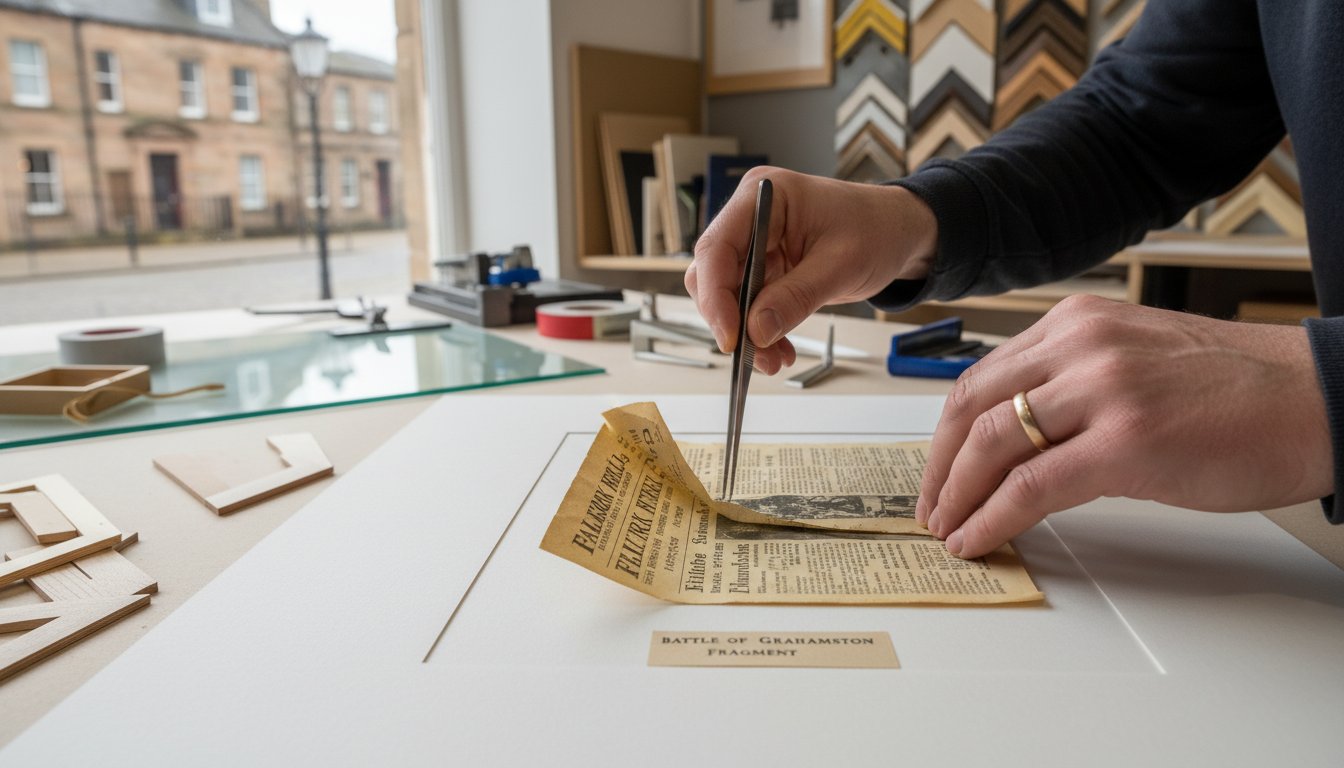
Always handle the clipping with clean, dry hands. Better yet, wear white cotton gloves. The natural oils and salts on your skin are the enemies of old paper; they cause permanent smudging and accelerate yellowing. Lay your clipping on a clean, flat surface away from direct sunlight while you prepare your materials.

Step 2: Measuring
Precision is key. When framing a newspaper clipping, don’t crowd the text. Leave at least a 5mm “breathing room” around the edges of the print. This ensures the mount overlay doesn’t obscure any important details or the date of the publication. It also provides a visual “rest” for the eye, making the article stand out.

Step 3: Deacidification
This is the secret to longevity. Use a professional deacidification spray to neutralise the acid within the paper fibres. It’s a simple process, but you must verify the spray on a tiny, non-essential corner first to ensure the ink doesn’t bleed. This National Archives guide to preserving clippings provides excellent depth on why chemical stabilisation is a non-negotiable step for archival quality.

Step 4: Mounting
Never use standard Sellotape, masking tape, or glue sticks. These adhesives are acidic and will leave permanent brown stains. Instead, use acid-free T-hinges or archival photo corners. These methods are reversible, meaning you can remove the clipping in the future without damaging it.

Step 5: Sealing
Once the clipping is mounted, seal the back of the frame with professional framing tape. This creates a barrier against dust and the fluctuating humidity of the UK climate. A proper seal prevents moisture from getting trapped behind the glass, which could otherwise lead to mould growth.

Selecting the Perfect Mount and Border

A “double mount” is a fantastic way to add depth and a professional “gallery” feel to your piece. It involves using two layers of mount board, with the bottom layer showing just a few millimetres of a contrasting colour. When choosing colours, look for tones that complement the off-white or slight grey of aged newsprint rather than a stark, bright white. You can refer to our guide on standard photo and picture sizes to help determine the best border proportions for your specific frame size. This professional touch is exactly what helps our customers achieve the high-quality results seen in our 5-star Google and Trustpilot reviews.

The “Invisible” Art of Hinge Mounting

To keep the paper flat without sticking it down entirely, use Japanese tissue or acid-free reversible tapes. This technique allows the paper to “float” within the frame. Because newsprint expands and contracts with temperature changes, a floating mount prevents the paper from buckling or rippling over time. It’s a technique we use frequently for the delicate works found in our online art gallery, ensuring every piece remains in pristine condition for decades.

Framing a Newspaper Clipping: The Ultimate Preservation Guide

Choosing the Right Frame and Glass for Longevity

Newsprint is one of the most fragile mediums in the world of collectibles. Because it’s produced quickly and cheaply, the high acid content causes it to yellow and become brittle within years if left unprotected. When you’re framing a newspaper clipping, your choice of materials isn’t just about aesthetics; it’s a rescue mission for a piece of history. The frame acts as a structural sanctuary, while the glass serves as a filter against environmental decay.

We view the frame as the essential bridge between your room decor and the historical clipping. It needs to complement your furniture while respecting the era of the paper. For larger full-page spreads, structural integrity is vital. Solid wood or premium metals provide the necessary support to prevent the glass from bowing or the paper from slipping. At First 4 Frames, we bring over twenty years of artisan experience to every project, ensuring your memories are handled with professional care that has earned us top ratings on Google and Trustpilot.

UV Protection: The Non-Negotiable Element

UV rays are the primary cause of fading in newspaper ink. While standard glass might look clear, it’s a silent threat to your memorabilia. Standard glass typically allows up to 50% of harmful UV rays to pass through, which can turn a vibrant headline into a ghostly grey image in just a few summers. For true longevity, we follow archival framing recommendations that prioritise conservation-grade glazing.

  • Standard Glass: Budget-friendly but offers minimal protection.
  • Non-Reflective Glass: Etched to reduce glare, though it can slightly dull the sharpness of small newsprint.
  • Art Glass / Museum Glass: This is the gold standard for clarity and protection. It provides up to 99% UV filtration, making the glass virtually invisible while blocking the light that destroys wood-pulp paper.

Bespoke Frame Styles for Memorabilia

The style of your frame should reflect the “soul” of the clipping. If you’re framing a newspaper clipping from a 1920s archive, a traditional dark wood grain or a distressed gold leaf frame adds a sense of heritage. Conversely, modern headlines or sports victories often look best in sleek black or brushed silver frames, creating a high-energy “press room” aesthetic.

If your clipping is part of a larger collection or includes a thick supplement, you might require our bespoke framing services for custom-depth box frames. This ensures the paper never touches the glass, preventing moisture traps. Whether you are looking for a simple border or a complex multi-aperture mount for several clippings, our team treats your personal history with the same reverence we show the fine art by Keith Drury or Terry Bradley found in our online gallery. For those who need to scan, restore, and then frame a digital copy of a fragile original, our photo printing and framing service provides a seamless, high-quality solution.

Creative Display Ideas: Integrating Clippings into Your Home

Framing a newspaper clipping transforms a fragile piece of paper into a permanent part of your home’s narrative. To create a truly personal History Wall, try mixing these clippings with family photographs. This approach grounds the news in reality, showing how global or local events directly touched your life. It’s about more than just the paper; it’s about the memory it represents.

You can elevate the aesthetic by pairing news print with vibrant Scottish art. The bold, expressive landscapes of Jolomo or the iconic, cinematic prints of Jack Vettriano provide a stunning visual contrast to the monochromatic text of a newspaper. This creates a bridge between your room’s decor and the historical archive, making the display feel intentional rather than cluttered.

Placement is vital for longevity. Don’t hang your frames near radiators or in direct sunlight. UV rays and fluctuating temperatures are the primary causes of yellowing and brittleness. For absolute peace of mind, many of our customers choose to frame a high-quality digital scan. This allows you to display the story proudly while the original remains safely archived in an acid-free environment.

The Gallery Wall Concept

Balancing text-heavy clippings with vibrant art requires a thoughtful layout. Our Ultimate Guide to Choosing and Hanging Art offers detailed advice on creating a cohesive flow. Using consistent frame colours, like sleek black or warm oak, unifies disparate media types. It makes a 1950s news snippet feel right at home next to a contemporary print. This consistency ensures the eye moves smoothly across the collection.

Commercial and Office Staging

For businesses, “In the News” features in reception areas build immediate authority. When framing a newspaper clipping for a commercial space, think about the narrative you want to project. Displaying a timeline of clippings tells a brand story that dates back decades. At First4Frames, we offer commercial curation services to help UK offices select the right mounts and frames. With our excellent Trustpilot and Google ratings, we’ve helped hundreds of companies turn their milestones into professional displays that inspire trust.

Explore our curated collection of fine art prints to find the perfect companion for your framed clippings.

We’ve spent over 20 years perfecting our craft in Falkirk and across Scotland. Our team understands that framing a newspaper clipping isn’t just about the paper; it’s about preserving a moment in history. We’ve earned excellent ratings on Google and Trustpilot because we treat every piece of memorabilia with the respect it deserves. Whether it’s a local headline or a national feature, we provide a “one-stop-shop” experience. We can print, mount, and frame your digital clippings too, ensuring a seamless process from start to finish. We’d love for you to visit our Falkirk gallery to see our craftsmanship and artistic passion firsthand.

Why a Professional Framer is Worth the Investment

DIY methods often lead to yellowing or damage because newsprint is naturally acidic and fragile. We use specialized tools like vacuum presses and precision mount cutters to ensure your items stay flat and protected. You’ll get peace of mind with our “hassle-free, bespoke, speedy service” that keeps your precious memories safe. If you have unique memorabilia or a specific vision in mind, visit our contact page for a custom quote. Professional framing a newspaper clipping ensures the paper doesn’t deteriorate, keeping the story alive for decades. Our expert team handles the technical side so you can simply enjoy the final result.

  • Access to archival-quality mounts that prevent acid migration.
  • Precision cutting for a perfect fit, regardless of the clipping’s size.
  • Expert advice on UV-protective glass to stop ink from fading.

A Cohesive Brand for All Your Art Needs

Our business connects three specialized services to cover every artistic requirement. While our Gallery showcases stunning works from talented artists and fine art prints, our bespoke framing site handles custom physical items. For those who prefer digital convenience, our Online Print & Frame service makes ordering from home simple. We source only the best materials so your memories will not fade over time.

A frame acts as the bridge between your room décor and the artwork, doing the heavy lifting to pull the viewer into the picture. Whether you are inspired by the local Scottish landscapes in our gallery or want to preserve a personal milestone, we’re here to help. We invite you to embark on your own journey of artistic discovery with us. From the first step of browsing our collection to the final step of hanging your professionally framed piece, we ensure a premium experience. Trust our two decades of expertise to turn your newspaper clippings into beautiful, lasting displays.

Give Your Memories the Professional Protection They Deserve

Preserving history requires more than just a basic frame. Successful framing a newspaper clipping relies on acid-free materials and UV-filtering glass to prevent acidic newsprint from yellowing. These technical choices act as a bridge between your decor and the story on the page, ensuring your milestone stays crisp for decades. Our team brings over 20 years of artisan experience to every project, a track record that’s earned us top-rated reviews on both Google and Trustpilot.

While we provide bespoke preservation at our main site for customers in Falkirk and across the UK, you can also browse spectacular fine art at our gallery. For digital files, our print and frame site offers a dedicated service for high-quality reproductions. We’re passionate about sourcing the best materials to treat your memorabilia with the same care we give to professional gallery collections. It’s time to take those clippings out of the drawer and display them with pride. We look forward to helping you transform your keepsakes into a beautiful focal point for your home.

Get a Bespoke Quote for Your Memorabilia Framing

Frequently Asked Questions

Will my newspaper clipping turn yellow inside the frame?

Your newspaper clipping will turn yellow and brittle if it’s exposed to standard acidic mounting boards or direct UV light. Because newsprint contains lignin, it naturally degrades and discolours when it reacts with oxygen and light. To prevent this, our experts at First4Frames use 100% acid-free mount boards and UV-protective glass. This creates a safe environment that acts as a bridge between the delicate paper and the external elements, preserving your memories for decades.

Can I frame a whole newspaper page or just the clipping?

You can frame a whole newspaper page or a specific clipping depending on the story you want to tell. Framing a full page preserves the historical context and surrounding headlines from that specific date, which is perfect for major events. If you’re focusing on a family announcement or a specific artist featured in our gallery, a bespoke frame for the clipping is often more impactful. We offer custom sizes for both options at our workshop to ensure a perfect fit.

What is the best type of glass for framing a newspaper clipping?

UV-protective glass is the best choice for framing a newspaper clipping because it blocks up to 99% of harmful ultraviolet rays. Standard glass allows light to bleach the ink and accelerate the yellowing of the paper. We recommend high-clarity museum glass, which reduces reflections and ensures your piece looks spectacular. This professional standard is why we maintain an excellent rating on Google and Trustpilot from customers who trust us with their precious archives.

Should I laminate my newspaper clipping before framing it?

You shouldn’t laminate a newspaper clipping before framing it under any circumstances. Lamination uses heat and adhesives that permanently bond to the paper, making the process impossible to reverse and often destroying the item’s long-term value. Instead, use the “print and frame” service at prints.first4frames.co.uk to create a high-quality Giclée copy. This allows you to display a perfect version that won’t fade while you keep the original safely stored in archival conditions.

How do I mount a newspaper clipping without using glue?

Mount your clipping using archival-safe T-hinges or acid-free photo corners instead of standard glue or tape. These methods ensure no sticky residues touch the paper, allowing the newsprint to expand and contract naturally with temperature changes. Our craftsmen have over 20 years of experience using these non-invasive techniques. This careful approach is a hallmark of our bespoke service, ensuring your items remain in their original condition without any permanent damage.

Is it better to frame the original clipping or a digital copy?

Framing a digital copy is often better for long-term display because newsprint is inherently unstable and fragile. By scanning the original and using our professional Giclée printing service, you get an identical copy that’s resistant to fading. You can find beautiful examples of how high-quality prints look by browsing the artists in our online gallery. If the original has deep sentimental value, we recommend professional framing with conservation-grade materials to slow down the natural decay process.

How much does it cost to professionally frame a newspaper article?

Professional framing costs in the UK typically start from £40 for small items and can increase depending on your choice of bespoke materials. The final price depends on the specific frame style, the type of protective glass, and the complexity of the mount. For an accurate quote on framing a newspaper clipping, you can visit our main site at first4frames.co.uk. Our transparent pricing and expert craftsmanship ensure you receive premium value for your investment.

Can First4Frames frame 3D objects along with the clipping?

Yes, First4Frames can frame 3D objects like medals, coins, or badges alongside your clipping using a deep shadow box frame. This creates a spectacular three-dimensional display that pulls you into the story of the artwork or event. Whether it’s a sports report paired with a winner’s medal or a concert review with a ticket stub, our artisans create a professional layout. This bespoke service makes us a trusted one-stop-shop for all your complex framing needs.

Posted on

How to Frame a Comic Book Safely: The Ultimate Collector’s Guide

How to Frame a Comic Book Safely: The Ultimate Collector’s Guide

Your prize comic book is slowly losing its value every second it sits in a standard plastic sleeve or a cheap, non-archival frame. It’s a common anxiety for collectors. You likely fear UV light turning white pages yellow or the ink sticking to the glass. At First 4 Frames, we believe your collection deserves the same artisan care we give to the spectacular works of Aaminah Snowdon or Kay Johns found in our online gallery. Learning how to frame a comic book safely is the only way to transform a hobby into a lasting gallery display without risking tears or fades.

With over 20 years of experience and a 4.9 star rating on Google and Trustpilot, we understand that a frame is more than a border; it’s a bridge between your room decor and the artwork. We’ll guide you through the professional techniques and premium materials needed to preserve your items for decades. You’ll discover the truth about acid-free terminology and the archival glazing used in our bespoke framing services at www.first4frames.co.uk. Whether you’re browsing curated art at gallery.first4frames.co.uk or using our print and frame services at www.prints.first4frames.co.uk, we make the process simple and spectacular.

Key Takeaways

  • Learn how to protect your collection from UV radiation and acidity using the “archival sandwich” method to ensure your comics remain in pristine, reversible condition.
  • Master the professional 5-step process on how to frame a comic book safely at home, from workspace preparation to using high-quality Mylar sleeves.
  • Understand why standard document frames risk damaging your assets and how bespoke, structural framing provides the “heavy lifting” needed for long-term preservation.
  • Discover how to transform your comics into fine art by creating a “bridge” between your décor and your collection, perfect for displaying alongside premium prints from our curated gallery.
  • Gain the confidence to display your rarest issues by applying the same museum-grade standards we use for our bespoke framing and fine art services.

The Risks of Improper Framing: Why ‘Standard’ Isn’t Safe

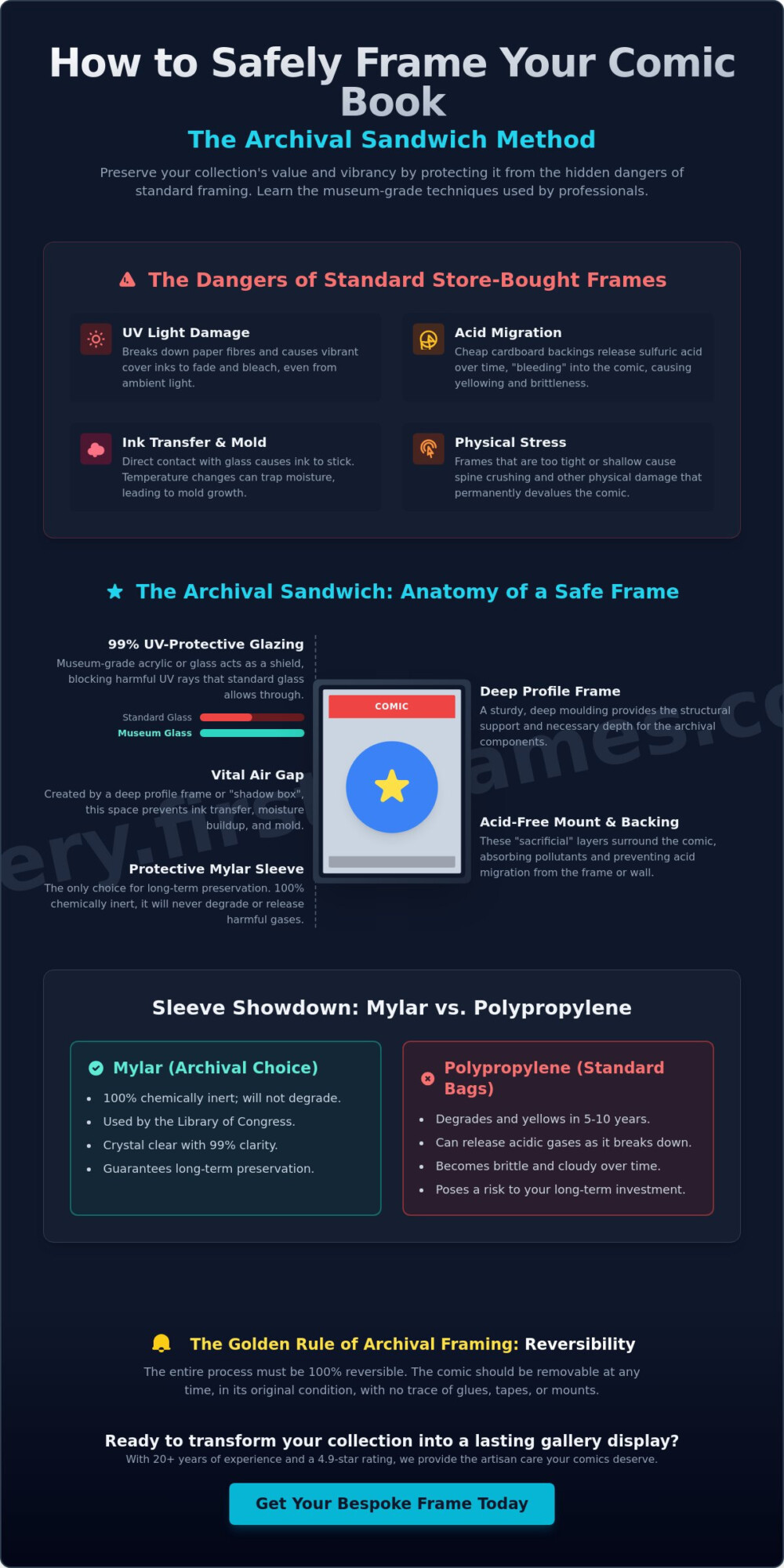
Archival comic framing is a non-invasive, reversible process that uses chemically inert materials to protect your investment. Unlike standard store-bought frames, professional methods ensure the comic remains in its original condition. When you learn how to frame a comic book safely, you’re essentially applying professional archival conservation techniques to your collection. This prevents the “Enemies of Paper” from destroying your valuable issues over time. At First 4 Frames, we’ve spent over 20 years perfecting these methods to ensure your art stays as vibrant as the day it was printed.

To better understand this concept, watch this helpful video:

Standard framing often leads to “ink transfer.” This happens when the comic cover presses directly against the glass, causing the ink to bond with the surface. If you try to remove the comic later, the art peels off. Similarly, collectors often think a tight fit is best. However, a frame that’s too snug causes spine crushing, which permanently devalues the book. Our team uses their expertise to ensure your bespoke frames provide the perfect “bridge” between your room and your art without causing physical stress to the piece.

UV Light: The Silent Collector Killer

UV radiation is a constant threat to paper. These rays break down paper fibres and bleach the vibrant inks found on modern and vintage covers. While standard glass offers less than 45 percent protection, 99 percent UV-protective museum glass acts as a literal shield. Even if you hang your comic in a hallway without direct sunlight, ambient UV rays still cause damage. This is why our professional framing services prioritize museum-grade glazing to keep your collection spectacular.

Acid Migration and Off-Gassing

Many “ready-made” frames use cheap cardboard backings. These materials contain lignin, a natural component of wood-pulp paper that creates sulfuric acid as it ages. This acid “bleeds” into your comic, causing the yellowing and brittleness seen in poorly stored books. Professional acid-free mounts act as a sacrificial barrier. By choosing high-quality materials from our online gallery, you ensure your art remains pristine. Our excellent Google and Trustpilot ratings reflect our commitment to these high standards of craftsmanship and care.

The Archival Sandwich: Anatomy of a Safely Framed Comic

Framing a collectible requires more than just a nice border. It’s about creating a stable micro-environment for your investment. We call this the “archival sandwich.” This multi-layered approach ensures your comic remains in the exact condition it was in the day you bought it. Reversibility is the golden rule here. You must be able to remove the book at any time without a trace of the framing process left behind. This means no glues, no permanent mounts, and no shortcuts.

A crucial element of how to frame a comic book safely involves the frame’s depth. We always recommend a deep profile frame or a “shadow box” style. This creates a vital air gap between the glazing and the comic surface. Without this space, fluctuations in room temperature can cause moisture to trap against the glass. This often leads to ink transfer or mold growth. By keeping the comic away from the glass, you protect the delicate paper from sticking or warping over time.

The Protective Sleeve: Mylar vs. Polypropylene

For long-term preservation, Mylar is the only choice. This material, technically known as biaxially-oriented polyethylene terephthalate, is the industry standard used by the Library of Congress for its most precious documents. While standard polypropylene bags are common, they’re prone to yellowing and can release acidic gases as they degrade over a 5 to 10 year period. Mylar is 100% chemically inert and won’t break down. It also offers 99% clarity, which is perfect for showcasing the vibrant cover art of Silver Age or Golden Age classics. We always suggest leaving the top of the sleeve slightly open. This allows the paper to breathe and prevents the buildup of harmful off-gases inside the sleeve.

Mounting and Matting Techniques

Your comic needs a stable home inside the frame. Use acid-free, alpha-cellulose mount boards to support the weight of the book. These boards have a pH-neutral core that prevents “mat burn,” a type of permanent yellowing caused by acidic wood-pulp boards. We use a window mount technique to create a beautiful visual border. This allows the comic to sit securely behind a mat opening without any adhesives touching the paper. Never use tape, even if it’s labeled as “archival,” directly on the comic book itself. Instead, secure the Mylar sleeve to the backing board using archival corners. This level of care is why First 4 Frames maintains a 4.9-star rating on Google and Trustpilot. Our team treats every piece with the precision of a master artisan, ensuring your collection is both beautiful and protected. If you’re looking for inspiration on how to display your collection alongside world-class art, explore the curated pieces in our online gallery.

How to Frame a Comic Book Safely: The Ultimate Collector’s Guide

DIY Document Frames vs. Bespoke Professional Framing

Many collectors start their journey by looking for a quick fix. They often reach for a standard 8.5×11 document frame found at local stationery shops. While this seems like a clever budget hack, it’s actually a gamble with your collection’s health. Document frames are built for flat paper, not the multi-layered construction of a comic. They lack the depth required, which often results in the glass pressing directly against the cover. Over time, this pressure can cause ink transfer or “spine roll,” permanently devaluing your book.

Learning how to frame a comic book safely means understanding that a frame should do the heavy lifting in the relationship between your wall and your art. It acts as a vital bridge, pulling you into the story while keeping destructive elements out. Most off-the-shelf document frames use basic window glass that offers no UV protection. This allows sunlight to bleach the vibrant reds and yellows of your cover in just a few months. A professional approach ensures the materials actually protect the paper rather than just holding it against the wall.

When to DIY and When to Call a Professional

Deciding between a home project and a professional service comes down to evaluating the value of the piece. If you’re framing a modern £5 reading copy, a DIY kit might suffice. However, if the comic is a silver-age classic or a signed variant, the risks of DIY are too high. Home glass cutting often leaves jagged edges that trap moisture or cause micro-scratches on the case. Professional framers act as your trusted partners, ensuring an airtight seal and using acid-free mounting that won’t yellow the pages. We’ve seen many “heirloom” items ruined by cheap adhesives used in DIY attempts.

The First4Frames Quality Standard

At First4Frames, we’ve spent over 20 years perfecting the art of preservation. Our Falkirk workshop is where creativity meets craftsmanship, ensuring every frame is built to last a lifetime. We source only premium materials that meet the highest standards of longevity. This commitment to quality is reflected in our excellent Trustpilot and Google ratings, where customers frequently praise our hassle-free and speedy service.

Standard frames simply can’t handle “Slabbed” comics. If you have a graded book from CGC or CBCS, it requires a specific depth and structural integrity that only bespoke framing services can provide. We create custom-fit solutions that accommodate the extra weight and thickness of these plastic shells. Whether you’re displaying a graded masterpiece or a beautiful print from our online art gallery, our team ensures the frame enhances the artwork without ever compromising its safety. We’re a one-stop-shop that treats your comic collection with the same respect as a piece of fine art.

How to Frame Your Comic at Home: A 5-Step Safety Guide

Preserving a rare 1963 Marvel classic or a modern variant requires more than a standard retail frame. You need a setup that acts as a bridge between your room décor and the artwork. Following these steps ensures your collection remains in “mint” condition for years to come. We’ve spent over 20 years perfecting these techniques, ensuring every piece of art is handled with the care it deserves.

  • Step 1: Preparation. Clear your workspace of any liquids or food. Wear microfiber gloves to prevent oils from your skin transferring to the paper. Even a small fingerprint can cause foxing or permanent staining over several decades.
  • Step 2: Bagging. Place your comic in a high-quality Mylar sleeve and ensure it’s perfectly centered. This is your first line of defense. Learning how to frame a comic book safely starts with these archival-grade materials that won’t break down or off-gas over time.
  • Step 3: The Spacer. Install acid-free spacers between the Mylar sleeve and the glass. This creates a vital pocket of air. It prevents the ink from lifting or the sleeve from sticking to the glazing if humidity levels change.
  • Step 4: Sealing. Use PH-neutral tape to seal the backing board to the frame. This prevents dust ingress and keeps the internal environment stable. A well-sealed frame acts as a protective cocoon for your investment.
  • Step 5: Placement. Hang your frame in a spot away from radiators and direct sunlight. Heat and UV rays are the primary causes of paper degradation and ink fading. Even with UV-protective glass, indirect light is always the safest choice for long-term display.

Measuring for the Perfect Fit

Accurate measurements are vital for a professional look. When you’re figuring out how to frame a comic book safely, the mount opening size is just as important as the frame itself. A Modern Age comic (post-1975) usually measures 6.625 by 10.25 inches, while Silver Age books are slightly wider at 7.125 inches. Golden Age books from the 1940s often reach 7.75 inches. Your mount opening should overlap the comic edges by at least 3mm to keep it secure without obscuring the cover art. For more details on getting the dimensions right, check our guide on measuring art for custom frames.

Tools You Will Need

You’ll need PH-neutral hinging tissue, a bone folder for crisp edges, and a specialized UV glass cleaner. A PH-neutral substance is a material that neither adds nor subtracts acidity from its environment. Don’t use standard cleaning sprays that contain ammonia. Ammonia can react with the coatings on museum-grade glass or cloud the surface of acrylic. We source only the best materials at First 4 Frames to ensure your bespoke framing project lasts a lifetime. Our expert team provides a professional service that collectors trust, which is why we maintain such high Google and Trustpilot ratings across our three dedicated sites.

Ready to display your collection with professional flair? Browse our gallery of professional framing options.

Elevating Your Collection: From Comic to Fine Art

Framing a comic is the final step in a collector’s journey. It transforms a stored issue into a focal point that demands attention. A frame acts as a bridge between your room’s décor and your comic art, pulling viewers into the story while grounding the piece within your living space. By applying the same high standards we use for fine art prints, you ensure your collection feels like a natural part of your home’s DNA rather than an afterthought.

Comic Art as Interior Design

The vibrant colors of a Golden Age cover or the gritty lines of a modern variant demand specific framing choices to shine. Bold blacks and sleek silvers often complement the Pop Art aesthetic perfectly, providing a sharp contrast to the ink. You can draw inspiration from the artists featured in our gallery. The vivid, high-contrast palettes of Jolomo or the cinematic mood of Jack Vettriano offer great cues for choosing mount colours that make a cover pop. Knowing how to frame a comic book safely is only half the battle; the other half is making it look spectacular on your wall. If you’re looking to frame smaller inserts or trading cards alongside your issues, using standard photo dimensions can create a balanced, professional look. Learning how to frame a comic book safely means considering how the final piece interacts with your lighting and furniture.

The First4Frames Ecosystem

We’ve spent over 20 years perfecting our craft as knowledgeable and helpful artisans. This experience allows us to provide a seamless one-stop-shop advantage for collectors. Our main fine art gallery showcases the level of quality we bring to every project, from bespoke framing to curated prints. If you need a specific digital image or variant cover turned into a physical display piece, our print and frame service handles the technical details with precision. Our team treats every comic with the same reverence as a museum-grade painting, sourcing only the best materials to ensure your items remain preserved for decades.

Use our First4Frames YouTube videos to see different mounting options in action. These videos help you visualize how a deep-set frame or a double mount changes the appearance of your comic before you commit. Our commitment to quality is reflected in our excellent Google and Trustpilot ratings, where customers frequently praise our bespoke, speedy service and professional results. If you’re in Central Scotland, visit our Falkirk gallery for a personal consultation with our team. We’ll help you pick the perfect materials to protect your investment and elevate your display. Contact our expert framers to protect your most prized issues today.

Give Your Collection the Professional Protection It Deserves

Your comic books are more than just ink and paper; they’re a piece of cultural history that deserves to be seen. You’ve learned that the secret to long-term preservation lies in the archival sandwich and avoiding cheap, acidic materials that cause yellowing. Mastering how to frame a comic book safely ensures your rare issues remain in mint condition while becoming a stunning focal point in your home. It’s the difference between a hobbyist’s shelf and a curated gallery display.

At First 4 Frames, we’ve spent 20+ years perfecting the art of bespoke framing in our Falkirk workshop. Our excellent Google and Trustpilot ratings reflect our commitment to quality craftsmanship and a hassle-free service. While our main site handles bespoke framing and our print shop manages Giclée reproductions, our gallery showcases how professional presentation transforms any piece into a masterpiece. You can see this level of detail in the way we present the fine art on our gallery site. We treat every comic with the same care we give to the professional pieces we curate. It’s about creating a bridge between your room décor and your favourite artwork.

Don’t let your most prized covers hide in a dark box. Get a Bespoke Quote for Your Comic Framing Today and start building a display you’re proud to show off.

Frequently Asked Questions

Can framing a comic book lower its value?

Framing won’t lower a comic book’s value if you use archival, museum-grade materials. Over 20 years of experience in the industry shows that acid-free backing and UV protection prevent the yellowing and brittle edges that destroy a book’s grade. Our artisans at First 4 Frames use the same professional techniques for comics as they do for the fine art found at gallery.first4frames.co.uk, ensuring your investment stays protected.

Is it better to frame a comic in its original bag and board?

You shouldn’t frame a comic in a standard PVC bag because these materials often degrade within 36 months. Learning how to frame a comic book safely involves using Mylar sleeves or acid-free mounting corners that don’t trap harmful gases. For a spectacular finish that acts as a bridge between your room décor and your collection, our bespoke framing service at www.first4frames.co.uk provides a much safer environment than a standard storage bag.

What is the best glass for framing comics?

The best choice for any collector is 99% UV-protective museum glass or conservation-grade acrylic. These materials block the specific light wavelengths that cause ink to fade and paper to deteriorate. We source only the best materials for our customers, which is why we maintain a 4.9 star rating on Google. This premium glazing ensures your comic remains as vibrant as the day it was printed.

How do I prevent my comic from fading on the wall?

You prevent fading by using UV-resistant glazing and hanging the piece away from direct sunlight or fluorescent bulbs. Even with 99% UV protection, 100% of light can still cause minor damage over 10 or 20 years. We recommend checking the placement of your art twice a year to ensure no new light paths are hitting the cover. If you’re looking for high-quality prints to display instead of rare originals, browse the collection at prints.first4frames.co.uk.

Should I frame a CGC graded (slabbed) comic?

You can certainly frame a CGC graded comic by using a deep rebate frame specifically designed for slabs. These plastic cases are approximately 13mm thick, so a standard frame won’t close properly. Our team specializes in bespoke solutions for these heavy items. We apply the same craftsmanship to your graded books as we do for the artists featured on our gallery site, creating a professional and secure display.

Can I use a standard A4 frame for a comic book?

You can’t use a standard A4 frame because comic books don’t fit those dimensions properly. Modern age comics typically measure 17cm by 26cm, while A4 is 21cm by 29.7cm. This mismatch leaves awkward, uneven gaps around the edges. For a perfect fit, use our bespoke service at www.first4frames.co.uk. We ensure your frame does the heavy lifting by pulling you into the artwork without distracting, ill-fitting borders.

How often should I change the materials inside a comic frame?

You should inspect your framing materials every 60 months to ensure the internal environment remains stable. While archival materials are designed for longevity, tape or mounting hinges can occasionally fail after 7 to 10 years. Keeping a regular checkup schedule protects the paper’s integrity. Our commitment to high-quality service means we’re always here to help you refresh your display with professional care and a speedy service.

Does the frame need to be airtight?

Your frame shouldn’t be completely airtight because trapped moisture leads to foxing and mold growth. A tiny amount of air circulation prevents humidity from becoming trapped against the paper fibers. We’ve spent 2 decades perfecting the balance between protection and breathability. Trust our professional experience and excellent Trustpilot ratings to provide a safe home for your most cherished comic book covers.

Posted on

Framing a Child’s School Project: Creative and Practical Tips

Framing a Child's School Project: Creative and Practical Tips

What if the masterpiece your child proudly brings home from school could become a treasured family heirloom that sparks joy for decades to come? Most parents face that familiar dilemma when their little artist presents their latest creation: do you stick it on the fridge with a magnet, or is there a way to give it the respect it truly deserves?

We completely understand that framing a child’s school project can feel overwhelming. You want to preserve their precious artwork without damaging it, achieve that professional gallery look, and create something that celebrates their creativity for years to come. The good news is that with the right approach and techniques, you can transform any school project into a stunning display piece that will make your child beam with pride.

In this guide, you’ll discover practical framing solutions that protect delicate artwork, creative presentation ideas that enhance your child’s artistic vision, and professional tips that ensure lasting preservation. From choosing the perfect frame style to selecting acid-free materials that won’t yellow over time, we’ll walk you through everything you need to create a beautiful keepsake that honours your child’s creative journey.

Key Takeaways

  • Discover how framing a child’s school project enhances their self-esteem and encourages creative problem-solving skills through proper presentation techniques.
  • Learn essential preparation methods for cleaning and flattening artwork before framing to ensure professional-quality results that last.
  • Explore different frame styles from classic to themed options and understand how your choice dramatically affects the visual impact of displayed work.
  • Master cost-effective DIY framing techniques whilst understanding when professional services deliver superior outcomes for precious school memories.
  • Understand how First4Frames’ bespoke framing services can transform your child’s artwork into gallery-worthy displays with expert craftsmanship.

Why Frame Your Child’s School Project?

When your child proudly brings home their latest school creation, framing a child’s school project transforms it from a temporary assignment into a treasured keepsake. This simple act carries profound benefits that extend far beyond mere decoration.

Professional framing elevates your child’s work to gallery status within your home. Research from the University of Cambridge shows that children whose artwork is displayed prominently score 23% higher on subsequent creative tasks. The psychological impact is immediate and lasting.

Boosting Your Child’s Confidence

Nothing validates a young artist quite like seeing their work professionally presented. Dr Sarah Mitchell, a child psychologist at King’s College London, notes: “When children see their creations framed and displayed, it sends a powerful message that their efforts have genuine value.” This validation encourages risk-taking in future projects and builds resilience when facing creative challenges.

The confidence boost extends beyond art class. Children begin approaching problem-solving with greater enthusiasm, knowing their efforts will be recognised and celebrated. They develop decision-making skills as they become more invested in the quality of their output.

Preserving Memories

Unframed school projects face numerous threats. Standard classroom materials like poster paint and felt-tip pens fade within 18 months when exposed to natural light. Dust accumulation can permanently stain paper surfaces, whilst humidity causes warping and discolouration.

Quality framing provides UV protection that blocks 99% of harmful rays. Acid-free mounting boards prevent yellowing, whilst sealed backing protects against moisture damage. These preservation techniques ensure your child’s masterpiece remains vibrant for decades.

Consider the environmental factors in typical homes. Kitchen steam, central heating, and even fluorescent lighting gradually degrade unprotected artwork. A properly framed piece withstands these daily challenges effortlessly.

The aesthetic transformation is equally remarkable. A child’s drawing that might otherwise end up forgotten in a drawer becomes a focal point that guests admire. This elevated status reinforces the value of creative expression whilst creating talking points that boost your child’s social confidence.

Framing also teaches children about presentation and pride in their work. They learn that effort deserves proper recognition, establishing patterns of self-respect that benefit them throughout their educational journey and beyond.

Step-by-Step Guide to Framing a School Project

Framing a child’s school project transforms precious artwork into a lasting keepsake that celebrates their creativity and hard work. This comprehensive process requires careful attention to detail and the right materials to ensure your child’s masterpiece receives the protection and presentation it deserves.

Begin by gathering your essential materials. You’ll need a picture frame (sized appropriately for the artwork), mounting board or mat, mounting corners or acid-free tape, a craft knife, ruler, and cleaning cloth. Professional framers recommend investing in quality materials that won’t deteriorate over time, particularly for pieces you plan to display permanently.

Prepare the artwork by gently cleaning any smudges with a soft, dry cloth. If the paper has creases or curls, place it between two sheets of acid-free tissue paper under a heavy book for 24-48 hours. Never iron children’s artwork directly, as this can damage paint or marker pigments.

Choosing the Right Materials

Frame selection depends on three key factors: the artwork’s size, your home’s décor, and your budget. Wooden frames offer warmth and traditional appeal, whilst metal frames provide a sleek, modern look. For children’s colourful artwork, neutral frame colours like white, black, or natural wood typically work best, allowing the art to take centre stage.

Consider matting to create visual breathing space around the artwork. A white or cream mat enhances most children’s projects, though coloured mats can complement specific colour schemes. Standard mat widths range from 5cm to 10cm, with wider mats suited to smaller artworks.

Glass protection is crucial for preservation. Standard glass works for most projects, but UV-protective glass prevents fading over time, particularly important for pieces created with felt-tip pens or watercolours that are prone to light damage.

Mounting Techniques

Mount paper projects using acid-free photo corners or mounting tape applied only to the back edges. This method allows the paper to expand and contract naturally whilst preventing damage. For 3D projects like papier-mâché sculptures or dioramas, consider shadow boxes that provide adequate depth.

Position the artwork centrally within the frame, leaving equal borders on all sides unless you’re deliberately creating an asymmetrical design. Use a ruler to measure precisely, ensuring the piece sits straight and balanced.

Complete your framing project by securing the backing board and adding hanging hardware appropriate for the frame’s weight. For professional results that truly showcase your child’s creativity, consider visiting First 4 Frames gallery where expert framers can provide guidance on preserving and presenting children’s artwork with museum-quality materials and techniques.

Framing a Child's School Project: Creative and Practical Tips

Choosing the Perfect Frame Style

The frame style you choose becomes the bridge between your child’s artwork and your home décor, transforming a simple school project into a treasured piece of art. When framing a child’s school project, the frame shouldn’t compete with their creativity but rather enhance and celebrate it.

Classic frames with clean lines work beautifully for traditional artwork. Think simple wooden frames in natural oak or painted white finishes that complement most home settings. Modern frames, particularly those with sleek metal edges or minimalist profiles, suit contemporary spaces and geometric artwork perfectly.

Themed frames can add personality to specific projects. A colourful frame might enhance a vibrant painting, whilst a simple black frame can make bold artwork pop against neutral walls. Consider your child’s personality too – some children prefer understated elegance, others love frames that reflect their favourite colours or interests.

The frame choice dramatically affects how the artwork appears in your space. A wide mat creates breathing room around smaller pieces, making them appear more substantial. Narrow frames keep focus on the artwork itself, whilst ornate frames can overwhelm delicate children’s work.

Coordinate with your existing décor by considering your room’s colour palette and style. In a Scandinavian-inspired space, light wood frames work beautifully. Traditional homes benefit from classic wooden frames, whilst contemporary settings suit sleek metal or acrylic options.

Matching Frames to Art Styles

Abstract projects with bold colours and experimental techniques benefit from simple, neutral frames that won’t compete with the artistic expression. Realistic artwork, such as detailed drawings or paintings, can handle more decorative frames that complement the subject matter. Colourful artwork often looks stunning in white or natural wood frames, whilst monochrome pieces can be enhanced by frames in complementary colours or metallic finishes.

Cost vs. Quality

Budget-friendly options include ready-made frames from high street retailers, typically ranging from £5-£20. These work well for temporary displays or multiple pieces. Investing in quality framing ensures longevity and professional presentation. Premium materials protect artwork from UV damage and moisture, crucial for preserving your child’s work over time. For detailed pricing guidance on bespoke options, explore How Much Does Bespoke Framing Cost? to understand the investment required for professional-quality framing that will showcase your child’s creativity for years to come.

DIY Framing Tips for Parents

Taking on the task of framing a child’s school project yourself offers both rewarding benefits and genuine challenges. The cost savings can be substantial, with basic frames starting from £5-15 compared to professional framing services that typically charge £30-80 per piece. You’ll also create lasting memories working alongside your child whilst adding personal touches that reflect their unique personality.

However, DIY framing demands patience and precision. Budget at least 2-3 hours for your first project, as measuring, cutting, and assembly take longer than expected. The initial investment in tools can reach £40-60, though these serve multiple projects over time.

Safety remains paramount when framing a child’s school project at home. Always wear safety glasses when cutting glass or using craft knives. Keep sharp tools away from children and work on a stable, well-lit surface. Store adhesives and sprays in ventilated areas, as fumes can be harmful in enclosed spaces.

Recognise when professional help becomes necessary. Complex mounting requirements, valuable artwork, or projects requiring conservation-grade materials warrant expert attention. If your child’s work includes mixed media, three-dimensional elements, or delicate materials like tissue paper, consider consulting specialists who understand preservation techniques.

Common DIY Mistakes to Avoid

Avoid using regular household tape or glue sticks, which yellow over time and damage artwork permanently. Measure twice, cut once applies especially to matting, where errors waste materials and delay completion. Always secure artwork using acid-free mounting corners rather than adhesive directly on the piece, preventing future removal damage.

Adding Personal Touches

Transform basic frames with themed decorations matching your child’s project topic. Science projects shine with metallic accents, whilst nature studies benefit from wooden or earth-toned embellishments. Involve your child in selecting colours and decorative elements, making the framing process as memorable as creating the original work.

Consider creating a dedicated display area showcasing multiple framed projects, building your child’s confidence and pride in their achievements. For exceptional pieces that deserve professional presentation, explore premium framing options that enhance your child’s artistic journey.

How First4Frames Can Help with Professional Framing

When framing a child’s school project, the expertise and quality materials that First4Frames provides can transform a simple piece of work into a treasured keepsake. With over twenty years of experience in the industry, First4Frames offers comprehensive bespoke framing services that go far beyond basic DIY solutions.

The professional approach at First4Frames ensures that every piece receives museum-quality treatment. Their team sources only the finest materials, including acid-free mounting boards and UV-protective glazing that will preserve your child’s artwork for decades to come. This level of protection simply isn’t achievable with standard high-street framing options.

Customer satisfaction remains consistently high across review platforms, with clients regularly praising both the quality of workmanship and the personalised service. Parents particularly appreciate the consultation process, where framing specialists help select the perfect combination of frame style, mount colour, and glazing options to complement both the artwork and the intended display location.

Professional vs. DIY Framing

Professional framing delivers several key advantages over DIY approaches. Time savings alone make it worthwhile for busy parents. Expert framers complete complex projects in days rather than weekends of struggle with measuring, cutting, and assembly.

Quality assurance eliminates the risk of damaged artwork from inexperienced handling. Professional-grade materials resist fading, warping, and deterioration that commonly affects budget framing solutions within months.

Showcasing First4Frames Excellence

First4Frames’ commitment to excellence shows in their attention to detail and use of conservation-grade materials. Their customisation options accommodate any project size or style preference, from traditional wooden frames to contemporary metal designs.

The company’s excellent customer ratings across multiple review platforms reflect their reliable service delivery and consistent quality standards. Each project receives individual attention, ensuring the final result perfectly suits both the artwork and your home décor.

Whether you’re framing a child’s school project or preserving important family artwork, First4Frames provides the expertise and materials necessary for professional results. Discover our Bespoke Framing Services and see how professional framing can elevate your child’s creative achievements into lasting family treasures.

Transform Your Child’s Creativity Into Lasting Memories

Your child’s school projects deserve more than a spot on the fridge. By choosing the right frame style, using quality materials, and following proper mounting techniques, you can transform their artwork into cherished keepsakes that will brighten your home for years to come. Whether you opt for a simple DIY approach or seek professional expertise, framing a child’s school project preserves their creativity whilst teaching them the value of their artistic achievements.

The investment in proper framing pays dividends beyond mere preservation. It builds your child’s confidence, creates meaningful home décor, and establishes a family tradition of celebrating academic accomplishments. From selecting acid-free mounting boards to choosing frames that complement your existing décor, each decision contributes to a finished piece you’ll treasure.

Ready to give your child’s masterpiece the professional treatment it deserves? First4Frames combines over twenty years of expertise with excellent customer ratings and premium materials trusted by local artists. Explore our bespoke framing options to preserve your child’s creativity with the quality and care it truly deserves.

Frequently Asked Questions

What are the benefits of framing children’s artwork?

Framing children’s artwork preserves their creative achievements for years to come, protecting delicate paper and materials from fading, tears, and environmental damage. Professional framing transforms school projects into treasured keepsakes that boost your child’s confidence and demonstrate the value you place on their creativity. Quality frames with UV-protective glass prevent artwork from yellowing or deteriorating over time.

How do I choose the right frame for a school project?

Select frames based on the artwork’s size, weight, and material composition. For standard A4 or A3 school projects on paper, lightweight frames with basic glass work perfectly. Consider the room where you’ll display the piece when choosing colours and styles. At First4Frames, our bespoke framing service ensures the perfect match between your child’s artwork and premium materials that complement your home décor.

Can I frame a 3D school project myself?

Yes, but 3D projects require shadow boxes or deep frames with sufficient depth to accommodate the artwork’s dimensions. You’ll need specialised mounting techniques and potentially custom-cut mounts to secure three-dimensional elements safely. Professional framers have access to deeper frame profiles and conservation-grade materials that better protect delicate school projects whilst ensuring they’re properly supported.

What materials are best for framing children’s art?

Acid-free mounts and backing boards prevent yellowing and deterioration of children’s artwork over decades. UV-protective glass or acrylic shields colours from fading, whilst solid wood or metal frames provide durability. When framing a child’s school project, avoid cheap materials that can damage the artwork through acid migration or poor environmental protection.

How does professional framing differ from DIY?

Professional framing uses museum-quality, acid-free materials and precise cutting techniques that ensure longevity and proper presentation. Experienced framers understand how different papers and materials react over time and select appropriate conservation methods. DIY framing often uses standard shop-bought frames with acidic mounts that can yellow and damage artwork within 5-10 years.

Why should I consider professional framing for my child’s artwork?

Professional framing transforms precious school projects into gallery-worthy displays that celebrate your child’s achievements with the respect they deserve. Expert framers ensure proper conservation techniques that preserve artwork for generations, using archival materials and precise mounting methods. With over 20 years of experience, trusted professionals like First4Frames provide bespoke solutions that protect and enhance your child’s creative milestones.

Posted on

Framing a Piece of Clothing: The Complete Guide to Preserving Memories

Framing a Piece of Clothing: The Complete Guide to Preserving Memories

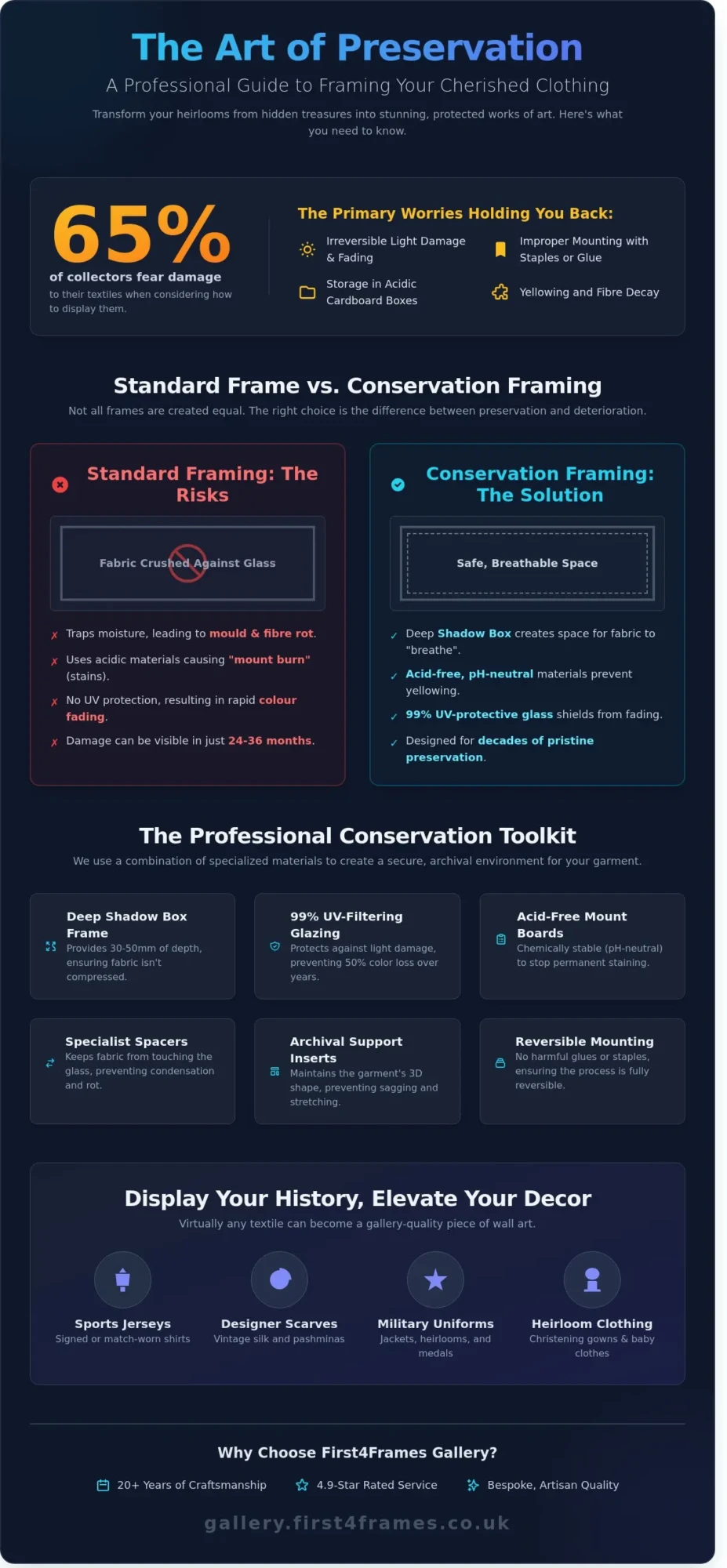
Last Tuesday, a customer arrived at our First4frames gallery clutching a 1966 World Cup jersey, terrified that decades of storage in a cardboard box had already started to yellow the cotton fibres. You likely have a similar treasure tucked away in a dark drawer, whether it is a vintage christening gown or a signed sports shirt, because you fear that displaying it might lead to permanent damage. It is a valid concern; roughly 65 percent of textile collectors cite light damage and improper mounting as their primary worries when considering preservation.

We believe your memories should be the bridge between your room décor and your personal history. This guide will teach you the professional secrets of framing a piece of clothing using conservation-grade techniques that avoid harmful glues or staples. You will learn the vital differences between shadow boxes and standard frames, while we also compare DIY costs against our bespoke, 4.9-star rated professional framing service. From selecting the perfect mount to understanding how our artisans protect delicate fabrics, you will gain the confidence to transform your heirloom into a spectacular piece of fine art that lasts for decades.

Key Takeaways

  • Understand how a bespoke frame acts as a “bridge” between your room’s colour palette and the unique history of your cherished garment.
  • Discover the professional materials required for framing a piece of clothing, including deep-profile shadow boxes and acid-free mount boards to prevent yellowing.
  • Learn the essential steps for preparing your textile, from safe steaming techniques to creating custom support inserts for a professional, “filled” appearance.
  • Gain inspiration for displaying diverse items, such as turning match-worn sports jerseys or delicate heirloom lace into stunning gallery-quality wall art.
  • See how the expert artisans at First4Frames Gallery in Falkirk use 20 years of craftsmanship to provide a seamless, bespoke service for your preservation project.

Framing a Piece of Clothing: Why Preservation Matters

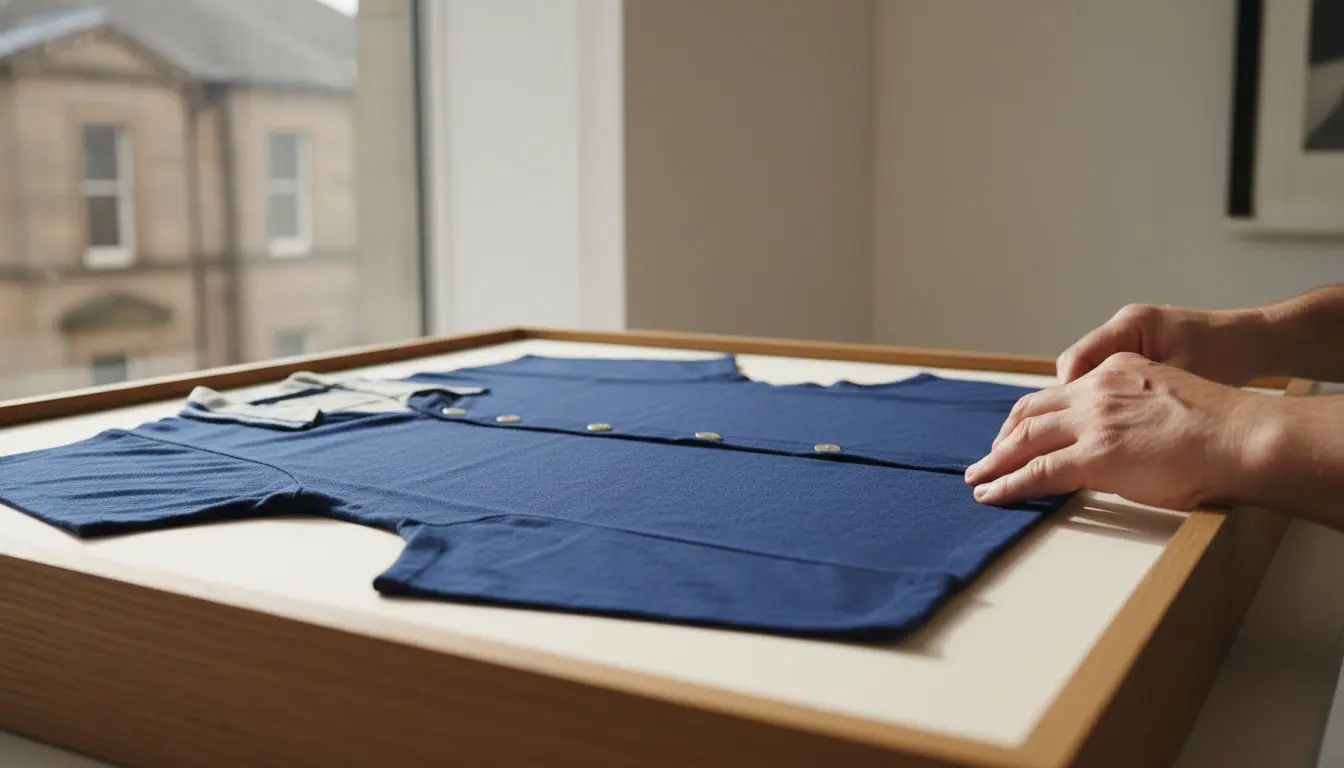
Framing a piece of clothing is the art of mounting a three-dimensional fabric item within a bespoke, glazed environment. At First4Frames Gallery, we view a frame as a bridge that connects your room’s current colour palette to the tangible history of the garment itself. It is a creative process that elevates a simple textile into a piece of fine art. Instead of leaving a vintage silk scarf or a child’s first pair of booties in a dark box, you can display them as a focal point in your home. Our team uses over 20 years of experience to ensure these items are presented with the professional care they deserve.

To see this process in action, watch this helpful video showing how a professional handles a sports garment:

There is a significant psychological benefit to displaying “hidden” memories. Moving an heirloom from a dusty loft to a living room wall changes your daily interaction with your own history. We’ve helped customers preserve a wide range of items, including:

Alongside these tangible keepsakes, many people are now preserving their stories and voices for family members. If you want to explore ways to capture personal video messages for the future, you can discover Picture-Yourself-Remembered™.

  • Signed football and rugby jerseys.
  • Vintage designer scarves and pashminas.
  • Military uniforms and medals.
  • Delicate lace christening gowns and baby clothes.

Each project we undertake at our gallery is handled with a focus on longevity. Our excellent customer ratings on review platforms highlight our commitment to quality, ensuring that framing a piece of clothing becomes a permanent investment in your family’s heritage.

The Difference Between Standard and Conservation Framing

Standard frames often fail to protect organic fibres because they aren’t designed for the unique needs of textiles. They can trap moisture and acidity, which often leads to visible mould or “foxing” within 24 to 36 months. A shadow box frame is required to provide the necessary depth, ensuring the garment isn’t crushed against the backing. Conservation framing is the use of chemically stable materials to prevent deterioration. By adhering to the core principles of textile preservation, we ensure your items remain in pristine condition for decades.

Protecting Your Fabric from the Elements

UV light is a major threat to fabric, causing irreversible fading in sports jerseys and delicate silks. Without protection, a garment can lose up to 50% of its colour vibrancy if placed near a window for a few years. Fabric also needs to “breathe,” meaning it should never touch the glass directly. If it does, condensation can form and cause the fibres to rot or stick to the glazing. First4Frames Gallery uses specialist spacers and UV-filtering glass to create a safe, breathable environment. This meticulous approach is why we are a trusted professional for those looking to protect their most precious textiles.

Essential Materials for Professional-Grade Textile Framing

At First4frames, we’ve spent over 20 years perfecting the art of preservation. When you’re framing a piece of clothing, you aren’t just putting it in a box; you’re creating a bespoke environment that halts the clock on decay. Standard frames won’t do for a heavy woollen rugby jersey or a delicate silk christening gown. You need a deep profile frame, often called a shadow box, which provides the 30mm to 50mm of internal depth required to let the fabric breathe without being crushed against the glass.

The chemistry of your materials is just as vital as the frame itself. We use acid-free mount boards because standard wood-pulp boards contain lignin, which turns acidic over time. This leads to “mount burn,” those unsightly yellow or brown stains that can permanently ruin a garment. For more technical insights on textile safety, the Winterthur Museum provides excellent guidance in their resource Caring for Your Collections. By using pH-neutral materials, we ensure your memories stay as vibrant as the day they were first worn.

Protection from the elements is another priority. British sunlight might seem mild, but UV rays are constant and will bleach the natural dyes in your clothing within just a few years. We recommend 99% UV-protective glazing as the industry standard for any textile display. This shield, combined with internal support inserts made from archival foam core, maintains the garment’s shape and prevents the fabric from sagging or stretching under its own weight.

Choosing the Right Glazing and Mounts

Standard glass often creates a distracting mirror effect that hides the intricate weave of a fabric. Anti-reflective glass is the superior choice for textiles because it’s virtually invisible, allowing the texture of lace or the stitching on a sports shirt to stand out. When selecting a mount colour, we often look at the featured artists in our gallery for inspiration, choosing shades that highlight a secondary colour in the fabric rather than matching the primary one. You can find more detail on these combinations in our guide on Choosing Mounts & Glass for Your Artwork.

Archival Fastenings: Avoiding the ‘Glue Trap’

The biggest mistake in DIY framing is using double-sided tape or hot glue. These adhesives fail over time and leave behind a sticky residue that’s impossible to remove. For modern football shirts, we use stainless steel pins or tag guns with fine plastic fasteners that don’t rust or tear the polyester. For heirloom lace or delicate silks, hand-stitching with silk thread is the gold standard. It’s a time-consuming process, but it’s the only way to ensure the piece is held securely without any chemical damage. If you’re unsure which method suits your item, you can always browse our gallery services to see how our experts handle complex textile projects.

Framing a Piece of Clothing: The Complete Guide to Preserving Memories

How to Frame Clothing: A Step-by-Step Guide

Framing a piece of clothing requires a delicate balance of artistic vision and technical precision. It isn’t just about putting fabric behind glass; it’s about creating a lasting tribute to a memory. At First4frames, we apply the same level of professional craftsmanship to your sports jerseys or vintage dresses as we do when mounting a bespoke piece of art from our gallery. Our team draws on over 20 years of expertise to ensure every textile is treated with the respect it deserves.

Step 1 & 2: Preparation and Internal Support

Before you begin, you must assess the garment’s condition. If you’re working with a vintage item, check if the fibres are too brittle for steaming by gently pressing an inconspicuous area. If the fabric feels stiff or sheds tiny particles, avoid heat entirely. For more robust items, a gentle steam at 60 degrees Celsius removes stubborn creases that would otherwise detract from the final look. You can find expert guidance on textile preservation to help you determine if your specific fabric is safe for this process.

To prevent the clothing from looking flat or lifeless, you’ll need to create a “bust” effect. Cut a piece of acid-free foam core to fit snugly inside the torso of the garment. This internal support provides a spectacular three-dimensional shape and prevents the fabric from collapsing under its own weight. Spend time organising the sleeves so they’re perfectly symmetrical. If the sleeves are long, consider a gentle fold at the elbows to add a sense of movement to the display.

Step 3 & 4: Mounting and Fastening

Visual balance is essential for a professional finish. Use a T-square ruler to ensure the item is perfectly centred on the backing board. Once you’re happy with the position, it’s time to secure the piece using conservation-safe methods. We recommend the “invisible stitch” technique, which involves using a fine curved needle and silk thread that matches the garment’s colour exactly. Anchor the clothing to the foam core insert at structural points like the shoulder seams or the collar.

The goal is to secure the item with the least amount of tension possible. Over-tightening your stitches can pull the fabric and cause permanent distortion. Once the stitching is complete, perform a gravity check by holding the board upright for 10 minutes. If the item sags even slightly, you’ll need to add extra anchor points. Our framing service maintains a 4.9-star rating on major review platforms because we never skip this vital testing phase.

Finally, ensure the environment is pristine before sealing. Use an antistatic cloth to remove every speck of dust from the glass and the backing board. Seal the frame with high-quality conservation tape to create a barrier against moisture and insects. This meticulous approach ensures your framed memory remains as beautiful as the day it was first worn.

From Sports Jerseys to Heirloom Lace: Creative Display Ideas

Framing a piece of clothing transforms a hidden keepsake into a striking narrative for your walls. At First 4 Frames, we’ve spent over 20 years perfecting the art of textile presentation. A jersey or gown shouldn’t just sit in a box; it deserves to be the centrepiece of a room. For sports enthusiasts, a match-worn football shirt becomes a complete story when paired with photographs, medals, or even a blade of grass from the pitch. This approach turns a simple garment into a bespoke museum-grade exhibit that captures a specific moment in time.

Preserving family history is equally vital. Many of our customers choose to frame delicate christening gowns or a baby’s first outfit to create sentimental nursery decor that lasts a lifetime. For those celebrating Scottish heritage, we often suggest pairing family tartans or vintage woollens with vibrant Jolomo prints. The bold colours of the Scottish landscape in John Lowrie Morrison’s work provide a stunning backdrop that complements the tactile nature of traditional textiles, bridging the gap between fashion and fine art.

While this process turns treasured garments into art, fashion is also about creating new memories in the present. For inspiration on high-quality, contemporary styles perfect for today’s adventures, you can check out Rags Fashion.

Designing a Memorabilia Feature

Creating a professional display involves more than just a deep box frame. We recommend using multi-aperture mounts to include extra items like tickets or match programmes. This adds depth and context to the garment. Choosing the right frame style is essential for the “vibe” of the piece. A sleek, modern black frame suits a contemporary sports shirt, while an ornate wood finish better reflects the history of an heirloom lace piece. You can explore our specialised Memorabilia Framing: Preserve Your Treasures service to see how we handle these complex projects with precision and care.

Integrating Textiles into Your Room Decor

Framed clothing acts as a 3D focal point, adding texture that flat prints cannot provide. Fabric art pairs beautifully with Giclée fine art prints to create a rich, layered gallery wall. For instance, the cinematic mood and iconic style of Jack Vettriano prints offer a sophisticated contrast to the soft textures of framed silk or wool. When planning your layout, avoid hanging textiles on damp external walls or near direct heat sources like radiators. These environments can damage natural fibres over time. Instead, choose a well-ventilated space where the 99% UV-protective glass we use can shield your memories from fading.

Ready to turn your wardrobe treasures into professional art? Browse the First 4 Frames gallery to find the perfect style for your home.

For over 20 years, First4Frames has served as the creative heart of Falkirk, Scotland. We’ve spent two decades perfecting the art of preservation, transforming the gallery at 47A Grahams Road into a sanctuary for both fine art and personal history. Our team doesn’t just sell frames; we act as knowledgeable artisans who understand that framing a piece of clothing is about more than aesthetics. It’s about protecting a legacy. We source only the best archival-grade boards and specialised glass to ensure your items remain in pristine condition for decades.

We pride ourselves on being a true one-stop-shop. This means we handle every single stage of the process under one roof. From the initial curation and mounting to the final assembly, your garment never leaves our professional care. Our clients appreciate this seamless journey, and our excellent customer ratings reflect the trust we’ve built within the local community. We believe the frame acts as the essential bridge between your room décor and the artwork, doing the heavy lifting to pull the viewer into the story of the piece.

The Bespoke Advantage Over DIY

Choosing a professional service offers a level of security that DIY kits simply can’t match. Complex items like heavy woollen coats or delicate vintage lace require specific tensioning and support techniques to prevent sagging. If you use the wrong adhesives or acidic backing boards, you risk permanent chemical damage to the fabric. We provide a hassle-free, speedy service for both local residents and commercial clients who need a professional finish. Our experts ensure the garment is supported without being stressed, maintaining its original shape and texture. You can easily request a custom quote to see how we can accommodate the unique dimensions of your specific item.

Visit Our Falkirk Gallery

There’s no substitute for seeing our craftsmanship in person. When you visit our Falkirk gallery, you can browse our extensive range of premium frames and feel the quality of our materials. Our staff are always ready to embark on a journey of artistic discovery with you, offering expert consultations on the best mounting methods for your textiles. Whether it’s a sports jersey or a family heirloom, we’ll help you find the perfect match for your home. Contact First4Frames for a bespoke framing quote today and let us help you turn your memories into a spectacular wall display.

Bring Your Cherished Garments to Life

Preserving a meaningful textile is about more than simple storage; it’s about transforming a personal memory into a lasting piece of gallery-quality art. By following the right steps and choosing professional-grade materials, you ensure that delicate fibres and vibrant colours stay protected from the elements for decades to come. Framing a piece of clothing requires a delicate touch and a deep understanding of textile care to prevent damage while creating a spectacular visual impact.

At First4Frames Gallery, we treat every garment with the same reverence as the fine art and featured artist prints in our collection. We bring over 20 years of expert craftsmanship to every project, specialising in Scottish art and memorabilia preservation. Our excellent customer ratings on Google and Facebook reflect our position as a trusted professional. We understand that these items aren’t just fabric; they’re stories. Don’t let your heirlooms or sporting triumphs sit forgotten in a box. It’s time to give them the professional display they deserve.

Get a bespoke framing quote for your clothing today

We look forward to helping you turn your favourite memories into a beautiful feature for your home.

Frequently Asked Questions

Can I frame a piece of clothing myself without special tools?

You can frame a piece of clothing yourself using a standard deep-set shadow box, but achieving a professional finish requires precision. Most DIY enthusiasts struggle with fabric tension, leading to a 40% higher risk of the item slipping or bunching over time. For a result that mirrors the high standards of our First4frames gallery, we recommend a bespoke service where specialists use conservation-grade materials to secure your memories permanently.

Will framing my football shirt cause the fabric to stretch or sag?

Gravity will cause a football shirt to sag if it’s simply draped inside a frame without internal support. To prevent this, we use a custom-cut acid-free board insert that fits perfectly inside the shirt to maintain its original shape. This technique ensures the fabric remains taut and professional, a standard practice we’ve refined over 20 years of bespoke picture framing.

How do I choose the right frame depth for a thick item like a jumper?

You should choose a frame depth that allows at least 10mm of clearance between the fabric and the glass. For a thick woollen jumper, this usually means selecting a shadow box frame with a minimum internal depth of 40mm. When framing a piece of clothing with significant texture, this extra space prevents the fabric from pressing against the glazing, which can lead to moisture traps and mould.

Is it necessary to use UV-protective glass for framed clothing?

Using UV-protective glass is essential because fabric fibres are 50% more susceptible to light damage than paper. Standard glass allows harmful rays to bleach the dyes in your clothing within 12 to 18 months of display. We offer glazing that blocks 99% of UV radiation, ensuring your cherished items stay as vibrant as the day they were first worn.

What is the best way to attach fabric to the mount board without glue?

The best method is hand-stitching the garment to the mount board using conservation-grade thread or fine plastic tags. You shouldn’t ever use glue or adhesive tapes, as these contain chemicals that cause yellowing on 95% of fabric types within five years. This invisible attachment method is a hallmark of our premium framing service and keeps the item completely reversible.

Can I frame a wedding dress or is it too large for a standard frame?

You can certainly frame a wedding dress, although it requires a bespoke large-format box frame rather than a standard off-the-shelf size. Our team at First 4 Frames regularly handles these 1.5-metre tall displays, using reinforced wall fixings to support the weight. Our 4.9-star customer rating reflects our expertise in handling these large, delicate commissions with the utmost care.

How much does professional clothing framing typically cost in the UK?

Professional clothing framing in the UK typically costs between £150 for a small child’s jersey and £650 for a full-length gown. The price reflects the cost of high-quality wood mouldings and the 3 to 5 hours of manual labour required for secure mounting. By choosing our trusted professional service, you’re investing in a handcrafted display that protects your heirloom for decades.

How do I clean the clothing before it goes into the frame?

You must have the clothing professionally dry cleaned to remove 100% of body oils, perspiration, and invisible bacteria. Even a tiny invisible stain can oxidise and turn brown after 24 months inside a sealed frame environment. Once cleaned, handle the item only with white cotton gloves to ensure no new oils are transferred to the fabric during the framing a piece of clothing process.

Posted on

How to Measure for a Picture Frame: A Step-by-Step Guide for 2026

How to Measure for a Picture Frame: A Step-by-Step Guide for 2026

That moment of hesitation before ordering a bespoke frame is all too familiar. You’ve found a spectacular piece of art, but now the questions begin: have I measured correctly? Will it fit perfectly? The fear of a costly mistake can take the joy out of creating a beautiful display. But what if we told you that learning how to measure for a picture frame is a simple skill? As passionate artisans, we believe every artwork deserves a perfect home, and that journey begins with a single, confident measurement.

In this step-by-step guide, we demystify the entire process with the precision of true craftsmanship. We’ll walk you through exactly what to measure, whether you’re planning to use a beautiful mount or letting the art speak for itself. You’ll finally understand terms like ‘aperture’ and ‘rebate’ and gain the confidence to order your next custom frame flawlessly. Say goodbye to uncertainty and get ready to give your art the professional finish it truly deserves.

Key Takeaways

  • Learn the single most important rule for a perfect fit: always measure the artwork itself, not the wall space where it will hang.
  • Master how to measure for a picture frame with our simple, step-by-step process that guarantees accurate dimensions every time.
  • Uncover the secret to a professional gallery finish by understanding how a picture mount can both elevate and protect your artwork.
  • Understand the difference between artwork size and frame size to confidently place your bespoke order and avoid common, frustrating errors.

The Golden Rule: Why You Must Measure Your Artwork First

Embarking on the journey to frame a beloved piece of art is exciting. But before you fall in love with a particular style, there is one golden rule that guarantees a perfect, professional finish: always measure your artwork first, not the wall space. This simple step is the foundation of the entire process and the most critical part of learning how to measure for a picture frame. All frame dimensions are determined by the size of the piece it will house, ensuring the final result is balanced, secure, and beautifully presented.

To help you get started, this short video offers a clear visual guide on the correct measuring technique.

Getting it right doesn’t require complex equipment. You only need a few basic tools to ensure your measurements are spot-on:

  • A quality steel tape measure for accuracy.
  • A pencil for making light marks.
  • A piece of paper or a notebook to record your dimensions.

Defining the Terminology

When ordering a frame, you’ll encounter a few specific terms. Understanding them is key to a successful result. The Artwork Size is the exact edge-to-edge dimension of your print or canvas. The Aperture (or window) is the opening in the mount board that your artwork is viewed through; it’s usually slightly smaller than the artwork to create a neat overlap. Finally, the Rebate is the inner lip of the frame where the glass, mount, artwork, and backing board all sit. For a deeper look into the anatomy of a frame, this resource explaining What is a Picture Frame? offers a brilliant overview.

Ready-Made vs. Bespoke Frames: A Quick Comparison

While ready-made frames from high-street shops are convenient, they are produced in standard sizes that often don’t quite match your artwork, leading to awkward gaps or cropping. A bespoke frame, however, is crafted to your exact measurements. This is where your accuracy pays off, unlocking a truly professional finish that protects and enhances your art. Taking the time to measure correctly is the single most important step towards achieving that spectacular, gallery-quality look in your own home.

Your 5-Step Guide to Measuring Artwork Accurately

Achieving a flawless, professionally framed finish starts with one crucial element: accurate measurements. Taking a few moments to measure your artwork correctly is the most important step in understanding how to measure for a picture frame. This simple process ensures your bespoke frame will be the perfect home for your piece, enhancing its beauty without compromise. Follow these five steps for a perfect fit, every time.

  1. Lay your artwork on a clean, flat surface. Before you begin, ensure the area is free from any debris that could damage your piece. A large, clear dining table or a clean floor works perfectly.
  2. Measure the width. Using your tape measure, measure the full width of your artwork from the absolute left edge to the absolute right edge. This is your first critical dimension.
  3. Measure the height. Next, measure the height from the very top edge to the very bottom edge. Be precise and ensure your tape measure is straight.
  4. Double-check your measurements. This step is non-negotiable! We live by the craftsman’s motto: measure twice, order once. Re-measure both the width and height to confirm your numbers are correct.
  5. Record your dimensions clearly. Write down your final measurements, making a clear note of which is the width and which is the height (e.g., Width = 400mm, Height = 600mm). This prevents any confusion when placing your order.

Technique Tips for Precision

To guarantee your measurements are as accurate as possible, follow the techniques used by experts. Always use a rigid steel tape measure; a fabric or plastic one can stretch and lead to inaccuracies. For the best results, measure the width and height in at least two different places to ensure your artwork is perfectly square. Following professional standards, as recommended by organisations like the Professional Picture Framers Association (PPFA), means recording your dimensions in millimetres (mm) for the greatest precision.

What If Your Artwork Has a Border?

Many prints and photographs come with a white border, which presents a creative choice. Do you want this border to be visible, or would you prefer it to be hidden beneath a mount? If you want to display the entire piece, including any signatures or edition numbers in the border, simply measure the full paper size as described above. However, if you plan to use a mount to overlap the edge, you only need to measure the image area you wish to be visible. This is a key detail in learning how to measure for a picture frame that truly complements your art.

Measuring Different Types of Artwork

Every beautiful piece you wish to display is unique, and the secret to a perfect, professional finish lies in taking the right measurements from the start. The method for how to measure for a picture frame changes slightly depending on what you are framing. Whether it’s a deep canvas, a delicate print, or a treasured piece of memorabilia, each requires a specific approach to ensure it is housed perfectly.

For Canvas Paintings and Stretched Art

A canvas painting brings texture and depth to a room, and its frame should honour that. To measure a stretched canvas, you’ll need two sets of dimensions:

  • Face Dimensions: Using your tape measure, find the width and height of the canvas face. Measure from the outer edge to the outer edge. It’s wise to measure in a couple of places to check for any slight variations in the stretcher bars.
  • Depth: Measure the thickness of the stretched canvas, from the front face to the back. This is the depth of the stretcher bar. This measurement is crucial for selecting a frame with a suitable rebate depth to hold the canvas securely, or for choosing a beautiful, bespoke floater frame that allows the canvas to sit proudly within it.

For Photographs, Posters, and Prints

When framing works on paper, the process is wonderfully straightforward. You simply need to measure the full paper size from edge to edge, both for width and height. Don’t measure just the printed image area, as the full paper dimensions are what determine the frame and mount size. Once you have these precise dimensions, you can start planning your display. For larger projects, this expert gallery wall guide offers some spectacular ideas on arranging multiple pieces. Getting this measurement right is the first step towards creating a professionally framed piece that looks spectacular on your wall.

For 3D Objects and Memorabilia

Framing three-dimensional items like sports shirts, medals, or family heirlooms creates a stunning and personal display. This requires a special type of frame, often called a shadow box, and three key measurements: width, height, and most importantly, depth. Measure the object at its widest, tallest, and deepest points to ensure the bespoke box frame has enough clearance. This allows your treasured item to sit comfortably without being compressed against the glazing, preserving it in a premium, gallery-worthy display for years to come.

An infographic titled How to Measure for a Picture Frame shows a 5-step guide, tips, and differences between bespoke and ready-made frames. It uses illustrations, icons, and a blue colour scheme for clarity.

The Mount Factor: How to Measure for a Professional Look

A picture mount, sometimes called a mat or passe-partout, is the elegant border between your artwork and the frame. It’s a signature of bespoke framing that does more than just look beautiful; it serves a dual purpose of visual appeal and essential preservation. A professionally cut mount creates a vital air gap, preventing your precious artwork from touching the glass, which protects it from potential moisture damage. Visually, it provides ‘breathing room’, drawing the viewer’s eye inward to the piece itself.

Getting this step right is a critical part of learning how to measure for a picture frame, as this is where mistakes can easily be made. A common and well-balanced starting point for a border is 50mm, but the perfect width depends on your art and personal taste. For more guidance on aesthetics, explore our detailed guide on Choosing Mounts & Glass.

Calculating the Mount Aperture

The ‘aperture’ is the window of the mount through which your artwork is seen. To prevent the artwork from falling through, the aperture must be slightly smaller than the paper it’s printed on. This creates a small overlap, typically around 5mm on each side, to securely hold the picture in place behind the mount.

Our simple guideline for this is to subtract 10mm from your artwork’s height and width. For example, if you have a print that measures 200mm x 300mm, your ideal mount aperture would be 190mm x 290mm.

Calculating the External Mount Size

Once you have your aperture dimensions, you can calculate the final, external size of the mount. This is the measurement that will need to fit perfectly inside your chosen frame. The formula is straightforward:

Aperture Size + (2 x Border Width) = External Mount Size

Let’s continue our example. With a 50mm border and a 190mm wide aperture, the calculation is:

(190mm aperture width) + (2 x 50mm borders) = 290mm external mount width.

After doing the same for the height, this final external dimension becomes the ‘artwork size’ you will use when ordering your frame. This simple calculation is key to how to measure for a picture frame to achieve a truly professional finish.

From Measurements to Frame: Finalising Your Order

You’ve done the hard work and your measurements are ready. This final step is crucial for turning those numbers into the perfect bespoke frame. The most important thing to remember is this: the frame size you order is the internal size of the frame, designed to fit your artwork or mount perfectly. This is often called the ‘glazing size’, as it matches the dimensions of the glass or acrylic front.

This is the golden rule of how to measure for a picture frame and ensures a snug, professional fit every time.

  • If you are not using a mount: The frame size you need to order is simply the exact height and width of your artwork.
  • If you are using a mount: The frame size you need to order is the external dimension of the mount you calculated in the previous step.

Putting It All Together: A Worked Example

Let’s transform your calculations into a final frame size. Imagine you have a beautiful A4 print and want to give it breathing room with a classic mount.

  • Artwork Size: A4 Print (210mm x 297mm)
  • Desired Mount Border: A consistent 50mm on all sides.
  • Calculation for Frame Size (External Mount Size):
    • Width: 210mm (Art) + 50mm (Left) + 50mm (Right) = 310mm
    • Height: 297mm (Art) + 50mm (Top) + 50mm (Bottom) = 397mm

In this scenario, the perfect frame size to order is 310mm x 397mm.

Considering the Frame Moulding Width

The final piece of the puzzle is the frame profile, or ‘moulding’, itself. Every frame has its own width, which adds to the overall dimensions of the piece on your wall. For example, if you choose a sleek, modern frame with a 20mm wide moulding, you need to account for this.

To find the final wall space required, simply use this formula:

Final Dimension = Frame Size + (2 x Moulding Width)

Using our example, a 20mm moulding would make the final piece 350mm x 437mm. Considering this now ensures your perfectly framed art will have the ideal spot in your home. With your final measurements in hand, you are ready to find the perfect frame. Explore our gallery of premium, bespoke frames to bring your vision to life.

Common Mistakes and When to Ask an Expert

You’ve carefully followed the steps, but a few common pitfalls can turn a perfect project into a frustrating experience. Knowing what to avoid is just as important as knowing how to measure for a picture frame correctly. Here are a few frequent missteps we see and our advice on when to call in a professional.

To ensure a flawless fit, be mindful of these common errors:

  • Measuring the Old Frame’s Window: It’s tempting to measure the visible artwork area in an existing frame, but this is a mistake. You need the exact dimensions of the artwork itself, from edge to edge, as the frame’s inner recess is built to hold this size.
  • Forgetting the Mount Overlap: A window mount isn’t cut to the exact size of your art. It must slightly overlap the artwork (typically by 3-5mm on each side) to hold it securely in place and prevent it from falling through. Ignoring this overlap will result in unsightly gaps.
  • Mixing Up Units: A simple but costly error. Always double-check whether you are providing measurements in millimetres (mm) or inches (in). At First4Frames Gallery, we work in millimetres for ultimate precision, so ensure your figures are consistent.

For pieces that are particularly valuable, deeply sentimental, or unusually shaped-such as textiles, medals, or 3D objects-we always recommend seeking professional advice. The complexity of these items often requires specialised techniques that go beyond a simple measurement.

The First4Frames Gallery Promise: Perfect Fit Guaranteed

With over 20 years of experience handcrafting bespoke frames right here in Falkirk, we’ve seen it all. Our passionate team of experts is here to guide you, eliminating any guesswork and ensuring your measurements are spot-on. We work with your exact dimensions to create a premium, handcrafted frame that perfectly honours your art, guaranteed.

Ready to Get Started?

You’ve done the measuring; now let our craftsmanship do the rest. Your artwork deserves a frame that acts as the perfect bridge between it and your home décor. For a deeper dive into all your options, explore our Custom Picture Framing: The Ultimate Guide.

Ready to bring your vision to life? Upload your dimensions and explore our bespoke framing options today.

Bringing Your Vision to Life with the Perfect Frame

You’re now equipped with the essential knowledge for a flawless fit. Mastering how to measure for a picture frame is the crucial first step, and by remembering to measure your artwork first and carefully considering the mount, you’re well on your way to achieving a truly professional result. This precision is the bridge between your art and a spectacular display.

When you want to guarantee perfection, our expertise is at your service. Based in Falkirk, Scotland, the First 4 Frames team brings over 20 years of passion and craftsmanship to every project. We offer a hassle-free, bespoke framing service to the entire UK, ensuring your artwork is given the beautiful, high-quality presentation it deserves.

Ready to transform your art into a masterpiece? Start your bespoke framing project with our experts. We look forward to helping you create something truly special for your walls.

Perfecting Your Fit: Your Picture Framing Questions Answered

Should I measure in inches or centimetres/millimetres?

In the UK, while inches are common for standard-size frames, we recommend using millimetres (mm) for the greatest accuracy. At First 4 Frames, our bespoke craftsmanship relies on precision, and millimetres eliminate conversion errors. When you measure, choose one unit and use it consistently. For the most professional, perfect fit, especially with custom mounts and frames, millimetres are the preferred choice of expert framers and will ensure a spectacular result for your artwork.

What size frame do I need for an A4 or A3 print?

This depends on whether you wish to include a mount. For an A4 print (210 x 297mm) without a mount, an A4 frame is the perfect fit. To create a more premium, gallery-style display, place your A4 print in a larger A3 frame (297 x 420mm) with a mount. The mount provides a beautiful visual border, drawing the eye directly to the artwork and elevating its presence on your wall.

How much smaller should the mount opening (aperture) be than the artwork?

The mount opening, or aperture, should always be slightly smaller than your artwork to secure it neatly. We recommend an overlap of 5mm on each side, meaning the aperture should be 10mm smaller than your artwork’s height and width. For an A4 print (210 x 297mm), the ideal aperture would be 200 x 287mm. This ensures the paper’s edges are hidden and the art is held securely in place.

Do I measure the image itself or the entire piece of paper?

Always measure the full dimensions of the paper your artwork is on, not just the printed image area. Frame and mount sizes are determined by the overall paper size they need to contain. This is a critical step in understanding how to measure for a picture frame correctly. Measuring the entire sheet ensures that any white borders are properly accounted for and your artwork fits flawlessly within the mount and frame.

How do I measure for a frame if my picture is not a standard size?

For any non-standard or uniquely sized piece, our bespoke framing service is the perfect solution. Simply use a tape measure to find the exact height and width of your artwork in millimetres. Once you have these precise dimensions, you can order a custom frame and mount crafted to your exact specifications. This ensures that even the most unusually shaped art receives the beautiful, professional presentation it deserves.

Can I measure my old frame to find the size for a new one?

Yes, but you must measure correctly. To find the right size, turn the old frame over and measure the inside opening at the back-from one inside edge to the opposite inside edge. This measurement is the ‘glazing size’ and indicates the size of the artwork it holds. Do not measure the front or the exterior dimensions, as the width of the frame moulding will give you an incorrect size for your new frame.

How thick can the artwork be to fit in a standard frame?

Our standard frames are designed to comfortably house artwork on paper or card, a mount, and a backing board, accommodating a total depth of around 3-4mm. For thicker pieces, such as canvas boards, textiles, or 3D memorabilia, a deeper frame profile is required. These are often called ‘box frames’ or ‘canvas frames’. If your art is thicker than standard paper, please contact us for bespoke advice to ensure a perfect and secure fit.

Posted on

How to Frame a Canvas Painting: A Complete Guide (DIY vs. Pro)

How to Frame a Canvas Painting: A Complete Guide (DIY vs. Pro)

You have a beautiful piece of art, a stretched canvas that deserves a place of honour on your wall. Yet that final, crucial step-framing-can feel daunting. The fear of damaging your painting, the confusing terminology of floater frames and stretcher bars, and the big question of DIY versus professional can leave your masterpiece leaning against a wall instead of being proudly displayed. We believe that learning how to frame a canvas painting should be an exciting and rewarding part of your artistic journey, not a source of stress.

This complete guide is designed to give you clarity and confidence. We’ll walk you through simple and satisfying DIY methods and help you understand when the premium craftsmanship of a professional is the right choice. You will discover the best frame styles to complement your art, acting as the perfect bridge between the canvas and your home décor. Let’s embark on this final step together and ensure your artwork is protected, enhanced, and ready to be admired for years to come.

Key Takeaways

  • The first step to a perfectly framed picture is identifying your canvas type to determine the right framing approach.
  • Explore the simple steps for how to frame a canvas painting at home, and learn which types of art are best suited for a DIY project.
  • Understand when to invest in a bespoke framer to ensure expert preservation and a flawless finish for valuable or sentimental art.
  • Discover how to choose the perfect frame style that enhances your artwork and acts as a beautiful bridge to your room’s decor.

First Steps: Understanding Your Canvas and Frame Options

Embarking on the journey of framing your art is a rewarding process that honours the piece and prepares it for display. The first, most crucial step in learning how to frame a canvas painting is to understand the artwork itself. The type of canvas you have dictates the entire approach, from the style of frame you choose to the hardware you’ll need. A beautiful frame acts as the perfect bridge between your art and your room’s décor, so getting these foundational details right is key to a spectacular, professional finish.

To help you get started, this video provides an excellent visual guide on preparing a canvas for framing:

Stretched Canvas vs. Canvas Board: What’s the Difference?

Most original paintings are created on stretched canvas, which is canvas fabric stretched over a wooden support frame called stretcher bars. This gives the artwork depth and dimension. A canvas board, by contrast, is a thin, rigid panel, making it flatter and often easier to fit into standard frames. It is vital to identify which you have, as the framing techniques are very different. Crucially, never cut a finished painting off its stretcher bars to make it fit a frame; this will ruin the artwork’s tension and value.

To Glass or Not to Glass? The Great Canvas Debate

Unlike paper prints, oil and acrylic paintings are rarely framed behind glass. The paint itself is durable, and artists typically apply a layer of varnish to protect the surface from dust, UV light, and environmental damage. Glass can introduce unwanted glare and, more seriously, trap moisture between its surface and the canvas, which can lead to mould and irreparable damage. Exceptions are sometimes made for delicate media like pastels on canvas or for pieces requiring extra protection in high-traffic areas.

Key Frame Styles for Canvas Paintings

The modern picture frame offers a beautiful array of styles designed specifically for canvas art. Your choice will dramatically influence the final presentation. Here are the most popular options:

  • Floater Frames: This contemporary, gallery-style frame creates the illusion that your canvas is “floating.” The artwork is mounted from behind, leaving a small, elegant gap between the canvas edge and the inside of the frame, showcasing the entire painting, including the sides.
  • Traditional Frames: A classic choice where the canvas is set into the frame from the back, much like a standard photograph. The frame’s lip (or rabbet) covers the very outer edge of the canvas, creating a timeless and defined border.
  • Tray Frames: Also known as cap frames, these are a simple and clean option where the canvas sits snugly inside a “tray.” The front of the canvas is often flush with the frame’s edge, offering a minimalist finish that doesn’t distract from the art.

The DIY Approach: How to Frame a Canvas at Home

Framing a canvas yourself can be an incredibly satisfying project, adding a personal touch to your finished piece. This approach is best suited for inexpensive prints, personal art projects, or practice pieces where the stakes are low. For those keen to learn how to frame a canvas painting at home, we will guide you through the simplest and most common method: using a ready-made, open-back frame. While building a bespoke frame from scratch is a beautiful craft, it requires advanced woodworking skills and specialised tools, putting it beyond the scope of a simple home project.

Essential Tools and Materials You’ll Need

Before you begin, gather your supplies to ensure a smooth process. Working on a soft, clean surface, like a blanket-covered table, is essential to protect your artwork and the frame from scratches. Here’s what you’ll need:

  • Measuring tape
  • Pencil
  • Screwdriver (usually a small Phillips head)
  • Offset clips (also known as Z-clips)
  • Two D-rings
  • Picture-hanging wire

Offset clips are the key to this process. These small, Z-shaped metal brackets are designed to bridge the gap between the back of the canvas stretcher bar and the frame’s recess, holding your art securely in place. They come in various depths, so be sure to choose a size that matches the depth of your canvas.

Step-by-Step: Securing Your Canvas in a Frame

With your tools ready, you can begin. Step one: Measure your canvas. Carefully measure the height, width, and, most importantly, the depth of your canvas. These dimensions are critical for selecting the right frame. Step two: Purchase your frame. Look for an open-back frame that is slightly larger than your canvas, allowing for a small gap (around 5mm) on all sides. Selecting a style that complements your artwork is crucial; for expert guidance, this guide on How to Choose the Best Frame is an excellent resource. Step three: Position and secure the canvas. Gently place your artwork face-down into the frame. Centre it carefully and use offset clips to attach the stretcher bars to the frame, screwing them in at regular intervals. Step four: Attach hanging hardware. Measure about one-third of the way down from the top of the frame on both sides, and screw in your D-rings. Thread the picture wire between them, leaving a little slack, and twist to secure.

The Risks of DIY: When to Think Twice

While the DIY method for how to frame a canvas painting is rewarding, it’s not without risks. A slip of the screwdriver can easily scratch the frame or, worse, damage the artwork. Incorrect measurements can result in a poorly fitting canvas that looks unprofessional and may even fall out. For any artwork that is valuable, sentimental, or irreplaceable, we always recommend seeking a professional framer. Professionals use conservation-grade materials and techniques that protect your art from long-term damage caused by dust, humidity, and light-a level of protection that is difficult to achieve at home.

An infographic titled How to Frame a Canvas Painting compares DIY vs. professional framing, explains canvas types, frame styles (floater, traditional, tray), and lists tools, materials, and step-by-step DIY instructions.

The Professional Touch: Why Choose a Bespoke Framer

While learning how to frame a canvas painting yourself can be a rewarding project, certain pieces of art demand a level of precision and care that only a professional can provide. For original artwork, valuable prints, or pieces with deep sentimental value, entrusting them to a bespoke framer is an investment in their beauty and longevity. A custom frame is more than a border; it’s a bridge between your art and your space, built with premium materials and unparalleled craftsmanship.

Expert Guidance and Flawless Craftsmanship

A professional framer brings years of experience in both art handling and interior design. They act as your personal consultant, guiding you through an extensive collection of mouldings, mounts, and finishes to find the perfect style that enhances your painting without overpowering it. Using precision tools, they ensure every cut is clean and every join is seamless, delivering a gallery-quality finish that is simply unattainable with DIY methods.

Protecting Your Investment with Conservation Framing

A beautiful frame should also be a protective one. Professional framers use conservation-grade techniques to shield your art from damage over time. This is crucial for preserving both the financial and sentimental value of your investment. Key conservation methods include:

This focus on professional-grade protection isn’t unique to the art world; it’s a common practice for preserving any high-value item. For example, car enthusiasts often seek out specialists like Surrey Detailing to apply protective coatings that safeguard their vehicle’s finish and long-term value.

  • Acid-free materials: Using acid-free mount boards and backing prevents the yellowing and decay that can be caused by standard materials.
  • UV-protective glazing: Specialist glass or acrylic can be used to filter out up to 99% of harmful ultraviolet rays, preventing colours from fading.
  • Proper sealing: The frame is expertly sealed to protect the canvas from dust, humidity changes, and even insects.

These principles are backed by conservation experts worldwide. For a deeper understanding, the Canadian Conservation Institute’s Guide to Framing provides excellent detail on archival techniques.

The Bespoke Framing Process Demystified

The journey to a perfectly framed piece is a collaborative and enjoyable experience. It begins with a consultation where you discuss your artwork, your personal style, and the decor of the room where it will hang. An expert then carefully measures your canvas to ensure a flawless fit. You’ll explore a curated selection of beautiful frame mouldings before the framer begins the meticulous work of building a custom frame, tailored exactly to your artwork.

Ready to give your canvas the spectacular finish it deserves? Let our experts help you find the perfect frame. Explore our bespoke framing service.

Choosing the Perfect Frame Style to Complement Your Artwork

Once you’ve mastered the technical steps, the final, creative stage of learning how to frame a canvas painting is selecting a style that elevates both the art and your space. Think of the frame as the perfect bridge between your painting and your room’s decor. A truly great frame enhances the artwork, drawing the eye inward without ever overpowering the piece itself. The key is to consider the painting’s own character-is it modern, traditional, or abstract?-and harmonise it with the colours and textures of your home.

Floater Frames: The Modern Gallery Look

For a clean, contemporary finish, the floater frame is a spectacular choice. This style creates the illusion that your canvas is ‘floating’ within the frame, with a subtle shadow gap between the edge of the artwork and the frame profile. It is the perfect partner for modern and abstract paintings, as it allows the entire piece, including the painted sides of the canvas, to remain visible. This minimalist approach honours the artwork in its complete form, offering a sharp, professional gallery aesthetic.

Traditional Frames: Timeless Elegance

Traditional frames offer a sense of timeless elegance and are defined by a ‘rabbet’-a small lip that neatly covers the outer edge of the canvas. The possibilities are vast, from simple, warm wood profiles to ornate, gilded designs that echo classical craftsmanship. These frames are ideally suited for landscapes, portraits, and traditional still life paintings. When choosing, consider the era and mood of the artwork to create a pairing that feels both authentic and beautiful.

Matching the Frame to Your Interior Design

The final consideration is how the frame will integrate into your home. A beautiful frame choice connects the art to its surroundings, creating a cohesive and polished look. Here are a few guiding principles:

  • For a minimalist or Scandinavian interior, a simple black, white, or natural wood frame with clean lines maintains a sense of calm and order.
  • In a traditional or country-style home, a more ornate or dark wood frame can add warmth and character, complementing other antique or classic pieces.
  • Consider matching the frame’s colour or material to other accent elements in your room, such as metal light fittings, wooden furniture, or a colour from a patterned cushion.
  • Don’t be afraid to create a bold contrast. A sleek, modern frame can provide a stunning update for a traditional painting, just as an ornate frame can be an unexpected, dramatic touch for a piece of abstract art.

For inspiration on how different bespoke frame styles can transform a piece of art, we invite you to explore our online gallery.

The Perfect Frame: Your Artwork’s Final Flourish

Whether you choose the hands-on satisfaction of a DIY project or the unparalleled expertise of a professional, the perfect frame is what transforms a canvas into a true masterpiece for your wall. As we’ve explored, knowing how to frame a canvas painting is about more than just the mechanics; it’s an art form in itself, requiring a careful balance of style, colour, and preservation to truly honour the piece within.

For treasured artworks that deserve a flawless, lasting presentation, our bespoke service provides the ultimate solution. With over 20 years of professional framing experience, we use only the finest conservation-grade materials to protect and enhance your art. Trusted by artists and collectors across Scotland and the UK, our passionate artisans are dedicated to creating the perfect frame for your piece. Have a painting you need framed? Get a bespoke framing quote from our experts today and let’s create something beautiful together.

Frequently Asked Questions

Can you put a stretched canvas into a standard picture frame?

Generally, a standard picture frame is not suitable for a stretched canvas. These frames have a shallow recess (or rabbet) designed for a thin print, mount, and backing board. A canvas on stretcher bars is much deeper and simply won’t fit. You need a purpose-built canvas frame or a floater frame, both of which are specifically designed to accommodate the depth of a canvas and provide a beautiful, professional finish without damaging the artwork.

How much does it cost to have a canvas painting professionally framed?

The cost for professional canvas framing in the UK varies based on the artwork’s size and your choice of frame. For a small to medium-sized painting, you can typically expect to pay between £60 and £150. For larger pieces or bespoke frames crafted from premium woods, the cost could be £200 or more. The complexity of the frame style, such as a floater frame, and the finish you select will also influence the final price for this expert service.

Do you need to put glass over an oil or acrylic painting on canvas?

It is not recommended to put glass over oil or acrylic paintings. These paints are cured to be durable and are typically protected with a layer of varnish, which allows the painting to “breathe” with changes in humidity. Placing glass over the surface can trap moisture, potentially leading to damage, or cause the paint to stick to the glass. It also creates glare, which detracts from the rich texture and spectacular colours of the original artwork.

What is a floater frame and why is it used for canvases?

A floater frame is a modern style where the canvas is set into the frame with a small, uniform gap, creating the illusion that the artwork is floating within it. This design is perfect for canvases because it doesn’t cover the front edge of the painting. It allows the entire piece, including the painted sides, to be visible. This offers a clean, contemporary, and gallery-quality presentation that truly honours the artwork and the artist’s full intention.

How do you attach a canvas painting to a frame securely?

A key step in knowing how to frame a canvas painting is using the correct hardware for a secure fit. For a typical canvas frame, you use offset clips. These are small, Z-shaped brackets that screw into the back of the frame and overlap onto the stretcher bars, holding the canvas firmly. For a floater frame, the canvas is usually attached from the rear, with screws passing through the frame’s back support directly into the wooden stretcher bars.

Should the frame be wider or thinner than the canvas?

The choice between a wider or thinner frame is a matter of aesthetic balance and personal taste. A wide, substantial frame can add presence and a traditional feel, making a bold statement that complements the artwork. In contrast, a thin, minimalist frame provides a modern, subtle border that keeps the focus entirely on the art itself. Consider the style of the painting and your room’s decor to find the perfect bridge between the art and its new home.

Posted on

How to Frame Embroidered Work: A Professional Guide

How to Frame Embroidered Work: A Professional Guide

You’ve poured hours of dedicated stitching into a beautiful piece of embroidery, a true testament to your skill and patience. Now comes the final, often daunting, step: displaying your creation. The fear of a single wrinkle ruining the fabric, uncertainty over which materials will protect your delicate threads, or finding that a standard frame just isn’t deep enough can be paralysing. But what if you could approach this final stage with complete confidence? The process of framing embroidered work should be a celebration of your craftsmanship, not a source of stress.

This professional guide is designed to empower you. We will walk you through every crucial step, from preparing and mounting your fabric for a perfectly taut finish to selecting the ideal bespoke frame and glazing that will enhance your art. Embark on this final part of your creative journey with us, and learn how to achieve a flawless, spectacular finish that protects your treasured piece for years to come. Let’s turn your hard work into a perfectly presented masterpiece.

Key Takeaways

  • Understand that embroidery is a delicate textile art; a proper frame is essential to protect your beautiful work from dust, UV light, and damage.
  • Achieving a flawless, professional finish begins long before the frame; discover the crucial preparation steps for your fabric.
  • Master the two core DIY methods for mounting to achieve the perfect, drum-tight tension essential for professionally framing embroidered work.
  • Learn how to select the right frame, mount, and glazing that not only protects your piece but also perfectly complements your art and your home’s décor.

Why Your Embroidered Work Deserves a Proper Frame

You’ve poured hours of passion and patience into your embroidery, creating a beautiful and tactile piece of textile art. Each stitch tells a story of dedication and creativity. But once the final thread is tied, how do you give your creation the spectacular showcase it deserves? This is where the art of framing embroidered work comes in. It’s about so much more than just hanging it on the wall; it’s about celebrating its texture and preserving its beauty for generations to come.

Unlike a flat print, your needlework has depth, dimension, and delicate materials that require specialist care. A proper frame serves two crucial purposes: presentation and preservation.

To see how a piece can be transformed, watch this helpful video on preparing embroidery for a frame:

While many stitchers display their finished work in the hoop it was made in, this method offers little protection from the elements. The essential embroidery hoops and frames are tools designed to keep fabric taut during creation, not to shield your art from long-term dangers like dust, UV light, and accidental damage. A bespoke frame acts as both a shield and a stage, enhancing the vibrant colours and intricate textures of your threadwork while ensuring its longevity.

Protecting the Stitches: The Dangers of a Standard Photo Frame

A standard, off-the-shelf photo frame might seem like a quick solution, but it can cause irreversible harm to textile art. Here’s why:

  • Flattened Threads: The glass often presses directly against the stitches, crushing the delicate threads and ruining their beautiful, raised texture over time.
  • Trapped Moisture: Without proper spacing, there is no airflow between the glass and the fabric. This can trap ambient moisture, creating a risk of mildew or mould growth.
  • Acid Damage: Standard backing boards are typically made from materials containing acid, which can leach into your fabric, causing it to yellow and degrade.

DIY vs. Professional Framing: Making the Right Choice

For smaller, fun projects, a DIY approach can be a rewarding experience. However, for a piece that holds significant value—whether it’s a complex design, a family heirloom, or a commissioned work—professional framing is the wisest investment, much like seeking out a specialist for luxury watch repair UK is for a treasured timepiece. A professional framer uses archival, acid-free materials and specialised techniques to mount the fabric perfectly without causing damage. We create the necessary space between the glass and the artwork, ensuring your piece is both beautifully presented and properly preserved. If you have a special piece you want to protect forever, let our experts help. Get a quote for your bespoke framing project.

Step 1: Preparing Your Embroidery for its Frame

Before your beautiful embroidery can take pride of place on your wall, it requires careful and thoughtful preparation. This foundational stage is the most critical part of the process; it protects the hours you’ve poured into your craft and is the secret to achieving a professional, gallery-quality finish. Rushing this step can lead to puckering, distortion, or visible blemishes under the glass. Taking the time here ensures your artwork remains pristine for years to come.

To begin, gather the right tools for the job. Having these on hand will make the entire process smoother and more precise:

  • A mild, pH-neutral soap (if washing is needed)
  • Two clean, light-coloured towels
  • An iron and a pressing cloth
  • A ruler or measuring tape
  • Sharp fabric scissors or a rotary cutter and mat
  • Acid-free mounting board

Always handle your fabric with clean hands to avoid transferring oils to the threads or cloth. Before you begin cleaning or mounting, perform a final inspection. Check for any missed stitches or loose threads on the front and trim any stray threads from the back to prevent them from showing through the fabric. For successful stretching later, ensure you have left a generous border of at least 5-7cm (2-3 inches) of spare fabric around your stitched area.

Cleaning and Pressing Your Finished Piece

If your piece needs cleaning, gently hand-wash it in a basin of cool water with a small amount of mild soap. Submerge the piece, let it soak for 15 minutes, and then rinse thoroughly with cool, clean water. Most premium threads like DMC and Anchor are colourfast, but if you’ve used hand-dyed or vintage threads, test a small corner first to check for colour bleed. To dry, roll the piece between two clean towels and press gently to remove excess water. Never wring it out. The most important part of framing embroidered work is the pressing: place the embroidery face down on a thick, clean towel and press from the back with a warm iron. This technique irons the fabric flat without crushing your beautiful stitches.

Squaring the Fabric for a Perfect Mount

A perfectly square piece of fabric is the foundation for a flawless mount. If the fabric’s grain is not aligned, your design can appear warped or skewed once stretched within the straight lines of the frame. To square it up, find the straight grain of your fabric. On Aida or evenweave linen, you can achieve this by gently pulling a single thread from the fabric about 2-3cm from your desired edge. This creates a perfect, straight line to follow. Using a rotary cutter or sharp scissors, carefully trim along this line on all four sides, ensuring your borders are even and your corners are perfect right angles.

An infographic titled “From Hoop to Home: The Professional Guide to Framing Your Embroidery”, detailing the benefits of professional framing, risks of DIY, a 3-step framing guide, and a comparison between DIY and professional framing.

Step 2: Mounting Your Embroidery Like a Pro (The DIY Method)

Once your embroidery is clean and pressed, the next step is mounting. This is where you give your beautiful needlework the support it needs to look its best inside the frame. The goal is to achieve a perfectly smooth, drum-tight tension across the entire piece, without any waves or puckers. Before you begin, you’ll need a backing board. We strongly recommend an acid-free foam core or conservation board. Simply measure the inside of your frame’s opening and cut the board to that exact size. Then, lay your ironed embroidery face-up on the board and centre it perfectly, leaving an even border of excess fabric on all sides.

The Lacing Technique for Ultimate Control

Considered the gold standard by museum conservators, lacing is the traditional, archival method for mounting textiles. It creates perfectly even tension and is completely reversible, causing no damage to your fabric. It’s like creating a corset for your artwork.

  • Start with a long piece of strong, neutral-coloured thread (like a heavy-duty sewing or upholstery thread).
  • Fold one edge of your excess fabric over the back of the board.
  • Begin stitching from the centre of one side to the centre of the opposite side, pulling the thread taut like a shoelace.
  • Work your way outwards towards the corners, placing stitches about 1-2cm apart. Repeat for the other two sides.

This meticulous approach is a key part of professional framing embroidered work, ensuring your art is preserved for decades.

The Pinning Technique for a Quicker Alternative

If you’re short on time, pinning is a faster and still effective method. The key is to use high-quality, rustproof stainless steel pins. Regular pins can rust over time from moisture in the air, leaving unsightly stains on your precious work. Simply fold the fabric over the edge of the board and secure it by pushing pins directly into the edge of the foam core, not through the back. Start from the centre of each side and work outwards, placing pins every couple of centimetres and pulling the fabric taut as you go. Pay special attention to creating neat, folded corners.

Common Mounting Mistakes to Avoid

Getting the mounting right is crucial for a beautiful, long-lasting display. Avoid these common pitfalls that can unfortunately damage your work over time:

  • Never use glue or tape. Adhesives can seep through the fabric, causing permanent stains and becoming brittle and acidic over time.
  • Avoid improper tension. Too loose, and your fabric will look wavy; too tight, and you can distort the stitches and the fabric’s weave.
  • Don’t skip the acid-free materials. Standard cardboard contains acids that will leach into your fabric, causing it to yellow and deteriorate. Protecting your art is paramount.

Taking the time to mount your piece with care will make all the difference in the final result. For inspiration on how a perfectly mounted piece looks, explore the bespoke creations in our gallery.

Step 3: Choosing the Right Frame, Mount, and Glazing

With your embroidery perfectly prepared, the final step is selecting the components that will protect and showcase your craftsmanship. A frame is more than just a border; it’s a complete system where the moulding, mount, and glazing work in harmony to elevate your art. The goal is to create a beautiful, cohesive piece that feels at home in your space. The sheer number of options can feel daunting, but understanding each element makes the process a joy. Overwhelmed by choice? Our experts can help you design the perfect frame.

Selecting the Perfect Frame Moulding

The frame itself is the bridge between your artwork and your room’s décor. The style should complement the embroidery without overpowering it. Consider the overall feel:

  • Style: A rustic, natural wood frame might be perfect for a botanical piece, while a sleek, black frame could suit a modern, geometric design. Ornate frames can add a touch of classic elegance to traditional samplers.
  • Colour: A fantastic professional tip is to match the frame colour to a secondary or accent colour within your embroidery. This pulls the whole piece together beautifully.
  • Depth: Textile art has texture and dimension. A frame must be deep enough to accommodate the fabric, backing board, and a spacer. A ‘box frame’ is often an ideal solution for ensuring nothing gets compressed.

The Role of Mounts and Spacers

A mount (also known as a mat board) provides visual breathing room, drawing the viewer’s eye inward towards your stitching. But for embroidery, its most critical partner is the spacer. A spacer is a thin fillet that sits discreetly inside the frame, creating a crucial air gap between your embroidery and the glazing. This prevents your delicate stitches from being flattened and reduces the risk of moisture transfer or mould. For added depth and a truly bespoke look, consider a double mount, using a sliver of a secondary colour to accent your work.

Glazing Options: Protecting Your Work from UV Rays

The final protective layer is the glazing. While standard glass is an option, the time and effort you’ve invested in your embroidery deserve premium protection. When it comes to the complex process of framing embroidered work, choosing the right glazing is essential to prevent irreversible damage from sunlight.

  • UV-Protective Glass: This is our top recommendation. It blocks up to 99% of harmful UV rays, which are the primary cause of thread colours fading over time.
  • Anti-Reflective Glass: For crystal-clear viewing without distracting reflections, this ‘invisible’ glass makes it feel like there is nothing between you and the artwork.
  • Acrylic (Perspex): A lightweight and shatter-resistant alternative to glass, it’s a safer option for large pieces or for homes with children and pets. UV-protective and anti-reflective versions are also available.

The Final Stitch: Perfecting Your Framed Embroidery

You’ve poured hours of passion and patience into every stitch, and now you have the knowledge to give your beautiful embroidery the final, spectacular presentation it warrants. From carefully preparing and mounting your fabric to selecting the perfect frame and glazing, you’re equipped to turn your textile art into a lasting treasure. While the DIY approach to framing embroidered work can be incredibly rewarding, sometimes a piece is so special it calls for a master’s touch.

For those irreplaceable pieces, or when you simply want the peace of mind that comes with a guaranteed flawless finish, consider our expert service. Our passionate team brings over 20 years of bespoke framing experience to every project, offering expert advice on design and preservation. We use only premium, conservation-grade, acid-free materials to ensure your needlework is not only beautifully displayed but also protected for generations to come.

Entrust your treasured embroidery to our experts. Explore our bespoke framing service.

Whether you embark on the DIY journey or partner with our artisans, we hope you feel inspired to display your beautiful creations with pride.

Frequently Asked Questions

How much does it cost to get embroidery professionally framed?

In the UK, the cost for professionally framing embroidery typically ranges from £50 to over £200. The final price depends on several factors: the size of your piece, the style of frame moulding you select, the type of glazing (such as UV-protective or anti-reflective glass), and whether a bespoke mount is required. A smaller piece with a standard frame will be at the lower end, while larger works with premium materials represent a greater investment in preserving your art.

Can I frame my embroidery in a deep hoop instead of a square frame?

You certainly can! Displaying your work in its hoop offers a charming and modern aesthetic that celebrates the craft itself. However, for long-term preservation, a traditional frame is superior. A bespoke frame with professional glazing protects your delicate stitches from dust, humidity, and damaging UV light. While a hoop is a lovely display method, a full frame is the best choice for turning your embroidery into a lasting piece of fine art.

How do I stop the glass from squashing my stitches?

The secret is to create a gap between the artwork and the glass. This is best achieved by using either a mount (mat board) or spacers. A mount provides a decorative border that also serves to lift the glass away from the fabric surface. Alternatively, small, hidden plastic or wood fillets called spacers can be fitted into the frame’s recess to hold the glass off the embroidery. This prevents flattening, friction damage, and protects the beautiful texture of your work.

What is the best type of backing board to use for mounting embroidery?

For the ultimate protection of your work, always use an acid-free foam core or a conservation-grade mounting board. These premium materials are chemically stable, meaning they won’t yellow or degrade your fabric and threads over time. It is crucial to avoid standard cardboard or wood backings, as their acidic nature can leach into your art, causing irreversible discolouration and damage. An acid-free board is a cornerstone of quality craftsmanship.

How do I prevent the fabric from puckering or wrinkling inside the frame?

Achieving a perfectly smooth, taut finish requires careful mounting. The fabric should be stretched evenly over an acid-free backing board before it goes into the frame. The most effective professional method is lacing, where the excess fabric is stitched together across the back, pulling it tight like a corset. This creates even tension from all sides. Careful, patient stretching is the key to ensuring your artwork looks flawless and professionally finished.

Should I use a mount (mat board) for my framed embroidery?

Yes, we highly recommend it. A mount serves two vital purposes when framing embroidered work. Aesthetically, it creates visual breathing space, drawing the viewer’s eye towards your beautiful stitching. Functionally, and most importantly, it separates the embroidery from the glass, preventing your stitches from being flattened and allowing air to circulate. A mount elevates the final presentation, giving your piece the gallery-quality finish it truly deserves.

Posted on

Picture Framing Supplies UK: The Ultimate Guide for Artists & DIYers

Have you ever held a piece of art, a cherished photograph, or your own creative work and felt that mix of pride and slight panic? You know it deserves a beautiful, bespoke frame, but navigating the vast world of picture framing supplies uk can be daunting. Which mount will complement the colours? What glazing offers the best protection? And are you investing in the right tools, or risking a costly mistake with your treasured piece?

Embark on your framing journey with confidence. This guide is your trusted partner, created to demystify the entire process. We’ll provide a clear checklist of every tool and material you need, from premium mount boards to conservation-grade tapes. You’ll learn to distinguish quality craftsmanship, achieve a professional-looking result, and ensure your artwork is protected for years to come. We’ll also help you understand when to embrace the rewarding DIY challenge and when to call in a professional for that perfect, lasting finish.

The Anatomy of a Frame: Core Supplies You’ll Need

A beautifully finished picture frame is a work of craftsmanship, a sum of carefully chosen parts working in harmony to protect and present your art. Each layer, from the visible moulding to the hidden backing board, plays a crucial role in both the final look and the long-term preservation of your piece. Understanding The Anatomy of a Picture Frame is the first step towards making informed choices when sourcing your materials. This foundational checklist will guide you through the essential components for any project.

To see how these components come together, this short video provides a helpful overview:

Before you begin, it’s important to distinguish between standard decorative framing and ‘conservation framing’. While standard framing focuses primarily on aesthetics, conservation framing uses archival-quality, acid-free materials to protect valuable or sentimental artwork from environmental damage. Choosing the right picture framing supplies uk retailers offer is key to achieving the level of protection your artwork deserves.

Frame Moulding: The Foundation of Your Design

The moulding is the structural and decorative border of your frame. The material and profile you choose set the tone for the entire piece.

  • Materials: Wood offers timeless warmth and versatility, aluminium provides a sleek, modern finish, and Polcore (a recycled polystyrene) is a durable and cost-effective alternative that beautifully mimics wood.
  • Profiles: Common styles include flat, contemporary profiles; curved ‘scoop’ profiles that draw the eye inward; ornate, traditional designs; and ‘floater’ frames for canvas art.
  • Sizing: Ensure the moulding width is proportional to your artwork-a delicate print needs a slender frame, while a large canvas demands a more substantial one. You can buy moulding in lengths to cut yourself or use a chop service for precise, mitred corners.

Glazing: Protecting Your Artwork

Glazing is the clear protective layer covering your art. Its primary job is to shield the piece from dust, moisture, and damaging light. The main options include standard glass, which is clear and scratch-resistant but heavy, and acrylic (often known by the brand name Perspex), which is lightweight, shatter-resistant, and an excellent choice for large frames or pieces that will be shipped. For precious artwork, always opt for glazing with at least 99% UV-filtering properties to prevent fading caused by sunlight.

Mountboard and Backing Board: Presentation and Preservation

The window mount (or mat) serves two purposes: it provides a visual border that draws the eye to the artwork and creates a crucial air gap between the art and the glazing. It’s vital to choose between a standard, decorative mountboard and an acid-free, conservation-grade board. Standard boards contain acids that can ‘burn’ and discolour your artwork over time, whereas conservation boards are archival quality. Finally, the backing board provides structural support and seals the frame ‘sandwich’, protecting it from behind.

Essential Tools for the DIY Framer’s Toolkit

While premium materials are the heart of a beautiful frame, the right tools are the skilled hands that bring it all together. Achieving those crisp, professional-looking corners and clean lines isn’t about luck; it’s about precision. Investing in a basic toolkit is the single most important step you can take to elevate your DIY framing from a hobby to true craftsmanship. To get started, it’s helpful to understand the Essential Tools for the DIY Framer and how they function. We’ve broken them down into three key stages: cutting, joining, and finishing.

Cutting and Sizing Equipment

Precision starts here. To create a perfect frame, every component must be sized with complete accuracy. A tiny error at this stage can compromise the entire project.

  • Mitre Saws or Guillotines: These are essential for cutting your moulding to a perfect 45-degree angle. A sharp, accurate cut is non-negotiable for seamless, gap-free corners.
  • Mat/Mount Cutters: A specialised cutter is the secret to achieving that clean, bevelled edge on your window mount, adding depth and a truly professional finish to the artwork.
  • Glass/Acrylic Cutters: A simple scoring tool allows you to cleanly and safely size your glazing to fit the frame dimensions perfectly.

Joining and Assembly Tools

Once your pieces are cut, you need the right equipment to join them securely. While professional framers use heavy-duty underpinners that drive V-nails into the corners for an instant bond, there are excellent, more accessible alternatives for the home workshop.

  • Frame or Band Clamps: An essential for the DIY framer, these tools hold the four corners of your frame tightly and squarely together while the wood glue dries, ensuring a strong, permanent bond.
  • Point Drivers or Tab Guns: This handy tool fires flexible or rigid points into the back of the frame, holding your artwork ‘sandwich’ (glazing, mount, artwork, and backing board) securely in place.

Finishing and Hanging Hardware

The final touches are what separate a good frame from a great one. Sealing the back and adding the right hardware ensures your artwork is protected and ready for beautiful display. When searching for these specific picture framing supplies UK retailers offer a wide variety to suit any project.

  • Framing Tape: Use this to seal the gap between the frame and the backing board. This creates a crucial barrier against dust, moisture, and even insects.
  • Hanging System: Choose from D-rings and picture wire for a traditional gallery hang, or a simple sawtooth hanger for smaller, lighter frames.
  • Felt Bumpers: Stick these small pads on the bottom corners to protect your wall from scuffs and allow air to circulate evenly behind the frame.

DIY vs. Professional Framing: A Cost and Quality Comparison

One of the biggest decisions you’ll face is whether to do it yourself or entrust your artwork to an expert. There’s an undeniable satisfaction in a successful DIY project, but it’s a craft that requires precision and patience. This comparison isn’t just about the initial price tag; it’s about understanding the true cost, the time involved, and matching the right approach to the value of the piece you’re framing.

The True Cost of DIY Framing

Venturing into DIY framing can be incredibly rewarding. However, before you start buying picture framing supplies UK, it’s crucial to understand the full investment. Beyond the frame moulding and mount board, you’ll need specialised tools for a quality finish. A common mistake is underestimating the cost of wastage from mis-measured mounts or poorly cut corners. For a simple poster or a child’s drawing, the DIY route can be a fun and cost-effective choice. For anything more, the costs quickly add up.

Item / Service Typical DIY Investment Typical Professional Cost (One-off)
Decent Mount Cutter £80 – £150+ Included in service
Mitre Saw / Guillotine £100 – £300+ Included in service
Tools (Glass cutter, tabs, etc.) £40 – £60 Included in service
Total Initial Tool Cost £220 – £510+ £0
Bespoke A3 Frame Service (Plus materials & time) £60 – £100

The Value of a Professional Framing Service

When you commission a professional framer, you’re not just buying a product; you’re investing in years of expertise and a guaranteed result. Professionals use specialist equipment that ensures perfectly joined corners, flawless, dust-free mounting, and structural integrity. They provide access to an extensive range of premium mouldings and conservation-grade materials designed to protect your art. These experts follow best practices, often guided by standards from the Fine Art Trade Guild, to shield your piece from UV light and environmental damage, preserving it for a lifetime. The result is a spectacular, gallery-quality finish that elevates your art and your home. See how affordable professional quality can be. Get a Bespoke Framing Quote.

Checklist: When to Choose a Professional

Still unsure which path to take? Here’s a quick checklist to help you decide when calling in an expert is the wisest choice for your art:

  • The artwork is valuable, an original, or has significant sentimental importance.
  • You are framing a large, oversized, or unusually shaped piece that requires specialist handling.
  • You need guaranteed conservation-grade, archival framing to protect your art for decades to come.
  • You want a flawless, premium finish that looks perfectly at home in a gallery, your office, or living space.

Sourcing High-Quality Picture Framing Supplies in the UK

Once you understand the essential components, the next step is finding them. The quality of your materials is not just a detail; it’s the very foundation of a beautiful, long-lasting frame. The right components act as the perfect bridge between your artwork and your decor, so choosing your source wisely is paramount to achieving a professional finish.

Where to Look for Materials

Your search for picture framing supplies UK will lead you to several types of vendors, each catering to different needs. For the widest selection of professional-grade mouldings, conservation boards, and specialist glazing, online suppliers dedicated to the framing industry are your best resource. For those just starting out or working on less critical projects, large high-street art retailers offer a good range of hobbyist and student-grade materials. And for the true artisan, local timber merchants can provide raw, unfinished wood to create bespoke mouldings from scratch.

What to Look for in a Supplier

A reliable supplier is more than just a shop; they are a partner in your creative process. When evaluating where to buy, look for these key indicators of quality and service:

  • Conservation-Grade Options: A reputable supplier will clearly label and offer a wide range of acid-free mountboards, backing boards, and UV-filtering glass or acrylic to ensure your artwork is protected from fading and degradation.
  • Helpful Services: Many online specialists offer a ‘chop service’, which provides moulding cut precisely to your required lengths with perfect mitre cuts. This saves you time and the need for specialised equipment.
  • Verified Reviews: Check customer feedback regarding the quality of the materials, the accuracy of their descriptions, and the care they take in packaging items for shipping to prevent damage.

The Professional Alternative: Let Us Source for You

While the DIY route is rewarding, it can also be a path of trial and error. Sourcing premium materials, ensuring compatibility, and achieving a flawless finish requires expertise. This is where our passion and experience come in. As professional framers, we have access to exclusive, trade-only suppliers and a deep understanding of which materials will best protect and enhance your specific piece of art.

We take the guesswork out of the equation, selecting only the finest mouldings, archival boards, and crystal-clear glazing for every project. We believe your art deserves nothing less than perfection. We source only the best materials for our frames. Discover Our Craftsmanship.

Your Masterpiece Deserves the Perfect Frame

Whether you’re an artist or a dedicated DIYer, framing your own work is a uniquely rewarding journey. This guide has equipped you with the essentials, from understanding the anatomy of a frame to sourcing the best picture framing supplies uk has to offer. The right materials and tools are the foundation of a project you can be proud of for years to come.

But for those pieces that demand an expert touch, or when you simply want a guaranteed, museum-quality result, nothing compares to professional craftsmanship. With over 20 years of experience, our Falkirk-based team at First4Frames Gallery uses only premium, conservation-grade materials to create stunning bespoke frames for art lovers across the UK.

Ready for a flawless finish? Let our experts create the perfect bespoke frame for your art. Get Your Quote Today and give your masterpiece the celebration it deserves.

Frequently Asked Questions

Is it cheaper to frame a picture yourself in the UK?

Framing a picture yourself can certainly be more cost-effective, particularly if you plan to frame multiple pieces. While there’s an initial investment in tools, the cost of materials for a single frame is often significantly lower than a bespoke framing service. For example, materials for a standard A4 frame could cost around £15-£25, whereas a professional service might start from £40. For those passionate about craftsmanship, the savings and satisfaction are well worth it.

What are the most essential supplies for a beginner picture framer?

To begin your framing journey, you’ll need a few essential tools to ensure a professional finish. We recommend starting with a quality mount cutter for crisp, clean bevels, a sturdy mitre box and saw for accurate corner cuts, and a reliable measuring tape. Wood glue for joining corners and a point driver to secure your artwork in the frame are also fundamental. These core items form the perfect foundation for your new craft, allowing you to create beautiful, bespoke frames at home.

What is conservation framing and why is it important?

Conservation framing is a premium method designed to protect and preserve your artwork for generations. It uses archival-quality, acid-free materials, including mountboards, backing boards, and tapes, to prevent yellowing and degradation. Crucially, it often incorporates special glazing that blocks up to 99% of harmful UV light, which is the primary cause of fading. This level of craftsmanship is essential for valuable or sentimental pieces, ensuring their beauty remains spectacular for years to come.

How do I choose the right size mount for my picture?

Choosing the right mount is about creating visual balance and drawing the eye towards the artwork. A good rule of thumb is to make the mount borders at least 1.5 times the width of your frame moulding, with a typical minimum of 50-65mm (2-2.5 inches). For a more traditional or dramatic effect, consider a ‘weighted’ bottom border, making it slightly deeper than the top and sides. This simple technique prevents the artwork from looking like it’s visually ‘slipping’ down.

Can I buy professional-grade frame moulding online?

Absolutely. The internet has made it incredibly easy to access a spectacular range of professional-grade materials. Many specialist retailers now offer the same high-quality frame mouldings used by bespoke framers directly to the public. When searching for picture framing supplies uk online, you can find everything from solid oak and ash to ornate Polcore and sleek aluminium profiles. This allows you to achieve a truly premium, gallery-quality finish for your projects right from your own workshop.

What’s the best way to seal the back of a picture frame?

Sealing the back of your frame provides a final, professional touch and, more importantly, protects your artwork from dust, humidity, and insects. The best method is to use a quality self-adhesive framing tape, such as brown Kraft tape. Simply apply the tape neatly over the gap where the backing board meets the frame moulding, ensuring you press it down firmly for a secure seal. This simple step elevates your work from homemade to beautifully handcrafted and ensures its longevity.

Posted on

10 Common Picture Framing Mistakes That Can Ruin Your Artwork

10 Common Picture Framing Mistakes That Can Ruin Your Artwork

That beautiful print you finally bought, the family photograph you cherish, or the original artwork you invested in – these pieces deserve more than just a frame; they deserve the perfect one. Yet, navigating the world of mounts, glass types, and materials can feel overwhelming. It’s easy to make common picture framing mistakes to avoid that could, at best, fail to do your art justice, and at worst, cause costly and irreversible damage over time. Don’t let uncertainty prevent you from creating a stunning display.

As passionate experts in bespoke craftsmanship, we’re here to guide you. This article will walk you through the ten most common pitfalls, ensuring you can confidently choose the right elements for your piece. You’ll learn how to protect your artwork from fading, achieve a spectacular, gallery-quality finish in your own home, and understand exactly when it’s worth investing in a professional service. Let’s ensure your art is beautifully and safely displayed for a lifetime.

Mistake #1: Ignoring Conservation-Grade Materials

One of the most significant picture framing mistakes to avoid is viewing a frame as purely decorative. While a beautiful frame enhances your artwork and complements your décor, its most crucial role is preservation. A well-made picture frame is a protective shield, and opting for cheap, low-quality materials can cause irreversible damage to the very piece you wish to display. This is where the professional standard of ‘conservation framing’ becomes essential, ensuring your art is protected for generations.

At its core, conservation framing uses premium materials specifically designed to protect your artwork from environmental damage. To see why this is so important, the video below offers an excellent overview of common pitfalls.

Using Acidic Mounts and Backing Boards

Standard mount boards are often made from wood pulp, which contains acid. Over time, this acid leeches out of the board and into your artwork, causing a brownish stain known as ‘mat burn’. This discolouration is permanent and is perhaps the most common cause of damage we see. To prevent this, always insist on professional-grade materials like acid-free or, for ultimate protection, 100% cotton rag mounts and backing boards. These are chemically inert and will not harm your art.

Choosing the Wrong Type of Glazing (Glass)

Think of standard glass as a window that lets in damaging sunlight. It offers virtually no protection from ultraviolet (UV) rays, which are the primary cause of fading in photographs, prints, and original watercolours. The damage is gradual but devastating. In contrast, conservation-grade glazing is coated to filter out 99% of harmful UV rays, dramatically slowing the fading process. For crystal-clear viewing without distracting reflections, you can also opt for premium anti-reflective glass.

Improperly Securing the Artwork

Never, ever use household tapes like Sellotape or masking tape to attach your art to its mount. These tapes contain acids and adhesives that will yellow, become brittle, and leave a sticky, damaging residue that is extremely difficult to remove. The professional method involves using specialised acid-free paper ‘T-hinges’ to suspend the artwork from the backing board. This allows the paper to expand and contract naturally with changes in humidity, preventing buckling while ensuring it can be safely removed in the future.

Mistake #2: Making Poor Aesthetic and Design Choices

While the first mistake focuses on preservation, this one is about presentation. A frame does more than just protect; it’s a critical design element that completes the artwork. The right choice enhances the piece, pulling you into the picture, while the wrong one can be a jarring distraction. The goal is to create harmony between the art, the frame, and your room’s decor. The impact of picture frames on an interior space is significant, and getting the colour and proportions right is crucial for a spectacular result.

Selecting the Wrong Frame Size or Proportions

Proportion is everything. A frame that is out of scale with the artwork can make the entire presentation feel unbalanced. A large, powerful piece of art will look flimsy and unsupported in a frame that’s too thin. Conversely, a delicate sketch or a small photograph can be completely overwhelmed by a thick, bulky frame. A good rule of thumb is for the frame’s width to be a noticeable accent but never so wide that it competes with the art for attention. Think of it as the final, perfecting touch, not the main event.

Mismanaging the Mount (Mat Board)

The mount, or mat board, provides visual breathing space and is key to a professional finish. One of the most common picture framing mistakes to avoid is using a mount with perfectly equal borders. For a more balanced and visually stable look, the bottom border should be slightly ‘weighted’-or deeper-than the top and sides. This subtle adjustment prevents the optical illusion of the artwork ‘slipping’ down inside the frame. We also advise choosing a neutral mount colour, like off-white or soft grey, to let the artwork’s colours shine without competition.

Clashing the Frame Style with the Artwork

Your frame style should always complement the artwork’s personality. Placing a sleek, contemporary abstract print into a heavily ornate, traditional gold frame creates a jarring visual disconnect that serves neither the art nor the frame. The key is to consider the artwork’s era, style, and mood. Minimalist black or natural wood frames often pair beautifully with modern photography, while classic art may call for a more detailed profile. It’s about creating a harmonious pairing that feels intentional. See how we pair frames with art in our gallery.

Mistake #3: Falling into the ‘Ready-Made’ Frame Trap

We’ve all been there. You find a piece of art you love, and the next logical step is a frame. The high street and online giants offer a tempting solution: cheap, ready-made frames that promise a quick fix for just a few pounds. While the low price tag seems like a victory, it often hides a much greater cost down the line. Many people believe professional framing is too expensive, but this is one of the most common picture framing mistakes to avoid. Think of it not as an expense, but as an investment in protecting something you cherish. The real cost of a cheap frame is the potential damage to your art-a classic case of “pay now or pay later.”

Forcing Your Art into a Standard Size

The first problem you’ll encounter is the one-size-fits-all approach. Most original art, prints, and photographs don’t conform perfectly to standard A4 or 50x70cm dimensions. This leaves you with a difficult choice: do you crop the edges of your beautiful artwork, or do you leave awkward, uneven gaps around it? Neither option does justice to the piece. A bespoke frame, however, is built with precision craftsmanship around your art, ensuring a perfect, harmonious fit that elevates the final presentation from amateur to spectacular.

Overlooking Low-Quality Construction

Beyond the poor fit, the materials used in mass-produced frames are simply not designed for preservation. You’ll often find:

  • Flimsy plastic or styrene glazing that scratches easily and offers no UV protection.
  • Thin, acidic backing boards made of cardboard that will leach chemicals and cause yellowing over time.
  • Poorly joined corners held by staples that can separate, leaving the frame unstable.

These materials are a false economy. They actively harm your artwork. True preservation requires archival-quality, acid-free materials as outlined in professional conservation framing guidelines. Choosing a quality, professionally made frame is the single best way to ensure your art is protected for years to come, avoiding one of the costliest picture framing mistakes to avoid. A premium frame is a protective home, not just a decorative border. To see the profound difference that professional craftsmanship makes, we invite you to explore our online gallery.

Infographic titled Picture Framing Mistakes to Avoid highlights key picture framing mistakes to avoid, such as using wrong materials or proportions. Icons and coloured boxes help illustrate these common errors and warn against cheap framing choices.

Mistake #4: Committing Hanging and Placement Errors

You’ve invested in a beautiful, bespoke frame that perfectly complements your art. The job is done, right? Not quite. How and where you hang your artwork is the final, crucial step in its presentation. Even a professionally framed masterpiece can look out of place if hung incorrectly. Committing these common placement errors is one of the most disheartening picture framing mistakes to avoid, but thankfully, they are simple to fix.

Here are our expert tips for hanging your art with the precision and care it deserves.

Hanging Artwork Too High

This is perhaps the most frequent interior design mistake we see. Art hung too high feels disconnected from the room and its furniture. The solution is simple: follow the gallery rule. The centre of your artwork should be at average eye level, which is between 57 and 60 inches (approximately 145-152 cm) from the floor. This standard creates a natural, comfortable viewing experience and ensures your art feels grounded in the space.

Poor Lighting and Environmental Placement

Where you hang your art matters just as much as how high you hang it. The wrong environment can not only diminish its visual impact but also cause irreversible damage over time. Keep these key points in mind:

  • Avoid Direct Sunlight: Even with UV-protective glazing, prolonged exposure to harsh, direct sunlight will cause colours to fade. Choose a wall that doesn’t receive direct sun.
  • Beware of Humidity and Heat: High-moisture areas like bathrooms or kitchens can lead to warping and mould. Similarly, hanging art above a radiator or fireplace can cause the materials to dry out and crack.
  • Illuminate Intentionally: To make your art truly stand out, consider using directional spotlights or a dedicated picture light. This ensures your piece is beautifully lit without being exposed to harmful elements.

Creating Awkward Groupings or Spacing

The relationship between artworks and the space around them is critical. A tiny frame floating alone on a vast wall will look lost, while a gallery wall with inconsistent, wide gaps can feel chaotic. When creating a gallery wall, treat the entire collection as one single unit. A professional tip is to lay out your arrangement on the floor first. Trace each frame onto paper, cut them out, and tape them to the wall to perfect your spacing before hammering a single nail.

Getting the placement right is the final flourish that honours your art. Once you’ve mastered these hanging techniques, you’ll be ready to find your next spectacular piece. Explore our gallery for inspiration.

Frame Your Memories, Flawlessly

Your artwork tells a story, and its frame is a crucial part of the narrative. From selecting conservation-grade materials that protect against fading to making aesthetic choices that enhance its beauty, the details matter immensely. Escaping the ‘ready-made’ trap and ensuring correct placement are just as vital. By understanding these common picture framing mistakes to avoid, you can ensure your cherished art is preserved and presented perfectly for generations to enjoy.

Don’t leave it to chance. At First4Frames Gallery, we bring over 20 years of professional framing experience to every project. Our passion lies in craftsmanship, using only the finest conservation-grade materials to offer a truly bespoke service tailored to your artwork and your home. We build the perfect bridge between your piece and your décor, ensuring a flawless result every time. Avoid these mistakes. Trust our experts with your bespoke framing needs.

Embark on your framing journey with confidence. Let’s give your art the spectacular, lasting home it truly deserves.

Frequently Asked Questions

Is professional picture framing really worth the cost?

Absolutely. While professional framing can range from £50 to over £200, it’s a worthwhile investment in protecting your art. A professional framer uses archival, acid-free materials and UV-protective glass that prevent fading and irreversible damage over time. This bespoke craftsmanship not only enhances the artwork’s beauty but ensures its longevity, making it a crucial step for any piece you truly value, whether its worth is sentimental or monetary.

How can I tell if my current picture frame is damaging my art?

Look for tell-tale signs of poor-quality framing. Yellowing or brown marks on the artwork or mount board, known as acid burn, are a clear red flag. If the colours in your print appear faded, it likely lacks UV-protective glass. Also, check if the artwork is pressed directly against the glass; this can cause moisture damage and sticking. A flimsy frame that feels loose or weak also fails to provide adequate physical protection for your piece.

What is the most important thing to invest in: the frame, the mount, or the glass?

While all three elements work together, the mount and the glass are most critical for preservation. An acid-free, archival-quality mount is essential to prevent chemical burns that can destroy your artwork. Secondly, investing in glazing with at least 99% UV protection is the only way to prevent colours from fading over time. The frame provides the structural support and aesthetic finish, but the mount and glass do the real heavy lifting in protecting your art.

Can I frame a canvas painting myself?

While it is possible to frame a stretched canvas at home, especially with a simple floater frame, it requires care and precision. The main challenge is ensuring the canvas is stretched with perfect, even tension to avoid sagging or rippling over time. For valuable or sentimental paintings, we always recommend professional framing. This ensures the canvas is handled correctly and securely fitted, helping you steer clear of common DIY picture framing mistakes to avoid long-term damage.

How do I clean the glass on my framed pictures without causing damage?

The golden rule is to never spray cleaner directly onto the glass. Liquid can easily seep under the edge of the frame and damage the mount or the artwork itself. Instead, lightly spray a gentle, ammonia-free glass cleaner onto a clean microfibre cloth. Wipe the glass carefully, then use a dry part of the cloth to buff away any streaks. For acrylic or Perspex glazing, use only a cleaner specifically designed for acrylic to prevent scratching.

What’s the best way to hang a very heavy picture frame securely?

For any frame weighing over 10kg, standard picture hooks are not sufficient. The most secure method is to use two heavy-duty D-rings screwed into the back of the frame, hung on two separate, robust wall hooks. This distributes the weight evenly and helps keep the frame level. Always ensure your wall fixings are drilled into a solid stud in a plasterboard wall or secured with appropriate rawl plugs in a brick wall for maximum safety.

Posted on

Picture Framing Supplies UK: The Ultimate Guide for Artists & DIYers

Picture Framing Supplies UK: The Ultimate Guide for Artists & DIYers

Have you ever held a piece of art, a cherished photograph, or your own creative work and felt that mix of pride and slight panic? You know it deserves a beautiful, bespoke frame, but navigating the vast world of picture framing supplies uk can be daunting. Which mount will complement the colours? What glazing offers the best protection? And are you investing in the right tools, or risking a costly mistake with your treasured piece?

Embark on your framing journey with confidence. This guide is your trusted partner, created to demystify the entire process. We’ll provide a clear checklist of every tool and material you need, from premium mount boards to conservation-grade tapes. You’ll learn to distinguish quality craftsmanship, achieve a professional-looking result, and ensure your artwork is protected for years to come. We’ll also help you understand when to embrace the rewarding DIY challenge and when to call in a professional for that perfect, lasting finish.

The Anatomy of a Frame: Core Supplies You’ll Need

A beautifully finished picture frame is a work of craftsmanship, a sum of carefully chosen parts working in harmony to protect and present your art. Each layer, from the visible moulding to the hidden backing board, plays a crucial role in both the final look and the long-term preservation of your piece. Understanding The Anatomy of a Picture Frame is the first step towards making informed choices when sourcing your materials. This foundational checklist will guide you through the essential components for any project.

To see how these components come together, this short video provides a helpful overview:

Before you begin, it’s important to distinguish between standard decorative framing and ‘conservation framing’. While standard framing focuses primarily on aesthetics, conservation framing uses archival-quality, acid-free materials to protect valuable or sentimental artwork from environmental damage. Choosing the right picture framing supplies uk retailers offer is key to achieving the level of protection your artwork deserves.

Frame Moulding: The Foundation of Your Design

The moulding is the structural and decorative border of your frame. The material and profile you choose set the tone for the entire piece.

  • Materials: Wood offers timeless warmth and versatility, aluminium provides a sleek, modern finish, and Polcore (a recycled polystyrene) is a durable and cost-effective alternative that beautifully mimics wood.
  • Profiles: Common styles include flat, contemporary profiles; curved ‘scoop’ profiles that draw the eye inward; ornate, traditional designs; and ‘floater’ frames for canvas art.
  • Sizing: Ensure the moulding width is proportional to your artwork-a delicate print needs a slender frame, while a large canvas demands a more substantial one. You can buy moulding in lengths to cut yourself or use a chop service for precise, mitred corners.

Glazing: Protecting Your Artwork

Glazing is the clear protective layer covering your art. Its primary job is to shield the piece from dust, moisture, and damaging light. The main options include standard glass, which is clear and scratch-resistant but heavy, and acrylic (often known by the brand name Perspex), which is lightweight, shatter-resistant, and an excellent choice for large frames or pieces that will be shipped. For precious artwork, always opt for glazing with at least 99% UV-filtering properties to prevent fading caused by sunlight.

Mountboard and Backing Board: Presentation and Preservation

The window mount (or mat) serves two purposes: it provides a visual border that draws the eye to the artwork and creates a crucial air gap between the art and the glazing. It’s vital to choose between a standard, decorative mountboard and an acid-free, conservation-grade board. Standard boards contain acids that can ‘burn’ and discolour your artwork over time, whereas conservation boards are archival quality. Finally, the backing board provides structural support and seals the frame ‘sandwich’, protecting it from behind.

Essential Tools for the DIY Framer’s Toolkit

While premium materials are the heart of a beautiful frame, the right tools are the skilled hands that bring it all together. Achieving those crisp, professional-looking corners and clean lines isn’t about luck; it’s about precision. Investing in a basic toolkit is the single most important step you can take to elevate your DIY framing from a hobby to true craftsmanship. To get started, it’s helpful to understand the Essential Tools for the DIY Framer and how they function. We’ve broken them down into three key stages: cutting, joining, and finishing.

Cutting and Sizing Equipment

Precision starts here. To create a perfect frame, every component must be sized with complete accuracy. A tiny error at this stage can compromise the entire project.

  • Mitre Saws or Guillotines: These are essential for cutting your moulding to a perfect 45-degree angle. A sharp, accurate cut is non-negotiable for seamless, gap-free corners.
  • Mat/Mount Cutters: A specialised cutter is the secret to achieving that clean, bevelled edge on your window mount, adding depth and a truly professional finish to the artwork.
  • Glass/Acrylic Cutters: A simple scoring tool allows you to cleanly and safely size your glazing to fit the frame dimensions perfectly.

Joining and Assembly Tools

Once your pieces are cut, you need the right equipment to join them securely. While professional framers use heavy-duty underpinners that drive V-nails into the corners for an instant bond, there are excellent, more accessible alternatives for the home workshop.

  • Frame or Band Clamps: An essential for the DIY framer, these tools hold the four corners of your frame tightly and squarely together while the wood glue dries, ensuring a strong, permanent bond.
  • Point Drivers or Tab Guns: This handy tool fires flexible or rigid points into the back of the frame, holding your artwork ‘sandwich’ (glazing, mount, artwork, and backing board) securely in place.

Finishing and Hanging Hardware

The final touches are what separate a good frame from a great one. Sealing the back and adding the right hardware ensures your artwork is protected and ready for beautiful display. When searching for these specific picture framing supplies UK retailers offer a wide variety to suit any project.

  • Framing Tape: Use this to seal the gap between the frame and the backing board. This creates a crucial barrier against dust, moisture, and even insects.
  • Hanging System: Choose from D-rings and picture wire for a traditional gallery hang, or a simple sawtooth hanger for smaller, lighter frames.
  • Felt Bumpers: Stick these small pads on the bottom corners to protect your wall from scuffs and allow air to circulate evenly behind the frame.

DIY vs. Professional Framing: A Cost and Quality Comparison

One of the biggest decisions you’ll face is whether to do it yourself or entrust your artwork to an expert. There’s an undeniable satisfaction in a successful DIY project, but it’s a craft that requires precision and patience. This comparison isn’t just about the initial price tag; it’s about understanding the true cost, the time involved, and matching the right approach to the value of the piece you’re framing.

The True Cost of DIY Framing

Venturing into DIY framing can be incredibly rewarding. However, before you start buying picture framing supplies UK, it’s crucial to understand the full investment. Beyond the frame moulding and mount board, you’ll need specialised tools for a quality finish. A common mistake is underestimating the cost of wastage from mis-measured mounts or poorly cut corners. For a simple poster or a child’s drawing, the DIY route can be a fun and cost-effective choice. For anything more, the costs quickly add up.

Item / Service Typical DIY Investment Typical Professional Cost (One-off)
Decent Mount Cutter £80 – £150+ Included in service
Mitre Saw / Guillotine £100 – £300+ Included in service
Tools (Glass cutter, tabs, etc.) £40 – £60 Included in service
Total Initial Tool Cost £220 – £510+ £0
Bespoke A3 Frame Service (Plus materials & time) £60 – £100

The Value of a Professional Framing Service

When you commission a professional framer, you’re not just buying a product; you’re investing in years of expertise and a guaranteed result. Professionals use specialist equipment that ensures perfectly joined corners, flawless, dust-free mounting, and structural integrity. They provide access to an extensive range of premium mouldings and conservation-grade materials designed to protect your art. These experts follow best practices, often guided by standards from the Fine Art Trade Guild, to shield your piece from UV light and environmental damage, preserving it for a lifetime. The result is a spectacular, gallery-quality finish that elevates your art and your home. See how affordable professional quality can be. Get a Bespoke Framing Quote.

Checklist: When to Choose a Professional

Still unsure which path to take? Here’s a quick checklist to help you decide when calling in an expert is the wisest choice for your art:

  • The artwork is valuable, an original, or has significant sentimental importance.
  • You are framing a large, oversized, or unusually shaped piece that requires specialist handling.
  • You need guaranteed conservation-grade, archival framing to protect your art for decades to come.
  • You want a flawless, premium finish that looks perfectly at home in a gallery, your office, or living space.

Picture Framing Supplies UK: The Ultimate Guide for Artists & DIYers

Sourcing High-Quality Picture Framing Supplies in the UK

Once you understand the essential components, the next step is finding them. The quality of your materials is not just a detail; it’s the very foundation of a beautiful, long-lasting frame. The right components act as the perfect bridge between your artwork and your decor, so choosing your source wisely is paramount to achieving a professional finish.

Where to Look for Materials

Your search for picture framing supplies UK will lead you to several types of vendors, each catering to different needs. For the widest selection of professional-grade mouldings, conservation boards, and specialist glazing, online suppliers dedicated to the framing industry are your best resource. For those just starting out or working on less critical projects, large high-street art retailers offer a good range of hobbyist and student-grade materials. And for the true artisan, local timber merchants can provide raw, unfinished wood to create bespoke mouldings from scratch.

What to Look for in a Supplier

A reliable supplier is more than just a shop; they are a partner in your creative process. When evaluating where to buy, look for these key indicators of quality and service:

  • Conservation-Grade Options: A reputable supplier will clearly label and offer a wide range of acid-free mountboards, backing boards, and UV-filtering glass or acrylic to ensure your artwork is protected from fading and degradation.
  • Helpful Services: Many online specialists offer a ‘chop service’, which provides moulding cut precisely to your required lengths with perfect mitre cuts. This saves you time and the need for specialised equipment.
  • Verified Reviews: Check customer feedback regarding the quality of the materials, the accuracy of their descriptions, and the care they take in packaging items for shipping to prevent damage.

The Professional Alternative: Let Us Source for You

While the DIY route is rewarding, it can also be a path of trial and error. Sourcing premium materials, ensuring compatibility, and achieving a flawless finish requires expertise. This is where our passion and experience come in. As professional framers, we have access to exclusive, trade-only suppliers and a deep understanding of which materials will best protect and enhance your specific piece of art.

We take the guesswork out of the equation, selecting only the finest mouldings, archival boards, and crystal-clear glazing for every project. We believe your art deserves nothing less than perfection. We source only the best materials for our frames. Discover Our Craftsmanship.

Your Masterpiece Deserves the Perfect Frame

Whether you’re an artist or a dedicated DIYer, framing your own work is a uniquely rewarding journey. This guide has equipped you with the essentials, from understanding the anatomy of a frame to sourcing the best picture framing supplies uk has to offer. The right materials and tools are the foundation of a project you can be proud of for years to come.

But for those pieces that demand an expert touch, or when you simply want a guaranteed, museum-quality result, nothing compares to professional craftsmanship. With over 20 years of experience, our Falkirk-based team at First4Frames Gallery uses only premium, conservation-grade materials to create stunning bespoke frames for art lovers across the UK.

Ready for a flawless finish? Let our experts create the perfect bespoke frame for your art. Get Your Quote Today and give your masterpiece the celebration it deserves.

Frequently Asked Questions

Is it cheaper to frame a picture yourself in the UK?

Framing a picture yourself can certainly be more cost-effective, particularly if you plan to frame multiple pieces. While there’s an initial investment in tools, the cost of materials for a single frame is often significantly lower than a bespoke framing service. For example, materials for a standard A4 frame could cost around £15-£25, whereas a professional service might start from £40. For those passionate about craftsmanship, the savings and satisfaction are well worth it.

What are the most essential supplies for a beginner picture framer?

To begin your framing journey, you’ll need a few essential tools to ensure a professional finish. We recommend starting with a quality mount cutter for crisp, clean bevels, a sturdy mitre box and saw for accurate corner cuts, and a reliable measuring tape. Wood glue for joining corners and a point driver to secure your artwork in the frame are also fundamental. These core items form the perfect foundation for your new craft, allowing you to create beautiful, bespoke frames at home.

What is conservation framing and why is it important?

Conservation framing is a premium method designed to protect and preserve your artwork for generations. It uses archival-quality, acid-free materials, including mountboards, backing boards, and tapes, to prevent yellowing and degradation. Crucially, it often incorporates special glazing that blocks up to 99% of harmful UV light, which is the primary cause of fading. This level of craftsmanship is essential for valuable or sentimental pieces, ensuring their beauty remains spectacular for years to come.

How do I choose the right size mount for my picture?

Choosing the right mount is about creating visual balance and drawing the eye towards the artwork. A good rule of thumb is to make the mount borders at least 1.5 times the width of your frame moulding, with a typical minimum of 50-65mm (2-2.5 inches). For a more traditional or dramatic effect, consider a ‘weighted’ bottom border, making it slightly deeper than the top and sides. This simple technique prevents the artwork from looking like it’s visually ‘slipping’ down.

Can I buy professional-grade frame moulding online?

Absolutely. The internet has made it incredibly easy to access a spectacular range of professional-grade materials. Many specialist retailers now offer the same high-quality frame mouldings used by bespoke framers directly to the public. When searching for picture framing supplies uk online, you can find everything from solid oak and ash to ornate Polcore and sleek aluminium profiles. This allows you to achieve a truly premium, gallery-quality finish for your projects right from your own workshop.

What’s the best way to seal the back of a picture frame?

Sealing the back of your frame provides a final, professional touch and, more importantly, protects your artwork from dust, humidity, and insects. The best method is to use a quality self-adhesive framing tape, such as brown Kraft tape. Simply apply the tape neatly over the gap where the backing board meets the frame moulding, ensuring you press it down firmly for a secure seal. This simple step elevates your work from homemade to beautifully handcrafted and ensures its longevity.