
Posted on

How to Choose a Mount Width That Fits Your Artwork

How to Choose a Mount Width That Fits Your Artwork

A mount border of 30-60 mm is a useful starting point for many pictures. Choose a single mount for a clean finish or a double mount for extra depth and colour. The right width depends on the artwork’s proportions and the frame you have in mind.

With online picture framing, you can choose a frame and plan how the finished artwork will look around the image. Custom framing gives art prints and other pictures a considered finish. Explore fine art, contemporary prints and photography, including coastal, landscape and Scottish landscape art. A wall art visualiser can help you preview a piece before buying and imagine how it might look at home. Browsing artists and their work can also help you find a style that suits your space.

Next, learn which dimensions to measure, how to position the aperture around the artwork, and how to size the mount’s outer edge to fit the frame. These steps make it easier to plan a framed print or choose framed wall art with confidence.

Key Takeaways

  • Use the glass or backing board dimensions to establish the mount’s outer size, and measure the artwork itself carefully before setting the aperture.
  • Choose a single mount for a simple finish or a double mount when an extra edge of colour and depth will suit the artwork.
  • Balance the border against the image and frame; a wider border can give a piece more presence, while a weighted bottom can help it look centred.
  • Plan the finished mount’s external dimensions to fit the frame, rather than assuming the artwork size determines the frame size.

Should I Measure the Internal Frame or the Glass?

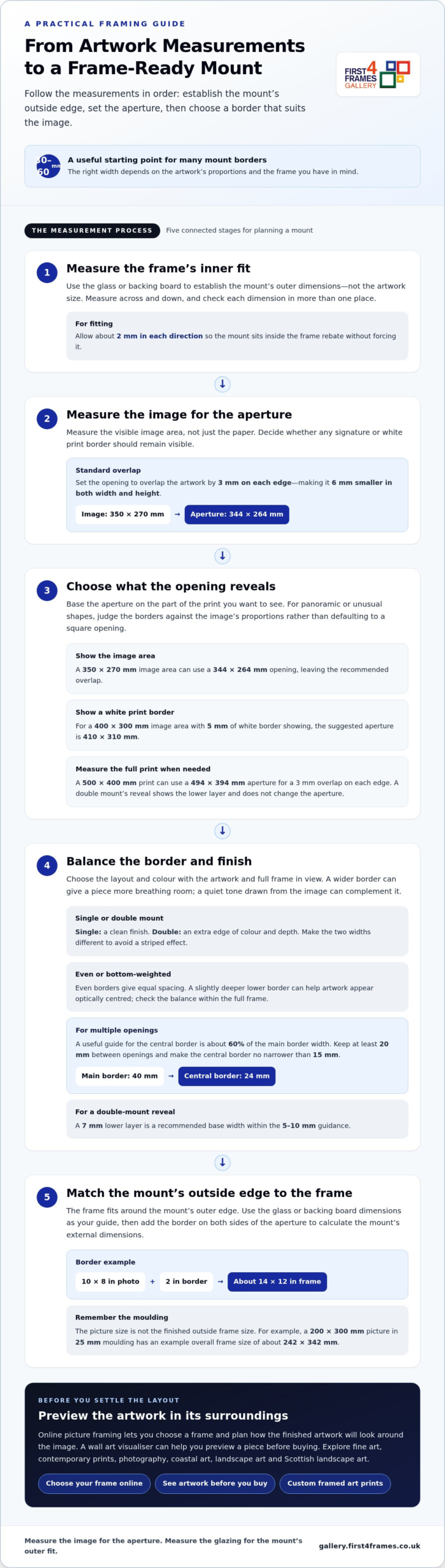
For a secure fit, measure the glass or hardboard inside the frame, not just its internal dimensions. A practical guide to how to decide on a mount width starts with this outer measurement and the artwork’s visible image size. Set the aperture to overlap the artwork by 3 mm on each edge, making it 6 mm smaller in both width and height.

For panoramic or unusually shaped artwork, judge the borders against the image’s proportions rather than defaulting to a square opening. Keep the mount balanced around the image, then check that its outer dimensions suit the frame.

Watch this framing guide for a visual explanation of how to choose a mount:

  1. Measure the glazing and frame rebate. Remove the glass and backing board, then measure across and down. Check each dimension in more than one place because paper may not be perfectly square. The rebate usually overlaps the picture by about 5 mm on each side and is typically 3 mm larger than the glass size.
  2. Set the aperture using the image, not the paper. To understand how to decide on a mount width for a particular print, measure the image area and account for any signature below it. For a 350 mm × 270 mm image, a suitable opening is 344 mm × 264 mm. A 10 × 8 inch photo typically has a 9.75 × 7.75 inch window.
  3. Choose what the opening should reveal. For larger prints, subtract 10 mm from each image dimension to create 5 mm overlap on each side. To show a print’s white border, measure the full print: a 500 mm × 400 mm print needs a 494 mm × 394 mm aperture. A double mount’s reveal shows the lower layer and doesn’t change the aperture.
  4. Select a complementary finish. A wider mount gives artwork more breathing room, while a quiet colour drawn from the image can complement it. For valuable or sentimental prints, acid-free mount board and backing help reduce the risk of yellowing or acid damage over time.

How Do I Choose the Border Width?

Set the border after considering the image shape, frame and number of openings. Then choose an even or weighted layout and check that the aperture reveals the intended part of the artwork.

  1. Balance Even and Bottom-Weighted Borders

    Choose an even border for equal spacing around the image. For a bottom-weighted mount, make the lower border slightly deeper than the top and sides; this can help the artwork appear optically centred. Compare both layouts within the full frame, not just around the aperture, and avoid extra weight if it makes the picture feel too low.

  2. Select Mount Width and Colour

    Choose a border that gives the artwork breathing room without overwhelming it. Wider borders can create a gallery-style finish and add presence, particularly around a larger frame. A mount colour drawn from a quiet tone in the image, such as soft off-white or cream, can work with many styles of artwork. Compare it beside the print, because surrounding colours can affect how the mount appears.

  3. Set the central border for multiple openings. In a multiframe mount, keep the central border narrower than the main borders to avoid a striped effect. A useful guide is about 60% of the main mount width, with at least 20 mm between openings. For example, a 40 mm main border pairs proportionately with a 24 mm central border. Keep it no narrower than 15 mm.
  4. Check the aperture and reveal. Base the opening on the image area you want visible, then consider whether any white print border should remain in view. For a 400 mm × 300 mm image area with 5 mm of white border showing, the suggested aperture is 410 mm × 310 mm. For a double mount, make the two widths different to avoid striping; a 7 mm lower layer is a recommended base width, within the 5-10 mm guidance. Browse framed artwork in the gallery to compare how border proportions frame different images.
How to Choose a Mount Width That Fits Your Artwork

How Do I Measure the External Mount Size?

Measure the glass or backing board to establish the mount’s outer dimensions. The frame fits around that outer edge, not just the picture.

  1. Measure the Picture and Frame

    Start by measuring the picture’s visible image, then measure the glass or backing board across and down. These measurements serve different purposes: the image guides the aperture, while the glass or board helps establish the mount’s outer dimensions. Use millimetres for precision and note the width before the height. Measure the paper in more than one place, as it may not be perfectly square.

  2. Account for Frame Moulding and Overall Dimensions

    Measure the frame’s visible opening separately from its outside edges. Moulding adds to the overall frame dimensions, so don’t treat the picture size as the finished frame size. For example, a 200 × 300 mm picture in 25 mm moulding has an example overall frame size of about 242 × 342 mm. A 25 mm moulding overlapping the picture by 5 mm extends 20 mm beyond it on each side.

  3. Match the External Mount to the Frame

    Use the glass or backing board dimensions as the guide for the mount’s outside edge, then allow about 2 mm in each direction for fitting. Check that the mount sits inside the frame rebate without forcing it. An A4 frame, for instance, can hold a mount with an aperture sized for a 7 × 5-inch photo, showing why frame size and picture size aren’t interchangeable.

  4. Check How the Mount Affects Frame and Picture Size

    Add the border on both sides of the aperture to calculate the mount’s external dimensions. A 10 × 8-inch photo with a 2-inch border needs a frame of about 14 × 12 inches. A double mount or acid-free backing adds thickness, so ensure the frame rebate can accommodate the complete stack. Ready-made frames suit standard sizes; made-to-measure frames can follow a chosen mount’s outer dimensions.

Standard picture mount border widths

Use standard widths only as a starting point. Judge the mount against the image and frame: the border should give the artwork space without making the opening feel cramped.

  1. Start with the common range. Mount border widths vary, so choose one that suits the image and frame. For many pieces, 2-3 inches is a useful starting range. These are guides, not fixed rules: compare the border with the visible image and the frame’s proportions before settling on a width.
  2. Scale the border to the picture. A small photo can sit comfortably within a 5-8 cm border, while a larger print may need more space to feel balanced. Consider the image’s visual weight too. A busy composition often benefits from a quieter margin, while a simple image can carry a broader border without losing focus.
  3. Check the full framing proportions. Picture the mount and frame together rather than judging the opening alone. A narrow border inside a broad frame can feel crowded; a wider mount can create a gallery-style finish and give the artwork more presence. Compare the proposed border on all four sides, then consider how the finished piece will look on the wall.
  4. Adapt standard widths to the image shape. A square photograph and a panoramic print may need different border proportions. Centre the opening on the visible image, then adjust the border to create a balanced overall shape. For a panoramic picture, an even border can keep the presentation clean, while a wider mount may help the long image hold its own within the frame.
  5. Choose by looking at real examples. Compare mount widths around different prints before deciding. Notice whether the border supports the image or draws attention away from it. Explore framed artwork in the gallery to see how artwork and framing proportions work together, then use the standard ranges as a practical starting point for your own picture.

First4Frames Gallery offers Ready-to-Hang Framed Art with frames handmade to order from high-quality materials. Each frame is made for its individual order, with 2 mm float glass and expert mounting for a considered finish. If you have a particular picture, Custom Picture Framing lets you choose a frame to suit it; Giclée Fine Art Prints can be paired with a frame from the available range.

Explore the framing and artwork options to find a combination that feels right for your image and space. Browse the First4Frames Gallery to see framed art and choose a direction for your own piece.

When you’re ready, contact First4Frames Gallery to discuss your framing needs.

Give Your Artwork Room to Belong

A mount shapes the space around the image and influences how the artwork sits in a room. Knowing how to decide on a mount width gives you a practical starting point, but the final choice should feel in harmony with both the picture and its intended setting.

Before choosing a finish, picture the framed piece in its intended setting. Consider nearby colours, available wall space and whether you want the artwork to blend in or become a focal point. A paper outline at the intended outer dimensions can help you judge its presence before you decide.

When you’re ready to explore artwork and framing options, browse the First4Frames Gallery. Let your chosen image guide the details, and create a presentation that feels right at home on your wall.

Frequently Asked Questions

Single or double mount?

Choose a single mount when you want the image to remain the main focus, especially with detailed artwork. A double mount can add a second tone that picks up a small accent in the image. For a coordinated display of several pictures, use the same mount treatment throughout so the frames feel connected, even when the artwork differs.

How wide should a mount be?

Let the image’s composition guide the visible margin. A portrait with a small signature beneath the image may need enough space to keep that detail visible, while a full-bleed print has no paper border to preserve. Sketch the proposed opening over a copy or outline of the artwork, then check that important details remain clear.

How wide should the border be?

Consider where the framed picture will hang before choosing its border. A piece displayed alongside other frames may look more cohesive with a similar treatment, while a standalone work can have a more individual presence. For a pair of prints, test the same border design around both images and adjust only if their compositions need different breathing room.

How do you choose the right mount width for a picture frame?

Start with the frame’s available space and the picture’s visible image, then make a paper template of the proposed mount. Place it over the artwork and view it from the distance where the picture will usually be seen. This helps show whether the opening cuts into an important feature or leaves an awkward sliver of the image.

What is the standard mount border width in the UK?

No single border width suits every picture. Common framing guidance provides a starting point, but the image’s shape, composition and display setting all affect the choice. For a group of photographs, consistent borders may matter more than finding a separate ideal width for each picture.

How wide should a picture mount be for different print sizes?

Choose the border based on the visible image and intended presentation, not the paper size alone. For a print with a white margin, decide whether to leave it visible or cover it with the mount. With a collection of different print sizes, matching the visual treatment can create unity while preserving each picture’s proportions.
Posted on

The 12×16 Inch Frame Guide: Choosing the Perfect Size for Your Art

The 12x16 Inch Frame Guide: Choosing the Perfect Size for Your Art

Choosing the wrong frame size can make a stunning Giclée print look like an afterthought, but the 12*16 inch format is the secret weapon of professional galleries across Scotland. You likely already feel the frustration of choosing between standard A3 metric sizes and imperial measurements. It’s a common struggle to find a frame that protects your investment rather than detracting from it with poor materials or a loose fit.

We’re here to help you master this versatile format. In this guide, you’ll discover why this specific size is the professional choice for showcasing fine art and how a bespoke frame acts as the essential bridge between your room’s decor and your favorite pieces. We’ll explore our range of premium wood frames, starting at £32.00, and show you how our artisan craftsmanship ensures your art arrives ready to hang with a gallery-standard aesthetic. You’ll gain the confidence to choose a frame that doesn’t just hold a picture, but does the heavy lifting to pull you into the scene.

Key Takeaways

  • Learn why the 12*16 inch size is the professional “Goldilocks” choice for your home, offering enough presence to stand alone while fitting perfectly into a gallery wall.
  • Discover why a bespoke solid wood frame does the heavy lifting to pull viewers into your artwork and protect your Giclée prints for years.
  • Get expert tips on styling vibrant Scottish landscapes with premium finishes to create a professional gallery aesthetic in your own space.
  • Explore our ability to source rare prints and provide almost any framing style in the UK, ensuring your piece is truly unique.
  • See how our “one-stop-shop” approach combines high-quality craftsmanship with flexible delivery or local workshop collection.

The Versatility of 12×16 Inch Frames: Why This Size Works for Every Room

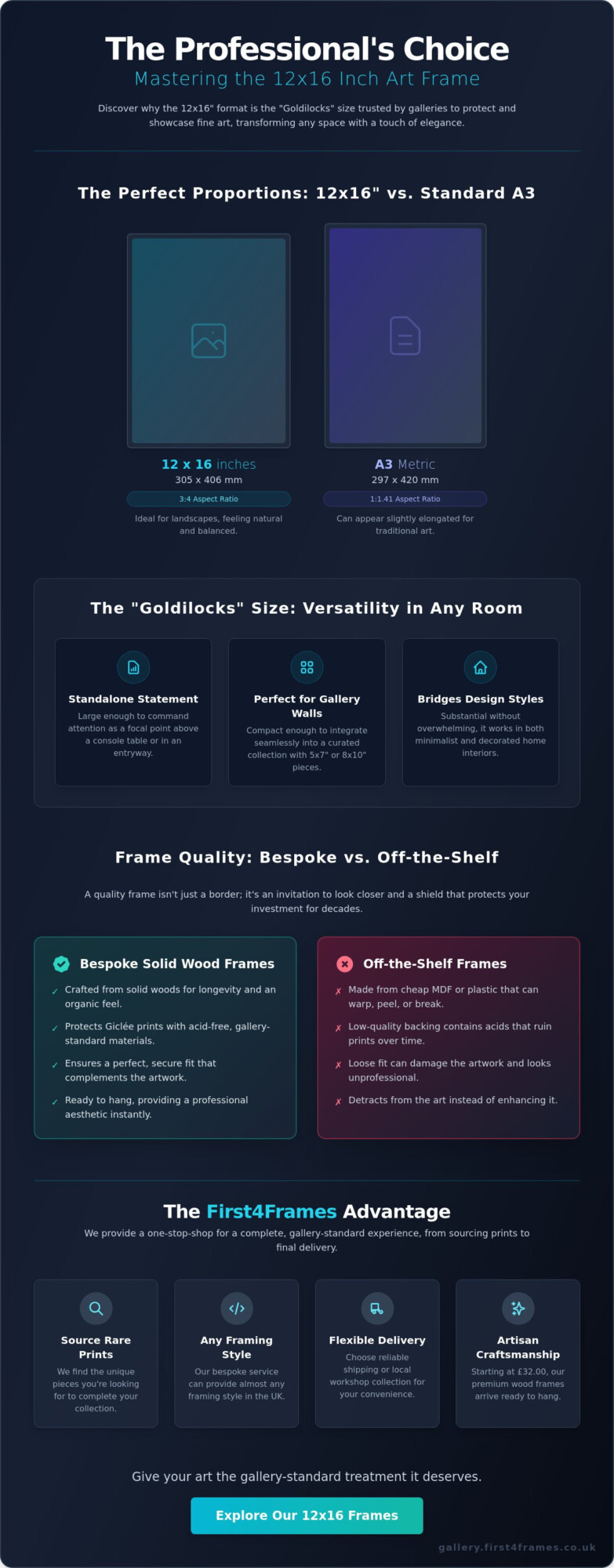
The 12*16 inch format is often called the “Goldilocks” size of the framing world. It provides enough surface area to showcase intricate details in a Giclée print, yet it remains compact enough to fit comfortably on a crowded gallery wall. Professionals frequently choose this size for portrait photography and vibrant Scottish landscapes because it strikes a perfect balance. Whether you’re staging a commercial property in Edinburgh or decorating a cozy hallway in a family home, this dimension offers a versatility that smaller prints simply lack. It is large enough to command attention but small enough to maintain an air of understated elegance.

To better understand how this specific size looks when professionally mounted, watch this helpful video demonstrating a 12×16 setup:

12X16 vs. A3: Understanding the Dimensions

Precision is vital when you want your art to sit perfectly within its picture frame. A 12*16 inch frame measures exactly 305 by 406 mm, whereas a standard A3 sheet is 297 by 420 mm. This might seem like a small difference, but the 3:4 aspect ratio of the imperial size feels more natural for traditional landscape paintings. It avoids the elongated, narrow look of metric paper, providing a more balanced window for your artwork. We often see customers choose this size for fine art prints because it honors the original proportions of the artist’s canvas. You can browse our gallery online to find the perfect fit for your specific print dimensions.

The Aesthetic Impact in Home Decor

In home styling, these frames act as a bridge between different design philosophies. They are substantial enough to serve as a focal point above a small console table, but they don’t overwhelm a minimalist room. If you’re building a curated set, these frames pair beautifully with smaller 5×7 or 8×10 pieces. We recommend placing them in high-traffic areas like entryways or dining rooms where guests can appreciate the craftsmanship of the wood and the depth of the print. The team at First4Frames Gallery ensures every piece is ready to hang; we offer both reliable shipping and local workshop collection to make the process as simple as possible for you.

Choosing the Right Materials: Bespoke Framing vs. Off-the-Shelf Options

A quality frame does the heavy lifting in your home’s relationship with art. It isn’t just a border; it is an invitation to look closer. While big-box retailers offer cheap 12*16 inch frames made from MDF or plastic, these materials often warp or peel. We believe your art deserves better. We source only the best solid woods and premium metals to ensure your frame acts as a sturdy, beautiful bridge for your decor. Interest in sustainable and recycled wood frames has increased by 50% since 2019, reflecting a growing consumer shift toward materials that offer both longevity and an organic feel.

The Importance of Fine Art Giclée Prints

Giclée prints are more than just digital copies; they are museum-quality reproductions. Because they use archival inks, they won’t fade over time. However, a 12*16 inch Giclée print is only as good as the protection it receives. Framing it in a low-quality, off-the-shelf product can expose it to acids that ruin the paper. At First4Frames Gallery, our Art in the Frame resource explains how professional materials maintain that “identical copy” status for decades. We don’t just sell frames; we provide a bespoke service that ensures every component meets professional gallery standards.

Mounting Options for 12×16 Inch Prints

A mount isn’t just for looks. It provides essential breathability, keeping the art from touching the glass. For 12×16 inch pieces, a single mount offers a clean, modern look, while a double mount adds dramatic depth. We use acid-free boards to prevent yellowing, ensuring your Scottish landscapes remain as vibrant as the day they were printed. Choosing the right colour can transform a piece, making the art pop against your wall. You can explore our full range of custom styles in our online gallery to find a combination that suits your room perfectly. Whether you need a specific shade or a non-standard size, our artisan team is ready to help.

The 12x16 Inch Frame Guide: Choosing the Perfect Size for Your Art

Styling Your Space: How to Display 12×16 Inch Art for Maximum Impact

Designing a room is about more than just filling gaps on a wall; it’s about creating a narrative. A 12*16 inch frame offers a substantial presence without the bulk of larger formats, making it an ideal anchor for a gallery wall. You can mix these frames with smaller 8×10 prints or larger A2 pieces to create a dynamic, curated look. For commercial property staging or office dressing, this size is a favorite because it fits standard architectural niches perfectly. Our team provides bespoke solutions for businesses looking to elevate their professional environment with high-quality, ready-to-hang art.

Lighting plays a vital role in how your guests perceive the depth of a Giclée print. To avoid distracting glare, position your 12*16 inch art away from direct windows or use adjustable LED spotlights. Proper lighting highlights the rich textures of the archival paper, making the colors appear more vibrant. If you’re unsure which finish will work best under your specific lighting, we invite you to visit our workshop for a consultation. Our customers often tell us that seeing the materials in person makes all the difference, and you can read about their experiences on Trustpilot, Google, and Yell.

Pairing Frames with Scottish Landscape Art

For a “Scotland at Home” theme, the frame choice should reflect the spirit of the scenery. We recommend pairing rustic, natural wood finishes with Highlands landscapes to bring an organic warmth to your room. Consumer interest in sustainable wood frames has increased by 50% since 2019, reflecting a shift toward these natural textures. Whimsical pieces by Matylda Konecka or the energetic figures of Janet McCrorie look spectacular in sleek, modern black or brushed metal frames. If you have a specific artist in mind who isn’t in our current inventory, we can source prints upon request to ensure your collection is complete.

Hanging Tips for a Professional Finish

Achieving a gallery aesthetic requires precision. Follow the “eye-level” rule by ensuring the center of your 12×16 inch frame sits exactly 57 inches from the floor. This creates a consistent visual line that ties the room together. Always use sturdy hardware to keep your piece secure and level. Whether you prefer the convenience of shipping or want to opt for local collection at our workshop, we ensure your art arrives with everything needed for a hassle-free installation. You can browse our best-selling Scottish art to find the perfect piece to start your project.

Choosing a frame is personal. We’ve spent over twenty years perfecting our craft to ensure your experience is as rewarding as the art itself. First4Frames Gallery operates as a comprehensive one-stop-shop, handling everything from the initial print sourcing to the final professional framing. If you have a specific 12*16 inch vision that isn’t currently listed on our website, don’t worry. We can provide almost any framing option available in the UK and will happily source rare prints upon request. This flexibility sets us apart from impersonal, automated marketplaces that lack human expertise.

Our hassle-free service follows a simple three-step formula designed for your convenience:

  • Step One: Browse our extensive online collection of Giclée prints and bespoke frame styles.
  • Step Two: Select your preferred materials and mounting options to suit your specific decor.
  • Step Three: Place your order and receive your professionally finished, ready-to-hang art.

We believe in complete transparency. Our reputation is built on the trust of our customers; we encourage you to check our latest reviews on Trustpilot, Google, and Yell to see why we’re a leading name in Scottish fine art. When you choose us, you’re partnering with artisans who genuinely love what they do. We take pride in ensuring every piece leaves our workshop in perfect condition.

Sourcing Exclusive Prints and Custom Options

We work closely with talented Scottish artists to ensure our collection remains fresh and inspiring. Whether you’re looking for a specific local scene or a contemporary abstract piece, our bespoke sourcing service means we can track down the exact print you need even if it’s not in our current inventory. You can start your journey by exploring the First4Frames Gallery, where creativity meets our expert craftsmanship.

Local Service, National Reach

While we provide secure shipping to every corner of the UK, we remain a local business at heart. Customers in Central Scotland can skip the shipping and select local collection at our Falkirk workshop. This option allows you to meet our team and see the care that goes into every frame. If you’re a business owner looking for commercial bulk orders or have a unique framing request that requires a professional’s touch, please contact us directly. We’re here to ensure your 12*16 inch art makes a lasting impression.

Transform Your Space with Professional Artistry

Your home deserves a bridge between its decor and the art you love. Choosing a 12*16 inch frame ensures a perfect balance of detail and scale, especially when paired with the vibrant textures of a Giclée print. We’ve spent over 20 years perfecting our handcrafted frames at our Falkirk workshop, ensuring every piece meets the high standards our customers praise on Trustpilot and Google Reviews. By selecting professional materials over mass-produced alternatives, you protect your investment and elevate your room’s aesthetic instantly.

Whether you’re looking for a specific Scottish landscape or need a bespoke solution not listed online, our team is ready to help. We handle the heavy lifting so you can enjoy a hassle-free journey from browsing to hanging. Our one-stop-shop approach makes fine art accessible to everyone, regardless of your framing experience. Now’s the perfect time to give your favorite artwork the professional home it deserves.

Browse our collection of 12×16 inch framed prints today and start your journey of artistic discovery with a trusted partner.

Frequently Asked Questions

Is 12×16 inches the same as 30x40cm?

No, these two sizes aren’t identical and shouldn’t be used interchangeably. A 12*16 inch frame measures exactly 305 by 406 mm, while a 30 by 40 cm frame is 300 by 400 mm. This 6 mm difference is enough to cause visible gaps or a loose fit around your artwork. We always recommend choosing the exact imperial size to ensure your art sits securely and looks professionally framed.

Will a 12×16 inch frame fit an A3 print?

No, a standard A3 print won’t fit inside this frame because it’s too long. A3 paper measures 297 by 420 mm, which exceeds the 406 mm internal length of the 12×16 format by 14 mm. Forcing the fit will result in creased edges and a ruined Giclée print. We can easily provide a bespoke frame sized specifically for A3 if you need a professional solution for that format.

What is the best frame material for a 12×16 inch Giclée print?

Solid wood is the superior choice for protecting a 12*16 inch Giclée print. Wood frames currently hold 43.78% of the global market share because they provide the structural integrity that MDF or plastic lacks. This strength prevents the archival paper from warping over time. Our artisan team sources only the best sustainable timbers to ensure your fine art stays protected from environmental damage for over 20 years.

Can I get a custom mount for my 12×16 inch frame?

Yes, we provide bespoke acid-free mounts tailored to your specific 12*16 inch requirements. While our standard packages include a white mount for a 12 by 8 inch print, our workshop can cut any aperture size you need. This flexibility allows you to choose the exact border width to match your room’s decor. If you don’t see your preferred color online, we can source almost any mount board available in the UK.

Do you offer local collection for 12×16 frames in Falkirk?

Yes, you can choose to collect your finished frames directly from our Falkirk workshop. This option is ideal for customers in Central Scotland who want to skip shipping times and meet the craftsmen behind their art. Simply select “Local Collection” during the checkout process. We also offer reliable UK-wide shipping, and you can read our reviews on Trustpilot and Google to see how much our customers value our speedy service.