Imagine unrolling a rare 1968 exhibition poster you found at a London market, only to notice the edges are as brittle as autumn leaves. You know that framing a vintage poster is the only way to save it, but the fear of making a permanent, costly mistake feels heavy. It’s a common worry we hear from collectors at the First4Frames Gallery. You want that piece to act as a bridge between your room’s decor and the art’s history, yet you’re likely stuck weighing up the merits of plexiglass versus traditional glazing or worrying about acidic mounts turning your treasure yellow.
We understand that your collection represents more than just paper; it’s a passion. With over 20 years of experience and a 4.9 star rating on Google from satisfied art lovers, our artisans treat every piece with the reverence it deserves. This guide reveals the professional secrets to preserving your art for decades, ensuring it remains as vibrant as the day it was printed. You’ll discover the vital differences between framing an original find through our bespoke framing service and using our dedicated print and frame service for Giclée reproductions. From selecting the perfect mount to understanding the value of professional craftsmanship, we’re here to make the process simple and spectacular.
Key Takeaways
- Understand why a specialist gallery approach is vital for protecting the delicate lithographic paper used in vintage prints from environmental degradation.
- Learn how to safeguard your investment by avoiding irreversible methods like dry-mounting in favour of acid-free, archival materials.
- Discover how framing a vintage poster with period-specific styles can create a beautiful narrative link between your artwork and your home’s interior.
- See why the First4frames gallery is a trusted professional for bespoke framing, offering premium craftsmanship and a hassle-free service backed by 20 years of experience.
- Gain professional insights on the best practices for hanging and maintaining your framed art to prevent fading and structural stress over time.
Why Framing a Vintage Poster Requires a Specialist Gallery Approach
Framing a vintage poster involves much more than just picking a style that matches your sofa. It’s a technical process using reversible, archival techniques to support fragile paper while preventing environmental degradation. At First4frames gallery, we believe the frame acts as the vital bridge between a historical artwork and your contemporary room décor. It does the heavy lifting in the relationship, pulling you into the scene while keeping the physical paper safe. We’ve spent over twenty years perfecting this craft, ensuring every piece that leaves our workshop is handled with the precision of a knowledgeable artisan.
To better understand this concept, watch this helpful video:
The Fragility of Vintage Paper
Vintage paper is a living material that reacts to its surroundings. Older posters were often printed on newsprint or specific lithographic stocks that contain high levels of acid. These materials are significantly more susceptible to light damage and chemical breakdown than modern art papers. Standard adhesives can be disastrous, as older inks react poorly to the chemicals in common tapes. You’ve likely seen “foxing” on older prints. These are the small brown spots caused by high humidity and metallic impurities in the paper. Proper housing prevents these issues from escalating. Archival framing is a non-invasive, fully reversible preservation method that ensures the artwork remains untouched by the mounting process. High-quality conservation and restoration of painting frames and their contents is the only way to ensure your investment doesn’t crumble over time.
Original vs. Reproduction: Does It Change the Framing?
The method we choose often depends on the nature of the print. Original lithographs are investment pieces that require the highest level of conservation. However, the high-quality Giclée reproductions found in our gallery, including vibrant works from artists like Jolomo, also demand professional care. Even though modern Giclée prints use advanced lightfast inks, they still require premium materials to prevent fading over the next fifty years. Our picture framing service treats every piece as a potential heirloom. Whether you’re framing a vintage poster from a 1950s cinema or a brand-new Jolomo print, the goal remains the same: spectacular presentation and long-term protection. We pride ourselves on being a one-stop-shop where craftsmanship meets creativity, backed by excellent customer ratings from clients across the UK.
Essential Preservation Rules: The Do’s and Don’ts of Poster Framing
Framing a vintage poster isn’t just about aesthetics; it’s about acting as a custodian for a piece of history. At the First4frames gallery, we treat every original lithograph or film poster with the respect a 50-year-old artifact deserves. Our team draws on over 20 years of bespoke framing experience to ensure your investment stays protected for decades. Professional preservation starts with understanding that what you do to the poster is just as important as the frame you choose.
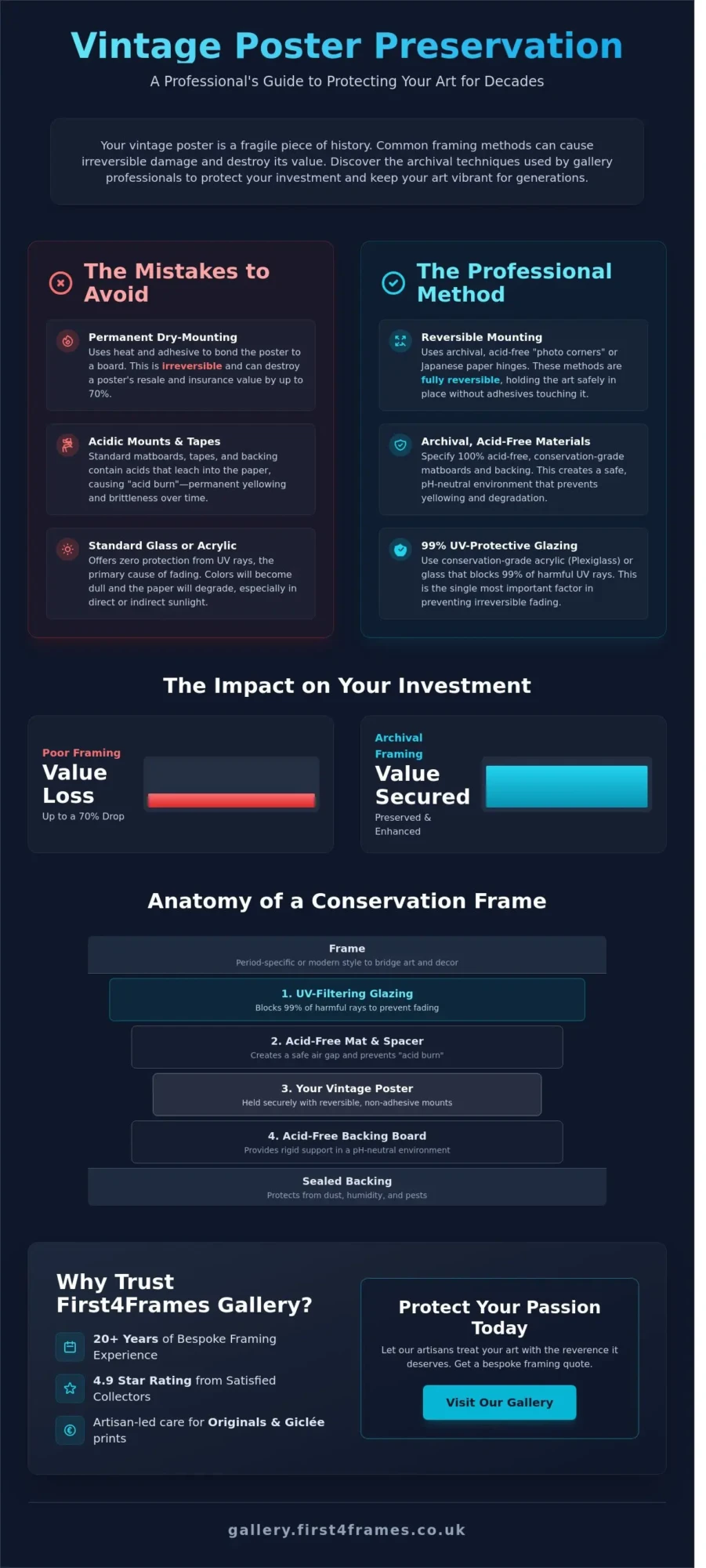
The most critical rule is to never use dry-mounting for original posters. This process uses heat and adhesive to bond the paper permanently to a backing board. While it makes the paper look perfectly flat, it destroys the resale and insurance value instantly. Collectors often see a 70% drop in value for dry-mounted pieces because the process is irreversible. Instead, we embrace the “imperfections” of vintage art. Registration shifts, slight ripples, and minor edge wear are part of the story. A high-quality frame acts as a bridge between your room décor and the artwork, celebrating these unique historical markers rather than hiding them.
To prevent “acid burn,” you must specify acid-free matboards and foam core backing. Standard wood-pulp boards contain lignin, which turns paper yellow and brittle over time. By using archival-grade materials, you’re creating a pH-neutral environment that halts chemical degradation. This level of care is why our customers consistently give us top ratings for our professional framing services.
The Golden Rule: Reversibility
Every mounting technique used should be easily undone by a professional conservator. We prefer using Japanese paper hinges with wheat starch paste or archival photo corners instead of sticky tape. Standard tapes contain adhesives that yellow and sink into the paper fibres, causing permanent damage. If a framer suggests glueing it down to make it flat, find a new framer. Our commitment to reversible techniques ensures your art remains in its original state. You can explore our
to see how professional presentation elevates historical pieces.
Glazing Choices: Glass vs. Acrylic
UV-protective glazing is non-negotiable to stop light from bleaching historical inks. Standard glass allows UV rays to penetrate, which can fade a vibrant 1960s film poster into a washed-out ghost in just a few years. For posters displayed in bright, sun-drenched rooms, anti-reflective coatings are a fantastic addition to reduce glare.
- UV-Filter Glass: Best for smaller posters where clarity and scratch resistance are the priorities.
- Acrylic (Plexiglass): Highly recommended for posters larger than 16×20 inches. It’s much lighter than glass, making large frames easier to hang safely.
- Safety First: Acrylic is shatter-resistant. If a large frame falls, acrylic won’t break into sharp shards that could pierce and ruin the vintage paper.
By choosing the right glazing and mounting methods, you ensure that framing a vintage poster results in a beautiful display that actually increases in value over time.
Choosing the Right Frame Style for Your Vintage Art
A frame does the heavy lifting in the relationship between your wall and your art. It acts as a bridge, pulling you directly into the artistic narrative and anchoring the piece within your home. When framing a vintage poster, you aren’t just protecting a piece of paper; you’re preserving a slice of history. At First4frames gallery, we see how the right profile transforms a 1920s travel advert or a classic film bill into a spectacular focal point. Our experts use their twenty years of experience to ensure the frame complements the art without competing with it.
Colour coordination is vital for a professional finish. Instead of matching the frame to the most dominant colour, look for secondary or tertiary tones within the design. A subtle hint of ochre or deep teal pulled from the background and reflected in the mount or the frame itself can make the entire piece pop. For oversized posters, balance is everything. If a poster is particularly large, choose a slimmer, stronger profile. This prevents the art from overwhelming your room’s furniture while still providing the necessary structural support to keep the paper flat and secure.
Era-Appropriate Mouldings
Matching your moulding to the era of the print creates a cohesive look. Sleek, dark woods or minimalist black frames work perfectly for 1950s Mid-Century Modern travel posters. In contrast, Victorian opera bills or early 20th-century advertisements often benefit from ornate gold or heavily textured finishes. We often recommend a floated look for posters with deckled or raw edges, as this showcases the paper’s unique character and history. A bespoke frame acts as a one-stop-shop solution for both premium style and essential conservation protection.
Mounting and Borders
Deciding whether to mat your artwork depends on the design’s density. A mount provides breathing room for busy, text-heavy vintage designs, preventing the art from feeling cramped against the glass. Using double mounts is an excellent way to add depth and achieve that professional gallery finish seen in our own collections. You can refer to our guide on standard photo picture sizes to see how standard mounts fit common poster dimensions. This helps you decide if a custom-cut mount is needed to bridge the gap between a classic print size and a modern frame. Our customers consistently give us top ratings for this attention to detail, ensuring every piece of history is treated with the craftsmanship it deserves.
The First4Frames Bespoke Service: Craftsmanship in Falkirk
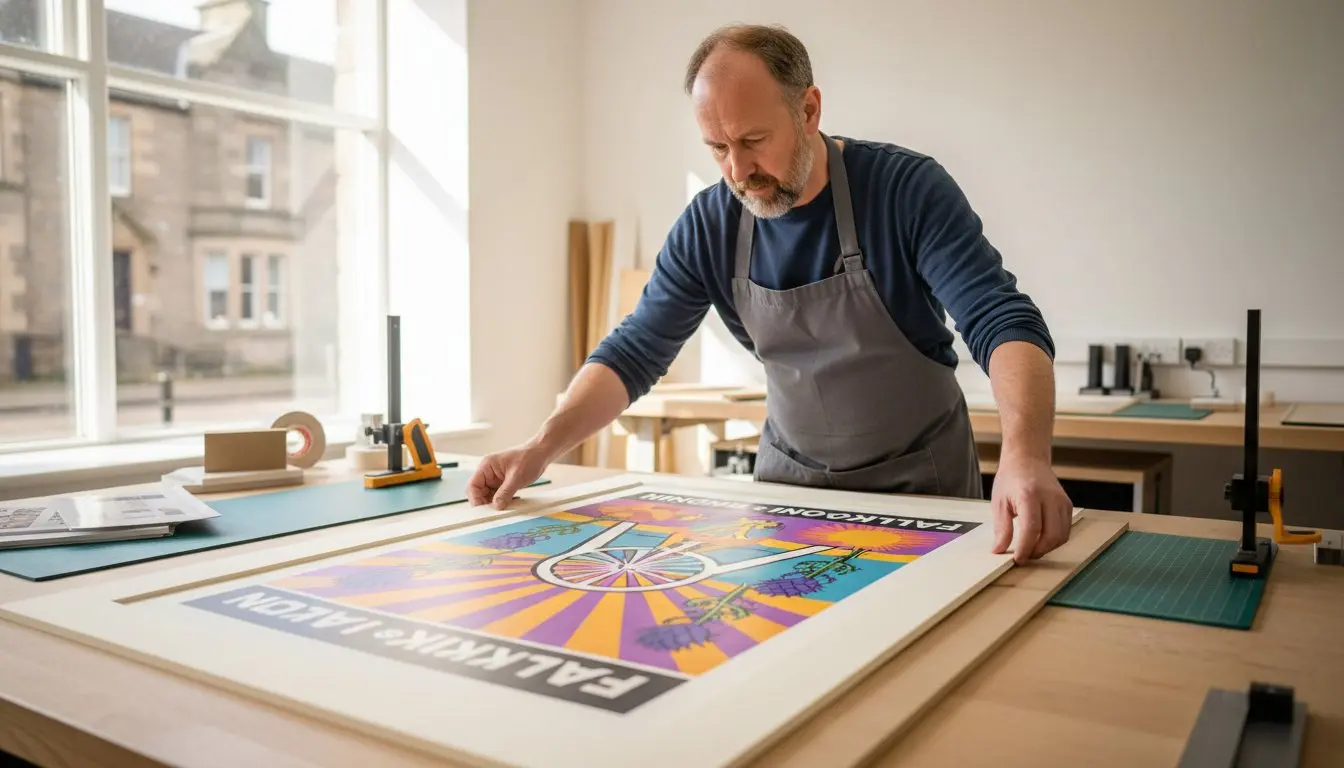
We’ve spent over 20 years establishing First4Frames as a trusted professional within the Scottish art community. Our passion for craftsmanship means we don’t just put a border around a picture; we create a bridge between your room’s decor and the artwork itself. When you’re framing a vintage poster, the process requires a delicate touch to preserve the history of the paper while enhancing its visual impact. Our team brings an artisan’s eye to every project, ensuring your piece gets the care it deserves.
Our step-by-step process is designed to be entirely hassle-free. It starts with an initial consultation where we discuss your vision and the specific needs of the artwork. From there, we move to the workshop where our experts craft your bespoke frame using premium materials. The final result is a ready-to-hang piece that meets our rigorous quality standards. This commitment to excellence is why we maintain such high customer ratings for both our craftsmanship and our speedy service.
A One-Stop-Shop for Art and Frames
We’ve built a unique environment where creativity meets practical service. By collaborating with local artists, we provide a curated selection of unique prints that are professionally framed in-house. Sourcing your Giclée print and frame from the same gallery ensures a perfect match and guaranteed quality. This integrated approach is a favorite for commercial clients, including property developers and estate agents, who rely on us for high-end staging. Our print-and-frame service provides a polished, professional finish that transforms any commercial or residential space instantly.
Preserving Scottish Heritage
Our gallery takes immense pride in our specialisation in iconic Scottish art. We frequently work with masterpieces by Jack Vettriano and Jolomo, applying specialized preservation techniques to ensure these works never fade. Whether we’re framing a vintage poster or a modern Giclée print, we use acid-free mounts and UV-protective glass to shield the art from environmental damage. We invite you to visit our gallery at 47A Grahams Road, Falkirk, for a personal consultation. You’ll see firsthand how our frames do the heavy lifting, pulling viewers into the picture and protecting Scottish heritage for the next generation.
Ready to transform your space with professional craftsmanship? Browse the featured artwork at our online gallery and find your next statement piece.
How to Safely Hang and Maintain Your Framed Poster
Once the process of framing a vintage poster is complete, your focus should shift to long-term preservation. A frame is more than a decorative border; it is a protective environment that shields delicate paper from the elements. Even with premium UV-filtering glass, direct sunlight remains a silent enemy. It can cause irreversible fading to 1950s lithograph inks or modern limited editions within just 12 months of exposure. Position your artwork on a wall that receives consistent, indirect light to keep those colours as vibrant as the day they were printed.
Cleaning your display requires a gentle touch to avoid damaging the internal components. Never spray glass cleaner directly onto the glazing. Liquid often seeps under the edge of the frame, leading to unsightly tide marks on the mount or the poster itself. Instead, apply a small amount of pH-neutral cleaner to a soft microfibre cloth before wiping. Every three years, it’s a good idea to inspect the back of the frame. Check that the framing tape isn’t lifting and ensure no dust or small insects have breached the seal.
Secure Hanging Techniques
Large-scale posters, particularly those exceeding 36″ x 48″, require more than a simple wire. Heavy frames put immense pressure on the mitred corners of the timber. Using two heavy-duty hooks aligned with the D-rings on the back of the frame ensures the weight is distributed evenly across the structure. This prevents the frame from bowing or the corners from pulling apart over time.
- Wall Types: Always identify your wall material before drilling. Plasterboard requires specific hollow-wall metal anchors, while solid brick needs high-quality Rawlplugs to support the weight of heavy glass safely.
- Airflow: Place small rubber or felt “bumpers” on the bottom corners of the frame. This creates a small gap that allows air to circulate behind the artwork, which is essential for preventing trapped moisture and mould growth on the wall.
Long-Term Environmental Care
Kitchens and bathrooms are unsuitable zones for original paper-based art. The frequent fluctuations in steam, heat, and airborne grease will eventually penetrate even a professionally sealed frame. This leads to “cockling,” where the paper becomes wavy and distorted. At First 4 Frames, we’ve spent over 20 years helping collectors in Falkirk and beyond protect their investments from these environmental stressors.
Aim to keep your collection in a room with a stable temperature between 18°C and 21°C. Humidity levels should ideally stay between 40% and 55% to keep the paper fibres stable. By following these professional standards, you ensure that framing a vintage poster remains a lasting tribute to the artist’s work. Our gallery showcases how proper maintenance keeps fine art in pristine condition for decades.
Ready to give your collection the professional treatment it deserves? Explore our full range of bespoke framing options or visit our Falkirk gallery to speak with our expert team today.
Give Your Vintage Art the Professional Protection It Deserves
Your vintage posters are more than just paper. They’re historical snapshots that deserve a bridge between your room’s decor and the artwork itself. Successful framing a vintage poster requires a balance of aesthetic style and strict preservation techniques, such as using UV-protective glass and acid-free mounting to prevent irreversible fading. At First4Frames Gallery, we’ve spent over 20 years mastering these techniques within our Falkirk workshop. We specialize in Scottish art and Giclée print preservation, ensuring every piece remains vibrant for decades. Our team maintains excellent customer ratings on major review platforms because we treat every project with artisan care. While our gallery showcases incredible featured artists, our bespoke picture framing service is dedicated to protecting your personal collection. We offer a simple, three-step process to ensure your art is handled with the excellence it requires. Don’t leave your art’s longevity to chance when professional craftsmanship is so accessible. We’re ready to help you transform your space while safeguarding your investment for the future.
Find your perfect bespoke frame at First4Frames Gallery
Frequently Asked Questions
Can I use a standard A3 or A4 frame for my vintage poster?
You shouldn’t use standard A3 or A4 frames for original vintage pieces because they rarely align with historical printing dimensions. Most vintage posters follow older formats like the 30 by 40 inch British Quad or the 20 by 30 inch Double Crown. Forcing a 1960s lithograph into a modern A3 frame risks crushing the edges or leaving gaps. Our bespoke framing service ensures your artwork fits perfectly within a frame designed specifically for its unique size.
Should I have my vintage poster linen-backed before framing?
Linen-backing is highly recommended if your poster is printed on the fragile, acidic paper common before 1980. This archival process mounts the poster onto acid-free paper and cotton canvas to stabilize the fibers. It flattens heavy folds and provides a secure base for framing a vintage poster. At First4frames gallery, we see many collectors choose this method to preserve the 85 percent of a poster’s value that’s often lost through poor storage.
What is the difference between dry-mounting and archival hinging?
Dry-mounting uses heat to permanently bond the artwork to a backing board, while archival hinging uses small pieces of acid-free tape to “hang” the art inside the frame. You should avoid dry-mounting vintage originals because it’s an irreversible process that can reduce the resale price by 50 percent or more. Our professional framing service uses archival hinging to keep the artwork secure while allowing the paper to breathe and expand naturally over time.
Is plexiglass better than traditional glass for large posters?
Acrylic, often called plexiglass, is a better choice for large vintage posters because it’s approximately 50 percent lighter than traditional glass. It won’t shatter during transit or if it’s accidentally knocked, which protects your valuable investment. For the best results, we recommend UV-filtering acrylic. This blocks 99 percent of harmful rays, preventing the vibrant inks on your poster from fading when displayed in a bright room.
How much does it cost to professionally frame a vintage poster?
Professional framing costs depend on the dimensions of the piece and the specific materials you choose for protection. According to the Fine Art Trade Guild, bespoke framing for a standard 27 by 41 inch poster often starts around £150 in the UK market. This price covers the use of acid-free mounts and specialist glazing. Our customers frequently highlight the value of our craftsmanship in their 5-star reviews, noting that the investment protects the poster’s long-term market worth.
Can you frame a poster that already has tears or folds?
You can certainly frame posters with existing tears, folds, or minor creases. Professional framing provides the structural support needed to prevent these flaws from worsening over time. We often use a mount to overlap the edges by 5mm, which hides small nicks or fraying. This technique draws the eye toward the central artwork, acting as a bridge between your room’s decor and the vintage aesthetic of the piece.
How do I clean the glass on my framed poster without damaging it?
You must never spray glass cleaner directly onto the frame. The liquid can seep under the edge of the glass and cause permanent water damage to the paper. Instead, apply a small amount of ammonia-free cleaner to a microfiber cloth first. Wipe the surface in a gentle circular motion. This simple method keeps the display crystal clear without risking the integrity of the framing a vintage poster project.
Will my poster lose value if I trim the white border to fit a frame?
Trimming the white border will significantly decrease the financial value and historical authenticity of your vintage poster. Collectors view the original margins as essential evidence of the poster’s provenance and printing history. If the border is too wide for your taste, our expert team can use a bespoke mount to cover the excess paper without cutting it. This preserves the piece’s integrity while achieving a clean, professional look for your wall.