Posted on

Choosing Quality Mountboard for Your Custom Frames

Choosing Quality Mountboard for Your Custom Frames

Did you know that the very thing meant to highlight your artwork could actually be slowly destroying it from the inside out? We understand how frustrating it is to see a cherished print start to yellow or ripple after just a few years in a standard, mass-produced frame. It’s a common worry for anyone investing in bespoke framing, and technical jargon like pH neutral or lignin-free often adds more confusion than clarity. The quality mountboard used on artwork in your frames is far more than just a decorative border; it’s a vital chemical shield that preserves the life and vibrancy of your piece.

We’re here to help you understand the difference between basic decorative boards and professional conservation mounting. You’ll discover how our handmade approach and use of premium materials, such as 2mm float glass instead of the cheap perspex used by others, create a professional, gallery-quality look for your home. We’ll walk you through the industry standards so you can choose the perfect level of protection for your art with total confidence, ensuring your memories remain in perfect condition for years to come.

Key Takeaways

  • Understand how professional-grade mountboard functions as both an aesthetic window and a protective barrier for your most precious pieces.
  • Learn why the quality mountboard used on artwork in your frames is essential for preventing “cockling” and maintaining the perfect air gap behind the glass.
  • Discover the benefits of our bespoke, handmade approach, featuring 2mm float glass for clarity that far surpasses standard online alternatives.
  • Master our simple two-step process for choosing the right mount colours and widths to create a high-end, gallery-quality display in any room.

What is Mountboard and Why is Quality Essential?

At First4Frames Gallery, we believe that the foundation of a great frame starts long before the wood is cut. What is Mountboard? In its simplest form, it is the thick, protective card that surrounds your artwork. However, the quality mountboard used on artwork in your frames is far more than just a decorative border. It serves as both a structural support and a chemical barrier, ensuring that your art remains isolated from environmental pollutants and the acidic components found in cheaper framing materials. We select our boards based on their ability to preserve the integrity of the paper and the vibrancy of the ink for decades to come.

The choice of material is the first line of defence for your art. While a standard frame might look acceptable on the day it’s bought, professional-grade mounting is an investment in the future of the piece. We treat every order with a focus on longevity, ensuring that the materials we use in our Falkirk workshop meet the rigorous standards expected by galleries and collectors alike.

Mountboard vs. Mat Board: Clearing the Confusion

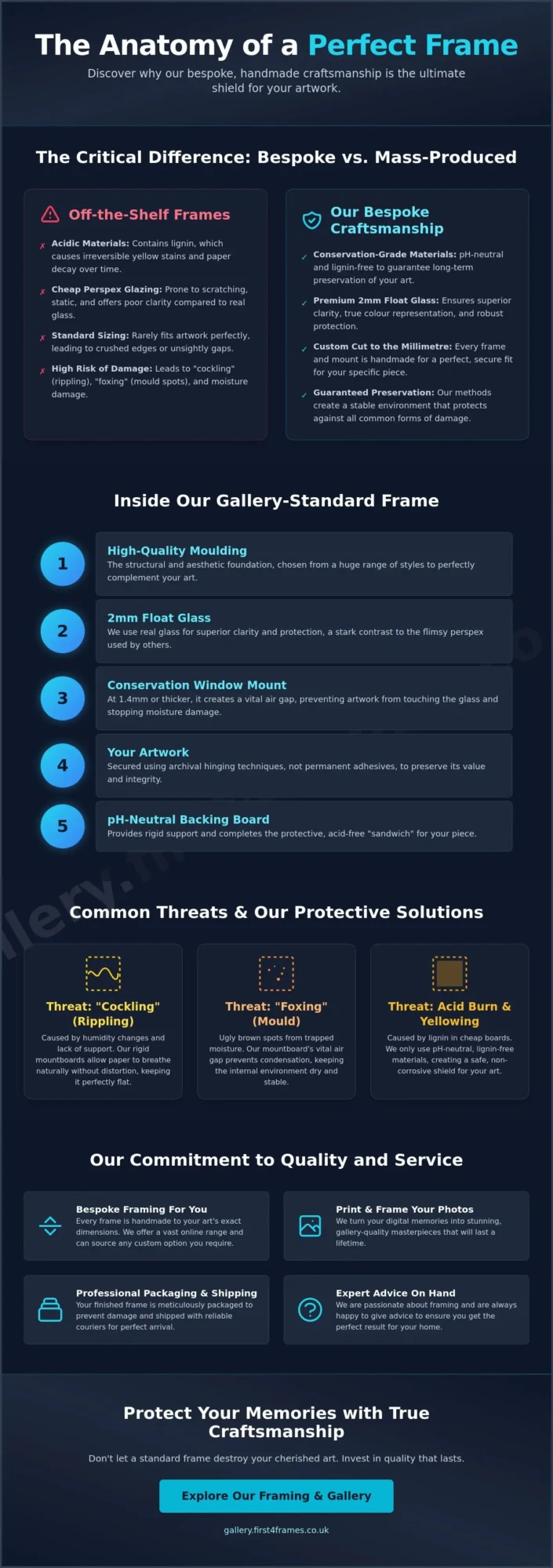
It’s helpful to clear up some terminology, as you’ll often see different names used online. While the US typically uses the term “mat board,” here in the UK, we almost exclusively call it mountboard. It’s also vital to distinguish between the window mount, which creates the visual frame around the art, and the backing board. The backing board provides the rigid rear support that keeps everything flat and secure. At First4Frames Gallery, we ensure that every layer of the “sandwich” inside your frame meets our high professional standards, providing a complete environment of protection.

The Chemistry of Protection: pH Neutral and Acid-Free

The secret to long-term preservation lies in the chemistry of the board. A pH neutral state prevents harmful chemical migration from the mount to the artwork. Standard “white core” boards often contain lignin, a natural substance in wood pulp that eventually turns into acid. This acidity is what causes those unsightly brown stains on old prints. By using professional conservation-grade, lignin-free materials, we eliminate the risk of the “yellow edge” that plagues mass-produced frames. This commitment to quality materials is why the quality mountboard used on artwork in your frames is such a critical component of our bespoke service.

How Quality Mounting Prevents Artwork Damage

Paper art is a living material. It breathes. When humidity levels in your home shift, paper fibres naturally expand and contract. Without the right support, this movement leads to “cockling” or “buckling,” which are those frustrating ripples that ruin a smooth, professional look. The quality mountboard used on artwork in your frames provides the necessary structure to allow this natural movement while preventing permanent distortion. We see many pieces brought into our Falkirk workshop that have been damaged by tight, restrictive mounting, and we’re always happy to give advice on how to avoid these common pitfalls.

Beyond structural support, professional mounting guards against “foxing,” those unsightly brown mould spots caused by trapped moisture. We never use permanent adhesives that can devalue your art; instead, we use archival hinging techniques. This approach is essential for the conservation of precious items, ensuring the environment inside the frame remains stable and dry for years to come.

Creating the Vital Air Gap

Your artwork should never touch the glass directly. When it does, even minor temperature changes can cause condensation to form on the inside of the pane. This moisture can cause the art to stick to the glass or lead to ink transfer, which is often irreversible. Our professional mountboards, usually 1.4mm to 2mm thick, create a safe buffer zone. We pair this protective gap with 2mm float glass for superior clarity, which is a significant upgrade over the thin perspex used by many other online galleries.

The Problem with “Off-the-Shelf” Standard Frames

Mass-produced frames frequently rely on thin, acidic paper inserts that offer no real protection. These generic sizes rarely fit your artwork perfectly, which often results in crushed edges or gaps. Our bespoke process ensures that every mount is cut to the exact millimetre of your specific print. This precision ensures the quality mountboard used on artwork in your frames acts as a perfect, tailored shield. If you’re ready to see the difference professional materials make, you can explore our range of ready-to-hang art to see these standards in action.

Choosing Quality Mountboard for Your Custom Frames

Every frame produced at First4Frames Gallery is a unique creation, hand-made to order in our Falkirk workshop. We don’t believe in the “one size fits all” approach of mass-produced alternatives that often fail to support your art correctly. Instead, we hand-make every order to ensure a perfect fit for your specific piece. By choosing our bespoke photo frames, you’re investing in a product where the quality mountboard used on artwork in your frames is just the beginning of a high-standard build. We take pride in being an approachable team, always happy to give advice to help you navigate the many choices available for your project.

Beyond the Board: 2mm Float Glass vs. Perspex

While many online galleries cut corners by using acrylic or perspex, we strictly use 2mm float glass for all our bespoke glazing. This choice provides superior clarity and a premium feel that plastic simply cannot match. Perspex is notoriously prone to scratching and attracts static electricity. This static can actually pull delicate particles off the surface of pastel or charcoal drawings, causing permanent damage. Our use of real glass ensures that the quality mountboard used on artwork in your frames works in harmony with the glazing to provide a clear, undistorted view of your art.

Professional Logistics and Packaging

Crafting a beautiful frame is only half the journey. We understand the anxiety of waiting for a fragile item to arrive, which is why we’ve perfected our professional logistics and packaging methods. Each finished frame is fully encased in protective materials designed to withstand transit, ensuring the delicate glass and mount arrive in perfect condition. We partner with reliable couriers for UK-wide delivery, so your order reaches you exactly as it left our hands. If you are looking for inspiration, you can view our latest work to see the quality of our finished products.

Choosing the Right Mount Style for Your Art

Once you understand the protective role of materials, you can focus on the aesthetic transformation. Selecting the right mount is an art form itself. We recommend a simple three-step approach to achieve that professional, bespoke look. First, choose a colour that picks out a subtle highlight from the artwork rather than simply matching your wall paint. This draws the viewer’s eye into the piece. Second, don’t be afraid of width. A wider mount often creates that sought-after “gallery-standard” feel, giving the art room to breathe. Finally, consider the depth of a double mount. This technique adds a sophisticated layer that can provide a tiny “pop” of contrasting colour. For inspiration on these pairings, feel free to browse our online gallery.

Single vs. Double Mounting

A single mount is a classic, clean choice. However, a double mount uses a second board underneath, typically showing just a 5mm “inner mount” or reveal. This creates a beautiful bevelled edge that adds 3D depth to the presentation. The quality mountboard used on artwork in your frames provides this structural “step” that guides the eye. While neutral off-whites are the most popular choice for a timeless look, a bold, contrasting inner mount can make a modern print truly stand out. It’s a simple way to add a touch of luxury to your bespoke frames.

Framing Your Own Memories

The quality mountboard used on artwork in your frames isn’t reserved just for high-end gallery pieces. We apply these same rigorous conservation standards to your personal photographs. If you have digital images you’d love to see on your wall, our photo printing and framing service ensures your memories are treated with the same hand-made care as a masterpiece. We use the same 2mm float glass and acid-free boards to ensure your family photos never fade or stain. Our team is always happy to give advice on which mount style will best suit your home and your history.

Give Your Artwork the Protection It Deserves

Choosing the right mount is about more than just picking a pretty colour; it’s about the chemistry of preservation and the precision of craftsmanship. High-quality materials act as a vital shield against environmental damage, while our bespoke sizing ensures your art is never crushed or distorted. We take pride in every piece we handle, ensuring that the quality mountboard used on artwork in your frames meets the highest conservation standards to prevent yellowing or staining over time.

Every order is hand-made in our Falkirk workshop using 2mm float glass as standard, providing a level of clarity and safety you simply won’t find in mass-produced frames. Whether you’re framing a rare print or a cherished family photograph, our team is always on hand to provide expert advice on all custom framing options. We’re dedicated to making professional-grade protection accessible for every home and every creative project.

Ready to transform your space? Browse our Gallery of Framed Prints or Start Your Bespoke Order Today. We look forward to helping you create a beautiful, lasting display that you can enjoy with total confidence for decades to come.

Frequently Asked Questions

Is all mountboard acid-free?

No, not all mountboard is acid-free or suitable for long-term preservation. Many mass-produced frames use standard boards that contain lignin, which breaks down into acid over time and stains your art. We only use conservation-grade materials that are lignin-free and pH neutral. This ensures the quality mountboard used on artwork in your frames acts as a protective shield rather than a source of chemical damage.

What is the difference between a single and a double mount?

The main difference is that a single mount uses one layer of board, whereas a double mount uses two layered boards for added depth. In a double mount, the top board is cut with a slightly larger window to reveal about 5mm of the board underneath. This technique adds a sophisticated, 3D effect. It’s an excellent way to introduce a secondary accent colour that draws the eye toward the finer details of your art.

Can I choose a custom mount colour for my frame online?

Yes, we offer a wide variety of mount colours that you can select directly through our online shop. We provide a large range of options to suit everything from traditional watercolours to modern giclée prints. If you don’t see the exact shade you need, our team in Falkirk is happy to give advice on custom combinations to ensure your bespoke frame looks perfect and fits your decor.

Does the mountboard touch the artwork directly?

Yes, the window mount sits directly against the surface of your artwork to secure it in place. Because of this direct contact, using professional-grade material is vital for the safety of your piece. The quality mountboard used on artwork in your frames prevents harmful chemicals from migrating into the paper. It also creates a crucial air gap between the art and the 2mm float glass, protecting it from condensation.

How do I know if my existing frame has an acidic mount?

You can identify an acidic mount by inspecting the bevelled edge of the window opening for any signs of yellowing or browning. If this edge has turned a dark cream, tan, or brown colour, the board is acidic and is likely “burning” your artwork. This discolouration is a clear sign that the materials are breaking down. We recommend replacing these old mounts with conservation-quality boards to stop the damage before it becomes permanent.

Posted on

Professional Photo Printing and Framing: A Complete UK Guide (2026)

Professional Photo Printing and Framing: A Complete UK Guide (2026)

Your camera is filled with beautiful memories, but the thought of turning them into physical art can be daunting. Do you worry the print will look pixelated, or feel lost in a sea of technical terms like ‘Giclée’ and ‘archival quality’? It’s a common fear that the final piece won’t do your photo justice. This is where the craft of professional photo printing and framing transforms a simple image into a spectacular, lasting treasure.

Welcome to your complete 2026 UK guide. Here, we will demystify the entire process, from selecting the perfect fine art paper to understanding the craftsmanship behind a bespoke frame. By the end, you’ll feel confident in your choices, ready to create a beautiful, professionally finished piece of art for your home that captures your memory perfectly and is built to be cherished for a lifetime.

Key Takeaways

  • Learn the crucial differences between a standard print and a professional one, focusing on the archival quality and colour accuracy that makes your art last.
  • Discover Giclée printing, the fine art technique used by galleries to achieve breathtaking colour depth and detail that high-street services can’t match.
  • Understand why bespoke components-from the mount to the glazing-are a vital part of professional photo printing and framing for protecting and elevating your image.
  • Follow a clear, step-by-step guide to confidently transform your favourite digital photograph into a beautifully finished piece of wall art.

What Does ‘Professional’ Photo Printing and Framing Actually Mean?

When you invest in capturing a precious moment-be it a wedding, a family portrait, or a piece of fine art-the journey doesn’t end with the click of a shutter. The term ‘professional’ in this context moves beyond a simple print. It signifies a commitment to three core principles: longevity, colour accuracy, and protection. Unlike a standard high-street or online service that might produce a print that fades in just a few years, a professional service ensures your image is preserved with the vibrancy and detail it deserves for a lifetime.

To see the craftsmanship involved, this short video offers a glimpse into the world of fine art framing:

This commitment to quality is what separates a fleeting image from a lasting heirloom. The process of professional photo printing and framing is a beautiful partnership between two key components: the print itself and the frame that houses it.

The Print: More Than Just Ink on Paper

A professional print is an art form in itself. It’s created using archival-quality inks and papers, designed to resist fading and discolouration for generations. Meticulous colour calibration is essential, ensuring the final print is a perfect, true-to-life representation of the original digital file. For the pinnacle of quality, especially in fine art, many professionals turn to Giclée printing. This sophisticated inkjet process uses pigment-based inks to produce spectacular, gallery-worthy results with an incredible depth of colour and detail.

The Frame: A Guardian for Your Memory

A frame does more than just hang your picture on the wall; it serves the dual role of enhancement and preservation. While a mass-produced, off-the-shelf frame might look fine initially, a bespoke, professional frame is crafted to protect your print for the long term. This involves using superior materials that actively guard against damage. Key components of a premium frame include:

  • Solid Wood Mouldings: Offering durability and a timeless, premium finish.
  • Acid-Free Mounts: Preventing the acidic “browning” that can damage prints over time.
  • Quality Glazing: Using glass or acrylic with UV protection to shield the print from harmful light.

Together, these elements create a perfect, protective environment where your most treasured memories can be displayed with confidence and pride.

The Heart of the Art: A Deep Dive into Professional Printing

A digital photograph is a collection of data, but a professional print transforms it into a tangible piece of art. The magic happens in the printing process, where light, colour, and emotion are brought to life on paper. At the core of high-end printing is a method that ensures every detail is captured with spectacular clarity and permanence: Giclée printing.

Forget standard photo prints. Giclée (pronounced “zhee-clay”) is a fine art digital printing process using a specialised, high-resolution inkjet printer to spray microscopic droplets of archival pigment inks onto premium paper. Unlike standard dye-based inks, these pigment inks offer superior colour depth and are incredibly light-fast, meaning your print is protected against fading for generations. This commitment to quality is the first crucial step in the professional photo printing and framing journey. To maintain this longevity, the print must be paired with materials that meet rigorous archival framing standards, ensuring the entire piece is built to last.

Choosing the Right Paper for Your Photograph

The paper you choose is the foundation of your print, influencing its final look and feel. Each finish has a unique character that can elevate your image:

  • Matte: With a smooth, non-reflective surface, matte is perfect for portraits and black-and-white images. It imparts a soft, artistic quality and avoids glare.
  • Lustre: Our most popular choice for a reason. It offers the vibrant colour of a gloss finish with a subtle texture that reduces glare and hides fingerprints. Ideal for colourful landscapes.
  • Fine Art Papers: For a truly premium, gallery-quality feel, consider a 100% cotton rag paper. Its beautiful texture adds physical depth and a tactile dimension to the artwork.

Getting Your Digital File Ready for Print

To achieve a beautiful result, your print needs a great source file. Always use the highest-resolution version of your photo-ideally the original file from your camera or smartphone. Images saved from social media are often heavily compressed and too small for a sharp, detailed print. For colour, ensuring your file is saved in the sRGB colour space is the safest bet for accurate results, as it’s the standard for most professional labs.

Of course, for specialized applications like real estate marketing, the quality of the initial photograph is everything. Services such as Houzpics showcase the kind of professional, high-impact imagery that not only sells properties but also makes for stunning printed art.

The Perfect Finish: Understanding Bespoke Framing Components

It can be tempting to reach for a standard, off-the-shelf frame, but a bespoke frame is far more than just a decorative border. Think of it as a custom-built home for your photograph, designed not only to enhance its beauty but to protect it for a lifetime. While a cheap frame can actively harm your print over time, a professionally crafted one acts as the perfect bridge between your art and your decor, ensuring your cherished memory remains the focal point.

The secret lies in the quality of the components. A truly bespoke frame is an assembly of four critical parts, each chosen for its specific role in presentation and preservation. When you invest in professional photo printing and framing, you are investing in this complete, protective system.

Frame Mouldings: Wood, Styles, and Finishes

The moulding is the first thing you see, and its quality sets the tone. We use premium solid wood for its durability, strength, and timeless aesthetic. Unlike MDF or plastic alternatives that can warp or chip easily, a solid wood frame has a substantial, authentic feel. From a simple, contemporary black or white profile to the warm, natural grain of oak or an ornate, traditional finish, the right moulding elevates your image. The key is to choose a style that not only complements the photograph but also harmonises with your interior design.

Mounts and Glazing: The Unsung Heroes

Often overlooked, these elements are crucial for protecting your print. A mount (also known as a mat) is the card border that sits between the photo and the frame. Its most important job is to create a small air gap, preventing the print from touching the glass, which can lead to moisture damage and mould growth. Crucially, we only use acid-free, conservation-grade mount board. Cheaper, acidic boards will cause ‘mat burn’-an ugly, irreversible yellow stain that leaches into your artwork over time.

The glazing is the final protective barrier. While standard glass is an option, upgrading can make a spectacular difference. Protecting the print itself is paramount-as you can explore in this comprehensive guide to fine art printing-and your choice of glazing is key to that preservation. We offer:

  • UV-Protective Glass: Blocks up to 99% of harmful ultraviolet rays that cause fading. Essential for any artwork displayed in a naturally lit room.
  • Anti-Reflective Glass: A premium option that reduces glare and reflections, offering crystal-clear viewing from any angle.

Finally, every component, from the archival backing board to the moulding itself, is cut to the exact millimetre for your specific print. This precision fit ensures the artwork sits perfectly flat and secure, completing a beautiful, bespoke piece designed to be enjoyed for generations.

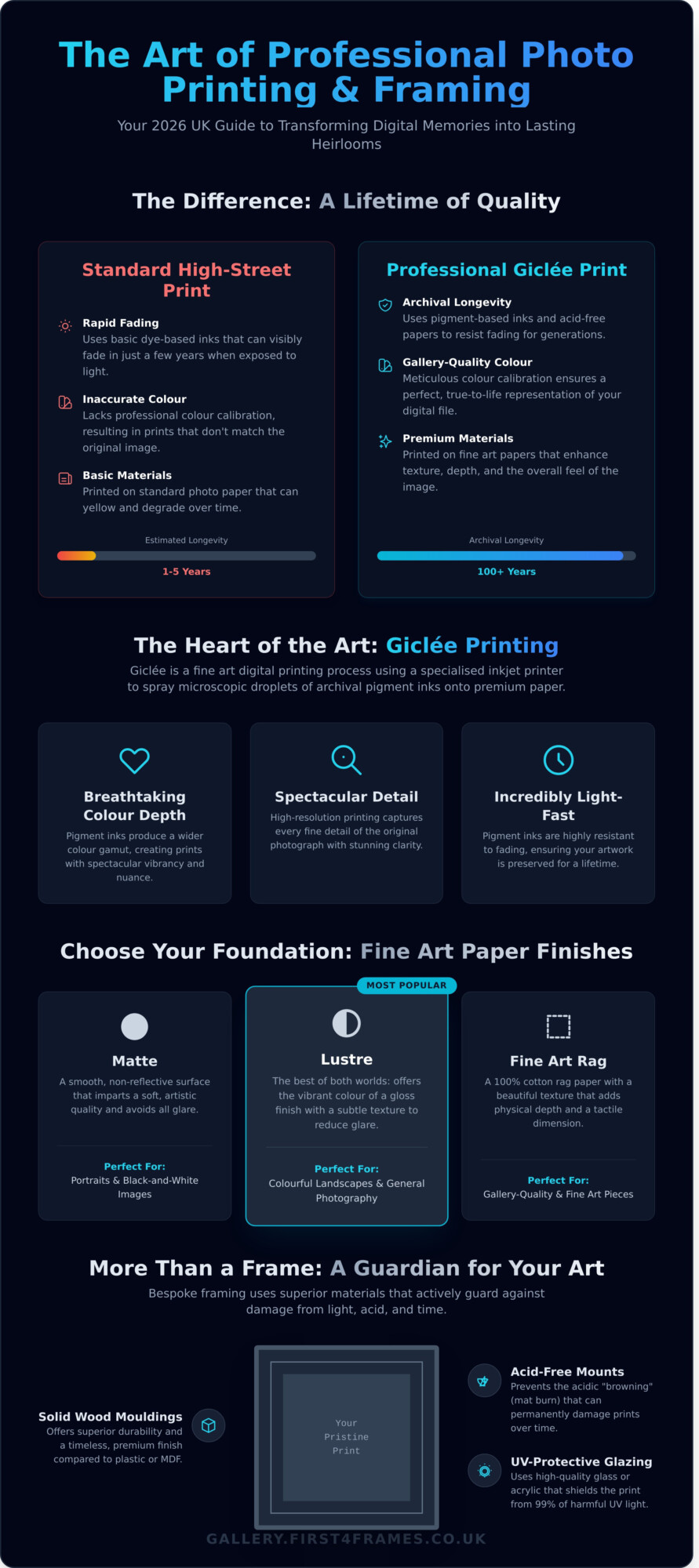
Infographic titled The Art of Professional Photo Printing & Framing explaining differences between standard and professional printing, giclée printing, print finishes, and framing options for preserving digital memories as lasting heirlooms.

From Your Screen to Your Wall: A 5-Step Guide

Transforming a cherished digital memory into a tangible piece of art is a deeply rewarding experience. This simple, 5-step guide synthesises everything we’ve discussed, taking you from a file on your computer to a beautifully framed photograph ready to hang on your wall. Let’s begin this creative journey together.

Of course, the first step is capturing a memory worth preserving. Whether it’s a dramatic landscape from your travels or a candid city moment, the best photos often come from unique experiences.

If you’re looking for inspiration on how to create such memories in and around London, you can check out Timescape Tours for guided trips designed to showcase the most photogenic locations.

Step 1: Select Your Best High-Resolution Photograph
Start with your finest work. To ensure your final print is sharp, clear, and bursting with detail, it’s essential to select a high-resolution digital file. A premium print always begins with a quality source image.

Step 2: Choose Your Print Size & Paper Finish
Consider the final aesthetic you wish to achieve. Choose a print size that suits your intended space and select a paper finish-such as fine art matte or a classic lustre-that complements the mood and style of your photograph.

Step 3: Design Your Bespoke Frame (Moulding & Mount)
This is where your creativity truly shines. Design a bespoke frame by selecting the perfect moulding and mount combination. The right choices will elevate your photograph from a simple print to a stunning, gallery-worthy piece.

Step 4: Place Your Order with a Professional Service
Partner with the experts. Place your order with a trusted service that specialises in professional photo printing and framing. True craftsmanship ensures your vision is realised with archival-quality materials and meticulous attention to detail.

Step 5: Hang and Enjoy Your Custom-Made Artwork
The final, most satisfying step. Once your custom-made artwork arrives, hang it in its chosen spot. Step back and enjoy the powerful connection that a perfectly presented photograph brings to your home or office.

Sizing Your Print and Frame

Deciding on the final dimensions can feel daunting. Consider the scale of your room and the available wall space. Remember that adding a mount will increase the overall frame size, creating valuable breathing room around your image. A simple tip: use masking tape or a sheet of paper to map out the final frame size on your wall. This helps you visualise the impact before you commit.

Matching the Frame to Your Photo

A common question we hear is, “Should the frame match my room or my artwork?” The answer is always the artwork. A frame should act as a bridge, complementing the colours and tones within your photograph to draw the viewer’s eye inward. A simple black frame works wonders for monochrome images, while a natural oak can enhance earthy, outdoor scenes. Feeling unsure? Our experts in Falkirk can help you choose.

The First4Frames Difference: Scottish Craftsmanship, Simplified

Throughout this guide, we’ve explored the essential elements that go into creating a beautifully finished piece of photographic art. Understanding paper types, printing methods, and framing styles is crucial, but the final step is choosing a partner who can bring all those elements together with expertise and care. At First4Frames Gallery, we combine time-honoured Scottish craftsmanship with a simple, modern process to transform your digital photos into treasured heirlooms.

We believe that every image deserves the best presentation. That’s why we use museum-quality Giclée printing for every photo, ensuring spectacular colour accuracy and archival longevity. Your print is then passed to our skilled artisans in our Falkirk workshop, who build your bespoke frame by hand. We offer a carefully curated selection of high-quality papers and sustainable wood frames, giving you premium choices without overwhelming you. Our intuitive online tool makes it easy to upload your image, customise your options, and visualise the final product before placing your order.

A One-Stop-Shop for Your Framed Art

The beauty of our service lies in its seamless integration. There’s no need to coordinate with separate printers and framers or worry about prints getting damaged in transit. We manage the entire process of professional photo printing and framing under one roof, ensuring a perfect, harmonious result. From the moment you upload your digital file to the final delivery, we guarantee a flawless transition from screen to stunning wall art.

Why Choose a Local UK Framing Expert?

Choosing a UK-based specialist offers significant advantages. You benefit from accessible, friendly customer service from a team that is passionate about its craft. More importantly, you avoid the uncertainty of international orders.

  • No Surprise Fees: All our pricing is transparent, with no unexpected import duties or taxes.
  • Fast, Reliable Delivery: We ship directly from our Scottish workshop, ensuring quicker and more dependable delivery across the UK.
  • Support Local Craftsmanship: By choosing us, you are supporting a dedicated local business committed to quality and tradition.

Ready to see your photos transformed into gallery-quality art? Start creating your masterpiece today.

Your Journey to Beautifully Framed Art Starts Here

We’ve explored what sets true craftsmanship apart, from the intricacies of archival printing to the fine details of a bespoke frame. Ultimately, the journey of professional photo printing and framing is about transforming your digital images into tangible, lasting art that resonates with your personal style. It’s about honouring your memories with the beautiful quality they deserve, turning a simple photograph into a spectacular centrepiece for your home.

At First4Frames, this is the standard we live by. With over 20 years of bespoke framing experience, every piece is passionately handcrafted in our Falkirk, Scotland workshop. We use museum-quality Giclée printing as standard, ensuring your art is not only perfect today but for generations to come. We make the entire process simple, so you can focus on the joy of creating.

Ready to see your own photos transformed? Don’t let your favourite images stay hidden on a hard drive. Give them the premium finish they’ve been waiting for. Upload your photo and create your own framed art today.

Frequently Asked Questions

How big can I print my photo?

The maximum print size is determined by the quality and resolution of your original digital file. A high-resolution photo from a DSLR camera can be printed to a spectacular large format, while a smartphone picture may be better suited to a smaller size. We always assess your image file and will advise on the largest possible size that maintains perfect sharpness and clarity, ensuring your final piece is nothing short of beautiful.

What is the difference between a Giclée print and a regular photo print?

A Giclée print is the gold standard for fine art reproduction. It uses archival-quality pigment inks on premium, acid-free paper, resulting in incredible colour depth, accuracy, and longevity. Unlike regular photo prints which can fade, a Giclée print will retain its vibrancy for a lifetime. It’s the perfect choice for turning a treasured photograph into a true piece of art that will be cherished for generations to come.

How long does professional photo printing and framing take?

Our bespoke service combines meticulous craftsmanship with efficiency. Typically, you can expect your beautifully finished, framed photo to be ready for dispatch within 7-10 working days from when you place your order. This allows our expert team the necessary time to perfect the print, hand-craft your chosen frame, and carefully assemble the final piece to our exacting standards, ensuring it arrives looking absolutely perfect.

Is it better to have a mount on my framed photo?

While a personal choice, adding a mount (or passe-partout) is highly recommended for a professional, gallery-style finish. A mount creates a visual breathing space, drawing the viewer’s eye into the photograph itself. It also serves a practical purpose by preventing the print from making direct contact with the glass, which helps preserve it over time. A mount truly elevates the artwork, acting as a beautiful bridge between the image and the frame.

Can you frame a photo from my phone?

Absolutely! Modern smartphones have fantastic cameras capable of producing high-quality images perfect for printing and framing. For the best results, it’s important to upload the original, highest-resolution file directly from your phone’s gallery, rather than a compressed version from social media. We can then assess its quality and help you choose the ideal size to transform your mobile memory into a stunning piece for your wall.

How much does professional printing and framing cost in the UK?

The cost of professional photo printing and framing is tailored to your specific choices, as every piece we create is bespoke. Prices can start from around £40 for a smaller, standard print and frame. For larger pieces with premium mouldings, specialist glass, and a mount, the cost can range from £80 to £150 or more. The final price depends entirely on the size, materials, and custom finishes you select for your unique artwork.

What is the best way to clean the glass on my frame?

To keep your framed photo looking pristine, we recommend using a soft, lint-free microfibre cloth. For any stubborn marks, lightly spray a small amount of glass cleaner onto the cloth itself-never spray directly onto the frame. Wiping the glass gently with the dampened cloth will prevent any liquid from seeping behind the frame and potentially damaging your mount or the beautiful print within.

Do you deliver framed photos safely across the UK?

Yes, we take the utmost care to ensure your artwork arrives in perfect condition, no matter where you are in the UK. Each framed photo is securely packaged with corner protectors, bubble wrap, and a sturdy, custom-fitted box designed for safe transit. We partner with trusted and insured couriers to handle your delivery, giving you complete peace of mind that your new piece will arrive safely at your doorstep.

Posted on

What Are Giclée Prints? A Complete Guide to Fine Art Quality

What Are Giclée Prints? A Complete Guide to Fine Art Quality

Have you ever browsed for the perfect piece of art, only to be stopped by a word you’re not quite sure of: Giclée? It’s a common question-is it just a fancy marketing term for a poster, or is there a real difference in quality? When you’re investing in art for your home, you deserve to know that your chosen piece won’t fade and that its quality matches its beauty. True Giclée prints represent the pinnacle of fine art reproduction, a world away from a standard print in both their spectacular detail and their longevity.

As passionate artisans with a love for craftsmanship, we want to demystify the jargon and share our expertise with you. In this complete guide, we will embark on a journey into the technology and artistry behind Giclée. You’ll discover exactly what makes these prints so special, learn how to identify genuine fine art quality, and understand the simple steps to care for your artwork, ensuring it remains a cherished masterpiece for a lifetime. Let’s explore the beauty and brilliance of Giclée together.

Key Takeaways

  • Understand the crucial differences between a standard poster and a true fine art Giclée, from the archival inks to the premium paper it’s printed on.
  • Discover the meticulous process that gives Giclée prints their spectacular colour accuracy and detail, making them a worthwhile art investment.
  • Learn how to confidently identify high-quality Giclee Prints by asking the right questions and looking for specific signs of professional craftsmanship.
  • Protect your beautiful new artwork by learning the essential care and framing techniques that will preserve its vibrancy for decades to come.

What Exactly is a Giclée Print? Beyond the Buzzword

You’ve likely seen the term ‘Giclée’ when browsing for premium art, but what does it truly mean? In simple terms, a Giclée (pronounced zhee-KLAY) print is the highest quality art reproduction available today. The term itself comes from the French verb ‘gicler,’ meaning ‘to spray,’ which aptly describes how microscopic droplets of ink are applied to the paper with incredible precision. But to truly understand what is a Giclée print, we must look beyond the name to the meticulous process that creates a near-perfect, museum-quality copy of an original piece.

To see this process in more detail, this video offers a fantastic overview:

This sophisticated method is worlds away from a standard desktop inkjet print. While a home printer uses a few dye-based inks on basic paper, the Giclée process relies on a combination of superior technology and premium materials. This synergy is what gives Giclée prints their spectacular colour accuracy, detail, and impressive longevity.

The Three Pillars of Giclée Quality

True Giclée quality rests on three essential components working in perfect harmony:

  • The Printer: We use sophisticated, large-format printers that hold up to 12 different pigment ink cartridges. This allows for a much wider colour gamut, capturing subtle tones and hues that standard printers simply cannot replicate.
  • The Ink: Giclée printing uses archival-quality pigment-based inks, not standard dyes. These pigments are lightfast and designed to resist fading for over 100 years, ensuring your artwork remains as vibrant as the day it was printed.
  • The Paper: The foundation of the print is just as crucial. We use acid-free, archival certified fine art papers made from materials like 100% cotton rag. This premium substrate ensures the ink is absorbed perfectly and prevents the paper from yellowing over time.

Is Giclée Considered Fine Art?

Absolutely. The Giclée process has earned its place in the world’s most prestigious galleries, museums, and private collections. Artists embrace it as a way to create faithful reproductions of their original works, often in limited, hand-signed editions that hold significant value. This technology makes fine art more accessible, allowing collectors and art lovers to own a beautiful, lasting piece that captures every brushstroke and nuance of the original at a more approachable price point.

Giclée vs. Standard Prints: A Side-by-Side Comparison

When choosing art for your home, one of the most common questions is: what’s the real difference between a standard print and a Giclée? While both can look beautiful initially, the distinction lies in the premium materials and the precision of the process. This difference determines not just how the art looks today, but how it will look for generations to come, transforming a simple picture into a treasured heirloom. Let’s break down the key factors.

The Great Ink Debate: Pigment vs. Dye

The soul of a print is its ink, and this is where the first major difference appears. Standard printers typically use dye-based inks. These inks soak into the paper to create vibrant colours, but they are highly susceptible to fading from UV light and environmental factors. Their brilliance can sadly diminish in just a few years.

In contrast, Giclée prints use archival-quality pigment-based inks. These are microscopic particles of solid colour suspended in a liquid that sit on the surface of the paper. This method provides superior lightfastness, ensuring your art resists fading for 100-200 years under normal conditions, preserving the artist’s original vision.

Paper & Longevity: Why ‘Archival’ Matters

The foundation of a lasting print is the paper it’s printed on. Standard posters often use paper containing acid and lignin, which cause it to yellow and become brittle over time. Archival paper, essential for Giclée printing, is acid-free and made from high-quality materials like 100% cotton rag, alpha-cellulose, or premium canvas. To be considered a true fine art reproduction, the materials must meet strict criteria, often guided by Fine Art Trade Guild standards, ensuring your artwork is beautifully preserved for a lifetime.

Colour Accuracy and Detail

This is where the artistry of the Giclée process truly shines. A standard printer uses four colours (CMYK: Cyan, Magenta, Yellow, and Black) to create an image. A professional Giclée printer uses a far more sophisticated system with up to 12 different pigment inks. This dramatically expands the colour gamut, allowing for the reproduction of breathtakingly subtle tones, deep blacks, and delicate gradients that are simply impossible with standard printing. The result is a near-perfect, true-to-life copy of the original masterpiece.

Ultimately, the higher price of a Giclée print-often ranging from £50 to over £200 depending on size and artist-directly reflects an investment in longevity, colour fidelity, and museum-grade quality. It’s the choice for anyone who sees art not just as a decoration, but as a beautiful piece to be enjoyed for a lifetime.

The Giclée Printing Process: From Digital File to Masterpiece

Creating a giclée print is far more than just clicking ‘print’. It’s a meticulous, hands-on process where art and technology meet, guided by the expert eye of a master printer. This dedication to craftsmanship is what transforms a digital file into a breathtaking piece of fine art, justifying its value and longevity. The difference in quality is immediately apparent; this hands-on approach is a world away from a standard desktop printer, a distinction expertly detailed in this comparison of Giclée vs. Standard Prints.

Step 1: The Perfect Digital Capture

Everything begins with the source. The final print can only ever be as good as the digital file it comes from. For an original piece of art, this means using a professional, high-resolution scanner or camera to capture every subtle brushstroke and colour nuance. This digital master file is then painstakingly colour-corrected and proofed by a specialist, who adjusts tones and brightness to perfectly match the original artwork. This foundational step ensures the digital file is a flawless blueprint for the final print.

Step 2: The Master Printer’s Role

This is where human expertise truly shines. A skilled printer doesn’t just load the paper; they act as a custodian for the artist’s vision. Their first decision is crucial: selecting the perfect archival paper. Whether it’s a textured cotton rag or a smooth matte finish, the choice is made to complement the artwork’s style and mood. Next, they calibrate the specialised giclée printer, ensuring its wide-gamut pigment inks are perfectly aligned to reproduce the colours from the proofed digital file with stunning accuracy. They oversee the entire printing process, making micro-adjustments to guarantee a flawless result.

Step 3: Quality Control and Finishing

The journey isn’t over when the print emerges from the machine. Each piece is carefully inspected under controlled lighting for any imperfections, no matter how minor. The print is then left to ‘cure’ for up to 24 hours, allowing the pigment inks to fully set and stabilise, which is vital for its archival quality. For limited edition Giclee Prints, this is also when the artist or publisher will sign and number each piece by hand, adding a final, authenticating touch to the masterpiece.

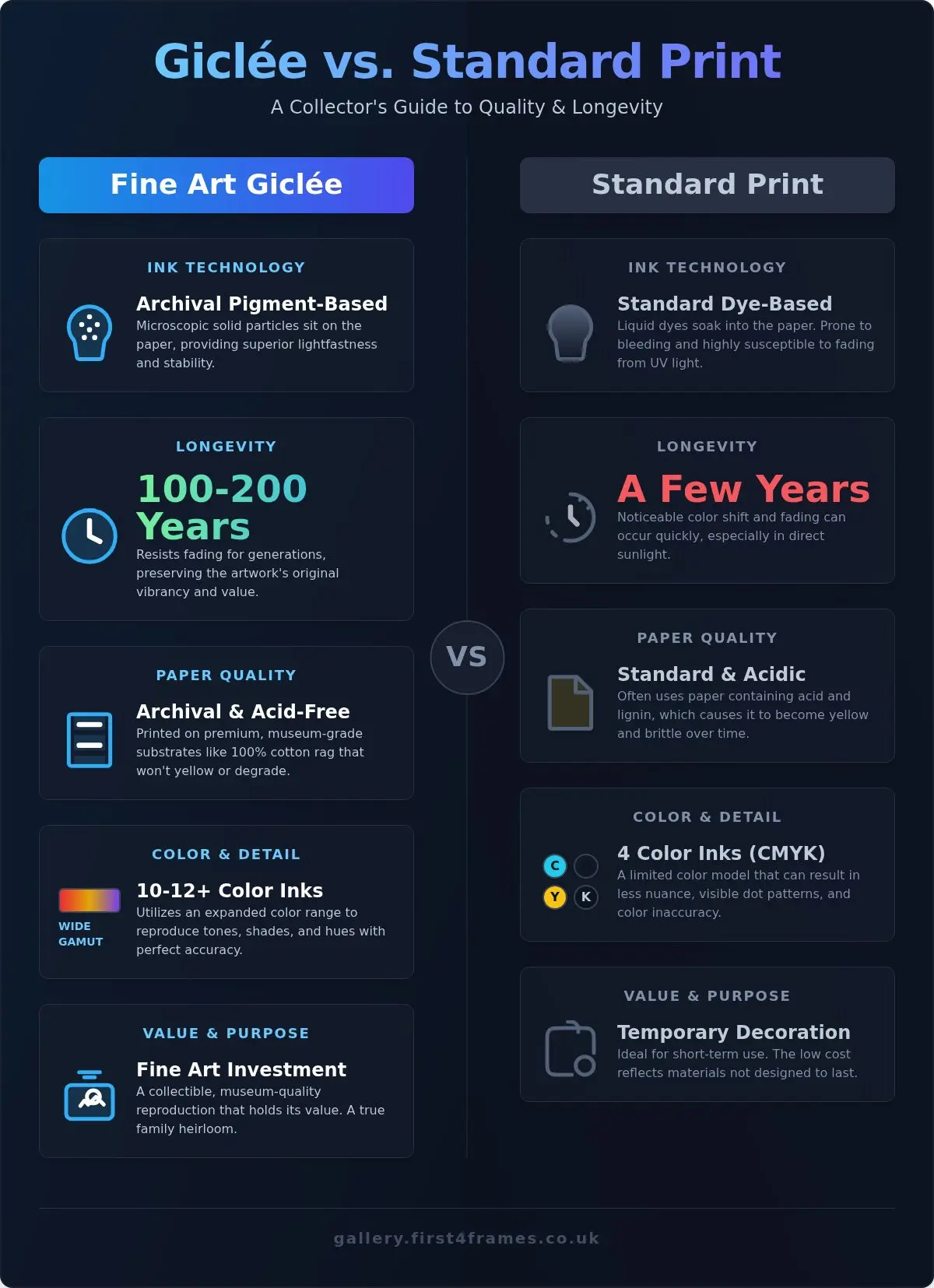
An infographic compares Fine Art Giclée and Standard Print, detailing differences in longevity, paper quality, colour & detail, and value. Giclée lasts 100–200 years; standard prints last a few years.

How to Choose and Identify a High-Quality Giclée Print

Embarking on your art-buying journey is an exciting experience. To ensure you invest in a piece that offers lasting beauty and value, it helps to know the hallmarks of quality. A little knowledge empowers you to become a savvy collector, choosing spectacular art with confidence. Think of this as your checklist for identifying premium giclée prints that you will treasure for a lifetime.

What to Look For Before You Buy

The difference between a standard poster and a fine art print lies in the details. A truly exceptional giclée print is a testament to craftsmanship, built from superior materials. Before you purchase, look for transparency from the seller on these key components:

  • The Paper: The foundation of the print must be of archival quality. Look for descriptions like “acid-free,” “100% cotton rag,” or “museum-grade.” This ensures your print won’t yellow or degrade over time, preserving its original beauty.
  • The Inks: The printer should use high-quality, pigment-based archival inks. Unlike standard dye-based inks that can fade in a few years, pigment inks are rated to last for 100+ years without noticeable fading when kept out of direct sunlight.
  • The Visual Quality: Examine the print closely if you can. The colours should be deep, rich, and accurately represent the original artwork. Details should be crisp and clear, with no signs of pixelation or blurriness, even on close inspection.

Understanding Limited vs. Open Editions

You will often see prints described as either “open” or “limited” editions. An open edition means an unlimited number of prints can be produced, making them more affordable and accessible. A limited edition, however, has a fixed production run-for example, only 50 or 100 prints will ever be made. These are often hand-signed and numbered by the artist (e.g., 5/50), adding a layer of scarcity and collectability that can help the piece hold or even increase its value over time.

Trust the Seller: The Importance of a Good Gallery

Ultimately, the best way to guarantee quality is to buy from a reputable source. A trusted gallery or printmaker will be passionate about their craft and completely transparent about their process. They should be able to tell you exactly what paper and inks they use and provide details about the artist. This expertise is your assurance that you are purchasing a genuine, high-quality piece of fine art.

At First4Frames, we pride ourselves on this transparency and our commitment to premium craftsmanship. We believe art should be both beautiful and built to last. Ready to find your perfect piece? Browse our curated collection of artist prints.

Caring for Your Giclée Print: The Crucial Role of Framing

You’ve invested in a beautiful piece of fine art-a giclée print that captures every nuance of the original artist’s vision. To ensure this spectacular artwork remains vibrant for generations, proper care is essential. The single most important step you can take to protect its longevity and value is professional framing. A frame is far more than a decorative border; it is the bridge between your art and its environment, providing crucial protection from the elements that can cause damage over time.

The Golden Rules of Framing a Giclée Print

To preserve the archival quality of your print, a few non-negotiable rules apply. These conservation-grade practices ensure your art is shielded from harm:

  • Use UV-Protective Glazing: Always opt for glass or acrylic that filters out at least 97% of harmful ultraviolet (UV) light. This is your first line of defence against fading and discolouration caused by light exposure.
  • Choose Acid-Free Materials: The mount (also known as a mat) and backing board must be 100% acid-free and of archival quality. Standard materials contain acids that can leach into the paper over time, causing yellowing and irreversible damage.
  • Create a Breathing Space: The surface of the print should never be in direct contact with the glazing. A mount or special spacers create a small air gap, preventing moisture build-up, mould growth, and the print potentially sticking to the glass.

Choosing the Right Display Location

Where you hang your art is just as important as how it’s framed. Even the best conservation framing needs a helping hand. Avoid placing your treasured Giclée prints in environments that could compromise their integrity. Steer clear of hanging them in direct sunlight, as constant exposure can cause fading. It’s also wise to keep them away from areas of high humidity or fluctuating temperatures, such as bathrooms, kitchens, or above radiators, which can cause the paper to warp or ripple.

Why Professional Framing Makes a Difference

While DIY framing is an option, the expertise of a professional framer is an investment in the life of your art. We understand the science behind art preservation, using only premium, conservation-grade materials and proven techniques to protect your piece. A perfectly chosen bespoke frame does more than just protect; it enhances the artwork, complements your décor, and draws the viewer’s eye to the image. It’s the final, perfect touch that allows your art to truly shine. Let our experts frame your art perfectly and give it the presentation and protection it deserves.

Embrace the Lasting Beauty of Giclée

As we have explored, a Giclée print is far more than just a reproduction; it is a testament to artistic quality and longevity. By understanding the meticulous process involving archival inks and premium paper, you can confidently distinguish a true fine art piece from a standard print. Remember that professional framing is the final, crucial step in preserving its spectacular colour and detail for generations to come.

At First4Frames Gallery, we combine our passion for art with over 20 years of bespoke framing expertise. We collaborate with talented Scottish artists and use only museum-quality materials to create our beautiful Giclee Prints, ensuring every piece is a lasting masterpiece. We handle the craftsmanship so you can focus on finding the art you love.

Your journey into the world of fine art is just beginning. Discover your next masterpiece in our Giclée print gallery and find the perfect piece to bring your space to life.

Your Giclée Print Questions Answered

Are Giclée prints worth the money?

Absolutely. Think of a Giclée not as a simple poster, but as a long-term investment in art. While the initial cost, which can range from £50 to over £200, is higher than a standard print, you are paying for superior quality. Giclée printing uses archival inks and acid-free paper, ensuring spectacular, fade-resistant colours that faithfully capture the artist’s original vision. This level of craftsmanship ensures your art remains beautiful for a lifetime.

How long will a Giclée print last?

A professionally produced Giclée print is created to museum-quality standards. When cared for properly and displayed away from direct, prolonged sunlight, it can last for over 100 years without any significant fading or discolouration. This exceptional longevity is thanks to the use of stable, pigment-based archival inks and premium, acid-free paper. It’s a testament to a process designed to preserve the integrity and beauty of an artwork for generations to enjoy.

Can I make my own Giclée prints at home with a desktop printer?

Unfortunately, a standard home printer isn’t equipped for true Giclée printing. The process requires a specialised, professional-grade inkjet printer that uses a minimum of 8 to 12 pigment-based archival inks. This technology achieves a far wider range of colours and much finer detail than typical home devices. For a genuine fine art reproduction that captures every nuance, it’s essential to use a trusted professional printing service with the correct equipment and expertise.

Is a Giclée print the same as a canvas print?

Not always, though you can have a Giclée print on canvas. “Giclée” refers to the premium printing *process*-using archival pigment inks for superior colour and detail. “Canvas print” simply refers to the *material* the image is printed on. You can have a lower-quality print on canvas, or you can elevate it by choosing the Giclée method. The key difference is the print quality, ink longevity, and colour fidelity that makes Giclée the fine art standard.

How can you tell if a print is a genuine Giclée?

There are a few clear signs of genuine Giclée craftsmanship. The print should exhibit incredibly fine detail with no visible dot patterns, even under close inspection; the colour should appear as a continuous tone. It will be on heavy, high-quality archival paper or canvas, not thin or glossy photo paper. Reputable sellers and artists will also often provide a certificate of authenticity, giving you confidence that you are purchasing true Giclée prints.

Do Giclée prints increase in value?

While their primary value is in their exceptional quality and longevity, a Giclée print can increase in monetary value. This is most likely to happen with a limited-edition print that is hand-signed by a well-regarded or rising artist. Factors like the artist’s reputation, the rarity of the edition, and the print’s condition all play a crucial role. It is best viewed as an investment in lasting, beautiful art, with the potential for financial appreciation.