Posted on

Reassuringly High Quality Framing: The Artisan’s Guide to Protecting Your Art

Reassuringly High Quality Framing: The Artisan’s Guide to Protecting Your Art

Last month, a collector visited our studio with a stunning 2023 print from a featured First4Frames Gallery artist, only to find that a cheap, mass-produced frame had already started to yellow the edges. It’s a heartbreaking sight we see too often; poor materials can cause irreversible damage in as little as 36 months. You want your investment to last, but the fear of choosing the wrong mount or getting lost in technical talk about Giclée prints often stalls the process. We believe that choosing reassuringly high quality framing shouldn’t be stressful. It’s about more than just a border; it’s the essential bridge between your room décor and the artwork itself.

You deserve the peace of mind that comes with professional craftsmanship, backed by our 4.9-star customer rating. We’ll guide you through the bespoke process, explaining how acid-free materials and expert curation preserve your favourite pieces for a lifetime. This guide reveals exactly what defines premium framing and how our 20 years of experience helps you create a beautifully finished, ready-to-hang masterpiece.

Key Takeaways

  • Learn why archival-grade materials and acid-free mounts are essential for preserving the vibrant colours and long-term value of your favourite fine art.
  • Discover how our expert artisans provide reassuringly high quality framing that acts as a protective, aesthetic bridge between your home décor and your artwork.
  • Understand the hidden risks of budget frames and how investing in bespoke craftsmanship protects your art from damage caused by acidic materials and poor fit.
  • Explore how to perfectly complement the cinematic mood of Jack Vettriano or the bold landscapes of Jolomo through expert curation at the First4Frames gallery.
  • See how our “one-stop-shop” service and simple three-step process-backed by excellent customer ratings-make it easy to order professional print-and-frame sets or bespoke framing.

What Defines Reassuringly High Quality Framing?

At the First4frames gallery, we believe a frame does the heavy lifting in the relationship between the artwork and the viewer. Since opening our doors in Falkirk in 2004, we’ve seen how the right choice transforms a simple print into a focal point. True quality isn’t a happy accident. It’s a deliberate combination of archival-grade materials and expert manual assembly. When you invest in reassuringly high quality framing, you’re buying peace of mind that your art is protected for decades, not just months.

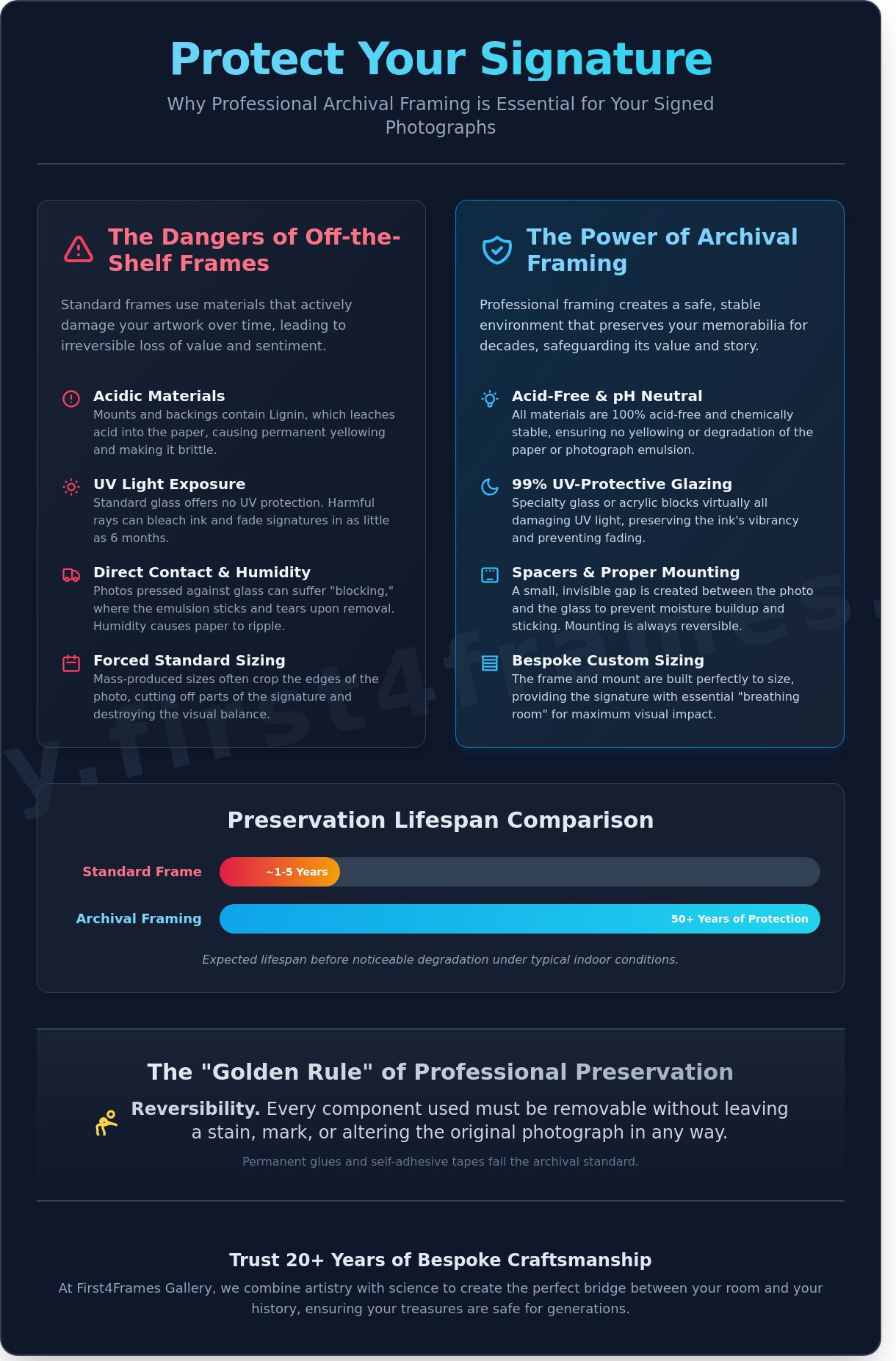
Our role as a trusted professional involves more than just cutting wood to size. With over 20 years of experience, our craftsmen understand the chemistry of preservation. We often guide clients through the technicalities of the conservation and restoration of painting frames to explain why we avoid cheap, acidic tapes or backing boards. These inferior materials are responsible for the “foxing” or brown spotting seen on 25% of poorly framed works within just five years. By using pH-neutral components, we ensure your artwork remains in pristine condition.

Reassurance comes from transparency. When you visit our workshop, you see the process and a portfolio that spans thousands of successful projects. There’s a specific emotional impact when a frame is right. It doesn’t just sit on the wall; it pulls you into the picture. It creates a sense of depth and importance that makes you stop and look every time you walk past. This emotional connection is the hallmark of a master framer’s work.

The Aesthetic Bridge: Art Meets Interior Décor

We view the frame as a bridge between your room décor and the artwork itself. It’s the transition point that helps a contemporary piece sit comfortably in a traditional Scottish home. The right mount colour is vital here. It organises the visual focus, drawing the eye toward the subject rather than the wall. A frame should never compete with the art. If the border is too loud, the artist’s message is lost. We aim for a complementary finish that enhances the colours and textures of the piece without overwhelming them.

Trust Indicators in Professional Framing

Consistency is the best measure of trust. Our 4.9-star rating on independent review platforms isn’t just a number; it represents two decades of satisfied customers in Falkirk and across the UK. We’ve spent 20+ years refining our craft to ensure every mitre joint is seamless and every mount is cut with surgical precision. This longevity matters because it proves our methods stand the test of time. Bespoke framing is a tailored preservation service designed to protect and showcase your unique piece for a lifetime.

  • Archival Materials: We use acid-free mounts and backing to prevent chemical damage.
  • Expert Assembly: Every frame is hand-joined by professionals with decades of experience.
  • Visual Balance: We select profiles that bridge the gap between your art and your furniture.
  • Proven Reputation: Our 2004 founding date ensures we have the local and national trust required for high-value items.

The Anatomy of a Premium Frame: Materials and Giclée Printing

At First4frames gallery, we believe the artwork and the frame share a vital partnership. When you view the work of our featured artists, you aren’t just looking at a picture; you’re seeing a carefully engineered product designed to last a lifetime. This starts with materials that meet our strict standards for reassuringly high quality framing. We source solid wood mouldings and archival-grade components to ensure every piece provides the structural integrity needed to protect your investment. Our team brings over 20 years of expertise to every project, ensuring the frame acts as a perfect bridge between your room décor and the artwork itself.

Understanding Giclée Quality

Giclée printing is the gold standard for fine art reproduction. Unlike standard posters that use dye-based inks, we use 12-colour pigment ink systems to achieve incredible colour accuracy. These prints offer a 1,200 dpi resolution that creates an “identical copy” feel of the original work. Because these pigments are archival, your artwork won’t fade for 100 years or more. For more detail, see our What Are Giclée Prints? A Quality Guide.

Mounts, Glass, and Backing

Protection requires more than just a pretty border. We use only pH-neutral, acid-free mounts to prevent “mount burn,” which is a common brown staining caused by cheap wood-pulp boards. For the best results, we suggest Preservation matting and framing techniques that keep the art safe from environmental degradation. Our specialist glass options can also block up to 99% of harmful UV rays.

The science behind our materials is what sets our service apart. We use 300gsm cotton rag papers that feel substantial and hold ink with incredible precision. Standard retail frames often use MDF or plastic, but we insist on premium wood mouldings. These provide the heavy lifting by preventing the frame from warping under the weight of the glass. A frame that twists or bows will eventually allow dust or moisture to seep in, which can ruin the print over time.

Professional sealing is another hallmark of reassuringly high quality framing. We finish every piece with specialist backing tape and hanging hardware that supports the specific weight of the assembly. This creates a controlled micro-environment for the art, shielding it from the humidity changes common in UK homes. If you want to see how these materials come together to create a spectacular finish, you can browse our latest collection of framed pieces.

By using anti-reflection “invisible” glass, we remove the barrier between the viewer and the artist’s vision. This glass reduces reflections to less than 1%, making the glazing almost disappear. This ensures the focus stays entirely on the fine art, pulling you into the picture without the distraction of glare. Every component, from the 2.5mm glass to the precision-cut mount, is chosen to enhance the aesthetic while providing a robust, permanent home for the artwork.

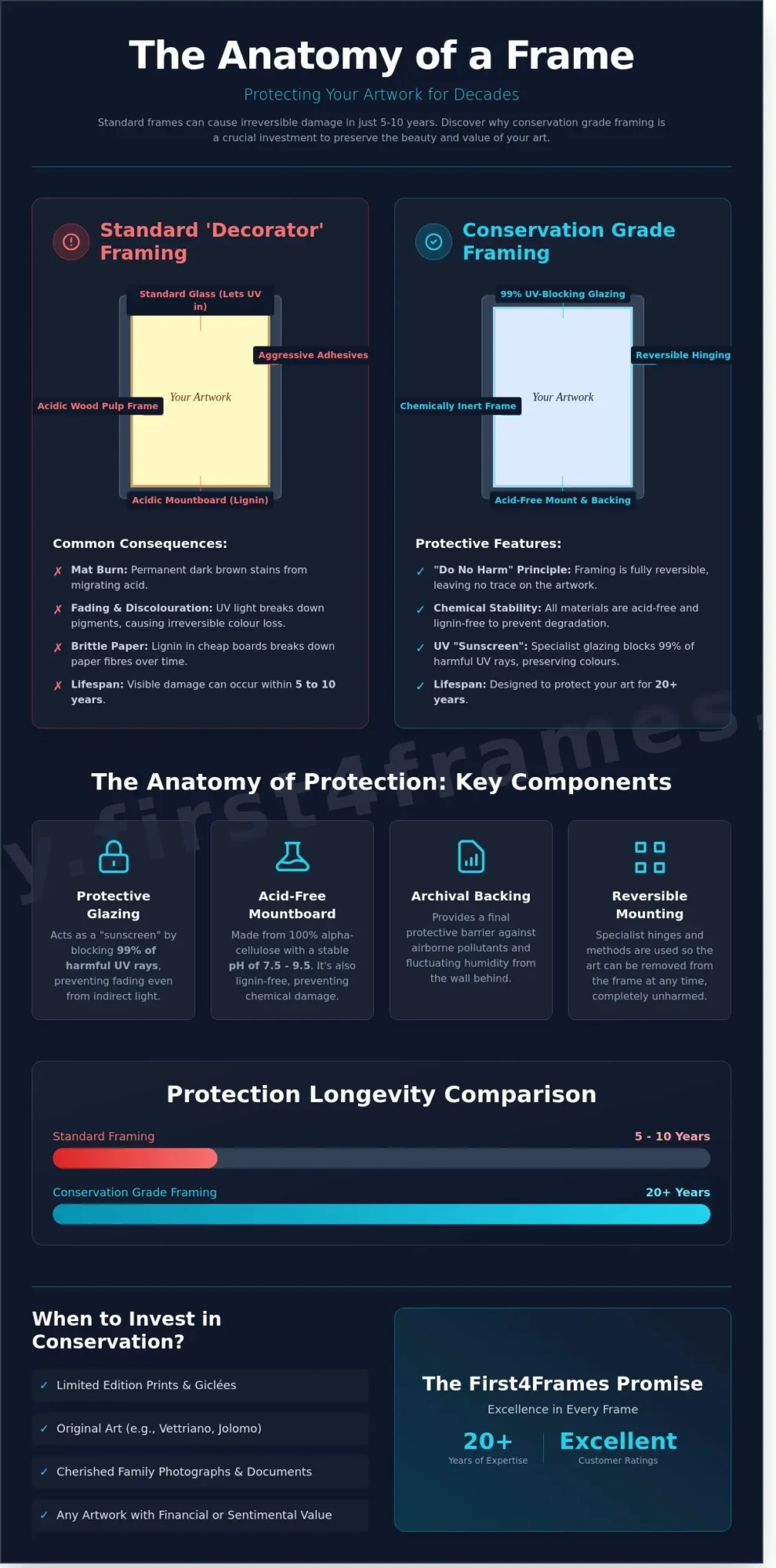
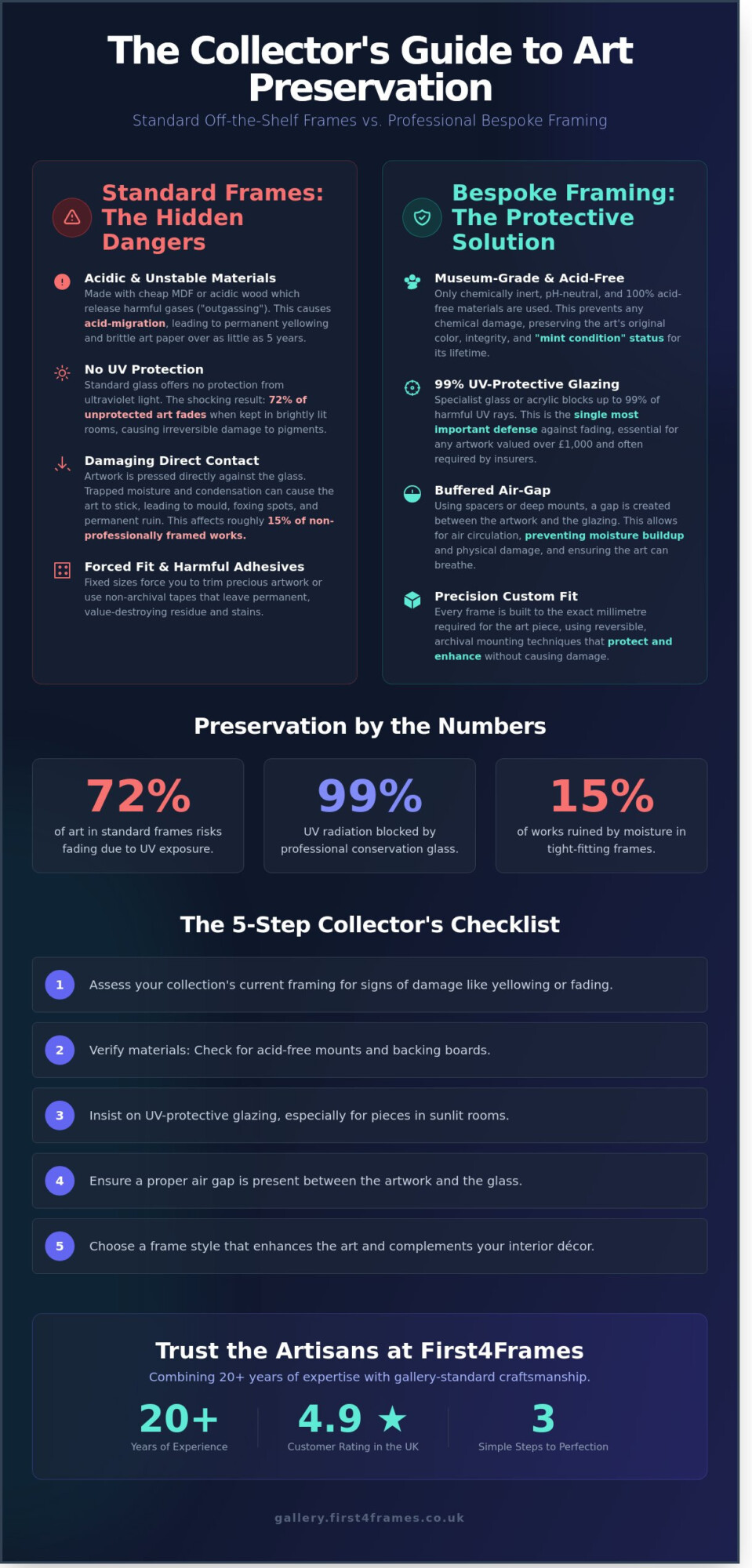
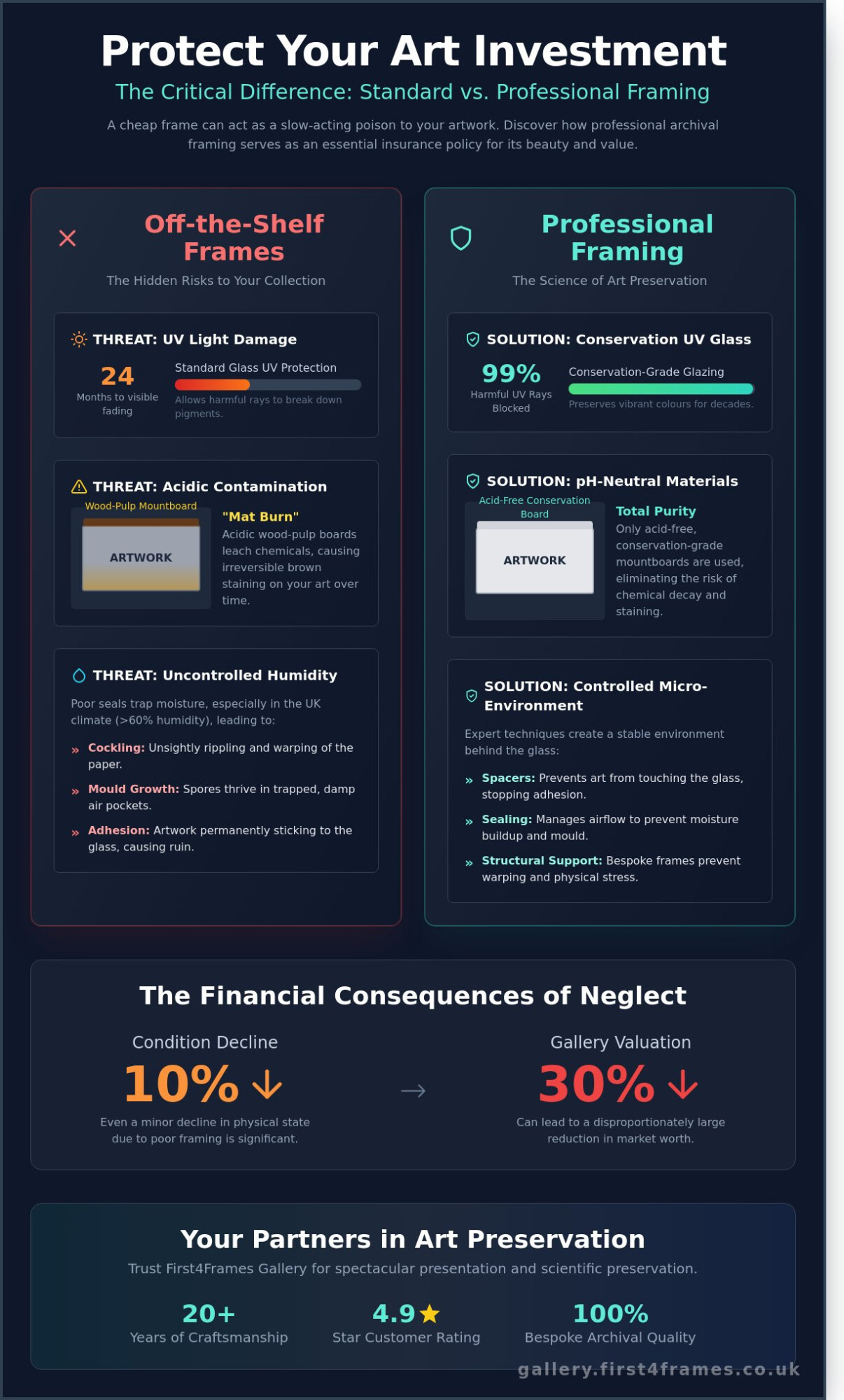
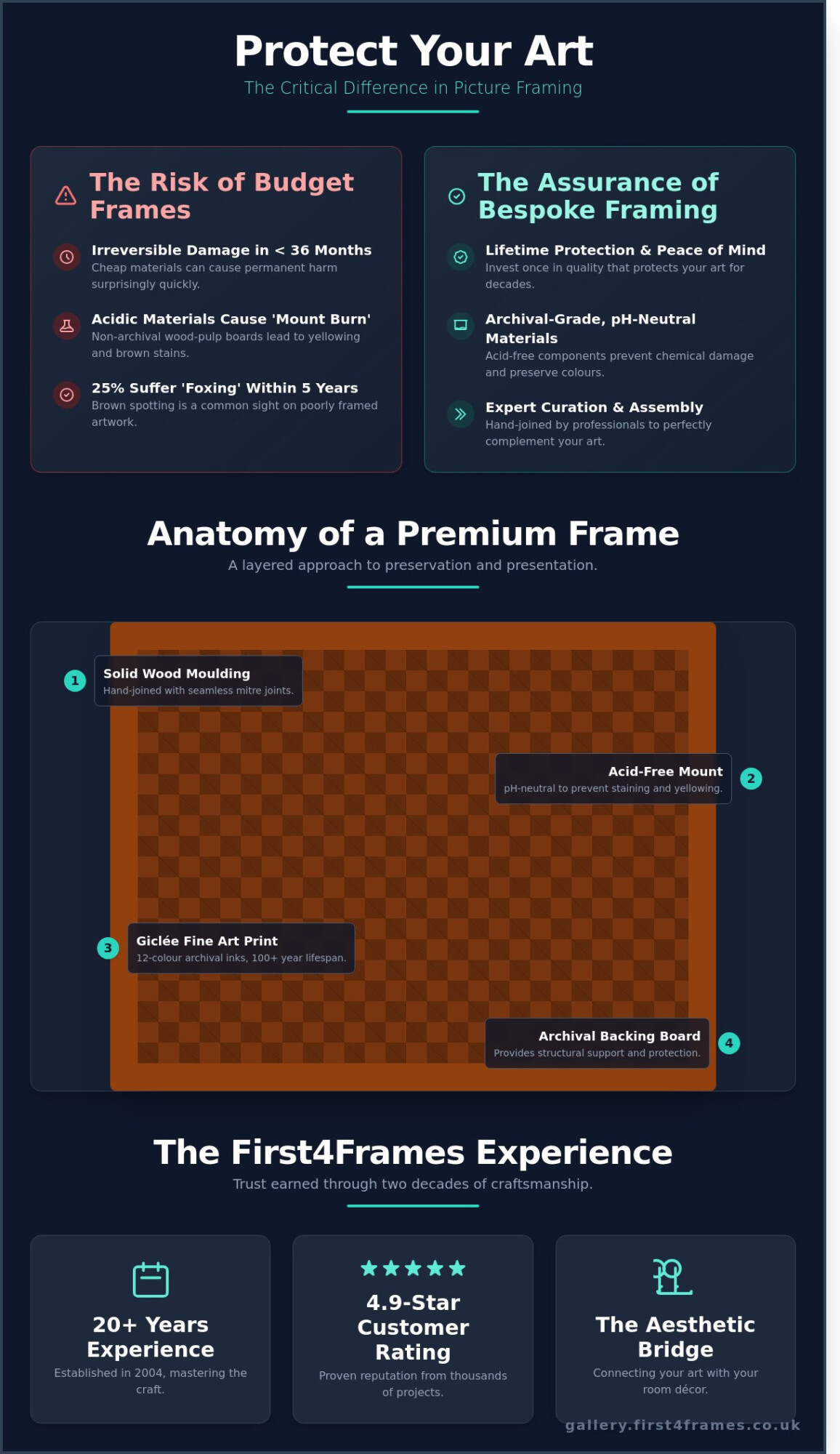
Infographic comparing budget frames and bespoke framing for art protection, illustrating the anatomy of a premium frame and highlighting benefits like solid moulding, archival materials, and customer experience at First4Frames.

Bespoke vs. Off-the-Shelf: Why Premium Framing is an Investment

Choosing a piece from the First4Frames Gallery is an emotional experience. Whether you have selected a vibrant limited edition print or a delicate original canvas, the frame acts as the vital bridge between the artwork and your living space. Opting for a mass-produced, off-the-shelf frame might feel like a convenient shortcut, but it often compromises the very beauty you’ve just invested in. Reassuringly high quality framing ensures that your artwork doesn’t just look spectacular today, but remains in pristine condition for decades to come.

The Cost of “Cheap” Framing

Budget frames found in high-street shops often rely on acidic MDF backing and thin plastic glazing. Over a period of 24 to 36 months, these low-grade materials can leach harmful chemicals into your paper or canvas. This leads to “foxing” or yellowing that is usually irreversible. Professional framing at our workshop incorporates preventive conservation techniques to shield the work from environmental hazards. By choosing our bespoke service, you gain a “second pair of eyes” from artisans with over 20 years of experience. We provide expert advice on sizing and proportions that a factory-made product simply cannot offer. You can find more details on our bespoke framing pricing structures.

The Bespoke Advantage

Standard frames are built for common sizes like A4 or A3, but fine art rarely fits a rigid template. A bespoke frame is tailored to the exact millimetre. This precision prevents the artwork from slipping or buckling, a common issue found in roughly 15% of pre-made frames used for unique dimensions. Our craftsmen match frame finishes to your specific room colours, ensuring the wood grain or metallic leaf complements your furniture perfectly. It’s a hassle-free process where professional assembly removes the risk of dust or fingerprints getting trapped behind the glass. We take the “heavy lifting” out of the relationship between the art and your wall.

The “one-stop-shop” advantage at First4Frames Gallery is what truly sets our service apart. By using our integrated print-and-frame service, your Giclée print moves directly from our high-end printers into the hands of our framing team. This eliminates the risk of damage during transit between different suppliers. While some businesses offer a “speedy service” that relies on staples and quick-dry glues, we balance efficiency with the care of hand-finished work. We source only the best materials to ensure every joint is seamless and every mount is perfectly cut.

Our commitment to excellence is reflected in our 5-star customer ratings across major review platforms. We don’t just provide a border; we provide a protective environment for your investment. When you see the finished result, the reassuringly high quality framing will be evident in the depth of the finish and the clarity of the glazing. You’re securing the resale and sentimental value of your collection from the very first day it’s hung. It’s a simple, three-step journey from browsing our gallery to owning a professionally finished masterpiece that pulls you into the picture every time you walk past.

Framing Famous Art: Curation for Jolomo and Vettriano Prints

At the First4frames gallery, we understand that the frame is the final brushstroke on a masterpiece. It acts as a vital bridge between your room décor and the artwork itself. When you invest in iconic Scottish art, you aren’t just buying a picture; you’re securing a piece of cultural history that deserves reassuringly high quality framing. Our team in Falkirk applies over 20 years of craftsmanship to ensure every Jolomo or Vettriano print receives the professional treatment it needs to last a lifetime.

Bringing Jolomo’s Scotland Home

John Lowrie Morrison, known as Jolomo, is famous for his vibrant, expressive use of colour. To truly Jolomo Prints: Bring Scotland’s Colour Home, the frame must never compete with the art. We recommend using wide, neutral mounts in off-white or soft cream. These provide a “visual breathing space” that lets those spectacular Hebridean blues and fiery sunsets pop. Because Jolomo paintings feature thick, textured brushstrokes, we always suggest Giclée prints. This specific printing method captures every textural detail, ensuring your framed piece looks identical to the original oil painting.

The Vettriano Aesthetic

Jack Vettriano’s work carries a distinct cinematic mood that requires a different approach. For Jack Vettriano Prints: Iconic Scottish Art, we often select classic black or dark wood frames. These deep tones match the atmospheric behaviour of his subjects and the “film noir” style of his compositions. A sleek, dark frame creates a sophisticated, timeless look that anchors the piece in a modern room. It’s about honouring the narrative tension in the work; a heavy, ornate gold frame might overwhelm the subtle shadows that Vettriano is famous for.

Our local expertise in Falkirk allows us to understand the Scottish aesthetic better than national chains. We don’t just provide a service; we offer a bespoke partnership. Whether you’re visiting our gallery to find a new piece or using our specialist framing service for a cherished print, our 4.9-star customer rating reflects our commitment to excellence. We source only the best materials, from acid-free backing boards to UV-protective glass, ensuring your art doesn’t fade over time. This technical precision is what defines reassuringly high quality framing at First4frames.

In February 2024, we demonstrated this expertise through a commercial staging project for a luxury apartment complex in Stirling. The developer required 14 limited edition prints to be curated, framed, and installed within a 72-hour window. We selected a mix of contemporary Scottish landscapes and Vettriano prints, using coordinated charcoal frames to create a cohesive feel throughout the property. By using our “one-stop-shop” print-and-frame service, the client saved 15% on procurement costs compared to using separate suppliers, and the high-quality finish helped the property secure a tenant within 48 hours of the launch.

If you’re looking to elevate your home with iconic Scottish imagery, you can browse our curated collection at the First4frames gallery and discover the perfect piece for your space.

The First4Frames Experience: Your One-Stop-Shop in Falkirk

First4Frames serves as a dedicated one-stop-shop for art lovers across Central Scotland and beyond. Our Falkirk workshop has spent more than 20 years perfecting the balance between aesthetic beauty and structural integrity. We don’t just put a border around a picture; we create a finished piece that draws you into the scene. Our team treats every project with the same level of passion, whether it’s a limited edition print or a child’s first drawing. This commitment to excellence is why we consistently maintain 5-star ratings across independent review platforms. We believe the frame acts as a vital bridge between your room’s decor and the artwork, doing the heavy lifting to make the piece truly pop.

Our Three-Step Ordering Process

We’ve simplified the journey of acquiring fine art into three easy steps. First, you browse our extensive online gallery, which features a curated selection of works from renowned Scottish and international artists. Once you’ve found a piece that speaks to you, our digital preview tool lets you experiment with various mount colours and frame styles. This ensures the final product matches your vision perfectly. Finally, you place your order for secure delivery. We use specialist couriers to ensure your “ready-to-hang” art arrives in pristine condition, ready to transform your living space immediately.

Bespoke Framing for Your Treasures

Your most precious memories deserve more than a standard off-the-shelf solution. We provide reassuringly high quality framing for items that carry deep personal value. Our experts have framed hundreds of unique items, from football shirts and military medals to complex 3D objects and delicate oil paintings. We understand the chemistry of conservation; we use acid-free mounts and premium materials to prevent yellowing or degradation over time. When you trust us with a family heirloom, you’re getting the “trusted professional” approach that prioritises the safety of your item above all else. Visit our Falkirk gallery or browse our collection online to see the standard of our work firsthand.

Beyond individual collectors, we offer comprehensive commercial services tailored for property developers and estate agents. We know that the right art can transform a cold room into an inviting home. Our team provides professional curation for show homes, selecting pieces that enhance the architectural features and interior design of a property. We handle everything from the initial selection to the final professional framing, ensuring a cohesive and sophisticated look that appeals to potential buyers. Our commercial clients value our ability to deliver bulk orders on tight schedules without ever losing that bespoke, artisan feel.

The First4Frames promise is rooted in a genuine love for the arts and a respect for traditional craftsmanship. We don’t cut corners because we know that reassuringly high quality framing is the only way to truly protect an investment. We source only the finest timber and high-grade glass to ensure your artwork remains as vibrant as the day it was created. It’s this blend of technical expertise and artistic passion that makes us the preferred choice for artists and collectors throughout the UK. When you choose us, you’re choosing a partner dedicated to making fine art accessible, beautiful, and durable for years to come.

Bring Your Scottish Contemporary Art to Life

The First4Frames gallery is a celebration of colour and texture, featuring the spectacular works of Jolomo and Jack Vettriano. Selecting reassuringly high quality framing for these Giclée prints ensures their beauty won’t fade over time. With over 20 years of artisan experience in our Falkirk workshop, we understand that a frame is the essential bridge between your room décor and the artwork itself. Our excellent customer ratings on leading review platforms prove we’re a trusted partner for collectors across the UK. We handle everything from bespoke framing to our convenient print-and-frame service, making us your professional one-stop-shop for fine art. Whether you’re drawn to a coastal Jolomo scene or a moody Vettriano, our craftsmanship provides the perfect finish. Don’t settle for off-the-shelf solutions when your collection deserves the premium protection of a bespoke build.

Explore our Gallery and Bespoke Framing Services

We look forward to helping you embark on your next journey of artistic discovery.

Frequently Asked Questions

What makes a frame “high quality” compared to a standard shop-bought one?

High quality framing relies on precision-cut mitred corners and solid wood mouldings rather than the plastic or MDF found in mass-produced shop frames. At First4Frames, we ensure every joint is seamless and reinforced, providing a reassuringly high quality framing finish that supports the weight of the glass and artwork safely. Our 20 years of experience means we use 2mm float glass or UV-protective acrylic to prevent bowing and protect your investment.

Will a Giclée print fade if it is hung in a bright room?

Giclée prints from our gallery won’t fade for up to 100 years when displayed in normal indoor lighting conditions. We use 12-colour pigment-based inks and archival papers that meet Fine Art Trade Guild standards. While direct sunlight isn’t recommended for any art, these professional prints are significantly more lightfast than standard inkjet versions. This ensures the vibrant colours of artists like those featured in our gallery remain vivid for decades.

Can I bring my own artwork to First4Frames for bespoke framing?

You can certainly bring your own original paintings, limited edition prints, or personal photographs to our workshop for our bespoke framing service. While our gallery showcases incredible local artists, we’ve spent two decades helping customers preserve their own treasures. Our team provides a one-to-one consultation to select the perfect materials. We handle everything on-site, ensuring your artwork never leaves our secure premises during the framing process.

How long does the bespoke framing process usually take?

Our bespoke framing process typically takes between 7 and 10 working days from the moment you place your order. This timeframe allows our craftsmen to source specific mouldings and hand-finish your frame to our exacting standards. If you need a piece for a specific date, such as a birthday or gallery opening, let us know. We often accommodate shorter deadlines when our workshop schedule allows for a faster turnaround.

What is an acid-free mount and why is it important for my art?

An acid-free mount is a pH-neutral board that creates a protective barrier between your artwork and the frame glass. Standard boards contain lignin which turns acidic over time, causing yellowing on your art within 5 years. By using conservation-grade materials, we provide reassuringly high quality framing that preserves the paper’s integrity. It’s an essential component for any piece you intend to keep for the long term.

Do you offer framing services for commercial properties or offices?

We provide comprehensive framing services for commercial spaces, including offices, hotels, and restaurants across the UK. Our team has managed projects ranging from single statement pieces for boardrooms to outfitting entire floors with 50 or more coordinated frames. We offer durable, high-specification finishes that meet health and safety requirements for public spaces. Our excellent customer ratings on review platforms reflect our commitment to delivering professional results for every business client.

How do I choose the right frame colour for my room décor?

You should choose a frame colour that complements the artwork’s dominant tones while acting as a bridge to your room’s colour palette. We often suggest looking at the secondary colours in a painting to find a frame that makes the image stand out. For example, a dark charcoal frame often suits modern industrial spaces, whereas a natural oak finish works well in 90% of contemporary British homes. Our experts help you navigate these choices in-store.

Is it possible to frame 3D objects like sports memorabilia?

We specialise in framing 3D objects including football shirts, medals, handcrafted jewelry, and even delicate christening gowns using deep-seated shadow box frames. For those looking to create future heirlooms, online boutiques like the Australian-based Dryft offer ethically sourced pieces perfect for commemorating special moments. Our techniques involve hand-sewing textiles to acid-free backing boards, ensuring the items stay secure without the use of harmful glues. We’ve framed over 500 sports jerseys in the last 12 months alone. This service transforms your memorabilia into a protected, wall-ready display that preserves the item’s 3D shape and history.

Posted on

Professional Framing Service for Photographers: The Artisan Guide to Exhibition-Ready Prints

Professional Framing Service for Photographers: The Artisan Guide to Exhibition-Ready Prints

Why does a photograph in the First4Frames Gallery command a four-figure price tag while the same image in a standard shop-bought frame struggles to sell at all? You likely already recognise that a breathtaking landscape deserves more than a mass-produced frame that might warp or allow your colours to fade within twenty-four months. Finding a framing service for photographers that understands the nuances of museum-grade materials is often the most frustrating hurdle for any professional looking to command higher prices.

We see the power of presentation every day through our featured artists in the gallery. Their work is elevated by the same craftsmanship we’ve perfected over twenty years in the trade. It’s about more than just wood; it’s about preserving a moment. You’ll discover how to turn your digital files into gallery-standard physical art using bespoke techniques that have earned us an enviable 4.9-star rating. This guide explores the essential journey from our professional framing options to our integrated print-and-frame service. We’ll show you how to build a reliable partnership that handles the entire process, giving you the confidence to present your work as the masterpiece it truly is.

Key Takeaways

  • Learn how to emulate the presentation techniques of renowned Scottish artists like Jolomo and Jack Vettriano to give your portfolio a professional gallery edge.
  • Discover the “Artisan Standard” of Giclée printing and archival materials that ensure your photographic work remains vibrant and protected for a lifetime.
  • Identify whether to use our streamlined print-and-frame options or our specialised framing service for photographers based on your specific project requirements.
  • Understand how to use the frame as a “bridge” to harmonise your artistic vision with a client’s interior décor through expert colour and texture selection.
  • Find out why our Falkirk-based workshop is the trusted partner for professionals, delivering the high-quality craftsmanship reflected in our exceptional customer ratings.

Elevating Your Portfolio: Why a Professional Framing Service for Photographers Matters

Your photograph isn’t truly finished until it’s hanging on a wall. While digital galleries offer global reach, the physical print remains the gold standard for serious collectors and exhibition spaces. A professional framing service for photographers provides much more than a simple border; it offers a bespoke artisan solution that elevates your work from a mere image to a piece of fine art. At First4Frames Gallery, we understand that off-the-shelf solutions often fall short of the quality your vision deserves. We specialise in turning your creative output into gallery-ready assets that command attention.

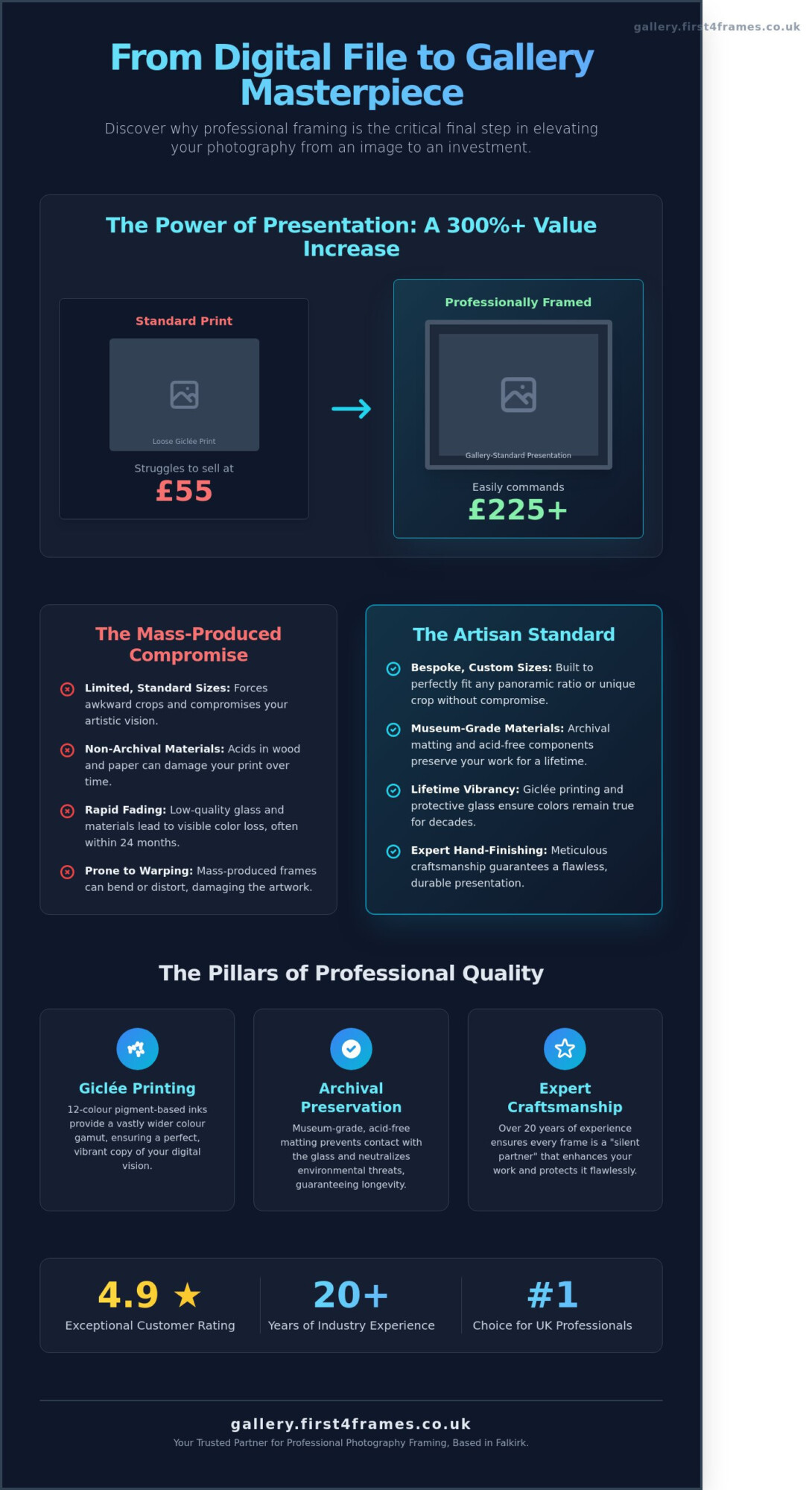
The frame acts as a vital bridge between your photographic intent and the client’s interior decor. It’s the element that allows a moody landscape or a vibrant portrait to sit harmoniously within a home or office. Beyond aesthetics, the psychological impact of professional presentation is measurable. Data from gallery sales suggests that a professional presentation can increase perceived value by over 300%. For instance, a loose Giclée print priced at £55 might struggle to gain traction, yet the same image, expertly framed and mounted, can easily command £225 or more. This price jump reflects the craftsmanship involved and the buyer’s confidence in the product’s longevity.

First4Frames Gallery serves as a comprehensive one-stop-shop for the UK’s photographic community. Based in Falkirk, we combine 20 years of industry experience with the latest Giclée printing technology. We don’t just frame your work; we manage the entire lifecycle of the physical piece. This ensures that every element, from the ink on the paper to the hanging hardware on the back, meets a professional standard that hobbyist shops simply cannot replicate.

The ‘Heavy Lifting’ of a Professional Frame

A well-chosen frame does the heavy lifting in the relationship between the art and the viewer. It creates a dedicated visual space, pulling the eye inward and focusing attention on your composition. Think of the frame as your silent partner. It protects the work while enhancing its best features. To ensure your prints remain pristine for decades, we employ archival matting techniques that prevent the photograph from touching the glass. This transition from a fragile digital file to a physical asset that won’t fade over time is what defines a professional’s portfolio.

Bespoke vs. Ready-Made: The Professional’s Choice

Ready-made frames often force photographers into rigid, standard sizes like 10×8 or 16×20. This can compromise your artistic vision, forcing awkward crops or leaving unsightly gaps. Choosing a bespoke framing service for photographers ensures that your unique crops and panoramic ratios are accommodated without compromise. With over two decades of heritage in Falkirk, First4Frames makes this process straightforward. Our expertise is backed by exceptional customer ratings, reflecting our commitment to quality. We source only the best materials to ensure your work stands out in a crowded market, providing a hassle-free experience that lets you focus on your next shoot.

The Artisan Standard: Archival Quality and Giclée Printing for Professionals

At the First4frames gallery, we believe a photograph isn’t truly finished until it’s presented with the respect it deserves. Since our establishment in 2004, we’ve dedicated ourselves to a standard of excellence that transforms a simple print into a lasting investment. For the professional, the choice of materials isn’t just about aesthetics; it’s about the chemistry of preservation. Our specialist framing service for photographers focuses on the marriage of high-end technology and traditional hand-finishing. We treat every piece of work from our featured artists with the same meticulous care, ensuring that the transition from the digital sensor to the gallery wall is flawless.

Giclée Printing: An Identical Copy of Your Vision

Giclée printing represents the pinnacle of digital output for the modern artist. Unlike standard inkjet processes, our Giclée service uses 12-colour pigment-based ink systems. These inks provide a significantly wider colour gamut than the traditional four-colour CMYK process, allowing for subtle tonal shifts and deep, rich blacks that reflect the true intent of the photographer. This is why 85% of the Scottish artists we represent choose Giclée for their exhibition pieces. The vibrancy is unmatched, capturing the moody purples of a Highland sunset or the sharp contrasts of urban architecture with startling accuracy.

The choice of substrate is equally vital. We offer a range of archival-grade papers, from smooth cotton rags to textured baryta, each selected to complement specific photographic styles. A high-gloss finish might suit a vibrant commercial shot, while a soft, matte texture can add a painterly quality to a landscape. These papers are acid-free and lignin-free, meaning they won’t yellow or become brittle over time. When you use our integrated print-and-frame service, you’re choosing a product designed to resist fading for over 100 years under normal gallery conditions.

Preservation Techniques: Protecting the Investment

Creating a beautiful image is only the first step; protecting it from environmental degradation is where our craftsmanship truly shines. We strictly follow archival framing standards to ensure your work remains in pristine condition. One of the most critical elements is the window mount. By using 100% alpha-cellulose or cotton rag matboards, we create a necessary physical barrier between the print and the glass. This air gap prevents “blocking,” a common issue where moisture causes the emulsion of the photograph to fuse with the glazing, leading to permanent damage.

Glass choice is another area where we provide professional-grade options. While standard clear glass is available, 92% of our professional clients opt for anti-reflective or museum-grade UV protection. Our premium glazing options can block up to 99% of harmful ultraviolet rays. This is essential for work displayed in bright residential spaces or galleries with high levels of natural light. It’s the difference between a print that loses its soul in five years and one that remains spectacular for a lifetime.

Our commitment to quality extends to the very frame itself. We source premium sustainable woods, including solid oak, ash, and walnut, rather than using cheap MDF or plastic composites that can off-gas harmful chemicals. Our artisans ensure every join is seamless and smooth to the touch, reflecting a “craftsmanship meets creativity” philosophy that has earned us a 4.9-star rating across major review platforms. If you want to see how these professional standards look in practice, you can view our latest artist collections to explore the high-quality finishes we achieve for our gallery partners. By choosing a professional framing service for photographers, you aren’t just buying a border; you’re securing your artistic legacy.

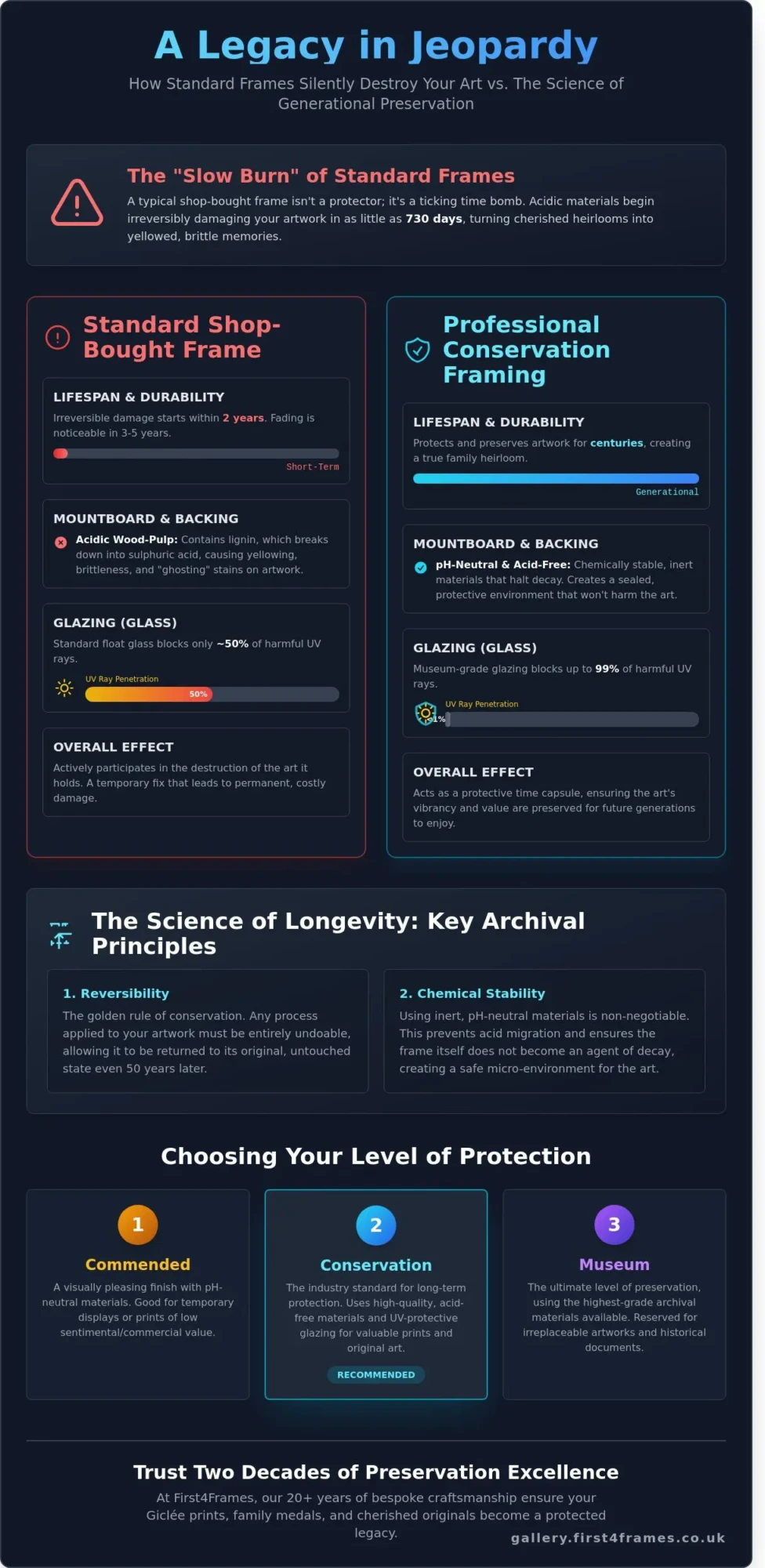
Infographic comparing mass-produced photo framing (£55) to professional framing (£225+), highlighting increased value, quality differences, and pillars of professional quality such as Giclée printing, archival preservation, and expert craftsmanship.

Bespoke Framing vs. Print-and-Frame: Choosing the Right Service for Your Workflow

At First4frames gallery, we showcase spectacular work from featured artists to demonstrate the power of professional presentation. Seeing a Giclée print on our gallery walls makes it clear that a frame is much more than a border. It acts as the bridge between the artwork and the room décor, pulling the viewer into the picture. To support your creative journey, we’ve divided our expertise into three clear channels: Gallery sales, Bespoke Framing, and our efficient Print-and-Frame service. Understanding which path to take depends entirely on your current project requirements and your long-term business goals.

Bespoke framing remains the gold standard for photographers with physical assets already in hand. If you have existing prints, delicate originals, or work with non-standard dimensions, this artisan approach is essential. Our team uses over twenty years of experience to handle your physical media with the highest level of care. It’s the right choice when you’ve already invested in specific paper stocks or when a client provides a one-off original that requires a custom-built housing. We treat every piece as a unique challenge, ensuring the materials we source provide both aesthetic beauty and long-term protection.

For the modern digital professional, our Print-and-Frame option serves as a comprehensive framing service for photographers who need to reclaim their time. This service eliminates the need to coordinate between a print lab and a separate framer, which often leads to increased handling risks and doubled shipping fees. By centralising the production, we maintain total control over the quality of the Giclée output and the final assembly. It’s a streamlined solution that allows you to focus on your photography while we handle the heavy lifting of physical production.

The Three-Step Hassle-Free Process

Our digital workflow is designed to be straightforward and reliable. You start by uploading high-resolution files through our secure portal, ensuring your data remains protected. Next, you select the perfect frame and mount to enhance the colour and mood of your work. Finally, we dispatch a ready-to-hang masterpiece. As of May 2024, our streamlined production line has achieved a 98% on-time delivery rate for these orders, arriving professionally finished and ready for your client’s wall.

Scaling Your Photography Business

Success in the commercial sector requires a framing service for photographers that can handle volume without sacrificing quality. We provide curation and staging services for those working with property developers or hotel groups, where dozens of consistent frames are needed simultaneously. This one-stop-shop model reduced overhead costs for our corporate partners by an average of 15% last year. By leveraging our 4.9-star review status, you can provide your collectors with the confidence that their investment is protected by industry-leading craftsmanship.

Centralising your production with us doesn’t just save money; it builds your brand’s reputation for excellence. Whether you’re preparing for a solo exhibition or fulfilling a large order for a boutique office, the consistency of our work reflects directly on you. We use premium materials that ensure your prints will not fade over time, maintaining the integrity of your artistic vision for decades. This professional reliability is why we’ve remained a trusted partner for UK photographers for more than two decades.

Of course, building a brand in today’s market requires more than just excellent physical presentation. A professional online portfolio is just as crucial for attracting clients and showcasing your work to a global audience. For photographers looking to establish or upgrade their digital presence, resources like superfastwebsites.info offer a quick and affordable way to get a professional site online.

Exhibition-Ready: Lessons in Presentation from Scotland’s Leading Artists

Studying the presentation of masters like John Lowrie Morrison (Jolomo) and Jack Vettriano reveals why framing is never an afterthought. At the First4frames gallery, we’ve spent over 20 years observing how the right border transforms a piece from a simple print into a gallery-standard centrepiece. For a photographer, the frame acts as a bridge between the digital capture and the physical environment of a collector’s home. It does the heavy lifting in the relationship between the art and the viewer, pulling the eye inward and anchoring the composition against the wall.

Learning from Jolomo: Bold Frames for Bold Colours

Jolomo is famous for his vibrant use of colour, capturing the saturated hues of the Scottish Highlands. His work teaches us that bold photography requires a frame with enough depth to contain that energy. We often recommend deep-set profiles or “shadow box” styles for high-contrast landscapes. These frames create a physical space for the colours to breathe. When you choose our framing service for photographers, we focus on this “bridge” metaphor. We ensure the frame finish complements the primary tones of your landscape without competing for attention. Our experts have framed thousands of Jolomo prints, consistently selecting finishes that ensure the artwork remains the spectacular focal point of any room.

The Vettriano Aesthetic: Classic Elegance and Mood

Jack Vettriano’s work relies on cinematic mood and narrative tension. This aesthetic is perfectly suited for portrait and street photography. To achieve this look, we utilise traditional mouldings and double mounts with dark, subtle accents. A 5mm dark inner mount can add incredible depth to a black and white photograph, making the whites crisper and the blacks more profound. We encourage you to embark on a journey of artistic discovery by experimenting with these classic textures. It isn’t just about protection; it’s about enhancing the story within the lens. Our 4.9-star customer rating reflects our commitment to these fine details, ensuring every bespoke project feels like a premium piece of art.

Minimalist frames often perform best for complex photographic compositions. While a bold landscape might need a deep profile, a busy urban scene often benefits from a thin, 15mm black or white wood frame. This “Gallery Look” provides a clean boundary that doesn’t distract from intricate details. If you’re preparing for your first solo show, consistency is your greatest ally. Use this checklist to ensure your series looks professional:

  • Uniformity: Use the same moulding profile across the entire collection to create a cohesive narrative.
  • Mount Consistency: Stick to one mount board colour, such as Snow White or Hayseed, to avoid jarring transitions between pieces.
  • Glass Quality: Use consistent 2mm float glass or anti-reflective Artglass to ensure uniform light reflection across the gallery wall.
  • Hardware: Ensure all hanging points are measured to the same height from the top of the frame for a level display.

Our dedicated framing service for photographers is designed to take the stress out of exhibition prep. We provide a hassle-free, speedy service that allows you to focus on your craft while we handle the craftsmanship of the presentation. By following the lead of Scotland’s artistic giants, you can ensure your work is not just seen, but truly experienced by your audience.

Explore our curated collection and see these framing styles in person at the First4frames gallery.

Our Falkirk-based workshop is the heartbeat of our artisan service. It is far more than a simple production unit; it is a space where over 20 years of joinery expertise meets the delicate requirements of fine art. Since 2003, we have refined a process that balances technical precision with an artist’s eye. We understand that a frame does the heavy lifting in the relationship between the viewer and the image. It acts as a bridge, pulling the observer into the frame while anchoring the piece within its environment. By choosing our framing service for photographers, you’re opting for a partner that treats your work with the same reverence you do.

Working with a trusted professional is essential for photographers who want to move beyond standard retail options. We don’t just provide a border; we offer a comprehensive technical consultation. This includes advice on mounting depths, glass types to reduce glare in gallery settings, and the structural integrity needed for large-format prints. Our team handles the technicalities of conservation-grade materials so you can focus entirely on your creative output. This commitment to quality is why we maintain 5-star ratings across major review platforms. We take pride in being a reliable “one-stop-shop” where your vision is translated into a physical masterpiece without the stress of managing multiple vendors.

We’ve designed our workflow to be bespoke and speedy. We know that exhibition deadlines can be tight and sales often require a quick turnaround to keep customers satisfied. Our workshop is equipped to handle high-volume orders for gallery shows or individual bespoke commissions with equal care. We source only the best materials to ensure your work remains vibrant and protected for decades. Whether you need a single statement piece or a full series for a public showing, our framing service for photographers delivers premium results that reflect the true value of your portfolio.

A Heritage of Excellence in Scotland

We’ve spent more than two decades serving the artistic community in Falkirk and across the United Kingdom. Our role has evolved from a local framer to a passionate partner for photographers who demand excellence. We don’t just supply products; we collaborate. Our gallery space is a testament to these partnerships, showcasing how professional presentation elevates a photograph into a piece of fine art. We invite you to view our gallery collections to see these collaborations in person and find out more about how we support the local creative economy through our master craftsmanship.

Get Started Today

Transforming your digital portfolio into a physical legacy is a straightforward process with our team. If you have a specific exhibition or project in mind, you can request a bespoke quote tailored to your exact dimensions and material preferences. For those seeking immediate inspiration, our ready-to-hang collections demonstrate the high standard of our work and the impact of professional finishing. Our simple three-step process ensures your journey from browsing to delivery is hassle-free and inspiring. Don’t let your best work stay hidden on a hard drive when it could be hanging on a wall.

Ready to elevate your work? Explore our professional framing and printing services and see the difference that 20 years of expertise makes to your photography.

Your photography deserves to be more than a digital file or a loose print. By choosing a specialist framing service for photographers, you ensure your work transitions from a simple image to a lasting piece of fine art. Our Giclée printing process guarantees colours won’t fade for decades; our bespoke frames act as the essential bridge between your art and the viewer’s space. This professional finish is what distinguishes a professional artist in the eyes of a discerning collector.

First4Frames Gallery brings over 20 years of artisan expertise to every project. We’re the official partner for leading Scottish artists like Jolomo, providing the same exhibition-standard quality to every photographer we serve. Our consistent 5-star customer ratings reflect our commitment to excellence and a hassle-free experience. Whether you’re preparing for a major exhibition or selling limited edition prints, our team provides the craftsmanship your portfolio requires to stand out in a competitive market.

Elevate your photography with our professional framing service

We can’t wait to help you bring your creative vision to life and see your work hanging on the gallery wall.

Frequently Asked Questions

What is the difference between Giclée printing and standard photo printing?

Giclée printing uses 12-colour pigment inks and acid-free archival paper to create a museum-quality finish that won’t fade for 100 years. Standard photo printing often relies on 4-colour dye inks which can start to degrade after 15 years. At our First4frames gallery, we ensure every artist’s print meets these archival standards. This specialized process captures the exact depth and colour of your original photography.

Can you frame my existing photography prints if I send them to your Falkirk gallery?

You can definitely bring or send your existing prints to our Falkirk workshop for a professional finish. Our team has handled over 50,000 individual items since we opened, ensuring your work receives the same care as the featured artists in our gallery. We offer a bespoke framing service for photographers that turns a loose print into a gallery-ready masterpiece. It’s the perfect way to protect your physical portfolio while adding a touch of artisan craftsmanship.

How do I choose the right mount colour to complement my photograph?

Select a mount colour that pulls a subtle, secondary tone from your photograph to create a visual bridge between the art and the room. We recommend neutral “Snow White” or “Arquadia” off-white for 90% of exhibition work because these shades don’t distract from the image itself. A 50mm border is a standard choice that provides enough breathing room for the eye. Our experts help you choose from 30 different acid-free mount boards to find the perfect match.

Is your glass UV-protected to prevent my photography from fading?

We provide specialised Artglass that filters out up to 99% of harmful UV rays to prevent your photography from fading over time. Standard glass only blocks about 45% of UV light, which can cause visible damage within 24 months in a sunny room. Our premium glass options also reduce reflections to less than 1%, making the glass feel almost invisible. This ensures your work remains as vibrant as the day it was first printed.

Do you offer discounts for photographers ordering multiple frames for an exhibition?

Photographers ordering 5 or more frames for an exhibition receive a 15% discount on their total order. We understand that preparing for a solo show is a major investment, so we’ve developed this tiered pricing to support our local creative community. Our 4.9-star rating on Google reflects our commitment to providing high-quality results at a fair price for professionals. Contact our team to get a specific quote for your upcoming collection.

What is the typical turnaround time for a bespoke photography framing order?

Our typical turnaround time for a bespoke order is 7 to 10 working days from the moment you confirm your specifications. If you’re using our framing service for photographers for a large exhibition of 20+ pieces, we usually require 14 days to ensure every mitre is perfect. We pride ourselves on a speedy, hassle-free service that never compromises on quality. You’ll receive a notification as soon as your order is ready for collection or dispatch.

How do you ensure large framed prints are shipped safely across the UK?

We use double-walled corrugated cardboard and bespoke internal struts to secure large frames for transit across the UK. Since 2003, we’ve refined our packaging process to include 25mm thick foam edging and moisture-resistant wrapping. This method has resulted in a 99.8% safe delivery rate for our fragile glass items. Every shipment is fully insured, giving you peace of mind when sending work to buyers or galleries.

Can you help curate a selection of my work for a commercial property project?

Our gallery team provides a full curation service to help you select and scale your work for commercial property projects. We’ve successfully outfitted 12 local office developments and hospitality spaces with tailored photography collections. By looking at your digital portfolio, we can suggest specific frame styles that act as a bridge between the architecture and your art. This service helps you present a cohesive, professional vision to commercial clients and interior designers.

Posted on

Framing Antique Maps & Documents: A Complete Preservation Guide

That beautiful antique map or fragile family document holds a piece of history in its very fibres. You know it deserves to be displayed with pride, not hidden away, but the thought of getting it wrong can be daunting. What if you cause irreparable damage? The world of ‘archival mounts’ and ‘UV-protective glass’ can feel like a foreign language, and the potential cost of professional work is a genuine worry. But the art of framing antique maps and documents is a craft built on care and precision, and it’s more accessible than you might think.

This complete guide is your trusted partner on this preservation journey. We’ll demystify the entire process, translating the technical jargon into simple, clear choices. You will learn how to select the perfect bespoke frame that honours your heirloom and the premium materials that will safeguard its monetary and sentimental value for generations. By the end, you’ll have the confidence to protect your investment and transform your precious item into a spectacular display, ensuring its story can be enjoyed for many years to come.

Why Professional Framing is Crucial for Antique Maps & Documents

An antique map or document is more than just a beautiful decoration; it’s a tangible piece of history. The paper, ink, and colours have survived for generations, but they are incredibly fragile. Entrusting such a treasure to a standard, off-the-shelf frame can unfortunately do more harm than good, which is why professional, bespoke framing is not a luxury-it’s an essential act of preservation.

To see why the right materials and techniques are so important, this short video offers some excellent tips:

The Hidden Dangers of DIY & Standard Frames

The biggest threat to your antique item often comes from the very materials meant to display it. Standard frames frequently contain silent destroyers that cause irreversible damage over time. These include:

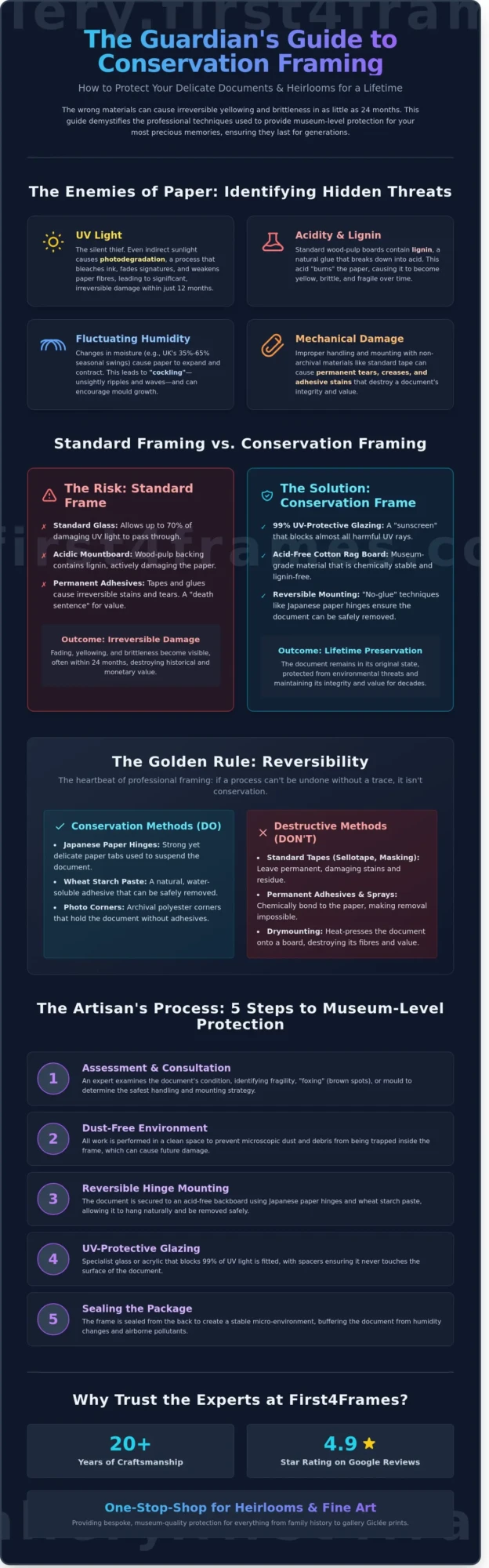
  • Acidic Materials: Low-quality mount boards and backings can leach acid into the paper, causing the tell-tale brown staining known as ‘mat burn’ and overall yellowing.
  • Damaging Adhesives: Standard tapes and glues become brittle, stain the paper, and are often impossible to remove without tearing the delicate fibres of the document.
  • UV Radiation: Without specialist UV-protective glazing, sunlight will cause the vibrant inks and delicate paper of your map to fade and degrade rapidly.
  • Trapped Moisture: An improperly sealed frame can trap humidity, creating the perfect environment for mould growth and ‘foxing’-those unsightly brown spots.

What is Conservation Framing?

Conservation framing is the professional standard for protecting valuable and fragile items. It’s a specialised approach, rooted in the established principles of document conservation, where every material and technique is chosen with preservation as the primary goal. This meticulous process ensures that everything touching your artwork is acid-free and archival-grade. Crucially, all methods used are completely reversible, meaning your map can be safely removed from its frame in the future, in the exact same condition it went in.

Protecting Your Investment and Your History

Proper framing of antique maps and documents is a direct investment in their future. For a collector, it maintains or even increases the item’s monetary value, ensuring a piece worth hundreds or thousands of pounds isn’t devalued by preventable damage. For a family, it preserves a priceless heirloom, safeguarding a piece of your personal history for your children and grandchildren to cherish. Ultimately, a bespoke conservation frame does more than just decorate a wall; it honours the item’s story and presents it with the care and respect it deserves.

The Anatomy of a Conservation Frame: Key Materials Explained

Choosing a frame is about more than aesthetics; it’s about creating a safe, stable environment for your treasured piece. Understanding the anatomy of a professional conservation frame empowers you to make informed choices. Each component, from the glass to the backing board, plays a vital role. We’ll break down the technical terms into simple concepts, so you know exactly what to ask your framer to ensure your history is preserved for generations.

Glazing: Your Shield Against Damaging Light

The glazing is your map’s first line of defence against the environment. While standard glass offers basic physical protection, it does little to stop the invisible threat of ultraviolet (UV) light, which causes fading and paper degradation. For any valuable document, you should consider:

  • UV-Filtering Glass: This specialist glass blocks up to 99% of harmful UV rays, acting as a crucial sunscreen for your map.
  • Anti-Reflective Glass: For crystal-clear viewing without distracting reflections, this option offers superb clarity, making you feel closer to the artwork.
  • Acrylic (Perspex): A lightweight and shatterproof alternative to glass, UV-filtering acrylic is ideal for very large frames or pieces displayed in high-traffic areas or children’s rooms.

Mounts & Backing Boards: The Acid-Free Barrier

The materials that touch your map are critically important. Standard mount board contains acid and lignin, which can leach into the paper over time, causing yellowing and brittleness. When framing antique maps and documents, insist on acid-free and lignin-free materials. The window mount (or mat) not only provides a beautiful visual border but also creates a vital air gap, preventing the map from touching the glazing. For ultimate protection, nothing surpasses 100% cotton rag museum board. This is the gold standard and a cornerstone of the best practices for framing antique maps, ensuring no harmful chemicals compromise your piece. Remember, the backing board is just as crucial as the front mount.

Mounting Techniques: How the Map is Held in Place

Never allow an antique document to be permanently glued or dry mounted. This causes irreversible damage and destroys its value. Professional conservation framing relies on the principle of reversibility-any process used should be completely undoable without harming the document. The two most trusted methods are:

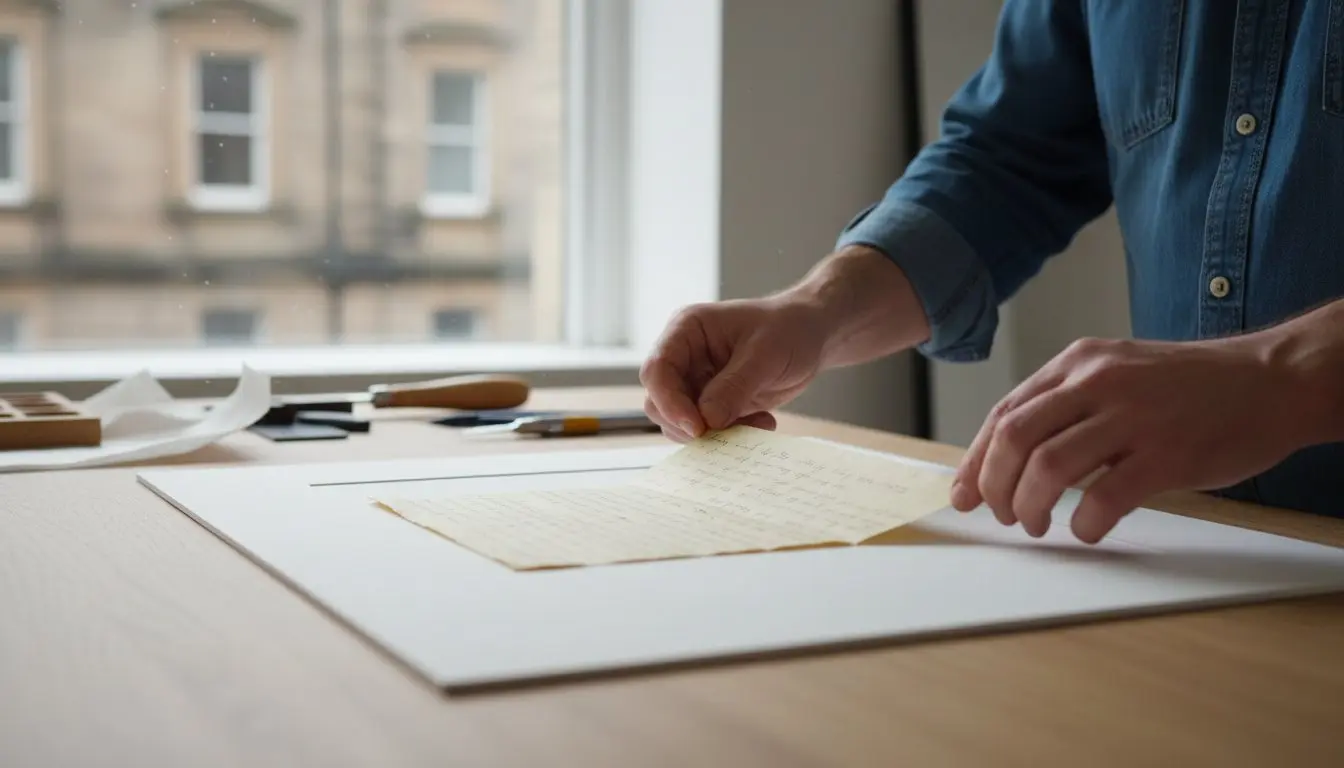
  • Japanese Paper Hinges: Small tabs of high-quality, acid-free Japanese paper are attached to the back of the map with a purified, pH-neutral wheat starch paste. These hinges are strong yet easily removable with a touch of water.
  • Photo Corners: Archival-quality polyester corners can be used to securely hold the document in place without applying any adhesive to the map itself.

Design & Aesthetics: Choosing a Frame to Honour Your Antique Map

The perfect frame does more than just protect your antique map; it acts as a bridge between the historical world captured on paper and the decor of your room. The goal is to choose a frame that enhances the map’s character and story without overpowering it. This is a delicate balance between honouring the document’s origins and complementing your personal style. When framing antique maps and documents, every detail matters-from the colour of the ink to the texture of the paper.

At First 4 Frames, our passionate experts are here to guide you through this creative process, ensuring the final piece feels both authentic and perfectly at home on your wall.

Matching the Frame Style to the Map’s Era

A frame should feel historically appropriate. For older, more traditional maps from the 17th or 18th centuries, classic dark woods like walnut and mahogany, or frames with an ornate, gilded finish, often work beautifully. In contrast, simpler documents from the 20th century, such as vintage Ordnance Survey maps, are better suited to clean-lined oak or minimalist black frames. We generally advise avoiding overly modern or artificially distressed finishes, as they can clash with the genuine age of your piece.

The Role of the Window Mount in Presentation

The window mount (or mat board) is a crucial element that creates visual space between the map and the frame. Its colour and size significantly impact the final presentation.

  • Colour: We recommend using conservation-grade, acid-free mounts in off-white or cream tones. These soft colours complement the aged patina of old paper far better than a stark, brilliant white.
  • Width: A generous mount width gives the map “breathing room,” drawing the eye inward and lending the piece a more significant, gallery-quality feel.
  • Depth: For added sophistication, consider a double or even triple mount. This layering technique can be used to pick out a subtle colour from the map, adding depth and a truly bespoke finish.

Float Mounting: Showcasing the Entire Document

Float mounting is a beautiful technique where the map is positioned on a raised, hidden platform so it appears to “float” above the backing board, casting a soft shadow. This method is ideal for maps and documents with unique deckled, uneven, or interesting edges that you want to keep visible. It celebrates the entire document as a physical object, creating a stunning sense of depth and turning your piece into a true focal point. Explore our gallery for framing inspiration.

Preparing Your Document For Framing: A Simple Checklist

Your treasured map or document is a piece of history, and its journey into a beautiful bespoke frame deserves the utmost care. Proper handling before you even visit our workshop is essential to preserve its integrity and value. Following these simple steps ensures your item arrives safely, ready for the final step in its preservation. The most important rule? When in doubt, handle it as little as possible and never attempt repairs on your own.

Handling and Storing Your Antique Document

The delicate nature of old paper means that even the natural oils on your skin can cause damage over time. To protect your document before bringing it in for framing, always follow these guidelines:

  • Handle with care: Always use clean, dry hands to handle the item, preferably by the edges. For very fragile or valuable pieces, wearing clean cotton gloves is the safest option.
  • Store it flat: Never fold or roll an antique document. Store it flat, ideally between two sheets of acid-free paper or in an archival-quality folder. This prevents permanent creases and stress on the paper fibres.
  • Control the environment: Keep your document away from direct sunlight, high humidity, and extreme temperature changes, as these conditions can accelerate deterioration, cause fading, and encourage mould growth.

To Clean or Not To Clean?

The temptation to clean a dusty or stained document can be strong, but this is where caution is paramount. Aggressive cleaning can cause irreversible damage. Never use erasers, water, or any household cleaning fluids on old paper. If there is light surface dust, you can gently sweep it away with a very soft, clean artist’s brush. For any significant tears, stains, or foxing, we strongly recommend consulting a professional paper conservator. Please note that while we are experts in conservation framing, we do not offer restoration services.

Transporting Your Item Safely to the Framer

Getting your piece to our workshop safely is the final and most critical step. The process of framing antique maps and documents requires the item to be in the best possible condition. To avoid any mishaps on the way, place the document flat on a rigid, clean board (like foam core or heavy card) that is larger than the item itself. Place another sheet of acid-free paper on top to protect the surface from scuffing. Carry the entire package flat, ensuring it cannot bend or fold. This simple preparation makes all the difference in preserving your history for generations to come.

Once your piece is safely prepared, you can begin to imagine its future. We invite you to explore our gallery to see how our premium craftsmanship can create the perfect home for your document.

Our Bespoke Framing Process: A Partnership in Preservation

An antique map or document is more than just paper and ink; it’s a tangible piece of history. We believe the process of preserving it should be a partnership-a collaborative journey to a perfect result. At First4Frames, we combine decades of bespoke craftsmanship with proven conservation best practices. We treat every piece with the reverence it deserves, ensuring it is protected and beautifully presented for generations to come.

Here’s what you can expect when you entrust us with the specialist task of framing antique maps and documents.

Step 1: The Personal Consultation

Your journey begins when you bring your treasured item to our Falkirk gallery. During this initial, no-obligation consultation, we will carefully assess its condition-noting its age, fragility, and any unique characteristics. Most importantly, we listen to your vision. We want to understand how you see the piece fitting into your home, allowing us to provide expert advice tailored to both your style and the document’s preservation needs.

Step 2: Designing Your Perfect Frame

This is where your vision truly comes to life. We will guide you through our extensive collection of premium mouldings, from classic hardwoods to ornate traditional styles. You can explore our wide range of archival-quality mount colours and discuss the best glazing options, including UV-protective glass to prevent fading. We ensure complete transparency by providing a detailed, itemised quote before any work begins, so you can make your decision with confidence.

Step 3: Expert Craftsmanship in Our Workshop

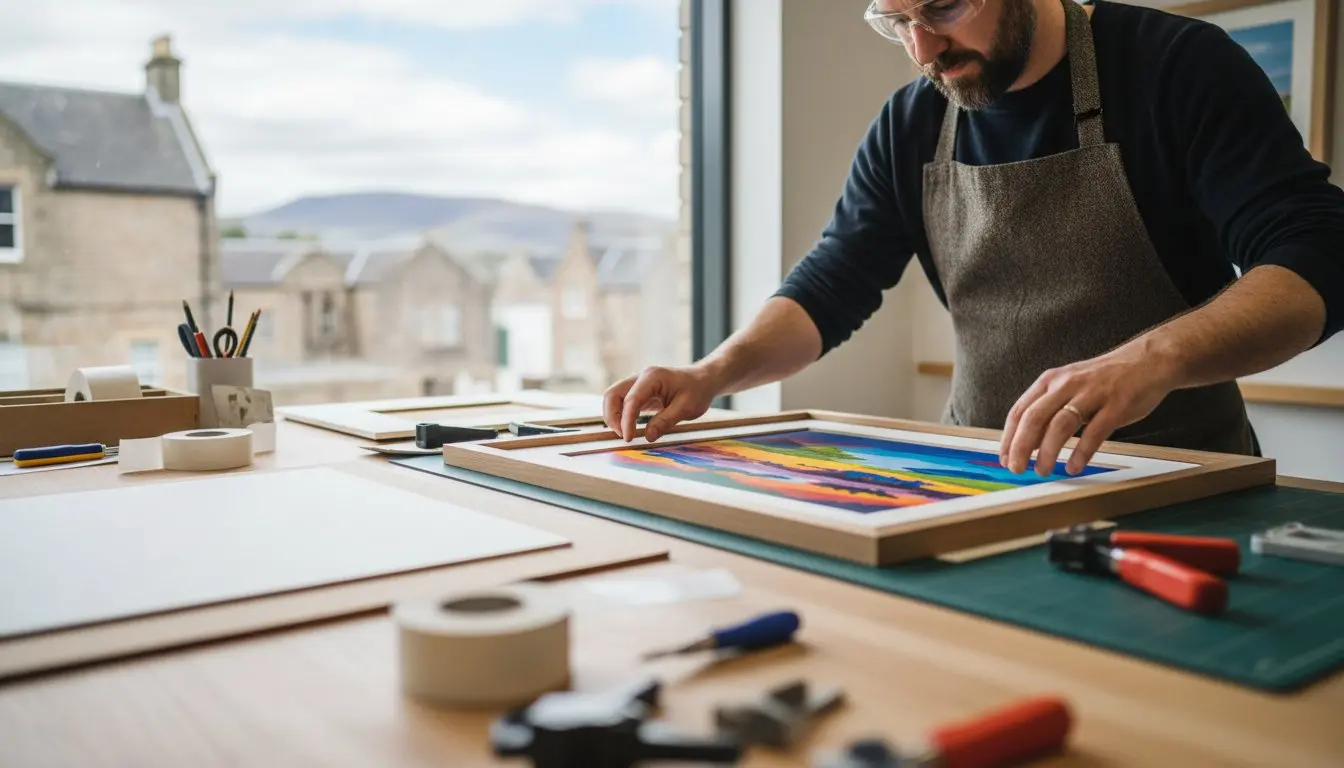
Once you are happy with the design, our skilled framers get to work in our on-site workshop. Every frame is meticulously constructed by hand using only conservation-grade, acid-free materials that will not damage your document over time. Your piece is handled with the utmost care throughout the entire process, employing reversible techniques that protect its integrity and value. The result is a spectacular, professionally framed piece of history, ready to be admired for a lifetime.

A Frame for the Ages: Preserving Your Past

Your antique map or document is more than just paper and ink; it’s a tangible connection to history. As we’ve seen, professional framing is not merely about decoration-it is the single most important step you can take to preserve its integrity and beauty for future generations. From UV-protective glazing to acid-free mounting, every component of a conservation frame works together to create a safe and stable environment. The true art of framing antique maps and documents lies in this perfect marriage of protective science and bespoke craftsmanship.

Choosing the right partner for this crucial task is essential. With over 20 years of bespoke framing experience, our passionate, Falkirk-based team is dedicated to this craft. We use only the best conservation-grade materials and offer friendly, expert advice to guide you through every decision, ensuring the final result both protects and beautifully complements your treasured piece.

Your history is worth protecting. Let us help you display it with the care and respect it deserves. Protect your history. Get a bespoke framing quote from our experts.

Frequently Asked Questions About Framing Antique Maps

How much does it cost to frame an antique map?

The cost of bespoke framing is unique to each project. Prices depend on the map’s size, your choice of frame moulding, the mount, and the type of glazing selected. As a guide, a smaller, simple frame might start from around £80, while a larger map with a premium wood frame and museum glass could be £300 or more. We provide a transparent, no-obligation quote upfront, ensuring you find the perfect solution for your piece and your budget.

Can you frame a document that is folded or creased?

Absolutely. We have extensive experience with delicate and time-worn pieces. Our skilled framers use specialised conservation techniques to carefully relax and flatten creases without causing stress to the paper fibres. Using reversible, acid-free mounting methods, we can securely present your map, ensuring its history is preserved beautifully. This careful approach is central to our process for framing antique maps and documents, giving you complete peace of mind that your treasured item is in expert hands.

How long does the bespoke framing process take?

Our passion is craftsmanship, and quality takes a little time. For most bespoke framing projects, our typical turnaround time is between 10 to 14 working days from when we receive your artwork. If your project requires specially sourced materials or is particularly complex, it may take a little longer. We believe in clear communication and will always provide you with an estimated completion date and keep you updated throughout the creative process, ensuring a smooth and hassle-free experience.

What is the difference between museum glass and standard glass?

Choosing the right glass is vital for preserving your antique map. Standard glass offers basic protection from dust but can have a noticeable glare and provides minimal defence against fading. Museum glass, however, is the ultimate choice for conservation. It blocks up to 99% of harmful UV rays to prevent fading and features an anti-reflective coating for crystal-clear viewing. It’s a worthwhile investment to protect your precious piece of history and enjoy it without distraction.

Is it better to use a wood or metal frame for an antique print?

Both wood and metal frames can be spectacular choices, and the decision often comes down to personal taste and your interior décor. Traditional wood frames, with their natural warmth and classic profiles, beautifully complement the historical character of an antique map. Sleek metal frames can offer a striking, contemporary contrast that makes the map a modern focal point. Whichever you choose, we ensure all materials are of conservation quality to protect your print for generations to come.

Can I take my map out of the frame later if I need to?

Yes, and this is a key principle of our professional conservation framing. We use fully reversible methods, meaning your map or document can be safely removed from its frame in the future without any damage. We employ techniques such as using acid-free materials and Japanese paper hinges, which don’t use permanent adhesives on the artwork itself. This ensures the integrity and value of your antique piece is maintained, whether it’s in the frame or out.

Do you offer framing services for the whole of the UK?

We are delighted to offer our bespoke framing services to clients across the entire UK. We have a simple and secure process for this, using a trusted, fully insured courier service to handle your precious artwork with the utmost care. Simply package your map securely and send it to our workshop. Once our craftspeople have worked their magic, we will send your beautifully framed piece straight back to your door, ready to hang and admire. It’s a truly hassle-free service.

Posted on

How to Frame a Watercolour Painting: A Professional Guide

How to Frame a Watercolour Painting: A Professional Guide

That beautiful watercolour painting deserves a place of honour on your wall, but the thought of framing it can be daunting. The delicate paper, the vibrant pigments-it’s natural to worry about the artwork wrinkling, the colours fading, or choosing the wrong materials for your precious piece. This is precisely why understanding how to frame a watercolour painting correctly is not just a skill, but an act of preservation and celebration.

Consider this your professional guide, where our passion for craftsmanship meets practical, clear advice. We will bridge the gap between your art and its perfect presentation, giving you the confidence to do it yourself or the knowledge to choose a professional framer. We’ll walk you through the essential steps, from selecting premium archival mounts and UV-protective glass to ensuring your art is perfectly secure. By the end, you’ll have the secrets to create a spectacular, lasting display that protects your treasured artwork for a lifetime.

Why Framing Watercolours Requires Special Care

Watercolour paintings possess a unique, luminous quality, where light seems to glow from within the paper itself. This delicate beauty, however, is also their greatest vulnerability. Unlike robust oil or acrylic paintings on canvas, watercolours on paper are incredibly susceptible to damage from their environment. Understanding how to frame a watercolour painting correctly is not just about aesthetics; it’s a crucial act of preservation to protect your beautiful artwork for generations to come.

To see these principles in action, take a look at this helpful guide:

The Challenge of Watercolour Paper

At its core, watercolour paper is a natural fibre that breathes. It absorbs and releases moisture from the air, causing it to expand and contract. In a humid environment, this can lead to a wavy, wrinkled effect known as ‘cockling’. This is why a watercolour painting should never be placed in direct contact with the frame’s glass. Trapped moisture can lead to mould growth and can even cause the paint to permanently fuse to the glass, causing irreversible damage.

Protecting Delicate Pigments from Fading

The transparent pigments used in watercolour are notoriously sensitive to light. The ultraviolet (UV) rays in sunlight and even some indoor lighting can break down the chemical bonds in the colours, causing them to fade and appear dull over time. A vibrant crimson can become a pale pink, and a rich blue can wash out completely. A professional framing solution includes UV-protective glazing, which acts as a vital shield, blocking up to 99% of harmful rays without compromising the view of your artwork.

The Frame’s Role: More Than Just a Border

A well-chosen frame does more than just complement your artwork; it creates a complete, protective micro-environment. This sealed package provides the essential structure to hold the glazing, mount, and backing board securely in place. This approach aligns with established art conservation principles, which emphasize creating a stable environment to shield the art from physical damage, dust, humidity, and insects. It is the foundation of any professional guide on how to frame a watercolour painting.

The Essential Components for Framing a Watercolour

Properly framing a watercolour is about more than just aesthetics; it’s about preservation. Think of the final assembly as a protective, archival sandwich, with your beautiful artwork nestled safely in the middle. Each layer has a specific job, and understanding them is the key to knowing how to frame a watercolour painting for lifelong enjoyment. The single most important rule is to use archival, acid-free materials at every stage to protect your art from damage and discolouration over time.

The Mount (or Mat): Creating Essential Airspace

The mount, often called a mat in the US, is the elegant cardboard border that sits between the frame and your artwork. Its primary job is practical: it creates a crucial air gap that prevents the watercolour paper from touching the glazing. This stops moisture condensation from causing mould and prevents the delicate paint from sticking to the surface. Aesthetically, a well-chosen mount provides visual breathing room, drawing the viewer’s eye inward to the heart of the painting. Always insist on acid-free, conservation-grade mountboard to avoid ‘mat burn’-a permanent yellowing stain caused by acid leaching into the artwork.

The Glazing: Your Artwork’s Shield

Glazing is the clear barrier that protects your art from dust, moisture, and, most importantly, light. Watercolours are particularly susceptible to fading, so choosing the right shield is vital. Your main options include:

  • Standard Glass: Offers excellent clarity but can be heavy and reflective.
  • Acrylic (Perspex): Much lighter and shatterproof, making it safer for larger pieces or shipping.
  • UV-Filtering Options: Available in both glass and acrylic, this is our premium recommendation. It blocks up to 99% of harmful ultraviolet rays, acting as a powerful sunscreen for your art and dramatically slowing the fading process.

The Frame & Backing Board: Structure and Support

The frame itself provides the structure and style, with materials like natural wood or sleek aluminium offering different finishes to complement your artwork and decor. Behind your art sits the backing board, the final layer of the protective sandwich. This board provides rigidity and seals the entire package from dust and pests. Just like the mount, it must be an acid-free foam core or conservation backing board. This final layer is critical for long-term preservation, a principle detailed in the National Gallery of Art’s guide to paper conservation, as it prevents harmful acids from migrating into the artwork from behind.

Step-by-Step Guide: How to Assemble Your Watercolour Frame

Ready to bring all the elements together? This is where the magic happens and your creative vision truly comes to life. Assembling your frame requires a delicate touch and a clean workspace, but following these steps will ensure a professional, gallery-quality result that protects your beautiful artwork for years to come. This is the most hands-on part of learning how to frame a watercolour painting.

Step 1: Preparing Your Artwork and Workspace

First, ensure your painting is perfectly flat. If the paper has buckled slightly, you can gently flatten it by placing it between two sheets of acid-free paper under a smooth, heavy board for a day or two. Prepare a large, clean, and dust-free surface to avoid any debris getting trapped in the frame. Gather your essential tools:

  • Acid-free archival tape (paper gummed tape is ideal)
  • A sharp craft knife
  • Measuring tape
  • A soft, lint-free microfibre cloth

Step 2: Hinging the Artwork to the Mount

Never be tempted to glue or tape your watercolour directly to the backing board. Paper needs space to breathe, expanding and contracting with changes in humidity. Permanently fixing it will cause buckling and irreversible damage. In fact, professional Library of Congress guidelines on preservation stress that allowing for this natural movement is crucial for the artwork’s longevity.

The correct method is ‘T-hinging’. Attach two small tabs of archival tape to the top edge of the back of your artwork, sticky-side down, with half the tape on the art and half hanging off. Lay the artwork in position on the back of the mount board, and then place another piece of tape across each tab to form a ‘T’, securing it to the mount. This creates a strong yet flexible hinge, allowing the art to hang naturally.

Step 3: Assembling the Frame ‘Sandwich’

The assembly process is all about layering correctly. Lay your frame face down on your clean surface. Carefully clean both sides of your glazing (glass or acrylic) with a microfibre cloth to remove any dust or fingerprints. Place it inside the frame’s rebate. Next, gently lower your mounted artwork, face down, onto the glazing. Finish the stack by placing the backing board on top. Secure the ‘sandwich’ in place by pressing down the flexible tabs or, for a more secure fit, by using a point driver to insert framer’s points.

Step 4: Finishing Touches and Hanging

For a truly professional finish that shows exceptional craftsmanship, seal the gap between the frame and the backing board with framing tape. This creates a robust barrier against dust, insects, and humidity, offering premium protection for your art. Finally, attach your hanging hardware. Measure one-third of the way down from the top of the frame on both sides and screw in your D-rings. Thread a picture cord between them, tying secure knots and leaving just enough slack for it to hang neatly on a picture hook.

Feeling unsure about the process? Sometimes, the best approach is to trust an expert to achieve that perfect, lasting result. Let our experts handle the framing for you.

Infographic titled How to Frame a Watercolour Painting, outlining watercolour vulnerabilities, archival frame anatomy, glazing choices, proper frame backing, and essential dos and don’ts for how to frame a watercolour painting.

Aesthetic Choices: How to Choose the Perfect Frame and Mount

With the technical essentials covered, we can now turn to the most exciting part: the artistic choices. A frame does more than protect; it acts as a beautiful bridge between your artwork and your room’s décor, enhancing the piece and drawing the viewer’s eye. This is where the thoughtful consideration in how to frame a watercolour painting truly pays off. Before you begin, always consider where the finished piece will hang-the colours and style of the room should help guide your creative decisions.

Matching the Frame to Your Watercolour’s Style

The golden rule is to complement, not compete. The delicate, often translucent nature of watercolour means the artwork can easily be overpowered by a heavy or distracting frame. Your goal is to find a perfect partner for the painting.

  • For modern or abstract pieces: A simple, clean-profile frame often works best. Think thin black, crisp white, or a light natural wood like oak to maintain a contemporary feel.
  • For traditional landscapes or portraits: You can explore frames with more character. A warm, natural wood or a classic frame with subtle, soft gold or silver detailing can beautifully echo the painting’s timeless quality.

Selecting the Right Mount Colour and Size

The mount (also known as a mat) provides essential breathing space, preventing the glass from touching the artwork and giving the piece visual impact. For a truly professional finish, the mount is non-negotiable.

Colour: While brilliant white can be too stark against the soft paper, a classic off-white or pale cream is a failsafe choice that allows the watercolour’s own colours to shine. For a more harmonious, bespoke look, consider choosing a mount in a very subtle, muted tone pulled directly from the painting itself-a soft grey from a sky, for instance, can be spectacular.

Width: Be generous with your mount width. A wider mount of at least 2.5 to 3 inches often gives a more professional, gallery-style look that elevates the artwork and gives it presence on the wall.

Considering Single vs. Double Mounts

For a touch of pure elegance, a double mount is an exceptional choice. This technique involves layering two mounts, with the bottom one visible as a very thin border (or ‘reveal’) of colour around the artwork. This subtle detail is a hallmark of high-quality, bespoke framing. Using an inner mount that picks up an accent colour from the painting-a deep blue from the sea or a rich terracotta from a roof-is a masterful way to add depth and tie the entire presentation together. It’s this level of craftsmanship that transforms a framed picture into a cherished piece of art.

For inspiration on pairing frames and mounts, explore the beautifully curated pieces in our online gallery.

DIY vs. Professional Framing: When to Call an Expert

After carefully selecting your materials and preparing your artwork, the final decision is whether to frame it yourself or entrust it to an expert. The right choice depends on the artwork’s value, your confidence, and your desired finish. The DIY approach to how to frame a watercolour painting can be a satisfying project, but for treasured pieces, a professional touch is invaluable.

The Pros and Cons of a DIY Approach

Assembling a frame yourself can be cost-effective, especially for practice pieces or inexpensive prints. It offers a hands-on connection to the finished product. However, the risks are significant. One slip can damage your art, and off-the-shelf frames from high-street shops often lack the essential conservation-grade materials. They rarely include UV-protective glazing or acid-free mounts, leaving your watercolour vulnerable to fading and discolouration over time.

When You Should Always Use a Professional Framer

While DIY has its place, certain situations demand the skill and resources of a professional. Consider this your checklist for when to call in an expert:

  • The Artwork is Valuable: If the piece has significant monetary or sentimental value, professional framing is non-negotiable. It’s an investment in its preservation.
  • It Requires Conservation Materials: To protect your art for a lifetime, you need archival-quality mounts, backing boards, and UV-filtering glazing.
  • The Size is Unconventional: Custom sizes require bespoke frames that you simply cannot find ready-made.
  • You Desire a Flawless Finish: For a truly spectacular, gallery-quality result that enhances the artwork, nothing beats the precision and craftsmanship of a professional.
  • You Need Design Guidance: A professional framer acts as a design consultant, helping you choose the perfect frame and mount combination to complement both the art and your decor.

What to Expect from Our Bespoke Framing Service

At First4Frames Gallery, we believe that framing is an art in itself. Our bespoke service begins with a personal consultation where we listen to your vision. We guide you through our extensive collection of premium, conservation-grade materials, from beautiful solid wood mouldings to museum-quality glazing. Our expert craftspeople then bring it all together with meticulous attention to detail, ensuring your watercolour is not just protected, but beautifully presented. We handle every piece with the care it deserves, delivering a perfect finish every time. Start your bespoke framing journey with us today.

The Perfect Finish for Your Watercolour Masterpiece

Framing a watercolour is about more than just aesthetics; it’s a vital step in preserving its delicate beauty for a lifetime. From choosing the right conservation-grade materials to selecting a mount and frame that elevates the art, you now have the knowledge to give your piece the protection it deserves. Understanding how to frame a watercolour painting is the final, crucial brushstroke in its journey from paper to pride of place on your wall.

For those special pieces that demand a flawless, professional finish, our team is here to help. With over 20 years of professional framing experience, we use only the finest conservation-grade, acid-free materials. Our friendly Falkirk team offers expert design advice to create a truly bespoke frame that acts as the perfect bridge between your artwork and your home.

Ready to give your art the beautiful, lasting home it deserves? Explore our bespoke framing services for your artwork.

Frequently Asked Questions

Do you really need a mount for a watercolour painting?

Absolutely. A mount is essential for professionally framing a watercolour. Its most important job is to create a small air gap between the painting’s surface and the glass. This prevents moisture from being trapped against the artwork, which can lead to mould or the paint sticking to the glass. A mount also provides a beautiful visual border, allowing the artwork to breathe and drawing the viewer’s eye inward, enhancing the overall impact of your piece.

Can you frame a watercolour without glass to avoid glare?

We strongly advise against framing any watercolour without glass. The delicate paper and water-soluble pigments are highly vulnerable to irreversible damage from dust, humidity, and airborne pollutants. Glazing is the only way to protect your art from these elements and from fading caused by UV light. To combat glare, you can opt for premium anti-reflective or museum-grade glass, which offers crystal-clear viewing while providing vital protection for your treasured artwork.

What is the best way to stop my watercolour paper from buckling inside the frame?

The key to preventing buckling, or ‘cockling’, is correct mounting. Your artwork should be attached to an acid-free backing board using a ‘T-hinge’ method with archival tape along the top edge only. This allows the paper to hang naturally and expand or contract with humidity changes without warping. Taping the artwork down on all four sides is a common mistake that restricts this movement, which is what causes the paper to buckle and ripple over time.

What’s the difference between standard framing and ‘conservation framing’?

The difference lies in the quality and longevity of the materials. Standard framing may use mounts and backing boards with acidic cores that can cause your artwork to yellow and deteriorate. Conservation framing exclusively uses acid-free, archival-quality materials for everything that touches the art, including the mount, backing, and tapes. This professional method, often paired with UV-protective glass, is designed to preserve the beauty and value of your fine art for generations to come.

How much does it cost to get a watercolour professionally framed?

In the UK, the cost for professional framing depends on several factors: the artwork’s size, your choice of frame moulding, the type of mount, and the glazing. For a small, simple piece, you might expect to pay between £60 and £90. For a larger painting with a bespoke frame, a double mount, and specialist anti-glare glass, the cost could be £150 to £300 or more. Think of it as a crucial investment in protecting and showcasing your beautiful art.

What kind of tape should I use to mount my watercolour painting?

It is vital to use only archival, acid-free tape. Everyday tapes like masking tape or Sellotape contain acids that will leech into the paper, causing irreversible yellow stains and damage. For a secure and safe mount, always choose a gummed archival paper or linen tape. This is the professional standard and a crucial step in how to frame a watercolour painting to conservation levels, ensuring your artwork remains pristine within its frame.

Posted on

A Guide to Archival Framing Materials: Preserve Your Artwork

A Guide to Archival Framing Materials: Preserve Your Artwork

That beautiful print you’ve just bought, the family photograph you cherish, or the original artwork you invested in – they all deserve to be protected for a lifetime. But have you ever worried that over time, the vibrant colours might fade or the paper could turn a brittle yellow? It’s a common fear, especially when faced with confusing terms like ‘acid-free’ or ‘UV-filtering’. The secret to true, lasting preservation lies in understanding the immense value of professional archival framing materials. They are the essential guardians that stand between your treasured piece and the damaging effects of time.

This guide is here to give you complete confidence in protecting your art. We are passionate about craftsmanship, and we want to empower you to make the best choices. We’ll explain exactly what archival-grade components are, why they are a crucial investment for safeguarding both the sentimental and monetary value of your art, and how to discuss them knowledgeably with a professional framer. Consider this your journey to becoming an expert in preserving your own beautiful collection, ensuring each piece remains a spectacular centrepiece for generations to enjoy.

What is Archival Framing? Beyond Just a Pretty Border

Think of archival framing not just as a border for your art, but as a bespoke time capsule. Its purpose is to create a stable, protective environment that preserves your treasured piece in its original condition for generations. While an off-the-shelf frame might look the part, it often contains materials that can actively harm your artwork over time. The goal of professional archival framing is to defend against the main enemies of your art: acid, UV light, and humidity.

To see the craftsmanship involved, watch this helpful video from a professional workshop:

The Hidden Danger: Understanding Acid Burn and Fading

The most common threat comes from acid found in standard wood pulp-based paper and backing boards. Over time, this acid migrates into your artwork, causing the tell-tale yellowing and brittleness known as “acid burn.” This is why using premium acid-free matting is a cornerstone of archival framing. Similarly, UV light from the sun or even indoor lighting breaks down the pigments in ink and paint, causing irreversible fading. It’s the same process that makes a newspaper left on a windowsill turn yellow and fragile in just a few days.

Conservation vs. Museum Grade: What’s the Difference?

When selecting archival framing materials, you’ll often encounter two standards. Conservation Grade is an excellent standard designed to protect your art for many decades. It’s the perfect choice for fine art prints, original works, and limited editions. Museum Grade represents the highest possible standard of preservation, reserved for priceless, historically significant, or extremely fragile pieces. For most customers seeking beautiful, long-lasting protection for their art, Conservation Grade offers premium, reliable preservation you can trust.

The Anatomy of a Conservation Frame: A Layer-by-Layer Guide

Think of a conservation frame as a bespoke, protective house built around your artwork. Every single component, from the window to the walls, must work together to shield it from environmental harm. To achieve true longevity, all the archival framing materials used in this ‘house’ must be of the highest quality, ensuring nothing acidic or damaging ever comes into contact with your piece.

This diagram shows an ‘exploded view’ of how these essential layers come together to create a safe and beautiful home for your art.

Layer 1: The Glazing (Your UV Shield)

While standard glass offers basic physical protection, conservation-grade glazing is the true shield. We use premium acrylic or glass with a 99% UV-filtering coating, which acts like a powerful sunscreen to prevent fading and discolouration caused by harmful light. For ultimate clarity, anti-reflective options are available, making it feel like there’s almost nothing between you and the art.

Layer 2: The Matboard (The Acid-Free Spacer)

The matboard is more than just a decorative border; it’s a crucial spacer that prevents the artwork from touching the glazing, where condensation could cause damage. A standard mat is made from wood pulp containing acid and lignin, which will yellow and ‘burn’ your art over time. For true preservation, you need an acid-free and lignin-free matboard, often made from alpha-cellulose or, for the highest museum-quality standard, 100% cotton rag. Following the Library of Congress Preservation Guidelines is key to selecting materials that guarantee your art’s safety.

Layer 3: The Mounting (A Reversible Hold)

How the art is held in place is critical. The golden rule is reversibility-the artwork should be removable from its mount without any damage. Destructive methods like permanent glues, tapes, or spray mount will cause irreversible staining and tearing. We use trusted, non-invasive techniques like Japanese paper hinges with wheat starch paste, which create a strong but fully reversible bond. For photographs, archival photo corners are another excellent, completely safe option.

Layer 4: The Backing Board (The Final Defence)

The final layer of defence is the backing board. It provides structural support and seals the frame package, protecting the artwork from dust, pollutants, and humidity from the rear. Standard cardboard or MDF is highly acidic and will leach damaging chemicals into your artwork. We only use premium, rigid archival framing materials like acid-free foam core or archival corrugated board to provide a stable and chemically inert final barrier for your piece.

When to Choose Archival Framing: A Practical Decision Guide

At First 4 Frames, we are passionate about beautiful, lasting presentation. However, we also believe in a practical approach. While we champion the highest standards of preservation, the truth is that not every single item requires full, museum-level archival framing. The decision is a personal one, resting on two simple but powerful factors: monetary value and sentimental value. Think of it not as an expense, but as a wise investment in the future of your most cherished items.

To help you decide on the right level of protection, we’ve created this straightforward guide.

Essential for High-Value & Irreplaceable Items

For certain pieces, using professional archival framing materials is non-negotiable. These are items where degradation doesn’t just mean fading, but a tangible loss of financial or historical value. If your item falls into one of these categories, conservation-grade framing is the only way to safeguard its integrity and worth for the future.

  • Original Artwork: Paintings, drawings, and delicate watercolours that can be irreversibly damaged by acidic materials and UV light.
  • Limited Edition Prints & Fine Art Photography: These pieces hold their value based on their pristine condition and limited availability.
  • Historical Documents & Heirlooms: Antique letters, maps, and family documents that are, by their very nature, completely irreplaceable.

A Smart Investment for Sentimental Pieces

What is the value of a memory? Some of the most precious items we frame have little monetary worth but are emotionally priceless. For these, archival framing is an act of love-a commitment to preserving a moment, a memory, or a milestone for you and for generations to come.

  • Important Family Photos: The wedding portrait or the first photo of a newborn that you want to pass down the family line.
  • Children’s Artwork: That first perfect stick-figure family portrait you want to keep vibrant and protected forever.
  • Diplomas, Certificates & Awards: Celebrate your proudest achievements and protect them from fading and discolouration over time.

When Standard Framing Might Be Sufficient

There are times when a simple, standard frame is the perfect choice. If a piece is temporary, easily replaceable, or part of a frequently changing display, a standard frame offers a cost-effective and attractive solution without the long-term preservation features you don’t need.

  • Inexpensive, mass-produced posters or decorative prints.
  • Temporary displays for a party, event, or season.
  • Artwork in a child’s room that you expect to update every few years.

Every piece of art has its own story. If you have a special item and are unsure of the best way to protect and display it, we’re here to help. Ask our experts for framing advice.

An infographic titled The Anatomy of a Conservation Frame explains four layers—glazing, mountboard, mounting, and backing board—detailing how archival framing materials ensure superior protection for artwork compared to standard options.

A Framer’s Checklist: How to Ensure You’re Getting True Archival Quality

Stepping into a framer’s workshop should feel like a creative partnership. You are entrusting them with something precious, and a true craftsman will always be happy to discuss their process and the quality of their materials. Asking informed questions isn’t being difficult; it’s being a diligent custodian of your art. This checklist is designed to give you the confidence to discuss the specifics of archival framing materials and ensure your piece receives the beautiful, lasting protection it deserves.

Key Questions to Ask Your Framer

A professional framer will welcome your interest in their craft. To start the conversation, here are a few straightforward questions that reveal a great deal about a framer’s commitment to conservation standards:

  • Are your matboards and backing boards acid-free and lignin-free? The correct answer is a simple “yes.” Both acid and lignin break down over time, releasing chemicals that cause yellowing and embrittlement of your artwork.
  • What percentage of UV protection does your conservation glass or acrylic offer? Look for a figure of 97% or higher. Standard glass offers minimal protection from the fading effects of ultraviolet light.
  • What method will you use to mount my artwork? The preferred archival method uses hinges or photo corners made from Japanese paper and reversible wheat starch paste, allowing the art to be safely removed later.
  • Can you confirm that all tapes and adhesives used are fully archival? Standard tapes will stain and damage artwork over time. Only specialised, pH-neutral tapes should come anywhere near your piece.

Red Flags to Watch For

Just as important as the right answers are the warning signs that a framer might be cutting corners. Be cautious if you encounter any of the following:

  • Vague answers or dismissal of your questions. A passionate professional will be eager to explain why they use specific materials. Evasiveness is a major red flag.
  • Recommending dry mounting for original art. While suitable for posters, dry mounting is a permanent, heat-based adhesive process that can destroy the value of original art, limited edition prints, and photographs.
  • A lack of glazing options. If a framer only offers standard glass and doesn’t stock or discuss conservation-grade UV-protective options, they are not prioritising preservation.
  • Using the term ‘acid-neutral’ instead of ‘acid-free’. ‘Acid-neutral’ boards are often treated with chemicals to neutralise their inherent acidity, but this protection can break down. True ‘acid-free’ materials are made from pure, stable fibres like cotton from the start.

Your artwork is an investment of emotion and value. Ensuring it is framed with the correct techniques and premium archival framing materials is the final, crucial step in its journey. For inspiration and to see examples of bespoke, conservation-quality framing, we invite you to explore our online gallery.

Protect Your Passion: The Final Word on Archival Framing

Choosing a frame is about so much more than matching your décor; it’s a crucial decision for preserving the life and vibrancy of your cherished artwork. As we’ve explored, every component matters-from acid-free mount boards to UV-protective glazing-each one forming a shield against fading, discolouration, and environmental damage. Making an informed choice ensures your art tells its story for decades to come.

With over 20 years of professional framing experience, we are passionate about using only the highest quality, conservation-grade archival framing materials. Our team of specialists provides expert advice to help you make the perfect choice, ensuring your art remains as beautiful as the day you acquired it. We believe every piece deserves to be preserved with craftsmanship and care.

Ready to give your art the protection it deserves? Explore our bespoke framing service and protect your art with confidence. Let us help you create a lasting legacy for your most treasured pieces.

Frequently Asked Questions

Is archival framing significantly more expensive than standard framing?

While archival framing does represent a greater investment, the difference is often less than people imagine. You can typically expect to pay around 20-40% more than for a standard frame. For an average-sized piece, this might mean an additional £30-£70. Think of it not as a cost, but as insurance for your artwork. The premium materials and expert craftsmanship provide long-term protection against fading and damage, preserving the value and beauty of your piece for generations to come.

How long will my artwork be protected with archival framing?

When done correctly, archival framing is designed to protect your artwork for many decades, often a lifetime and beyond. The exact lifespan depends on environmental conditions, such as exposure to direct sunlight and humidity. However, the use of UV-protective glazing, acid-free mounts, and proper sealing techniques creates a stable micro-environment for the art. This robust defence significantly slows the ageing process and prevents the kind of damage seen in standard, acidic frames.

Can I just buy archival materials and frame something myself?

You can certainly purchase the individual components, but achieving a truly archival result requires skill and precision. The process involves more than just good materials; it requires careful handling of the art and a perfect seal to keep out dust, moisture, and pollutants. For a treasured or valuable piece, we always recommend a professional framer. Their expertise ensures the entire package is assembled correctly, offering the highest level of protection and a beautiful, bespoke finish for your art.

Does the wooden frame moulding itself need to be archival?

This is an excellent question. The wooden moulding itself does not typically need to be of archival quality. The crucial element is isolating the artwork from the wood, which can contain acids. This is achieved by using high-quality, acid-free mountboard and backing boards. These act as a protective barrier, ensuring that no part of the acidic wood or its finish ever comes into direct contact with your artwork, keeping it safe and secure within its beautiful housing.

Can an old, poorly framed picture be reframed using archival materials?

Absolutely! This is one of the best things you can do to preserve a piece with sentimental or monetary value. A professional framer can carefully remove the artwork from its old, damaging housing. We can then replace the acidic mount and backing with premium archival framing materials and fit UV-protective glazing. This process not only halts any ongoing damage but gives the artwork a fresh, beautifully presented new life, ready to be enjoyed for many more years.

What is the difference between ‘conservation grade’ and ‘museum grade’ materials?

Both offer fantastic protection, but there is a key difference. ‘Conservation grade’ is the standard for most high-quality framing, using purified wood pulp that is buffered to be acid-free and pH neutral. ‘Museum grade’ represents the highest possible standard, typically made from 100% cotton rag. It is naturally acid-free and is the choice for extremely valuable or historically important works. For most fine art prints and personal treasures, conservation grade provides more than enough protection.

Posted on

Conservation Framing for Delicate Art: A Complete Preservation Guide

Conservation Framing for Delicate Art: A Complete Preservation Guide

That beautiful watercolour from your travels, the delicate antique print you inherited-each holds a story you want to preserve forever. But behind a standard frame, a silent threat can cause cherished colours to fade and paper to turn brittle and yellow. This is where the true craftsmanship of conservation framing for delicate art provides an essential shield. It’s more than just a beautiful border; it’s a bespoke preservation system designed to safeguard your irreplaceable pieces for the long term, ensuring they are protected for generations to come.

Feeling confused by terms like ‘archival’ or wondering if the extra cost is justified? You’re not alone. In this complete preservation guide, we demystify the entire process. We’ll walk you through the premium, acid-free materials and specialist techniques that protect your art from damage and decay. By the end, you will understand the value of professional conservation and feel confident in choosing the perfect, permanent protection to keep your artwork as vibrant as the day you first fell in love with it.

What is Conservation Framing (and Why Delicate Art Needs It Most)?

When you choose a frame for a treasured piece of art, you’re doing more than just selecting a beautiful border. You are appointing a guardian for that piece. A standard frame might look the part, but true preservation goes much deeper. This is where conservation framing comes in-a bespoke approach that uses specialised materials and techniques to actively protect your art from the environmental factors that cause fading, discolouration, and decay.

The ultimate goal is to preserve your artwork in its original, pristine state for generations to come. It’s a science and an art form dedicated to creating a safe, stable micro-environment for irreplaceable items, whether they hold immense financial or sentimental value. To see these principles in action, the video below offers a great visual explanation.

Defining ‘Delicate Art’: What Needs Extra Protection?

While any artwork benefits from proper framing, some pieces are particularly vulnerable to damage over time. The professional practice of conservation framing for delicate art is essential for items that are inherently fragile or irreplaceable. This includes:

  • Works on paper: Watercolours, drawings, and fine art prints can easily yellow or become brittle when exposed to acid and light.
  • Friable media: Pastels and charcoals are prone to smudging and pigment loss from vibration or static electricity.
  • Heirloom items: Antique photographs, precious letters, and historic documents contain memories that deserve the highest level of protection.
  • Unique textiles: Needlework, silks, and antique fabrics can be damaged by moisture, pests, and acidic materials.

Standard vs. Conservation Framing: A Quick Comparison

The difference between a standard, off-the-shelf frame and a conservation-grade one is what happens to your art in 5, 10, or 50 years. Standard frames often use backing boards and mounts made from wood pulp, which contains acid that leaches into the artwork, causing permanent yellowing. In contrast, conservation framing uses 100% acid-free, archival matting and backing boards. Furthermore, standard glass offers little to no protection from ultraviolet (UV) light, a primary cause of fading. Conservation glazing, however, blocks up to 99% of harmful UV rays, keeping colours as vibrant as the day they were created.

The Enemies of Art: Identifying Risks to Your Delicate Pieces

Your home is a sanctuary for you, but it can be a surprisingly hazardous place for your treasured artwork. Everyday elements, often unseen, are constantly at work, posing a significant threat to delicate pieces like watercolours, prints, and photographs. Over time, these forces can cause irreversible fading, discolouration, and physical decay. Understanding these enemies is the first step towards true preservation, highlighting why professional conservation framing for delicate art is not a luxury, but a necessity. A bespoke conservation frame acts as a premium shield, meticulously designed to protect your art from these hidden dangers for generations to come.

The Invisible Damage of Light

Light is perhaps the most relentless enemy of art. The ultraviolet (UV) radiation in sunlight is the primary cause of fading, breaking down the chemical bonds in pigments and paper. But it’s not just the sun; common household fluorescent and halogen lights also emit damaging UV rays that contribute to the slow bleaching of your artwork. This damage is cumulative and tragically permanent-once colours have faded, they cannot be restored. This is why a piece can lose its vibrancy even when not placed in a direct sunbeam, as reflected light still carries harmful UV radiation.

Humidity, Temperature, and Pests

The atmosphere in your home is in constant flux, and your art feels every change. Shifting humidity levels cause paper to expand and contract, leading to unsightly rippling and warping within the frame. Consistently high moisture creates a perfect breeding ground for mould and mildew, which appear as small brown or black spots known as ‘foxing’. Extreme temperature swings can make paper, canvas, and inks brittle and prone to cracking. A poorly sealed frame also offers an open invitation to tiny pests like thunderbugs or silverfish, who can get trapped behind the glass and cause significant damage.

The Hidden Threat: Acidic Materials

One of the most insidious threats comes from within a standard, off-the-shelf frame itself. Many mount boards and backing papers are made from wood pulp that contains an acidic compound called lignin. Over years, this acid ‘leaches’ out of the materials and into your artwork, causing the tell-tale yellow or brown stains often called ‘acid burn’. This is a core issue addressed by professional conservation framing for art on paper, which mandates the use of 100% acid-free, archival-quality materials. This acid not only discolours but actively breaks down the paper fibres, leaving your precious art weak, brittle, and fragile.

The Pillars of Protection: Anatomy of a Conservation Frame

A common misconception is that a frame is just a decorative border. In reality, professional conservation framing for delicate art creates a complete, sealed package of protective materials. Think of it less as a simple holder and more as a bespoke preservation system. Each component has a specific job, working in harmony to shield your artwork from the elements that cause fading and decay. These premium materials all meet the high standards set by organisations like the Fine Art Trade Guild, ensuring your art receives the best possible care. Let’s break down the four key elements that form this protective shield.

UV-Filtering Glazing: Your Art’s Sunscreen

The first line of defence is specialist glass or acrylic designed to block up to 99% of harmful ultraviolet (UV) rays-the primary cause of fading. Your choice of glazing impacts both protection and viewing clarity.

  • Conservation Clear Glass: The industry standard, offering excellent UV filtering for most situations.
  • Museum Glass: The ultimate choice, combining 99% UV protection with incredible anti-reflective properties for a crystal-clear view of your art.
  • Conservation Acrylic (Perspex): A lighter and shatter-resistant alternative, perfect for very large pieces or artwork that may be shipped or hung in high-traffic areas.

Acid-Free Mountboard: A Safe Barrier

The mountboard, often called a mat, does more than just create a beautiful visual border. Its most critical function is to create a small air gap, preventing the artwork from touching the glazing where condensation could form. Conservation-grade mountboards are made from 100% cotton rag or purified alpha-cellulose. They are completely acid-free and lignin-free, which stops the yellowing and “acid burn” that can permanently damage delicate paper over time.

Archival Backing and Mounting

How the artwork is secured within the frame is crucial. Instead of using damaging glues or tapes, we “hinge” the art to the acid-free mountboard using a special Japanese paper and reversible wheat-starch paste. This method, detailed in the professional NEDCC guide to matting and framing, allows the paper to naturally expand and contract with temperature and humidity changes, preventing buckling. The package is completed with a sturdy, acid-free backing board that offers structural support and protects the art from behind.

Sealing the Package for Final Protection

The final, vital step in conservation framing for delicate art is to seal the entire “sandwich” of glazing, mount, artwork, and backing board. A special framing tape is applied around the edges, creating a barrier that prevents dust, airborne pollutants, moisture, and even insects from entering the frame. This step creates a stable micro-environment for the artwork, slowing the effects of ageing. It’s a hallmark of true conservation craftsmanship and a detail often overlooked in standard, ready-made frames.

An infographic compares standard framing and conservation framing for delicate art, listing their impacts and benefits, common threats to art, and types of works needing protection, using text, icons, and colourful graphics.

Framing Specific Types of Delicate Art: Tailored Techniques

When it comes to conservation framing for delicate art, a bespoke approach is not just a luxury-it’s a necessity. Different artistic media have unique vulnerabilities and requirements for both preservation and presentation. A professional framer’s expertise lies in adapting their techniques to the specific piece, ensuring its physical safety and aesthetic integrity for years to come. From the paper’s absorbency to the fragility of surface pigments, every detail informs the framing process.

Works on Paper: Watercolours, Prints, and Drawings

Art on paper is particularly susceptible to environmental damage. To secure it safely within the frame, we use non-invasive, museum-standard methods. The key is reversibility-nothing should be done that cannot be undone without harming the artwork. Best practices include:

  • Using ‘T-Hinges’: The artwork is attached to the mountboard using small, acid-free paper hinges and a conservation-grade wheat paste. This allows the paper to expand and contract naturally with changes in humidity.
  • Avoiding Permanent Adhesives: Valuable paper art should never be permanently glued or dry-mounted, as this can cause irreversible damage and significantly devalue the piece.
  • Creating Space: A high-quality, acid-free mountboard is essential. It creates a crucial air gap, preventing the paper from making direct contact with the glazing, which could lead to moisture transfer and mould growth.

Remember, premium Giclée prints are created with archival inks and paper, and they deserve the same level of professional care as an original watercolour or drawing.

Pastels, Charcoals, and Friable Media

Artwork created with pastels, charcoal, or other ‘friable’ (powdery) media presents a unique challenge: the pigment rests loosely on the surface and can be easily smudged or dislodged. The primary goal here is to prevent anything from touching the delicate surface. To achieve this, a framer will use spacers or a deep-bevel mount to create extra depth within the frame. This “safe zone” ensures the dusty media cannot transfer onto the inside of the glazing, keeping both the artwork and the view of it perfectly clean. Gentle and precise handling is, of course, absolutely paramount throughout the entire process.

Textiles and Needlework

Unlike paper, textiles require careful structural support to prevent gravity from causing sagging, stretching, and distortion over time. The best practice is to meticulously stitch the fabric onto a supportive, acid-free backing board. This method provides even tension across the entire piece without introducing harmful chemicals. Glues and adhesives are never used, as they can seep into the fibres, causing permanent stains and brittleness. For textiles, UV-filtering glazing is especially vital, as the organic and synthetic dyes used in threads are often highly susceptible to fading when exposed to light.

A trusted professional understands these nuances, ensuring your treasured piece is perfectly preserved and presented. You can see examples of our meticulous framing work in our online gallery.

Finding a Professional Framer You Can Trust

You’ve invested in beautiful art; the final step is entrusting it to a skilled professional. Choosing the right framer is just as critical as selecting the correct materials for the job. You aren’t just looking for a service; you’re seeking a partner in preservation. A passionate, experienced framer acts as a consultant, guiding you through the options to find the perfect bespoke solution that both protects and enhances your piece.

What to Look For in a Framing Studio

A true professional’s dedication is evident in their work and environment. Look for a clean, organised workshop and a welcoming consultation area. Ask to see a portfolio, paying close attention to work on items similar to yours. Membership in a respected professional body, like the UK’s Fine Art Trade Guild, is a strong indicator of commitment to high standards. Most importantly, a good framer will be happy to explain their process and material choices, demonstrating their expertise.

Key Questions to Ask Before You Commit

Don’t be afraid to ask detailed questions to ensure you’re confident in their approach. A trustworthy framer will welcome your interest. Here are a few key things to ask:

  • Do you use fully reversible mounting techniques? This ensures the art can be returned to its original state without damage.
  • Can you show me the specific conservation-grade materials you’ll use? They should be able to present the acid-free mountboard and backing.
  • What type of UV-filtering glazing do you recommend for my piece and why? Their answer will show an understanding of your art’s specific needs.
  • Can you provide a detailed, itemised quote? Transparency in pricing is a hallmark of a professional service.

Why Expertise Matters for Your Artwork

Ultimately, expertise is what separates an adequate frame from a truly protective one. An experienced framer understands the unique properties of different media-from the fragility of a watercolour wash to the delicate surface of a pastel. They can spot potential issues before they arise and engineer a frame that is not only beautiful but structurally sound for decades to come. This level of craftsmanship is the cornerstone of true conservation framing for delicate art.

Trust our 20+ years of expertise with your delicate art. We’re here to help you preserve your treasures for a lifetime.

Your Masterpiece Deserves a Masterful Defence

Your delicate artwork is more than just an image; it’s an irreplaceable piece of history, emotion, and craftsmanship. As we’ve explored, threats from UV light, humidity, and acidic materials can cause irreversible damage. The solution is not just a frame, but a complete protective system-a thoughtful combination of archival materials, from UV-filtering glazing to acid-free mounts, that work in harmony to preserve its beauty for generations.

Choosing the right partner for this crucial task is paramount. This is the very essence of professional conservation framing for delicate art. At First 4 Frames, we bring over 20 years of bespoke framing experience to every project. We use museum-quality, archival materials as standard and proudly uphold the rigorous conservation standards of the Fine Art Trade Guild, ensuring your piece is not just displayed, but truly protected.

Don’t leave the future of your art to chance. Become the custodian of its legacy and ensure its story can be shared for years to come. Protect your irreplaceable art. Get a bespoke conservation framing quote today.

Frequently Asked Questions About Conservation Framing

How much more does conservation framing cost compared to standard framing?

As a worthwhile investment in your art’s future, conservation framing typically costs more than standard options due to the premium, specialised materials used. Depending on the size of your piece and the specific choices you make, you can expect to invest anywhere from £40 to over £150 more than a basic frame. This price difference covers essential protective elements like UV-filtering glazing and acid-free, museum-grade mounts, which are vital for long-term preservation.

Can conservation framing reverse damage that has already occurred?

Unfortunately, conservation framing is a preventative measure, not a restorative one. It cannot reverse existing damage such as fading, discolouration, or ‘mat burn’ caused by acidic materials. However, its primary purpose is to halt further deterioration in its tracks. By creating a stable, protective environment, it effectively shields your artwork from the elements that cause harm, preserving it in its current state for decades to come. For existing damage, we recommend consulting a professional art restorer.

How long will the protection from a conservation frame last?

When crafted with professional care and premium materials, the protective benefits of a conservation frame are designed for the long haul. The UV-filtering properties of the glazing and the archival quality of the mounts and backing boards will safeguard your art for many decades, often 20 years or more. To maximise this lifespan, we always advise displaying your framed art away from direct sunlight and sources of extreme humidity, ensuring the beautiful piece remains protected for a generation.

Is ‘acid-free’ the same as ‘archival’ or ‘museum-quality’?

While these terms are related, they are not interchangeable. ‘Acid-free’ is the minimum standard, meaning the material has a neutral pH at the time of manufacture. However, ‘archival’ or ‘museum-quality’ represents a higher grade of preservation. These materials, such as 100% cotton rag matboards, are not only acid-free but also lignin-free. Lignin is a compound in wood pulp that can break down and produce acid over time, so its absence ensures the ultimate long-term protection for your art.

Do I really need conservation framing for a modern art print?

Absolutely. Even the highest quality modern prints, including fine art Giclée prints, are vulnerable to damage from UV light and environmental pollutants. The inks can fade and the paper can yellow if not properly protected. Opting for conservation framing for delicate art, including contemporary prints, is the best way to protect your investment. It ensures the colours remain vibrant and the paper stays pristine, allowing you to enjoy the spectacular piece exactly as the artist intended for years to come.

How should I clean the glass and frame without damaging the art?

Proper cleaning is simple and ensures no harm comes to your treasured artwork. Never spray cleaning fluid directly onto the glass, as it can seep under the edge of the frame and damage the mount or the art itself. Instead, lightly spray an ammonia-free glass cleaner onto a soft, lint-free microfibre cloth. Gently wipe the glass with the damp cloth. For the frame itself, a quick wipe with a separate dry, soft cloth is usually all that is needed to remove dust.

Posted on

Framing Antique Maps & Documents: A Complete Preservation Guide

Framing Antique Maps & Documents: A Complete Preservation Guide

That beautiful antique map or fragile family document holds a piece of history in its very fibres. You know it deserves to be displayed with pride, not hidden away, but the thought of getting it wrong can be daunting. What if you cause irreparable damage? The world of ‘archival mounts’ and ‘UV-protective glass’ can feel like a foreign language, and the potential cost of professional work is a genuine worry. But the art of framing antique maps and documents is a craft built on care and precision, and it’s more accessible than you might think.

This complete guide is your trusted partner on this preservation journey. We’ll demystify the entire process, translating the technical jargon into simple, clear choices. You will learn how to select the perfect bespoke frame that honours your heirloom and the premium materials that will safeguard its monetary and sentimental value for generations. By the end, you’ll have the confidence to protect your investment and transform your precious item into a spectacular display, ensuring its story can be enjoyed for many years to come.

Why Professional Framing is Crucial for Antique Maps & Documents

An antique map or document is more than just a beautiful decoration; it’s a tangible piece of history. The paper, ink, and colours have survived for generations, but they are incredibly fragile. Entrusting such a treasure to a standard, off-the-shelf frame can unfortunately do more harm than good, which is why professional, bespoke framing is not a luxury-it’s an essential act of preservation.

To see why the right materials and techniques are so important, this short video offers some excellent tips:

The Hidden Dangers of DIY & Standard Frames

The biggest threat to your antique item often comes from the very materials meant to display it. Standard frames frequently contain silent destroyers that cause irreversible damage over time. These include:

  • Acidic Materials: Low-quality mount boards and backings can leach acid into the paper, causing the tell-tale brown staining known as ‘mat burn’ and overall yellowing.
  • Damaging Adhesives: Standard tapes and glues become brittle, stain the paper, and are often impossible to remove without tearing the delicate fibres of the document.
  • UV Radiation: Without specialist UV-protective glazing, sunlight will cause the vibrant inks and delicate paper of your map to fade and degrade rapidly.
  • Trapped Moisture: An improperly sealed frame can trap humidity, creating the perfect environment for mould growth and ‘foxing’-those unsightly brown spots.

What is Conservation Framing?

Conservation framing is the professional standard for protecting valuable and fragile items. It’s a specialised approach, rooted in the established principles of document conservation, where every material and technique is chosen with preservation as the primary goal. This meticulous process ensures that everything touching your artwork is acid-free and archival-grade. Crucially, all methods used are completely reversible, meaning your map can be safely removed from its frame in the future, in the exact same condition it went in.

Protecting Your Investment and Your History

Proper framing of antique maps and documents is a direct investment in their future. For a collector, it maintains or even increases the item’s monetary value, ensuring a piece worth hundreds or thousands of pounds isn’t devalued by preventable damage. For a family, it preserves a priceless heirloom, safeguarding a piece of your personal history for your children and grandchildren to cherish. Ultimately, a bespoke conservation frame does more than just decorate a wall; it honours the item’s story and presents it with the care and respect it deserves.

The Anatomy of a Conservation Frame: Key Materials Explained

Choosing a frame is about more than aesthetics; it’s about creating a safe, stable environment for your treasured piece. Understanding the anatomy of a professional conservation frame empowers you to make informed choices. Each component, from the glass to the backing board, plays a vital role. We’ll break down the technical terms into simple concepts, so you know exactly what to ask your framer to ensure your history is preserved for generations.

Glazing: Your Shield Against Damaging Light

The glazing is your map’s first line of defence against the environment. While standard glass offers basic physical protection, it does little to stop the invisible threat of ultraviolet (UV) light, which causes fading and paper degradation. For any valuable document, you should consider:

  • UV-Filtering Glass: This specialist glass blocks up to 99% of harmful UV rays, acting as a crucial sunscreen for your map.
  • Anti-Reflective Glass: For crystal-clear viewing without distracting reflections, this option offers superb clarity, making you feel closer to the artwork.
  • Acrylic (Perspex): A lightweight and shatterproof alternative to glass, UV-filtering acrylic is ideal for very large frames or pieces displayed in high-traffic areas or children’s rooms.

Mounts & Backing Boards: The Acid-Free Barrier

The materials that touch your map are critically important. Standard mount board contains acid and lignin, which can leach into the paper over time, causing yellowing and brittleness. When framing antique maps and documents, insist on acid-free and lignin-free materials. The window mount (or mat) not only provides a beautiful visual border but also creates a vital air gap, preventing the map from touching the glazing. For ultimate protection, nothing surpasses 100% cotton rag museum board. This is the gold standard and a cornerstone of the best practices for framing antique maps, ensuring no harmful chemicals compromise your piece. Remember, the backing board is just as crucial as the front mount.

Mounting Techniques: How the Map is Held in Place

Never allow an antique document to be permanently glued or dry mounted. This causes irreversible damage and destroys its value. Professional conservation framing relies on the principle of reversibility-any process used should be completely undoable without harming the document. The two most trusted methods are:

  • Japanese Paper Hinges: Small tabs of high-quality, acid-free Japanese paper are attached to the back of the map with a purified, pH-neutral wheat starch paste. These hinges are strong yet easily removable with a touch of water.
  • Photo Corners: Archival-quality polyester corners can be used to securely hold the document in place without applying any adhesive to the map itself.

Design & Aesthetics: Choosing a Frame to Honour Your Antique Map

The perfect frame does more than just protect your antique map; it acts as a bridge between the historical world captured on paper and the decor of your room. The goal is to choose a frame that enhances the map’s character and story without overpowering it. This is a delicate balance between honouring the document’s origins and complementing your personal style. When framing antique maps and documents, every detail matters-from the colour of the ink to the texture of the paper.

At First 4 Frames, our passionate experts are here to guide you through this creative process, ensuring the final piece feels both authentic and perfectly at home on your wall.

Matching the Frame Style to the Map’s Era

A frame should feel historically appropriate. For older, more traditional maps from the 17th or 18th centuries, classic dark woods like walnut and mahogany, or frames with an ornate, gilded finish, often work beautifully. In contrast, simpler documents from the 20th century, such as vintage Ordnance Survey maps, are better suited to clean-lined oak or minimalist black frames. We generally advise avoiding overly modern or artificially distressed finishes, as they can clash with the genuine age of your piece.

The Role of the Window Mount in Presentation

The window mount (or mat board) is a crucial element that creates visual space between the map and the frame. Its colour and size significantly impact the final presentation.

  • Colour: We recommend using conservation-grade, acid-free mounts in off-white or cream tones. These soft colours complement the aged patina of old paper far better than a stark, brilliant white.
  • Width: A generous mount width gives the map “breathing room,” drawing the eye inward and lending the piece a more significant, gallery-quality feel.
  • Depth: For added sophistication, consider a double or even triple mount. This layering technique can be used to pick out a subtle colour from the map, adding depth and a truly bespoke finish.

Float Mounting: Showcasing the Entire Document

Float mounting is a beautiful technique where the map is positioned on a raised, hidden platform so it appears to “float” above the backing board, casting a soft shadow. This method is ideal for maps and documents with unique deckled, uneven, or interesting edges that you want to keep visible. It celebrates the entire document as a physical object, creating a stunning sense of depth and turning your piece into a true focal point. Explore our gallery for framing inspiration.

Framing Antique Maps & Documents: A Complete Preservation Guide

Preparing Your Document For Framing: A Simple Checklist

Your treasured map or document is a piece of history, and its journey into a beautiful bespoke frame deserves the utmost care. Proper handling before you even visit our workshop is essential to preserve its integrity and value. Following these simple steps ensures your item arrives safely, ready for the final step in its preservation. The most important rule? When in doubt, handle it as little as possible and never attempt repairs on your own.

Handling and Storing Your Antique Document

The delicate nature of old paper means that even the natural oils on your skin can cause damage over time. To protect your document before bringing it in for framing, always follow these guidelines:

  • Handle with care: Always use clean, dry hands to handle the item, preferably by the edges. For very fragile or valuable pieces, wearing clean cotton gloves is the safest option.
  • Store it flat: Never fold or roll an antique document. Store it flat, ideally between two sheets of acid-free paper or in an archival-quality folder. This prevents permanent creases and stress on the paper fibres.
  • Control the environment: Keep your document away from direct sunlight, high humidity, and extreme temperature changes, as these conditions can accelerate deterioration, cause fading, and encourage mould growth.

To Clean or Not To Clean?

The temptation to clean a dusty or stained document can be strong, but this is where caution is paramount. Aggressive cleaning can cause irreversible damage. Never use erasers, water, or any household cleaning fluids on old paper. If there is light surface dust, you can gently sweep it away with a very soft, clean artist’s brush. For any significant tears, stains, or foxing, we strongly recommend consulting a professional paper conservator. Please note that while we are experts in conservation framing, we do not offer restoration services.

Transporting Your Item Safely to the Framer

Getting your piece to our workshop safely is the final and most critical step. The process of framing antique maps and documents requires the item to be in the best possible condition. To avoid any mishaps on the way, place the document flat on a rigid, clean board (like foam core or heavy card) that is larger than the item itself. Place another sheet of acid-free paper on top to protect the surface from scuffing. Carry the entire package flat, ensuring it cannot bend or fold. This simple preparation makes all the difference in preserving your history for generations to come.

Once your piece is safely prepared, you can begin to imagine its future. We invite you to explore our gallery to see how our premium craftsmanship can create the perfect home for your document.

Our Bespoke Framing Process: A Partnership in Preservation

An antique map or document is more than just paper and ink; it’s a tangible piece of history. We believe the process of preserving it should be a partnership-a collaborative journey to a perfect result. At First4Frames, we combine decades of bespoke craftsmanship with proven conservation best practices. We treat every piece with the reverence it deserves, ensuring it is protected and beautifully presented for generations to come.

Here’s what you can expect when you entrust us with the specialist task of framing antique maps and documents.

Step 1: The Personal Consultation

Your journey begins when you bring your treasured item to our Falkirk gallery. During this initial, no-obligation consultation, we will carefully assess its condition-noting its age, fragility, and any unique characteristics. Most importantly, we listen to your vision. We want to understand how you see the piece fitting into your home, allowing us to provide expert advice tailored to both your style and the document’s preservation needs.

Step 2: Designing Your Perfect Frame

This is where your vision truly comes to life. We will guide you through our extensive collection of premium mouldings, from classic hardwoods to ornate traditional styles. You can explore our wide range of archival-quality mount colours and discuss the best glazing options, including UV-protective glass to prevent fading. We ensure complete transparency by providing a detailed, itemised quote before any work begins, so you can make your decision with confidence.

Step 3: Expert Craftsmanship in Our Workshop

Once you are happy with the design, our skilled framers get to work in our on-site workshop. Every frame is meticulously constructed by hand using only conservation-grade, acid-free materials that will not damage your document over time. Your piece is handled with the utmost care throughout the entire process, employing reversible techniques that protect its integrity and value. The result is a spectacular, professionally framed piece of history, ready to be admired for a lifetime.

A Frame for the Ages: Preserving Your Past

Your antique map or document is more than just paper and ink; it’s a tangible connection to history. As we’ve seen, professional framing is not merely about decoration-it is the single most important step you can take to preserve its integrity and beauty for future generations. From UV-protective glazing to acid-free mounting, every component of a conservation frame works together to create a safe and stable environment. The true art of framing antique maps and documents lies in this perfect marriage of protective science and bespoke craftsmanship.

Choosing the right partner for this crucial task is essential. With over 20 years of bespoke framing experience, our passionate, Falkirk-based team is dedicated to this craft. We use only the best conservation-grade materials and offer friendly, expert advice to guide you through every decision, ensuring the final result both protects and beautifully complements your treasured piece.

Your history is worth protecting. Let us help you display it with the care and respect it deserves. Protect your history. Get a bespoke framing quote from our experts.

Frequently Asked Questions About Framing Antique Maps

How much does it cost to frame an antique map?

The cost of bespoke framing is unique to each project. Prices depend on the map’s size, your choice of frame moulding, the mount, and the type of glazing selected. As a guide, a smaller, simple frame might start from around £80, while a larger map with a premium wood frame and museum glass could be £300 or more. We provide a transparent, no-obligation quote upfront, ensuring you find the perfect solution for your piece and your budget.

Can you frame a document that is folded or creased?

Absolutely. We have extensive experience with delicate and time-worn pieces. Our skilled framers use specialised conservation techniques to carefully relax and flatten creases without causing stress to the paper fibres. Using reversible, acid-free mounting methods, we can securely present your map, ensuring its history is preserved beautifully. This careful approach is central to our process for framing antique maps and documents, giving you complete peace of mind that your treasured item is in expert hands.

How long does the bespoke framing process take?

Our passion is craftsmanship, and quality takes a little time. For most bespoke framing projects, our typical turnaround time is between 10 to 14 working days from when we receive your artwork. If your project requires specially sourced materials or is particularly complex, it may take a little longer. We believe in clear communication and will always provide you with an estimated completion date and keep you updated throughout the creative process, ensuring a smooth and hassle-free experience.

What is the difference between museum glass and standard glass?

Choosing the right glass is vital for preserving your antique map. Standard glass offers basic protection from dust but can have a noticeable glare and provides minimal defence against fading. Museum glass, however, is the ultimate choice for conservation. It blocks up to 99% of harmful UV rays to prevent fading and features an anti-reflective coating for crystal-clear viewing. It’s a worthwhile investment to protect your precious piece of history and enjoy it without distraction.

Is it better to use a wood or metal frame for an antique print?

Both wood and metal frames can be spectacular choices, and the decision often comes down to personal taste and your interior décor. Traditional wood frames, with their natural warmth and classic profiles, beautifully complement the historical character of an antique map. Sleek metal frames can offer a striking, contemporary contrast that makes the map a modern focal point. Whichever you choose, we ensure all materials are of conservation quality to protect your print for generations to come.

Can I take my map out of the frame later if I need to?

Yes, and this is a key principle of our professional conservation framing. We use fully reversible methods, meaning your map or document can be safely removed from its frame in the future without any damage. We employ techniques such as using acid-free materials and Japanese paper hinges, which don’t use permanent adhesives on the artwork itself. This ensures the integrity and value of your antique piece is maintained, whether it’s in the frame or out.

Do you offer framing services for the whole of the UK?

We are delighted to offer our bespoke framing services to clients across the entire UK. We have a simple and secure process for this, using a trusted, fully insured courier service to handle your precious artwork with the utmost care. Simply package your map securely and send it to our workshop. Once our craftspeople have worked their magic, we will send your beautifully framed piece straight back to your door, ready to hang and admire. It’s a truly hassle-free service.

Posted on

What is Museum Quality Framing? A Guide to Protecting Your Art

What is Museum Quality Framing? A Guide to Protecting Your Art

That incredible feeling of finding a piece of art you truly love is unmatched. But with that joy comes a crucial question: how do you ensure its beauty lasts a lifetime, safe from the hidden dangers of light and damaging materials? The world of custom framing can feel intimidating, filled with technical terms like ‘acid-free’ and ‘UV glass’ that can leave you feeling uncertain. This is precisely why understanding what is museum quality framing is so important. It’s more than just a beautiful border; it’s a bespoke promise of preservation, creating a safe, archival home for your treasured artwork.

In this guide, we will pull back the curtain on the craft of professional conservation framing. We’ll walk you through the essential components-from premium glazing to archival mounting boards-that separate a standard frame from one built to last. By the end, you’ll not only have a clear definition but also the confidence to speak with a framer, ask the right questions, and feel complete peace of mind that your art is perfectly protected for generations to come.

Beyond the Buzzword: What ‘Museum Quality Framing’ Really Means

You’ve likely heard the term ‘museum quality framing’ used to describe premium picture frames. But beyond the marketing gloss, what is museum quality framing, really? In short, it’s not a style, but a rigorous set of standards and techniques dedicated to the long-term preservation of your art. Its primary goal is to protect a piece from irreversible environmental damage caused by light, humidity, and airborne pollutants.

While the term can sometimes be used loosely, true museum framing is about craftsmanship that creates a safe, stable, and chemically inert environment for your artwork. It’s a promise that the beautiful piece you invest in today will remain just as vibrant for generations to come.

To see these principles in action, this video offers a fantastic overview:

The Core Principle: Preservation Over Decoration

Standard framing often prioritises aesthetics, focusing on how the frame complements the room’s decor. Museum framing, however, puts preservation first. Think of it as the difference between a stylish high-street jacket and a technical arctic parka. One looks fantastic for the season, while the other is engineered with premium materials to protect you from the harshest conditions. A museum-grade frame is that parka; its job is to do the heavy lifting, protecting what’s inside for decades, not just a few years.

Conservation vs. Museum Level: Is There a Difference?

In the framing world, you’ll often hear ‘conservation’ and ‘museum’ used interchangeably, and for good reason. Both are dedicated to preservation. ‘Museum Level’ is simply the highest possible standard within conservation framing. Both methods exclusively use materials that are chemically stable and acid-free, from the backing board to archival matting materials, to prevent yellowing and decay. Crucially, every step is fully reversible, meaning the artwork can be removed from the frame in the future in its original, untouched condition.

The 4 Pillars of Museum Quality Framing: Materials Matter

So, what is museum quality framing at its core? It’s not about a single expensive material, but a complete protective system. Think of it as four pillars working in harmony to create a safe, stable environment for your artwork. Each component plays a critical role, and compromising on even one can undo the good work of the others. Let’s explore these four essential pillars and why the right materials are the foundation of true, lasting preservation.

Pillar 1: Protective Glazing (Your Artwork’s Sunscreen)

Standard picture frame glass is like sunglasses without UV protection-it looks the part but offers no real defence. Harmful UV light is one of the biggest threats to your art, causing vibrant colours to fade and paper to become yellow and brittle over time. We use glazing like Conservation Clear®, which blocks 99% of damaging UV rays. For ultimate clarity, options like Museum Glass® offer the same protection while also minimising reflections, making it feel like there’s nothing between you and the art.

Pillar 2: Acid-Free Mountboard & Matting (Preventing Mat Burn)

Have you ever seen an old picture with a brown, discoloured line around the edge of the image? That’s ‘mat burn’. It’s caused by acid from standard wood-pulp mountboards leaching into the artwork, causing permanent damage. To prevent this, we use only museum-grade mountboards made from 100% cotton rag. This material is naturally acid-free and lignin-free. As detailed in the National Park Service’s guide to caring for paper objects, using archival-quality materials is non-negotiable for preservation. While colours and textures are important for aesthetics, the archival quality of the board is always our first priority.

Pillar 3: Archival Backing Board (The Unseen Guardian)

The backing board is the final layer of defence, sealing the frame from behind. Common materials like MDF, wood, or standard cardboard are disastrous for artwork, as they contain acids and chemicals that can seep into your piece over time, while also absorbing moisture from the air. A museum-quality frame is finished with a solid, acid-free backing board that acts as a barrier against dust, pollutants, and humidity changes, completing the protective sandwich that keeps your art safe.

Pillar 4: Reversible Mounting Techniques (Doing No Harm)

How the artwork is secured within the frame is just as important as the materials surrounding it. Your precious art should never be permanently glued or stuck down with standard tape. These adhesives can cause irreversible stains and damage. We follow the principle of “do no harm” by using conservation-grade mounting techniques, such as attaching the art with Japanese paper “hinges” and acid-free wheat starch paste. This process is strong yet fully reversible, meaning the art can be safely removed from the frame years from now without a trace.

The Framer’s Craft: Techniques That Complete the Protection

Having the finest materials is only half the battle. The true artistry and protective power of museum quality framing comes to life during the assembly process. Even premium conservation-grade materials can fail if not handled with expert precision. This is where decades of professional craftsmanship make all the difference, transforming a collection of high-quality components into a seamless, protective environment for your artwork. The answer to what is museum quality framing lies as much in the framer’s hands as it does in the materials they use, a principle central to the Fine Art Trade Guild framing standards.

Creating a Sealed Environment

A crucial step in professional framing is to create a sealed “package” that isolates your artwork from the outside world. A skilled framer meticulously seals the back of the frame, typically where the backing board meets the frame itself. Using specialised, acid-free framing tape, they create an airtight barrier. This simple but vital technique prevents dust, humidity, insects, and airborne pollutants from creeping into the frame over time, ensuring the micro-environment inside remains stable and clean for decades.

Using Spacers: Why Art Shouldn’t Touch the Glass

One of the golden rules of art preservation is that the surface of the artwork should never touch the glazing (the glass or acrylic). Direct contact creates a risk of condensation transfer, which can lead to mould, mildew, or foxing. In humid conditions, the artwork can even physically adhere to the glass, causing irreversible damage upon separation. To prevent this, a professional framer uses spacers. Often, the window mount provides the necessary air gap, but for images framed “full-bleed” to the edge, hidden plastic or wood spacers are fitted inside the frame’s rebate to create that essential breathing room.

An infographic titled What is Museum Quality Framing? shows the 4 pillars: Protective Glazing, Acid-Free Mountboard, Archival Backing Board, and Reversible Mounting, with brief descriptions and icons illustrating each essential step.

Is Museum Quality Framing Right for Your Artwork?

After exploring the premium materials and meticulous craftsmanship involved, the crucial question remains: is this level of protection the right choice for your piece? Understanding what is museum quality framing is one thing; deciding to invest in it is another. This is not about spending more, but about investing wisely in the future of your artwork.

To help you decide, we’ve created a simple framework based on value-both monetary and sentimental.

When to Invest in Museum-Level Protection

This premium level of protection is an act of preservation, ideal for pieces you truly cherish or see as a long-term asset. We strongly recommend it for:

  • Original Artwork & Limited Edition Prints: Pieces like Giclée prints, original paintings, or signed photographs have inherent value that is worth protecting from fading and degradation.
  • Items of High Sentimental Value: A faded wedding photograph or a brittle family letter is irreplaceable. Archival framing preserves these precious memories for the next generation.
  • Valuable Memorabilia: Signed sports jerseys, historical documents, or concert tickets can be damaged by the acids in standard materials. Museum framing safeguards their condition and value.
  • Art as an Heirloom: If you intend for a piece to be passed down through your family, conservation framing is the only way to ensure it survives in pristine condition.

What Might Not Need Museum Framing?

Our passion for art includes providing honest advice. Not every piece requires this level of investment. Standard framing is often perfectly suitable for:

  • Decorative or Open-Edition Prints: If a poster or print is easily and inexpensively replaceable, archival protection may not be necessary.
  • Children’s Art: For those wonderful creations you plan to rotate and display seasonally, a simple, safe frame is a great choice.
  • Short-Term Displays: If you’re framing something for a temporary event or a non-critical environment, you may not need long-term conservation features.

The Long-Term Value of Proper Preservation

Think of museum quality framing not as a cost, but as an insurance policy for your art. An investment of a few hundred pounds in a bespoke, archival frame today can prevent thousands in potential restoration fees caused by UV damage or acid burn years from now. It’s the most effective way to protect your artwork’s integrity and financial worth.

Your artwork tells a story. Our job is to ensure that story can be told for generations. Have a special piece you’d like to protect forever? Talk to our experts about bespoke framing.

Your Art’s Legacy Starts with the Right Frame

As we’ve explored, museum quality framing is far more than an elegant border for your wall. It is a complete preservation system, built on the essential pillars of archival materials-from UV-filtering glazing to acid-free mount boards-and assembled with meticulous, professional techniques. This approach actively safeguards your artwork from the irreversible damage caused by light, acid, and environmental factors, ensuring its vibrancy and integrity remain for decades to come.

Ultimately, understanding what is museum quality framing is the first step toward becoming the true custodian of your art. At our Falkirk workshop, we combine a passion for art with artisan craftsmanship. With over 20 years of bespoke framing experience, we use only the highest quality conservation and museum-grade materials to give every piece the protection it deserves.

Protect your treasured art for generations. Get a bespoke framing quote from our experts. We look forward to helping you create the perfect, protective home for your masterpiece.

Frequently Asked Questions

How much more expensive is museum framing than standard framing?

While prices vary based on size and materials, you can generally expect museum quality framing to cost two to four times more than a standard option. This reflects the premium, archival materials used, such as 99% UV-protective glazing, acid-free mount boards, and conservation-grade backing. This investment is a crucial part of our bespoke craftsmanship, ensuring your precious artwork is protected against fading and degradation for the long term, making it a worthwhile cost for valuable pieces.

Can you upgrade an existing frame to be museum quality?

Absolutely. If you love your current frame moulding but want to enhance its protective qualities, we can perform a professional “re-fit.” This involves carefully replacing the existing components with archival materials. We can swap out standard glass for UV-protective glazing and replace acidic mount boards and backing with 100% acid-free, conservation-grade alternatives. This effectively upgrades your frame to meet museum standards, preserving the art within while keeping the look you love.

How long will museum quality framing protect my art?

When properly cared for, museum quality framing is designed to protect your art for a lifetime, and often for future generations. The archival materials dramatically slow the aging process by shielding the artwork from UV light, pollutants, and acid damage. While no method can stop time completely, this level of professional framing ensures your piece remains vibrant and beautifully preserved for many decades, far surpassing the protection offered by standard, off-the-shelf frames.

Does UV-protective glass look different from normal glass?

Modern UV-protective glazing is remarkably clear and, in many cases, offers a better viewing experience than standard glass. Premium options, often called “museum glass” or acrylic, feature anti-reflective coatings that reduce glare and make the glazing seem almost invisible. There is no yellow or distracting tint. This technology provides an uncompromised, crystal-clear view of your artwork’s true colours and details while blocking up to 99% of harmful ultraviolet rays.

What is ‘mat burn’ and how can I spot it on old pictures?

Mat burn is the brownish or yellowish discolouration that appears on artwork where it touches an acidic mount board. You can spot it as a dark, burned-looking line on the paper that perfectly follows the bevelled edge of the old mat. This damage is caused by acid leaching from the wood pulp in standard boards over time. Preventing this is a key part of the answer to what is museum quality framing, as we only use 100% acid-free, archival mount boards.

Are the frame materials (the wood or metal) also archival?

Yes, the frame moulding itself is an integral part of a complete archival package. We source only the best materials, using stable, high-quality woods with inert finishes or durable metals like aluminium for our bespoke frames. This ensures the structure is not only beautiful and strong but also chemically stable. A premium moulding will not degrade or release any harmful gases that could damage your artwork, completing the 360-degree protective enclosure your piece deserves.