Posted on

How to Frame a Comic Book Safely: The Ultimate Collector’s Guide

How to Frame a Comic Book Safely: The Ultimate Collector’s Guide

Your prize comic book is slowly losing its value every second it sits in a standard plastic sleeve or a cheap, non-archival frame. It’s a common anxiety for collectors. You likely fear UV light turning white pages yellow or the ink sticking to the glass. At First 4 Frames, we believe your collection deserves the same artisan care we give to the spectacular works of Aaminah Snowdon or Kay Johns found in our online gallery. Learning how to frame a comic book safely is the only way to transform a hobby into a lasting gallery display without risking tears or fades.

With over 20 years of experience and a 4.9 star rating on Google and Trustpilot, we understand that a frame is more than a border; it’s a bridge between your room decor and the artwork. We’ll guide you through the professional techniques and premium materials needed to preserve your items for decades. You’ll discover the truth about acid-free terminology and the archival glazing used in our bespoke framing services at www.first4frames.co.uk. Whether you’re browsing curated art at gallery.first4frames.co.uk or using our print and frame services at www.prints.first4frames.co.uk, we make the process simple and spectacular.

Key Takeaways

  • Learn how to protect your collection from UV radiation and acidity using the “archival sandwich” method to ensure your comics remain in pristine, reversible condition.
  • Master the professional 5-step process on how to frame a comic book safely at home, from workspace preparation to using high-quality Mylar sleeves.
  • Understand why standard document frames risk damaging your assets and how bespoke, structural framing provides the “heavy lifting” needed for long-term preservation.
  • Discover how to transform your comics into fine art by creating a “bridge” between your décor and your collection, perfect for displaying alongside premium prints from our curated gallery.
  • Gain the confidence to display your rarest issues by applying the same museum-grade standards we use for our bespoke framing and fine art services.

The Risks of Improper Framing: Why ‘Standard’ Isn’t Safe

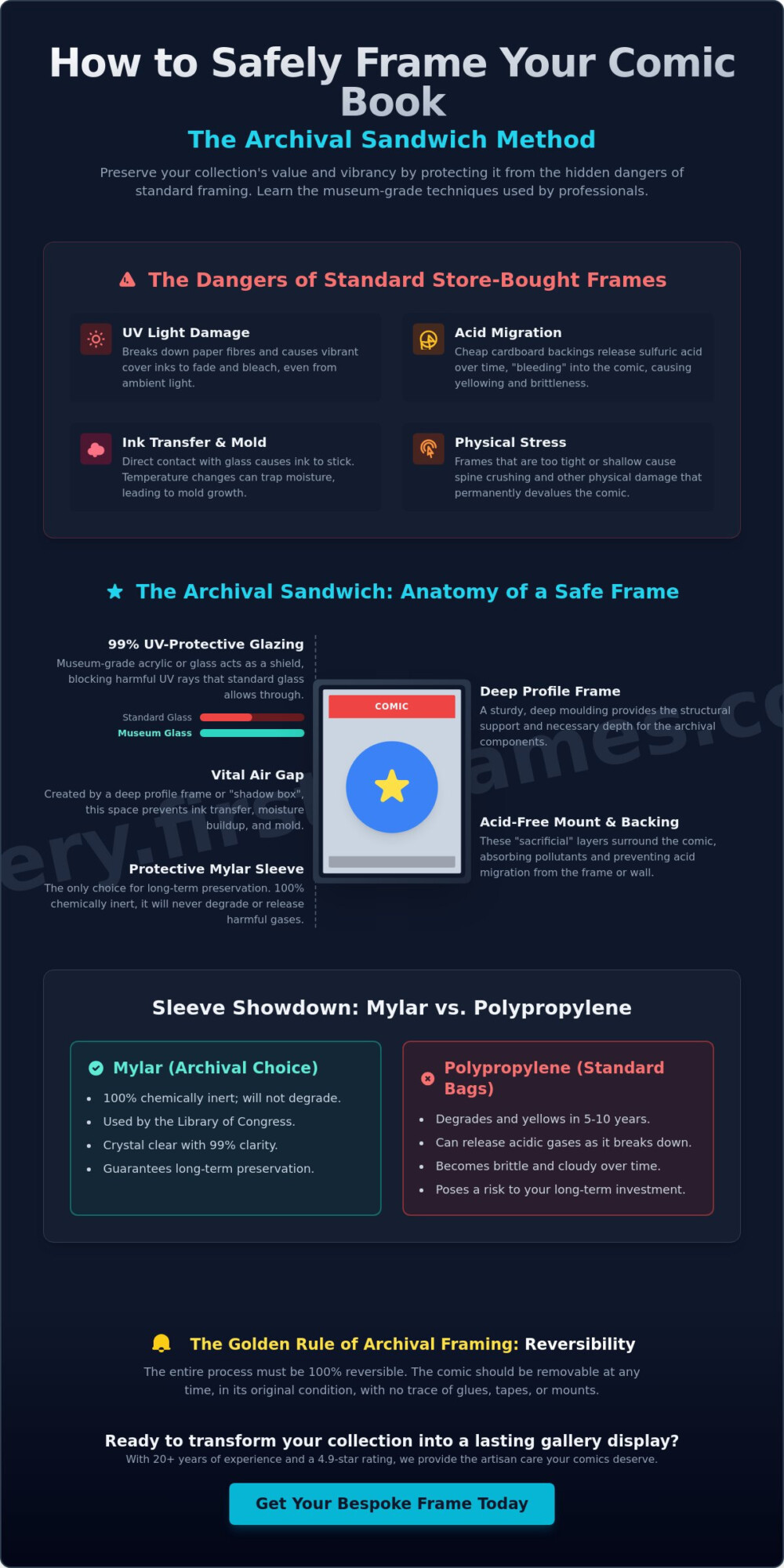
Archival comic framing is a non-invasive, reversible process that uses chemically inert materials to protect your investment. Unlike standard store-bought frames, professional methods ensure the comic remains in its original condition. When you learn how to frame a comic book safely, you’re essentially applying professional archival conservation techniques to your collection. This prevents the “Enemies of Paper” from destroying your valuable issues over time. At First 4 Frames, we’ve spent over 20 years perfecting these methods to ensure your art stays as vibrant as the day it was printed.

To better understand this concept, watch this helpful video:

Standard framing often leads to “ink transfer.” This happens when the comic cover presses directly against the glass, causing the ink to bond with the surface. If you try to remove the comic later, the art peels off. Similarly, collectors often think a tight fit is best. However, a frame that’s too snug causes spine crushing, which permanently devalues the book. Our team uses their expertise to ensure your bespoke frames provide the perfect “bridge” between your room and your art without causing physical stress to the piece.

UV Light: The Silent Collector Killer

UV radiation is a constant threat to paper. These rays break down paper fibres and bleach the vibrant inks found on modern and vintage covers. While standard glass offers less than 45 percent protection, 99 percent UV-protective museum glass acts as a literal shield. Even if you hang your comic in a hallway without direct sunlight, ambient UV rays still cause damage. This is why our professional framing services prioritize museum-grade glazing to keep your collection spectacular.

Acid Migration and Off-Gassing

Many “ready-made” frames use cheap cardboard backings. These materials contain lignin, a natural component of wood-pulp paper that creates sulfuric acid as it ages. This acid “bleeds” into your comic, causing the yellowing and brittleness seen in poorly stored books. Professional acid-free mounts act as a sacrificial barrier. By choosing high-quality materials from our online gallery, you ensure your art remains pristine. Our excellent Google and Trustpilot ratings reflect our commitment to these high standards of craftsmanship and care.

The Archival Sandwich: Anatomy of a Safely Framed Comic

Framing a collectible requires more than just a nice border. It’s about creating a stable micro-environment for your investment. We call this the “archival sandwich.” This multi-layered approach ensures your comic remains in the exact condition it was in the day you bought it. Reversibility is the golden rule here. You must be able to remove the book at any time without a trace of the framing process left behind. This means no glues, no permanent mounts, and no shortcuts.

A crucial element of how to frame a comic book safely involves the frame’s depth. We always recommend a deep profile frame or a “shadow box” style. This creates a vital air gap between the glazing and the comic surface. Without this space, fluctuations in room temperature can cause moisture to trap against the glass. This often leads to ink transfer or mold growth. By keeping the comic away from the glass, you protect the delicate paper from sticking or warping over time.

The Protective Sleeve: Mylar vs. Polypropylene

For long-term preservation, Mylar is the only choice. This material, technically known as biaxially-oriented polyethylene terephthalate, is the industry standard used by the Library of Congress for its most precious documents. While standard polypropylene bags are common, they’re prone to yellowing and can release acidic gases as they degrade over a 5 to 10 year period. Mylar is 100% chemically inert and won’t break down. It also offers 99% clarity, which is perfect for showcasing the vibrant cover art of Silver Age or Golden Age classics. We always suggest leaving the top of the sleeve slightly open. This allows the paper to breathe and prevents the buildup of harmful off-gases inside the sleeve.

Mounting and Matting Techniques

Your comic needs a stable home inside the frame. Use acid-free, alpha-cellulose mount boards to support the weight of the book. These boards have a pH-neutral core that prevents “mat burn,” a type of permanent yellowing caused by acidic wood-pulp boards. We use a window mount technique to create a beautiful visual border. This allows the comic to sit securely behind a mat opening without any adhesives touching the paper. Never use tape, even if it’s labeled as “archival,” directly on the comic book itself. Instead, secure the Mylar sleeve to the backing board using archival corners. This level of care is why First 4 Frames maintains a 4.9-star rating on Google and Trustpilot. Our team treats every piece with the precision of a master artisan, ensuring your collection is both beautiful and protected. If you’re looking for inspiration on how to display your collection alongside world-class art, explore the curated pieces in our online gallery.

How to Frame a Comic Book Safely: The Ultimate Collector’s Guide

DIY Document Frames vs. Bespoke Professional Framing

Many collectors start their journey by looking for a quick fix. They often reach for a standard 8.5×11 document frame found at local stationery shops. While this seems like a clever budget hack, it’s actually a gamble with your collection’s health. Document frames are built for flat paper, not the multi-layered construction of a comic. They lack the depth required, which often results in the glass pressing directly against the cover. Over time, this pressure can cause ink transfer or “spine roll,” permanently devaluing your book.

Learning how to frame a comic book safely means understanding that a frame should do the heavy lifting in the relationship between your wall and your art. It acts as a vital bridge, pulling you into the story while keeping destructive elements out. Most off-the-shelf document frames use basic window glass that offers no UV protection. This allows sunlight to bleach the vibrant reds and yellows of your cover in just a few months. A professional approach ensures the materials actually protect the paper rather than just holding it against the wall.

When to DIY and When to Call a Professional

Deciding between a home project and a professional service comes down to evaluating the value of the piece. If you’re framing a modern £5 reading copy, a DIY kit might suffice. However, if the comic is a silver-age classic or a signed variant, the risks of DIY are too high. Home glass cutting often leaves jagged edges that trap moisture or cause micro-scratches on the case. Professional framers act as your trusted partners, ensuring an airtight seal and using acid-free mounting that won’t yellow the pages. We’ve seen many “heirloom” items ruined by cheap adhesives used in DIY attempts.

The First4Frames Quality Standard

At First4Frames, we’ve spent over 20 years perfecting the art of preservation. Our Falkirk workshop is where creativity meets craftsmanship, ensuring every frame is built to last a lifetime. We source only premium materials that meet the highest standards of longevity. This commitment to quality is reflected in our excellent Trustpilot and Google ratings, where customers frequently praise our hassle-free and speedy service.

Standard frames simply can’t handle “Slabbed” comics. If you have a graded book from CGC or CBCS, it requires a specific depth and structural integrity that only bespoke framing services can provide. We create custom-fit solutions that accommodate the extra weight and thickness of these plastic shells. Whether you’re displaying a graded masterpiece or a beautiful print from our online art gallery, our team ensures the frame enhances the artwork without ever compromising its safety. We’re a one-stop-shop that treats your comic collection with the same respect as a piece of fine art.

How to Frame Your Comic at Home: A 5-Step Safety Guide

Preserving a rare 1963 Marvel classic or a modern variant requires more than a standard retail frame. You need a setup that acts as a bridge between your room décor and the artwork. Following these steps ensures your collection remains in “mint” condition for years to come. We’ve spent over 20 years perfecting these techniques, ensuring every piece of art is handled with the care it deserves.

  • Step 1: Preparation. Clear your workspace of any liquids or food. Wear microfiber gloves to prevent oils from your skin transferring to the paper. Even a small fingerprint can cause foxing or permanent staining over several decades.
  • Step 2: Bagging. Place your comic in a high-quality Mylar sleeve and ensure it’s perfectly centered. This is your first line of defense. Learning how to frame a comic book safely starts with these archival-grade materials that won’t break down or off-gas over time.
  • Step 3: The Spacer. Install acid-free spacers between the Mylar sleeve and the glass. This creates a vital pocket of air. It prevents the ink from lifting or the sleeve from sticking to the glazing if humidity levels change.
  • Step 4: Sealing. Use PH-neutral tape to seal the backing board to the frame. This prevents dust ingress and keeps the internal environment stable. A well-sealed frame acts as a protective cocoon for your investment.
  • Step 5: Placement. Hang your frame in a spot away from radiators and direct sunlight. Heat and UV rays are the primary causes of paper degradation and ink fading. Even with UV-protective glass, indirect light is always the safest choice for long-term display.

Measuring for the Perfect Fit

Accurate measurements are vital for a professional look. When you’re figuring out how to frame a comic book safely, the mount opening size is just as important as the frame itself. A Modern Age comic (post-1975) usually measures 6.625 by 10.25 inches, while Silver Age books are slightly wider at 7.125 inches. Golden Age books from the 1940s often reach 7.75 inches. Your mount opening should overlap the comic edges by at least 3mm to keep it secure without obscuring the cover art. For more details on getting the dimensions right, check our guide on measuring art for custom frames.

Tools You Will Need

You’ll need PH-neutral hinging tissue, a bone folder for crisp edges, and a specialized UV glass cleaner. A PH-neutral substance is a material that neither adds nor subtracts acidity from its environment. Don’t use standard cleaning sprays that contain ammonia. Ammonia can react with the coatings on museum-grade glass or cloud the surface of acrylic. We source only the best materials at First 4 Frames to ensure your bespoke framing project lasts a lifetime. Our expert team provides a professional service that collectors trust, which is why we maintain such high Google and Trustpilot ratings across our three dedicated sites.

Ready to display your collection with professional flair? Browse our gallery of professional framing options.

Elevating Your Collection: From Comic to Fine Art

Framing a comic is the final step in a collector’s journey. It transforms a stored issue into a focal point that demands attention. A frame acts as a bridge between your room’s décor and your comic art, pulling viewers into the story while grounding the piece within your living space. By applying the same high standards we use for fine art prints, you ensure your collection feels like a natural part of your home’s DNA rather than an afterthought.

Comic Art as Interior Design

The vibrant colors of a Golden Age cover or the gritty lines of a modern variant demand specific framing choices to shine. Bold blacks and sleek silvers often complement the Pop Art aesthetic perfectly, providing a sharp contrast to the ink. You can draw inspiration from the artists featured in our gallery. The vivid, high-contrast palettes of Jolomo or the cinematic mood of Jack Vettriano offer great cues for choosing mount colours that make a cover pop. Knowing how to frame a comic book safely is only half the battle; the other half is making it look spectacular on your wall. If you’re looking to frame smaller inserts or trading cards alongside your issues, using standard photo dimensions can create a balanced, professional look. Learning how to frame a comic book safely means considering how the final piece interacts with your lighting and furniture.

The First4Frames Ecosystem

We’ve spent over 20 years perfecting our craft as knowledgeable and helpful artisans. This experience allows us to provide a seamless one-stop-shop advantage for collectors. Our main fine art gallery showcases the level of quality we bring to every project, from bespoke framing to curated prints. If you need a specific digital image or variant cover turned into a physical display piece, our print and frame service handles the technical details with precision. Our team treats every comic with the same reverence as a museum-grade painting, sourcing only the best materials to ensure your items remain preserved for decades.

Use our First4Frames YouTube videos to see different mounting options in action. These videos help you visualize how a deep-set frame or a double mount changes the appearance of your comic before you commit. Our commitment to quality is reflected in our excellent Google and Trustpilot ratings, where customers frequently praise our bespoke, speedy service and professional results. If you’re in Central Scotland, visit our Falkirk gallery for a personal consultation with our team. We’ll help you pick the perfect materials to protect your investment and elevate your display. Contact our expert framers to protect your most prized issues today.

Give Your Collection the Professional Protection It Deserves

Your comic books are more than just ink and paper; they’re a piece of cultural history that deserves to be seen. You’ve learned that the secret to long-term preservation lies in the archival sandwich and avoiding cheap, acidic materials that cause yellowing. Mastering how to frame a comic book safely ensures your rare issues remain in mint condition while becoming a stunning focal point in your home. It’s the difference between a hobbyist’s shelf and a curated gallery display.

At First 4 Frames, we’ve spent 20+ years perfecting the art of bespoke framing in our Falkirk workshop. Our excellent Google and Trustpilot ratings reflect our commitment to quality craftsmanship and a hassle-free service. While our main site handles bespoke framing and our print shop manages Giclée reproductions, our gallery showcases how professional presentation transforms any piece into a masterpiece. You can see this level of detail in the way we present the fine art on our gallery site. We treat every comic with the same care we give to the professional pieces we curate. It’s about creating a bridge between your room décor and your favourite artwork.

Don’t let your most prized covers hide in a dark box. Get a Bespoke Quote for Your Comic Framing Today and start building a display you’re proud to show off.

Frequently Asked Questions

Can framing a comic book lower its value?

Framing won’t lower a comic book’s value if you use archival, museum-grade materials. Over 20 years of experience in the industry shows that acid-free backing and UV protection prevent the yellowing and brittle edges that destroy a book’s grade. Our artisans at First 4 Frames use the same professional techniques for comics as they do for the fine art found at gallery.first4frames.co.uk, ensuring your investment stays protected.

Is it better to frame a comic in its original bag and board?

You shouldn’t frame a comic in a standard PVC bag because these materials often degrade within 36 months. Learning how to frame a comic book safely involves using Mylar sleeves or acid-free mounting corners that don’t trap harmful gases. For a spectacular finish that acts as a bridge between your room décor and your collection, our bespoke framing service at www.first4frames.co.uk provides a much safer environment than a standard storage bag.

What is the best glass for framing comics?

The best choice for any collector is 99% UV-protective museum glass or conservation-grade acrylic. These materials block the specific light wavelengths that cause ink to fade and paper to deteriorate. We source only the best materials for our customers, which is why we maintain a 4.9 star rating on Google. This premium glazing ensures your comic remains as vibrant as the day it was printed.

How do I prevent my comic from fading on the wall?

You prevent fading by using UV-resistant glazing and hanging the piece away from direct sunlight or fluorescent bulbs. Even with 99% UV protection, 100% of light can still cause minor damage over 10 or 20 years. We recommend checking the placement of your art twice a year to ensure no new light paths are hitting the cover. If you’re looking for high-quality prints to display instead of rare originals, browse the collection at prints.first4frames.co.uk.

Should I frame a CGC graded (slabbed) comic?

You can certainly frame a CGC graded comic by using a deep rebate frame specifically designed for slabs. These plastic cases are approximately 13mm thick, so a standard frame won’t close properly. Our team specializes in bespoke solutions for these heavy items. We apply the same craftsmanship to your graded books as we do for the artists featured on our gallery site, creating a professional and secure display.

Can I use a standard A4 frame for a comic book?

You can’t use a standard A4 frame because comic books don’t fit those dimensions properly. Modern age comics typically measure 17cm by 26cm, while A4 is 21cm by 29.7cm. This mismatch leaves awkward, uneven gaps around the edges. For a perfect fit, use our bespoke service at www.first4frames.co.uk. We ensure your frame does the heavy lifting by pulling you into the artwork without distracting, ill-fitting borders.

How often should I change the materials inside a comic frame?

You should inspect your framing materials every 60 months to ensure the internal environment remains stable. While archival materials are designed for longevity, tape or mounting hinges can occasionally fail after 7 to 10 years. Keeping a regular checkup schedule protects the paper’s integrity. Our commitment to high-quality service means we’re always here to help you refresh your display with professional care and a speedy service.

Does the frame need to be airtight?

Your frame shouldn’t be completely airtight because trapped moisture leads to foxing and mold growth. A tiny amount of air circulation prevents humidity from becoming trapped against the paper fibers. We’ve spent 2 decades perfecting the balance between protection and breathability. Trust our professional experience and excellent Trustpilot ratings to provide a safe home for your most cherished comic book covers.

Posted on

How to Care for Framed Artwork: The Expert Gallery Guide to Longevity

How to Care for Framed Artwork: The Expert Gallery Guide to Longevity

Last week, a collector at the First4frames gallery discovered a small ripple in their favorite landscape print, a common worry when a radiator is placed too close to a bespoke frame. You’ve likely felt that same flash of concern when the afternoon sun hits your wall, wondering how to care for framed artwork without accidentally causing damage with the wrong cleaning spray. It’s natural to want to protect the fine art prints that serve as the bridge between your room decor and your personal style.

We’ve spent over 20 years helping people preserve their treasures, earning a 5-star reputation for our professional framing service and craftsmanship. This guide shares the expert secrets to maintaining your prints and frames for a lifetime of enjoyment. You’ll walk away with a clear cleaning routine, the confidence to choose the perfect hanging spot, and the knowledge of when to bring a piece back to our workshop for professional attention. We’re here to ensure your journey of artistic discovery stays as vibrant as the day it began.

Key Takeaways

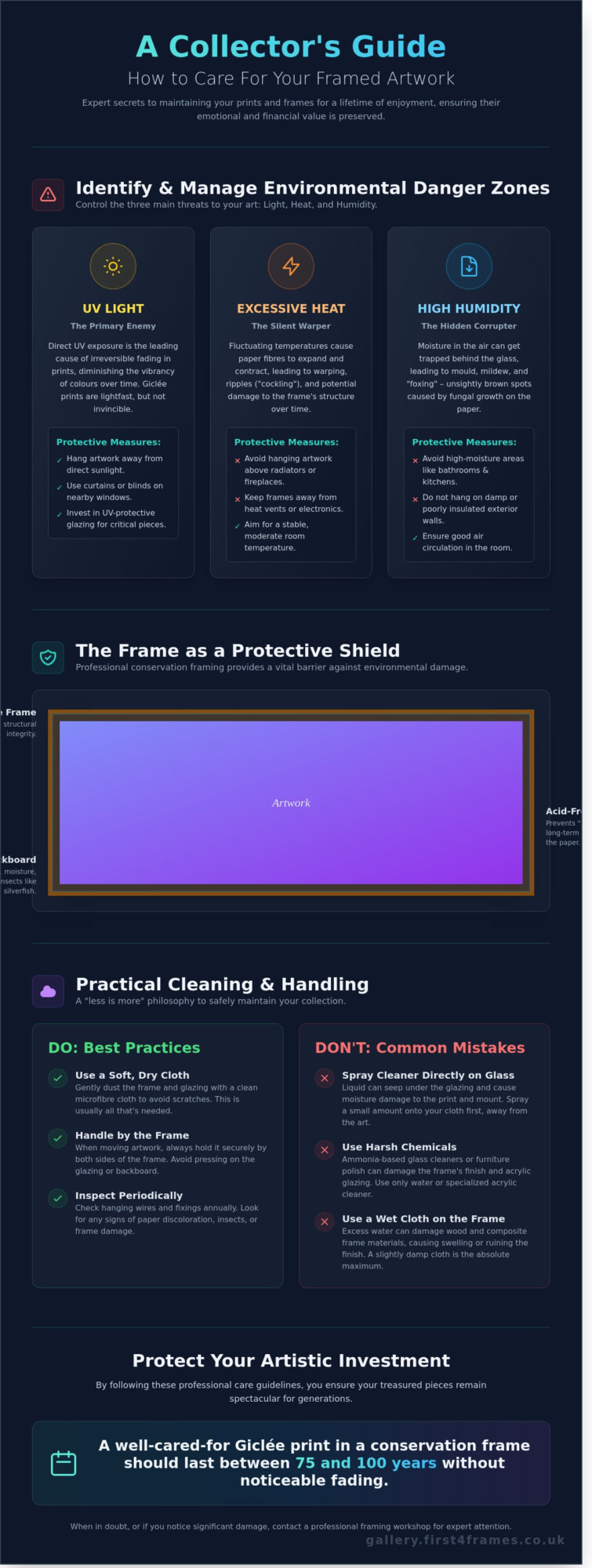
  • Discover how to identify and manage environmental “danger zones” in your home to protect your fine art prints from fading and UV damage.
  • Learn the professional “less is more” cleaning philosophy to safely maintain your bespoke frames and delicate artwork without the risk of moisture damage.
  • Understand the vital role of conservation framing and how First4Frames uses acid-free mounts to prevent “mount burn” and long-term deterioration.
  • Master the expert secrets of how to care for framed artwork to ensure the spectacular colours of artists like Jolomo and Jack Vettriano remain vibrant for a lifetime.
  • Explore why professional framing acts as a protective bridge between your décor and your art, safeguarding both its emotional resonance and financial value.

Why Caring for Your Framed Artwork Matters for Longevity

Owning a piece from the First4Frames Gallery isn’t just about filling a gap on your wall. It’s about preserving a story and a specific moment in time. Whether it’s a vibrant, limited-edition landscape by one of our featured artists or a cherished personal photograph, understanding how to care for framed artwork ensures these treasures remain spectacular for generations. A frame isn’t just a border; it’s the bridge between your room décor and the artwork. It does the heavy lifting in the relationship, pulling the viewer into the picture while providing a necessary barrier against the harsh elements of a typical home environment.

Neglect leads to irreversible damage that can devalue your collection both emotionally and financially. Issues like foxing, which appears as unsightly brown spots caused by fungal growth, or acid burn from low-quality mounting materials can ruin a piece in less than 10 years. At First4Frames, our commitment to quality is a point of pride. This dedication is reflected in our 5-star customer reviews across major platforms, where clients frequently highlight our expertise and the lasting durability of our work. For those wanting to understand the complex science behind preservation, the Conservation and restoration of paintings offers a comprehensive look at how professionals maintain artistic integrity over centuries.

To better understand the fundamentals of keeping your art in top condition, watch this helpful video:

Protecting Your Artistic Investment

Giclée prints are the heart of the First4Frames Gallery collection. These prints offer incredible colour depth and detail, but they require specific care to maintain their brilliance. Unlike standard digital prints, Giclée uses pigment-based inks that are designed to be lightfast. However, they still need protection from direct UV exposure to prevent gradual fading. Our professional framing service provides a level of security that off-the-shelf options simply can’t match. While a cheap, mass-produced frame might look fine initially, our bespoke solutions use archival-grade, acid-free materials. When you treat your art with this level of professional respect, a well-cared-for piece should last between 75 and 100 years without any noticeable loss in quality.

The Frame as a Protective Shield

A frame serves a vital structural role beyond its aesthetic appeal. It prevents paper warping, often called cockling, which happens when paper fibres expand and contract due to changes in room humidity. Our print-and-frame service ensures every piece is fitted with a precision-cut mount. This isn’t just for visual breathing room. The mount creates a necessary 2mm air gap between the artwork and the glazing. Without this gap, condensation can trap moisture directly against the print surface, leading to mould or the ink sticking to the glass. Additionally, we use a sealed backboard system. This keeps out dust and tiny insects, such as silverfish, which are known to cause significant damage to paper-based art in just a few months if left unchecked.

Managing Environmental Factors: Light, Heat, and Humidity

The First4frames gallery features spectacular works from talented artists that are designed to be the centerpiece of your home. To keep these pieces looking as fresh as the day they left our workshop, you need to understand the unique “danger zones” found in many British houses. From drafty Victorian hallways to modern kitchens with high humidity, every room has its own microclimate. Learning how to care for framed artwork starts with identifying these environmental threats before they cause lasting damage.

We’ve spent over 20 years perfecting our craft, and our high customer ratings reflect our commitment to quality. We treat every piece as a bridge between your room décor and the artist’s vision. To maintain that bridge, you must control the three big variables: light, temperature, and moisture. These factors don’t just affect the surface; they can alter the structural integrity of the paper and the frame itself.

Shielding Prints from UV Light and Fading

UV light is the primary enemy of vibrant colours. It triggers a chemical reaction in the ink and paper, leading to irreversible bleaching. You shouldn’t hang art directly opposite a south-facing window, as this exposure can cause noticeable fading in as little as 24 months. According to the preventive conservation guidelines, light damage is cumulative and cannot be reversed once it occurs.

Our bespoke framing service addresses this by offering premium UV-protective glass. This specialized glazing filters out up to 99% of harmful rays, acting like a high-factor sunblock for your art. Be careful with artificial lighting too. Halogen bulbs are notorious “hotspots” that emit both heat and UV. We recommend switching to LED bulbs, which stay cool and provide a safe, beautiful glow for your collection. You can explore our latest arrivals and see how professional glazing enhances clarity on our online gallery.

Balancing Temperature in the British Home

Temperature fluctuations cause organic materials like paper and wood to “breathe.” When a room gets warm, the paper fibers expand; when it cools, they contract. Over time, this constant movement leads to “cockling,” which is that unsightly wavy appearance you sometimes see behind the glass. Following the “Radiator Rule” is essential: never hang artwork directly above a radiator or heat vent. The intense, dry heat can make the wooden frame shrink and the artwork become brittle.

External walls are another hidden risk because they often stay colder than the rest of the room. This temperature gap can cause moisture to condense inside the frame. To prevent this, we use small spacers or “bumpers” on the back of the frame. These create a 5mm gap that allows air to flow freely behind the piece. For high-risk areas like bathrooms or kitchens, our print-and-frame service often suggests using acrylic instead of glass. It’s more resistant to thermal shock and won’t trap condensation as easily as traditional glazing. This practical approach ensures your investment stays protected while looking perfect on your wall.

How to Care for Framed Artwork: The Expert Gallery Guide to Longevity

Practical Cleaning and Handling Techniques for Fine Art

Maintaining the pristine condition of your collection starts with understanding that how to care for framed artwork is as much about handling as it is about cleaning. At First4frames gallery, we’ve spent over 20 years perfecting the art of presentation. Before you touch a large piece, such as a 100cm wide landscape print, clear a flat, stable workspace. Laying the piece on a clean, soft towel prevents accidental scratches to the moulding. Always grip bespoke frames by the sides. Lifting from the top rail puts unnecessary stress on the joined corners, which can lead to structural failure over time.

Our expert team recommends a “less is more” philosophy. Dry cleaning is almost always superior to wet cleaning for fine art. Moisture is a primary enemy of paper-based art and can seep under the glazing to cause foxing or mould growth. We’ve earned our 4.9-star customer rating by ensuring every piece leaves our workshop in peak condition; keeping it that way requires a gentle touch and the right tools. Don’t rush the process, as most damage occurs during hasty cleaning sessions.

How to Clean Glazing Without Risking Damage

If your artwork features acrylic glazing, put away the paper towels. Paper is abrasive and creates microscopic scratches that dull the surface over time. Use a high-quality, clean microfibre cloth instead. Never spray glass cleaner directly onto the frame. Liquid can run down the glass and soak into the mount board, ruining the artwork. Spray a small amount of ammonia-free cleaner onto the cloth first. This protects the delicate bond between the frame and your fine art prints.

Safe Methods for Dusting Bespoke Frames

Intricate mouldings on gilt or painted frames require a delicate approach. A soft-bristled brush, like a 1-inch natural hair artist’s brush, is the best tool for removing dust from deep crevices. This prevents the buildup of grime that can become difficult to remove without damaging the finish. Check your hanging hardware every six months. Ensure that wires haven’t frayed and that D-rings remain tight. Our professional framing service uses premium steel components, but seasonal temperature shifts in UK homes can occasionally loosen screws.

Follow this simple seasonal maintenance checklist to ensure longevity:

  • Spring: Dust the top edge of the frame where debris accumulates during winter.
  • Summer: Check for any signs of insect ingress behind the glass or within the frame spacers.
  • Autumn: Inspect the backing tape for peeling or gaps that might let in moisture.
  • Winter: Verify that the artwork hasn’t been placed too close to active radiators or heat sources.

Learning how to care for framed artwork properly ensures that your investment remains a beautiful bridge between your room décor and the artist’s vision for decades. Whether you’re displaying a piece from our latest gallery collection or using our print-and-frame service for your own photography, these small steps preserve the spectacular quality of the work.

Understanding Conservation Framing Standards

Conservation framing is the gold standard we uphold at First4Frames. It’s the difference between a frame that merely looks good and one that preserves your investment for 75 years or more. When you’re learning how to care for framed artwork, understanding what happens inside the frame is vital. We treat every piece from our gallery with archival principles to prevent environmental decay and chemical damage. This professional approach ensures the frame acts as a protective cocoon for the art inside.

One critical element is the mounting process. We never use standard adhesive tapes or “pressure-sensitive” glues that can permanently bond to the paper. Instead, we utilize reversible hinging techniques. This allows the artwork to expand and contract naturally with temperature changes. If the art ever needs to be removed, these hinges can be safely detached without tearing the paper fibers or leaving sticky residues. We also offer various glazing options. While standard float glass is a common choice, we often recommend museum-grade acrylic for high-value pieces. This specialized glazing blocks 99% of harmful UV rays, preventing the colors in your favorite prints from fading over time.

Acid-Free Materials and pH Neutrality

The chemistry of your frame matters. Traditional wood-pulp paper contains lignin, an organic polymer that turns acidic over time. This leads to “mount burn,” which appears as unsightly brown stains on the edges of the artwork. Our bespoke framing service avoids this by using alkaline-buffered boards with a pH level of 8.5. These boards neutralize acidic gases and pollutants before they can reach the art. You can identify acid damage in older, non-professional frames by looking for yellowing paper or brittle edges. Our Falkirk workshop replaces these damaging materials with museum-quality alternatives to halt further deterioration.

The Professional Difference in Print-and-Frame Services

Our “one-stop-shop” model ensures your art is handled safely from the moment it’s printed. By combining Giclée printing with archival-quality framing, we guarantee a product that won’t fade or warp. Since we opened our doors in 2003, our Falkirk workshop has become a trusted choice for Scottish art lovers who demand excellence. We don’t just frame a picture; we build a bridge between your room décor and the artwork. Our 5-star customer ratings across review platforms reflect our dedication to this craft. When you choose a piece from our collection, you’re benefiting from twenty years of technical expertise and a genuine passion for fine art preservation.

Discover our latest collection of professionally preserved pieces and how to care for framed artwork in your own home.

Explore the First4Frames Gallery

At First4Frames, we believe a frame is more than just a border; it’s the vital bridge between your room décor and the artwork itself. Whether you’ve recently acquired a moody Jack Vettriano or a sun-drenched John Lowrie Morrison (Jolomo) piece from our Falkirk gallery, knowing how to care for framed artwork is the key to protecting your investment for decades. Our team has spent over twenty years perfecting the art of preservation, ensuring that every limited edition print remains as striking as the day it left our workshop.

Preserving the Vibrant Colours of Jolomo Prints

John Lowrie Morrison’s signature style relies on high-contrast, vibrant palettes that capture the raw energy of the Scottish Highlands. To keep these colours spectacular, we always recommend UV-protective glass. This specific barrier prevents bold pigments from fading when exposed to the changing Scottish light. We also focus on the “heavy lifting” for large-scale Jolomo works. This means using sturdy, high-quality wood frames that provide the structural integrity needed to prevent the paper from bowing or warping over time. Choosing a neutral or subtly complementary mount colour further enhances the landscape’s tones without distracting from the artist’s bold brushwork.

Why Professional Framing is the Best Insurance

While off-the-shelf options might seem convenient, professional framing is the only real insurance for your art. Our bespoke services are designed to pull you into the picture, using materials that actively protect the print’s texture and detail. This commitment to quality is why we maintain excellent customer ratings on major review platforms, where clients frequently praise our attention to detail and craftsmanship. If you have a cherished item at home, you can easily get a quote for our framing service to ensure it receives the same level of care as our gallery collections.

To keep your collection in peak condition, we recommend following these expert steps:

  • Monitor the environment: Avoid hanging vibrant Scottish landscapes directly opposite large, south-facing windows.
  • Check the seals: Every five to seven years, bring your artwork to our Falkirk gallery for a professional check-up to ensure no dust or moisture has breached the frame.
  • Trust the experts: For limited edition prints with delicate textures, only use our professional print-and-frame service to guarantee acid-free mounting.

We pride ourselves on being a one-stop-shop for art lovers. If you’re unsure about the current state of your display, don’t wait for visible damage to appear. Visit us in Falkirk for a consultation. We’ll help you understand how to care for framed artwork while ensuring your Jack Vettriano or Jolomo pieces continue to tell their story for generations to come. Our passion for fine art is matched only by our dedication to the craftsmanship that protects it.

Preserving the Beauty of Your First4Frames Collection

Your fine art collection deserves a home where it can thrive for decades. By managing light exposure and maintaining stable humidity, you ensure that every vibrant detail of your Scottish fine art prints remains as spectacular as the day you brought them home. Master the basics of how to care for framed artwork to prevent irreversible damage from environmental stressors. Choosing high-quality conservation materials is the best way to safeguard your investment for the long term.

At First4Frames, we’ve spent over 20 years providing bespoke framing expertise in Falkirk. Our team specializes in conservation standards that act as a protective bridge between your room’s decor and the delicate art itself. We’re proud of our excellent customer ratings on review platforms, which reflect our commitment to craftsmanship and professional service. Whether you’re selecting a new piece from the First4frames gallery or need a bespoke solution for a cherished heirloom, our artisans are ready to assist.

Browse our Ready-to-Hang Gallery or book a Bespoke Framing consultation today

Let your walls tell a story that lasts a lifetime with pieces that stay as bright and inspiring as your very first discovery.

Frequently Asked Questions

Can I hang my framed artwork in a bathroom?

You shouldn’t hang delicate paper artwork in a bathroom because humidity levels often spike above 70 percent. This moisture causes the paper to warp and can lead to mould growth within 48 hours. If you want to display a piece from our gallery in a humid space, choose our print-and-frame service with an acrylic glaze to provide better protection against damp conditions.

How do I clean the glass on my picture frame without streaks?

To clean frame glass without streaks, apply a small amount of ammonia-free cleaner directly to a microfibre cloth. Never spray liquid onto the glass because it can seep under the edges and ruin the artwork. First 4 Frames recommends using a 50/50 distilled water and white vinegar solution. This simple mixture ensures your Giclée prints remain crystal clear and visible.

Why is my artwork starting to ripple inside the frame?

Artwork ripples, a process called cockling, when it reacts to changes in temperature and humidity. When you learn how to care for framed artwork, you’ll find that a 10 percent shift in room moisture can cause paper fibers to expand. Our professional framing service uses conservation mounting techniques to allow the art to breathe, which prevents this permanent distortion from occurring.

What is the best way to dust a bespoke wooden frame?

The best way to clean a bespoke wooden frame is by using a soft, dry brush or a dedicated ostrich feather duster. Avoid all liquid polishes or damp cloths, as moisture can penetrate the wood grain and cause the finish to swell. Since we’ve spent 20 years crafting premium frames, we know that a gentle, dry touch preserves the wood’s natural beauty for decades.

How can I tell if my frame uses acid-free materials?

You can tell if materials are acid-free by checking for a conservation or museum grade stamp on the mounting board. These materials maintain a pH level between 7.5 and 9.5, which prevents the yellowing seen in older, cheaper frames. Every piece of art we frame for our customers uses these high-quality materials to ensure your investment stays in perfect condition.

Is it safe to hang art directly above a radiator?

It’s not safe to hang art directly above a radiator because the rising heat will quickly dry out the frame and the paper. Temperatures exceeding 25 degrees Celsius can cause wooden joints to shrink and separate by several millimetres. To protect your collection, keep a distance of at least 1 metre from any active heat source or direct sunlight.

How often should I check the hanging wires on my heavy frames?

You should check the hanging wires and wall fixings on heavy frames at least once every 12 months. Wires can fray over time, especially when supporting pieces over 5kg. Our 4.9-star customer rating is built on providing secure, professional-grade hardware, but annual inspections are essential for total peace of mind. Regular checks prevent accidental falls and glass breakage.

What should I do if I see small insects behind the glass?

If you spot small insects like 1mm thunderflies behind the glass, you must take the frame to a professional for cleaning and resealing. These pests crawl through tiny gaps in the backing tape and can leave permanent stains on your artwork. Our workshop team can safely dismantle the frame, remove the insects, and apply a fresh, airtight seal to protect your prints.

Posted on

Framing to Pass Down Through Generations: The Archival & Conservation Guide

Framing to Pass Down Through Generations: The Archival & Conservation Guide

A standard shop-bought frame can begin irreversibly damaging your artwork in as little as 730 days. When you invest in a piece by a featured artist at the First4Frames Gallery, you are likely thinking about framing to pass down through generations rather than a temporary fix. It’s a common frustration for collectors who find their cherished heirlooms yellowing because of cheap, acidic materials. You deserve a display that acts as a bridge between your décor and the art, rather than a hidden source of decay.

With over 20 years of expertise, we believe that protecting your collection should be a rewarding and simple experience. This guide will show you how our professional conservation framing ensures your art remains in pristine condition for centuries. Whether you’re using our bespoke framing service for an original or choosing a convenient print-and-frame option for a new Giclée, you’ll discover the museum-grade materials required for total protection. We’re going to explore the essential steps that turn a beautiful print into a protected legacy.

Key Takeaways

  • Identify the “slow burn” of acidic materials and environmental enemies like UV light that cause standard shop-bought frames to damage your artwork over time.
  • Discover the science of archival framing to pass down through generations, ensuring your family heirlooms are protected by chemically stable, reversible materials.
  • Navigate the differences between Commended, Conservation, and Museum-grade standards to select the perfect level of protection for your specific piece.
  • Explore how bespoke craftsmanship at First4Frames preserves a wide range of items, from vibrant Jolomo Giclée prints to precious family medals.
  • Learn our hassle-free, three-step process for creating a lasting legacy with expert framing services trusted by customers for over twenty years.

Why Standard Frames Fade: The Importance of Framing to Pass Down Through Generations

When you fall in love with a piece from the First4frames gallery, you aren’t just buying a print; you’re acquiring a piece of heritage. Placing a beautiful Giclée print by one of our featured artists into a standard, mass-produced frame can be a costly mistake. Most shop-bought frames act as a ticking clock for your artwork because they often harbour acidic components that trigger a “slow burn” effect. This chemical reaction gradually destroys the paper fibres of a cherished print or original painting, leading to irreversible damage. Choosing framing to pass down through generations isn’t just about aesthetics; it’s about creating a protective time capsule for the next century.

A frame serves as a vital bridge between your room décor and the artwork. It does the heavy lifting in the relationship, pulling you into the picture while keeping external threats at bay. Longevity depends on defeating three main enemies: UV light, fluctuating humidity, and acid migration. Without professional intervention, these factors will degrade your investment until the vibrant colours of the original work are nothing but a memory. We believe every piece of art deserves a home that protects its soul as much as its surface.

The Hidden Dangers of Non-Archival Materials

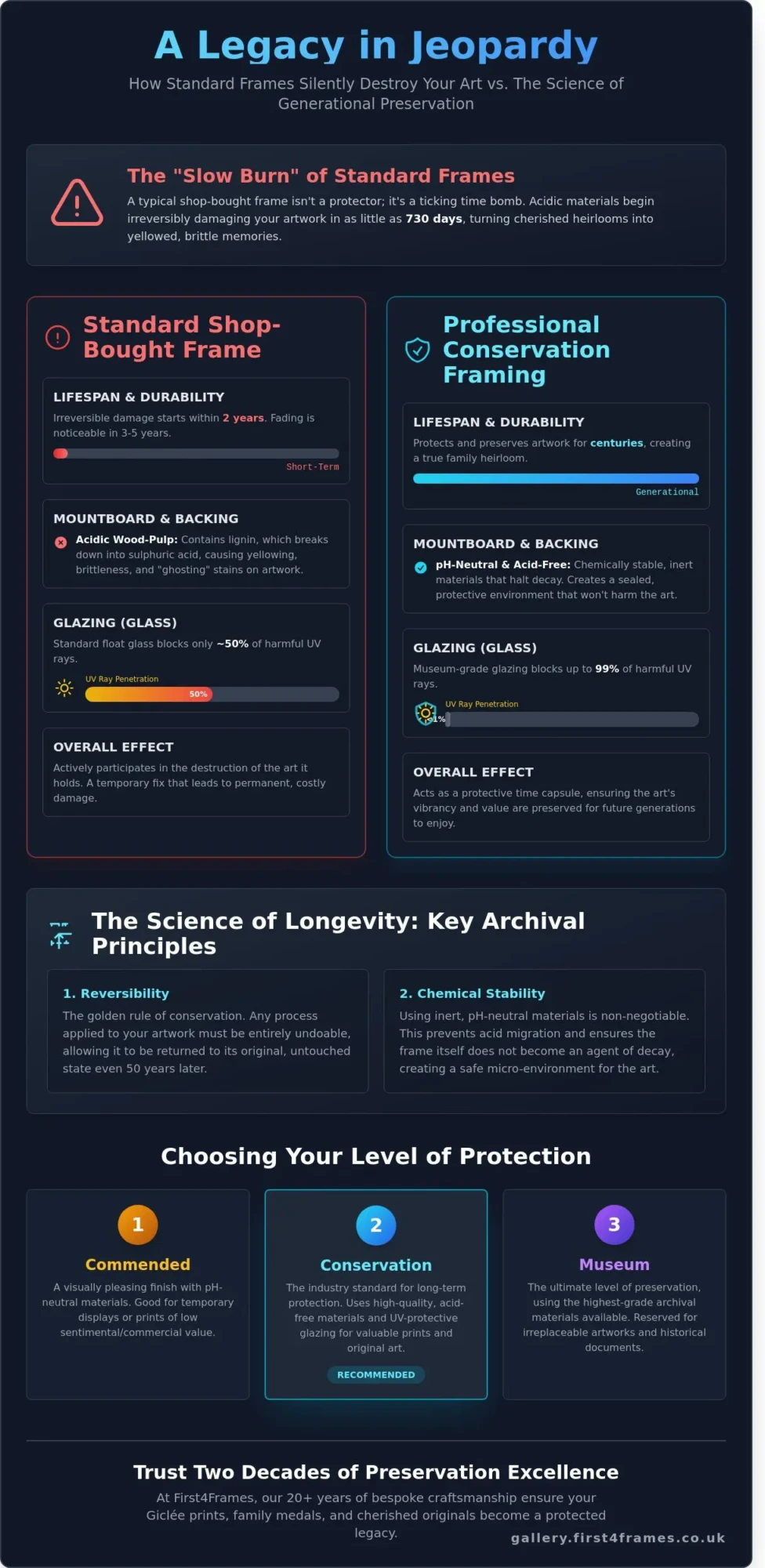
Cheap frames often use mountboards made from wood-pulp paper containing lignin. Over time, lignin produces sulphuric acid, which turns paper yellow and brittle. You’ll often see “ghosting,” where a dark, permanent stain appears on the artwork where it once touched the mount. Standard 2mm float glass is another silent killer. It allows up to 50% of harmful UV rays to pass through, causing pigments to bleach and fade within just 3 to 5 years of display in a sunlit room. These materials don’t just fail to protect; they actively participate in the destruction of the art they hold.

The First4Frames Philosophy: Excellence in Preservation

At First4Frames, we’ve spent 20 years perfecting the art of bespoke preservation in our Falkirk workshop. We don’t just sell frames; we provide a professional sanctuary for the fine art we showcase. Our team treats every piece with the same passion we have for our featured artists’ work, ensuring that framing to pass down through generations is a reality for every customer. This dedication to quality is why we maintain such excellent customer ratings across major review platforms. When you choose our professional framing service, you’re trusting two decades of craftsmanship to ensure your artwork stands the test of time and remains a spectacular focal point in your home.

The Science of Longevity: Understanding Archival and Conservation Framing

Archival framing isn’t just about choosing a pretty border. It’s a scientific method that uses chemically stable, inert materials to halt the natural decay of paper and pigments. At First 4 Frames, we’ve spent 22 years mastering these techniques to ensure your art survives the test of time. The most vital principle we follow is reversibility. This rule dictates that any process applied to your artwork must be entirely undoable. If a professional cannot return the piece to its original, untouched state in 50 years, it doesn’t meet the standard for framing to pass down through generations.

Our “one-stop-shop” model means we source and control every premium material that touches your art. This is especially important for Giclée prints from the First4Frames gallery. These prints use pigment-based inks designed to last between 100 and 200 years; however, they remain sensitive to atmospheric pollutants and moisture. We handle these pieces with specific archival protocols, ensuring the frame acts as a sealed, protective environment rather than just a decorative edge.

UV-Protective Glass: The Sunscreen for Your Art

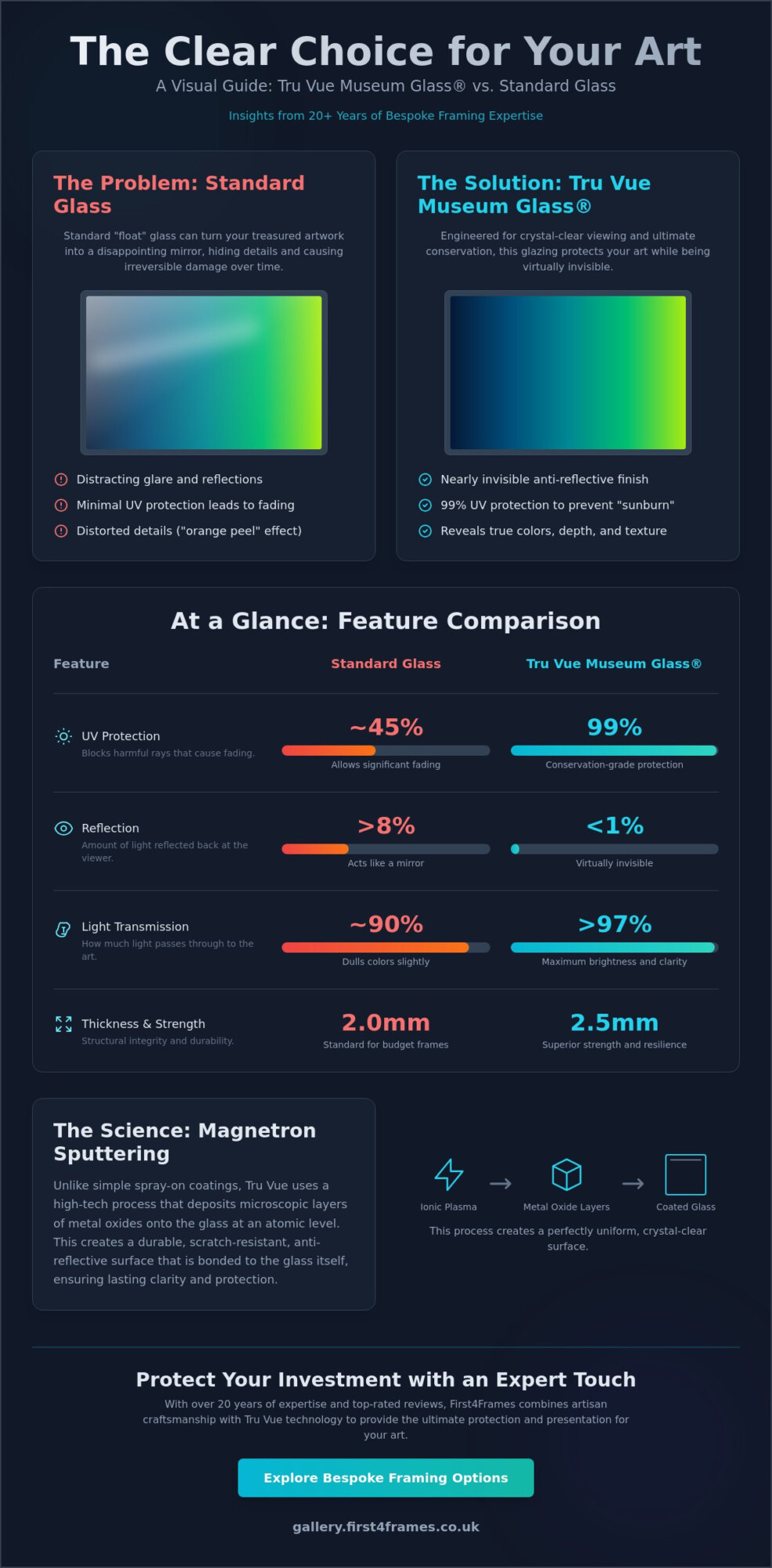
Sunlight is the primary enemy of fine art. Standard glass typically only blocks about 45% of harmful UV rays, which leads to irreversible fading and brittle paper within a decade. We provide 99% UV-filtering glass to stop this degradation at the source. While standard non-reflective glass can sometimes dull the image, museum-grade acrylic offers 99% protection with near-invisible clarity, allowing the vibrant colours of your print to shine. UV-protective glass is a non-negotiable requirement for any artwork intended to be a family heirloom.

pH-Neutral and Acid-Free Mounts

Many people confuse “acid-free” with “archival” quality. Standard acid-free boards are often wood-based pulps treated with chemicals to neutralise acidity, but these can become acidic again over time. We prefer archival cotton rag, which is naturally pH-neutral and won’t cause the “mount burn” or yellowing often seen in older frames. These mounts create a vital 2mm air gap between the glass and the print. This gap prevents condensation from trapped moisture, which otherwise causes the paper to stick to the glass or develop mould spots. Choosing the right mount texture also helps organise the visual focus, drawing the eye into the spectacular details of our curated gallery collection. By using these stable materials, you ensure your framing to pass down through generations remains a pristine window into the past.

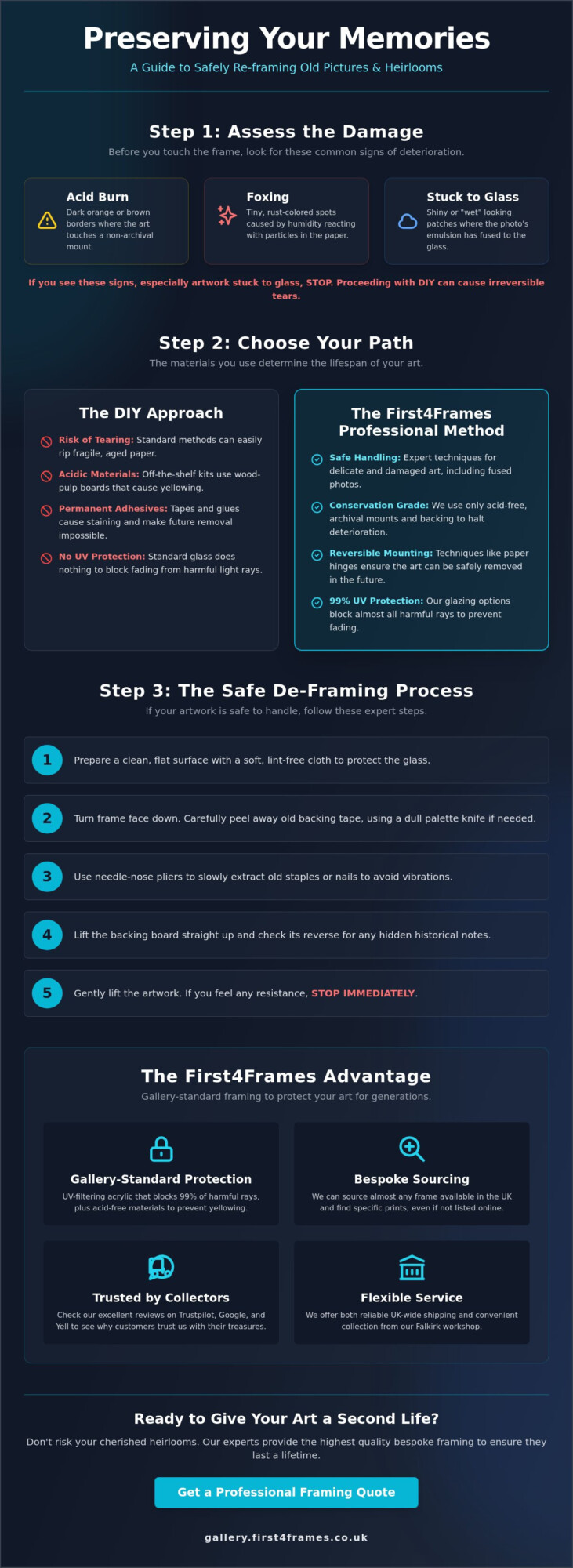
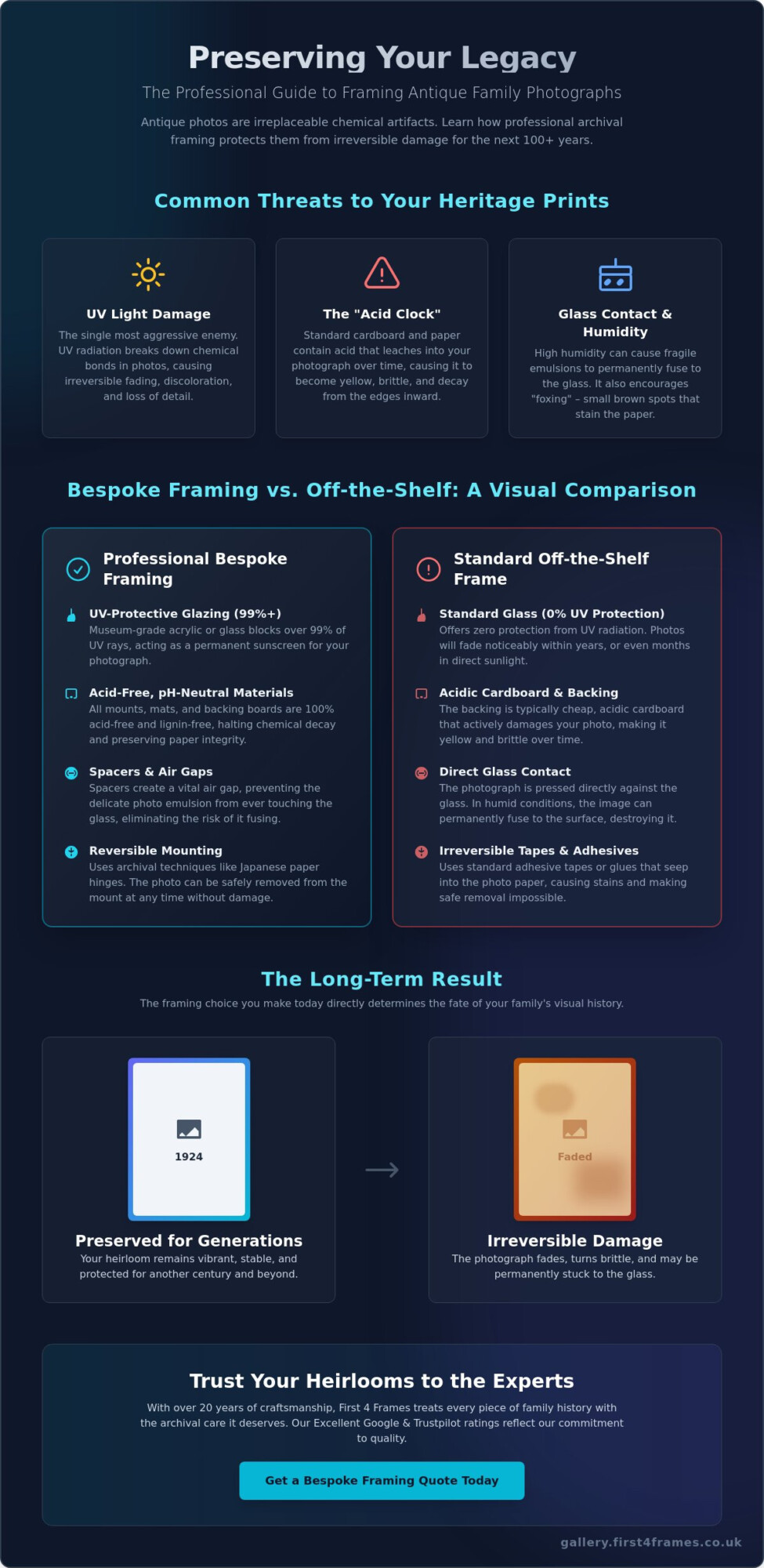
Infographic comparing standard shop-bought frames vs. professional conservation framing to pass down through generations. Includes sections on frame durability, materials, UV protection, and archival protection. Bold colours and icons highlight key points.

Standard vs. Museum Grade: Choosing the Right Protection Level

Selecting a frame isn’t just about matching your living room decor; it’s a decision about the life expectancy of your artwork. The Fine Art Trade Guild identifies four primary levels of framing: Budget, Commended, Conservation, and Museum. Budget framing often uses high-acid wood pulp boards that can cause visible yellowing on paper within 24 to 60 months. Commended framing offers better aesthetics but lacks the chemical stability required for long term preservation. When you’re looking for framing to pass down through generations, the professional tiers are where the real work happens.

The frame does the heavy lifting in your relationship with your art. It acts as a protective cocoon, shielding the piece from humidity, pollutants, and light damage. While a budget frame might cost £20, the cost of loss is 100% of the item’s value if acid burn or UV fading ruins the piece. Investing in professional standards ensures your artwork remains a financial asset rather than a fading memory.

  • Budget: Best for temporary displays or replaceable posters.
  • Commended: Good for non-archival items you want to look professional.
  • Conservation: The minimum standard for original art and limited editions.
  • Museum: The ultimate protection for items of high historical or financial value.

When to Invest in Conservation Grade

You should choose Conservation grade for any item with deep sentimental or historical significance. This includes original paintings and the limited edition Giclée prints featured in the First4Frames gallery. We use alpha-cellulose mount boards and 99% UV-protective glass to stop the “sunburn” effect that bleaches colours. To better understand the investment required for this level of protection, you can explore our guide on How Much Does Bespoke Framing Cost?

The Museum Grade Standard

Museum framing is the pinnacle of our craft at First4Frames. We use 100% cotton rag boards, which are naturally pH neutral and won’t degrade over time. This level of framing to pass down through generations ensures that an “identical copy” of a masterpiece remains visually perfect for 100 years or more. By using specialist anti-reflection glazing and reversible mounting techniques, we ensure your heirloom is preserved exactly as it was the day it was framed. We source only the best archival materials to maintain our reputation as a trusted professional for UK collectors.

From Giclée Prints to Family Medals: What Deserves Generational Framing?

Our First4frames gallery showcases the vibrant energy of acclaimed Scottish artists like Jolomo, whose work captures the rugged beauty of the Hebrides. When you invest in a piece of fine art, you’re beginning a story that spans decades. However, archival quality isn’t reserved solely for gallery acquisitions. Your own personal treasures, from a grandfather’s service medals to an original sketch, deserve professional framing to pass down through generations. A bespoke frame acts as a bridge between your home décor and the item itself. It pulls you into the picture and creates an emotional experience that standard shop-bought frames simply can’t replicate. With over twenty years of expertise, we understand that a frame should do the heavy lifting, protecting the soul of the piece while making it shine.

This principle extends to the modern heirlooms we create today. For families looking to capture those precious early moments that will be treasured for a lifetime, professional photography is essential. As an example of the beautiful portraits worth preserving, you can explore Newborn Session options.

Preserving Fine Art and Giclée Prints

High quality Giclée prints from our gallery are a brilliant starting point for any collection. These aren’t standard digital copies; they use pigment-based inks on acid-free archival paper to ensure the image remains vivid for 85 years or more. This interaction between premium inks and pH-neutral paper prevents the yellowing and brittle texture seen in cheaper prints. If you’re curious about the technical side of this process, you can read our guide on What Are Giclée Prints? to see why they’re the gold standard for modern art preservation.

Memorabilia and 3D Objects

Framing isn’t limited to flat paper. We specialise in box frame techniques for 3D objects such as medals, coins, or antique jewellery. It’s vital that these items don’t touch the glass. When an object sits directly against the glazing, condensation can form, leading to moisture damage or mould growth within months. We use deep spacers to create a protective pocket of air, ensuring your framing to pass down through generations remains pristine. Check out our Memorabilia Framing Guide for more on how we secure these delicate heirlooms using reversible, non-invasive methods.

The concept of preserving quality craftsmanship extends to all kinds of heirlooms, including fine leather goods which are often passed down. The longevity of such items starts with high-quality materials, often sourced from specialist trade suppliers like primehidetrade.co.uk.

Choosing professional framing means trusting your history to artisans who value craftsmanship. Our 4.9-star customer rating reflects our commitment to providing a reliable, high-quality service for every customer. Whether it’s a new Jolomo print or a century-old medal, we ensure it’s protected for the future. Explore our gallery collection to find a piece of Scottish art worth preserving today.

Creating a piece of history shouldn’t feel like a chore. At First4Frames Gallery, we’ve distilled over 20 years of expertise into a simple three-step journey. First, you Browse our extensive range of premium mouldings and acid-free mounts. Next, you Select the archival components that best highlight your artwork’s unique character. Finally, you Order with total confidence. Our Falkirk team handles the rest, providing a bespoke and speedy service that ensures your treasures are ready for display without the usual stress.

The Bridge Between Room Décor and Heritage

A well-chosen frame does the heavy lifting in any room. It acts as a vital bridge between your modern interior design and the rich history of your artwork. Our frames are far more than decorative borders; they are engineered protectors of your most cherished memories. We specialise in framing to pass down through generations, using museum-grade materials that prevent yellowing and UV damage.

Working with a trusted professional who understands the nuances of Scottish art ensures your heirloom receives the respect it deserves. Since 2004, we’ve helped thousands of clients turn fragile paper into lasting legacies. Whether you’re displaying a contemporary masterpiece or a century-old map, our frames pull you into the picture while keeping the elements out. We source only the best materials to ensure your art remains as spectacular as the day it was first created.

Visit Us in Falkirk or Order Online

You can find our gallery on Grahams Road in Falkirk, where we offer one-to-one consultations for your most complex bespoke projects. If you’re further afield, our online one-stop-shop simplifies the process for customers across the UK. We take immense pride in our 5-star customer ratings, which reflect our commitment to craftsmanship and reliability.

  • Expert Consultations: Visit us at Grahams Road for professional advice on archival materials.
  • UK-Wide Shipping: Our print-and-frame service brings gallery quality to your doorstep.
  • Quality Guaranteed: We use only premium components designed for longevity.

Don’t leave your history to chance in a standard shop-bought frame. Investing in quality ensures your favourite memories remain vibrant for your children and grandchildren to enjoy. Start your journey of artistic discovery today by visiting our gallery or browsing our collection online. Your family’s story deserves a professional finish that stands the test of time.

Preserve Your Artistic Legacy for Future Centuries

Your most cherished pieces, from the spectacular Scottish fine art in our collection to delicate Giclée prints, deserve better than standard materials that yellow and become brittle over time. Choosing museum-grade protection ensures your items remain as striking as the day they were created. We’ve spent over 20 years perfecting the art of framing to pass down through generations, acting as a professional bridge between your home décor and the artwork itself. At First4Frames Gallery, we don’t just provide a service; we act as knowledgeable artisans for your most valuable memories. Our excellent customer ratings on Google and Trustpilot reflect our deep commitment to quality and craftsmanship. Whether you’re displaying a contemporary Giclée acquisition or a historic family medal, our specialists treat every project with the reverence it deserves. It’s an investment in your family history that pays dividends in beauty and preservation for years to come.

Protect your legacy with our Bespoke Framing Service

Let’s work together to ensure your story remains as vivid as the day it was first captured.

Frequently Asked Questions

What is the difference between acid-free and archival framing?

Acid-free materials have a neutral pH level at the time of manufacture, whereas archival materials are chemically stable and designed to remain so for over 100 years. Our bespoke framing service uses alpha-cellulose or cotton rag boards that don’t degrade into harmful acids over time. This level of protection is essential when you’re investing in framing to pass down through generations to ensure the artwork doesn’t yellow or become brittle.

How long will a conservation-framed print last compared to a standard frame?

A conservation-framed print can last over 100 years in typical home conditions, while a standard frame often shows signs of “mount burn” or discolouration within 12 to 15 years. We use 1,100 micron thick conservation boards to create a protective environment for every piece. This ensures the vibrant colours of a Giclée print from the First4frames gallery remain as spectacular as the day you first hung it on your wall.

Can UV glass really stop my art from fading if it’s in a sunny room?

UV-protective glass blocks up to 99% of harmful ultraviolet rays, which significantly slows the fading process even in bright UK sitting rooms. While no glazing can stop 100% of light damage, museum-grade glass prevents the rapid bleaching often seen with standard 2mm float glass. Our 20 years of expertise shows that high-quality glazing is the single best investment you can make for your artwork’s longevity.

Is archival framing worth the extra cost for sentimental items?

Spending an additional £45 to £90 on archival materials is a sensible investment to protect irreplaceable family memories from chemical decay. Standard shop-bought materials contain lignin which eventually turns paper brown and crumbly. By choosing our professional framing service, you’re securing a piece of your history, a fact reflected in our consistently high customer ratings for quality and trust.

What happens if I use a standard shop-bought frame for an old photograph?

Using a standard shop-bought frame often leads to permanent damage because the backing boards are usually made from acidic wood pulp. Within 7 to 10 years, these acids migrate into your photograph, causing irreversible staining and brown spots known as foxing. We often see beautiful old photos ruined by cheap materials, which is why we recommend our bespoke service for anything you value. This principle is equally important for new photographic heirlooms; for example, the delightful cake smash portraits found at momentsinbloom.com.au also deserve professional preservation to become treasured family keepsakes.

Can I change the frame later without damaging the artwork?

You can safely change your frame at any time if the artwork was originally mounted using reversible conservation techniques. We use T-hinges and acid-free Japanese paper tapes that allow the art to be removed without leaving sticky residue or causing tears. This flexibility is a core part of the premium craftsmanship we provide at First 4 Frames, ensuring your art stays safe during any future decor changes.

Does professional framing increase the resale value of my art?

Professional archival framing can increase the resale value of a piece by 20% or more by proving the artwork has been kept in a museum-quality environment. Collectors and galleries prioritise pieces that have been protected from environmental pollutants and UV light. It demonstrates that you’ve invested in framing to pass down through generations, maintaining the work’s physical integrity and its spectacular visual appeal.

What materials should I look for to ensure my framing is museum-grade?

You should look for 100% cotton rag matboards, acid-free barrier papers, and UV-filtering glazing to meet true museum standards. These materials are naturally lignin-free and provide the highest level of protection available in the UK framing market. At First 4 Frames, we source only these premium materials to ensure every project meets the rigorous standards our customers expect from a trusted artisan.

Posted on

Professional Football Shirt Framing in Glasgow: Preserve Your Sporting Legacy

Professional Football Shirt Framing in Glasgow: Preserve Your Sporting Legacy

That signed shirt tucked away in your wardrobe isn’t just a piece of memorabilia; it’s a moment of sporting history frozen in time. Leaving it in a drawer or, worse, a cheap off-the-shelf frame is a risk you don’t have to take with such a precious item.

We know the thought of getting it framed can be daunting. You worry about needles, glue, or the colours fading behind the wrong type of glass. It’s a piece of your history, and the fear of it being damaged is completely understandable. This guide will show you exactly how our professional football shirt framing in Glasgow transforms your cherished jersey into a spectacular, gallery-grade display, ensuring its legacy is protected and beautifully showcased for decades. We’ll demystify the entire process, from choosing the perfect conservation materials to creating a bespoke design that does your shirt justice.

In the paragraphs that follow, we will walk you through our damage-free mounting techniques, explain the crucial differences in glazing for long-term UV protection, and reveal how our expert craftsmanship turns your sporting memories into a stunning work of art for your wall.

Key Takeaways

  • Understand the crucial difference between a standard frame and a professional preservation system designed to protect your shirt’s fabric and signatures.
  • Discover why off-the-shelf frames often fail to fit correctly and how a bespoke approach to football shirt framing glasgow provides a superior, gallery-grade finish.
  • Follow a simple 3-step guide to prepare your shirt for framing, ensuring it looks its absolute best before the process begins.
  • Learn what to look for in a professional football shirt framing glasgow service, from acid-free mounting to the deep-seated box frames that create a stunning 3D effect.

Why Professional Football Shirt Framing is an Investment, Not a Cost

That signed shirt from a cup final, the vintage top from a title-winning season, or the jersey your child wore for their first team. These aren’t just pieces of polyester; they’re tangible memories. Thinking of professional framing as a simple “cost” misses the point entirely. It’s a bespoke preservation system designed to protect both the financial and sentimental value of your memorabilia for decades to come.

This passion for iconic apparel isn’t limited to the sports field; it extends to the worlds of film and pop culture, where a t-shirt can be just as much a collector’s item. For those interested in high-quality designs from these fandoms, you can learn more about McLaren Tee Hub.

To see the care and technique that goes into this craft, the video below offers a great look at the professional process:

The temptation to use an off-the-shelf frame is understandable, but the long-term risks are significant. DIY framing often involves materials that actively damage your shirt over time. The cheap adhesives and acidic backing cards found in standard frames can cause irreversible yellowing and fabric decay. Signatures penned in marker can fade to invisibility within just a few years when exposed to direct sunlight without UV protection. For Glasgow fans with treasured Rangers, Celtic, or Scotland national shirts, these risks are too great. This is why a bespoke service for football shirt framing in Glasgow isn’t a luxury; it’s essential guardianship.

At First4Frames, we call our approach the “Gallery Difference.” We apply the same meticulous, fine art standards to sports memorabilia that we do to a priceless painting. Your shirt is handled with archival-quality materials and techniques, ensuring its story and condition are preserved perfectly.

Preserving Value and Sentiment

A professionally framed shirt is a protected asset. The market for an investment in sporting memorabilia has grown significantly, and a pristine, well-preserved item will always command a higher resale value than one that’s faded or damaged. Our methods focus on protecting delicate fabrics from the specific challenges of the Scottish climate, like moisture and dust. We use conservation-grade, acid-free mountboard and options for 99% UV-protective glazing to shield your memorabilia from the elements. In short, conservation framing is the gold standard for using archival-quality materials and reversible techniques to protect sports jerseys for future generations.

The Emotional Impact of a Gallery Display

Let’s be honest, that legendary shirt deserves better than the back of a wardrobe. A professional frame elevates it from a stored keepsake to a stunning centrepiece in your home or office. We see the frame as a beautiful “bridge” between your home décor and your sporting passion, integrating your history into your living space. We’ve had the privilege of turning a father’s match-worn Partick Thistle shirt from the 1970s into a cherished family heirloom for his son, and framing a young fan’s first signed Celtic top as a spectacular 18th birthday gift. It’s about honouring the memory and making it a visible part of your life.

There’s a world of difference between a standard clip-frame and a professional, gallery-grade display. One simply covers your shirt; the other preserves it. A truly bespoke frame is a meticulously engineered conservation system, designed to protect your memorabilia for decades. It’s not just a border. It’s a bridge to the memory itself, built from premium materials and expert craftsmanship.

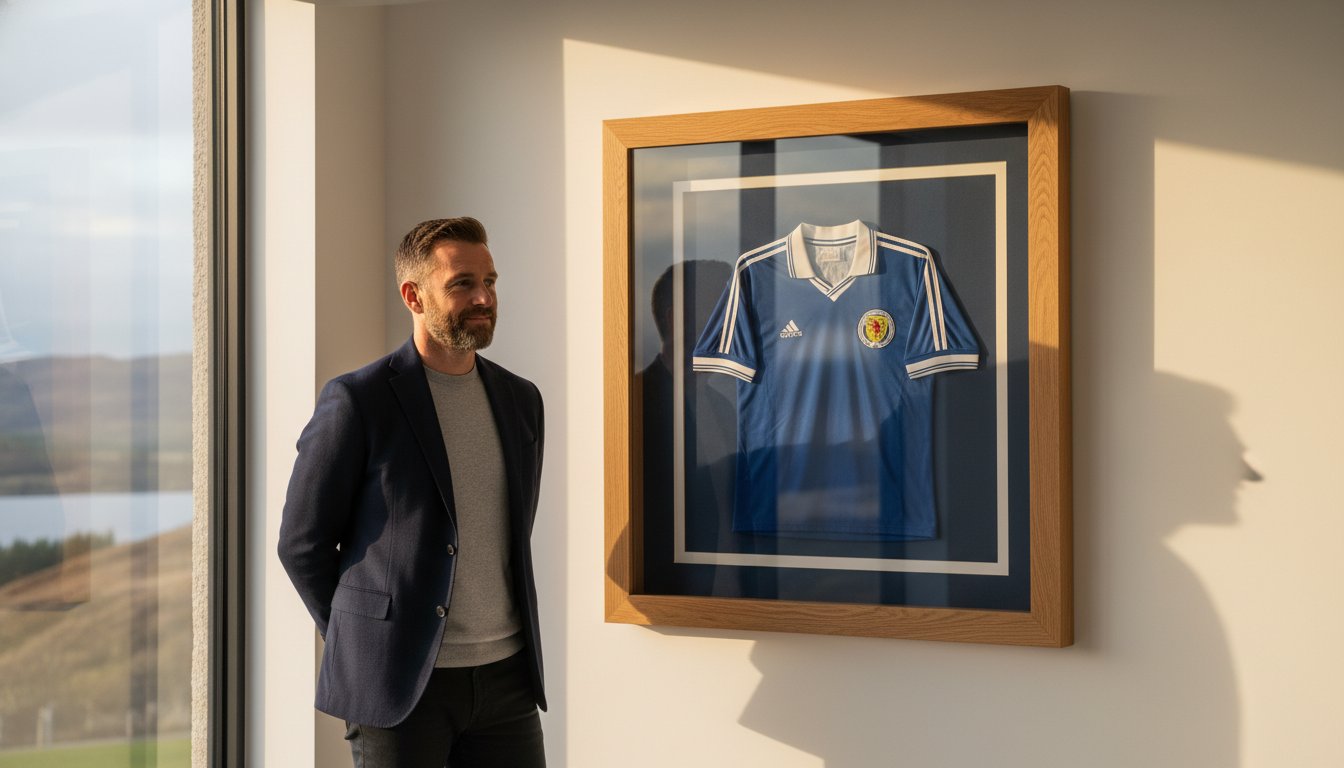
The foundation of any quality display is a deep-seated box frame. This creates a crucial air gap, typically between 20mm and 40mm, between the fabric and the glazing. This space is vital. It prevents the shirt from being flattened against the glass, which can trap moisture and lead to mould growth, and it protects delicate elements like embroidered badges and vinyl player names from being crushed.

Behind the scenes, the materials we use are just as important. Every mount board we use is acid-free, with a neutral pH between 7.5 and 9.5. Standard cardboard contains a chemical called lignin, which degrades over time, releasing acids that cause the tell-tale yellow staining known as “mat burn” on fabrics and signatures. Our commitment to archival quality aligns with established preventive conservation guidelines for textiles, ensuring no harmful chemicals ever leach into your jersey’s fibres.

Crucially, our methods are 100% reversible. We will never use glue, tape, or staples on your prized possession. These shortcuts cause irreversible damage and destroy the value of a shirt. Instead, we carefully stitch the jersey onto its acid-free backboard using a fine, colour-matched cotton thread. This technique secures the shirt perfectly while ensuring it can be removed in the future in its original condition. This professional approach to football shirt framing in Glasgow allows you to tell a complete story, incorporating items like match tickets, photos, medals, or a custom-engraved plaque to capture the full context of that glorious moment.

Choosing the Right Glass for Your Display

The glazing is your shirt’s first line of defence. Sunlight is the single greatest threat to signatures and fabric colours, and choosing the right glass is non-negotiable for proper preservation.

  • Standard Float Glass: A clear, basic option suitable for items in rooms with no direct sunlight.
  • UV-Protective Artglass: This is our standard recommendation for any signed item. It blocks up to 99% of harmful ultraviolet rays, preventing the fading that can render a priceless signature invisible in just a few years.
  • Anti-Reflective Glass: For the ultimate viewing experience, this ‘invisible’ glass reduces reflections to less than 1%. It ensures that annoying glare doesn’t get in the way of admiring every detail.
  • Safety Glass (Acrylic): A shatter-resistant and lightweight alternative, perfect for high-traffic areas, commercial spaces, or a child’s bedroom.

Bespoke Mounts and Colour Matching

The mount is where artistry meets precision. We use computerised mount cutters (CMCs) to achieve flawless, crisp lines and create custom shapes that perfectly frame badges, sponsors, or sleeve patches. For a truly premium finish, a double mount adds incredible depth. By using a primary team colour for the main mount and a secondary colour for the narrow inner “reveal,” we make the shirt pop. We can even match the frame itself to the era of the shirt; a classic dark wood for a retro 1980s kit or a sleek, minimal black moulding for a modern jersey. Every detail is considered. You can see these principles in action by browsing our gallery of completed projects.

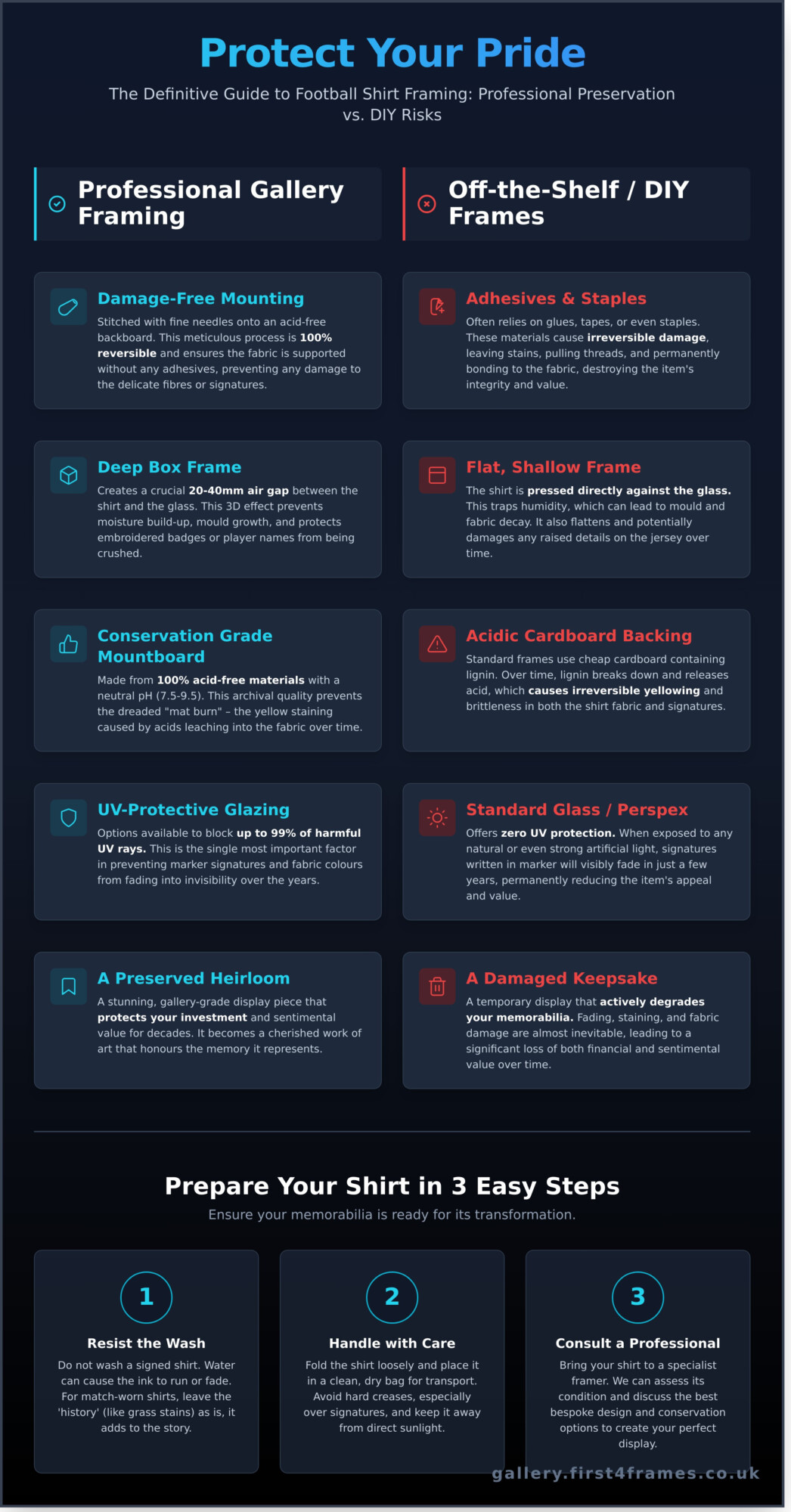
An infographic compares professional gallery framing and DIY/off-the-shelf methods for framing football shirts, listing pros and cons, preservation tips, and three easy prep steps, all on a dark blue background.

Glasgow Bespoke Framing vs. Off-the-Shelf Solutions

You’ve secured that treasured shirt, a piece of sporting history that means the world to you. The next step is displaying it. It’s tempting to search online, find a generic “shirt frame” for £40, and have it delivered tomorrow. We call this the “Amazon Trap”—a quick fix that often leads to long-term regret. An off-the-shelf frame is designed for a generic item, not your specific piece of memorabilia. It’s the difference between a tailored suit and one bought from a hanger; one is made to fit, the other forces the fit.

Your jersey is more than just fabric; it’s a story. Choosing the right frame is crucial to telling that story properly and preserving it for generations. Let’s break down why a custom solution is the only real choice for a valuable shirt.

The Problem with Standard Sizes

Football shirts are not standard. A 1990s Umbro top has a completely different cut, collar, and sleeve length than a modern, athletic-fit Castore jersey. A “one-size-fits-all” frame fails to account for this, leading to unsightly bunching around the shoulders or stretched fabric at the seams. The result is a display that looks amateurish and can even damage the shirt by putting stress on the material. With bespoke football shirt framing in Glasgow, we build the frame and mount around your specific jersey, ensuring a perfect, crease-free presentation every time.

Quality You Can Touch

When you visit our Falkirk gallery, you immediately feel the difference. Our frames are crafted from solid wood mouldings, not the flimsy plastic or compressed MDF that dominates the mass market. You can feel the reassuring weight and see the quality of the grain. This isn’t just about aesthetics; it’s about durability. Our frames won’t warp or discolour. It’s this commitment to premium materials that has earned us over 200 five-star customer reviews and makes us the preferred choice for Glasgow customers seeking true craftsmanship.

The value of speaking to an expert who understands the culture cannot be overstated. A framer who knows the significance of a Jota Champions League shirt or a classic ‘9-in-a-row’ jersey brings a level of passion and understanding to the project that an online checkout process simply can’t match. We treat your memorabilia with the reverence it deserves.

Ultimately, the choice comes down to a simple cost-benefit analysis. A cheap frame might save you £100 upfront, but it risks causing irreversible harm. Many off-the-shelf options use acidic backing boards that can yellow your shirt’s fabric within a few years. They often encourage using pins or adhesives that create permanent holes and stains. Our process, in contrast, uses acid-free, archival materials and reversible stitching techniques that align with professional conservation framing standards. This method ensures your shirt is not only beautifully displayed but also perfectly preserved. Spending more now is an investment that protects the financial and sentimental value of your shirt for a lifetime.

How to Prepare Your Shirt for Framing in 3 Steps

Transforming your treasured football shirt from a piece of memorabilia into a work of art is a journey we love to share. To ensure the final result is nothing short of spectacular, a little preparation goes a long way. Following these three simple steps will guarantee your shirt is ready for its bespoke frame, creating a perfect tribute to your sporting memories.

This process is the first chapter in your shirt’s new story. Let’s make it a great one.

Step 1: Inspect Your Shirt

Before any framing begins, take a moment to carefully inspect your shirt. Look for any small marks, grass stains, or loose threads. A match-worn shirt tells a story through its imperfections, and we can preserve that authenticity. However, if there’s a particular mark you’d prefer to hide within a fold, it’s crucial to identify it now. Check for the integrity of any signatures; if they are faded, we can use specialist UV-protective glass to prevent further deterioration. A quick 5-minute check ensures there are no surprises and that we display your shirt exactly as you envision it.

Step 2: Decide on Your Display Style

How do you want your shirt to look on the wall? This is where your personal taste comes to life. The two primary styles we offer provide very different aesthetics:

  • The Flat Lay: This classic approach involves pressing the shirt and laying it flat against the mount board. It offers a clean, graphic look that is perfect for displaying the full shirt, including the sleeves. It’s an excellent choice for shirts with multiple signatures across the front and back.
  • The 3D Form: For a more dynamic and lifelike presentation, we can mount the shirt on a custom-shaped form. This gives the jersey depth and body, making it appear as if it’s being worn. This style is incredibly effective for showcasing the player’s name and number on the back, giving it a powerful presence.

You also need to decide which side to feature. Do you want to showcase the iconic sponsor from a 1990s Celtic top, or is it the legendary “Gascoigne 8” on the back of a Rangers shirt that holds the magic? For those with a special pair of shirts, like a home and away top from a title-winning season, we can create stunning multi-shirt displays that tell an even bigger story.

Step 3: Gather Your Supporting Cast

A shirt is the star, but other items can complete the narrative. Think about what else tells the story of that specific match or season. Did you keep the ticket stub from the final? Do you have a photo of you or a family member at the game? Medals, programmes, or even a player’s signature on a separate card can be incorporated into the frame design.

Gathering these items beforehand allows us to design a truly bespoke layout. For clients seeking premier football shirt framing glasgow, bringing these extra elements to our Falkirk gallery allows our craftsmen to create a comprehensive and deeply personal piece of sporting history.

Finalizing the Details and Getting Here

The final touches are what elevate a framed shirt into a personal monument. Consider the text for a small, elegant plaque. We can include key details like the match, date, and final score (e.g., “Scottish Cup Final, Hampden Park, 25th May 2019”). Before you visit, it’s a great idea to measure your intended wall space. Use a tape measure to check the height and width available; this helps us recommend the perfect frame size for your room.

When you’re ready, transport your shirt safely. Fold it neatly and place it in a clean, dry bag. The journey from Glasgow to our Grahams Road gallery in Falkirk is straightforward, and taking this small step ensures your shirt arrives in perfect condition. Ready to start the process? Book your no-obligation consultation today and let’s preserve your legacy.

Choosing the right framer for your cherished football shirt is about more than just finding a service; it’s about entrusting a piece of your history to a true artisan. At First4Frames, we’ve spent over two decades earning the trust of art collectors and sports fans alike. Our unique identity as both a fine art gallery and a bespoke framing workshop gives us a perspective you won’t find anywhere else, blending artistic vision with technical precision.

Based in Falkirk, just a short and simple drive from the city centre, we offer a hassle-free experience for Glasgow residents seeking exceptional quality. We are proud to be a genuine “one-stop-shop” for all your wall art needs. This means you can browse our gallery for inspiration, get expert advice on conservation, and commission a completely bespoke frame, all under one roof. We make professional framing accessible and straightforward.

A Legacy of Excellence

Our roots are deeply embedded in the world of fine art. For over 20 years, we’ve collaborated with some of Scotland’s most celebrated artists, framing their work for major exhibitions and private collections. This experience isn’t separate from our memorabilia framing; it defines it. We apply the same museum-grade conservation principles to every project. This includes using acid-free mount boards to prevent discolouration and offering 99% UV-protective glass to stop signatures and colours from fading. We treat your shirt with the same care and reverence we would a Jack Vettriano original, because to you, it’s just as priceless.

This commitment to archival quality is matched by our reputation for a speedy, bespoke service. We understand you’re excited to see your memorabilia displayed, so we’ve perfected our process to deliver stunning results without unnecessary delays. Every frame is hand-built in our Falkirk workshop, tailored to your exact specifications, ensuring a perfect fit and a flawless finish for your prized jersey.

This unique blend of artistic sensibility and technical skill is what makes our approach to football shirt framing glasgow residents trust. We don’t just put your shirt in a box. We create a display that protects its value, enhances its visual impact, and serves as a timeless tribute to your sporting passion.

Start Your Framing Journey Today

The best way to appreciate the quality of our craftsmanship is to see it for yourself. We invite you to take the short drive from Glasgow to our Falkirk gallery. It’s a world away from a generic high-street framer. Here, you can feel the weight of our hundreds of premium mouldings, from classic hardwoods to sleek, modern profiles. You can see the difference between standard glazing and our anti-reflective museum glass, and discuss your vision with our expert team who live and breathe art and framing.

We’ll guide you through the exciting options to make your piece truly unique:

  • Choosing the perfect mount colours to complement your team’s crest.
  • Adding inset photos or ticket stubs to tell a richer story.
  • Designing a custom engraved plaque to immortalise the match or season.

Ready to get started? Getting a bespoke quote is simple. Bring your shirt to the gallery, or contact us with your ideas, and we’ll provide a detailed, no-obligation estimate. Let us help you transform your treasured jersey into a spectacular centrepiece.

For inspiration and to see examples of our work, please explore our online gallery.

View our Memorabilia Framing Gallery

Give Your Sporting Legacy the Display It Deserves

Your football shirt is more than just fabric; it’s a collection of memories and a piece of sporting history. Choosing a bespoke, gallery-grade frame is an investment in preserving the colour, signature, and story of your shirt for decades. It’s the definitive step up from a standard, off-the-shelf solution that simply can’t offer the same level of protection or aesthetic quality.

At First4Frames, we bring over 20 years of expert craftsmanship to every project. Our passion for memorabilia preservation has made us the trusted choice for professional football shirt framing glasgow residents rely on, a fact backed by our excellent customer ratings. We are specialists in ensuring your prized jersey is protected from UV damage and presented perfectly.

Ready to transform your shirt from the back of the wardrobe into a stunning centrepiece for your home or office? Get a Bespoke Quote for Your Football Shirt Framing and let’s create something spectacular together.

Frequently Asked Questions

How much does it cost to frame a football shirt in Glasgow?

Our professional football shirt framing service starts at £120. The final price depends on your specific choices, including the frame style, mount colours, and type of glazing selected. Adding extras like custom plaques or photographs will also affect the cost. We provide a clear, no-obligation quote for every bespoke project, ensuring there are no surprises. This investment guarantees your treasured shirt is preserved with premium, conservation-grade materials for decades to come.

Will framing damage my signed football shirt?

No, our conservation framing methods are designed to protect your shirt, not harm it. We never use damaging glues, tapes, or staples. Instead, we use a specialised, reversible stitching technique onto an acid-free backboard. This process is completely safe for the fabric and any signatures. It ensures your shirt is held securely without causing any stress or permanent alteration, preserving its condition and value for the future.

How long does the bespoke framing process take?

The entire bespoke framing process typically takes between 10 and 14 working days from the moment you drop off your shirt. This timeframe allows our skilled craftsmen to give your memorabilia the meticulous attention it deserves. During peak periods, such as after a major tournament or cup final, this may be slightly longer. We will always give you a precise completion date when you place your order with us.

Can you frame other sports items like rugby shirts or medals?

Yes, we can frame a wide variety of sporting memorabilia. While football shirts are a speciality, our team has over 20 years of experience framing rugby jerseys, cricket bats, marathon medals, running vests, boxing gloves, and more. Our 3D box frames are perfect for displaying bulkier items. If you have a unique piece of sporting history you want to preserve, bring it in and we’ll design the perfect display solution for it.

Do you offer UV-protective glass for sports frames?

Absolutely. We highly recommend upgrading to our 99% UV-protective conservation glass for any signed or valuable memorabilia. This premium glazing is essential for preventing the fading of signatures and fabric colours caused by prolonged exposure to natural and artificial light. It acts as a vital shield, ensuring your shirt’s vibrant colours and the player’s autograph remain sharp and clear for years, protecting your investment.

Is it better to show the front or the back of the football shirt?

The best way to display your shirt depends entirely on its key features and your personal preference. If the shirt has a prominent signature on the front, we recommend showing that side. However, if it’s a classic shirt famous for the player’s name and number, displaying the back creates a spectacular visual. We can discuss the options with you to help create the most impactful and meaningful display for your specific shirt.

Can I include photos and a plaque in my football shirt frame?

Yes, adding photos and a custom plaque is a fantastic way to elevate your display and tell a richer story. We can incorporate match day tickets, certificates of authenticity, or your favourite photos alongside the shirt. We also offer custom-engraved metal plaques to detail a specific match, player achievement, or a personal message. These bespoke elements transform your framed shirt into a truly unique piece of personal history.

Where is your gallery located for Glasgow customers?

Our workshop and gallery are conveniently located in the Finnieston area of Glasgow, making it easy for you to drop off your shirt and discuss your framing options in person. We invite you to visit us to see examples of our craftsmanship and browse our extensive range of frame and mount choices. It’s the perfect place to get inspired for your own **football shirt framing in Glasgow** and see the quality we deliver first-hand.

Posted on

How to Protect Art From Sun Damage: An Expert Guide

How to Protect Art From Sun Damage: An Expert Guide

That beautiful shaft of sunlight streaming into your living room brings life and warmth to your space. But for the cherished artwork on your walls, it can be a silent, slow-motion threat. Do you ever worry that your favourite pieces are losing their vibrancy, or feel you must choose between a bright, airy home and the preservation of your art? It’s a common dilemma for art lovers, but the solution is simpler and more elegant than you might imagine.

Thankfully, understanding how to protect art from sun damage doesn’t mean sacrificing your light-filled rooms. In this expert guide, we will walk you through the essential techniques to keep your collection safe. From the secrets of strategic placement to demystifying the world of UV-protective glass and bespoke framing, we’ll provide clear, actionable steps. You will gain the confidence to display your art beautifully and the knowledge to ensure its colours remain rich and true for a lifetime, safeguarding the pieces you love.

Why Sunlight is Art’s Greatest Enemy: Understanding the Damage

That beautiful stream of sunlight pouring into your room may feel warm and inviting, but for your cherished artwork, it’s a silent and persistent threat. The primary culprit is invisible to the human eye: ultraviolet (UV) radiation. This high-energy light is the single greatest cause of irreversible damage to art. The harm is cumulative, building up slowly over time until one day you notice that the vibrant colours you fell in love with have become a pale, faded memory. Understanding this process is the first step in learning how to protect art from sun damage effectively.

To see how different solutions can mitigate this damage, this video offers a helpful visual guide:

The Science of Fading: How UV Rays Break Down Pigments

Think of UV rays as tiny, energetic bullets that constantly bombard your artwork. When they strike the surface, they trigger chemical reactions that break down the molecular bonds in the pigments and dyes. This process, known as photodegradation, is what causes colours to fade. Certain pigments are more fragile than others; vibrant reds, yellows, and purples often fade much faster than earthy tones like browns and blues. Even our premium Giclée prints, which use archival-quality inks for longevity, are not immune and require proper protection to preserve their spectacular detail.

Beyond Fading: Heat and Visible Light Damage

UV radiation isn’t the only danger lurking in sunlight. The heat from direct sun causes materials to expand and contract, a cycle that puts immense physical stress on your art. Over time, this can lead to oil paint cracking, canvases sagging, and paper or photographs becoming warped and distorted. Furthermore, even intense visible light contributes to the decay, causing paper and mounting boards to yellow and become brittle. Managing these environmental factors is a core part of the preventive conservation techniques used by museum professionals to ensure a piece’s longevity.

Which Art is Most at Risk?

While all art is vulnerable to sunlight, some types are far more susceptible than others. It is crucial to know where your collection stands to provide the right level of care.

  • Highly Susceptible: Watercolours, photographs, and any works on paper are at the top of the list. Paper is absorbent and its fibres are easily broken down, leading to rapid fading and brittleness.
  • Textiles and Fabrics: Tapestries, quilts, and other fabric-based art can fade and their fibres can weaken and disintegrate very quickly when exposed to direct light.
  • More Robust (But Still Vulnerable): Oil and acrylic paintings are generally more resilient, as the pigments are suspended in a protective binder. However, they are still prone to cracking from heat and their colours will inevitably fade over many years of exposure.

Strategic Placement: Your First and Easiest Line of Defence

Before you even think about specialist glazing or frames, the most powerful tool in your art protection arsenal is completely free: the layout of your room. When learning how to protect art from sun damage, controlling the environment where your art lives is the foundational first step. A little planning when you first hang a piece can prevent a lifetime of irreversible fading and damage. It’s about working with your home, not against it.

Mapping the Sun in Your Home

Take a day to become a light cartographer in your own home. Observe which walls receive direct sunlight and, crucially, at what time of day. In the UK, north-facing walls are your safest bet, as they receive the least direct, most consistent light. Conversely, south-facing walls bear the brunt of the sun’s intensity, especially during midday, and require the most careful consideration for any valuable artwork.

The Best and Worst Walls for Hanging Art

With your new sun map in hand, choosing the right spot becomes much simpler. The goal is to minimise direct UV exposure as much as possible. Follow these key principles:

  • The Golden Rule: Never hang important or delicate art, like watercolours or photographs, in a location that receives prolonged, direct sunlight.
  • Avoid Direct Opposition: Walls directly opposite large, south-facing windows are high-risk zones. They receive both direct and intense reflected light.
  • Beware of Reflections: Be mindful of light bouncing off shiny surfaces. A polished wooden floor, a glass coffee table, or a mirror can redirect harmful rays onto a seemingly safe wall.

Using Window Treatments to Your Advantage

Your windows are the gateways for UV rays, but they don’t have to be an open invitation for damage. Simple, elegant solutions can make a spectacular difference. During peak sunlight hours, drawing curtains or lowering blinds is a highly effective tactic. For a more permanent and invisible solution, you can install professional window films that block UV rays, often rejecting up to 99% of them without obscuring your view. Even a simple set of sheer curtains can work wonders, diffusing harsh light and significantly reducing its damaging impact.

The Protective Power of a Professional Frame

While strategic placement and window films offer a great first line of defence, the single most effective, long-term solution for protecting your art is professional conservation framing. A beautiful bespoke frame is far more than a decorative border; it is a precisely engineered conservation tool designed to create a safe, stable environment for your treasured piece. This is the ultimate answer to how to protect art from sun damage, safeguarding it from multiple environmental threats for decades to come.

Choosing the Right Glazing: A Shield Against UV Rays

The glass or acrylic (glazing) is your artwork’s primary shield against light. Standard picture glass offers minimal protection, blocking less than half of damaging UV rays. To truly protect your art, you need specialist glazing. Invisible UV radiation is the main culprit behind fading, breaking down the chemical bonds in pigments. You can learn more about the science of how UV rays cause fading from university research, but the solution lies in choosing the right material:

  • Conservation Clear Glass/Acrylic: This is the industry standard for preservation. It is specially coated to block up to 99% of harmful UV rays, dramatically slowing down the fading process.
  • Museum Glass/Acrylic: The premium choice for both protection and viewing. It offers the same 99% UV protection but includes an advanced anti-reflective coating, making the glazing virtually invisible for breathtaking clarity.

The Importance of Archival Mounts and Backing

Light isn’t the only enemy. The materials touching your artwork are just as critical. Standard mount boards contain acidic compounds that, over time, can leach into the paper, causing irreversible yellowing and brown marks-a phenomenon known as ‘mat burn’. We only use premium, acid-free archival mount boards (made from pure rag mat or alpha-cellulose) that will never discolour or damage your art.

Furthermore, a professional frame is sealed with a sturdy, archival backing board. This creates a robust barrier against dust, moisture, pollutants, and even insects, ensuring the artwork remains pristine from all sides.

How a Bespoke Frame Provides a Complete Seal

An off-the-shelf frame rarely provides the perfect fit, leaving small gaps that allow dust and humidity to creep in. A bespoke frame is crafted to the exact dimensions of your artwork, ensuring a complete and secure seal. This creates a stable micro-environment, buffering your art from the damaging effects of fluctuating humidity that can cause paper to warp or ripple. It’s this complete, 360-degree approach that provides true, lasting protection.

Let our experts create the perfect protective home for your art. Explore Bespoke Framing.

Infographic titled The Art Lover’s Guide to Sun Protection explains how UV, heat, and visible light harm artwork, shares a vulnerability spectrum, and offers a 3-step strategy on how to protect art from sun damage: protective glazing, window treatments, and framing.

Long-Term Care for Your Art Collection

Protecting your beautiful art doesn’t stop once it’s perfectly hung on the wall. The journey of preserving its vibrancy and value is an ongoing one, built on simple, consistent habits. By understanding how to protect art from sun damage and other environmental factors inside your home, you can safeguard your entire collection-from professionally framed prints to unframed canvases-ensuring they remain a source of joy for years to come.

The Hidden Danger of Artificial Lighting

While direct sunlight is the most obvious threat, it’s a common misconception that your art is completely safe indoors. All light sources contribute to gradual fading over time. To minimise this risk, choose your lighting with care.

  • Embrace LED Bulbs: Modern LEDs are the best choice for illuminating art. They emit negligible UV radiation and very little heat, which helps preserve the delicate pigments in your favourite pieces.
  • Avoid Direct Halogen Spotlights: Older halogen and incandescent bulbs produce significant heat and UV rays, which can accelerate fading and cause lasting damage. Never aim a powerful, hot spotlight directly at your artwork.

Maintaining a Stable Environment

Fine art, much like any object of premium craftsmanship, thrives in stability. Drastic fluctuations in temperature and humidity cause materials like paper, canvas, and wood to expand and contract. This can lead to warping, cracking, or even mould. To create a safe haven for your art, avoid hanging it in areas with extreme environmental shifts, such as:

  • Directly above radiators or near fireplaces.
  • In the direct path of an air conditioning or heating vent.
  • In rooms prone to high humidity, like bathrooms or damp conservatories.

A consistent, moderate environment is crucial for long-term preservation.

The Art of Rotation: Keep Your Collection Fresh and Safe

One of the best professional tips for collectors is also one of the most enjoyable: rotate your art. Periodically swapping the pieces on your walls with those you have in storage significantly limits the cumulative light exposure for any single work. This simple practice not only preserves your most treasured pieces but also gives you a wonderful opportunity to refresh your home’s decor and fall in love with your collection all over again. It’s the perfect excuse to find a spectacular new print to add into the mix. Why not explore our gallery for fresh inspiration?

Give Your Art the Lasting Protection It Deserves

Protecting your cherished artwork from the irreversible effects of sunlight is a vital part of being a collector. As we’ve explored, from strategic placement away from direct light to mindful long-term care, every step you take makes a difference. Ultimately, understanding how to protect art from sun damage is about combining these smart daily habits with the unparalleled security and aesthetic finish of professional conservation framing.

At First4Frames Gallery, we bring over 20 years of bespoke framing experience to every piece we handle. We are passionate about our craft and believe a frame does more than just decorate-it protects. Trusted by artists and collectors across Scotland, we use premium, high-quality conservation materials to build a beautiful shield that preserves colour and detail for generations to come. Your art is an investment in joy, and it deserves to be preserved with expert care.

Your art deserves the best protection. Talk to our experts about conservation framing today.

Frequently Asked Questions About Protecting Your Art

Can sun-damaged art be repaired or restored?

Unfortunately, prevention is far better than a cure. Fading caused by UV light is irreversible, as the light has permanently altered the pigments in the ink or paint. While a professional art conservator may be able to treat issues like yellowing or brittle paper, the process is often complex and costly. The best strategy is always to protect your beautiful artwork from the very beginning to preserve its original vibrancy and integrity for years to come.

How can I tell if my artwork is already sun-damaged?

Look for tell-tale signs of UV exposure. The most obvious is fading, where colours appear washed out or less vibrant-reds and purples are often the first to go. You might also notice the paper or canvas has turned yellow or brown. In advanced cases, the material may feel brittle to the touch. A simple check is to carefully lift a corner of the art from under the frame’s lip and compare its colour to the exposed area.

Does UV-protective glass make the artwork look darker or change its colours?

This is a common concern, but rest assured, modern conservation-grade glazing is designed for optical purity. High-quality UV-protective glass is exceptionally clear and will not make your artwork look darker or alter its true colours. In fact, premium options often include anti-reflective properties, which can reduce glare and actually enhance the viewing experience, allowing the piece’s spectacular details and colours to shine through without interference from distracting reflections.

Is reflected or indirect sunlight still harmful to my art?

Yes, absolutely. UV rays are relentless and can bounce off walls, floors, and even furniture to reach your artwork. This means a piece hung on a wall opposite a bright window is still at significant risk. Understanding how to protect art from sun damage means recognising that any exposure to natural light, direct or indirect, contributes to cumulative and irreversible harm over time. Even on a cloudy day, harmful UV radiation is still present.

How much more does a frame with UV-protective glass cost?

Investing in UV-protective glazing is a wise choice for preserving your art. Typically, you can expect it to add between £20 and £60 to the cost of a standard-sized frame in the UK, depending on the size and the specific grade of protection. While it is an additional upfront cost, consider it a small price to pay for the priceless peace of mind that comes with safeguarding a valuable or sentimental piece from permanent damage.

Are LED lights completely safe for artwork?

LEDs are by far the safest lighting option for art, as they emit negligible UV radiation and very little heat compared to older incandescent or halogen bulbs. However, no light source is completely harmless. All visible light can cause fading over time, so it’s still best practice to use low-wattage LEDs, position them a sensible distance from the artwork, and only illuminate the piece when it’s being enjoyed rather than leaving lights on continuously.

Posted on

A Guide to Archival Framing Materials: Preserve Your Artwork

A Guide to Archival Framing Materials: Preserve Your Artwork

That beautiful print you’ve just bought, the family photograph you cherish, or the original artwork you invested in – they all deserve to be protected for a lifetime. But have you ever worried that over time, the vibrant colours might fade or the paper could turn a brittle yellow? It’s a common fear, especially when faced with confusing terms like ‘acid-free’ or ‘UV-filtering’. The secret to true, lasting preservation lies in understanding the immense value of professional archival framing materials. They are the essential guardians that stand between your treasured piece and the damaging effects of time.

This guide is here to give you complete confidence in protecting your art. We are passionate about craftsmanship, and we want to empower you to make the best choices. We’ll explain exactly what archival-grade components are, why they are a crucial investment for safeguarding both the sentimental and monetary value of your art, and how to discuss them knowledgeably with a professional framer. Consider this your journey to becoming an expert in preserving your own beautiful collection, ensuring each piece remains a spectacular centrepiece for generations to enjoy.

What is Archival Framing? Beyond Just a Pretty Border

Think of archival framing not just as a border for your art, but as a bespoke time capsule. Its purpose is to create a stable, protective environment that preserves your treasured piece in its original condition for generations. While an off-the-shelf frame might look the part, it often contains materials that can actively harm your artwork over time. The goal of professional archival framing is to defend against the main enemies of your art: acid, UV light, and humidity.

To see the craftsmanship involved, watch this helpful video from a professional workshop:

The Hidden Danger: Understanding Acid Burn and Fading

The most common threat comes from acid found in standard wood pulp-based paper and backing boards. Over time, this acid migrates into your artwork, causing the tell-tale yellowing and brittleness known as “acid burn.” This is why using premium acid-free matting is a cornerstone of archival framing. Similarly, UV light from the sun or even indoor lighting breaks down the pigments in ink and paint, causing irreversible fading. It’s the same process that makes a newspaper left on a windowsill turn yellow and fragile in just a few days.

Conservation vs. Museum Grade: What’s the Difference?

When selecting archival framing materials, you’ll often encounter two standards. Conservation Grade is an excellent standard designed to protect your art for many decades. It’s the perfect choice for fine art prints, original works, and limited editions. Museum Grade represents the highest possible standard of preservation, reserved for priceless, historically significant, or extremely fragile pieces. For most customers seeking beautiful, long-lasting protection for their art, Conservation Grade offers premium, reliable preservation you can trust.

The Anatomy of a Conservation Frame: A Layer-by-Layer Guide

Think of a conservation frame as a bespoke, protective house built around your artwork. Every single component, from the window to the walls, must work together to shield it from environmental harm. To achieve true longevity, all the archival framing materials used in this ‘house’ must be of the highest quality, ensuring nothing acidic or damaging ever comes into contact with your piece.

This diagram shows an ‘exploded view’ of how these essential layers come together to create a safe and beautiful home for your art.

Layer 1: The Glazing (Your UV Shield)

While standard glass offers basic physical protection, conservation-grade glazing is the true shield. We use premium acrylic or glass with a 99% UV-filtering coating, which acts like a powerful sunscreen to prevent fading and discolouration caused by harmful light. For ultimate clarity, anti-reflective options are available, making it feel like there’s almost nothing between you and the art.

Layer 2: The Matboard (The Acid-Free Spacer)

The matboard is more than just a decorative border; it’s a crucial spacer that prevents the artwork from touching the glazing, where condensation could cause damage. A standard mat is made from wood pulp containing acid and lignin, which will yellow and ‘burn’ your art over time. For true preservation, you need an acid-free and lignin-free matboard, often made from alpha-cellulose or, for the highest museum-quality standard, 100% cotton rag. Following the Library of Congress Preservation Guidelines is key to selecting materials that guarantee your art’s safety.

Layer 3: The Mounting (A Reversible Hold)

How the art is held in place is critical. The golden rule is reversibility-the artwork should be removable from its mount without any damage. Destructive methods like permanent glues, tapes, or spray mount will cause irreversible staining and tearing. We use trusted, non-invasive techniques like Japanese paper hinges with wheat starch paste, which create a strong but fully reversible bond. For photographs, archival photo corners are another excellent, completely safe option.

Layer 4: The Backing Board (The Final Defence)

The final layer of defence is the backing board. It provides structural support and seals the frame package, protecting the artwork from dust, pollutants, and humidity from the rear. Standard cardboard or MDF is highly acidic and will leach damaging chemicals into your artwork. We only use premium, rigid archival framing materials like acid-free foam core or archival corrugated board to provide a stable and chemically inert final barrier for your piece.

When to Choose Archival Framing: A Practical Decision Guide

At First 4 Frames, we are passionate about beautiful, lasting presentation. However, we also believe in a practical approach. While we champion the highest standards of preservation, the truth is that not every single item requires full, museum-level archival framing. The decision is a personal one, resting on two simple but powerful factors: monetary value and sentimental value. Think of it not as an expense, but as a wise investment in the future of your most cherished items.

To help you decide on the right level of protection, we’ve created this straightforward guide.

Essential for High-Value & Irreplaceable Items

For certain pieces, using professional archival framing materials is non-negotiable. These are items where degradation doesn’t just mean fading, but a tangible loss of financial or historical value. If your item falls into one of these categories, conservation-grade framing is the only way to safeguard its integrity and worth for the future.

  • Original Artwork: Paintings, drawings, and delicate watercolours that can be irreversibly damaged by acidic materials and UV light.
  • Limited Edition Prints & Fine Art Photography: These pieces hold their value based on their pristine condition and limited availability.
  • Historical Documents & Heirlooms: Antique letters, maps, and family documents that are, by their very nature, completely irreplaceable.

A Smart Investment for Sentimental Pieces

What is the value of a memory? Some of the most precious items we frame have little monetary worth but are emotionally priceless. For these, archival framing is an act of love-a commitment to preserving a moment, a memory, or a milestone for you and for generations to come.

  • Important Family Photos: The wedding portrait or the first photo of a newborn that you want to pass down the family line.
  • Children’s Artwork: That first perfect stick-figure family portrait you want to keep vibrant and protected forever.
  • Diplomas, Certificates & Awards: Celebrate your proudest achievements and protect them from fading and discolouration over time.

When Standard Framing Might Be Sufficient

There are times when a simple, standard frame is the perfect choice. If a piece is temporary, easily replaceable, or part of a frequently changing display, a standard frame offers a cost-effective and attractive solution without the long-term preservation features you don’t need.

  • Inexpensive, mass-produced posters or decorative prints.
  • Temporary displays for a party, event, or season.
  • Artwork in a child’s room that you expect to update every few years.

Every piece of art has its own story. If you have a special item and are unsure of the best way to protect and display it, we’re here to help. Ask our experts for framing advice.

An infographic titled The Anatomy of a Conservation Frame explains four layers—glazing, mountboard, mounting, and backing board—detailing how archival framing materials ensure superior protection for artwork compared to standard options.

A Framer’s Checklist: How to Ensure You’re Getting True Archival Quality

Stepping into a framer’s workshop should feel like a creative partnership. You are entrusting them with something precious, and a true craftsman will always be happy to discuss their process and the quality of their materials. Asking informed questions isn’t being difficult; it’s being a diligent custodian of your art. This checklist is designed to give you the confidence to discuss the specifics of archival framing materials and ensure your piece receives the beautiful, lasting protection it deserves.

Key Questions to Ask Your Framer

A professional framer will welcome your interest in their craft. To start the conversation, here are a few straightforward questions that reveal a great deal about a framer’s commitment to conservation standards:

  • Are your matboards and backing boards acid-free and lignin-free? The correct answer is a simple “yes.” Both acid and lignin break down over time, releasing chemicals that cause yellowing and embrittlement of your artwork.
  • What percentage of UV protection does your conservation glass or acrylic offer? Look for a figure of 97% or higher. Standard glass offers minimal protection from the fading effects of ultraviolet light.
  • What method will you use to mount my artwork? The preferred archival method uses hinges or photo corners made from Japanese paper and reversible wheat starch paste, allowing the art to be safely removed later.
  • Can you confirm that all tapes and adhesives used are fully archival? Standard tapes will stain and damage artwork over time. Only specialised, pH-neutral tapes should come anywhere near your piece.

Red Flags to Watch For

Just as important as the right answers are the warning signs that a framer might be cutting corners. Be cautious if you encounter any of the following:

  • Vague answers or dismissal of your questions. A passionate professional will be eager to explain why they use specific materials. Evasiveness is a major red flag.
  • Recommending dry mounting for original art. While suitable for posters, dry mounting is a permanent, heat-based adhesive process that can destroy the value of original art, limited edition prints, and photographs.
  • A lack of glazing options. If a framer only offers standard glass and doesn’t stock or discuss conservation-grade UV-protective options, they are not prioritising preservation.
  • Using the term ‘acid-neutral’ instead of ‘acid-free’. ‘Acid-neutral’ boards are often treated with chemicals to neutralise their inherent acidity, but this protection can break down. True ‘acid-free’ materials are made from pure, stable fibres like cotton from the start.

Your artwork is an investment of emotion and value. Ensuring it is framed with the correct techniques and premium archival framing materials is the final, crucial step in its journey. For inspiration and to see examples of bespoke, conservation-quality framing, we invite you to explore our online gallery.

Protect Your Passion: The Final Word on Archival Framing

Choosing a frame is about so much more than matching your décor; it’s a crucial decision for preserving the life and vibrancy of your cherished artwork. As we’ve explored, every component matters-from acid-free mount boards to UV-protective glazing-each one forming a shield against fading, discolouration, and environmental damage. Making an informed choice ensures your art tells its story for decades to come.

With over 20 years of professional framing experience, we are passionate about using only the highest quality, conservation-grade archival framing materials. Our team of specialists provides expert advice to help you make the perfect choice, ensuring your art remains as beautiful as the day you acquired it. We believe every piece deserves to be preserved with craftsmanship and care.

Ready to give your art the protection it deserves? Explore our bespoke framing service and protect your art with confidence. Let us help you create a lasting legacy for your most treasured pieces.

Frequently Asked Questions

Is archival framing significantly more expensive than standard framing?

While archival framing does represent a greater investment, the difference is often less than people imagine. You can typically expect to pay around 20-40% more than for a standard frame. For an average-sized piece, this might mean an additional £30-£70. Think of it not as a cost, but as insurance for your artwork. The premium materials and expert craftsmanship provide long-term protection against fading and damage, preserving the value and beauty of your piece for generations to come.

How long will my artwork be protected with archival framing?

When done correctly, archival framing is designed to protect your artwork for many decades, often a lifetime and beyond. The exact lifespan depends on environmental conditions, such as exposure to direct sunlight and humidity. However, the use of UV-protective glazing, acid-free mounts, and proper sealing techniques creates a stable micro-environment for the art. This robust defence significantly slows the ageing process and prevents the kind of damage seen in standard, acidic frames.

Can I just buy archival materials and frame something myself?

You can certainly purchase the individual components, but achieving a truly archival result requires skill and precision. The process involves more than just good materials; it requires careful handling of the art and a perfect seal to keep out dust, moisture, and pollutants. For a treasured or valuable piece, we always recommend a professional framer. Their expertise ensures the entire package is assembled correctly, offering the highest level of protection and a beautiful, bespoke finish for your art.

Does the wooden frame moulding itself need to be archival?

This is an excellent question. The wooden moulding itself does not typically need to be of archival quality. The crucial element is isolating the artwork from the wood, which can contain acids. This is achieved by using high-quality, acid-free mountboard and backing boards. These act as a protective barrier, ensuring that no part of the acidic wood or its finish ever comes into direct contact with your artwork, keeping it safe and secure within its beautiful housing.

Can an old, poorly framed picture be reframed using archival materials?

Absolutely! This is one of the best things you can do to preserve a piece with sentimental or monetary value. A professional framer can carefully remove the artwork from its old, damaging housing. We can then replace the acidic mount and backing with premium archival framing materials and fit UV-protective glazing. This process not only halts any ongoing damage but gives the artwork a fresh, beautifully presented new life, ready to be enjoyed for many more years.

What is the difference between ‘conservation grade’ and ‘museum grade’ materials?

Both offer fantastic protection, but there is a key difference. ‘Conservation grade’ is the standard for most high-quality framing, using purified wood pulp that is buffered to be acid-free and pH neutral. ‘Museum grade’ represents the highest possible standard, typically made from 100% cotton rag. It is naturally acid-free and is the choice for extremely valuable or historically important works. For most fine art prints and personal treasures, conservation grade provides more than enough protection.