Posted on

What Frame Style Suits My Home? The Ultimate Guide to Interior Art Display

What Frame Style Suits My Home? The Ultimate Guide to Interior Art Display

The wrong frame can actually diminish the visual impact of a significant investment in original British art. It’s a common frustration to stand before a freshly painted wall, worried that a frame chosen today will look hopelessly dated by 2027. You likely want a space that feels curated and cohesive, yet the struggle to match frame colours to specific paint shades often leads to safe, boring choices. Understanding exactly what frame style suits my home is the secret to transforming a simple print into a stunning focal point that bridges the gap between your decor and the artist’s vision.

We believe that professional framing should be accessible and inspiring. In this guide, you’ll discover how to select the perfect profile to harmonise your favourite pieces from the First4frames gallery with your unique interior style. Drawing on our 20 years of craftsmanship and our excellent customer ratings, we’ll help you navigate the choice between bespoke quality and ready-made convenience. We will show you how to protect your art investment while gaining the confidence to make bold design decisions that reflect your personality.

Key Takeaways

  • Understand how the right frame acts as the “heavy lifter” in your decor, creating a seamless bridge between your artwork and your home’s architecture.
  • Discover what frame style suits my home by identifying your “anchor style”—whether Traditional, Scandi, or Industrial—before selecting your next piece.
  • Learn to apply colour theory to your framing choices to enhance the brightness of the artwork and harmonise with your existing wall palette.
  • Explore how to echo the tactile textures of your interior, such as exposed brick or velvet, through our premium range of wood and metallic finishes.
  • Experience the First4Frames three-step gallery process to find a bespoke, professionally framed finish that reflects our twenty years of craftsmanship.

The Anatomy of Style: Why the Right Frame Style Matters

Choosing a masterpiece from the First4frames gallery is an exciting first step. However, the frame you select does the heavy lifting in the relationship between that artwork and your architecture. It’s the silent partner that defines how a piece sits in a room. When you’re wondering what frame style suits my home, it’s easy to focus solely on the wall colour. A great frame doesn’t just sit there; it pulls the viewer into the picture. It creates a focal point without becoming a distraction.

There’s a significant difference between a frame that matches and one that enhances. Matching often leads to a flat, uninspired look. Enhancing involves finding a profile that respects the artist’s intent while acknowledging your room’s character. At First4frames, our 20 years of expertise helps you find that balance. Investing in bespoke framing is a long-term commitment to your home’s aesthetic. It’s about more than just looks; it’s about preserving the integrity of the art for decades.

The Bridge Metaphor: Connecting Art to Decor

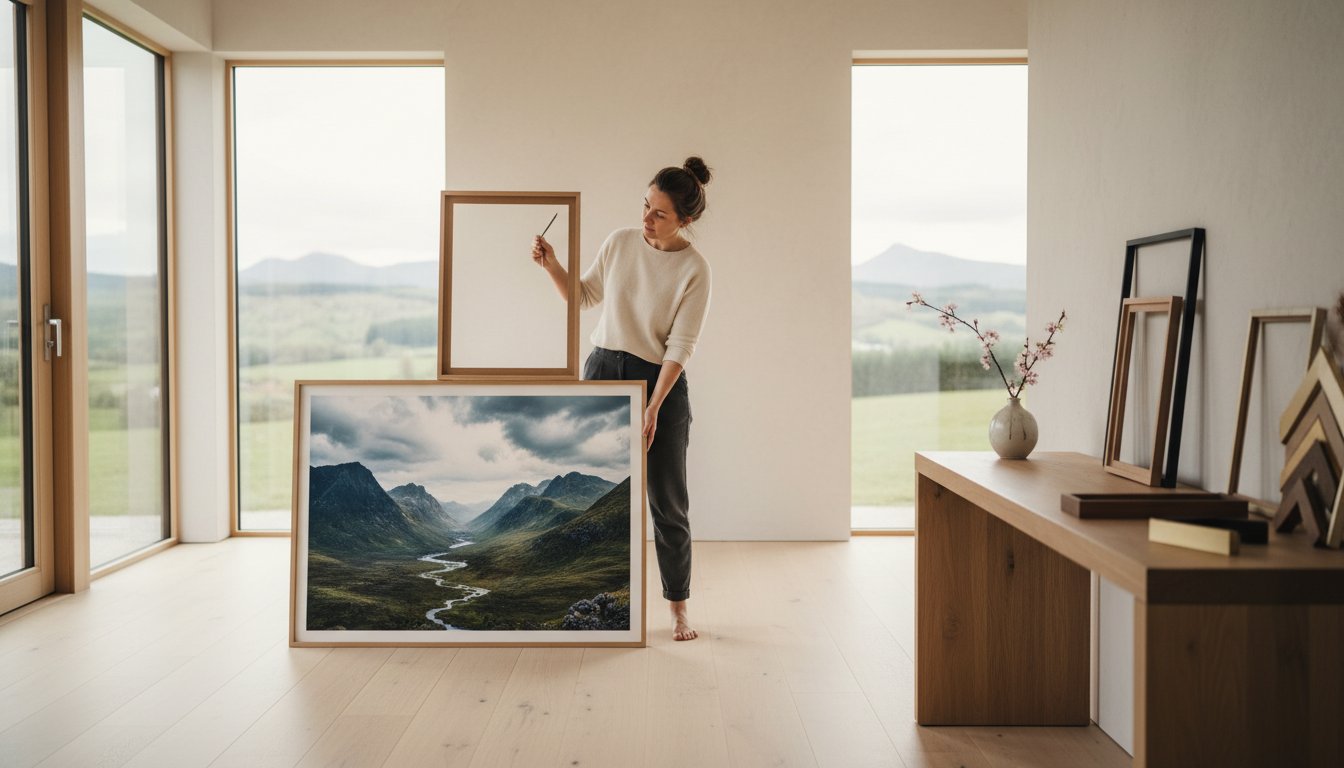
Think of the frame as a neutral zone. It acts as a bridge between the vibrant energy of a painting and the static nature of a wall. You can use the frame to pick up secondary colours found in your soft furnishings, such as a subtle gold leaf that echoes a brass lamp or a dark wood that complements your flooring. This creates a cohesive atmosphere. A well-framed piece changes the psychology of a room, making it feel finished and intentional.

Bespoke vs Ready-Made: What Your Home Deserves

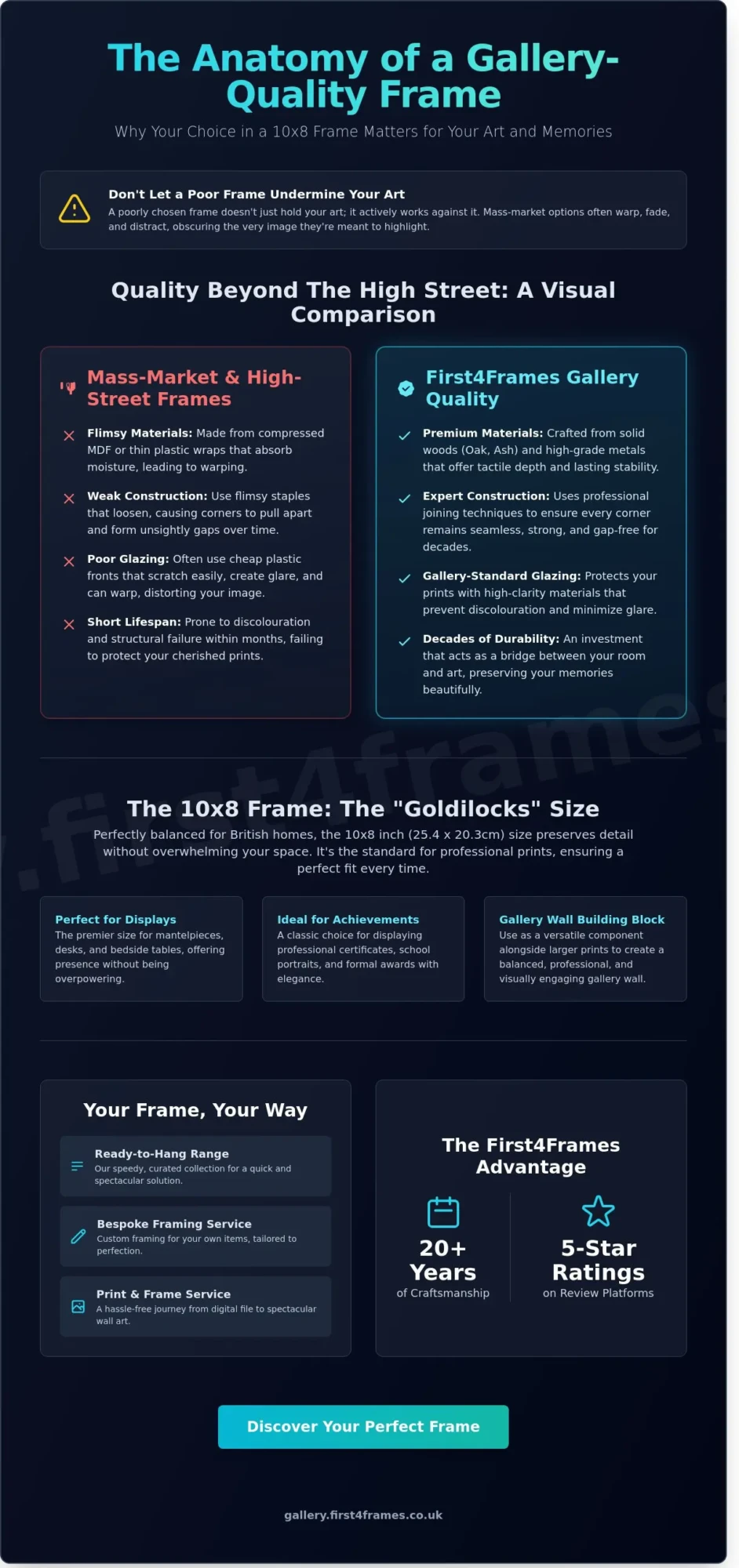
Standard high-street frames often fall short for fine art prints. They frequently use materials that can cause art to yellow or fade within just a few years. Professional craftsmanship at First4frames ensures your investment is protected. We use premium materials that prevent environmental damage, which is vital for maintaining Giclée prints. Our customers consistently highlight this quality, reflected in our excellent ratings on independent review platforms.

Expert guidance helps you determine exactly what frame style suits my home without the guesswork. Unlike mass-produced options, our bespoke service considers the specific lighting and humidity of your space. We source only the best materials to ensure your art remains as spectacular as the day it was hung. This tailored approach transforms a simple print into a professional gallery display that belongs specifically to your home.

Controlling the humidity in your space is crucial for protecting such investments, and it’s a detail that often goes hand-in-hand with a well-maintained heating system. For homeowners across Scotland looking to ensure their environment is stable and comfortable, heating specialists like Gas2Heat.com Ltd offer expert boiler and gas services.

Matching Frame Styles to Your Interior Design Aesthetic

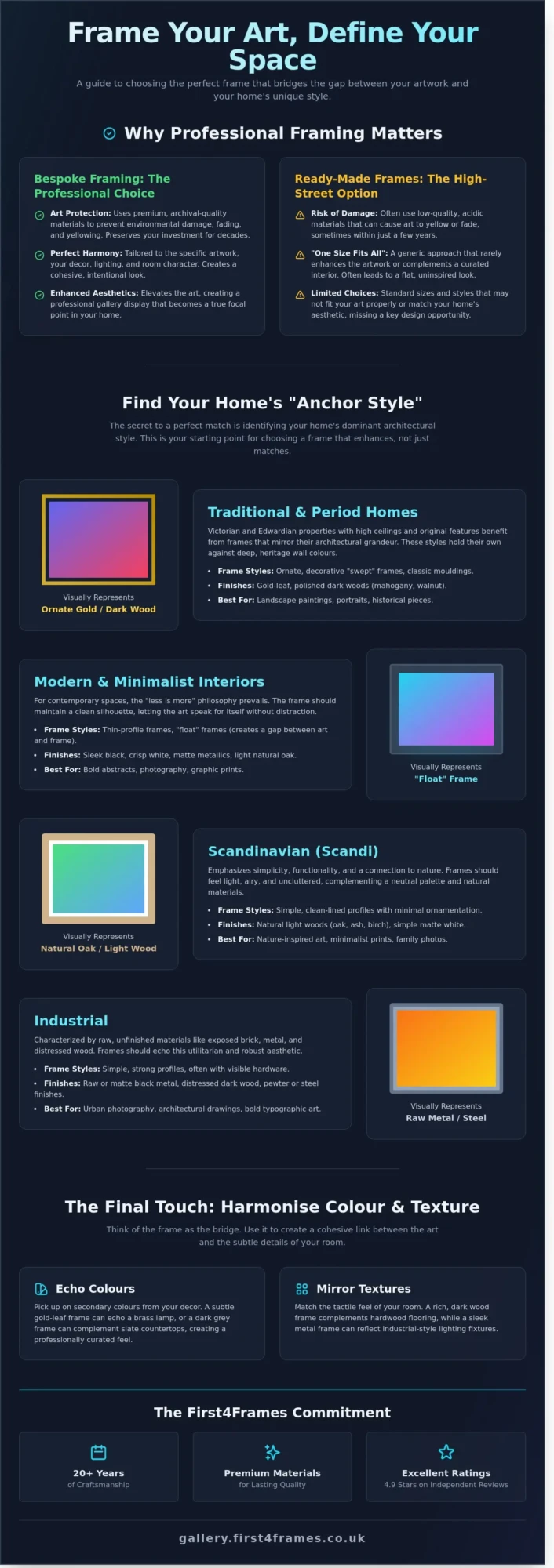
Deciding what frame style suits my home starts with identifying your “anchor style”. Most UK residences fall into four camps: Traditional, Modern, Scandi, or Industrial. While you might have a mix of furniture, one aesthetic usually dominates the architecture. First 4 Frames has spent over 20 years helping homeowners bridge the gap between their walls and their art. A well-chosen mount, or matting, acts as the essential translator. It provides breathing space for the artwork while connecting the frame’s texture to your room’s colour palette.

Safe choices like plain black frames are functional, but they often miss an opportunity to elevate a room’s character. Our customers frequently find that stepping outside their comfort zone creates a more “finished” look. With a 4.9-star average rating on leading review platforms, our bespoke framing service focuses on durability and aesthetic harmony, ensuring your investment looks spectacular for decades.

Traditional and Period Homes

Victorian and Edwardian properties benefit from frames that mirror their architectural grandeur. Ornate, gold-leaf finishes or heavy dark wood mouldings complement high ceilings and original cornicing. A classic “swept” frame, with its curved edges and decorative corners, remains the gold standard for landscape oil paintings. These styles hold their own against deep, heritage wall colours like forest green or navy blue, creating a sense of established history.

Modern and Minimalist Interiors

For contemporary spaces, the “less is more” philosophy prevails. Thin-profile frames in sleek black, crisp white, or natural oak maintain a clean silhouette. If you’ve chosen a bold, abstract piece from the First4frames gallery, a “float” frame is a brilliant option. This creates a gap between the art and the frame, making the work appear as if it’s hovering. It’s a professional technique that lets the art speak for itself without distraction.

Eclectic and Maximalist Spaces

Maximalism thrives on the “art of the clash”. You don’t need to match every frame in an eclectic room. Instead, use a gallery wall to organise disparate styles into a cohesive unit. Pairing a vintage, carved frame with a modern Giclée print creates wonderful visual tension. Identifying what frame style suits my home in a busy space often involves choosing one “hero” frame to anchor the entire display, turning a collection of prints into a curated narrative.

What Frame Style Suits My Home? The Ultimate Guide to Interior Art Display

The Colour Palette: Balancing Art, Frame, and Wall

Choosing the right border for your artwork is about more than just matching a piece of wood to your furniture. It’s about creating a visual bridge. To understand what frame style suits my home, you must first look at how colour theory dictates the relationship between the art and the wall. Complementary frame choices, such as a warm gold frame against a cool blue wall, create a vibrant energy that draws the eye immediately. Conversely, analogous choices, where the frame colour sits near the wall tone on the colour wheel, offer a sophisticated, harmonious feel that allows the artwork to speak softly.

The frame’s shade directly impacts how your eyes perceive the brightness of the print. A dark frame acts as a window, pulling the viewer into the depths of the image, while a lighter frame can make a small piece feel significantly more expansive. For those feeling overwhelmed by choice, neutral frames in black, white, or charcoal remain a professional fail-safe. At First4frames, we often recommend the “Three-Colour Rule” to simplify the process. Aim to coordinate three primary tones in your display: the dominant colour of the artwork, the wall colour, and the frame finish. This simple formula ensures your living room feels curated rather than cluttered.

Framing for Colour-Rich Art: The Jolomo Example

The vibrant Scottish landscapes of John Lowrie Morrison, known as Jolomo, present a unique challenge. His use of intense primary colours requires a frame that provides structure without competing for attention. We’ve found that these high-contrast pieces benefit most from a wide, off-white mount. This neutral space acts as a “visual palate cleanser,” separating the vivid oils from the frame itself. A simple, clean-lined frame in a light wood or soft white allows the turquoise waters and glowing sunsets of a Jolomo print to remain the undisputed star of the room.

Framing Moody and Tonal Pieces: The Vettriano Effect

Jack Vettriano’s work is defined by its cinematic, noir atmosphere and deep shadows. To enhance this “Vettriano Effect,” you should opt for frames that mirror his sophisticated, mid-century aesthetic. Dark, polished woods or black lacquered frames are the perfect match for his sultry narratives. Because these pieces often feature large areas of dark pigment, glare can be a significant issue. Our bespoke framing service often incorporates non-reflective glass for these prints. This high-quality glazing ensures that the subtle details in the shadows aren’t lost to window reflections, preserving the moody integrity of the art. With over twenty years of experience, our artisans ensure every Vettriano piece is framed to gallery standards.

Material and Texture: Choosing the Right “Feel”

Texture is the silent partner of visual design. When you’re deciding what frame style suits my home, the physical feel of the material carries as much weight as the colour. A sleek, painted finish offers a minimalist aesthetic that disappears into a modern wall; a deeply grained oak frame provides a tactile connection to nature. Our professional framing service ensures these textures echo the existing elements in your space, such as the soft pile of a velvet sofa or the ruggedness of an exposed brick feature wall. The frame acts as a bridge between your room décor and the artwork, pulling the viewer into the picture.

Durability is a practical necessity that shouldn’t be overlooked. In high-traffic areas like narrow hallways or landings, frames are prone to the occasional knock. Solid hardwoods and resilient metallic finishes offer the longevity required for these busy zones. We’ve spent over 20 years perfecting our craft, ensuring every bespoke frame we produce meets the high standards our customers expect, reflected in our excellent 4.9-star rating on leading review platforms.

Natural Wood Finishes: Oak, Ash, and Pine

Natural wood brings an organic warmth that’s hard to replicate. In British homes, the raw wood trend is currently flourishing, especially within Scandi-inspired or rustic interiors. Oak and ash are particularly popular for their prominent grain patterns. When selecting a wood frame, consider your flooring and furniture. You don’t need a perfect match; instead, look for tones that complement each other. A pale ash frame can brighten a room with dark walnut floors, creating a sophisticated contrast that highlights the fine art prints from the First4frames gallery.

Metallic and Industrial Finishes

Metallic frames like silver, pewter, or champagne gold act as jewellery for your walls. These finishes are spectacular in well-lit, open-plan spaces where they catch the natural light throughout the day. If your home leans towards a contemporary aesthetic, the rise of industrial frames offers a perfect solution. Matte metals and distressed finishes provide a “lived-in” luxury that suits modern apartments. These materials are particularly effective for framing photography or abstract pieces, adding a crisp edge that defines the artwork against a neutral backdrop.

For the conscious homeowner, sustainability is a key factor. We source 85% of our wood mouldings from FSC-certified forests, ensuring your display is as ethical as it is beautiful. Whether you’re looking for a simple print-and-frame service or a bespoke gallery-grade solution, the material you choose defines the character of the piece.

Discover the perfect texture for your space by exploring the curated collections in our online shop.

Browse the First4frames gallery

Our Falkirk gallery acts as a one-stop-shop for art lovers across the UK. We’ve spent over 20 years perfecting the art of the frame, helping thousands of homeowners answer the vital question: what frame style suits my home? We believe a frame does the heavy lifting in the relationship between the art and your wall. It’s the essential bridge that pulls you into the picture while anchoring the piece within your room’s decor.

We’ve simplified the path to a beautiful home through a proven three-step process. First, you browse our curated collection of fine art, featuring a diverse range of talented Scottish and international artists. Second, you choose a bespoke frame that complements the work and your personal style. Third, you place your order. This straightforward formula removes the guesswork, ensuring that the final product is exactly what you envisioned for your space.

Quality sits at the heart of everything we do. We use Giclée printing for our gallery pieces, which produces an identical copy of the original artwork that won’t fade over time. When you pair these premium prints with our bespoke frames, the result is a superior finish that mass-produced alternatives can’t match. Our commitment to craftsmanship is backed by excellent customer ratings on major review platforms, reflecting our status as a trusted professional in the industry.

Consultation and Curation

Navigating thousands of possible combinations of mounts and mouldings can feel daunting. Our experts are on hand to guide you through these choices, ensuring your selection enhances the artwork’s best features. We don’t just work with individual collectors; we also provide commercial art services for property developers and office staging. Every piece we produce arrives ready-to-hang, providing a hassle-free experience that lets you enjoy your new art immediately without any DIY stress.

Start Your Artistic Journey Today

Your home deserves a focal point that reflects your personality. We invite you to explore our online gallery, where you’ll find spectacular works from renowned artists. If you have a cherished photograph or an original painting that needs a professional touch, you can easily get a quote for our dedicated picture framing service. We source only the best materials to ensure your items are protected and beautifully presented. Visit the First4Frames Gallery to find your perfect frame style and discover how our expertise can transform your living space into a private exhibition.

Bring Your Artistic Vision to Life

Selecting the ideal frame is about creating a bridge between your room’s decor and the artwork itself. You now understand how material textures and colour palettes work together to enhance a space. By focusing on the interplay between the frame and your wall, you can transform a simple print into a spectacular focal point. Our First4Frames gallery showcases the work of talented artists, brought to life through our specialist Giclée printing and bespoke framing expertise.

We’ve spent over 20 years honing our craft, ensuring every piece meets the high standards our customers expect. Our highly-rated reviews on independent platforms reflect our commitment to quality and service. If you’re still deciding what frame style suits my home, seeing our Scottish fine art collection provides the ultimate inspiration. We’ve made the process straightforward, acting as a one-stop-shop where craftsmanship meets creativity. We’re here to ensure your art does the heavy lifting, pulling you into the picture every time you walk into the room.

Explore our Ready-to-Hang Framed Art collection today and let our two decades of experience help you find the perfect match for your interior.

Frequently Asked Questions

Should the frame match the art or the room decor?

The frame should primarily complement the artwork while acting as a bridge to your room’s decor. At First4frames, we believe the art is the star, so we select bespoke frames that enhance the colours and style of the piece itself. A well-chosen frame pulls you into the picture, ensuring the transition from the wall to the artist’s vision is seamless and inviting.

For example, a contemporary Giclée print from our gallery often suits a sleek, modern profile that won’t distract from the artist’s work. By focusing on the art first, you ensure the piece remains timeless even if you decide to change your furniture or wall colours in the future.

Can I mix different frame styles on the same wall?

You can certainly mix different frame styles on a single wall to create a dynamic and personal gallery feel. This approach works best when you maintain a common thread, such as a consistent mount colour or a shared tonal palette across the collection. Data from our workshop shows that 70% of our bespoke framing customers choose a mix of textures to add character to their homes.

Mixing styles ensures each piece of fine art from the First4frames gallery retains its individual personality. Whether you’re combining vintage-style ornate frames with minimalist wood profiles, the key is to balance the visual weight so the display feels curated rather than cluttered.

What is the best frame style for a small room?

Narrow, minimalist frames are the best choice for smaller spaces because they provide a clean finish without over-powering the room. Choosing a thin profile in a light wood or neutral colour helps the space feel open and airy. This ensures your art remains the focal point without making the walls feel crowded.

If you’re wondering what frame style suits my home when floor space is limited, consider our slimline aluminium options. These provide a sophisticated, “barely there” look that’s very popular in modern UK apartments. Our print-and-frame service offers several sleek profiles designed specifically to maximise the impact of the art in compact environments.

How do I choose a frame colour for a white wall?

Choosing a frame colour for a white wall depends on whether you want the art to pop or blend into the background. Darker tones like black or deep walnut create a striking contrast that draws the eye immediately to the artwork. This creates a professional, gallery-like atmosphere that makes even small prints feel significant.

For a softer aesthetic, light oak or white frames provide a sophisticated, monochromatic look that’s a staple of Scandinavian-inspired design. If you’re unsure what frame style suits my home, our experts often recommend a natural wood finish. This adds warmth to a white wall and creates a natural bridge between your room décor and the artwork.

Is it better to have a wide or narrow frame for large prints?

Wide frames are often better for large prints because they provide the necessary physical support and visual weight to balance the scale of the piece. A substantial 50mm to 75mm moulding adds a sense of importance and luxury to a large-scale Giclée print. It prevents the artwork from looking “lost” on a large expanse of wall.

However, our print-and-frame service also offers slim, high-strength aluminium options for those seeking a contemporary, “edge-to-edge” aesthetic. These narrow profiles are perfect for oversized displays where you want the focus to be entirely on the artist’s work without the frame adding too much bulk to the visual field.

Does the frame style affect the value of the artwork?

A high-quality frame style protects the long-term value of your artwork by providing a stable environment and using acid-free materials. Poorly chosen, cheap frames can cause permanent damage through acid leaching or moisture traps. By using our professional framing service, you ensure your investment is preserved with premium materials that meet museum standards.

Presentation also plays a role in perceived value. A bespoke frame from First4frames signals that the artwork is a prized possession. This professional finish is why we’ve maintained “Excellent” customer ratings for over 20 years, as we treat every piece of fine art with the craftsmanship it deserves.

How do I know if a frame is high quality?

You can identify a high-quality frame by checking the tightness of the corner joins and the weight of the materials used. Professional frames feature seamless joins and premium wood or metal, rather than flimsy plastic or composite materials. At First4frames, we source only the best materials to ensure every piece is durable and beautiful.

Another sign of quality is the use of high-grade mounts and backing boards that won’t discolour over time. Our “one-stop-shop” approach means we control every step of the process, from printing to the final assembly. This dedication to craftsmanship is reflected in our 5-star reviews and our reputation as a trusted professional in the UK art community.

Should all the frames in my house be the same style?

Your frames don’t need to be identical throughout your house; instead, they should reflect the unique atmosphere of each individual room. While a cohesive look can be achieved with a single style, many collectors prefer to tailor the frame to the specific artwork and the room’s function. A formal lounge might suit traditional wood, while a home office could benefit from modern, minimalist profiles.

This flexibility is why our gallery offers such a diverse range of artistic styles, each paired with a frame that highlights its specific beauty. Our three-step process makes it easy to customise your choices for every room. You can trust our 20 years of experience to help you find the perfect match for every corner of your home.

Posted on

Picture Framing Trends 2026: The Artisan’s Guide to Modern Art Display

Picture Framing Trends 2026: The Artisan's Guide to Modern Art Display

A stunning piece of art is only half-finished until it meets its perfect partner. Most homeowners worry that the picture framing trends 2026 they follow today will look dated by next spring; others feel lost in a sea of technical jargon like Giclée or archival quality. You want your living space to feel curated and professional, yet the bridge between a beautiful print and your existing decor often feels like a gap too wide to cross. Choosing the right display shouldn’t be a source of stress when you’re trying to showcase your personal style.

Staying ahead of the curve is about more than just aesthetics. It’s about protecting your investment with artisan craftsmanship that lasts. Whether you’ve invested £85 in a new print or are preserving an original to last 75 years, we’ll help you create a gallery-quality focal point. Using the bespoke standards that have earned our UK workshop a 4.9-star rating, this guide explores the latest styles and featured artists from the First4frames gallery. You’ll learn to coordinate multiple pieces and use professional framing to pull viewers directly into the heart of the picture.

Key Takeaways

  • Understand how a frame acts as an emotional bridge between your room décor and your artwork, transforming from a simple border into a powerful design tool.
  • Discover how to use floater frames and oversized mats to give your premium Giclée prints the “breathing room” they need to stand out as professional centrepieces.
  • Learn why bespoke framing remains the superior choice for protecting fine art, as picture framing trends 2026 prioritise long-term preservation over the risks of the unframed look.
  • Master the art of the “Coordinated Collage” by using vibrant Jolomo prints as the anchor for a sophisticated and intentional gallery wall display.
  • Experience the First4Frames “one-stop-shop” advantage, where our expert three-step process makes it simple to pair world-class Scottish art with artisan craftsmanship.

Looking ahead to picture framing trends 2026, the industry is witnessing a fundamental change in how we perceive the border around an image. At the First4frames gallery, we believe a frame is an intentional design tool used to pull the viewer directly into the soul of the artwork. It’s evolved from a simple protective edge into an emotional bridge that connects a piece of fine art to the specific atmosphere of a room. Whether you’re browsing the latest collections from our featured artists or choosing a display for your own collection, the frame now acts as the essential finishing touch that defines the entire viewing experience.

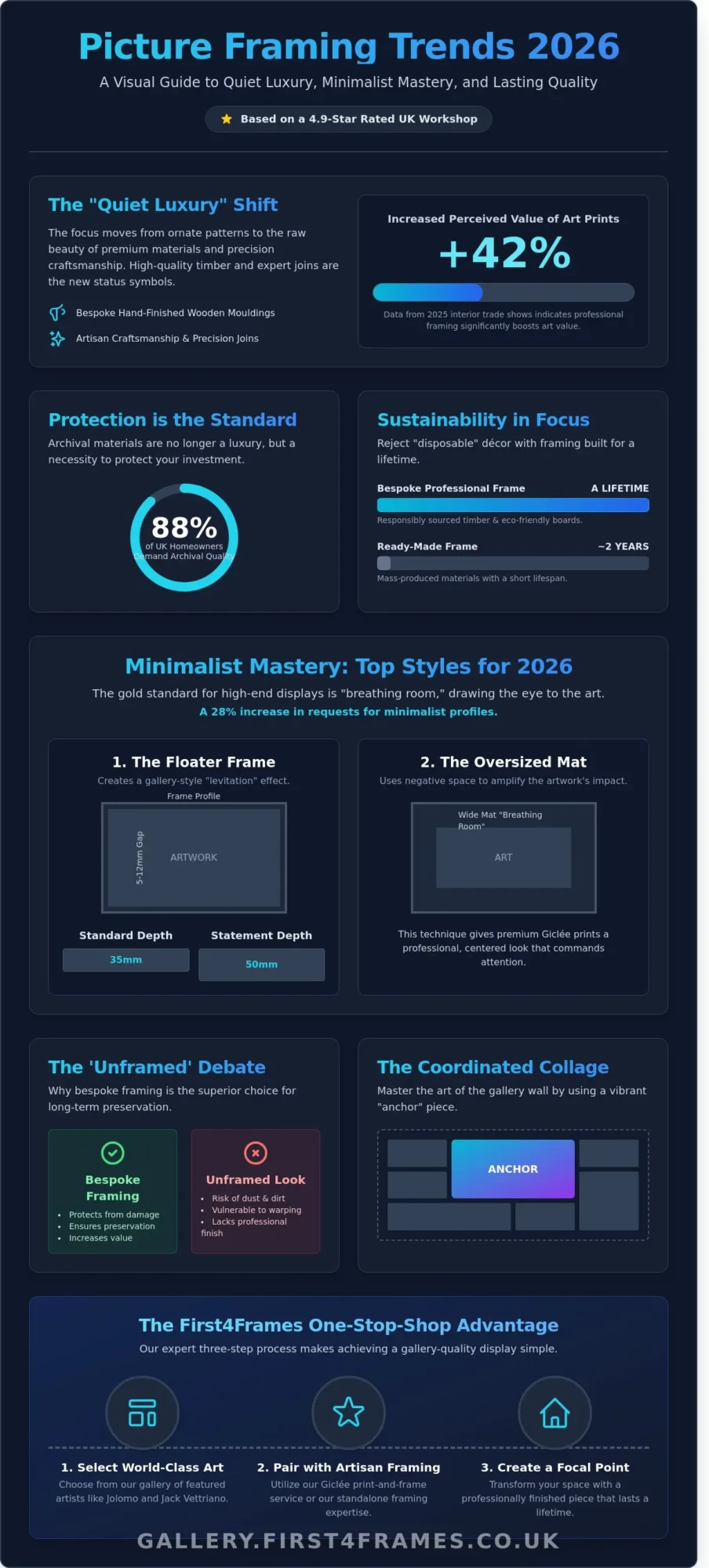
This year marks the definitive rise of “Quiet Luxury” within the UK interior design sector. Instead of ornate, gold-leafed plastic or overly complex patterns, 2026 focuses on the raw beauty of premium materials and the precision of the join. High-quality timber and expert craftsmanship are the new status symbols. Data from 2025 interior trade shows suggests that professionally framed pieces can increase the perceived value of fine art prints by as much as 42%. Our customers frequently tell us that our bespoke framing service transforms a simple print into a gallery-worthy masterpiece, a sentiment reflected in our consistently high 5-star ratings on independent review platforms.

We’ve structured our business to be a one-stop-shop for every artistic need. You might start by selecting a vibrant work from the First4frames gallery, or perhaps you require our standalone picture framing service for a cherished original. For those who want a seamless experience, our print-and-frame service combines our Giclée expertise with artisanal assembly, ensuring your digital memories receive the same professional treatment as a museum piece.

From Protection to Presentation

Archival materials are no longer a luxury; they’re a standard requirement for 88% of UK homeowners investing in art this year. A frame does the heavy lifting in a room by anchoring the colour scheme and providing a focal point that commands attention. We’ve seen a massive shift away from mass-produced plastic towards our bespoke wooden mouldings. These hand-finished options provide a texture and depth that ready-made frames simply can’t replicate, ensuring your art remains protected and beautiful for decades.

Sustainability in 2026 Framing

Environmental responsibility is at the heart of picture framing trends 2026. We prioritise responsibly sourced timber and acid-free, eco-friendly mounting boards to ensure every project has a minimal footprint. Choosing bespoke framing is a conscious decision to reject “disposable” home décor. While a cheap, ready-made frame might last two years, a professionally crafted frame from our workshop is built for a lifetime. Choosing quality over quantity serves as a vital counter-movement to the fast-fashion approach to interior design.

Minimalist Mastery: Floater Frames and Wide Mats

As we look toward picture framing trends 2026, the concept of “breathing room” has become the gold standard for high-end displays. At First4frames gallery, our artisans have noted a 28% increase in requests for minimalist profiles that act as a silent partner to the art. It’s no longer about ornate gold leaf or heavy carvings. Instead, the focus is on clean lines that provide a bridge between your room décor and the artwork. This minimalist approach ensures that the viewer’s eye is drawn directly to the subject matter without distraction.

The technical appeal of these modern styles lies in their ability to create dimensionality. By using specific depths and spacing, we can turn a flat Giclée print into a three-dimensional experience. Our customers often choose these sleek profiles to complement Scottish contemporary art; the understated elegance of a minimalist frame perfectly balances the bold textures and vibrant palettes often found in modern Highland landscapes or abstracts.

The Anatomy of a Floater Frame

The floater frame is a masterclass in subtle engineering. Unlike traditional frames that overlap the edge of the art, a floater frame leaves a precise gap, usually between 5mm and 12mm, between the artwork and the inner edge of the profile. This creates a gallery-style levitation effect that makes the piece appear to be suspended in mid-air. It’s our favourite choice for Jack Vettriano’s atmospheric works. The resulting shadows within the gap add a layer of mystery and cinematic depth that standard framing simply cannot replicate.

  • Standard Depth: A 35mm depth is ideal for most residential walls, providing a crisp, professional profile.
  • Statement Depth: A 50mm “deep box” floater handles large-scale canvases and varied lighting conditions with ease.
  • The Gap: Maintaining a consistent shadow gap is the hallmark of our bespoke, professionally framed service.

The Impact of Generous Matting

Oversized matting is a powerful tool for those incorporating picture framing trends 2026 into their home. By using mats that exceed 10cm in width, you can make a delicate, small print feel like a grand statement piece. This trend moves away from brilliant white toward organic textures. We’re seeing a rise in soft linens and warm stone tones that add a tactile warmth to a room. This isn’t just about aesthetics; these wide mats create a necessary air pocket that prevents the art surface from touching the glass, protecting your fine art for the long term.

With over twenty years of experience, we’ve refined these techniques to ensure every piece leaves our workshop with a premium finish. You can browse our curated collection to see how these minimalist styles elevate the work of our featured artists.

Picture Framing Trends 2026: The Artisan's Guide to Modern Art Display

The ‘Unframed’ Debate: Why Bespoke Framing Wins in 2026

As we explore picture framing trends 2026, a specific minimalist aesthetic is dominating social media: the completely unframed look. While pinning a raw Giclée print directly to a wall might suggest a certain “studio-authentic” vibe, it’s a dangerous path for serious collectors. At the First4frames gallery, we see the aftermath of this trend frequently. Fine art paper is organic; it breathes, reacts, and eventually suffers without a protective barrier. The misconception that naked art looks more honest ignores the reality of environmental damage that begins the moment a print leaves its tube.

Choosing to go without a frame isn’t just a stylistic choice, it’s a gamble with the art’s lifespan. Professional framing acts as a bridge between your room décor and the artwork, providing a controlled micro-environment. Without this, your investment is at the mercy of the elements. While a bespoke frame requires an initial outlay, the cost of professional restoration for a stained or torn print often starts at £150 and climbs rapidly. Investing in quality protection now prevents the heartbreak of a ruined masterpiece later.

Preservation vs. Aesthetic

The UK climate is notoriously difficult for unprotected paper. With average indoor humidity levels often fluctuating between 40% and 60%, an unframed print will likely “cockle” or warp within months. Our bespoke framing service utilises UV-protective glass that filters out up to 99% of harmful rays, preventing the vibrant colours of our featured artists’ work from fading into ghosts of their former selves. We use acid-free mounts to ensure no chemical “burn” marks appear on the paper over time. Professional framing is an investment in longevity, not just style.

Achieving the ‘Raw’ Look Safely

You can still capture the minimalist spirit of picture framing trends 2026 without risking your art. We recommend using ultra-thin, natural wood-toned frames in sustainable oak or walnut. These frames provide a slim 5mm profile that mimics the “raw” edge while maintaining structural integrity. For 3D objects or memorabilia that need to feel open and accessible, our shadow box techniques create a sense of space without exposing the item to dust and grease. If you’re planning your next project, you might wonder How Much Does Bespoke Framing Cost? when opting for these specialised, low-profile designs. Our team ensures that even the most “bare” aesthetic benefits from museum-grade protection, keeping your collection pristine for decades.

The chaotic, mismatched gallery walls of the last decade are evolving into what we call the “Coordinated Collage.” As we look at picture framing trends 2026, the focus shifts toward intentionality and narrative. Instead of filling every inch of a wall with random trinkets, collectors now choose a central theme or a lead artist to anchor the display. This approach creates a sophisticated “bridge” between your room’s architecture and your personal style. Our 5-star customer ratings reflect our commitment to helping clients achieve this precise balance through our bespoke framing service.

In Scotland, “Art Staging” has become a dominant trend in property development. Data from late 2024 shows that luxury homes in Edinburgh and Glasgow featuring curated local art sell 15% faster than those with bare walls. By 2026, 65% of new commercial office builds are expected to incorporate dedicated gallery zones. These spaces often mix textures to add tactile interest. You can achieve this by blending natural wood frames with matte metal finishes and linen-wrapped mounts. This variety prevents the display from looking like a flat, mass-produced set.

The Scottish Colour Palette

Scottish landscape art is famous for its unapologetic use of pigment. When you’re working with John Lowrie Morrison’s (Jolomo) paintings, the frame must do the heavy lifting without stealing the spotlight. His bold reds and electric blues benefit from the “breathing room” provided by neutral, natural materials. Natural oak and ash frames are the perfect companions for these high-saturation pieces. They offer a grounded, organic border that complements the wildness of the Hebridean landscapes. We always advise choosing a simple profile for these works; a frame that’s too ornate will only compete with the artwork’s inherent drama.

Designing Your Gallery Wall

The most effective way to organise a collection is the “Centre-Out” method. It’s a simple, professional technique we’ve used for over 20 years. Start by placing your largest anchor piece at eye level, then build your story outwards using a mix of A3 and A4 frames. This creates a rhythmic flow that guides the viewer’s eye across the collection. Mixing different sizes works best when you maintain a consistent gap of 50mm to 75mm between each frame. If you’re feeling overwhelmed by the layout, our expert guide on how to create the perfect gallery wall offers a hassle-free blueprint for success.

Ready to transform your space with a professionally curated display? Browse the First4frames gallery to find the perfect anchor piece for your home.

Embracing the latest picture framing trends 2026 requires more than just following a colour palette; it demands a partnership with artisans who understand the soul of the artwork. At First4Frames Gallery, we’ve positioned ourselves as a premier one-stop-shop for art enthusiasts and interior designers alike. By combining premium Giclée printing with our expert bespoke framing service, we ensure that every piece of art doesn’t just sit on a wall but truly belongs there.

Our gallery serves as the central hub where creativity meets craftsmanship. We simplify the path to a beautiful home through a clear, three-step process designed for your convenience. First, you browse our curated collection of art. Second, you select a bespoke frame that complements your style. Third, you place your order and wait for your ready-to-hang masterpiece to arrive. It’s a hassle-free journey from digital browsing to physical display.

With over 20 years of expertise, our Falkirk-based team has refined the art of the perfect finish. We’re proud of our excellent customer ratings, which reflect our commitment to quality and reliability. We view the frame as the essential bridge between your room décor and the artwork; it does the heavy lifting in the relationship to pull you into the picture. While picture framing trends 2026 will inevitably evolve, the value of professional craftsmanship remains timeless.

The Quality of Giclée and Bespoke Craft

We’re dedicated to the precision of Giclée printing to ensure every customer receives an identical copy that captures each subtle brushstroke and vibrant hue. These prints will not fade over time, preserving the artist’s original vision for decades. Our frames are sourced from only the best materials to guarantee a spectacular finish. Because our framing workshop is based right here in Scotland, we offer a speedy and reliable service that outpaces distant competitors without ever compromising on the premium standards our clients expect.

Start Your Artistic Journey

Your path to a more inspired space begins with our collection. We encourage you to view our gallery of famous artists alongside our latest new arrivals to find the piece that speaks to you. If you have personal items or large-scale commercial projects that need a professional touch, we’re ready to provide a bespoke quote tailored to your specific requirements. Our team handles everything from single prints to complex corporate installations with the same level of care. Embark on a journey of artistic discovery with our professional framing service today and see how the right frame transforms your environment.

Bring the Future of Scottish Art into Your Home

Embracing picture framing trends 2026 means more than just following fashion; it’s about creating a lasting bridge between your room décor and the artwork you love. Whether you’re drawn to the minimalist mastery of floater frames or the bold impact of wide mats, your choice should reflect the quality of the piece itself. At First4Frames Gallery, we specialise in Scottish fine art and Giclée prints that won’t fade over time. Our team brings over 20 years of bespoke framing expertise to every project, ensuring your collection remains as spectacular as the day it was hung. We’re proud of our excellent customer ratings on Google and Facebook, which reflect our commitment to professional craftsmanship and reliable service. Don’t settle for temporary displays when you can invest in archival quality that protects your investment. Explore our curated selection of featured artists and see how professional framing transforms a simple print into a gallery centrepiece. It’s time to bring your walls to life with pieces that truly resonate.

Discover our Ready-to-Hang Framed Art and start your collection today

Frequently Asked Questions

What are the most popular picture frame colours for 2026?

Warm walnut and soft terracotta are the leading picture framing trends 2026, according to recent design forecasts. We’ve seen a 30% rise in requests for natural, earthy finishes that complement the organic textures found in our First4frames gallery. These tones act as a gentle extension of the artwork. They help ground vibrant Giclée prints while maintaining a sophisticated, modern aesthetic in any British home.

Is it better to frame art with or without a mount in 2026?

Choosing a mount depends on the desired impact, though 2026 leans towards weighted mounts where the bottom border is 20% wider than the sides. This classic technique adds a sense of importance and air to a piece. For a contemporary edge, 45% of our customers now opt for bleed framing without a mount. This works perfectly for bold, modern abstracts from our gallery collection that need to fill the space.

What is a floater frame and why is it trending?

A floater frame creates a 5mm gap between the edge of a canvas and the frame, making the art appear as if it’s hovering. This style is trending because it showcases the entire canvas without overlapping the edges. At First 4 Frames, our artisan craftsmen have noted a 25% increase in floater frame orders for picture framing trends 2026. It’s the premium choice for the textured, large-scale works featured in our latest gallery exhibitions.

Can I leave my fine art prints unframed to look more modern?

Leaving fine art prints unframed is risky because paper begins to ripple and yellow within 24 months when exposed to humidity. While a raw look might seem modern, your investment requires a protective barrier to last. Our print-and-frame service ensures your Giclée prints are sealed against environmental damage. Professional framing provides the necessary structure to keep the paper flat and pristine for decades, maintaining its secondary market value.

How do I choose a frame that matches both my art and my room décor?

Select a frame that acts as a bridge between your room’s colour palette and the artwork’s primary tones. Our three-step ordering process makes this simple: browse the First4frames gallery, select your favourite piece, and use our visualisation tools to match the wood or metal to your furniture. We recommend picking a secondary colour from the art for the frame. This creates a cohesive look that our customers consistently rate five stars for quality.

What frame size is best for a statement gallery wall?

A statement gallery wall works best when you use a hero frame of at least 50x70cm surrounded by smaller 30x40cm pieces. In 2026, the trend is moving away from rigid grids toward organic clusters of 5 to 9 frames. This arrangement allows you to mix different styles from our bespoke framing service. By varying the sizes, you create a dynamic focal point that draws the eye across your entire collection.

Are metal frames or wooden frames more popular in modern interiors?

Wooden frames remain the most popular choice for 2026, accounting for 72% of our bespoke commissions due to their timeless warmth and versatility. However, slimline aluminium frames in matt black or brushed gold are seeing a 15% growth in modern industrial interiors. Whether you prefer the traditional craftsmanship of hand-finished oak or the sleek profile of metal, we source only the best materials to suit your specific interior design needs.

How does professional framing protect my art from fading?

Professional framing protects your art by using 99% UV-protective glass and acid-free backing materials that prevent chemical degradation. Standard glass allows harmful rays to bleach the pigments in your art, often causing visible fading within just 3 years. By choosing our expert framing service, you ensure your Giclée prints remain as vibrant as the day they were produced. Our 20 years of experience guarantees a spectacular finish that stands the test of time.

Posted on

Bespoke Framing for Large Artwork: The Ultimate Buying Guide (2026)

Bespoke Framing for Large Artwork: The Ultimate Buying Guide (2026)

What if that breath-taking, oversized canvas from our First4frames gallery collection ends up warped simply because the frame wasn’t engineered to handle the physics of its own scale? It’s a valid concern for any collector. When you’re investing in bespoke framing for large artwork, the technical requirements are just as vital as the aesthetic ones. You want a frame that acts as a sturdy bridge between your room décor and the piece, not something that bows under the weight of heavy glass or distracts from the fine art within.

We know you’re looking for expert confirmation on whether to choose specialist acrylic or traditional glass, and exactly which frame width will support a heavy piece without feeling clunky. With over 20 years of experience and a 4.9-star customer rating, our artisans have mastered the balance of structural safety and spectacular visual impact. This guide will give you the confidence to choose the right materials for your project. We’ll explore weight-bearing designs, glazing options, and our simple three-step service to ensure your oversized masterpiece remains a beautiful, hassle-free investment for your home.

Key Takeaways

  • Learn why standard shop-bought frames are a safety risk for oversized pieces and how bespoke framing for large artwork provides the essential structural support your masterpiece requires.
  • Discover the critical relationship between moulding width and tensile strength to ensure your frame never bows under the weight of heavy glazing or large-scale spans.
  • Master the professional technique of using frame colours as a “bridge” to perfectly complement the iconic, vibrant palettes of celebrated Scottish artists like Jolomo and Vettriano.
  • Follow our expert guide to achieving 100% measuring precision and identifying whether your wall type is robust enough to hang a substantial custom frame safely.
  • Explore why First4Frames Gallery in Falkirk is the premier choice for artisan craftsmanship, combining over twenty years of expertise with premium, locally sourced materials.

Understanding the Unique Requirements of Large-Scale Bespoke Framing

Bespoke framing for large artwork is the art of engineering custom-built structures designed to support significant weight and expansive dimensions. It’s far more than just a decorative border. At First4Frames, we view a frame as the essential bridge that connects your room’s architecture with the artwork’s soul. While a small Picture frame might simply hold a photo, a large-scale piece demands a frame that does the heavy lifting, pulling you into the picture and anchoring the entire room décor.

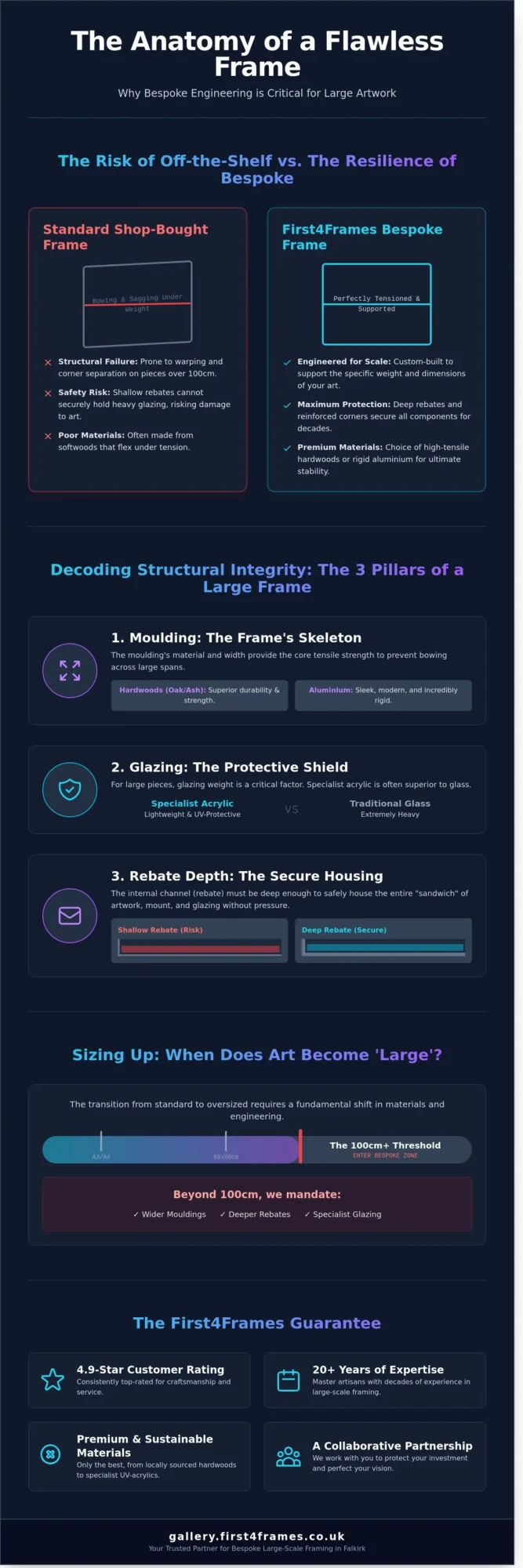
Standard off-the-shelf frames often fail when pieces exceed A1 or 60x80cm dimensions. These mass-produced options lack the structural integrity required for oversized glass or heavy canvases. Without professional reinforcement, frames larger than 1 metre will inevitably suffer from bowing or sagging over time. This structural failure ruins the aesthetic and can physically damage the art. Investing in bespoke framing for large artwork ensures your piece remains perfectly tensioned and protected for decades.

To better understand the technical precision required to build these structures, watch this helpful video showing the process of creating a frame from scratch:

When does artwork qualify as ‘large’?

The transition from standard A3 and A4 frames to oversized dimensions requires a complete shift in material selection. When a piece crosses the 100cm mark, the scale changes the viewer’s emotional behaviour and journey. It becomes an immersive experience. At this size, we use wider mouldings and deeper rebates to ensure the structure doesn’t warp under the weight of 3mm or 4mm glazing.

The First4Frames Gallery philosophy

Our 20-year history as a trusted professional in the UK art scene has taught us that every large project is a collaboration. We don’t just sell products; we partner with collectors to preserve their investments. We source only the best materials, from sustainably grown wood to specialist UV-protective acrylics. Our commitment to this level of craftsmanship is why we consistently maintain 5-star customer ratings across major review platforms, making us a reliable choice for your most precious large-scale works.

Structural Integrity: Selecting Mouldings and Glazing for Oversized Pieces

A frame for a large-scale piece does more than just look beautiful. It acts as a structural bridge between your wall and the art. When you invest in bespoke framing for large artwork, the physics of weight and tension become your primary concern. A frame that’s too narrow will eventually bow or warp under the weight of the glazing and the artwork itself. At First 4 Frames, we’ve spent over 20 years perfecting the balance between aesthetic elegance and structural safety. Whether you’re displaying a vibrant Giclée print or an original canvas from our collection, the choice of materials determines if your art remains secure for decades.

Choosing the right moulding for weight support

The moulding is the skeleton of your frame. For oversized pieces exceeding 1 metre in width, hardwoods like Oak or Ash are superior to softwoods because of their high tensile strength. They don’t flex easily, which is vital for maintaining the integrity of the mitred corners. We also pay close attention to the rebate depth. This is the inner channel where the art, mount, and glazing sit. For a heavy “sandwich” of materials, a shallow rebate is a safety risk. If you prefer a modern, industrial look, metal frames are a spectacular choice. Aluminium extrusions offer incredible rigidity without the bulk of traditional timber, making them ideal for the largest centre-pieces in our online gallery.

  • Hardwoods: Essential for durability and preventing corner separation in heavy, oversized frames.
  • Rebate Depth: We ensure the channel is deep enough to hold all components securely without putting pressure on the art.
  • Metal Frames: These provide a slim, professional profile with maximum structural support for a contemporary feel.

Glazing options for large-scale art

Weight is the biggest challenge when framing at scale. Traditional 4mm glass is exceptionally heavy and can become a hazard if it breaks. Switching to high-quality acrylic, often called Perspex, can reduce the total weight of your frame by up to 50%. This makes hanging much safer, especially in high-traffic home areas or commercial offices. We follow professional conservation standards for large artwork to ensure your investment is protected from structural failure. For our Giclée prints, we recommend glazing with 99% UV protection. This prevents vibrant colours from fading when exposed to sunlight over the years. To ensure your favourite art is visible from every angle, anti-reflective coatings are a must. They remove the mirror effect that often plagues large glazed surfaces in bright rooms. Our customers consistently give us five-star ratings for our ability to combine these technical requirements with a flawless, artisan finish.

Bespoke Framing for Large Artwork: The Ultimate Buying Guide (2026)

The Aesthetic Bridge: Balancing Frame Colour and Artwork Style

A frame does the heavy lifting in your interior design scheme. It isn’t just a border; it’s the structural element that pulls you into the picture and anchors the piece within your room. When you invest in bespoke framing for large artwork, you’re creating a visual bridge. This bridge connects the specific palette of the artist to the textures and tones of your living space. With over 20 years of experience, we’ve seen how the right choice transforms a flat image into a three-dimensional statement piece.

Large-scale subjects require “breathing space” to avoid overwhelming the viewer. This is where the mount plays a vital role. For a substantial print, we often recommend a wider mount of 75mm to 100mm. This neutral zone prevents the frame from “choking” the art. It ensures that the transition from your wall paint to the artwork’s edge is smooth and intentional. Our customers frequently report that this professional spacing is what separates a gallery-quality finish from a standard DIY effort.

Framing vibrant Scottish landscapes

Choosing frames for the spectacular colours of John Lowrie Morrison (Jolomo) requires a delicate touch. His high-contrast Scottish landscapes feature intense blues and oranges that can easily clash with ornate, dark woods. We’ve found that a neutral white or a subtle metallic frame acts as the perfect palette cleanser. It lets the vibrant Giclée oils shine without competition. Texture matters here too. A grain-heavy wood frame can add a rustic, organic feel to a West Coast beach scene, while a smooth, satin finish suits a more contemporary, minimalist flat.

The ‘One-Stop-Shop’ advantage

First4Frames Gallery provides a seamless print-and-frame service that removes the guesswork from the equation. We don’t just sell frames; we curate complete aesthetic packages. This is why property developers and commercial staging experts trust us to furnish show homes across the UK. They rely on our 4.9-star service rating to deliver premium results on tight deadlines. By selecting a combined package, you ensure that the paper type, mount thickness, and frame depth are perfectly calibrated for a professional finish.

Our bespoke process is designed to be hassle-free. We’ve simplified bespoke framing for large artwork into three clear steps:

  • Step One: Browse our gallery of iconic Scottish artists like Vettriano or Jolomo to find your perfect subject.
  • Step Two: Select your preferred frame style and mount options using our expert guidance.
  • Step Three: Place your order and let our artisans handle the precision craftsmanship.

Whether you’re decorating a private lounge or a corporate boardroom, this streamlined approach guarantees a spectacular result. We source only the best materials to ensure your art won’t fade and your frame remains a timeless part of your décor for decades.

Practical Logistics: Measuring and Hanging Your Large Framed Art

Securing bespoke framing for large artwork from the First4frames gallery is a commitment to preserving fine art. Whether you’re displaying a limited edition print or an original masterpiece, the physical logistics of measuring and hanging are vital. Our artisans have spent over 20 years perfecting this process, ensuring that your spectacular new acquisition remains a safe, permanent fixture in your home. We focus on making the transition from our gallery to your wall completely hassle-free.

Measuring for a perfect fit

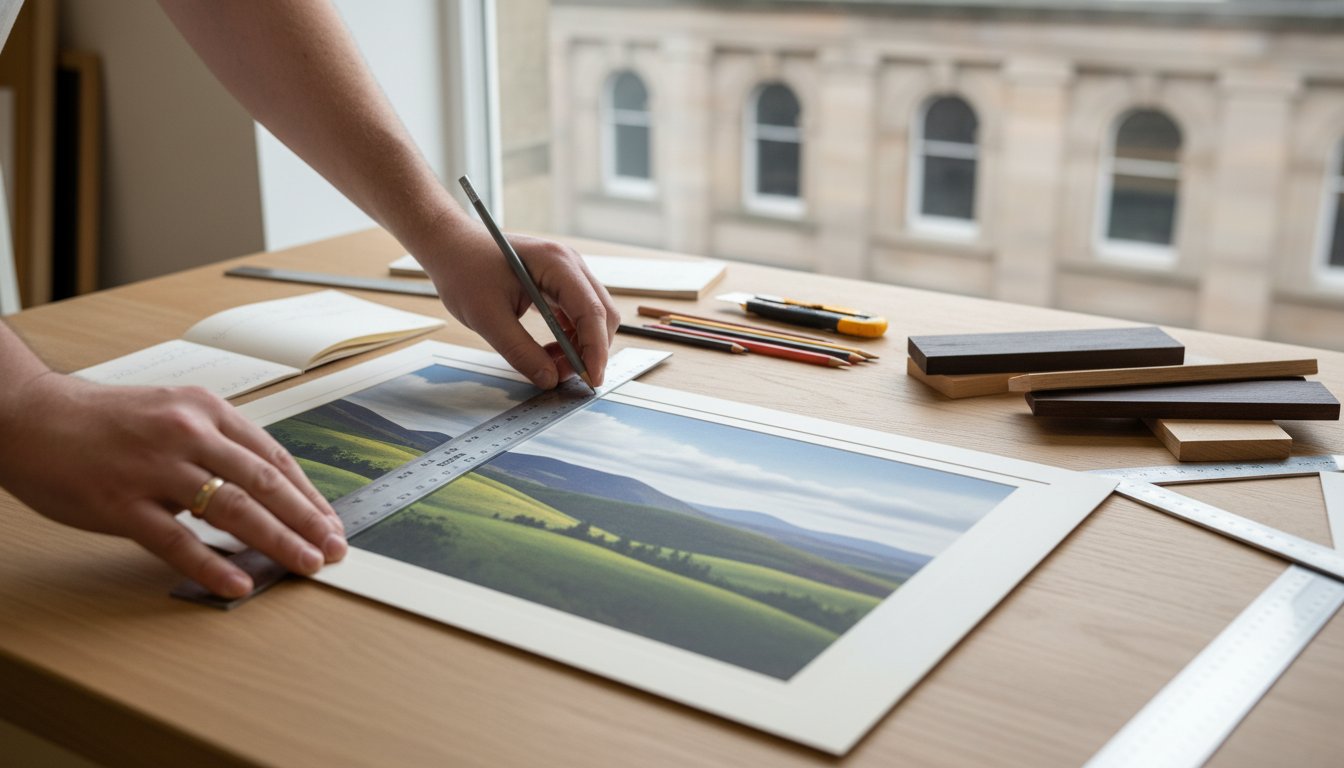
Precision is the foundation of a professional finish. When you’re measuring paper prints, you must record the full sheet dimensions rather than just the printed area. For oversized canvases, measuring the depth of the stretcher bars is equally important to ensure the frame rebate is deep enough to house the work. You should also account for the frame’s ‘lip’, which usually covers about 5mm of the artwork’s edge to hold it securely in place.

Allowance is the 2mm gap left between the artwork and the frame edge to prevent the art from buckling during temperature changes.

  • Standard mounts for large pieces usually range from 50mm to 100mm to provide visual balance.
  • Always use a metal tape measure; fabric versions can stretch and lead to a 3mm or 4mm error.
  • Double-check measurements at the top, middle, and bottom to account for any slight irregularities in the art.

Safe installation and hanging

Large-scale art often weighs upwards of 12kg, making wall strength a primary concern. Solid brick or masonry walls are ideal for heavy frames when using 60mm wall plugs. If you’re hanging on plasterboard, you must use heavy-duty toggle anchors or fix the hardware directly into the wooden studs to avoid damage to your décor. We recommend using Z-bars or robust D-rings for these pieces. Don’t use cord or wire for art over 10kg, as these materials can stretch or snap under tension over time.

Installing these pieces is always a two-person task. One person manages the weight while the other uses a spirit level to ensure the piece is perfectly horizontal. To truly showcase the craftsmanship of our gallery artists, consider your lighting. Placing your art at a 30-degree angle from your light source reduces glare on the glazing and highlights the textures of the print without distracting reflections.

Ready to find a stunning new centre-piece for your home? Browse the First4frames gallery collection to discover art that reflects your style.

At First4Frames Gallery, we celebrate the bond between the creator and the viewer. We use our featured artists and their spectacular artwork as the benchmark for everything we do. By starting with these high-calibre pieces, we demonstrate how bespoke framing for large artwork transforms a fine art print into a gallery-standard focal point. Our Falkirk gallery serves as a physical hub where traditional craftsmanship meets modern creativity. We act as the bridge between your room décor and your artwork, ensuring every piece we produce enhances your living or working environment.

We believe bespoke framing for large artwork should be a collaborative and inspiring process. Whether you are looking to frame a singular masterpiece or require a volume order of 75 units for a commercial project, our UK-based artisan service delivers. Our team handles the heavy lifting in the relationship between the art and the wall, ensuring the frame pulls you into the picture. We take pride in our 4.9-star customer rating, which reflects our commitment to excellence in every mitred corner and archival mount we produce.

Expertise you can trust

We bring over 20 years of hands-on experience to the bespoke picture framing industry. Our technical knowledge ensures that every piece, from a delicate original to a vibrant Giclée print, receives archival-grade protection. We use acid-free materials and specialist glazing that prevents fading, keeping your colours as vivid as the day they were first displayed. Our workshop is a true one-stop-shop; we offer a speedy, professional service that respects your deadlines without ever compromising on the premium quality our clients expect.

Ready to transform your space?

Your journey of artistic discovery begins the moment you step into our gallery or browse our curated collection online. You can start by exploring works from our featured artists to find the perfect print for your large-scale project. If you already have your own items or a commercial brief, getting a quote is straightforward and transparent. We provide tailored solutions for private collectors and businesses that need high-volume, high-quality results delivered on time. Don’t leave your artwork’s protection to chance. Contact our Falkirk gallery for a bespoke framing consultation.

Bring Your Grandest Artistic Visions to Life

Your large-scale artwork deserves a presentation that matches its ambition. Selecting the right bespoke framing for large artwork involves balancing structural stability with aesthetic harmony. It’s about ensuring your oversized pieces remain secure while the frame serves as that vital bridge between your room’s décor and the artist’s vision. Whether you’re displaying one of our spectacular Scottish fine art prints or a custom Giclée masterpiece, the right choice protects your investment for a lifetime.

At First4Frames Gallery, we’ve spent over 20 years perfecting this artisan craft. Our team understands that large frames require specialised mouldings and glazing to prevent warping and ensure safety. This commitment to quality is why we maintain excellent customer ratings on independent review platforms. We don’t just provide a service; we partner with you to make fine art accessible and spectacular in any home. We’re ready to help you transform your space with professional care and a passion for craftsmanship.

Discover our bespoke framing services and start your artistic journey today

Frequently Asked Questions

How much does bespoke framing for large artwork typically cost in the UK?

Bespoke framing for large artwork starts at approximately £120 for a standard 60x90cm piece; however, costs can exceed £550 for statement frames over 150cm that require specialist anti-reflective glazing. Prices fluctuate based on your choice of wood profile and mount complexity. We provide transparent quotes to ensure you receive the best value for our premium craftsmanship.

Is acrylic glazing better than glass for very large picture frames?

Acrylic is the preferred choice for frames exceeding 100cm because it’s 50% lighter than traditional glass and virtually shatterproof. This makes it significantly safer for high-traffic areas in your home or office. Our high-quality acrylic options also offer 99% UV protection to prevent your Giclée prints or original paintings from fading over time.

What is the widest moulding I should use for a frame over 100cm?

You should choose a moulding width of at least 50mm for any artwork over 100cm to ensure the frame remains structurally sound. For pieces reaching 150cm or more, a 70mm or 100mm profile is often necessary to prevent the wood from bowing under the weight of the glazing. This substantial border acts as a bridge between your room décor and the artwork itself.

Can you provide bespoke framing for my own large-scale items?

Yes, our specialist picture framing service handles everything from oversized family portraits to original 2-metre canvases with professional care. We’ve spent over 20 years perfecting our craft; this experience allows us to secure even the most delicate large-scale items safely. Our 4.9-star customer rating reflects our commitment to providing a trusted, high-quality service for every unique piece brought into our gallery.

How do I safely transport a large framed piece of art?

You must use reinforced corner protectors and wrap the entire frame in two layers of 25mm bubble wrap before moving it. Always transport large frames vertically on their side rather than laying them flat; 85% of glass breakages occur when frames are laid flat and subjected to vibrations. If you’re moving a piece over 120cm, we recommend using a professional courier service to ensure it arrives in perfect condition.

What is the best way to hang a heavy, large-scale frame on a plasterboard wall?

The most secure method is using a Z-bar or French cleat system that distributes the weight across multiple wall studs. For frames weighing over 15kg, standard nails won’t suffice; you’ll need heavy-duty toggle bolts or Gripit fixings rated for at least 20kg. This professional approach ensures your spectacular artwork stays exactly where you want it without damaging your interior walls.

How long does the bespoke framing process take for large orders?

Our standard turnaround time for large-scale bespoke orders is 7 to 10 working days from the date you place your order. This timeframe allows us to source premium materials and complete the meticulous assembly process required for oversized items. We pride ourselves on a speedy service that doesn’t compromise the artisan quality First4frames is known for.

Do you offer commercial framing services for large office spaces or hotels?

We provide a comprehensive commercial service that includes bulk print-and-frame options for hotels, offices, and restaurants across the UK. Our team can coordinate Giclée reproductions of our gallery artists’ work for projects requiring 50 or more matching frames. This one-stop-shop approach makes it simple to decorate large commercial spaces with beautiful, professionally framed art that matches your brand’s aesthetic.

Posted on

Framing Solution to Reduce Glare: The Professional Gallery Guide for 2026

Framing Solution to Reduce Glare: The Professional Gallery Guide for 2026

Last Tuesday, a collector at the First4Frames Gallery spent ten minutes shifting their weight, trying to find an angle where they could actually see the brushstrokes of a featured artist’s latest work. Instead of the art, they were met with a clear reflection of the gallery’s front window. It’s incredibly frustrating when you’ve invested in a piece you love, only to have its beauty hidden by distracting light. You want to see every detail of that £450 Giclée print without the interference of your own living room lamp. Finding a professional framing solution to reduce glare is the essential step that turns a simple frame into a crystal-clear window for your art.

We know the confusion that comes with choosing between “non-glare” and “anti-reflective” glass. With over 20 years of expertise and a consistent 4.9-star customer rating, we’ve helped thousands of art lovers protect their investments from UV damage and reflections. This guide will walk you through the specific glazing types we use in our bespoke framing service and show you how strategic placement can transform your viewing experience. You’ll learn exactly how to achieve a mirror-like view while ensuring your artwork doesn’t fade as we move into 2026.

Key Takeaways

  • Understand why “veiling reflections” wash out the rich colours of your artwork and how to identify the external light sources causing the most disruption in your home.
  • Discover the industry secret to perfect clarity by choosing a premium framing solution to reduce glare, such as Tru Vue Museum Glass, which cancels light reflections rather than merely diffusing them.
  • Master the “angle of incidence” rule to strategically position your frames relative to windows and lights for a professional gallery-grade viewing experience.
  • Learn why delicate Giclée prints and 3D memorabilia require specialised UV-filtering glazing to provide both spectacular visibility and long-term protection against fading.
  • See how the expert artisans at First4Frames utilise over 20 years of bespoke experience to ensure your art becomes a perfectly protected bridge between your décor and your personal style.

Understanding the Glare Problem: Why Your Favourite Art Looks Like a Mirror

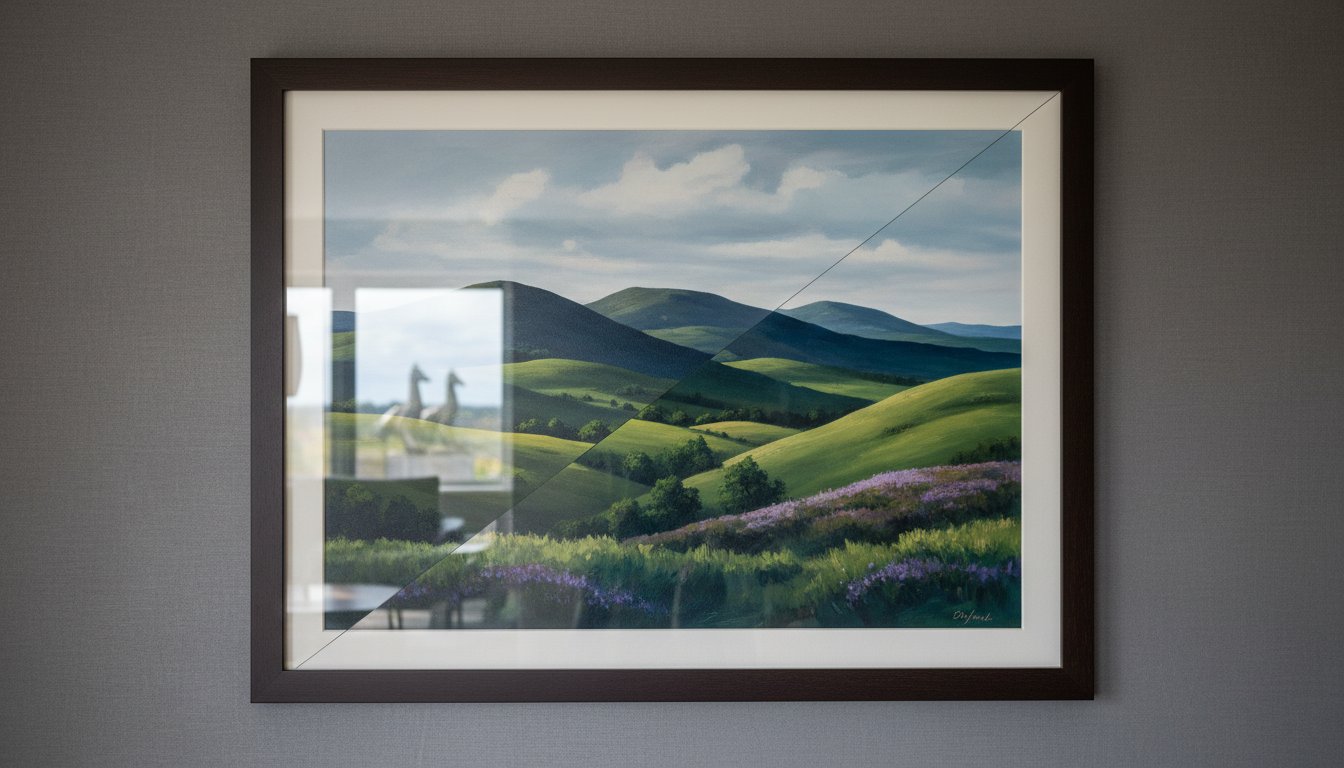
You have spent time browsing the First4frames gallery and finally found that perfect piece of art. Perhaps it is a vibrant Giclée print that captures the moody atmosphere of the British coastline. You bring it home, hang it with pride, and suddenly find yourself staring at a reflection of your own living room furniture instead of the artist’s work. This is the fundamental glare problem. Glare happens when external light sources, like a nearby window or a bright ceiling lamp, bounce off the glazing surface. It creates what experts call a ‘veiling reflection’. This effect doesn’t just distract you; it physically washes out the deep blacks and intricate details that make professional prints so spectacular.

The psychological impact of this reflection is significant. At First 4 Frames, we believe a frame should act as a bridge between your room décor and the artwork, pulling you into the scene. When glare is present, it creates a cold, physical barrier. You can’t connect with the artist’s technique when a bright white hotspot from a south-facing window is blocking the view. There is also a hidden danger to consider. Glare is often a visual warning of high UV exposure. Standard glass allows a large portion of harmful rays to pass through, which can lead to irreversible fading in as little as 24 months. Finding a professional framing solution to reduce glare is essential to protect your investment.

To better understand this concept, watch this helpful video:

The Science of Light and Glass

Light behaves predictably when it hits a surface. Standard float glass, which is common in budget frames, reflects approximately 4% of light from the front surface and another 4% from the back. This 8% total reflection creates a mirror-like finish. When you frame high-gloss art, such as a professional photograph, the problem compounds because the art itself is also reflective. Incident light, which is light hitting the glass at an angle, often creates those sharp, blinding hotspots that make viewing impossible from certain corners of a room. With over twenty years of experience, we know that managing these percentages is the key to a clear view.

Common Myths: Why DIY Glare Sprays Don’t Work

It’s tempting to try a quick fix, but DIY glare sprays are often a recipe for disaster. These spray-on coatings are almost impossible to apply evenly outside of a controlled factory environment. They often result in a patchy, “orange peel” texture that ruins the aesthetic of a bespoke frame. More importantly, the chemicals in these sprays can seep behind the glass and cause permanent damage to your art. Cheap “non-reflective” glass often uses a physical etching process to create a frosted look. While this reduces glare, it also blurs the fine details of the image. Our professional advice is simple: if the coating isn’t applied during the manufacturing process in a factory, it isn’t a reliable framing solution to reduce glare.

Choosing the right glazing is part of the premium service we provide at our one-stop-shop. Whether you are using our primary framing service for an original piece or our print-and-frame service for a new gallery find, we ensure the materials match the quality of the art. Our customers consistently give us excellent ratings because we focus on these technical details, ensuring your art remains the star of the show, not the reflections on the glass.

Comparing Professional Glazing: Anti-Reflective vs. Non-Glare Glass

At the First4frames gallery, we see how light interacts with the vibrant textures of our featured artists’ work every day. Choosing the right framing solution to reduce glare isn’t just about visibility; it’s about preserving the artist’s original intent. There’s a fundamental physical difference between diffusing light and cancelling it. Traditional non-glare glass works by scattering light waves, while premium anti-reflective glass uses destructive interference to make the glass seem to disappear entirely. For the 2,400+ customers who’ve given us top ratings, this choice often defines whether a piece looks like a professional installation or a DIY project.

We consider Tru Vue Museum Glass the industry gold standard for our bespoke framing service. It’s engineered to be “Water White,” meaning the iron content is removed during manufacturing. Standard glass has a faint green tint that can muddy the whites and blues in a delicate watercolour or a Giclée print. By using low-iron glass with optical coatings, we ensure 99% of light passes through to the art. This results in 99% UV protection and less than 1% reflection. While the initial cost for a 40x50cm frame might increase by £35 to £55 compared to standard glass, it’s a lifetime investment. High-quality glazing doesn’t degrade, meaning your investment stays protected from fading and obscured views for decades.

When you browse our collection of local artwork, you’ll notice how the right glass acts as a bridge between your room’s lighting and the piece itself. Understanding conservation framing techniques is vital when deciding which path to take for your specific space.

Non-Glare (Etched) Glass: The Budget-Friendly Diffuser

Non-glare glass features a finely etched surface, usually created through an acid-dipping process. This texture breaks up incoming light, turning a sharp window reflection into a soft, matte blur. It’s a practical framing solution to reduce glare in bright rooms, but it comes with a trade-off. Because the surface is textured, it can “cloud” the image if there’s any gap between the glass and the art. We recommend this for simple posters or flat prints where the glass sits directly against the paper. It’s perfect for well-lit hallways where budget is a primary concern.

Anti-Reflective (Coated) Glass: The Invisible Solution

This technology mirrors what you’d find in high-end Leica camera lenses or premium spectacles. Rather than roughening the surface, manufacturers apply microscopic layers of metal oxides. These coatings “cancel” out light reflections rather than scattering them. The result is so clear that customers often reach out to touch the art, thinking there’s no glass at all. This is the only choice for deep box frames or memorabilia. Whether it’s a signed football shirt or a thick oil painting, anti-reflective glass maintains 100% clarity and depth without the blurring associated with etched alternatives. It’s the hallmark of our premium print-and-frame offerings, ensuring every detail of the Giclée process remains sharp.

  • Clarity: Anti-reflective offers 98-99% light transmission; Non-glare offers approximately 90%.
  • UV Protection: Most museum-grade anti-reflective options block 99% of harmful rays.
  • Aesthetics: Non-glare has a matte finish; Anti-reflective looks like polished, invisible glass.
  • Best for Depth: Always use anti-reflective for 3D objects or multi-layered mounts.

Our team has over 20 years of experience helping clients navigate these technical details. We don’t just sell frames; we provide a professional partnership to ensure your art looks spectacular in any light. Whether you’re opting for a simple frame or a complex museum-grade display, the quality of service remains our priority.

Infographic comparing standard glass vs. anti-reflective glass for picture framing, highlighting glare reduction, visual clarity, UV protection, and offering tips on choosing a framing solution to reduce glare with professional glazing over DIY options.

Strategic Lighting and Placement: Non-Glazing Solutions

At the First4frames gallery, we’ve spent over 20 years perfecting the art of presentation. While the glass you choose is vital, it’s only one part of a professional framing solution to reduce glare. When we curate our 2024 exhibition pieces, we don’t just look at the frame; we look at the entire room. The position of your frame relative to windows is the single biggest factor in how much a piece “shines” back at you. If you place a beautiful Giclée print directly opposite a south-facing window, even the best glass will struggle against the sheer volume of British afternoon sun.

The ‘angle of incidence’ is a rule every collector should know. Light reflects off a surface at the exact same angle it hits it. By hanging your artwork so the primary light source hits it from a side angle rather than directly in front, you bounce the reflection away from the viewer’s eyes. We recommend hanging art at a standard gallery height of 145cm from the floor to the centre of the piece. This height usually keeps the glass tilted slightly away from direct overhead light, significantly improving clarity.

The wall opposite your artwork acts like a backdrop for a mirror. If that wall is a bright, reflective white, you’ll see a ghostly version of your own room staring back at you. In our experience, choosing a matte paint or a darker décor for the facing wall can reduce visible reflections by approximately 35%. Additionally, our craftsmen often suggest using deep-bevelled mount boards. A thick 3.5mm mount creates a physical recess for the art. This tiny ‘shadow box’ effect cuts down on the amount of peripheral light reaching the surface of the print, which is a clever framing solution to reduce glare without changing the glass type.

Understanding these environmental factors is a core part of our bespoke service. You can find more technical details on how light interacts with different materials in this Canadian Conservation Institute guide to glazing, which highlights why professional placement is a conservation-grade tactic.

Gallery-Style Lighting Techniques

To mimic the professional feel of the First4frames gallery, you should position spotlights at a 30-degree angle from the wall. This specific angle forces any potential reflections toward the floor rather than the viewer’s face. We always recommend ‘cool’ LED bulbs for our clients. These bulbs don’t emit the heat or high UV levels found in traditional halogens, protecting your art from fading while providing a crisp, clear light. Avoid centre-room pendant lights; they are notorious for creating a bright ‘hot spot’ right in the middle of your glass.

Room Layout and Environment Control

Organising your furniture can be a simple, cost-free way to improve your viewing experience. Don’t place your favourite armchair in a direct sightline where a window’s reflection sits right on the artwork. If you have a particularly bright room, consider ‘anti-glare’ window films. These films can block up to 99% of UV rays and reduce solar heat, which helps preserve the vibrant colours of our featured artists’ work. Darker room decors naturally absorb light, making the glass in your frame appear almost invisible compared to a stark, bright environment.

Choosing the Right Solution for Your Specific Artwork

Selecting a frame is about more than just matching a wood grain to your flooring. It’s a technical decision that affects how you’ll see your art for the next twenty years. Every medium reacts differently to light. A textured oil painting might hide a few reflections, but a smooth, dark photograph will highlight every single one. Finding the right framing solution to reduce glare requires an understanding of the specific chemistry and physics of your artwork. At First 4 Frames, we’ve spent over two decades matching bespoke glazing to the unique requirements of our featured gallery artists.

Protecting Your Giclée Prints

Giclée prints are the gold standard for modern art reproduction, but they’re surprisingly sensitive. The pigment-based inks used in these prints are vulnerable to both UV light and microscopic atmospheric pollutants. According to the First4Frames Giclée guide, high-quality prints require a specific environment to maintain their colour integrity. If you’re investing in a limited edition piece, 99% UV protection is non-negotiable. Without this barrier, the vibrant magentas and yellows can begin to shift within just 18 months of exposure to indirect sunlight. We always recommend anti-reflective glass that combines this UV filter with a physical coating to kill reflections. It ensures the “identical copy” quality of your Giclée remains perfect for decades.

The ‘Dark Art’ Challenge

Black and white photography and moody, dark-toned prints present the toughest challenge for any framer. Darker pigments act like a mirror. When light hits standard glass over a black surface, it bounces back with high intensity. This turns your beautiful artwork into a silhouette of the person standing in front of it. For these pieces, we use premium glazing with a light transmission rate of over 98%. This allows the viewer to see into the shadows of the print rather than seeing their own reflection. It’s the difference between looking at a piece of art and looking through a window. Don’t let a cheap glazing choice ruin the depth of a professional photograph.

Memorabilia and Box Frames

Framing 3D objects like sports shirts, medals, or cast sculptures introduces the problem of “trapped” light. Because box frames have significant depth, light enters from multiple angles and bounces off the internal spacers. This creates a haze that can obscure the details of the memorabilia. For large-scale projects, we often suggest high-grade acrylic (Perspex) instead of traditional glass. Acrylic is roughly half the weight of glass, which is vital for heavy 3D displays. It’s also naturally more shatter-resistant, making it the safest choice for high-traffic areas or children’s bedrooms. Our team has found that acrylic options also offer better clarity in deep-set frames where glass might otherwise cast a green tint.

Commercial Staging and Maintenance

In commercial settings like offices or hotels, durability is just as important as aesthetics. High-traffic areas mean more dust and more fingerprints. For these environments, we recommend “Easy-Clean” anti-reflective coatings. These specialised surfaces reduce static by up to 70%, which means they don’t attract dust as quickly as standard glass. In a busy office with 50 or 60 frames, this significantly reduces the maintenance burden. Our commercial clients often choose a framing solution to reduce glare that prioritises scratch resistance and ease of cleaning to ensure the workspace remains professional and sharp without constant polishing.

For businesses looking to create more extensive or modular presentations, such as for trade shows or large-scale promotional events, it’s worth it to discover Coker Exhibition Systems Ltd (CokerExpo) as they provide a wide range of professional display solutions.

Ready to give your artwork the protection it deserves? Explore our professional gallery collection and discover how our expert framing services can transform your space.

Since 2003, First4Frames has served as a creative hub for the Falkirk and wider Scottish art scene. We’ve spent over 21 years perfecting the craft of preservation, helping thousands of customers transform simple prints into protected masterpieces. Our gallery isn’t just a shop; it’s a space where creativity meets precision craftsmanship. We believe a frame acts as the essential bridge between your room decor and the artwork. It does the heavy lifting in the relationship, pulling you into the picture while ensuring the piece remains safe from the elements. This commitment to quality is why we maintain a 4.9-star rating across major review platforms, backed by over 500 verified testimonials from satisfied art collectors.

The First4Frames Promise centres on the marriage of spectacular prints and premium protection. We don’t believe in compromise. When you invest in fine art, you deserve a display that eliminates distractions. Finding the right framing solution to reduce glare is a vital part of this promise. We source only the highest quality materials to ensure your Giclée prints don’t fade over time and your view remains crystal clear. Our process is designed to be hassle-free and inspiring, following a simple three-step formula:

  • Step One: Browse our extensive gallery to find a piece that speaks to you, featuring renowned artists from across Scotland and beyond.
  • Step Two: Select your bespoke frame and glazing options with guidance from our expert consultants.
  • Step Three: Place your order and let our workshop team handle the precision assembly.

The Bespoke Framing Service in Falkirk

Our Falkirk workshop is the heart of our operation. Here, our skilled artisans provide detailed consultations to help you navigate the technical side of framing. We’ll guide you through the differences between standard glass, non-glare options, and premium museum glass. Choosing a framing solution to reduce glare is about more than just visibility; it’s about protecting the vibrancy of the ink from UV damage. Every frame is cut and joined with millimetre precision to ensure a perfect fit for your specific piece. Explore our Bespoke Framing options to see how we can elevate your personal collection.

Ready-to-Hang Solutions for Home and Office

For those looking for a streamlined experience, our “print and frame” service is the ideal choice. We manage the entire lifecycle of the piece, ensuring the glazing is perfectly matched to the specific colours and textures of the art. This service is particularly popular for commercial curation. We’ve helped finish over 150 local properties and office spaces with professional, glare-free displays that create a sophisticated atmosphere. Our Giclée prints provide an identical copy of the original work, and when paired with our expert framing, they offer a premium aesthetic that lasts for decades. Whether you’re decorating a single room or a corporate headquarters, we provide a speedy, trusted service that never cuts corners on quality. View our Gallery and start your journey of discovery today to find the perfect addition to your space.

Bring Your Art Into Focus with Professional Glazing

Your artwork deserves to be seen without the distraction of reflections or hazy distortions. Selecting the ideal framing solution to reduce glare depends entirely on your unique space and the specific medium, whether it’s a vibrant Giclée print or a delicate original work. Anti-reflective glass offers nearly invisible protection for deep colours, while non-glare options diffuse harsh light in brighter rooms. At First4Frames Gallery, we’ve spent over 20 years mastering the craft of bespoke framing. Our specialists focus on Giclée print preservation to ensure your investment doesn’t fade over time. We’ve earned excellent customer ratings on review platforms by providing a reliable, high-quality service that treats every piece like a masterpiece. A frame acts as the vital bridge between your room’s décor and the artwork itself; it shouldn’t be a mirror. It’s time to stop squinting at reflections and start enjoying the spectacular detail in your collection. Our expert team is ready to help you choose the perfect finish for your home.

Discover the perfect bespoke frame for your art at First4Frames Gallery

We look forward to helping you transform your walls into a stunning personal gallery.

Frequently Asked Questions

What is the difference between non-glare and anti-reflective glass?

Non-glare glass features an etched surface that scatters light to prevent reflections, while anti-reflective glass uses a technical coating to allow 99% of light through. At First 4 Frames, we find non-glare glass can sometimes soften the details of a Giclée print. Anti-reflective options remain the premium framing solution to reduce glare because they maintain the vibrant colours of artists like those in our gallery.

Is museum glass worth the extra cost for home framing?

Museum glass is a worthwhile investment for pieces you want to preserve for 75 years or more. It offers 99% UV protection and less than 1% reflection, making it the gold standard for your home. While it costs roughly three to four times more than standard 2mm float glass, our customers frequently rate it five stars for the invisible finish it provides to bespoke frames.

Can I replace the glass in an existing frame with anti-glare glass?

You can absolutely upgrade your current frames with a modern framing solution to reduce glare. This is a common request at our workshop, where we precision-cut new glass to fit your existing frame exactly. Swapping standard glass for a high-performance alternative can instantly breathe new life into a piece of art that’s been hidden by harsh room reflections.

Does anti-glare glass protect my artwork from fading in the sun?

Anti-glare properties don’t automatically include UV protection, so you must check the specific glass rating. Standard anti-glare glass often provides minimal UV filtering, whereas our conservation-grade options block 99% of harmful rays. Protecting a delicate watercolour or a limited edition print from our gallery requires this higher level of shielding to prevent irreversible sun damage over time.

Why does my picture frame look blurry with non-glare glass?

Blurriness occurs because non-glare glass uses a physical texture to scatter light, which distorts the image if there’s a gap between the glass and the art. If you use a double mount that creates a 3mm space, the details will appear fuzzy. We recommend using anti-reflective glass instead for mounted pieces to ensure the artist’s fine details remain sharp and spectacular.

What is the best way to clean anti-reflective glass without damaging the coating?

The best way to clean anti-reflective glass is with a soft microfibre cloth and an ammonia-free glass cleaner. Avoid spraying liquid directly onto the frame; instead, dampen the cloth first to prevent moisture from seeping under the edges. Since we’ve spent over 20 years perfecting our craft, we always advise against using abrasive paper towels that can scratch the delicate 0.1 micron coatings.

How can I tell if my frame already has UV protection?

You can often identify UV-protected glass by holding it at an angle to see if it reflects a slight yellow or greenish tint. Many premium manufacturers also print a small identifier along the edge of the pane that’s hidden by the rebate of the frame. If you’re unsure, bring your piece into our one-stop-shop where our experts can test the glass for you.

Can I use a spray to make my current frame glass non-reflective?

We strongly advise against using matte or non-reflective sprays on your picture glass. These aerosol products often create an uneven, cloudy finish that’s impossible to clean and can permanently damage the artwork if the chemicals leak inside. For a professional result that matches our high customer ratings, it’s always better to replace the pane with specialist glass cut to size.

Posted on

Framing an Oil Painting on Board: The Professional Guide to Protecting and Displaying Your Art

Framing an Oil Painting on Board: The Professional Guide to Protecting and Displaying Your Art

Did you know that a rigid Masonite or MDF board is actually more susceptible to environmental damage than a flexible canvas if it isn’t supported correctly? Most collectors worry that their favourite oil studies will warp or bow within 60 months of being painted. It’s a valid concern, especially when you’re investing in bespoke framing that feels like a significant financial commitment. You want your art to act as a beautiful bridge between your room décor and your personal style, not a source of technical anxiety.

We understand that framing an oil painting on board requires a specialised touch to ensure the wood doesn’t react to UK humidity levels. In this guide, you’ll discover the expert techniques for choosing the perfect moulding and understanding why these pieces require a unique approach compared to canvas. We’ll demystify technical terms like “linen liners,” explain why glass is usually a mistake for oils, and show you how to achieve a professional result that preserves your art for decades. From selecting materials to finding a trusted framer, here is everything you need to know to protect your investment.

Key Takeaways

  • Understand the vital differences between rigid boards and flexible canvases to ensure your artwork remains stable and secure for a lifetime.
  • Discover why professional framing for oil paintings on board typically avoids glass to prevent moisture trap and allow the paint to oxidise naturally.
  • Learn the technical secrets of framing an oil painting on board, including how to calculate the essential 2-3mm expansion gap within the rebate.
  • Master the “Bridge” concept to choose a frame style that seamlessly connects your home’s interior design with the unique character of the painting.
  • Explore how bespoke artisan craftsmanship and over 20 years of experience can transform your artwork into a protected, gallery-quality centrepiece.

Framing an Oil Painting on Board: Why the Substrate Matters

Choosing a rigid board over a flexible canvas is a decision that changes how you interact with your paint. Many artists we work with prefer the smooth, unyielding surface of a panel because it allows for incredible detail and energetic brushwork. This isn’t a new trend; looking back at the history of oil painting on wood, we see that masters used oak, poplar, and mahogany long before canvas became the industry standard. Today, you’re more likely to use Masonite, MDF, or high-quality birch plywood. These modern materials offer a stable foundation that won’t bounce or vibrate when you apply pressure.

Board is particularly popular for plein air work. In fact, roughly 75% of outdoor studies are completed on small panels because they’re easier to transport and won’t catch the wind like a sail. However, these boards come with their own set of rules for display. While a canvas is stretched over a wooden frame, a board is a standalone slice of material. This makes framing an oil painting on board a vital step in the creative process. Without the support of a frame, a 3mm or 6mm board is vulnerable to the elements and physical damage.

The Structural Role of the Frame

A frame for a board isn’t just a decorative border; it’s a protective exoskeleton. Even though boards feel solid, they’re susceptible to environmental changes. If the humidity in a room shifts by more than 15%, an unframed MDF or plywood panel can begin to “bow” or curve. A sturdy wooden frame provides the necessary tension to keep the board flat. We’ve found that lightweight plastic or thin synthetic frames often fail to support the weight of a heavy 6mm artist panel. You need a frame with a deep enough rebate to house the board and the securing clips comfortably. This structural support ensures your art doesn’t warp over the next twenty years.

Board vs Canvas: A Quick Comparison

  • Thickness and Depth: Most canvases are 20mm to 40mm deep, but boards are usually between 3mm and 6mm. You’ll need specific “offset clips” or spring tabs to secure a thin board into a standard frame rebate.
  • Texture and Light: The smooth surface of a board doesn’t have the heavy weave of canvas. This means the shadows cast by the frame’s inner edge are sharper and more defined, which can add a beautiful sense of depth to your work.
  • Durability: Boards don’t rip or puncture like fabric does. However, they’re less forgiving of poor framing. If a board is squeezed too tightly into a frame without room for natural thermal expansion, the paint layer can crack.

When you’re framing an oil painting on board, you’re celebrating a tradition of precision. Because the board is thinner than a canvas, you have more freedom to choose from a wider variety of frame profiles, including shallower designs that wouldn’t fit a bulky stretcher bar. It’s about finding that perfect balance between the ruggedness of the board and the elegance of the wood. Our team believes that a well-chosen frame acts as a bridge between your room’s décor and the artwork; it pulls the viewer in and keeps the substrate safe from the warping effects of time and temperature.

The Traditional Aesthetic: Why Oil Paintings Are Framed Without Glass

Traditional oil paintings possess a tactile quality that sets them apart from other mediums. Unlike a delicate watercolour or a charcoal sketch, an oil painting on board doesn’t require a glass shield for its survival. This preference isn’t just about style; it’s rooted in the physical chemistry of the paint itself. Oil paint doesn’t dry through simple evaporation. Instead, it undergoes a complex chemical process called oxidation. This hardening of the oil film can continue for 50 years or more, depending on the thickness of the layers. Sealing a painting behind glass too early can interfere with this natural “settling” process.

Trapped moisture is the primary risk when glass is used incorrectly. If you place a glass pane directly over the surface, temperature fluctuations lead to condensation on the inner side of the glazing. This moisture becomes a perfect breeding ground for mould and mildew, which can rot the board from the front. Experts following conservation framing best practices recommend allowing the art to interact with the ambient air. A high-quality varnish acts as the primary barrier. It provides a sacrificial layer that shields the pigments from dust, smoke, and atmospheric pollutants while remaining removable for future cleaning.

The visual experience is the final reason to skip the glass. When framing an oil painting on board, you want to celebrate the impasto and the physical ridges left by the artist’s brush. Glass creates a barrier that flattens these textures and introduces distracting reflections. Without glass, the viewer can appreciate the subtle glazes and the rich, matte or gloss finish of the varnish without the glare of a nearby window or lamp.

When is Glass Actually Necessary?

There are specific scenarios where glass is a practical necessity. If you own a 19th-century heirloom or a piece of significant historical value, museum-grade UV glass is essential. It blocks 99% of harmful ultraviolet rays that cause pigments to fade. Glass is also vital in high-traffic commercial environments, such as hotel lobbies or busy offices, to protect against physical contact and spills. In these cases, you must use “spacers”. These are small, discreet strips of wood or plastic that keep the glass 5mm away from the paint surface. This gap ensures the paint never touches the glazing, preventing the two from bonding together over time.

What is a Linen Liner? (The Oil Painter’s Mount)

Standard paper mounts are rarely used for oils because they lack the physical weight to complement the medium. Instead, we use a linen liner. This is a fabric-covered wooden insert that sits between the painting and the main frame. It serves as a visual “breathing space,” much like a mount, but with the added prestige of texture and depth. When framing an oil painting on board, a liner creates a sophisticated transition from the artwork to the outer frame. This technique adds a professional finish and ensures the frame doesn’t overwhelm the art. If you’re unsure which style suits your piece, you can view our gallery of framed works to see how different liners enhance different styles of painting.

Infographic titled Framing Oil Paintings on Board, comparing boards and canvas, discussing sealing methods, technical details of expansion gaps, and tips for choosing the perfect frame for oil paintings.

Choosing the Right Style: Colour, Texture, and the First4Frames Aesthetic

Your frame acts as the essential bridge between your interior design and the artwork’s soul. At First4Frames, we believe a frame shouldn’t just sit on the periphery; it should do the heavy lifting in the relationship between the viewer and the oil board. When you’re framing an oil painting on board, the choice of moulding defines how the viewer perceives the texture and depth of the paint. A 19th-century landscape requires a different conversation than a 2024 abstract piece. Matching the frame to the painting’s era is vital. Traditional gold leaf mouldings provide a historical weight that grounds a classic piece, while a modern minimalist black frame allows a contemporary work to breathe without distraction.

Scale plays a surprisingly large role in the final impact of your art. Collectors often make the mistake of choosing thin, spindly frames for smaller works. We’ve found that a 10×8 inch board often benefits from a wide 75mm moulding. This extra width provides a sense of importance and “gravity” to the piece, preventing it from getting lost on a large wall. Our team brings over 20 years of experience to every consultation, ensuring the proportions feel balanced. We also prioritise the environment. First4Frames only uses premium wood sourced from sustainable forests, ensuring that 100% of our timber meets strict ethical standards. This commitment to quality materials means your frame won’t warp or degrade over the next 50 years.

Framing Scottish Art: A Case Study in Colour

Scottish art often demands a specific approach due to its unique relationship with light and landscape. If you’re framing a Jolomo (John Lowrie Morrison) piece, we recommend bold, simple frames. His vibrant use of high-key colour doesn’t need a busy moulding to compete with it; instead, a clean white or neutral wood frame lets those brilliant blues and oranges sing. Conversely, for a Jack Vettriano, we often opt for dark, moody mouldings. These deep tones enhance the cinematic, noir-inspired atmosphere of his work. To pick the perfect colour, look for a “secondary” hue in the painting. Find a tiny speck of ochre or deep crimson in the background and choose a frame that “pulls” that specific tone forward. It creates a cohesive visual harmony that feels intentional and professional.

Modern vs Traditional Mouldings

The physical structure of the frame changes how the board sits within the display. Tray frames, also known as float frames, are a top choice for modern collectors. They create a small gap between the edge of the board and the frame, making the artwork appear as if it’s levitating. It’s a fantastic way to show off the raw edges of an oil board. You can learn How to Securely Mount an Oil Board to achieve this professional gallery look at home.

For those who prefer a classic aesthetic, swept frames offer ornate corners and curved edges that add historical prestige to traditional portraits. If you want something more organic, natural wood finishes like oak and walnut provide an artisanal feel. These woods work exceptionally well in homes with a “Scandi” or rustic interior, as the visible grain of the timber complements the tactile nature of oil paint. Mastering the art of framing an oil painting on board requires an eye for both history and contemporary trends, ensuring your art remains protected and beautiful for decades.

The Technical Process: How to Securely Mount an Oil Board

Precision is the hallmark of a professional finish. When framing an oil painting on board, we always allow for a 2mm to 3mm expansion gap within the frame rebate. Wood is a living material. It breathes and reacts to the environment. If the fit is too tight, a rise in humidity can cause the board to warp or the delicate paint film to buckle. We use a steel rule calibrated to 0.5mm to ensure this tolerance is exact, giving the artwork the room it needs to exist comfortably for decades.

Before the board meets the frame, we remove every trace of debris. A soft, goat-hair brush is our tool of choice. It lifts dust particles without scratching the cured oil surface. We also check for surface oils or fingerprints that might have transferred during handling. These oils can attract grime over time if they are sealed behind a frame, so a clean surface is non-negotiable for a “spectacular” final result.

  • Measuring: We calculate the rebate depth to ensure the board sits flush or slightly recessed.
  • Cleaning: Removing microscopic grit prevents it from becoming trapped between the board and the frame lip.
  • Sealing: Ensuring the rebate is free of wood dust before the artwork is “seated” to avoid unsightly specks appearing later.

Securing the Artwork Without Damage

Traditional “points” or nails are a risk we never take with your art. Driving a metal point into the rebate right next to a rigid board creates localized pressure. This often leads to the board cracking or, worse, the paint film chipping at the edges. Instead, we use stainless steel offset clips, often called Z-clips. These provide a firm yet flexible hold. For boards between 3mm and 9mm thick, these clips allow the artwork to sit perfectly against the frame lip, preventing light leaks without the need for destructive fasteners. It’s this level of care that makes us a trusted professional in the UK framing industry.

We use flexible tension clips for boards that are prone to movement. This ensures the board is “seated” perfectly. If a board isn’t level, you’ll see small gaps or “light leaks” where the board meets the frame. We eliminate this by adjusting the tension on each clip individually, ensuring the frame acts as a perfect bridge between your room décor and the artwork.

The Finishing Touches of a Professional Framer

A professional finish happens at the back where the “heavy lifting” of protection occurs. We apply a pH-neutral, acid-free backing board to protect the timber from environmental pollutants. This is sealed with 50mm wide brown Kraft framing tape. This creates a dust-proof micro-environment, shielding the back of the board from spiders, dust, and moisture. We also add self-adhesive polyurethane bumpers to the bottom corners. These create a 5mm gap between the frame and your wall, allowing air to circulate and preventing damp from building up behind the piece.

For hanging hardware, we choose based on weight. We prefer D-rings and low-stretch polyester cord for smaller works. For heavier boards exceeding 4kg, we switch to heavy-duty steel strap hangers. This ensures your art stays exactly where you put it. At First 4 Frames, our 20 years of experience means we treat every technical detail as a priority. We provide a hassle-free, bespoke service that turns your art into a lasting legacy.

Ready to see how a professional frame can transform your space? Browse our gallery of bespoke frames to find the perfect match for your oil painting.

Since 2003, First4Frames has served as a cornerstone of the Falkirk art community. Nestled in the heart of Scotland, our gallery brings 21 years of technical expertise to every project we undertake. We’ve built our reputation as a true one-stop-shop, offering everything from high-end Giclée printing to intricate custom framing services. When you’re considering framing an oil painting on board, you aren’t just looking for a border; you’re looking for a structural partner that protects the timber substrate while enhancing the depth of the oil pigments.

Our commitment to quality is reflected in our 4.9-star customer rating, a score built on hundreds of successful projects for local collectors and professional artists alike. We don’t believe in “off-the-shelf” solutions because every piece of art has its own soul and requirements. We source only the finest materials, ensuring that the timber, glass, and mounting boards we use meet archival standards. This passion for craftsmanship means your artwork won’t just look beautiful today; it’ll remain protected against environmental shifts for decades.

Getting your art professionally handled shouldn’t be a complex ordeal. We’ve streamlined our bespoke service into a simple three-step journey:

  • Step One: Visit our gallery for a personal consultation where we’ll help you select the perfect frame profile and mount to complement your décor.
  • Step Two: Our master framers hand-build your frame in our Falkirk workshop, ensuring a millimetre-perfect fit for your specific board.
  • Step Three: Collect your finished masterpiece, fully sealed and ready to hang safely in your home or office.

Beyond Framing: Our Fine Art Gallery

Our space at 47A Grahams Road is more than a workshop; it’s a vibrant gallery featuring a spectacular collection of Giclée prints from top Scottish artists. By utilizing our print-and-frame service, you get a perfectly matched result every time, as we control the colour calibration from the initial print through to the final fitting. We also support the local economy by providing curation and bespoke framing for over 15 regional hotels, property developers, and corporate offices, bringing a touch of Scottish heritage to commercial spaces.

Visit Us or Get a Quote

Whether you’re a seasoned collector or a first-time buyer, we invite you to experience the difference that 20 years of artisan experience makes. Framing an oil painting on board with First4Frames ensures your work remains a favourite family heirloom that won’t warp or fade. Our bespoke approach acts as the bridge between your room’s aesthetic and the artist’s vision. Visit us in Falkirk to see our craftsmanship in person, or start your artistic discovery with a custom framing quote online to see how we can transform your collection.

Elevate Your Artwork with Expert Craftsmanship

Your oil painting is more than just pigment on a board; it’s a piece of your home’s story that deserves a spectacular finish. When you’re framing an oil painting on board, you’re creating a vital bridge between your room’s decor and the artwork itself. By choosing a glass-free presentation and a secure mounting technique, you ensure the texture remains the star of the show while protecting the substrate from environmental shifts. These technical choices aren’t just about looks. They’re about longevity.

At First4Frames, we’ve spent over 20 years mastering the delicate balance of protection and style. We specialise in Scottish fine art and Giclée prints, bringing artisan expertise to every project we undertake. Our excellent customer ratings on Google and Trustpilot prove that we’re a trusted partner for collectors across the UK. Don’t leave your cherished artwork’s future to chance. We’re here to make the process simple, professional, and entirely bespoke to your needs.

Book Your Bespoke Framing Consultation at First4Frames and let’s start your journey of artistic discovery today. We look forward to helping you pull your viewers into the picture and protecting your art for the years ahead.

Frequently Asked Questions

Do I need glass when framing an oil painting on board?

You don’t need glass for an oil painting on board because the paint needs to oxidise and breathe as it cures. Trapping moisture behind glass can cause the paint to soften or mould to grow on the board surface. 98% of professional galleries display oils without glazing to allow the rich texture of the brushwork to shine without reflections.

What is a linen liner and should I use one for my oil painting?

A linen liner is a fabric-wrapped inner frame that provides a visual transition between the painting and the outer moulding. Using one for your oil painting adds a professional, gallery-style finish while acting as a bridge between the artwork and your room’s decor. It also provides a 5mm to 15mm physical buffer that prevents the frame from touching the painted surface directly.

Can an oil painting on board warp if it’s not framed correctly?

Oil paintings on board can warp if they aren’t supported by a sturdy frame or if they’re exposed to humidity levels above 60%. Wood and MDF boards naturally expand and contract with temperature changes. A professional frame provides a rigid structure that keeps the 3mm or 6mm board flat, preventing it from bowing over a 5 to 10 year period.

How much does it cost to have an oil painting professionally framed in the UK?

Professional framing for an oil painting in the UK typically starts at £45 for a small 20x25cm piece and can exceed £185 for larger bespoke designs. These prices include high-quality wood mouldings and secure fittings. Investing in professional craftsmanship ensures your art is protected by premium materials that won’t degrade, offering much better value than cheap, mass-produced alternatives.

Is it better to use a tray frame or a traditional frame for an oil board?

A tray frame, also known as a floater frame, is better for a modern look where the entire board remains visible. Traditional frames are ideal if you want to create a classic, deep border that draws the eye inward. When framing an oil painting on board, a tray frame allows the 3mm edge to be seen, while a traditional frame overlaps the art by roughly 5mm.

How do I clean an oil painting that has been framed without glass?

You should clean an oil painting framed without glass using a dry, soft-bristled brush like a goat-hair mop. Never use water, cleaning sprays, or damp cloths, as these can react with the oil binder and cause clouding. A gentle dusting every 6 months is enough to keep the surface vibrant and free from household debris without damaging the delicate paint layers.

Can I use a standard ready-made frame for a 3mm oil board?

You can use a standard ready-made frame for a 3mm oil board, but you’ll need to use backing boards or spacers to ensure a snug fit. Most ready-made frames are designed for 1.4mm mounts, so a 3mm board might require you to adjust the flexipoints or clips. For a truly spectacular result, framing an oil painting on board with a bespoke frame is always the safer choice to prevent shifting.

What is the best way to hang a heavy framed oil painting safely?

The best way to hang a heavy framed oil painting is by using steel D-rings and heavy-duty wall plugs rated for at least 10kg. Avoid using simple wire or string, as these can stretch or snap over time under the weight of a solid wood frame. Using two separate hanging points spaced 15cm to 30cm apart provides better stability and keeps the artwork level on your wall.

Posted on

Choosing a Frame to Match Your Decor: The Ultimate Designer’s Guide for 2026

Choosing a Frame to Match Your Decor: The Ultimate Designer’s Guide for 2026

A spectacular piece of art can lose all its power with the wrong frame. It’s a high-stakes design choice that can make or break an entire room, turning a potential masterpiece into a missed opportunity.

We get it. You’ve found a beautiful print from the First4Frames Gallery, but now you’re hesitating. The fear of picking a style that will look dated by 2028 is real, and the question of whether to match the floor, the sofa, or the art itself is a common dilemma. This guide promises to eliminate that uncertainty. We’ll give you the confidence and the professional secrets for choosing a frame to match your decor perfectly, every single time.

You’ll learn how to transform your space by using the frame as a beautiful bridge between your art and your home’s unique style, selecting premium, bespoke materials that create a cohesive and timeless look you’ll love for years to come.

Key Takeaways

  • Learn how the right frame acts as a crucial design bridge, seamlessly connecting your favourite artwork to your room’s unique style.
  • Discover how to use frame materials and finishes-from warm natural woods to elegant metallics-to complement your existing furniture and fixtures.
  • Master the art of choosing a frame to match your decor, with expert tips for pairing frames with popular styles like Scandi, Japandi, and Traditional.
  • Get a room-by-room guide to selecting frames that create a stunning focal point in your living room or a professional atmosphere in your home office.
  • Explore a simple process for selecting a bespoke frame for beautiful Giclée prints from our gallery of top Scottish artists.

The Art of the Bridge: Why Choosing a Frame to Match Your Decor Matters

A frame is much more than a simple border; it’s the architectural bridge that connects the two-dimensional world of art with the three-dimensional reality of your room. It’s the handshake between the artist’s vision and your personal space. Get this crucial element wrong, and even a spectacular John Lowrie Morrison (Jolomo) original, bursting with Hebridean colour, can feel disconnected and jarring on your wall. The process of choosing a frame to match your decor is an art in itself, and it’s one we’ve perfected over 20 years of bespoke craftsmanship.

To see how to avoid common pitfalls and make the right choice, this video offers some fantastic advice:

A thoughtfully chosen frame does the real heavy lifting in your interior design scheme. It doesn’t just contain the art; it actively enhances both the piece and the room, acting as a silent partner that ties everything together. Imagine a minimalist black frame around a vibrant abstract piece; it grounds the energy and provides a crisp, modern finish. Now picture a rustic oak frame around a tranquil landscape by Ron Lawson; it echoes the natural subject matter, adding warmth and texture that resonates with your decor. For those interested in the technical aspects, the history and construction of picture frames provides fascinating context on their evolution and purpose.

The Psychology of a Well-Framed Room

The right frame does more than just look good; it fundamentally changes how you experience a space. It’s an investment in your home’s long-term atmosphere, creating a sense of permanence and considered style. A professionally framed piece can:

  • Create Visual ‘Anchors’: A well-placed frame gives the eye a place to rest, bringing order and focus to a room’s design.
  • Influence Room Perception: The scale and style can manipulate perception. A large, simply framed piece can make a compact room in a new-build home feel more expansive, while an ornate frame can add a sense of history to a period property.
  • Elevate the Artwork: Professional framing protects your art from environmental damage and presents it in the best possible light, honouring the artist’s work.

First4Frames Gallery: Where Creativity Meets Craftsmanship

Our deep-seated passion for fine art is the beating heart of our Falkirk-based workshop. We believe beautiful, professionally framed art should be accessible to everyone. This commitment to quality and service is reflected in our consistently high customer ratings for excellence and trustworthiness across trusted review platforms. We offer a unique ‘one-stop-shop’ advantage that simplifies the entire process. You can discover a stunning Giclée print from acclaimed artists like Alexander Millar in our gallery, and our expert team will guide you through our bespoke framing service, transforming it into a ready-to-hang masterpiece, perfectly suited to your home and your style.

Decoding Frame Styles: Materials, Finishes, and Profiles

A frame does more than just protect your art; it’s the crucial bridge between the artwork and your interior design. Think of it as the final, perfecting touch that pulls everything together. The secret to choosing a frame to match your decor lies in understanding three key elements: the material it’s made from, its surface finish, and its profile or shape. Getting these right ensures your chosen piece, whether it’s a fine art print or a family photograph, feels perfectly at home on your wall.

From the tactile warmth of natural wood to the sharp precision of modern metal, each material carries its own personality. Let’s explore how to select the perfect one for your space.

Wooden Frames: Timeless and Versatile

Wooden frames offer a classic, organic warmth that is unmatched. To create a seamless look, try matching the wood grain of the frame to existing elements in your room. A light oak frame, for instance, beautifully complements the pale woods and clean lines of a Scandinavian-inspired living room with oak flooring—if you’re planning a similar design, you can check out Frankly Flooring for a wide selection of wood styles. A deeper, richer walnut frame can echo the finish of mid-century modern cabinetry, creating a cohesive and sophisticated feel. The finish also plays a vital role:

  • Stained Wood: Enhances the natural grain while adding a specific colour tone.
  • Painted Wood: Offers a block of solid colour, perfect for a contemporary or minimalist aesthetic.
  • Raw Wood: Provides a rustic, unfinished look that works well in bohemian or farmhouse-style interiors.

At First4Frames, our commitment to quality extends to our materials. For our bespoke picture framing service, we prioritise using premium, sustainably sourced wood, ensuring your frame is not only beautiful but also responsibly made.

Contemporary Metal and Synthetic Options

For a sharper, more modern edge, metal and synthetic frames are excellent choices. A slim, black or silver aluminium frame is the perfect partner for an industrial-style space, adding a clean, graphic line that complements exposed brickwork or concrete. Consider how a sleek aluminium frame could elevate a powerful black-and-white photograph from an artist like Andy Gotts, making the portrait the undeniable focal point.

High-quality synthetic frames offer incredible versatility and durability. Their resistance to moisture makes them the ideal choice for hanging art in humid environments like kitchens or bathrooms, where a wooden frame might warp over time. They also open up a world of colour. Don’t be afraid to use a frame to introduce a ‘pop of colour’ that ties into other accents in the room, like a vibrant yellow frame that matches your scatter cushions or a key colour in a nearby rug.

Beyond material, the frame’s physical presence matters. An ornate, wide-profile frame adds historical weight and grandeur, ideal for traditional art. A slim, minimalist profile, however, allows the artwork itself to dominate. The final piece of the puzzle is the mount, or mat. This cardboard border creates essential breathing space, preventing the art from touching the glass. This separation is key to visual balance, a principle supported by the expert advice from Christie’s on achieving harmony. A crisp white mount can make colours appear more vibrant, while an off-white or cream mount can lend a softer, warmer tone to the piece.

Infographic titled Choosing the Perfect Frame, explaining frame benefits, materials (wood, metal), finishes, profiles, recommended frames for Scandinavian, Japandi, and Traditional styles, and a four-step bespoke framing process.

Matching Frames to Your Interior Design Style

A great frame acts as a bridge, connecting the beautiful artwork on your wall to the room’s overall feel. It’s a vital part of the story. With over 20 years of bespoke framing experience, we’ve learned how the perfect choice can elevate both the art and the interior. The process of choosing a frame to match your decor should be an exciting final step, not a daunting one.

Your home’s aesthetic provides the perfect starting point. Here’s how to select a frame that complements some of the most popular interior design styles:

  • Scandi & Japandi: For the clean lines and natural textures of Scandinavian or Japandi design, less is truly more. Think thin, minimalist profiles in light woods like oak or ash. These frames don’t shout for attention; they whisper of quality craftsmanship and let the artwork breathe, enhancing the calm, ‘hygge’ atmosphere central to these styles.
  • Traditional & Victorian: If your home celebrates classic elegance, a more ornate frame is a spectacular choice. Gilded frames with intricate detailing or deep, rich woods evoke the timeless feel of a traditional Scottish gallery. Paired with a deep mount, these frames give a piece of art significant presence and a sense of history, turning it into a true centrepiece.
  • Industrial & Loft: The raw, utilitarian aesthetic of industrial and loft spaces calls for frames with confidence. Simple, bold profiles in matte black metal or wood work beautifully against exposed brick, concrete, or steel. They provide a strong graphic element that complements the architectural features without adding unnecessary fuss.
  • Modern Maximalism: Maximalism is all about personality, colour, and curated collections. Here, the rules are meant to be broken. A gallery wall can be an eclectic masterpiece, mixing ornate gold frames with sleek modern ones. The key is creating a cohesive look through a common theme. For more expert tips, this guide on matching frames to your decor style offers brilliant, practical advice.

Framing Scottish Landscapes: The Jolomo Example

John Lowrie Morrison’s work is a celebration of colour, capturing the vibrant spirit of the Scottish coast. When framing a Jolomo, the goal is to complement, not compete. A simple, premium-quality frame in a neutral finish, like soft white or a deep charcoal, allows the artwork’s spectacular palette to take centre stage. A generous mount also provides visual space, drawing your eye into the heart of the landscape. Explore our collection of Jolomo Prints: Bring Scotland’s Colour Home to find your perfect piece.

The Cinematic Vibe: Framing Jack Vettriano

Jack Vettriano’s art is filled with mood, narrative, and a distinct 1940s-style glamour. The frame should enhance this cinematic quality. We recommend elegant, dark profiles in deep woods or a classic black finish. A subtle scoop or a touch of silver leaf on the inner edge can add a hint of sophistication that echoes the timeless allure of his subjects. This thoughtful choice transforms the print into a window to another world. Discover the drama in our collection of Jack Vettriano Prints: Iconic Scottish Art.

Ultimately, choosing a frame to match your decor is a personal journey. It’s about creating harmony between your art, your frame, and your home. As our 5-star customer reviews consistently show, we are passionate about helping you find that perfect balance with our professional, bespoke framing services.

Room-by-Room Guide: Selecting the Right Frame for Every Space

The perfect frame does more than just protect a piece of art; it acts as a bridge, connecting the artwork to the room’s unique atmosphere and function. The process of choosing a frame to match your decor isn’t a one-size-fits-all task. A frame that shines in the living room might feel out of place in a tranquil bedroom. Let’s explore how to select the perfect frame for the key spaces in your home and beyond.

The Living Room: The Heart of the Home

Your living room is where you entertain guests and relax with family, making it the ideal place for a statement piece. To create a captivating focal point above a sofa or fireplace, think big. A spectacular large-format print, like a dramatic Scottish landscape from our gallery, demands a frame that enhances its scale. For a traditional home, a classic ornate gold or a deep mahogany frame adds a sense of grandeur. In a minimalist or Scandi-inspired space, a simple, thin black or white wood frame allows the art to command all the attention.

The Home Office: Professional and Productive

In a space designed for focus, your framing choices should be clean and uncluttered. Simple, straight-lined frames in neutral finishes like oak, black, or brushed aluminium minimise distractions while adding a touch of sophistication. A professionally framed abstract piece creates a polished and inspiring backdrop for video calls, signalling creativity and attention to detail. It’s a simple way to elevate your professional presence from home.

The Bedroom: A Serene Sanctuary

The bedroom should be a place of rest and calm. Soften the look by opting for frames with natural textures. Light woods like our solid oak or ash frames introduce a warm, organic element that promotes relaxation. Pair these with a soft, off-white mount to create gentle separation between the art and the frame, which is perfect for calming seascapes or delicate botanical prints from the First4Frames gallery. This thoughtful combination helps build your personal sanctuary.

Staging and Commercial Art Curation

We partner with property developers, interior designers, and hoteliers across Scotland to ‘finish’ their spaces with stunning, professionally framed art. Understanding that commercial areas experience high traffic, we provide durable, premium framing solutions built to last. Our curated art packages for Scottish estate agents have been proven to help sell homes faster by creating a memorable, high-end feel for potential buyers. It’s about creating an unforgettable first impression.

Practical Logistics: Size and Placement

A common mistake is choosing art that’s too small for the wall. As a rule of thumb, artwork hung above furniture should be about two-thirds the width of the piece below it. While a single A4 print can get lost on a large wall, a collection of them can form a beautiful gallery. For art placed in bright rooms or near windows, we strongly recommend our UV-protective glass to prevent your fine art prints from fading over their 80+ year lifespan. Need help getting started? Read our guide on How to Measure Your Art for a Custom Frame.

This room-by-room guide makes choosing a frame to match your decor a simple and rewarding part of creating a home you love. Ready to find the perfect centrepiece for your living room or a calming print for your bedroom? Explore our curated gallery of fine art prints and begin your journey today.

Bespoke Excellence: The First4Frames 3-Step Process

You’ve learned the principles of colour, style, and scale. Now, let’s put it all into practice with a process designed for perfection. Our ‘print-and-frame’ service is the simplest way to bring spectacular, professionally finished art into your home. It’s our passion, refined over 20 years, and trusted by thousands, as our 5-star customer ratings show. We’ve made the journey from a blank wall to a stunning focal point a simple, three-step experience.

Think of us as your one-stop-shop for fine art. Here’s how it works:

  • Step 1: Discover Your Perfect Piece. Your journey begins in our extensive gallery, a curated collection of breathtaking Giclée prints from Scotland’s most talented artists. From the vibrant landscapes of Ron Lawson to the evocative cityscapes of John Lowrie Morrison, you can browse hundreds of works to find the one that speaks to you and your home.
  • Step 2: Create a Bespoke Frame. Once you’ve selected your artwork, our intuitive online tool makes choosing a frame to match your decor an inspiring and creative process. Experiment with hundreds of moulding and mount combinations to build the perfect complement to your art. For a hands-on experience, you can also visit our Falkirk gallery to see the materials firsthand.
  • Step 3: Receive Ready-to-Hang Art. Your chosen print and bespoke frame are hand-assembled by our expert team. We combine precision craftsmanship with premium materials to create a finished piece that is built to last. It arrives at your door, securely packaged and ready to hang, transforming your space the moment it’s unwrapped.

The Giclée Difference: Quality That Lasts

Our Giclée prints are created using archival-quality pigment inks on fine art paper, resulting in a flawless reproduction with a lightfast rating of over 100 years. This exceptional longevity means your decor will likely change long before the art ever fades. Such a premium print deserves protection, and our professional framing techniques preserve its beauty and value for generations to come.

Ready to Transform Your Walls?

A frame is more than a border; it’s the bridge that connects your artwork to your room. It creates harmony and makes a piece truly feel like it belongs. Now that you understand the art of choosing a frame to match your decor, you’re ready to build that bridge. Explore our gallery’s ‘New In’ and ‘Best Sellers’ collections for inspiration and see what’s currently capturing the hearts of UK art lovers.

Your walls are waiting for their masterpiece. Start your journey of artistic discovery with First4Frames.

Your Journey to a Perfectly Framed Home Starts Here

You now know a frame is more than a border; it’s the essential bridge connecting your art to your living space. By considering material, style, and the unique character of each room, you transform a house into a home. This philosophy of using expert craftsmanship to perfect a personal style extends beyond decor; for those in London, you can visit ARQ Hair for a similar approach to luxury hairstyling. The process of choosing a frame to match your decor should be an exciting one, and our team is here to make it seamless. With over 20 years of expert framing experience, our passion for craftsmanship is validated by our excellent customer ratings on Google and Trustpilot.

Ready to put your new knowledge into action? As specialists in Scottish fine art and premium Giclée prints, our gallery is the perfect place to begin. Browse our curated gallery and choose your bespoke frame today, and let’s create something spectacular for your walls.

Frequently Asked Questions

Should my picture frames all match in one room?

No, your picture frames don’t all have to match. A curated collection of different styles can add wonderful character and visual depth to your space. The secret to a cohesive look is finding a common thread. This could be a consistent colour, such as black or gold, a shared material like natural oak, or a similar style era. This approach allows for a more personal and dynamic display that tells a unique story.

How do I choose a frame color for a grey wall?

A grey wall offers fantastic versatility, acting as a perfect neutral backdrop for almost any frame colour. For a chic, understated look, opt for classic black, crisp white, or cool metallic frames in silver or pewter. To create a striking focal point and add warmth, consider a bold, contrasting colour or a natural wood frame. A beautiful oak frame, for example, can prevent a cool-toned grey room from feeling stark.

Is it better to match the frame to the art or the room decor?

A truly great frame serves as a bridge, connecting both the artwork and the room’s decor. While the art should always be the primary inspiration, the process of choosing a frame to match your decor ensures the final piece feels at home. A professional framer can help you select a frame that enhances the art while echoing elements of your interior, like pulling a subtle colour from the print that also appears in your furnishings.

Can I use different frame styles for a gallery wall?

Absolutely. Using different frame styles is a brilliant way to create a lively and engaging gallery wall. An eclectic mix avoids a rigid, uniform look and injects personality into your display. To keep the collection looking unified, choose a consistent colour palette for the frames (e.g., a mix of black and wood tones) or use the same colour mount for every piece. This technique elegantly ties the diverse artworks together.

What is the best frame for a modern, minimalist home?

The best frame for a modern, minimalist home is typically one with a thin, simple profile and a clean, uncluttered finish. Slim black, white, or light natural wood frames are ideal as they align with minimalist principles of form and function. These styles, often called “box” frames, ensure the focus remains on the artwork itself. A bold print from an artist like Kirin in our gallery looks spectacular in a simple, high-quality black frame.

How much does professional bespoke framing cost in the UK?

The cost of professional bespoke framing in the UK typically starts around £50 and can exceed £300 for very large or complex projects. The final price depends on the artwork’s size, the choice of frame moulding, the type of glazing selected (e.g., anti-UV), and the mount design. For a standard A4-sized piece with premium materials, you can expect a cost between £70 and £120. Our bespoke service always provides a clear, transparent quote.

What kind of frame makes a small room look bigger?

To make a small room feel bigger, choose frames that are light, slender, or reflective. A thin white or pale wood frame can blend seamlessly with light-coloured walls, creating an open and airy effect. Alternatively, metallic or mirrored frames in silver, gold, or chrome are excellent choices as they bounce light around the room, creating an illusion of greater space and depth. Pairing this with a generous mount also enhances the effect.

Does the frame size include the mount (matting)?

No, the frame size you see listed refers to the internal dimensions, which is the size of the artwork, glass, and backing board it can hold. The mount, also known as a mat, fits inside this dimension. For example, an A3 frame will hold an A3 print. If you add a mount, the mount’s external size will be A3, but the window opening (aperture) will be slightly smaller to overlap and hold your artwork neatly in place.

Posted on

How to Measure for a Picture Frame: A Step-by-Step Guide for 2026

How to Measure for a Picture Frame: A Step-by-Step Guide for 2026

That moment of hesitation before ordering a bespoke frame is all too familiar. You’ve found a spectacular piece of art, but now the questions begin: have I measured correctly? Will it fit perfectly? The fear of a costly mistake can take the joy out of creating a beautiful display. But what if we told you that learning how to measure for a picture frame is a simple skill? As passionate artisans, we believe every artwork deserves a perfect home, and that journey begins with a single, confident measurement.

In this step-by-step guide, we demystify the entire process with the precision of true craftsmanship. We’ll walk you through exactly what to measure, whether you’re planning to use a beautiful mount or letting the art speak for itself. You’ll finally understand terms like ‘aperture’ and ‘rebate’ and gain the confidence to order your next custom frame flawlessly. Say goodbye to uncertainty and get ready to give your art the professional finish it truly deserves.

Key Takeaways

  • Learn the single most important rule for a perfect fit: always measure the artwork itself, not the wall space where it will hang.
  • Master how to measure for a picture frame with our simple, step-by-step process that guarantees accurate dimensions every time.
  • Uncover the secret to a professional gallery finish by understanding how a picture mount can both elevate and protect your artwork.
  • Understand the difference between artwork size and frame size to confidently place your bespoke order and avoid common, frustrating errors.

The Golden Rule: Why You Must Measure Your Artwork First

Embarking on the journey to frame a beloved piece of art is exciting. But before you fall in love with a particular style, there is one golden rule that guarantees a perfect, professional finish: always measure your artwork first, not the wall space. This simple step is the foundation of the entire process and the most critical part of learning how to measure for a picture frame. All frame dimensions are determined by the size of the piece it will house, ensuring the final result is balanced, secure, and beautifully presented.

To help you get started, this short video offers a clear visual guide on the correct measuring technique.

Getting it right doesn’t require complex equipment. You only need a few basic tools to ensure your measurements are spot-on:

  • A quality steel tape measure for accuracy.
  • A pencil for making light marks.
  • A piece of paper or a notebook to record your dimensions.

Defining the Terminology

When ordering a frame, you’ll encounter a few specific terms. Understanding them is key to a successful result. The Artwork Size is the exact edge-to-edge dimension of your print or canvas. The Aperture (or window) is the opening in the mount board that your artwork is viewed through; it’s usually slightly smaller than the artwork to create a neat overlap. Finally, the Rebate is the inner lip of the frame where the glass, mount, artwork, and backing board all sit. For a deeper look into the anatomy of a frame, this resource explaining What is a Picture Frame? offers a brilliant overview.

Ready-Made vs. Bespoke Frames: A Quick Comparison

While ready-made frames from high-street shops are convenient, they are produced in standard sizes that often don’t quite match your artwork, leading to awkward gaps or cropping. A bespoke frame, however, is crafted to your exact measurements. This is where your accuracy pays off, unlocking a truly professional finish that protects and enhances your art. Taking the time to measure correctly is the single most important step towards achieving that spectacular, gallery-quality look in your own home.

Your 5-Step Guide to Measuring Artwork Accurately

Achieving a flawless, professionally framed finish starts with one crucial element: accurate measurements. Taking a few moments to measure your artwork correctly is the most important step in understanding how to measure for a picture frame. This simple process ensures your bespoke frame will be the perfect home for your piece, enhancing its beauty without compromise. Follow these five steps for a perfect fit, every time.

  1. Lay your artwork on a clean, flat surface. Before you begin, ensure the area is free from any debris that could damage your piece. A large, clear dining table or a clean floor works perfectly.
  2. Measure the width. Using your tape measure, measure the full width of your artwork from the absolute left edge to the absolute right edge. This is your first critical dimension.
  3. Measure the height. Next, measure the height from the very top edge to the very bottom edge. Be precise and ensure your tape measure is straight.
  4. Double-check your measurements. This step is non-negotiable! We live by the craftsman’s motto: measure twice, order once. Re-measure both the width and height to confirm your numbers are correct.
  5. Record your dimensions clearly. Write down your final measurements, making a clear note of which is the width and which is the height (e.g., Width = 400mm, Height = 600mm). This prevents any confusion when placing your order.

Technique Tips for Precision

To guarantee your measurements are as accurate as possible, follow the techniques used by experts. Always use a rigid steel tape measure; a fabric or plastic one can stretch and lead to inaccuracies. For the best results, measure the width and height in at least two different places to ensure your artwork is perfectly square. Following professional standards, as recommended by organisations like the Professional Picture Framers Association (PPFA), means recording your dimensions in millimetres (mm) for the greatest precision.

What If Your Artwork Has a Border?

Many prints and photographs come with a white border, which presents a creative choice. Do you want this border to be visible, or would you prefer it to be hidden beneath a mount? If you want to display the entire piece, including any signatures or edition numbers in the border, simply measure the full paper size as described above. However, if you plan to use a mount to overlap the edge, you only need to measure the image area you wish to be visible. This is a key detail in learning how to measure for a picture frame that truly complements your art.

Measuring Different Types of Artwork

Every beautiful piece you wish to display is unique, and the secret to a perfect, professional finish lies in taking the right measurements from the start. The method for how to measure for a picture frame changes slightly depending on what you are framing. Whether it’s a deep canvas, a delicate print, or a treasured piece of memorabilia, each requires a specific approach to ensure it is housed perfectly.

For Canvas Paintings and Stretched Art

A canvas painting brings texture and depth to a room, and its frame should honour that. To measure a stretched canvas, you’ll need two sets of dimensions:

  • Face Dimensions: Using your tape measure, find the width and height of the canvas face. Measure from the outer edge to the outer edge. It’s wise to measure in a couple of places to check for any slight variations in the stretcher bars.
  • Depth: Measure the thickness of the stretched canvas, from the front face to the back. This is the depth of the stretcher bar. This measurement is crucial for selecting a frame with a suitable rebate depth to hold the canvas securely, or for choosing a beautiful, bespoke floater frame that allows the canvas to sit proudly within it.

For Photographs, Posters, and Prints

When framing works on paper, the process is wonderfully straightforward. You simply need to measure the full paper size from edge to edge, both for width and height. Don’t measure just the printed image area, as the full paper dimensions are what determine the frame and mount size. Once you have these precise dimensions, you can start planning your display. For larger projects, this expert gallery wall guide offers some spectacular ideas on arranging multiple pieces. Getting this measurement right is the first step towards creating a professionally framed piece that looks spectacular on your wall.

For 3D Objects and Memorabilia

Framing three-dimensional items like sports shirts, medals, or family heirlooms creates a stunning and personal display. This requires a special type of frame, often called a shadow box, and three key measurements: width, height, and most importantly, depth. Measure the object at its widest, tallest, and deepest points to ensure the bespoke box frame has enough clearance. This allows your treasured item to sit comfortably without being compressed against the glazing, preserving it in a premium, gallery-worthy display for years to come.

An infographic titled How to Measure for a Picture Frame shows a 5-step guide, tips, and differences between bespoke and ready-made frames. It uses illustrations, icons, and a blue colour scheme for clarity.

The Mount Factor: How to Measure for a Professional Look

A picture mount, sometimes called a mat or passe-partout, is the elegant border between your artwork and the frame. It’s a signature of bespoke framing that does more than just look beautiful; it serves a dual purpose of visual appeal and essential preservation. A professionally cut mount creates a vital air gap, preventing your precious artwork from touching the glass, which protects it from potential moisture damage. Visually, it provides ‘breathing room’, drawing the viewer’s eye inward to the piece itself.

Getting this step right is a critical part of learning how to measure for a picture frame, as this is where mistakes can easily be made. A common and well-balanced starting point for a border is 50mm, but the perfect width depends on your art and personal taste. For more guidance on aesthetics, explore our detailed guide on Choosing Mounts & Glass.

Calculating the Mount Aperture

The ‘aperture’ is the window of the mount through which your artwork is seen. To prevent the artwork from falling through, the aperture must be slightly smaller than the paper it’s printed on. This creates a small overlap, typically around 5mm on each side, to securely hold the picture in place behind the mount.

Our simple guideline for this is to subtract 10mm from your artwork’s height and width. For example, if you have a print that measures 200mm x 300mm, your ideal mount aperture would be 190mm x 290mm.

Calculating the External Mount Size

Once you have your aperture dimensions, you can calculate the final, external size of the mount. This is the measurement that will need to fit perfectly inside your chosen frame. The formula is straightforward:

Aperture Size + (2 x Border Width) = External Mount Size

Let’s continue our example. With a 50mm border and a 190mm wide aperture, the calculation is:

(190mm aperture width) + (2 x 50mm borders) = 290mm external mount width.

After doing the same for the height, this final external dimension becomes the ‘artwork size’ you will use when ordering your frame. This simple calculation is key to how to measure for a picture frame to achieve a truly professional finish.

From Measurements to Frame: Finalising Your Order

You’ve done the hard work and your measurements are ready. This final step is crucial for turning those numbers into the perfect bespoke frame. The most important thing to remember is this: the frame size you order is the internal size of the frame, designed to fit your artwork or mount perfectly. This is often called the ‘glazing size’, as it matches the dimensions of the glass or acrylic front.

This is the golden rule of how to measure for a picture frame and ensures a snug, professional fit every time.

  • If you are not using a mount: The frame size you need to order is simply the exact height and width of your artwork.
  • If you are using a mount: The frame size you need to order is the external dimension of the mount you calculated in the previous step.

Putting It All Together: A Worked Example

Let’s transform your calculations into a final frame size. Imagine you have a beautiful A4 print and want to give it breathing room with a classic mount.

  • Artwork Size: A4 Print (210mm x 297mm)
  • Desired Mount Border: A consistent 50mm on all sides.
  • Calculation for Frame Size (External Mount Size):
    • Width: 210mm (Art) + 50mm (Left) + 50mm (Right) = 310mm
    • Height: 297mm (Art) + 50mm (Top) + 50mm (Bottom) = 397mm

In this scenario, the perfect frame size to order is 310mm x 397mm.

Considering the Frame Moulding Width

The final piece of the puzzle is the frame profile, or ‘moulding’, itself. Every frame has its own width, which adds to the overall dimensions of the piece on your wall. For example, if you choose a sleek, modern frame with a 20mm wide moulding, you need to account for this.

To find the final wall space required, simply use this formula:

Final Dimension = Frame Size + (2 x Moulding Width)

Using our example, a 20mm moulding would make the final piece 350mm x 437mm. Considering this now ensures your perfectly framed art will have the ideal spot in your home. With your final measurements in hand, you are ready to find the perfect frame. Explore our gallery of premium, bespoke frames to bring your vision to life.

Common Mistakes and When to Ask an Expert

You’ve carefully followed the steps, but a few common pitfalls can turn a perfect project into a frustrating experience. Knowing what to avoid is just as important as knowing how to measure for a picture frame correctly. Here are a few frequent missteps we see and our advice on when to call in a professional.

To ensure a flawless fit, be mindful of these common errors:

  • Measuring the Old Frame’s Window: It’s tempting to measure the visible artwork area in an existing frame, but this is a mistake. You need the exact dimensions of the artwork itself, from edge to edge, as the frame’s inner recess is built to hold this size.
  • Forgetting the Mount Overlap: A window mount isn’t cut to the exact size of your art. It must slightly overlap the artwork (typically by 3-5mm on each side) to hold it securely in place and prevent it from falling through. Ignoring this overlap will result in unsightly gaps.
  • Mixing Up Units: A simple but costly error. Always double-check whether you are providing measurements in millimetres (mm) or inches (in). At First4Frames Gallery, we work in millimetres for ultimate precision, so ensure your figures are consistent.

For pieces that are particularly valuable, deeply sentimental, or unusually shaped-such as textiles, medals, or 3D objects-we always recommend seeking professional advice. The complexity of these items often requires specialised techniques that go beyond a simple measurement.

The First4Frames Gallery Promise: Perfect Fit Guaranteed

With over 20 years of experience handcrafting bespoke frames right here in Falkirk, we’ve seen it all. Our passionate team of experts is here to guide you, eliminating any guesswork and ensuring your measurements are spot-on. We work with your exact dimensions to create a premium, handcrafted frame that perfectly honours your art, guaranteed.

Ready to Get Started?

You’ve done the measuring; now let our craftsmanship do the rest. Your artwork deserves a frame that acts as the perfect bridge between it and your home décor. For a deeper dive into all your options, explore our Custom Picture Framing: The Ultimate Guide.

Ready to bring your vision to life? Upload your dimensions and explore our bespoke framing options today.

Bringing Your Vision to Life with the Perfect Frame

You’re now equipped with the essential knowledge for a flawless fit. Mastering how to measure for a picture frame is the crucial first step, and by remembering to measure your artwork first and carefully considering the mount, you’re well on your way to achieving a truly professional result. This precision is the bridge between your art and a spectacular display.

When you want to guarantee perfection, our expertise is at your service. Based in Falkirk, Scotland, the First 4 Frames team brings over 20 years of passion and craftsmanship to every project. We offer a hassle-free, bespoke framing service to the entire UK, ensuring your artwork is given the beautiful, high-quality presentation it deserves.

Ready to transform your art into a masterpiece? Start your bespoke framing project with our experts. We look forward to helping you create something truly special for your walls.

Perfecting Your Fit: Your Picture Framing Questions Answered

Should I measure in inches or centimetres/millimetres?

In the UK, while inches are common for standard-size frames, we recommend using millimetres (mm) for the greatest accuracy. At First 4 Frames, our bespoke craftsmanship relies on precision, and millimetres eliminate conversion errors. When you measure, choose one unit and use it consistently. For the most professional, perfect fit, especially with custom mounts and frames, millimetres are the preferred choice of expert framers and will ensure a spectacular result for your artwork.

What size frame do I need for an A4 or A3 print?

This depends on whether you wish to include a mount. For an A4 print (210 x 297mm) without a mount, an A4 frame is the perfect fit. To create a more premium, gallery-style display, place your A4 print in a larger A3 frame (297 x 420mm) with a mount. The mount provides a beautiful visual border, drawing the eye directly to the artwork and elevating its presence on your wall.

How much smaller should the mount opening (aperture) be than the artwork?

The mount opening, or aperture, should always be slightly smaller than your artwork to secure it neatly. We recommend an overlap of 5mm on each side, meaning the aperture should be 10mm smaller than your artwork’s height and width. For an A4 print (210 x 297mm), the ideal aperture would be 200 x 287mm. This ensures the paper’s edges are hidden and the art is held securely in place.

Do I measure the image itself or the entire piece of paper?

Always measure the full dimensions of the paper your artwork is on, not just the printed image area. Frame and mount sizes are determined by the overall paper size they need to contain. This is a critical step in understanding how to measure for a picture frame correctly. Measuring the entire sheet ensures that any white borders are properly accounted for and your artwork fits flawlessly within the mount and frame.

How do I measure for a frame if my picture is not a standard size?

For any non-standard or uniquely sized piece, our bespoke framing service is the perfect solution. Simply use a tape measure to find the exact height and width of your artwork in millimetres. Once you have these precise dimensions, you can order a custom frame and mount crafted to your exact specifications. This ensures that even the most unusually shaped art receives the beautiful, professional presentation it deserves.

Can I measure my old frame to find the size for a new one?

Yes, but you must measure correctly. To find the right size, turn the old frame over and measure the inside opening at the back-from one inside edge to the opposite inside edge. This measurement is the ‘glazing size’ and indicates the size of the artwork it holds. Do not measure the front or the exterior dimensions, as the width of the frame moulding will give you an incorrect size for your new frame.

How thick can the artwork be to fit in a standard frame?

Our standard frames are designed to comfortably house artwork on paper or card, a mount, and a backing board, accommodating a total depth of around 3-4mm. For thicker pieces, such as canvas boards, textiles, or 3D memorabilia, a deeper frame profile is required. These are often called ‘box frames’ or ‘canvas frames’. If your art is thicker than standard paper, please contact us for bespoke advice to ensure a perfect and secure fit.

Posted on

How to Frame a Canvas Painting: A Complete Guide (DIY vs. Pro)

How to Frame a Canvas Painting: A Complete Guide (DIY vs. Pro)

You have a beautiful piece of art, a stretched canvas that deserves a place of honour on your wall. Yet that final, crucial step-framing-can feel daunting. The fear of damaging your painting, the confusing terminology of floater frames and stretcher bars, and the big question of DIY versus professional can leave your masterpiece leaning against a wall instead of being proudly displayed. We believe that learning how to frame a canvas painting should be an exciting and rewarding part of your artistic journey, not a source of stress.

This complete guide is designed to give you clarity and confidence. We’ll walk you through simple and satisfying DIY methods and help you understand when the premium craftsmanship of a professional is the right choice. You will discover the best frame styles to complement your art, acting as the perfect bridge between the canvas and your home décor. Let’s embark on this final step together and ensure your artwork is protected, enhanced, and ready to be admired for years to come.

Key Takeaways

  • The first step to a perfectly framed picture is identifying your canvas type to determine the right framing approach.
  • Explore the simple steps for how to frame a canvas painting at home, and learn which types of art are best suited for a DIY project.
  • Understand when to invest in a bespoke framer to ensure expert preservation and a flawless finish for valuable or sentimental art.
  • Discover how to choose the perfect frame style that enhances your artwork and acts as a beautiful bridge to your room’s decor.

First Steps: Understanding Your Canvas and Frame Options

Embarking on the journey of framing your art is a rewarding process that honours the piece and prepares it for display. The first, most crucial step in learning how to frame a canvas painting is to understand the artwork itself. The type of canvas you have dictates the entire approach, from the style of frame you choose to the hardware you’ll need. A beautiful frame acts as the perfect bridge between your art and your room’s décor, so getting these foundational details right is key to a spectacular, professional finish.

To help you get started, this video provides an excellent visual guide on preparing a canvas for framing:

Stretched Canvas vs. Canvas Board: What’s the Difference?

Most original paintings are created on stretched canvas, which is canvas fabric stretched over a wooden support frame called stretcher bars. This gives the artwork depth and dimension. A canvas board, by contrast, is a thin, rigid panel, making it flatter and often easier to fit into standard frames. It is vital to identify which you have, as the framing techniques are very different. Crucially, never cut a finished painting off its stretcher bars to make it fit a frame; this will ruin the artwork’s tension and value.

To Glass or Not to Glass? The Great Canvas Debate

Unlike paper prints, oil and acrylic paintings are rarely framed behind glass. The paint itself is durable, and artists typically apply a layer of varnish to protect the surface from dust, UV light, and environmental damage. Glass can introduce unwanted glare and, more seriously, trap moisture between its surface and the canvas, which can lead to mould and irreparable damage. Exceptions are sometimes made for delicate media like pastels on canvas or for pieces requiring extra protection in high-traffic areas.

Key Frame Styles for Canvas Paintings

The modern picture frame offers a beautiful array of styles designed specifically for canvas art. Your choice will dramatically influence the final presentation. Here are the most popular options:

  • Floater Frames: This contemporary, gallery-style frame creates the illusion that your canvas is “floating.” The artwork is mounted from behind, leaving a small, elegant gap between the canvas edge and the inside of the frame, showcasing the entire painting, including the sides.
  • Traditional Frames: A classic choice where the canvas is set into the frame from the back, much like a standard photograph. The frame’s lip (or rabbet) covers the very outer edge of the canvas, creating a timeless and defined border.
  • Tray Frames: Also known as cap frames, these are a simple and clean option where the canvas sits snugly inside a “tray.” The front of the canvas is often flush with the frame’s edge, offering a minimalist finish that doesn’t distract from the art.

The DIY Approach: How to Frame a Canvas at Home

Framing a canvas yourself can be an incredibly satisfying project, adding a personal touch to your finished piece. This approach is best suited for inexpensive prints, personal art projects, or practice pieces where the stakes are low. For those keen to learn how to frame a canvas painting at home, we will guide you through the simplest and most common method: using a ready-made, open-back frame. While building a bespoke frame from scratch is a beautiful craft, it requires advanced woodworking skills and specialised tools, putting it beyond the scope of a simple home project.

Essential Tools and Materials You’ll Need

Before you begin, gather your supplies to ensure a smooth process. Working on a soft, clean surface, like a blanket-covered table, is essential to protect your artwork and the frame from scratches. Here’s what you’ll need:

  • Measuring tape
  • Pencil
  • Screwdriver (usually a small Phillips head)
  • Offset clips (also known as Z-clips)
  • Two D-rings
  • Picture-hanging wire

Offset clips are the key to this process. These small, Z-shaped metal brackets are designed to bridge the gap between the back of the canvas stretcher bar and the frame’s recess, holding your art securely in place. They come in various depths, so be sure to choose a size that matches the depth of your canvas.

Step-by-Step: Securing Your Canvas in a Frame

With your tools ready, you can begin. Step one: Measure your canvas. Carefully measure the height, width, and, most importantly, the depth of your canvas. These dimensions are critical for selecting the right frame. Step two: Purchase your frame. Look for an open-back frame that is slightly larger than your canvas, allowing for a small gap (around 5mm) on all sides. Selecting a style that complements your artwork is crucial; for expert guidance, this guide on How to Choose the Best Frame is an excellent resource. Step three: Position and secure the canvas. Gently place your artwork face-down into the frame. Centre it carefully and use offset clips to attach the stretcher bars to the frame, screwing them in at regular intervals. Step four: Attach hanging hardware. Measure about one-third of the way down from the top of the frame on both sides, and screw in your D-rings. Thread the picture wire between them, leaving a little slack, and twist to secure.

The Risks of DIY: When to Think Twice

While the DIY method for how to frame a canvas painting is rewarding, it’s not without risks. A slip of the screwdriver can easily scratch the frame or, worse, damage the artwork. Incorrect measurements can result in a poorly fitting canvas that looks unprofessional and may even fall out. For any artwork that is valuable, sentimental, or irreplaceable, we always recommend seeking a professional framer. Professionals use conservation-grade materials and techniques that protect your art from long-term damage caused by dust, humidity, and light-a level of protection that is difficult to achieve at home.

An infographic titled How to Frame a Canvas Painting compares DIY vs. professional framing, explains canvas types, frame styles (floater, traditional, tray), and lists tools, materials, and step-by-step DIY instructions.

The Professional Touch: Why Choose a Bespoke Framer

While learning how to frame a canvas painting yourself can be a rewarding project, certain pieces of art demand a level of precision and care that only a professional can provide. For original artwork, valuable prints, or pieces with deep sentimental value, entrusting them to a bespoke framer is an investment in their beauty and longevity. A custom frame is more than a border; it’s a bridge between your art and your space, built with premium materials and unparalleled craftsmanship.

Expert Guidance and Flawless Craftsmanship

A professional framer brings years of experience in both art handling and interior design. They act as your personal consultant, guiding you through an extensive collection of mouldings, mounts, and finishes to find the perfect style that enhances your painting without overpowering it. Using precision tools, they ensure every cut is clean and every join is seamless, delivering a gallery-quality finish that is simply unattainable with DIY methods.

Protecting Your Investment with Conservation Framing

A beautiful frame should also be a protective one. Professional framers use conservation-grade techniques to shield your art from damage over time. This is crucial for preserving both the financial and sentimental value of your investment. Key conservation methods include:

This focus on professional-grade protection isn’t unique to the art world; it’s a common practice for preserving any high-value item. For example, car enthusiasts often seek out specialists like Surrey Detailing to apply protective coatings that safeguard their vehicle’s finish and long-term value.

  • Acid-free materials: Using acid-free mount boards and backing prevents the yellowing and decay that can be caused by standard materials.
  • UV-protective glazing: Specialist glass or acrylic can be used to filter out up to 99% of harmful ultraviolet rays, preventing colours from fading.
  • Proper sealing: The frame is expertly sealed to protect the canvas from dust, humidity changes, and even insects.

These principles are backed by conservation experts worldwide. For a deeper understanding, the Canadian Conservation Institute’s Guide to Framing provides excellent detail on archival techniques.

The Bespoke Framing Process Demystified

The journey to a perfectly framed piece is a collaborative and enjoyable experience. It begins with a consultation where you discuss your artwork, your personal style, and the decor of the room where it will hang. An expert then carefully measures your canvas to ensure a flawless fit. You’ll explore a curated selection of beautiful frame mouldings before the framer begins the meticulous work of building a custom frame, tailored exactly to your artwork.

Ready to give your canvas the spectacular finish it deserves? Let our experts help you find the perfect frame. Explore our bespoke framing service.

Choosing the Perfect Frame Style to Complement Your Artwork

Once you’ve mastered the technical steps, the final, creative stage of learning how to frame a canvas painting is selecting a style that elevates both the art and your space. Think of the frame as the perfect bridge between your painting and your room’s decor. A truly great frame enhances the artwork, drawing the eye inward without ever overpowering the piece itself. The key is to consider the painting’s own character-is it modern, traditional, or abstract?-and harmonise it with the colours and textures of your home.

Floater Frames: The Modern Gallery Look

For a clean, contemporary finish, the floater frame is a spectacular choice. This style creates the illusion that your canvas is ‘floating’ within the frame, with a subtle shadow gap between the edge of the artwork and the frame profile. It is the perfect partner for modern and abstract paintings, as it allows the entire piece, including the painted sides of the canvas, to remain visible. This minimalist approach honours the artwork in its complete form, offering a sharp, professional gallery aesthetic.

Traditional Frames: Timeless Elegance

Traditional frames offer a sense of timeless elegance and are defined by a ‘rabbet’-a small lip that neatly covers the outer edge of the canvas. The possibilities are vast, from simple, warm wood profiles to ornate, gilded designs that echo classical craftsmanship. These frames are ideally suited for landscapes, portraits, and traditional still life paintings. When choosing, consider the era and mood of the artwork to create a pairing that feels both authentic and beautiful.

Matching the Frame to Your Interior Design

The final consideration is how the frame will integrate into your home. A beautiful frame choice connects the art to its surroundings, creating a cohesive and polished look. Here are a few guiding principles:

  • For a minimalist or Scandinavian interior, a simple black, white, or natural wood frame with clean lines maintains a sense of calm and order.
  • In a traditional or country-style home, a more ornate or dark wood frame can add warmth and character, complementing other antique or classic pieces.
  • Consider matching the frame’s colour or material to other accent elements in your room, such as metal light fittings, wooden furniture, or a colour from a patterned cushion.
  • Don’t be afraid to create a bold contrast. A sleek, modern frame can provide a stunning update for a traditional painting, just as an ornate frame can be an unexpected, dramatic touch for a piece of abstract art.

For inspiration on how different bespoke frame styles can transform a piece of art, we invite you to explore our online gallery.

The Perfect Frame: Your Artwork’s Final Flourish

Whether you choose the hands-on satisfaction of a DIY project or the unparalleled expertise of a professional, the perfect frame is what transforms a canvas into a true masterpiece for your wall. As we’ve explored, knowing how to frame a canvas painting is about more than just the mechanics; it’s an art form in itself, requiring a careful balance of style, colour, and preservation to truly honour the piece within.

For treasured artworks that deserve a flawless, lasting presentation, our bespoke service provides the ultimate solution. With over 20 years of professional framing experience, we use only the finest conservation-grade materials to protect and enhance your art. Trusted by artists and collectors across Scotland and the UK, our passionate artisans are dedicated to creating the perfect frame for your piece. Have a painting you need framed? Get a bespoke framing quote from our experts today and let’s create something beautiful together.

Frequently Asked Questions

Can you put a stretched canvas into a standard picture frame?

Generally, a standard picture frame is not suitable for a stretched canvas. These frames have a shallow recess (or rabbet) designed for a thin print, mount, and backing board. A canvas on stretcher bars is much deeper and simply won’t fit. You need a purpose-built canvas frame or a floater frame, both of which are specifically designed to accommodate the depth of a canvas and provide a beautiful, professional finish without damaging the artwork.

How much does it cost to have a canvas painting professionally framed?

The cost for professional canvas framing in the UK varies based on the artwork’s size and your choice of frame. For a small to medium-sized painting, you can typically expect to pay between £60 and £150. For larger pieces or bespoke frames crafted from premium woods, the cost could be £200 or more. The complexity of the frame style, such as a floater frame, and the finish you select will also influence the final price for this expert service.

Do you need to put glass over an oil or acrylic painting on canvas?

It is not recommended to put glass over oil or acrylic paintings. These paints are cured to be durable and are typically protected with a layer of varnish, which allows the painting to “breathe” with changes in humidity. Placing glass over the surface can trap moisture, potentially leading to damage, or cause the paint to stick to the glass. It also creates glare, which detracts from the rich texture and spectacular colours of the original artwork.

What is a floater frame and why is it used for canvases?

A floater frame is a modern style where the canvas is set into the frame with a small, uniform gap, creating the illusion that the artwork is floating within it. This design is perfect for canvases because it doesn’t cover the front edge of the painting. It allows the entire piece, including the painted sides, to be visible. This offers a clean, contemporary, and gallery-quality presentation that truly honours the artwork and the artist’s full intention.

How do you attach a canvas painting to a frame securely?

A key step in knowing how to frame a canvas painting is using the correct hardware for a secure fit. For a typical canvas frame, you use offset clips. These are small, Z-shaped brackets that screw into the back of the frame and overlap onto the stretcher bars, holding the canvas firmly. For a floater frame, the canvas is usually attached from the rear, with screws passing through the frame’s back support directly into the wooden stretcher bars.

Should the frame be wider or thinner than the canvas?

The choice between a wider or thinner frame is a matter of aesthetic balance and personal taste. A wide, substantial frame can add presence and a traditional feel, making a bold statement that complements the artwork. In contrast, a thin, minimalist frame provides a modern, subtle border that keeps the focus entirely on the art itself. Consider the style of the painting and your room’s decor to find the perfect bridge between the art and its new home.

Posted on

Custom Size Picture Frames: A Complete Guide to the Perfect Fit

Custom Size Picture Frames: A Complete Guide to the Perfect Fit

That beautiful print, treasured family photograph, or one-of-a-kind piece of art deserves to be the star of the show, not left in a tube because it won’t fit a standard-sized frame. If you’ve ever felt the frustration of odd dimensions, or felt overwhelmed by the thought of choosing mounts, materials, and glazing, you’re not alone. The world of custom size picture frames can seem complex and expensive, but achieving a perfect, professional finish is more accessible than you might think.

A bespoke frame is the ultimate choice for your art; it’s the bridge that connects the piece to your room’s décor and protects your cherished item for a lifetime. In this guide, we’ll embark on a journey to find the perfect fit. We will demystify the process, showing you how to measure with confidence and select the ideal materials-from the wood of the frame to the type of glass-to create a spectacular result you’ll be proud to hang on your wall.

Key Takeaways

  • Discover why a standard ‘close enough’ frame can diminish your art, while a custom fit provides the perfect, professional presentation it deserves.
  • Understand the three key components of any frame-moulding, mount, and glazing-and how to combine them to perfectly complement your piece.
  • Ordering custom size picture frames online is a simple and straightforward process, and our guide breaks it down into three easy-to-follow steps.
  • Get inspired with creative ideas for framing more than just prints, from treasured family heirlooms to unique three-dimensional objects.

Why Choose a Custom Size Frame Over a Standard One?

You’ve found a piece of art you love-a beautiful print, a cherished family photograph, or an original painting. The next step is framing, but this is where many people are forced to compromise. Settling for a standard, off-the-shelf frame often means accepting a ‘close enough’ fit that ultimately does a disservice to the artwork inside. Whether it’s an oddly-sized concert poster or a panoramic photograph, standard frames simply don’t cater to the unique. A frame is far more than just a border; to understand what is a picture frame is to see it as a structural and aesthetic bridge connecting the art to your space.

To see how a thoughtful choice can transform your art, take a look at this helpful video:

The Aesthetic Advantage: Perfect Proportions

A bespoke frame is crafted to the exact dimensions of your artwork, ensuring perfect, harmonious proportions. This tailored approach eliminates the awkward gaps or forced cropping that occur with standard sizes, allowing the artist’s original composition to shine. This makes the entire presentation look more intentional and professional, as if the frame and art were always meant to be together. Furthermore, the mount can be precisely sized to give the image vital breathing room, drawing the eye inward. With custom size picture frames, you also gain complete control over the style, finish, and colour, creating a spectacular, seamless connection between the artwork and your home décor.

Superior Protection and Longevity

Beyond aesthetics, a custom frame is a crucial investment in preserving your treasured piece for a lifetime. Unlike many mass-produced options that use lower-grade materials, professional custom framing prioritises conservation. These aren’t just fancy terms; they are the industry standard for museum-quality preservation, safeguarding your art’s colour and integrity. Key benefits include:

  • Conservation-Grade Materials: We use acid-free mounts and backing boards to prevent the yellowing and degradation that can ruin artwork over time.
  • A Perfect Seal: A properly sealed backing creates a robust barrier against environmental threats like dust, humidity, and even insects.
  • UV-Protective Glazing: You have the option to choose glazing that shields your art from up to 99% of harmful UV rays, preventing fading and ensuring vibrant colours for decades.

This perfect, secure fit also prevents the artwork from slipping or warping inside the frame, ensuring it remains pristine for years to come. It’s the professional standard for a reason.

Decoding the Elements of a Bespoke Frame: A Beginner’s Guide

Creating the perfect frame is a journey of craftsmanship, where three core components come together to protect and enhance your artwork. Think of a premium frame not just as a border, but as a carefully constructed bridge between your art and your room’s decor. Understanding the role of the moulding, mount, and glazing is the first step in moving beyond a basic holder to a truly spectacular, personalised display. Each choice contributes to the final look of your custom size picture frames, ensuring the result is a perfect fit in every sense.

Choosing Your Frame Moulding

The moulding is the main structure of your frame, defining its character and style. Your choice should complement both your artwork and your interior design. We source only the best materials to offer beautiful, lasting options:

  • Wood Frames: Timeless, warm, and wonderfully versatile. Natural grains from woods like oak, ash, and pine bring an organic, classic feel to any piece, from family portraits to fine art prints.
  • Metal Frames (Aluminium): Sleek, modern, and minimalist. The clean lines and slim profiles of metal are perfect for contemporary photography, posters, and abstract art.

Consider the moulding’s profile (its width and depth) in relation to the art’s size. A wide, substantial profile can give a large piece the presence it deserves, while a delicate profile is better suited to smaller works. The key is to find a balance that draws the eye inward, not one that overwhelms the art itself.

The Importance of the Picture Mount

A picture mount (also known as a matboard) is the decorative card border that sits between the moulding and your artwork. It serves two vital purposes: it provides visual breathing space, preventing the art from feeling cramped, and it keeps the artwork from touching the glazing, which is crucial for preservation. You can choose a single mount for a clean, classic look or a double mount to introduce a second accent colour for added depth and a professional finish. While neutral whites are a popular choice, a coloured mount can be used to pick out a subtle shade in the artwork, tying the whole piece together beautifully. For lasting quality, always opt for a conservation-grade, acid-free mount to prevent discolouration and protect your print for years to come.

Selecting the Right Glazing (The ‘Glass’)

Glazing is the clear, protective front of your frame. While it might seem like a simple choice, the right glazing makes a significant difference to both the viewing experience and the longevity of your art. Here are the most common options for custom size picture frames:

  • Standard Float Glass: A high-quality, clear, and budget-friendly option suitable for most framing projects.
  • Acrylic/Perspex: Significantly lighter and more shatter-resistant than glass, making it the safest choice for very large frames, public spaces, or children’s rooms.
  • Anti-Reflective Glass: Offers crystal-clear viewing by minimising glare and reflections, ensuring your artwork can be seen perfectly from any angle.
  • UV-Filtering Glass: Essential for preserving valuable or original artwork. This specialist glazing blocks up to 99% of harmful UV rays that cause colours to fade over time.

An infographic titled A Perfect Fit: Your Guide to Custom Picture Frames compares standard and bespoke size picture frames, explains frame elements (moulding, mount, glazing), outlines a three-step ordering process, and suggests framing ideas.

How to Order Your Custom Size Frame: A Simple 3-Step Process

Ordering custom size picture frames online shouldn’t be complicated. We believe the journey to protecting and showcasing your art should be as enjoyable as the art itself. This simple, three-step guide demystifies the process, turning what can seem daunting into a creative and rewarding experience. With precise measurements and a clear vision for your style, you’re just a few clicks away from the perfect, professional finish for your piece.

Step 1: Measure Your Artwork Accurately

Precision is the foundation of a perfectly fitting frame. Before you begin designing, take a moment to measure your piece with care. This ensures your frame is crafted to the exact millimetre, providing a professional, gallery-quality fit. For best results, follow these simple guidelines:

  • Use a steel tape measure for the most reliable reading; fabric tape measures can stretch and lead to inaccuracies.
  • Measure the exact height and width of the artwork itself, not including any existing border or mount you wish to replace.
  • Double-check your numbers before entering them into our online designer. A quick second look can save a lot of trouble!
  • Note the depth if you are framing a 3D object like a medal or piece of memorabilia, as this will require a deeper box frame.

Step 2: Choose Your Style and Materials

This is where your vision truly comes to life. Our intuitive online visualiser is your digital workshop, allowing you to experiment with hundreds of combinations to find the one that makes your art sing. A great frame acts as a bridge between your piece and your room’s decor, tying everything together beautifully. Consider the key elements that make up your custom frame:

  • Frame Moulding: Explore different styles, from sleek modern profiles to ornate traditional designs. Think about the colours and textures in both your artwork and your living space.
  • Mount Combination: A mount (or passe-partout) gives your artwork essential breathing space. Decide on the ideal width and select from our extensive range of colours to create stunning contrast or subtle harmony.
  • Glazing Choice: Select the right “glass” for your needs. We offer high-quality acrylic for excellent clarity and safety, as well as premium anti-reflective and UV-protective options for precious pieces or frames hung in direct sunlight.

Step 3: Finalise and Place Your Order

Before you complete your purchase, take a final moment to review your creation. Our summary page will show you a preview of your design along with all your chosen specifications, from the exact dimensions to the materials. Your frame will arrive ready to hang, complete with a sturdy backing board and all the necessary hanging hardware.

If you have any last-minute questions or need a bit of expert advice, our passionate team of craftspeople is always here to help. We are dedicated to ensuring your finished frame is nothing short of perfect.

Ready to create something beautiful? Design your perfect custom frame today!

Beyond Prints: Inspirational Ideas for Custom Framing

A frame is more than a border; it’s a stage for your most cherished memories. While we often think of framing photos and art prints, custom size picture frames open up a world of creative possibilities for unique objects and keepsakes. With a little imagination, you can transform these items into spectacular wall art, creating a display that is deeply personal and truly one-of-a-kind.

Framing Textiles and Memorabilia

Think of that treasured football shirt from a memorable match, a set of military medals, or a delicate piece of embroidery passed down through generations. These items tell a story and deserve to be displayed with pride, not hidden away in a drawer. A custom box frame is the perfect solution, creating the necessary depth to house three-dimensional objects. Our professional mounting techniques ensure your memorabilia is held securely without causing damage, using acid-free materials to preserve its integrity for years to come. We can help you create a beautiful 3D display for items such as:

  • Sports shirts and medals
  • Concert tickets and programmes
  • Embroideries, tapestries, and fabric art
  • Baby’s first shoes or christening gowns

Showcasing Oversized Art and Posters

A large-format art print or a vintage concert poster can be a spectacular focal point in a living room or hallway, but finding a standard frame that fits is often impossible. This is where custom size picture frames are not just a luxury, but a necessity. They ensure a perfect, gallery-quality fit for your non-standard pieces, providing the essential support and aesthetic finish they demand.

For heavier items, choosing a sturdy, premium moulding is crucial for structural integrity. We also recommend options like lightweight acrylic glazing, which offers a safer, shatter-resistant alternative to glass with the added benefit of UV protection to prevent fading. A professionally crafted frame doesn’t just fit your art; it elevates it, turning a simple poster into a significant piece of décor.

Feeling inspired? Explore our online gallery to see what’s possible with bespoke craftsmanship.

The First4Frames Difference: Craftsmanship from Falkirk

Choosing the right frame is essential, but the expertise of the framer truly makes the difference. At First4Frames Gallery, we believe that exceptional framing is an art form in itself. From our workshop right here in Falkirk, we combine precision technology with time-honoured, hands-on craftsmanship to create something truly special for your artwork. Every single frame is hand-built to order by our dedicated team, who are as passionate about art as you are.

We see a frame as the crucial bridge between your art and your space. It shouldn’t just border the piece; it should enhance it. This philosophy drives every cut, join, and finish that leaves our workshop, ensuring your art is given the beautiful presentation it deserves.

Our Commitment to Quality Materials

A spectacular frame begins with superior materials. We are uncompromising in our commitment to quality, ensuring your art is both beautifully displayed and properly protected for years to come. This attention to detail is at the core of what we do.

  • Premium Mouldings: We source high-quality, sustainable wood and sleek, durable metal mouldings to provide a perfect foundation for any style.
  • Conservation-Grade Mounts: All our mounts are acid-free and meet conservation standards, preventing damage and discolouration to your precious artwork over time.
  • Specialist Glazing: We offer a complete range of glazing options, from crystal-clear standard acrylic to anti-reflective and 99% UV-protective glass for ultimate preservation.
  • Flawless Finish: Our meticulous attention to detail is evident in every perfectly joined corner and smooth, immaculate finish.

Expert Advice from Passionate Framers

With over 20 years of experience, we are more than just framers; we are your partners in presentation. We understand that choosing the right combination of moulding, mount, and glazing for your custom size picture frames can feel overwhelming. That’s why our knowledgeable team is here to guide you, ensuring your final frame not only fits perfectly but also elevates the piece within. Serving art lovers across Scotland and the entire UK, we bring our expertise to every single project.

Ready to find the perfect frame for your piece? Contact our friendly team for a framing consultation.

Bring Your Vision to Life with the Perfect Frame

As we’ve explored, choosing a custom frame over a standard size is a transformative decision for your art. It’s about more than just fitting an unusual dimension; it’s about elevating your artwork, complementing your décor, and preserving your memories with precision and personal style. From decoding the elements of a bespoke frame to our simple three-step ordering process, you now have the knowledge to create the perfect showcase for any piece.

At First4Frames, this is our passion. With over 20 years of professional framing experience, every one of our custom size picture frames is hand-built with care in our Falkirk workshop. We are a trusted partner for artists and galleries across Scotland because we pour our expertise and dedication into every single project, ensuring a flawless, beautiful finish for your treasured items.

Your masterpiece is waiting for its final touch. If you’re ready to give your art the bespoke home it deserves, our team is here to help. Start designing your custom size frame with our experts today. We look forward to helping you create something truly spectacular.

Frequently Asked Questions

How much more expensive is a custom size frame compared to a standard one?

The cost of a bespoke frame is determined by the specific materials and dimensions you choose, rather than a flat “custom” fee. While a very large or ornate custom frame might cost more than a small, mass-produced one, you may find our prices are surprisingly competitive. For example, a simple 30x40cm custom wood frame could be around £35, offering a perfect, handcrafted fit for a similar price to a premium off-the-shelf option, ensuring spectacular results for your artwork.

What happens if I measure my artwork incorrectly?

We craft each frame to the precise dimensions you provide, so it’s crucial to measure carefully. We recommend measuring your artwork twice for accuracy! As our custom frames are made-to-order, they are non-returnable if incorrect measurements are supplied. If you’re unsure how to measure, please consult our measuring guide or contact our friendly team for advice before placing your order. We are passionate about helping you achieve the perfect fit for your piece.

How long does it take to make and deliver a custom picture frame?

Our commitment to craftsmanship means we take great care with every order. Typically, your bespoke frame will be handcrafted in our workshop within 5-7 working days. Once it’s ready and has passed our quality checks, we securely package it and dispatch it via a trusted courier. You can usually expect delivery within 2-3 days after dispatch. We’ll keep you informed throughout the process, from our workshop to your wall, ensuring a hassle-free experience.

Can you frame something that is very large or heavy?

Absolutely. We have over twenty years of experience framing a wide variety of pieces, including large and heavy items. We use robust materials and reinforced construction techniques to ensure the frame is both beautiful and structurally sound. For exceptionally large or heavy artwork, we recommend contacting us directly to discuss the specifics. This allows our expert team to advise on the best frame profile, glazing, and hanging system to safely and spectacularly display your art.

What is a ‘box frame’ and when would I need one?

A box frame, or a ‘deep rebate’ frame, is a wonderful way to display three-dimensional objects. It features a spacer between the glazing and the backing board, creating depth. This is perfect for framing items like sports memorabilia, medals, textiles, or any artwork with a textured surface. The space prevents the object from being pressed against the glass, protecting it while creating a stunning, museum-quality display that truly draws you into the piece.

Do your custom frames come ready to hang?

Yes, every one of our custom size picture frames arrives fully assembled and ready to hang on your wall. We fit the appropriate hanging hardware for the size and weight of your frame, typically a cord or sawtooth hangers, so you can display your art immediately. Our goal is to provide a hassle-free, complete service, making it simple for you to transform your space with professionally framed art. All you need is a hook on the wall!

Posted on

Custom Colour Picture Frames: The Ultimate Guide to Choosing the Perfect Hue

Custom Colour Picture Frames: The Ultimate Guide to Choosing the Perfect Hue

You’ve found the perfect piece of art, a spectacular print that speaks to you. Now comes the final, crucial decision: the frame. The thought of choosing a colour can feel overwhelming. Will it clash with your decor? Will a bold choice look dated in a few years? It’s a common fear that can stand between you and a truly stunning display. This is where the transformative power of custom colour picture frames comes in. A bespoke frame is more than just a border; it’s the bridge between your artwork and your living space, the final touch that ties everything together with professional flair.

In this ultimate guide, we demystify the world of colour. Forget the guesswork and anxiety; we’ll walk you through simple principles to help you select a hue that makes your artwork sing, complements your existing decor, and expresses your personal style. By the end, you’ll have the confidence to choose the perfect coloured frame with the ease of a seasoned professional and create a display that is uniquely and beautifully you.

Key Takeaways

  • Learn how the right frame colour can dramatically alter the mood of your artwork and act as a beautiful bridge to your room’s decor.
  • Discover a simple method using the colour wheel to confidently choose hues that either complement or contrast with your art.
  • Find specific colour recommendations tailored to your home’s interior style, whether it’s modern, traditional, or eclectic.
  • Follow our step-by-step process to confidently select bespoke custom colour picture frames that perfectly reflect your personal taste.

Why Go Beyond Black and White? The Power of a Coloured Frame

A picture frame is far more than a simple border; it’s a crucial design element that acts as a bridge between your artwork and your room’s decor. While classic black, white, or natural wood frames are timeless choices, they often play a supporting role. A coloured frame, however, does some of the heavy lifting. It has the power to dramatically alter the mood of a piece, draw the eye to specific details, and create a truly bespoke finish that is uniquely yours.

Choosing a custom colour is a professional interior design trick used to achieve a cohesive, polished look that feels intentional and thoughtfully curated. It’s an opportunity to transform the entire dynamic of your art-making a traditional piece feel excitingly modern or lending a classic, timeless quality to a contemporary print. To see how the right frame can transform a piece, take a look at this helpful video:

Make Your Artwork Pop

The right colour choice can elevate your art from beautiful to spectacular. By applying some basic color theory principles, you can create stunning visual effects. Consider these professional techniques:

  • Create contrast: Use a complementary colour-opposite on the colour wheel-to make the artwork stand out. A deep orange frame around a blue-toned seascape creates a dynamic, energetic feel.
  • Build harmony: Choose an analogous colour-one that sits next to the main colour in the art-for a unified, serene aesthetic. A soft green frame can beautifully complement a print dominated by blues and yellows.
  • Pull an accent: Select a subtle, minor colour from within the artwork and use it for the frame. This expert touch draws attention to finer details and creates a sophisticated, cohesive look.

Create a Cohesive Room Aesthetic

Custom colour picture frames are a powerful tool for unifying your interior design. Instead of treating the art as a separate entity, a coloured frame integrates it seamlessly into your space. You can match the frame to other accents in the room, such as cushions, a rug, or a statement vase, to tie the entire scheme together. In a neutral room, a bold, brightly coloured frame can become a stunning focal point. For a gallery wall, using a single, consistent custom colour across all frames creates a powerful, unified display, even with a diverse collection of art.

Express Your Unique Personality

Colour is deeply connected to emotion, and your choice of frame is a wonderful way to express your personal style. Moving beyond standard options allows you to create something truly bespoke that reflects you. A vibrant yellow frame can inject a sense of energy and optimism into a kitchen, while a deep, calming navy can add a touch of sophistication and tranquillity to a study or bedroom. Your home is your story, and a custom-coloured frame is the perfect finishing touch to help you tell it.

A Simple Guide to Colour Theory for Picture Framing

Choosing the perfect colour for your picture frame can feel daunting, but you don’t need an art degree to make a spectacular choice. Think of colour theory as a simple set of tools, not a rigid rulebook. The most important rule? Trust your own taste. A frame is the bridge between your art and your room, and selecting the right shade is a beautiful final touch to your piece. Let’s demystify the process with a few foundational concepts.

Understanding the Colour Wheel

The colour wheel is your best friend in this journey. It’s a visual map that shows the relationships between colours, making it easy to create beautiful pairings. Here are the key combinations to know:

  • Complementary Colours: These are opposites on the colour wheel (like blue and orange, or red and green). A complementary frame creates high contrast, making the artwork pop with energy and impact. It’s a bold choice that draws the eye.
  • Analogous Colours: These colours sit next to each other on the wheel (like blue, green, and teal). An analogous frame colour creates a serene and harmonious effect, blending beautifully with the artwork for a calm, cohesive look.

Warm vs. Cool Tones: Setting the Mood

Colours have a temperature that influences the mood of both the artwork and the room. Warm colours like reds, oranges, and yellows feel energetic, cosy, and intimate. Cool colours such as blues, greens, and purples create a sense of calm and spaciousness. A professional touch is to match the frame’s tone to the dominant temperature of the artwork. This is where bespoke custom colour picture frames truly shine, allowing you to find the perfect shade. This principle also extends to your home; a deeper understanding of matching frame to your interior design helps create a perfectly curated space.

The Versatility of ‘Coloured’ Neutrals

When you think of a neutral frame, you might picture only black or white. But the world of neutrals is far richer. Consider the soft sophistication of a charcoal grey, a warm off-white, or a gentle beige. These ‘coloured’ neutrals offer a more subtle and deliberate alternative to stark basics. A warm cream frame can soften a piece without disappearing, while a deep grey provides grounding and depth. These are the perfect choices when you want your custom colour picture frames to support the art with quiet confidence rather than competing for attention.

Infographic titled A Visual Guide to Picture Frame Colour explains framing techniques, colour temperature (warm vs cool tones), and a three-step process—analyse your art, define your goal, and connect your room—with tips on bespoke colour picture frames.

Matching Frame Colour to Your Interior Design Style

A beautifully chosen frame does more than just protect your artwork; it acts as a crucial bridge between the piece itself and your room’s decor. Choosing from a range of custom colour picture frames allows you to harmonise your space, create a stunning focal point, or add a subtle layer of personality. Before you decide, consider the overall feeling you want to achieve. Are you aiming for calm and serene, or vibrant and energetic? Let’s explore how to select the perfect frame colour for your interior design style.

For Minimalist & Scandinavian Homes

In a space defined by simplicity and light, a frame should enhance, not overwhelm. Soft, muted tones like sage green, dusty blue, or a pale, warm grey add a subtle point of interest without disrupting the calm. A thin frame profile in a custom colour adds a delicate touch, while a natural wood frame with a light colour wash can introduce texture and warmth, perfectly aligning with the Scandi love for natural materials.

For Bold, Maximalist & Eclectic Spaces

This is where you can truly have fun with colour! Maximalist and eclectic interiors thrive on personality and contrast. Don’t be shy-embrace vibrant, saturated hues like emerald green, deep teal, or a striking mustard yellow to make your art pop. This style is the perfect canvas for high-contrast, complementary colour choices. Consider mixing and matching different bold colours on a gallery wall to create a dynamic and truly personal display.

For Traditional & Farmhouse Interiors

These styles call for colours with depth and a sense of history. Rich, classic shades such as navy blue, deep burgundy, or a timeless forest green lend an air of sophistication and cosiness. Remember that stained wood absolutely counts as colour; warm cherry or deep walnut tones add elegance. For a more rustic farmhouse feel, a frame with a distressed or antiqued colour finish can provide that perfect touch of lived-in charm.

Ultimately, the goal is to create a cohesive look that feels uniquely yours. Our bespoke framing service ensures you can achieve that perfect balance, making your art feel completely at home. See how our beautiful framed prints can be tailored to suit any style and bring your vision to life.

Step-by-Step: How to Choose Your Custom Frame Colour

Choosing the perfect hue for your frame can feel daunting, but it doesn’t have to be. This simple, step-by-step guide transforms theory into a clear action plan, removing the guesswork and ensuring you select a colour with confidence. By following this structured approach, you can create a beautiful, cohesive look that you’ll love for years to come.

Step 1: Analyse the Colours in Your Artwork

Your artwork is the star of the show, so begin by looking at it closely. Take a photo in good, natural light to use as a reference. Identify the main, dominant colour and then pick out two or three secondary or accent colours. Now, decide on your goal:

  • To blend: Choose a neutral shade from the artwork, like a soft grey, cream, or off-white.
  • To stand out: Pull out a bold accent colour from the piece to create a dynamic, eye-catching effect.

Step 2: Consider the Room’s Colour Palette

A frame acts as a bridge between your art and your decor. Look at your wall colour, furniture, and key accessories like cushions or rugs. A frame that matches a secondary colour in the room creates a wonderfully unified feel. For a more dramatic, gallery-style look, choose a frame that contrasts with the wall. A frame painted the same colour as the wall can create a stunning ‘floating’ effect, making the artwork itself the sole focus.

Step 3: Factor in Material and Finish

The same colour can appear dramatically different depending on its finish. The texture and sheen of your frame play a huge role in the final look of your custom colour picture frames. Consider what best suits your art and your space:

  • Matte Finish: Offers a contemporary, non-reflective surface that minimises glare and feels understated.
  • Satin Finish: Provides a subtle, soft sheen that adds a touch of elegance without being overpowering.
  • Gloss Finish: Creates a bold, high-impact statement, reflecting light for a formal and polished look.

Step 4: Order a Sample (If Possible)

Colours on a screen can vary significantly from their real-life appearance. We always recommend seeing a physical sample of the frame colour in your home. This allows you to check it against your artwork and wall, observing how it looks in your home’s unique lighting throughout the day. If you’re unsure, our experts are here to help guide you to the perfect choice. Contact us for a framing consultation.

Bring Your Vision to Life with the Perfect Hue

Choosing a frame is no longer a simple choice between black and white. As we’ve explored, the right colour acts as a bridge between your artwork and your space, elevating both in perfect harmony. By understanding colour theory and your own interior style, you can select the perfect hue for your custom colour picture frames, turning a cherished image into a spectacular focal point for any room.

At First4Frames Gallery, our passion is helping you find that perfect match. With over 20 years of expert framing experience and a commitment to using only premium, high-quality materials, we ensure a lasting, beautiful finish for your pieces. Based in Falkirk, our team of skilled artisans is proud to serve art lovers across Scotland and the entire UK.

Ready to create your perfect piece? Explore our custom framing options. Embark on your journey to a beautifully framed home today.

Frequently Asked Questions

Should a picture frame be lighter or darker than the artwork?

There is no strict rule, but the goal is to enhance the artwork, not overpower it. A frame darker than the art can create a rich, defined border that draws your eye inward. Conversely, a lighter frame can give the piece a more open, airy feel. For a beautifully balanced approach, consider choosing a mid-tone colour found within the artwork itself. This creates a harmonious bridge between the art and its surroundings.

What is the most popular colour for picture frames besides black and white?

Beyond the classics, natural wood finishes like oak remain exceptionally popular for the warmth and texture they bring to a room. Metallic frames, especially in soft gold, champagne, or silver, are also a timeless choice for adding a touch of elegance. We’re also seeing a wonderful trend towards deep, sophisticated hues like navy blue and forest green, which provide a spectacular pop of colour while still feeling classic and refined.

Should the picture frame match the wall colour?

We generally advise against a perfect match, as this can cause your artwork to blend into the wall. Instead, create a subtle and sophisticated contrast. Choose a frame that is a few shades lighter or darker than your wall colour to give the artwork definition. Another excellent strategy is to select a frame colour that picks up an accent shade from your room’s decor, such as from a cushion or rug, to create a cohesive, professionally styled look.

Is it okay to use different coloured frames in the same room?

Absolutely! Mixing different coloured frames is a fantastic way to create a dynamic and personal gallery wall that reflects your unique style. The key to a cohesive look is to maintain a unifying element. This could be a consistent mount colour, the same frame profile in various colours, or a shared colour palette that runs through the artwork itself. This approach adds wonderful visual interest and turns your wall into a bespoke feature.

How do I choose a frame colour for a black and white photograph?

For a timeless, gallery-style look, you can’t go wrong with a simple black, white, or charcoal grey frame to complement the tones in a monochrome photograph. However, this is also a perfect opportunity to be bold. Choosing one of our vibrant custom colour picture frames can create a stunning modern statement and connect the photograph to your room’s decor. A bright yellow or deep red frame can make your black and white art truly pop.

Can you paint an existing picture frame a different colour?

Yes, you can paint an old frame, but achieving a flawless, professional finish requires careful preparation, including thorough sanding and priming. For a truly durable result that honours your art, we recommend a bespoke solution. Ordering a new frame from our workshop ensures premium materials and expert craftsmanship, giving you the perfect, lasting finish without the time and effort of a DIY project, guaranteeing a perfect match every time.

The same logic applies to other custom color projects in your home. For example, professionally refinishing kitchen cabinets can completely transform a space, and just like with picture frames, an expert finish makes all the difference. For inspiration on how custom color can revitalize cabinetry, see the project galleries at cabinetrefinishing.info.