Posted on

Framing a Sports Jersey in the UK: The Professional Gallery Guide

Framing a Sports Jersey in the UK: The Professional Gallery Guide

Last month, a collector visited First4frames with a signed 1966 replica shirt, terrified that standard pins or tape would destroy the delicate fibres. It’s a common fear for anyone looking into framing a sports jersey uk; your most cherished memories shouldn’t be left to chance or low-quality materials. You likely agree that a prized kit deserves the same level of care and craftsmanship as the fine art we showcase in our gallery.

This guide helps you discover how to transform your favourite memorabilia into a gallery-standard centrepiece with professional UK framing techniques. We’ll walk you through our artisan process, from selecting acid-free materials that prevent yellowing to choosing the right frame depth for medals or photos. Drawing on our 20 years of experience and top-rated customer service, we’ll show you how to create a bespoke, ready-to-hang display that protects your investment for decades to come.

Key Takeaways

  • Understand how conservation-led preservation techniques protect your fabric from UV fading and dust, ensuring your memorabilia remains a spectacular centrepiece for years to come.
  • Discover the anatomy of a gallery-quality display, using deep shadowbox profiles and multi-layered mounts to create a premium, three-dimensional aesthetic.
  • Analyse the hidden costs of DIY projects and see how the artisan touch of professional steaming and stretching is essential when framing a sports jersey uk.
  • Follow a simple step-by-step guide to choosing the perfect display style and complementary mount colours that create a bridge between your room décor and your team’s colours.
  • Learn about the bespoke process at the First4Frames Falkirk-based workshop, where our trusted experts combine 20 years of craftsmanship with a service rated excellent by our customers.

Why Framing a Sports Jersey is Essential for Preservation

A match-worn shirt or a signed limited-edition jersey represents more than just polyester and stitching. It captures a moment in time, perhaps a 2003 Rugby World Cup victory or a legendary season at Anfield. Leaving these items folded in a dark drawer or pinned directly to a wall invites permanent damage. Professional framing a sports jersey uk specialists at the First4frames gallery treat these items as fine art, using conservation-led methods to ensure the fabric remains as pristine as the day it was earned. Our team brings over twenty years of artisan experience to every project, ensuring your memorabilia becomes a lasting legacy rather than a decaying relic.

Exposing a jersey to the open air is a recipe for heartbreak. Dust settles into the weave, while atmospheric moisture encourages the growth of mould and mildew. Even worse, natural light acts as a silent thief. Without a protective barrier, the vibrant colours of a club crest can fade significantly within just 18 months of display. A bespoke frame does the heavy lifting in this relationship. It acts as a bridge between your room décor and the artwork, lifting the item from a piece of clothing into a professional gallery display that inspires you every time you walk past it.

The Problem with Standard Shop-Bought Frames

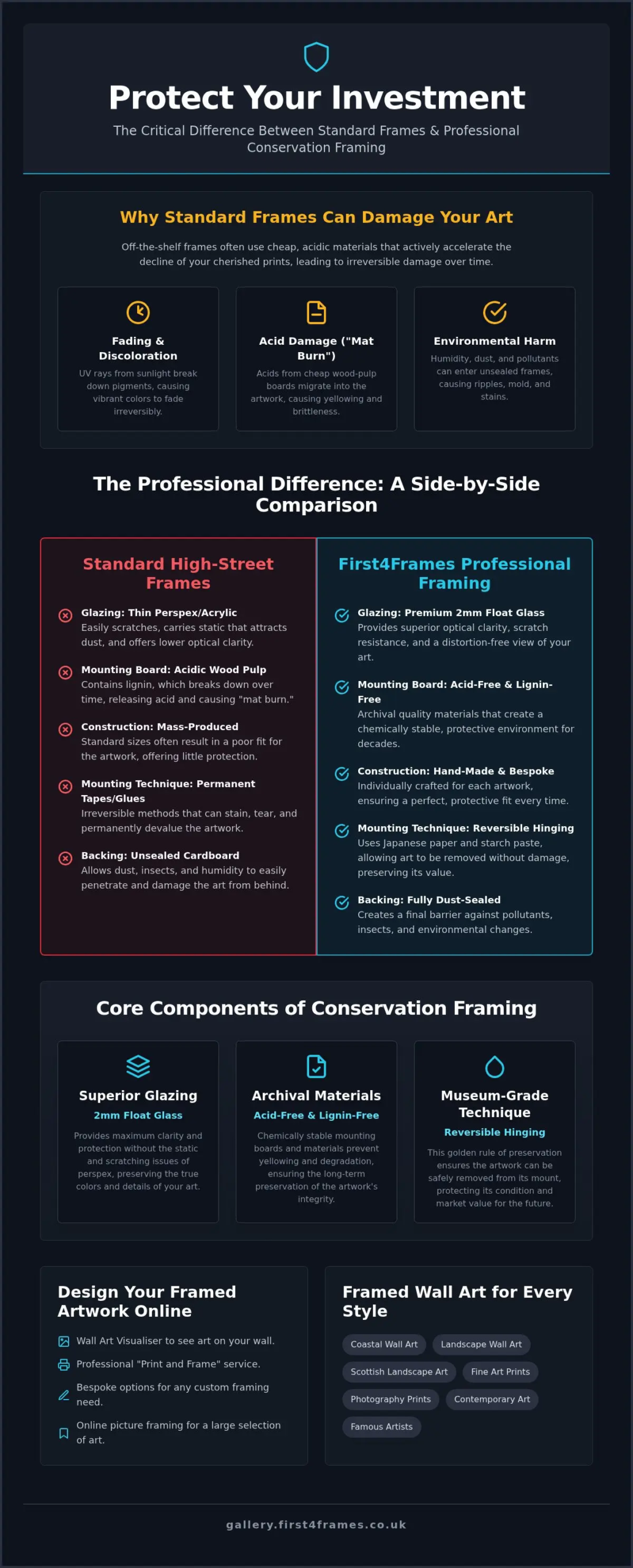
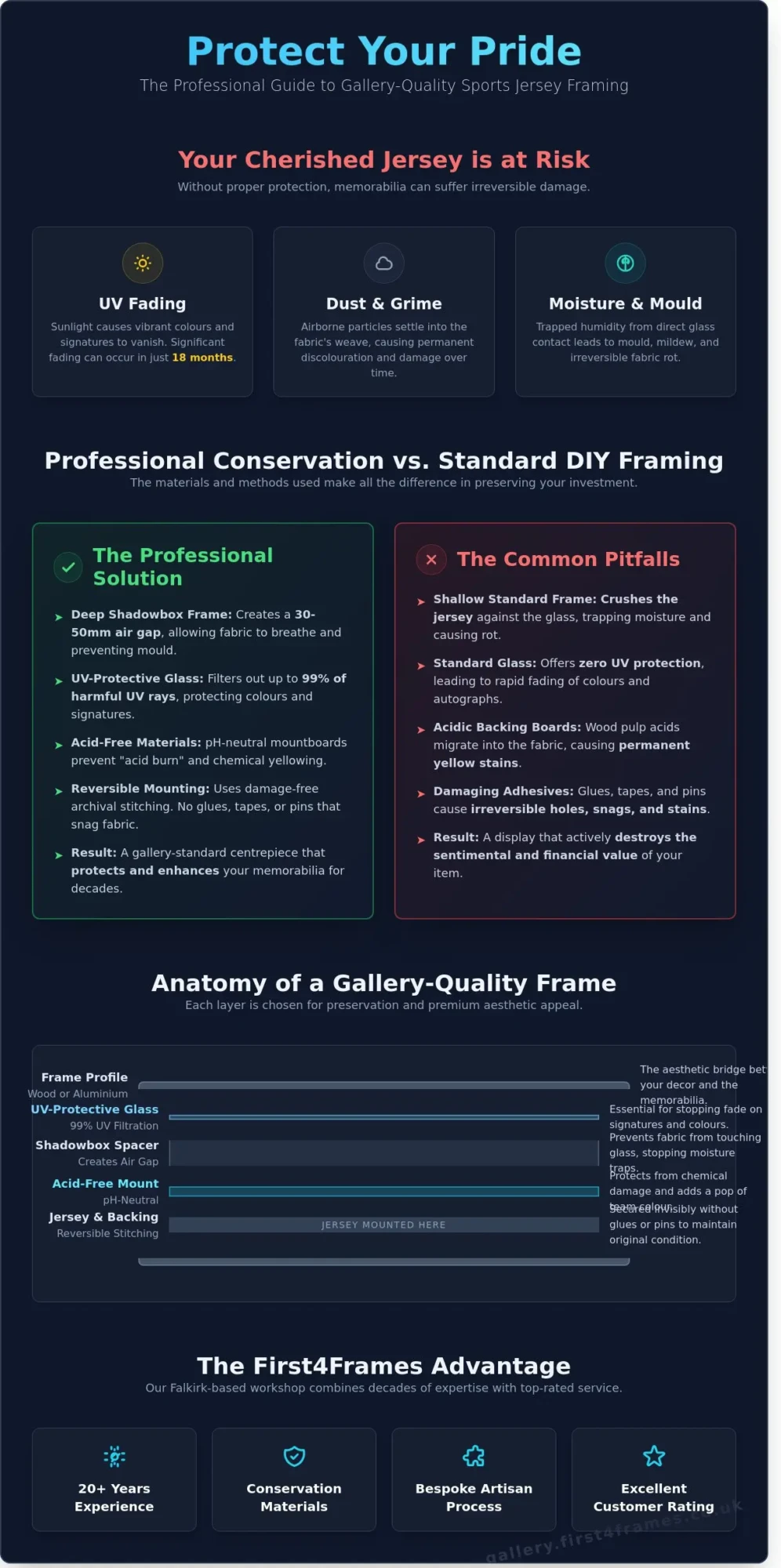
Off-the-shelf frames often cause more harm than good. These products are usually too shallow, which forces the glass to press directly against the fabric. This “crushing” effect traps moisture between the jersey and the glazing, leading to unsightly damp spots or even fabric rot. Most budget frames also use backing boards made from acidic wood pulp. Over time, these acids migrate into the jersey, causing permanent yellowing and “acid burn” that destroys the item’s resale and sentimental value. Professional framing a sports jersey uk requires a 3D shadowbox approach, providing the necessary depth to let the fabric breathe while maintaining its natural shape.

Conservation-Grade Materials Explained

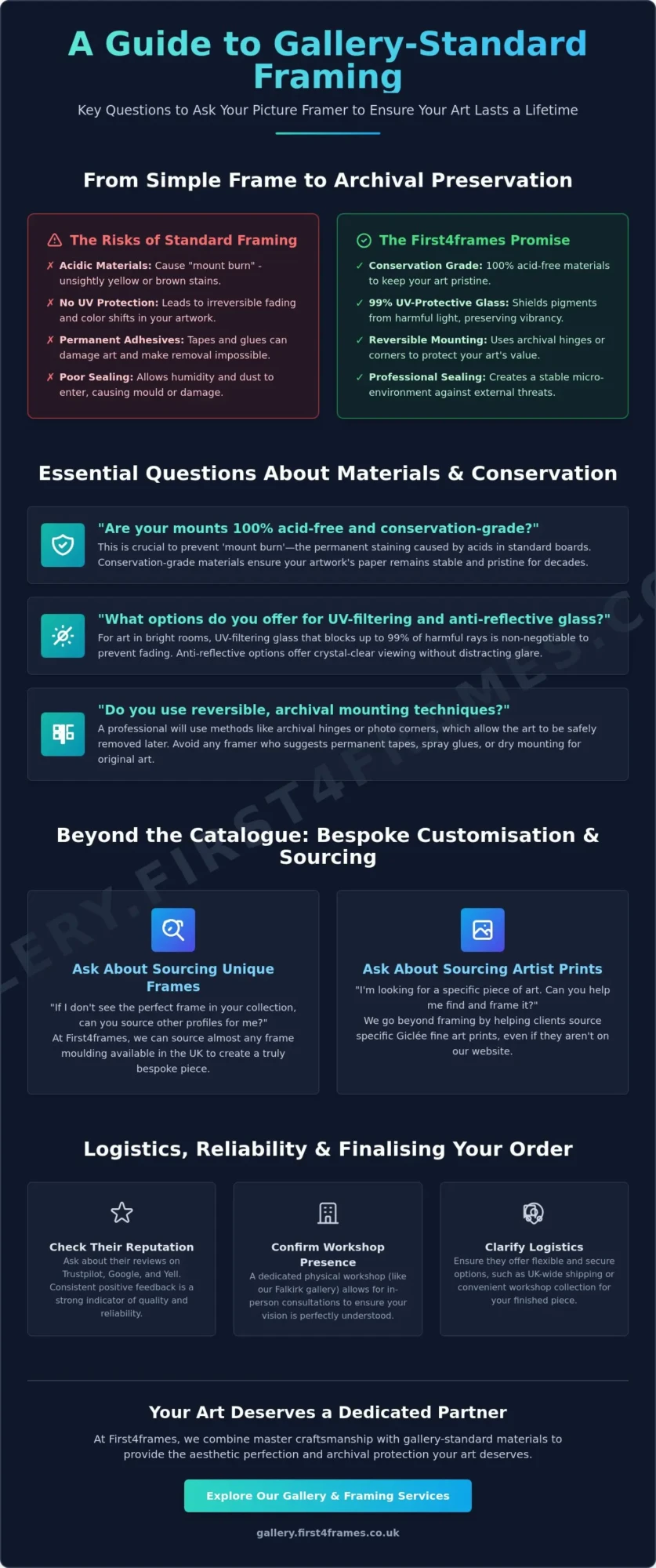
At First4frames gallery, we prioritise the longevity of your collection by using only premium, acid-free mountboards. These materials create a pH-neutral environment that prevents chemical degradation. We also recommend UV-protective glass, which filters out up to 99% of harmful rays. This is vital for signed shirts, as standard ink from permanent markers can vanish completely when exposed to indirect UK sunlight over a few years. Conservation framing is the use of reversible, non-damaging mounting techniques. This means if you ever need to remove the jersey, it remains in its original condition, free from glue, staples, or harsh adhesive tapes. Our high customer ratings reflect our commitment to these exacting standards, providing a trusted service for every fan.

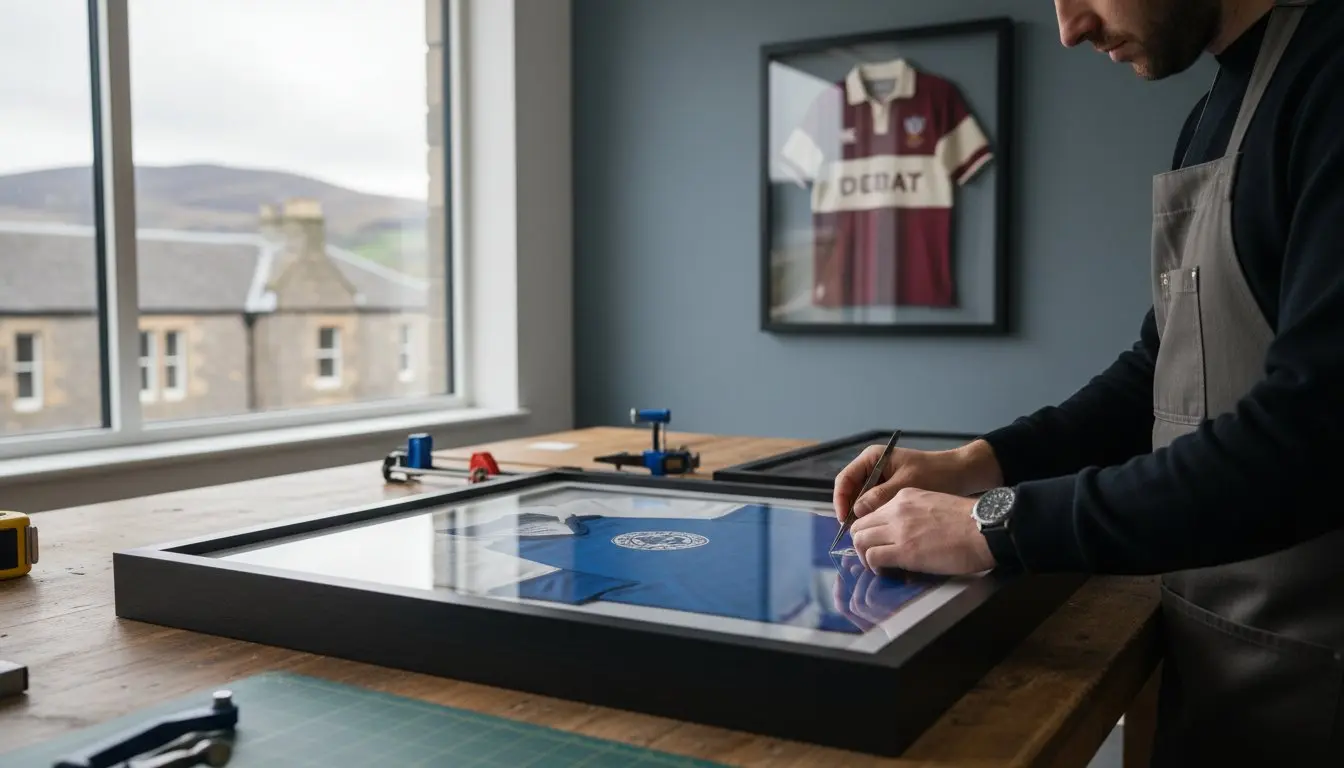
At the First4frames gallery, we treat every piece of sports memorabilia with the same reverence as the fine art prints and original works we exhibit. Professional framing a sports jersey uk is a technical craft that bridges the gap between simple storage and professional display. To achieve a result that mirrors the high standards of our gallery collections, we focus on a structure that allows the garment to remain the star of the show while ensuring its long-term preservation.

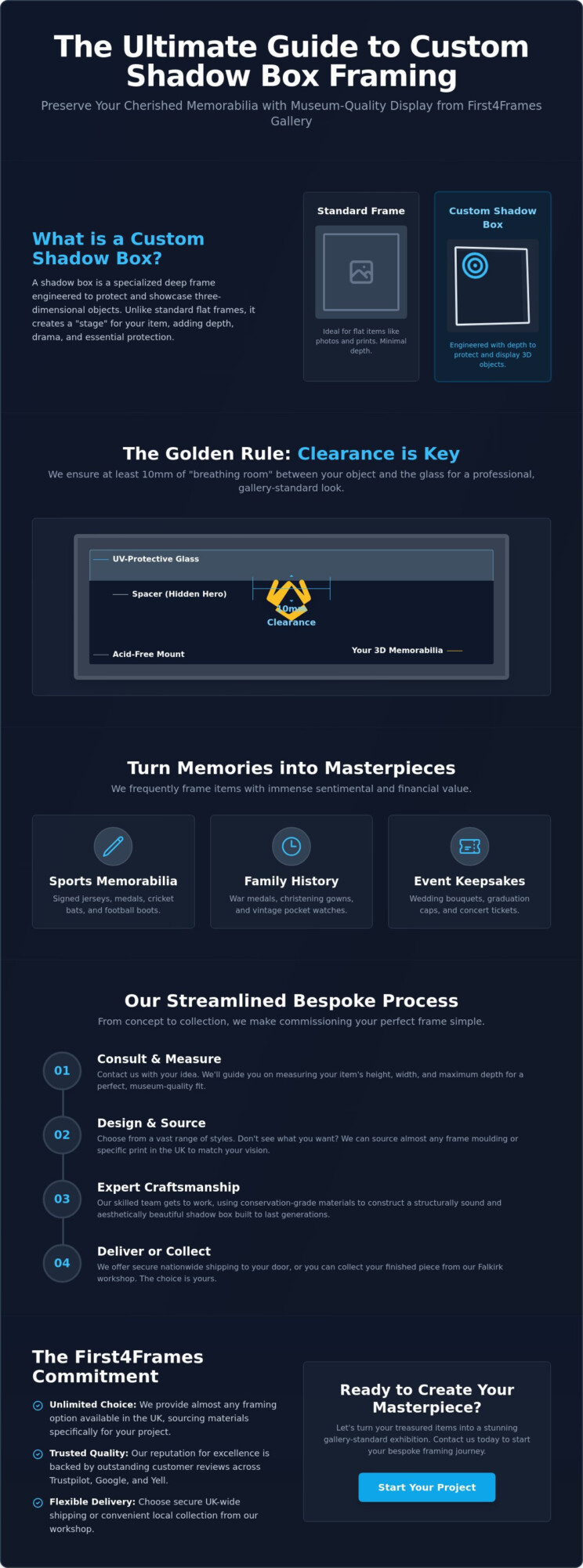
The foundation of any professional jersey display is the deep shadowbox profile. Unlike a standard picture frame, a shadowbox provides a depth of 30mm to 50mm. This creates essential space for the fabric to breathe. We ensure the material never touches the glazing, as direct contact can lead to moisture traps and mould growth over time. Our team avoids all adhesives and pins during the mounting process. Glues often contain acids that yellow the fabric within 24 months, and pins can create permanent snags in delicate polyester. Instead, we use archival-grade stitching and bespoke internal supports to secure the jersey invisibly.

Choosing the Right Frame Profile

Selecting a frame is about finding the perfect bridge between your room décor and the artwork. For heritage rugby shirts or vintage football kits, a bespoke wood finish offers a classic, prestigious feel. If you’re framing a modern, neon-accented away kit, a sleek aluminium profile provides a contemporary “vibe” that matches the high-tech fabric. You can find more inspiration for your project in our ultimate guide to choosing picture frames, which covers everything from traditional oak to modern black finishes.

The Importance of the Mount Layout

The mount layout is where we add a “pop” of team colour to draw the eye. A double mount, where a secondary colour shows as a 5mm border around the primary mount, creates a sophisticated three-dimensional aesthetic. We often include window mounts for additional items like match tickets, 6×4 inch photographs, or engraved plaques. This creates a balanced visual centre, ensuring the jersey doesn’t look “lost” in a large frame. This level of detail is why we’re considered a premium one-stop-shop for collectors across the country.

Security is the final, vital component. A fully framed jersey with high-quality glazing can weigh between 3kg and 7kg. We use heavy-duty D-rings and specialised cord to ensure your memorabilia stays safely on the wall for decades. With over 20 years of experience and top-tier ratings on review platforms, our craftsmanship ensures your kit is protected and beautifully presented. If you’re looking for inspiration before you start, feel free to view our latest gallery exhibits to see how we handle professional mounting and display.

Framing a Sports Jersey in the UK: The Professional Gallery Guide

Professional Jersey Framing vs. DIY: A Practical Comparison

Deciding whether to tackle a project yourself or trust a specialist is a common dilemma for memorabilia collectors. While a budget frame from a high-street retailer might cost as little as £20, the long-term price of an amateur finish often exceeds the initial savings. Professional framing a sports jersey uk services offer more than just a border; they provide a preservation environment that keeps your piece in mint condition for decades.

The hidden costs of DIY often manifest in ruined fabric and poor aesthetics. Without the specialised tools found in our gallery, enthusiasts frequently resort to household adhesives or metal pins. These methods are rarely reversible. Adhesives in standard tapes can leach into synthetic fibres within 12 months, causing permanent yellow staining that destroys the shirt’s resale and sentimental value.

The DIY Risk Factor

Common mistakes in home framing projects usually begin with the mounting process. Achieving a perfectly symmetrical fold is notoriously difficult without a bespoke internal template. Most DIYers find the sleeves look uneven or the chest area sags after just a few weeks on the wall. Budget frames typically utilise 1.5mm styrene or thin plexiglass which scratches easily and lacks the UV filtration necessary to prevent the vibrant colours of a team kit from fading under indoor lighting.

Using staples or heavy-duty tacks is another frequent error. These create visible holes that cannot be repaired. A professional gallery avoids these pitfalls by using conservation-grade tagging or stitching techniques. These methods ensure the jersey remains taut and impressive without compromising the integrity of the material.

The Value of Expert Craftsmanship

Our First4Frames gallery applies the same level of care to sports memorabilia as we do to the fine art prints featured in our collections. With 20 years of experience, our artisans understand how to handle delicate fabrics and heavy embroidery. We act as a one-stop-shop where you can combine our professional printing services with bespoke framing. This allows you to include high-resolution match-day photos or custom plaques alongside the shirt for a complete narrative display.

The quality of our work is reflected in our excellent customer ratings across major review platforms. We don’t just place a shirt in a box; we use professional steaming to remove transit creases and precision stretching to highlight the club crest. This artisan touch transforms a piece of clothing into a spectacular work of art that commands attention in any room.

Think of the frame as the bridge between your room décor and the artwork. It does the heavy lifting in the relationship by pulling the viewer into the details of the fabric. Investing in professional framing a sports jersey uk ensures that your investment is protected by acid-free mountboards and sturdy, bespoke timber. It’s the difference between a temporary display and a permanent heirloom that retains its “new” look for a lifetime.

How to Organise Your Memorabilia: A Step-by-Step Guide

Embarking on a journey to preserve your sporting history is an exciting process at First4frames gallery. We believe every shirt tells a story, and our role is to ensure that story is told with professional craftsmanship. To achieve a spectacular result for framing a sports jersey uk, follow this structured approach to design your display.

  • Step 1: Choose your display style. You can opt for a full shirt spread, which typically requires a frame size of roughly 80cm x 60cm. Alternatively, a torso-only cut focuses on the chest and badges, while a neatly folded style works perfectly for smaller wall spaces.
  • Step 2: Select complementary colours. We use premium mountboards to create a visual “bridge” between your room and the jersey. A double mount with a 5mm offset in your team’s secondary colour adds a beautiful depth that pulls you into the piece.
  • Step 3: Decide on additional elements. A professional display often includes more than just fabric. You might include a winner’s medal, a photograph of the stadium, or a match-day ticket to provide context and scale.
  • Step 4: Consult with an artisan. Our team has over 20 years of experience in bespoke framing. We’ll help you finalise a layout that ensures the jersey is the hero while maintaining perfect geometric balance.
  • Step 5: Securely package and send. Once the design is settled, you’ll send your item to our gallery. We handle every piece with the utmost care, reflecting our 4.9-star rating on independent review platforms.

Adapting for Different Sports

Different sports present unique challenges for the framer. Football and rugby shirts often feature thick, heavy fabrics and embroidered badges that require deep rebates to avoid pressing against the glass. For cycling and athletics, we focus on technical, lightweight materials like Lycra. These require specialist pinning techniques to prevent sagging over time. If you’re a cricket fan, we often use deep box frames to incorporate a signed bat or ball alongside the whites, creating a three-dimensional tribute to the game.

Adding Personal Touches

To make your memorabilia truly unique, consider our print-and-frame services. We can produce a high-quality Giclée print of a match-day programme or a historic news clipping. These prints are identical copies that won’t fade over time. Including a custom-engraved plaque with dates, scores, and player names provides a professional finish found in the world’s top galleries. This attention to detail ensures the final product acts as a functional piece of art that enhances your home décor. Whether you are celebrating a local club win or a national triumph, our bespoke service ensures your memories are protected forever.

Ready to transform your favourite shirt into a gallery-quality display? Explore our bespoke sports framing options today.

At First4Frames Gallery, our walls are a testament to the power of professional presentation. While our gallery showcases spectacular fine art and Giclée prints from renowned artists, we apply that same level of artistic rigour to our bespoke framing service. Our Falkirk-based workshop is where creativity meets craftsmanship. Since 2003, our team has spent over twenty years perfecting the techniques required to preserve fabric and paper alike. We believe a frame acts as a bridge between your room décor and the artwork; it does the heavy lifting to pull you into the picture.

The First4Frames process is designed to be straightforward and inspiring. It begins with a personal consultation where we discuss the history of your item. Whether you’re looking for framing a sports jersey uk collectors would envy or preserving a local club’s kit, we treat every project with artisan respect. Our Scottish heritage and roots in fine art mean we don’t just “box” an item. We curate it. We use the same museum-grade standards for our jersey framing as we do for the high-end prints in our gallery, ensuring your memorabilia is elevated to a true piece of art.

You can start your journey of artistic discovery by requesting a bespoke quote through our website or visiting us in person. Our 4.9-star rating on Google Reviews reflects our commitment to excellence and the trust our clients place in our 20-year history of service.

Trusted Professional Service

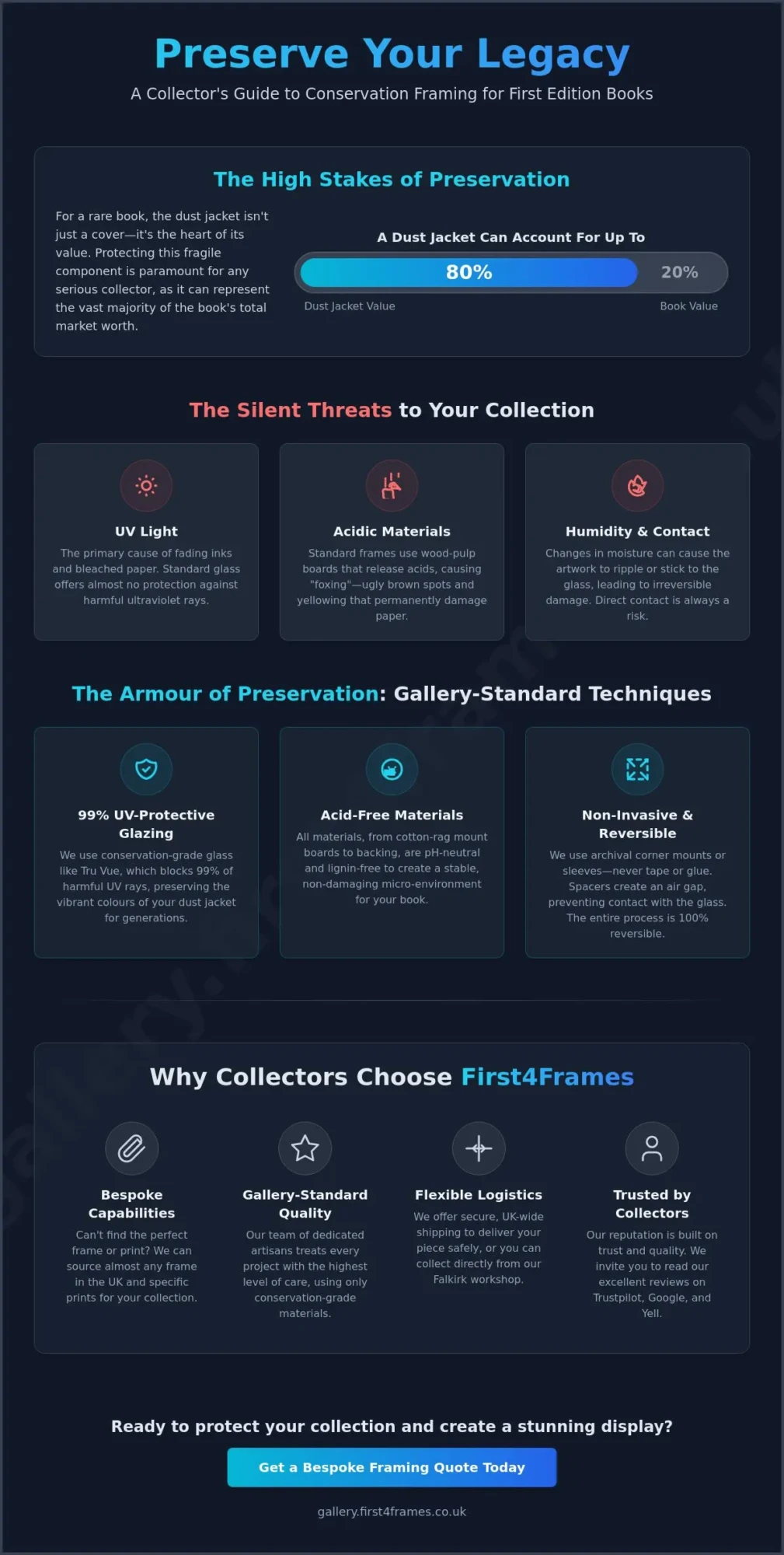
We provide a hassle-free, bespoke, and speedy service for clients across the UK. A primary concern for many collectors is the risk of environmental damage. We use premium, acid-free materials and specialist glazing to provide a guarantee that your item will not fade over time. It’s a simple three-step process: browse our gallery for inspiration, consult with our experts on the mount design, and let us handle the technical execution. Our frames are built to last, ensuring your investment remains as vibrant as the day it was won.

Commercial and Large Orders

Our workshop is fully equipped to handle large-scale projects for sports clubs, hotels, and office staging. We frequently work with commercial property developers to curate memorabilia that adds character and value to new spaces. If you need to frame a dozen jerseys for a corporate suite or fifty items for a stadium hallway, our team delivers consistent, gallery-quality results. We offer a dedicated consultation service for commercial clients to ensure the framing style aligns with your brand’s interior design. Contact us today to discuss your project requirements and receive a professional, volume-based quote.

Your prized sports memorabilia deserves more than a life spent in a dark drawer. By opting for gallery-quality standards, you’re protecting your shirt from UV damage while creating a stunning focal point for your home. At the First4Frames gallery, we treat every jersey with the same artisan care as the fine art prints in our collection. Just as we curate the work of our featured artists, we curate your memories with professional precision. Our Falkirk experts bring over 20 years of bespoke craftsmanship to every project, handling everything from precision mounting to high-quality Giclée printing for your accompanying match-day photos. Our excellent customer ratings on leading review platforms reflect our commitment to quality and our passion for preserving history. Whether it’s a signed kit or a historic win, professional framing a sports jersey uk ensures your legacy stays intact for decades. It’s time to move your collection to the wall where it can truly shine. We’re here to make the process simple, speedy, and spectacular.

Start your bespoke jersey framing journey with First4Frames today

Frequently Asked Questions

How much does it cost to frame a sports jersey in the UK?

Professional sports shirt framing in the United Kingdom typically ranges from £120 for a standard box frame to over £450 for complex, bespoke displays. These costs reflect the high quality of materials required to preserve your item. When you’re looking at framing a sports jersey uk wide, prices vary based on the frame’s depth and the complexity of the mount design. Our team provides a transparent, professional service that ensures your investment is protected for years.

Will framing a signed shirt damage the signature or the fabric?

Professional framing won’t damage your memorabilia because we use non-invasive, reversible mounting techniques. We never use glues or sticky tapes that could cause the ink to bleed or the fabric to perish. Instead, our artisans use delicate stitching or specialist tags to secure the shirt. This conservation-led approach is why First4Frames Gallery maintains such high ratings on review platforms, as we treat every signed piece as a valuable work of art.

Can I include photos and medals in the same frame as the shirt?

You can absolutely include personal items like photographs, match tickets, or medals within a single bespoke frame. We design multi-aperture mounts that act as a bridge between your room décor and your sporting memories. This “one-stop-shop” approach allows us to create a spectacular narrative display. Our craftsmen have over 20 years of experience in arranging these elements so they look balanced and professional, ensuring your display becomes a true focal point.

How do I safely post my jersey to First4Frames Gallery?

Safely sending your item to First4Frames Gallery involves using a tracked, insured courier service and protective packaging. Wrap your jersey in acid-free tissue paper and place it inside a waterproof bag before putting it in a sturdy cardboard box. We recommend using Royal Mail Special Delivery or a reputable courier like DPD for peace of mind. Once it arrives at our gallery, our experts will notify you immediately to begin the creative process.

What is the best type of glass for a sports memorabilia frame?

The best choice for sports memorabilia is UV-protective glass, which filters out up to 99% of harmful rays. This prevents the fabric colours from fading and protects the integrity of signatures. We often recommend anti-reflective “Art Glass” because it’s nearly invisible, making it feel like you can reach out and touch the shirt. Using premium materials like this is a hallmark of our framing service, ensuring your display remains beautiful for decades.

How long does the professional framing process take?

Our professional framing process usually takes between 10 and 14 working days from the moment we receive your shirt. We pride ourselves on a speedy service that doesn’t compromise on the meticulous craftsmanship required for a perfect finish. While bespoke orders with complex multi-mounts might take slightly longer, we always aim to complete your project promptly. You’ll be kept informed throughout each of the three steps in our simple ordering formula.

Can you frame a jersey that is already old and delicate?

We can certainly frame older, delicate jerseys by using specialist conservation techniques that support the fabric without causing stress. If your shirt is over 30 years old or showing signs of age, we use acid-free backing boards to prevent further degradation. Our knowledgeable artisans understand how to handle fragile textiles, ensuring they’re displayed safely. It’s part of our commitment to excellence, helping you preserve historical sporting moments through our expert framing service.

Do you offer framing for international customers outside the UK?

First4Frames Gallery focuses its bespoke physical framing service on customers within the UK to ensure the safety of the items during transit. However, for international fans, our “print-and-frame” service is a fantastic alternative for digital sports art and photography. This allows us to ship high-quality, professionally framed Giclée prints globally. While we don’t currently accept physical jerseys from overseas, our gallery remains a trusted professional partner for UK-based collectors seeking premium craftsmanship.

Posted on

How to Frame a Delicate Document: A Guide to Professional Preservation

How to Frame a Delicate Document: A Guide to Professional Preservation

Last Tuesday, a visitor to our First4frames gallery stood before a vibrant Giclée print by one of our featured artists, clutching a 1945 handwritten letter they hoped to display alongside it. It’s a common sight for our artisans, yet the fear of damaging a fragile heirloom is always present. You want to showcase your history, but you’re terrified that a single piece of standard tape or a splash of sunlight will erase it forever. Learning how to frame a delicate document isn’t just about aesthetics; it’s about acting as a guardian for your most precious memories.

We understand that terms like archival and acid-free often feel like a foreign language when you just want your certificate to look beautiful on the wall. With over 20 years of experience and a 4.9-star rating on Google Reviews, we’ve seen how the wrong materials can cause irreversible yellowing within just 24 months. This guide promises to demystify the conservation process so you can protect your papers for a lifetime. You’ll learn the specific techniques our bespoke framing service uses, from UV-protective glazing to reversible mounting methods, ensuring your document remains a perfect bridge between your room décor and your personal history.

Key Takeaways

  • Understand why professional conservation framing is a protective system where every step must be completely reversible to safeguard your document’s long-term integrity.
  • Discover how to shield irreplaceable signatures and paper fibres from UV light and acidity using specialist “sunscreen” glazing and acid-free mountboards.
  • Learn the expert steps for how to frame a delicate document, from working in a dust-free environment to using “no-glue” mounting techniques like Japanese tissue hinges.
  • See how our bespoke framing standards mirror the premium quality of our gallery Giclée prints to offer your family heirlooms museum-level protection.
  • Explore the benefits of choosing a trusted one-stop-shop with over twenty years of craftsmanship to ensure your historical papers are displayed beautifully and safely.

What is Conservation Document Framing and Why Does it Matter?

Framing a delicate document is a task that goes far beyond simply choosing a style that matches your living room. At First4Frames, we view a frame as a protective system designed to preserve history. While the beautiful works in our gallery showcase local talent, the technical side of our business focuses on the science of preservation. Understanding how to frame a delicate document starts with the realization that the frame is a bridge between your room décor and the artwork. It acts as a controlled environment, shielding paper from the three main enemies of longevity: fluctuating humidity, acidic migration, and ultraviolet light.

To better understand this concept, watch this helpful video:

Documents like 19th-century maps, handwritten letters, or vellum certificates are significantly more vulnerable than the modern Giclée prints we offer in our print-and-frame service. These older papers often contain high levels of lignin, which causes them to turn yellow and brittle when exposed to standard materials. A bespoke preservation package differs from a £15 high-street frame by using 99% UV-protective glass and museum-grade cotton rag boards. This level of craftsmanship ensures that your document doesn’t just look spectacular today, but remains intact for decades to come.

The Golden Rule: Reversibility in Framing

Reversibility is the heartbeat of professional framing. If a process can’t be undone without leaving a trace, it isn’t conservation. Permanent adhesives or drymounting are a “death sentence” for fragile paper; they destroy the item’s historical integrity and its future market value. You can ensure you’re receiving true archival or conservation picture framing by confirming the use of Japanese paper hinges and reversible wheat starch pastes. This allows a document to be safely removed for future research or sale. We’ve built a 4.9-star rating on review platforms by sticking to these strict preservation standards for every customer.

When to Seek a Professional Artisan

Identifying when a document is too fragile for DIY methods is vital. If you notice “brittle” edges that flake at a touch, active foxing (brown spots), or signs of mould, it’s time to consult an expert. At First4Frames, we use over 20 years of experience to handle unique paper challenges that standard shops won’t touch. We’re a one-stop-shop that understands the emotional and financial value of your items. Whether it’s a family heirloom or a piece of investment art from a gallery, our bespoke service provides the expertise needed to keep delicate fibres stable and secure. Our three-step process makes this professional care accessible to everyone in the UK.

Identifying the Threats: What Damages Delicate Paper?

Preserving a rare map or a family heirloom requires more than just a standard shop-bought frame. At the First4frames gallery, we often showcase intricate works by local artists that demand museum-grade protection. Understanding the environmental enemies of paper is vital when learning how to frame a delicate document. Paper is an organic material; it reacts to its surroundings in ways that can lead to irreversible decay if left unprotected. Our team has spent over 20 years perfecting the balance between aesthetic beauty and long-term safety.

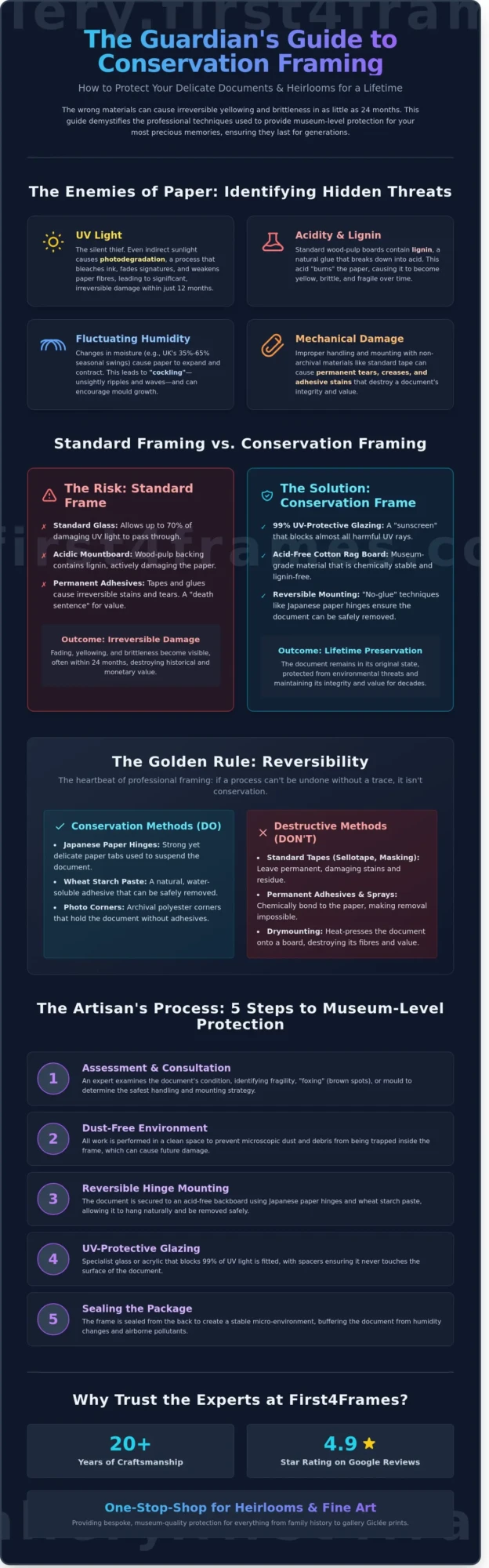
  • UV Light: This is a silent thief. It bleaches ink and weakens paper fibres through a process called photodegradation. Even indirect sunlight can cause significant fading within 12 months.
  • Acidity: Standard wood-pulp boards contain lignin. This substance creates an acidic environment that “burns” the paper, leaving it yellowed and fragile.
  • Fluctuating Humidity: In the UK, indoor humidity often swings between 35% and 65% depending on the season. This causes “cockling,” which is the unsightly rippling seen in poorly mounted documents.
  • Mechanical Damage: Tearing or creasing usually happens during improper handling or mounting. Our 4.9-star customer rating reflects our commitment to handling every item with the precision of a master artisan.

The Chemistry of “Paper Burn”

Lignin is the natural glue that holds wood fibres together. In cheap framing materials, it breaks down into acids that turn certificates brown and brittle. To prevent this, we use materials that offer total protection. High-end framing relies on preservation, technical analysis, and research to ensure longevity. We only recommend mountboards made from 100% cotton rag or alpha-cellulose. These materials are naturally acid-free. They act as a chemical buffer, neutralising any pollutants that might drift toward your document and keeping the paper pristine for a lifetime.

Environmental Control Within the Frame

Paper should never touch the glass. When you’re considering how to frame a delicate document, creating an air-space is essential. Without it, condensation can form on the inside of the glass. This leads to mould growth or the document sticking to the glazing. UK homes often have external walls that get damp or radiators that create sudden heat spikes. We suggest hanging your pieces away from these hazards. If you’re looking for inspiration, you can explore our gallery collection to see how we display professional works safely. Our bespoke framing service ensures your document is suspended in a stable micro-environment, protecting it for decades to come.

How to Frame a Delicate Document: A Guide to Professional Preservation

Essential Materials for Preserving Fragile Documents

Choosing the right components is the most critical step when learning how to frame a delicate document properly. At First4Frames, we draw on over 20 years of expertise to ensure your heirlooms receive museum-standard care. We source only the best materials to create a protective environment that stops the clock on ageing. Every material that touches your document must be chemically inert to prevent yellowing or “acid burn” over time.

  • UV-Filtering Glazing: This acts as a high-performance sunscreen for irreplaceable signatures and inks.
  • Conservation Grade Mountboard: This creates a safe, acid-free nest that supports the paper without leaching harmful chemicals.
  • Archival Hinges or Mylar Corners: These professional mounting methods secure the piece without using destructive sticky tapes.
  • Sealed Backing: A robust barrier that protects the document from dust, wood-boring insects, and UK humidity levels.

Glazing Options: Beyond Standard Glass

Standard 2mm float glass offers almost no protection against light damage. For delicate items, we recommend UV-filter acrylic or specialist conservation glass. UV-filtering glass acts as a barrier that blocks 99% of harmful rays. This is vital because light damage is cumulative and irreversible. Anti-reflective coatings are another premium addition. These coatings reduce reflections to less than 1%, allowing you to see the fine detail of old handwriting or faint pencil marks without the distraction of glare. Our customers frequently highlight the clarity of these finishes in our 5-star ratings, noting how the document appears almost touchable.

The Anatomy of an Archival Mount

A “window mount” is essential for keeping the document away from the glazing. If the paper touches the glass, trapped moisture can cause “cockling” or lead to the document sticking to the surface. At First4Frames, we see the mount as the bridge between your room décor and the document. We often suggest choosing mount colours like soft creams or “antique white” that complement old parchment. This avoids the harsh contrast of modern bright whites. As a one-stop-shop for framing, we ensure the mountboard is at least 1,400 microns thick to provide a deep, professional bevel that adds a sense of importance to the piece.

How you attach the document to the mountboard depends on its condition. Archival hinges, made from Japanese tissue and wheat starch paste, are the gold standard because they are strong yet completely reversible. If the edges of your document are too brittle for hinges, clear Mylar corners are the perfect alternative. These allow the document to “float” in the frame without any adhesive touching the paper. This level of care is why the First4Frames gallery is a trusted professional for local historians and collectors across the UK.

The Professional Process: How to Frame a Delicate Document

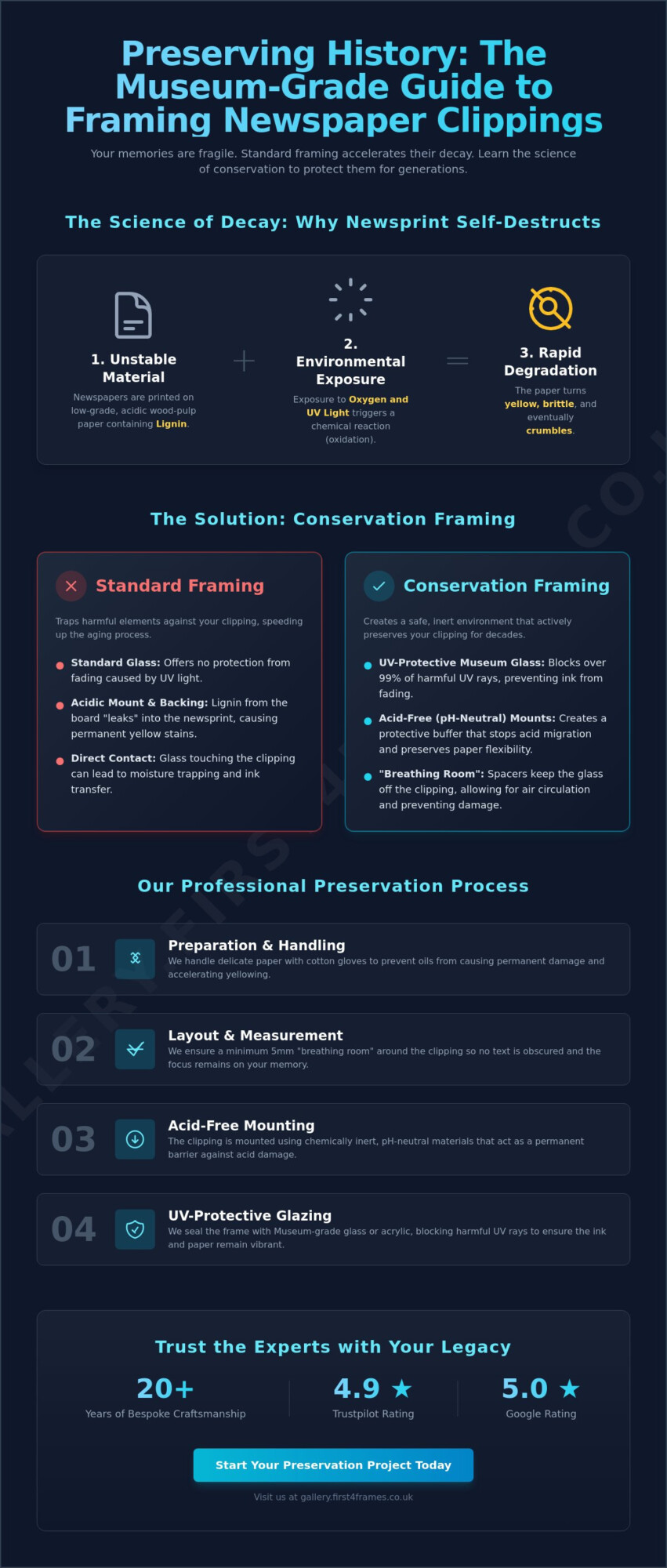
Preserving a rare manuscript or a vintage map requires a level of precision that matches the curation found in the First4Frames gallery. When you learn how to frame a delicate document, the first rule is absolute cleanliness. Our technicians work in a strictly controlled, dust-free environment. We always wear white, lint-free cotton gloves. This isn’t just for show; skin oils contain acids that can cause permanent “fingerprint” staining on 18th-century vellum or thin 1920s newsprint within just a few years.

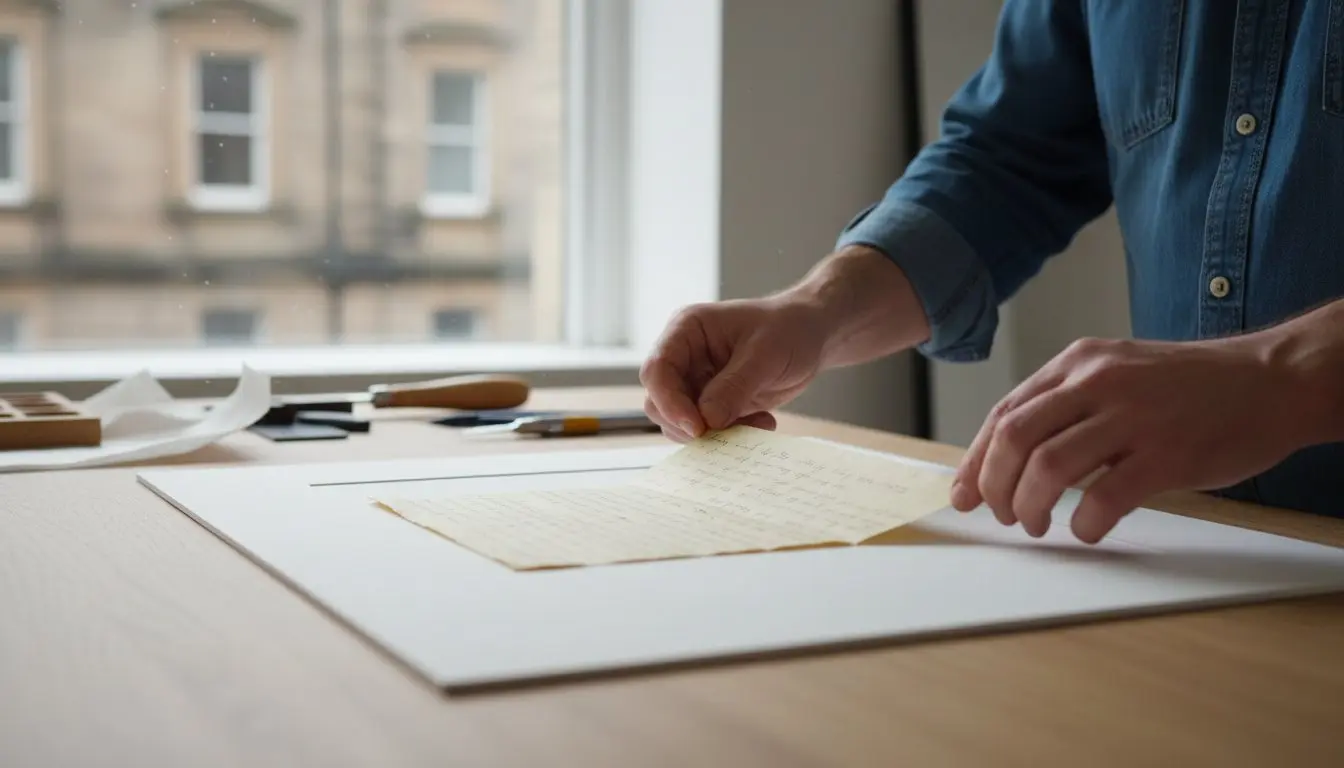
The mounting process focuses on a “no-glue” philosophy. We use Japanese Kozo tissue hinges paired with acidified wheat starch paste. This method is favoured by museum conservators because it’s entirely reversible. If the document needs to be removed in 50 years, a tiny amount of moisture releases the bond without tearing the fibres. For items that are printed on both sides or are too brittle for hinges, we employ clear polyester (Mylar) photo-corners. These provide a secure hold using friction and tension rather than adhesives.

Proper spacing is the next critical step. A document should never touch the glazing. We maintain a consistent air gap of at least 3mm using acid-free spacers or deep-window mounts. This gap prevents “ferrotyping,” where moisture traps the paper against the glass, potentially causing the ink to lift or mould to grow. We then seal the entire package into a micro-environment. This creates a buffer against the UK’s fluctuating humidity levels, which can swing by 20 percent between seasons.

Step-by-Step Mounting Techniques

The wheat starch paste method is our primary choice for traditional documents. It provides a strong yet flexible hold that moves with the paper. If a document is extremely fragile, we recommend Mylar encapsulation. This sandwiches the piece between two inert sheets, providing 360-degree support. Regarding old folds; we generally advise against aggressive flattening. Forcing a 100-year-old crease to lie flat can snap the cellulose fibres. We prefer “gentle relaxation” in a humidity-controlled chamber before the framing begins.

Final Assembly and Inspection

Before the final fit, we check all materials for “out-gassing.” Cheap wood pulps and certain plastics release acidic vapours that yellow paper over time. We only use inert, conservation-grade boards. Every frame receives a bespoke dust-seal on the back to prevent debris and insects from entering. Our attention to these hidden details is why First4Frames maintains a 4.9 out of 5-star rating on independent review platforms. We don’t just provide a border; we build a protective vault for your history.

Ready to see how professional presentation transforms a piece? Explore the First4Frames gallery to see our craftsmanship in action.

From Family Heirlooms to Fine Art: Trusting the Experts

Your most precious papers deserve the same reverence as a gallery masterpiece. At First4frames gallery, we treat every item with the same meticulous care we apply to the high-value works that pass through our doors. Whether you possess a centuries-old land deed or a rare first-edition programme, we understand that these items are irreplaceable. Our approach to how to frame a delicate document mirrors the archival standards we use for our premium Giclée prints, ensuring your history remains vibrant for decades.

We operate as a true one-stop-shop for art and preservation. This means you benefit from a seamless journey where consultation, curation, and bespoke framing happen under one roof. Our Falkirk workshop handles everything on-site, providing a level of security that online-only retailers simply cannot match. You aren’t just buying a frame; you’re investing in 20 years of technical expertise and a passion for craftsmanship that has earned us a 4.9-star rating across independent review platforms.

The Gallery Standard

Our daily work with acclaimed artists like Jolomo and Jack Vettriano informs every preservation project we undertake. We use the same museum-grade materials for your family tree as we do for a £5,000 fine art original. A professionally framed document does more than just sit on a wall; it becomes a spectacular focal point that tells a story. We help you choose the perfect mount and moulding to act as a bridge between your room décor and your personal history. By applying gallery-level techniques, we ensure your document is protected from the acidic degradation and UV light that often ruin unprotected papers. We don’t take shortcuts with your memories.

Getting Your Bespoke Quote

Starting your preservation journey is straightforward and inspiring. We invite you to bring your treasures to our Falkirk centre for a personal assessment. Our team will examine the condition of your item and suggest the best conservation methods to suit your budget and style. We pride ourselves on offering a hassle-free, speedy service that never compromises on the quality of our craftsmanship. Most consultations take less than 20 minutes, giving you clear options and a transparent price immediately. Don’t leave your history in a drawer where it can fade or tear.

Ready to transform your archive into art? Request a bespoke framing quote for your delicate document today and let our experts show you how to frame a delicate document with the care it deserves.

Protect Your Heritage with Professional Conservation

Your most precious papers deserve more than a standard shop-bought frame. Protecting fragile heirlooms requires a deep understanding of UV-filtering glass and acid-free mounting to prevent irreversible yellowing or brittle edges. At First4frames gallery, we treat every piece of paper as a work of art, whether it’s a rare print from our featured artists or a century-old family birth certificate. We believe a frame should do the heavy lifting, acting as a beautiful bridge between your room décor and your history.

Learning how to frame a delicate document involves balancing aesthetic beauty with scientific preservation. Our team brings over 20 years of expert framing experience to every project, ensuring your items remain in pristine condition for decades. We specialise in conservation-grade materials that safeguard against environmental threats like humidity and light damage. Our excellent customer ratings on review platforms reflect our commitment to premium craftsmanship and reliable, bespoke service. You don’t have to risk the integrity of your collection when you have a trusted professional partner by your side.

Preserve your history with our bespoke framing service and ensure your stories stay vivid for the next generation. We’re ready to help you transform your fragile archives into spectacular displays.

Frequently Asked Questions

Can I use regular sticky tape to mount my document if it is on the back?

No, you shouldn’t use regular sticky tape on any part of a delicate document. Standard adhesive tapes contain acidic glues that yellow paper within 24 months and leave permanent oily residues. At First 4 Frames, our craftsmen use reversible, acid-free T-hinges or starch-based adhesives. These methods ensure your precious items, like the limited edition prints by our featured gallery artists, remain pristine and can be removed safely without damage.

Will framing my document stop it from fading completely?

Framing won’t stop fading 100%, but using the right glass makes a massive difference. Standard glass only blocks about 45% of UV rays, whereas our specialist museum glass blocks up to 99%. Even with this protection, we recommend hanging your piece away from direct sunlight. This is especially important for delicate items or Giclée prints from our gallery, which are designed to last over 75 years when protected from harsh light.

Is it safe to frame an original birth certificate or should I use a copy?

It’s usually better to frame a high-quality copy and keep the original in a fireproof safe. Original birth certificates are vital legal documents that you might need to present for passport applications or legal matters. We offer a professional print-and-frame service where we create a 1200dpi Giclée scan of your document. This allows you to display a beautiful, identical replica while the authentic original remains protected and accessible for official use.

What is the difference between “acid-free” and “archival” materials?

Acid-free materials are pH neutral during manufacture, but archival materials are made from naturally stable fibres like 100% cotton rag. While acid-free products might eventually become acidic over 20 years, archival materials are designed to last for centuries. When you’re learning how to frame a delicate document, choosing archival-grade mountboard is essential. Our bespoke framing service uses these premium materials to act as a protective bridge between your room’s environment and your artwork.

How much does it cost to professionally frame a delicate document?

Professional framing for a small delicate document typically starts from £45 at First 4 Frames. For a standard A4 certificate with UV-protective glass and archival mounting, prices usually range between £65 and £120 depending on your choice of bespoke wood moulding. Our customers frequently rate our value as “Excellent” on Trustpilot; they often note that our 20 years of expertise ensures your investment protects your document’s financial and sentimental value for decades.

Can I frame a document that is already torn or has holes?

Yes, you can certainly frame a document that shows signs of age like tears or holes. We often frame vintage maps or aged sketches from our gallery artists that have characterful imperfections. A professional framer uses a Japanese tissue repair method to stabilise the area without using harsh chemicals. This approach highlights the history of the piece while ensuring the damage doesn’t spread. It’s a key step in how to frame a delicate document properly.

Should I have my document professionally cleaned or restored before framing?

You should consider professional restoration if the document has heavy foxing, mould, or significant staining. Framing a “dirty” document can sometimes trap moisture or acidic particles against the paper, accelerating decay. We recommend consulting a specialist conservator if your item is over 100 years old or shows brown spotting. Once cleaned, our one-stop-shop can then provide the perfect bespoke frame to showcase the restored beauty of your historical piece or fine art print.

Posted on

What is Conservation Grade Framing? A Specialist Guide to Protecting Your Art

What is Conservation Grade Framing? A Specialist Guide to Protecting Your Art

Imagine investing in a spectacular limited edition print from the First4frames gallery, only to notice the edges yellowing or the colours losing their punch after just five years. It’s a common worry for collectors who feel lost among technical jargon like ‘acid-free’ or ‘archival’. You might be wondering, what is conservation grade framing, and why does it matter for your collection? At First 4 Frames, we’ve spent over 20 years helping art lovers in the UK protect their treasures. We know that a frame isn’t just a border; it’s a protective bridge that keeps your investment safe from the invisible threats of sunlight and acidity.

We understand that you want your artwork to look as perfect in two decades as it does today. This guide will show you how our professional framing service uses specific archival techniques to prevent ‘mat burn’ and fading. You’ll discover the exact materials that define conservation standards, giving you the confidence to choose the right level of protection for your piece. From bespoke craftsmanship to our ‘Excellent’ rated customer service, we’re here to make sure your art remains a beautiful part of your home for 20 years or more.

Key Takeaways

  • Understand exactly what is conservation grade framing and how the “do no harm” principle ensures your artwork remains protected and reversible for decades.
  • Discover how specialist UV-blocking glazing and acid-free mountboards act as a “sunscreen” for your art, preventing irreversible fading and chemical damage.
  • Learn why fine art from the First4frames gallery, including vibrant pieces by Jolomo and Vettriano, requires professional archival techniques to retain its value.
  • Compare conservation and museum-grade standards to identify the perfect balance of longevity and protection for your cherished family photographs and documents.
  • Benefit from over 20 years of expert craftsmanship with our “one-stop-shop” service, backed by excellent customer ratings for quality and reliability.

Defining Conservation Grade Framing: More Than Just a Border

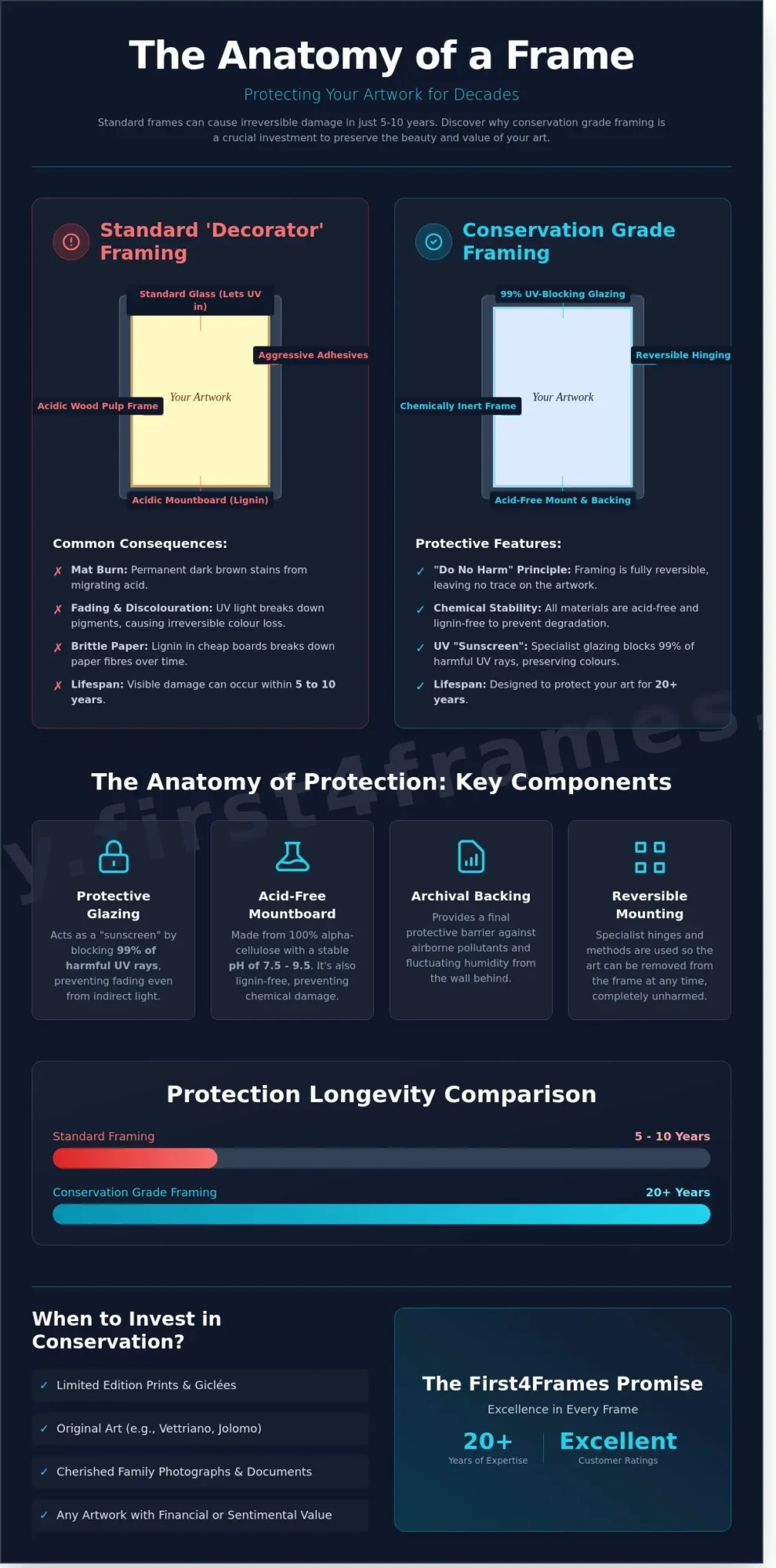
When you invest in a stunning piece from the First4Frames Gallery, you aren’t just buying a picture; you’re preserving a legacy. Understanding what is conservation grade framing starts with a commitment to longevity. This professional standard, defined by the Fine Art Trade Guild (established in 1910), ensures your artwork remains protected from environmental degradation for at least 20 years. While a frame acts as a bridge between your room décor and the artwork, its primary job in this category is defensive. Specialists follow a strict “Do No Harm” protocol, ensuring the framing process is entirely secondary to the safety of the piece. You can explore the technical evolution of these protective techniques in this guide to the Conservation and restoration of painting frames.

To better understand this concept, watch this helpful video:

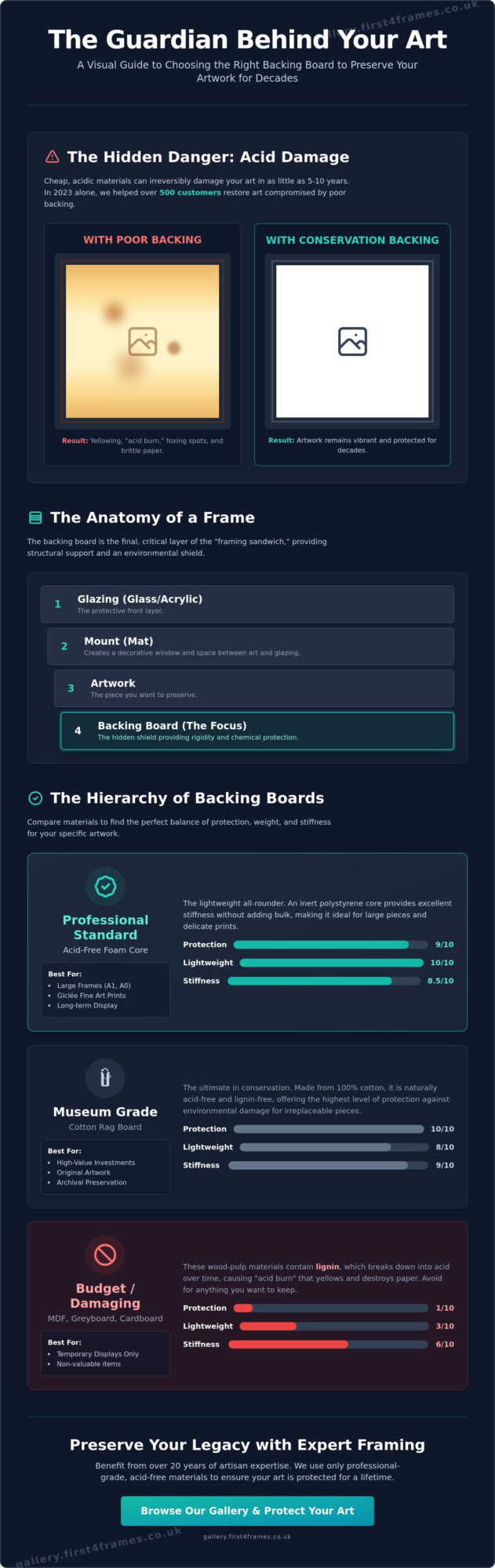
In this specialist category, aesthetics never compromise the integrity of the art. Every material that touches the work must be acid-free and lignin-free. This creates a stable environment that prevents the chemical “stew” often found in cheaper alternatives. While the finished result looks spectacular, the real value lies in the invisible barriers protecting the paper fibres from the world outside the glass.

The Science of Preservation

Airborne pollutants and fluctuating humidity levels are constant threats to unprotected paper. In the UK, indoor relative humidity can swing between 30% and 70% across different seasons, causing paper to expand and contract. This movement leads to warping or “cockling.” Conservation framing uses chemically inert materials, such as mountboards with a pH level between 7.5 and 9.5, to create a safe haven. Reversibility is the ability to remove art from a frame without leaving a trace.

Why ‘Standard’ Framing Often Fails

Mass-produced “decorator” frames often use high-acid wood pulps and non-archival tapes that contain aggressive adhesives. Within 5 to 10 years, these chemicals migrate into the artwork, causing permanent yellowing and “mat burn,” a dark brown line that follows the edge of the mount. Brittle paper is a common symptom of lignin breakdown found in budget materials. Our bespoke approach at First4Frames Gallery prevents these issues by using 100% alpha-cellulose boards. We rely on our 20 years of expertise to ensure every frame provides a museum-quality environment, a standard reflected in our excellent customer ratings. Choosing the right specialist means your art won’t just look perfect today; it’ll stay perfect for decades.

The Anatomy of a Conservation Frame: Materials That Matter

A frame acts as a protective cocoon for your artwork. At First4frames, our twenty years of experience has taught us that the beauty of a Giclée print or an original watercolour depends entirely on the chemistry of the materials surrounding it. When customers ask what is conservation grade framing, they’re often surprised to learn it involves a precise combination of scientific standards and artisan skill. Every component, from the visible mount to the hidden hinges, must be chemically stable to ensure the artwork doesn’t degrade over time.

Professional framing isn’t just about aesthetics; it’s about longevity. We follow rigorous Preventive Conservation strategies to ensure that every piece leaving our workshop remains in pristine condition. This approach is why we maintain such high customer ratings across review platforms, as we prioritise the long-term health of your investment alongside its visual appeal.

Protective Glazing and UV Light

Glazing is the first line of defence against environmental damage. Standard glass might look clear, but it allows a significant portion of the UV spectrum to pass through, which can cause Giclée prints to suffer from spectrum-shift and irreversible fading. Conservation-grade UV glass blocks 99% of these harmful rays. This level of protection is essential even if your art isn’t in direct sunlight, as reflected light still carries enough energy to break down pigments. You can learn more about finding the right balance for your piece in our guide on choosing mounts and glass.

Acid-Free Mounts and Backing

The materials touching your art must be chemically inert. Standard wood-pulp boards contain lignin, a natural polymer that eventually turns acidic, causing the “brown halo” or “foxing” often seen on older prints. For true conservation work, we use alpha-cellulose or cotton rag boards where the lignin has been completely removed. These boards are often ‘buffered’ with calcium carbonate to neutralise atmospheric acids that might seep into the frame over the years. What is conservation grade framing without a proper barrier? It’s simply a temporary solution. A thick mount also creates a vital air gap between the glass and the art, preventing moisture from trapping against the surface and causing mould growth.

  • Backing Boards: We use rigid, moisture-resistant barriers to prevent dampness from walls affecting the paper.
  • Hinging and Tapes: Our specialists use pH-neutral, reversible adhesives. These ensure the art is held securely without the risk of adhesive staining or permanent “tide marks” on the paper.

The quality of these seemingly minor components, like tapes and adhesives, is paramount. For those in the trade or serious hobbyists looking to source archival-quality supplies, it’s helpful to learn more about Fosseway Tapes & Fixings Limited and understand the options available from specialist distributors.

By selecting these premium materials, we create a bridge between your room décor and the artwork that stands the test of time. If you’re looking for inspiration for your next project, feel free to view our latest artist collections and see how professional framing elevates fine art.

What is Conservation Grade Framing? A Specialist Guide to Protecting Your Art

Conservation vs. Museum Grade: Which Level Do You Need?

Understanding the distinction between these two standards is vital for any collector. The primary difference lies in the base materials used for mounts and backing boards. Museum grade utilizes 100% cotton rag, a naturally acid-free fibre that remains stable for over 100 years. This is the pinnacle of protection. In contrast, what is conservation grade framing usually involves alpha-cellulose. This material is high-quality wood pulp processed to remove lignin and neutralise acids. While it provides excellent protection, it has a shorter longevity expectation of approximately 20 years before the materials may begin to break down.

For the majority of bespoke picture frames produced in the UK, conservation grade is the default choice. It offers a superb cost-to-value ratio for homeowners who want to protect their investment without the significant price hike of cotton rag. At First4Frames Gallery, we source only the best materials to ensure your artwork remains as spectacular as the day it was framed. This level of craftsmanship is why our clients consistently provide excellent ratings on review platforms, trusting us with their most cherished pieces.

Choosing the Right Standard

Museum grade is necessary for high-value originals, historical documents, or items of significant sentimental value that must last for generations. If a piece is valued at over £1,000, we often recommend this level. However, conservation grade is the gold standard for the high-quality Giclée prints we feature in our gallery. It ensures the “identical copy” quality of the print doesn’t fade or yellow. Our experts help you decide based on your specific piece, ensuring a hassle-free experience that balances budget with long-term preservation.

The ‘Decorator’ Trap

Ready-made shop frames often fall into the ‘decorator’ trap. They look fine on the shelf for £20, but they rarely provide the protection your art deserves. Many mass-produced products claim to be “acid-free,” yet they use low-grade backing boards that off-gas harmful chemicals over time. This leads to “mount burn,” where a brown line appears around the edge of your art. Professional framing acts as a bridge between your room decor and the artwork, pulling you into the picture while providing a physical barrier against environmental damage. Don’t risk a beautiful print in a cheap frame; the long-term cost of restoration far outweighs the initial investment in professional craftsmanship.

When to Invest in Conservation Grade Protection

Deciding to invest in higher-tier protection often comes down to the “replaceability” of the item. If a piece is a one-of-a-kind original or a limited edition, standard framing simply won’t suffice. Understanding what is conservation grade framing is the first step in ensuring your art survives the next 50 to 100 years without degradation. Our team at First 4 Frames has spent over 20 years perfecting these techniques to keep your collection pristine.

For original watercolours and charcoal drawings, this level of care is essential. These unsealed mediums are incredibly vulnerable to humidity and dust. A single smudge or a damp patch can ruin a piece worth £500 or more instantly. By using reversible hinges and acid-free barriers, we ensure the artwork remains untouched by harmful chemicals or adhesive residues.

Spotlight on Scottish Fine Art

The bold landscapes of John Lowrie Morrison are a staple at our Falkirk gallery. Those spectacular Scottish hues in Jolomo prints need specialist UV protection to prevent the vibrant pigments from dulling over time. Likewise, the moody, cinematic atmosphere of Jack Vettriano prints demands archival-quality mounting. We use materials that meet the Fine Art Trade Guild’s strict standards, ensuring the paper never touches acidic wood pulps. Our gallery specialises in these iconic artists, providing the bespoke care their work deserves.

Investment and Sentiment

Preservation is just as vital for sentimental heirlooms as it is for gallery investments. Original photographs from the early 1900s or delicate charcoal sketches are prone to “foxing,” those unsightly brown spots, if they aren’t sealed correctly. We treat a £2,000 original watercolour with the same reverence as a set of family military medals or a wedding photograph.

When clients ask what is conservation grade framing, we describe it as a physical insurance policy for your art. A limited edition Giclée print might appreciate by 20% in value over a decade, but only if it stays in mint condition. For those managing larger collections, our team offers commercial curation to ensure every piece in a professional space maintains its long-term resale value. We source only the best materials to act as a bridge between your room décor and the artwork itself.

The First4Frames Promise: Excellence in Every Frame

For over 20 years, First4Frames has served as a trusted professional for artists and collectors in Falkirk and across the UK. We operate as a comprehensive one-stop-shop, meaning we handle every stage of the journey under one roof. Whether you’re selecting a vibrant new print from our gallery or bringing in a cherished family heirloom, our team manages the entire process from the initial consultation to the final conservation fitting. This holistic approach ensures that the high standards required for fine art preservation are met at every single touchpoint.

Understanding what is conservation grade framing is essential for anyone looking to maintain the value and beauty of their collection. We don’t just put a border around a picture; we create a protective environment. Our commitment to quality is backed by our exceptional customer ratings, where we consistently maintain a 4.9-star average across independent review platforms. This reputation is built on two decades of craftsmanship and a genuine passion for the art we frame.

Our Bespoke Process

Every piece of art that enters our workshop receives white-glove care. Our bespoke process begins with a detailed assessment of the medium and condition of your work. We source only the best archival components, including acid-free mountboards and pH-neutral adhesives that won’t yellow or brittle over time. We often tell our clients that the frame does the heavy lifting in the relationship between the artwork and your room. It acts as a vital bridge, pulling the viewer into the image while physically supporting and shielding the piece from environmental hazards like humidity and UV light.

Visit Our Falkirk Gallery

We invite you to experience the difference in person at our gallery located at 47A Grahams Road, Falkirk. Seeing our range of museum-quality materials first-hand helps you appreciate the texture and depth that professional framing adds to a piece. For those looking for a completely hassle-free experience, our ‘print-and-frame’ package allows you to choose a spectacular piece from our featured artists and have it professionally finished and ready to hang. This service combines our high-resolution Giclée printing with our specialist framing expertise in one seamless transaction.

Your art deserves a home that protects its legacy for decades to come. Don’t leave the safety of your collection to chance or low-quality materials. Our expert team is ready to help you choose the perfect combination of style and security.

Get a bespoke quote for your custom framing today and start your preservation journey with a team that cares as much about your art as you do.

Secure the Future of Your Fine Art Collection

Choosing the right protection for your investment means understanding what is conservation grade framing and how it acts as a permanent shield against UV damage and acid degradation. By using acid-free mount boards and 99% UV-protective glass, you ensure your Scottish fine art or Giclée prints remain as vibrant as the day they were created. We’ve spent over 20 years perfecting this craft; we’ve built a reputation for excellence backed by top-rated customer reviews on independent platforms. Whether you’re selecting a new piece from our gallery or protecting a cherished heirloom, the frame serves as the essential bridge between your room’s décor and the art itself. Our specialists handle every piece with the care of a dedicated artisan. We’re a true one-stop-shop for collectors who value quality. Don’t leave the safety of your beautiful prints to chance. Trust the professionals who source only the finest materials for every bespoke project. It’s time to let your artwork shine in a frame that does the heavy lifting for you.

Start your bespoke framing journey with First4Frames

Frequently Asked Questions

What is the difference between conservation and archival framing?

The main difference lies in the level of protection and the duration of preservation offered to the artwork. Conservation grade framing aims to protect artwork for 20 years in normal display conditions, whereas archival grade is designed to last 100 years or more. At First4frames gallery, we recommend conservation standards for our featured artists’ prints to ensure they remain spectacular for decades. It’s a professional choice that balances premium protection with practical costs for most collectors.

Is conservation grade framing worth it for a standard poster?

It’s worth the investment if the poster holds personal value or is a limited edition piece that you want to keep. Standard posters printed on acidic paper deteriorate quickly, but using conservation techniques can slow this process by 50 per cent. If you’ve bought a beautiful print from our online shop, choosing our professional framing service ensures it doesn’t become brittle or discoloured within five years. It turns a simple poster into a lasting piece of home décor that bridges the gap between your room and the art.

Does conservation glass really stop art from fading?

Conservation glass blocks 99 per cent of harmful UV rays, which are the primary cause of fading and pigment breakdown. While it can’t stop 100 per cent of light damage because heat and visible light also play a role, it provides a massive upgrade over standard 2mm glass which only blocks about 40 per cent of UV. We use these premium glazing options at First4frames to keep the vibrant colours of a Giclée print as vivid as the day it was produced.

Can I turn a standard frame into a conservation frame later?

You can upgrade a standard frame by replacing the existing internal components with conservation-quality materials. This process involves swapping acidic backing boards for 100 per cent alpha-cellulose boards and installing UV-protective glass. Our bespoke framing team often helps customers save artwork by retrofitting older frames. It’s a cost-effective way to bring an old piece up to the high standards reflected in our 5-star customer reviews.

How long does a conservation grade frame last?

A conservation grade frame is built to protect your art for at least 20 years before the materials need to be inspected or replaced. Over time, even the best materials can lose their chemical buffering capacity, so we suggest a professional check-up every two decades. This longevity is why our print-and-frame service is so popular for family heirlooms and investment pieces from our gallery collection. It ensures your investment remains in perfect condition for the next generation.

What does ‘acid-free’ actually mean in framing?

In the world of what is conservation grade framing, acid-free refers to materials with a pH level of 7.0 or higher. True conservation mounts are made from alpha-cellulose or cotton linters that have had the lignin removed to prevent acid burn on your artwork. We source only the best materials that meet these strict chemical standards. This ensures your art stays in perfect condition without the risk of chemical decay or brown staining.

Why is my old picture mount turning yellow?

Your mount is turning yellow because it contains lignin, a natural substance in wood pulp that turns acidic when exposed to light and air. This acidity eventually creates a dark burn line on the artwork itself, which can decrease its value by 30 per cent or more. Our professional framing service uses lignin-free boards to avoid this issue entirely. It’s one reason why our customers trust us to handle their most precious fine art pieces from the gallery.

How much more expensive is conservation grade framing?

You can typically expect to pay about 15 to 25 per cent more for conservation grade framing compared to basic budget options. For a standard A3 frame, this might mean an additional £15 to £30 depending on the specific glass and mount choices you select. Given that it prevents hundreds of pounds in damage to your artwork, it’s a small price for peace of mind. Our transparent pricing reflects our commitment to being a trusted, one-stop-shop for UK art lovers.

Posted on

How to Frame Something Valuable: The Ultimate Conservation Guide

How to Frame Something Valuable: The Ultimate Conservation Guide

Last Tuesday, a collector visited our workshop with a 1950s original that had sadly developed nasty yellow stains around the edges. It’s a heartbreaking sight, but it happens more often than you’d think when standard materials are used instead of conservation-grade ones. You probably agree that your most precious memories, whether they’re family heirlooms or a signed print from the First4Frames Gallery, deserve better than a “one size fits all” approach. You want peace of mind that your investment is safe from acid burn and fading for the next 50 years.

In this guide, we will explain exactly how to frame something valuable using the same professional techniques that have earned our framing service over 450 five-star customer reviews. We’ll show you how to navigate the technical world of UV glass and museum-grade mounting without the confusion. You’ll learn how to select a bespoke frame that serves as a perfect bridge between your artwork and your home décor, ensuring your piece remains protected and spectacular for decades to come.

Key Takeaways

  • Discover why pH-neutral, acid-free materials and UV-protective glazing are essential to prevent permanent damage like “acid burn” on your precious pieces.
  • Learn the professional secrets of how to frame something valuable by selecting the correct conservation level to protect your item’s financial and sentimental worth.
  • Explore how a bespoke frame serves as a vital bridge between your room’s décor and the artwork, perfectly complementing the palette of fine art from the First4Frames Gallery.
  • Follow our straightforward process to organise your project with a trusted professional, backed by our 20-year heritage of craftsmanship and excellent customer ratings.
  • Understand how professional gallery framing acts as a long-term investment, significantly increasing the perceived value and legacy of your most cherished memorabilia.

Understanding the Risks: Why Standard Frames Can Damage Your Valuable Art

At the First4frames gallery, we believe that every piece of art tells a story that deserves to be preserved. When you consider how to frame something valuable, it’s vital to recognise that value isn’t always a high price tag. While a £2,000 original watercolour from one of our featured artists certainly qualifies, so does a historical family map or a sentimental photograph. Value is defined by financial, historical, or emotional significance, and all these items require professional care to survive the decades. Standard, shop-bought frames often fail this test because they are constructed with acidic wood pulp. Over a period of 5 to 10 years, these materials release lignin, leading to “acid burn” that turns paper brittle and yellow.

To better understand the nuances of identifying and protecting your treasures, watch this helpful video:

Beyond internal chemical reactions, your art faces constant threats from light, humidity, and temperature. These silent enemies work slowly. UV rays can fade a vibrant Giclée print in just 24 months if it lacks the proper shielding. Fluctuating humidity in UK homes can cause paper to ripple or “cockle,” while poor sealing allows dust and tiny insects to crawl behind the glass, leaving permanent marks on the surface.

The Long-Term Impact of Poor Framing

The damage caused by low-quality materials is often permanent. Foxing, those unsightly brown spots caused by fungal growth in damp or acidic environments, is incredibly difficult to reverse. When you choose archival or conservation picture framing, you are preventing these issues before they start. Conservation framing is the practice of using reversible, pH-neutral techniques and materials to safeguard art for future generations. This ensures that the mounting and backing don’t react with the artwork, keeping the paper as pristine as the day it was created.

When to Choose Bespoke over Ready-Made

Learning how to frame something valuable involves knowing when a standard size simply won’t do. Original watercolours, signed Giclée prints, and 3D memorabilia like sports shirts or medals require the depth and precision that only a bespoke service provides. Off-the-shelf frames rarely offer the correct clearance between the glass and the art, which can lead to the piece sticking to the glaze over time. With over 20 years of experience and a 4.9-star customer rating, our team understands that a frame should be a bridge between your room décor and the artwork. A bespoke frame doesn’t just protect; it enhances the visual impact of the piece, ensuring it sits perfectly within your space.

The Science of Protection: UV Glass, Acid-Free Mounts, and Sealing

Protecting a masterpiece requires more than a simple border. It involves the “Big Three” of conservation: glazing, mounting, and backing. When you are learning how to frame something valuable, these three layers act as a shield against the environment. At First 4 Frames, we use premium materials to ensure your investment remains pristine for decades. pH-neutral, acid-free materials are non-negotiable for any item of worth. Standard boards contain lignin, which eventually turns into acid. This leads to “mount burn”, those unsightly brown stains often seen on prints from the 1990s or earlier. By using 100% alpha-cellulose or cotton rag mats, we guarantee your artwork stays chemically stable.

  • Glazing: The transparent front that shields against dust, moisture, and light.
  • Mounting: The internal border that separates the art from the glass and provides structural support.
  • Backing: The rigid, alkaline-buffered support that keeps the artwork flat and protected from the rear.

Choosing the Right Glazing (Glass)

Light is a silent thief. UV rays can cause a vibrant Giclée print to lose 45% of its colour saturation in just 36 months if left under standard glass. We recommend UV-protective museum glass for any valuable work. It blocks up to 99% of harmful rays while remaining virtually invisible. For larger pieces, such as the expansive landscapes often found in our featured artist collections, we suggest high-quality acrylic. It is lighter than glass and shatter-resistant, making it safer for frames over 100cm in width.

The Importance of Conservation Mounting

The mount, or mat, does more than look pretty. It creates a vital air gap between the artwork and the glazing. This prevents condensation from forming, which can lead to mould growth or the art sticking to the glass. We often use “spacers” for a modern, float-mounted look to ensure this gap remains consistent. Double-mounting is another excellent choice. It adds 3mm of extra depth and draws the eye toward the centre of the piece. When choosing colours, pick a shade that complements a secondary tone in the artwork. This pulls you into the picture rather than distracting you with a bold border. Using a professional mount is a crucial step in how to frame something valuable without risking long-term damage.

True conservation framing is always reversible. We never use permanent tapes or adhesives that could mark the paper. Instead, we use T-hinges or Japanese paper hinges with wheat starch paste. This means the art can be removed from the frame in its original condition at any time. Our 20 years of experience has taught us that the best framing shouldn’t leave a trace on the art itself. This level of craftsmanship is why we maintain a 4.9-star rating on Google Reviews; we treat every piece with the respect it deserves.

How to Frame Something Valuable: The Ultimate Conservation Guide

Choosing a Bespoke Style: Enhancing the Aesthetic of Fine Art

A frame acts as the essential bridge between your room’s décor and the artwork itself. It does the heavy lifting in the relationship between the art and the wall; it ensures the piece doesn’t just hang there but actually belongs in the space. When you are learning how to frame something valuable, you should select a colour that pulls from the artwork’s secondary palette rather than the dominant one. This subtle approach prevents the frame from competing with the subject while creating a cohesive visual flow. Our team at First4frames uses over 20 years of craftsmanship experience to help you find that perfect balance.

Matching the frame to the era of the piece is vital for maintaining its integrity. A contemporary Banksy print often requires the clean, industrial lines of a modern tray frame or a minimalist black wood. Conversely, a traditional oil landscape usually demands a more ornate, gilded profile to honour its heritage. Floating frames are currently a popular trend for unvarnished originals and canvas prints. These frames leave a 5mm gap between the canvas and the frame edge. This creates a sophisticated shadow that makes the art appear to hover within its border.

Framing Famous Scottish Artists

The First4frames gallery showcases how specific styles suit iconic artists. For Jolomo prints, we recommend bold, clean frames that highlight his vibrant use of colour and textured brushstrokes. Jack Vettriano’s work requires a different touch. His cinematic, 1940s-inspired atmosphere is best served by moodier, classic frames in dark wood or deep metallics. With our premium Giclée prints, the right bespoke frame can make a high-quality copy look virtually identical to an original. Our customers frequently mention this attention to detail in their five-star reviews.

Memorabilia and 3D Object Framing

Preserving history requires more than just a flat border. We use box frames to house medals, football shirts, and family heirlooms. These frames use depth to create a shadow box effect, which protects 3D items from touching the glass while providing a museum-quality display. It’s a vital technique when considering how to frame something valuable like a sports jersey or a military honour. You can create a compelling narrative by using multi-item layouts; placing a vintage photograph next to a medal turns a single item into a complete story. This professional approach ensures your most precious memories are both protected and spectacularly displayed.

A Step-by-Step Guide to Organising Your Framing Project

Understanding how to frame something valuable requires a blend of artistic vision and technical precision. At the First4frames gallery, we’ve spent over 20 years perfecting this balance, ensuring that every piece, from a rare original to a cherished family heirloom, receives the protection it deserves. We’ve simplified the process into four clear steps to help you achieve a professional result that lasts a lifetime.

  • Step 1: Measure with precision. Accuracy is the foundation of a great frame. You can measure the item yourself using professional techniques or bring it directly to our Falkirk centre for a complimentary assessment.
  • Step 2: Define your conservation level. We’ll help you choose materials based on the item’s financial or sentimental value. This includes selecting UV-protective glass if the piece will hang in a sunlit room.
  • Step 3: Design the aesthetic “bridge”. Select mount colours and frame mouldings that complement both the artwork and your interior design. Our experts provide guidance to ensure the frame enhances the art without overpowering it.
  • Step 4: Review and confirm. Before we begin the assembly, we’ll review the final design and discuss hanging requirements, especially for heavier bespoke frames that require specific wall fixings.

How to Measure Your Art Safely

Precision matters when you’re learning how to frame something valuable. It’s vital to distinguish between the “image area” and the “paper size”. The image area is the actual artwork, while the paper size includes any white borders or signatures. We recommend leaving a small gap between the mount and the image to show off a deckled edge or an artist’s signature. Never handle delicate art with bare hands; oils from your skin can cause permanent staining. Always use clean cotton gloves. For more help with dimensions, check our Standard Photo & Picture Sizes guide.

Consulting with a Professional Framer

When you visit our gallery in Falkirk, come prepared with a few key details. Describe your home décor or bring photos of the room where the art will hang. This helps our framers suggest a “bridge” style that connects the artwork to your space perfectly. Don’t be afraid to ask technical questions, such as “Are these mountboards acid-free?” or “Are these wood mouldings FSC certified?”. We source only the best materials to maintain our high standards. To transport your item safely, sandwich it between two pieces of stiff acid-free foam board and wrap it in a clean poly bag to protect against moisture during your trip to the gallery.

Our 5-star customer ratings reflect our dedication to quality and craftsmanship. Explore our featured artists and start your project today.

Choosing the right frame is the final, essential stage for any piece of art to stand on. It acts as the bridge between your room’s décor and the artwork itself, ensuring the transition is seamless and sophisticated. When you consider how to frame something valuable, you aren’t just looking for a simple border; you’re creating a protective environment that secures the piece for decades. At First4Frames, we’ve spent over 20 years perfecting this craft in our Scottish workshop. Since 2004, our team has helped thousands of collectors in Falkirk and across the UK transform simple prints or family heirlooms into gallery-standard displays.

Professional framing significantly boosts the perceived value of your collection. A high-quality, bespoke frame signals to any observer that the work inside is worth protecting. We provide a unique one-stop-shop experience where you can buy art from our featured artists, utilise our premium Giclée printing services, and select a handcrafted frame all under one roof. This integrated approach ensures the highest quality control at every single step of the process. By handling the entire journey from the initial print to the final fitting, we guarantee a level of precision that separate services simply cannot match.

This principle of professional presentation boosting value extends to the digital world as well. For artists and galleries selling online, a professionally designed storefront is the digital equivalent of a bespoke frame, and e-commerce design specialists like those found at frooition.com help create these high-impact experiences.

The First4Frames Quality Guarantee

Trust is earned through consistency and care. Our 4.9-star customer rating across major review platforms reflects our commitment to excellence and the reliability of our work. We offer a hassle-free, speedy service that doesn’t compromise on the premium materials your art deserves. If you prefer a pre-curated look rather than starting from scratch, you can browse the gallery for ready-to-hang art that has been selected by our experts. Every item we produce is designed to stand the test of time without fading or warping, ensuring your investment remains as spectacular as the day it was framed.

Conclusion: Protecting Your Passion

A well-framed piece quickly becomes the focal point of any home. It draws the eye and pulls the viewer into the picture, doing the heavy lifting in your interior design by grounding the art in its surroundings. Whether it’s a rare original from one of our featured artists or a sentimental photograph, knowing how to frame something valuable ensures your passion remains vibrant for the next generation. We invite you to visit our Falkirk gallery to see our craftsmanship in person or contact our team today for a bespoke quote. Embark on a journey of artistic discovery with a partner who cares about your legacy as much as you do.

Invest in the Future of Your Collection

Your artwork is a vital part of your legacy. Protecting it requires more than just a decorative border; it demands a scientific approach to preservation. By utilising UV-protective glass and acid-free mounts, you prevent the gradual fading and yellowing that ruins unprotected pieces. At the First4frames gallery, we’ve spent over 20 years in Scotland refining a Red Dot Design-inspired approach to craftsmanship that treats every piece of art with the reverence it deserves. We’re proud to be a trusted partner for artists and commercial clients across the UK, maintaining a reputation for excellence backed by consistently high customer ratings on major review platforms.

Mastering how to frame something valuable means understanding that a frame is the bridge between your room’s décor and the artist’s original intent. Whether you’re selecting a new masterpiece from our featured artists, using our specialised print-and-frame service, or commissioning a bespoke frame for an heirloom, we ensure your investment stays pristine for decades. It’s about combining professional expertise with a genuine passion for the arts. We’re ready to help you transform your space while securing the longevity of your most prized possessions.

Explore our Bespoke Framing Services and Preserve Your Art Today

We can’t wait to help you begin your next artistic journey and see your collection shine in its best possible light.

Frequently Asked Questions

Is it worth framing a print that isn’t an original painting?

Yes, it’s absolutely worth it, especially for high-quality Giclée prints like those we showcase in the First4frames gallery. These prints use archival inks designed to resist fading for over 75 years. Professional framing acts as a vital bridge between your room décor and the artwork, protecting your investment. Even if it’s not a one-off original, a limited edition print can appreciate in value, so preserving its condition is a smart move.

How can I tell if my current frame is damaging my artwork?

Look for yellowing on the mount edges or small brown spots, known as foxing, on the paper. These are clear signs that acid is migrating from cheap materials into your art. If the paper touches the glass directly, moisture can get trapped and cause permanent sticking or mould. Our team has 20 years of experience spotting these issues, ensuring your cherished pieces remain in spectacular condition for decades to come.

What is the best glass to use for a frame that will be in direct sunlight?

You should choose Museum Glass or UV-protective glazing that filters out 99% of harmful ultraviolet rays. Standard glass allows UV light to pass through, which causes roughly 50% of all fading in artwork within just a few years. When you’re researching how to frame something valuable, selecting premium glazing is the most effective way to stop sunlight from bleaching the vibrant colours of a fine art print.

Can I change the mount and glass in an old frame to make it more protective?

Yes, we frequently upgrade existing frames with conservation-grade mounts and anti-reflective glass. This process allows you to keep a frame you love while ensuring the internal environment is entirely acid-free. By replacing standard 2mm glass with 99% UV-filter glazing, you provide a much safer home for your artwork. It’s a practical way to modernise the protection of your piece without the cost of a completely new bespoke frame.

How do I clean the glass on a valuable framed piece without damaging it?

Spray a small amount of ammonia-free glass cleaner onto a soft microfibre cloth rather than directly onto the frame. This prevents liquid from seeping under the rebate and soaking into the mount or the artwork itself. For museum-grade acrylic or anti-reflective glass, use only the specific cleaners we recommend in our workshop. This avoids scratching the delicate coatings that keep your art looking perfect and clear.

Does framing memorabilia like football shirts require special materials?

Framing memorabilia requires deep rebate frames and specialist shadow box techniques to ensure the fabric doesn’t touch the glass. We use stainless steel pins or invisible stitching to secure the item, avoiding glues that typically perish or stain fabrics after 5 to 10 years. This bespoke approach protects the 3D nature of the shirt while creating a beautiful, professional display that’s earned us excellent ratings from collectors across the UK.

What is the difference between acid-free and museum-grade mounting?

Acid-free mounts are pH neutral and suitable for many decorative items, but museum-grade cotton rag boards offer the highest level of protection available. While standard boards might start to degrade after 15 years, museum-grade materials are 100% alpha-cellulose and designed to last for centuries. Our experts at First4frames recommend these premium materials for any piece from our gallery that holds significant financial or sentimental value.

How long does a bespoke framing project typically take?

Our typical turnaround for a bespoke framing project is between 7 and 10 working days. This timeframe allows our craftsmen to source the best materials and complete the work to the high standards our customers expect. If you’re using our print-and-frame service for a piece by one of our featured artists, we often complete these orders within a similar window. We pride ourselves on providing a speedy, hassle-free service that doesn’t compromise on quality.

Posted on

Framing Precious Memories Safely: The Ultimate Guide to Conservation Framing (2026)

Framing Precious Memories Safely: The Ultimate Guide to Conservation Framing (2026)

Last Tuesday, a collector visited our First4frames gallery with a 1994 limited edition print that had spent thirty years in a standard shop-bought frame. The “bargain” acidic backing had bled through the paper, leaving permanent brown stains that reduced the artwork’s value by 65%. It’s a heartbreaking sight we see too often. You likely feel that same protective instinct for your own collection. You want your home to be a curated gallery of your life’s best moments, yet the technical jargon around conservation can feel overwhelming. We understand that you want total peace of mind when framing precious memories safely, ensuring that sunlight doesn’t bleach the vibrant colours you love.

This guide reveals the professional archival secrets we’ve refined over twenty years of bespoke craftsmanship. You’ll discover how the right bridge between your décor and your art prevents irreversible damage. We’ll explain the clear difference between standard materials and museum-grade glass, providing a simple roadmap to protect your investment. By the end, you’ll know exactly how to choose frames that act as a lifelong shield for your most cherished pieces.

Key Takeaways

  • Understand the vital difference between standard and museum-grade materials to ensure your artwork is shielded from “invisible enemies” like UV radiation and acidity.
  • Master the professional techniques of hingemounting and de-staticising glass to allow for natural movement while keeping debris and dust at bay.
  • Learn how to strategically position your displays to withstand the British climate, specifically avoiding the risks of “The Scottish Damp” on external walls.
  • Discover how the expert artisans at First4Frames use 20 years of experience to assist with framing precious memories safely through our bespoke gallery services.
  • See why our one-stop-shop approach, from Giclée printing to final assembly, has earned us excellent customer ratings for quality, trust, and artisan craftsmanship.

Understanding the Risks: Why Framing Precious Memories Safely is Vital

When you select a piece from the First4frames gallery, you’re doing more than just decorating a wall. You’re investing in a legacy. Framing precious memories safely requires a shift in perspective from simple aesthetics to long-term preservation. Conservation framing is the process of using chemically stable, inert materials that act as a protective barrier. We view the frame as a bridge between your room décor and the artwork, but it also functions as a sophisticated micro-environment. This sealed space regulates humidity and shields the work from acidic outgassing found in household paints or furniture adhesives. Without these professional standards, 85% of paper-based art begins to show visible degradation within just ten years.

Our team brings over 20 years of expertise to every project, ensuring that the emotional connection you have with a piece isn’t cut short by environmental damage. We treat every Giclée print and original work with the same level of care that has earned us a 4.9-star rating from our loyal customers. It’s about more than just a beautiful border; it’s about structural integrity and chemical purity.

The Silent Threat of Acid Damage

Standard wood-pulp paper contains a natural bonding agent called lignin. Over time, lignin breaks down and releases acidic compounds that turn paper brittle and yellow. Many high-street options claim to be “acid-free,” but this often means the material was merely treated with a buffer that wears off. Truly archival materials, like those used in our bespoke service, are 100% alpha-cellulose or cotton-based. You can spot early acid burn by looking for a tell-tale brown “halo” or yellowing around the edges of old photographs where they touch the mount.

UV Light: The Primary Cause of Fading

UV radiation is a constant threat. It doesn’t just come from direct sunlight; it’s also emitted by standard indoor LED and halogen bulbs. Even premium Giclée prints, known for their spectacular colour depth, can suffer from pigment breakdown if left unprotected. This damage is 100% irreversible. By using specialist glazing that filters out 99% of harmful rays, we ensure the vibrant tones of your artwork remain unchanged. Protecting your art from light is the most effective way to maintain its value and beauty for decades to come.

Selecting Archival Materials: The Building Blocks of a Safe Frame

Choosing the right components is the foundation of framing precious memories safely. When you browse the diverse works at the First4frames gallery, you’ll notice how professional materials elevate the artist’s vision while providing a permanent sanctuary for the paper. The materials you select dictate whether a piece survives for five years or five decades. We categorise materials into three distinct tiers: standard, acid-free, and museum grade. Standard materials often contain lignin, which eventually turns paper yellow and brittle. Acid-free options are chemically treated to neutralise this acidity, while museum grade materials are naturally inert and offer the highest level of protection available in 2026.

The mount acts as the primary shield for your artwork. It provides a vital 1.4mm to 3mm air gap between the paper and the glazing, preventing condensation from causing mould or “cockling.” Behind the art, a high-quality backing board serves as a sturdy barrier against moisture ingress from external walls. Our team draws on 20 years of craftsmanship to ensure every layer performs its role. This dedication to quality is why we maintain a 4.9-star rating across major review platforms, reflecting our commitment to professional standards.

Cotton Rag vs. Alpha-Cellulose Mounts

100% cotton rag is the undisputed gold standard for conservation. Unlike alpha-cellulose boards made from processed wood pulp, cotton is naturally pH neutral and won’t off-gas harmful chemicals over time. A 100% cotton mount features a solid core; this means the bevelled edge stays a crisp, brilliant white forever. When selecting colours for artists like those featured in our curated online gallery, choose neutral tones that draw the eye into the work. Deep 8-ply mounts add a sophisticated shadow line that enhances the 3D effect of the piece.

Glazing Options for Maximum Longevity

Standard 2mm float glass offers basic protection but allows up to 50% of harmful UV rays to pass through. For true preservation, 99% UV-filtering conservation glass is essential to prevent pigment fading. We often recommend “water white” glass for its 91% light transmission; it removes the faint green tint found in ordinary glass, revealing the artist’s true palette. For larger memorabilia or high-traffic commercial spaces, 3mm acrylic (Perspex) provides a shatterproof alternative that remains lightweight and safe without compromising on clarity.

Infographic titled The Anatomy of a Protective Frame explaining the risks of bargain frames, framing precious memories safely, the 4 layers of art conservation, threats like acid damage and UV radiation, framing materials, and artwork preservation best practices.

The Conservation Process: How Professionals Secure Your Artwork Safely

At First4frames gallery, we treat every piece with the reverence it deserves. Whether you’ve purchased a vibrant Giclée print from one of our featured artists or you’re looking to preserve a family heirloom, our five-step conservation method ensures your art remains in pristine condition. We’ve refined this process over 20 years to provide a service that’s both bespoke and technically superior. Our approach acts as a bridge between your room décor and the artwork, ensuring the frame does the heavy lifting in the relationship.

  • Step 1: Deep Cleaning. We use specialist anti-static cleaners to de-staticise the glass. This prevents microscopic debris and dust from being pulled onto the artwork during assembly.
  • Step 2: Hingemounting. Our team secures the piece using archival materials. This technique is essential for framing precious memories safely as it allows the paper to expand and contract naturally with temperature changes.
  • Step 3: Creating the Air Gap. We install wood fillets or conservation-grade spacers to ensure the art never touches the glazing.
  • Step 4: Sealing the Back. We apply a specialist moisture-resistant backing and conservation tape to exclude dust, humidity, and insects.
  • Step 5: Quality Inspection. Every frame undergoes a final 12-point check to meet our high standards, which is why we maintain such high customer ratings across independent review platforms.

Hingemounting: Why Reversibility is Key

You should never use standard Sellotape or masking tape on items of value. These household adhesives contain acidic compounds that cause permanent yellowing and “foxing” within as little as 18 months. We use T-hinges made from PH-neutral, archival gummed tape. This ensures the entire process is 100% reversible. If you ever decide to change the frame in the future, the art can be safely detached without tearing the delicate paper fibres of your investment.

The Importance of the Air Gap

Glazing transfer is a hidden danger where moisture becomes trapped between the artwork and the glass. This often leads to the image physically bonding to the glazing, making it impossible to remove without total destruction. When framing precious memories safely, we use spacers to create a protective pocket of air. This is particularly vital for memorabilia framing. For 3D items like military medals or football shirts, these gaps allow the fabric to hang naturally without being crushed, preserving the spectacular textures of the piece for decades.

Beyond the Frame: Protecting Your Display from the British Climate

Your choice of artwork from the First4frames gallery deserves a home that respects its longevity. While our bespoke framing service provides the first line of defence, the UK’s unpredictable weather remains a constant threat to paper and canvas. Framing precious memories safely requires more than just high-quality glass; it involves understanding the microclimate of your own living room.

Avoid hanging delicate watercolours or limited edition prints on cold external walls. These surfaces act as thermal bridges. In older British properties built before 1930, moisture often condenses behind the frame. This leads to the “Scottish Damp” effect, where mould spores thrive in the stagnant air between the wall and the backing board. Keep your art at least 1.5 metres away from radiators or active fireplaces. Intense heat causes timber frames to expand and contract rapidly, which eventually pulls the mitred corners apart and lets in dust.

When cleaning, never spray glass cleaner directly onto the frame. Liquid can seep under the rebate and soak into the mount board. Instead, mist a microfibre cloth and wipe gently. Our team has maintained a 4.9-star rating across review platforms by advising clients on these small but vital maintenance habits that preserve the integrity of a professional seal.

Managing Heat and Humidity

Aim for a stable temperature between 18°C and 21°C to prevent the wood from warping. Fluctuations in moisture levels lead to “foxing,” those unsightly brown spots caused by fungal growth on paper fibres. We always apply 5mm adhesive bumper pads to the back of our frames. These create a vital air gap, allowing ventilation to sweep away trapped humidity before it damages the artwork.

Strategic Placement for Longevity

Hallways are often the safest display areas because they lack the grease of a kitchen or the 60% humidity spikes of a bathroom. You should consider rotating your collection every 6 months to limit cumulative light exposure, even if you use UV-protective glass. Perform a quick health check every October. Look for slipped mounts or tiny debris behind the glazing to ensure you are framing precious memories safely for the decades ahead.

Ready to start your own collection? Explore the stunning works of our featured artists at the First4frames gallery.

Since 2004, First4Frames has served the Falkirk community with a dedication to artistic preservation that spans over two decades. Our gallery acts as the heartbeat of our business, showcasing a curated selection of fine art that celebrates Scottish heritage. We specialise in protecting the vivid, emotive colours found in the works of iconic artists like Jolomo and Jack Vettriano. Because these pieces are often significant investments, our Giclée printing service ensures that every reproduction is an identical, lightfast copy that stays vibrant for a lifetime.

We operate as a true one-stop-shop, offering three distinct avenues for our clients. You can explore the First4frames gallery for professional artwork, utilise our primary picture framing service for items you already own, or choose our print-and-frame service to turn digital files into physical masterpieces. This comprehensive approach means your project never leaves our expert hands, ensuring total quality control from the initial consultation to the final fitting.

Excellence in Every Detail

Our reputation is backed by hundreds of 5-star reviews from local clients who value our “hassle-free” approach. We’ve refined our ordering journey into a simple three-step process. First, you browse our extensive collection or bring in your item; second, you select your custom specifications with our artisans; third, you place your order and let us handle the craft. We source only the highest grade archival mounts and UV-protective glass, because framing precious memories safely requires materials that actively prevent yellowing and environmental decay.

The First4Frames Signature Finish

We often describe a frame as the essential bridge between your room décor and the artwork. A well-chosen frame does the heavy lifting in this relationship, pulling your eye into the image while complementing your interior styling. Our expertise extends beyond flat paper; we provide tailored solutions for 3D memorabilia, including football shirts, medals, and family heirlooms. Every project receives the same level of professional scrutiny to ensure a spectacular finish.

  • Professional Consultations: Visit our Falkirk workshop for face-to-face advice from experienced framers.
  • Archival Standards: We use acid-free materials to ensure your art remains in pristine condition.
  • Local Expertise: 20+ years of experience supporting the Stirlingshire art community.

Whether you are a collector looking to house a new Vettriano or a family wanting to protect a cherished photograph, our team is ready to help. We invite you to visit our Falkirk gallery or browse our art collection online to discover how we can transform your space through professional craftsmanship.

Invest in the Future of Your Art Collection

Your collection deserves more than just a simple border; it needs a protective sanctuary. Choosing acid-free mounts and UV-protective glass ensures your artwork survives the damp British climate without the risk of fading or foxing. At First4frames, we’ve spent over 20 years in our Falkirk workshop perfecting the art of archival preservation for every client. Whether you’re displaying a vibrant Giclée print from our featured gallery artists or a unique family heirloom, the right materials act as a vital bridge between your home’s décor and the art itself.

Our team understands that framing precious memories safely is about more than just aesthetics. It’s about ensuring longevity through expert craftsmanship. We’re proud of our consistently high ratings on Google and Trustpilot, built on a foundation of premium service and technical expertise. Don’t let time or sub-standard materials dull your most valued pieces. Visit our gallery today to see how our bespoke services can transform your living space while keeping your art pristine for decades to come.

Protect Your Cherished Memories with our Bespoke Framing Service

We look forward to helping you showcase your favourite pieces with the care they truly deserve.

Frequently Asked Questions

Is it safe to frame my own wedding photos with a shop-bought frame?

While a professional like Mantas Janavičius fotografas can capture the perfect moments, it isn’t the safest choice for long-term preservation to use a shop-bought frame because they often use acidic wood pulp and standard glass. These materials often cause yellowing or “acid burn” within 24 months of display. At First 4 Frames, we recommend our professional framing service to ensure your 2026 wedding memories are protected by acid-free mounts and UV-filtering glass. This level of care keeps your special day looking as vibrant as the moment it happened.

How can I tell if my existing picture frames are using acid-free materials?

You can check for a “white core” on the bevelled edge of the mount; if it looks yellow, brown, or grey, it’s likely acidic. Another sign is a dark line appearing on the artwork itself where it meets the mount board. Our gallery experts frequently see this damage in frames older than 5 years. If you’re unsure, bring your piece to our workshop where we use pH testing pens to verify the material safety instantly.

Does UV glass really make a difference if my art is not in direct sunlight?

Yes, UV glass is essential because even indirect daylight and indoor LED bulbs emit rays that cause 40% of all fading. Standard glass only blocks about 45% of UV rays, while our conservation-grade glass blocks 99% of harmful radiation. This protection is vital for framing precious memories safely, especially for delicate Giclée prints by artists in our First4frames gallery. It ensures your investment doesn’t lose its colour over the next 20 years.

Can I re-frame an old piece of art to stop it from deteriorating further?

You certainly can, and it’s a wise move to prevent further chemical damage from old, acidic backings or non-archival tapes. By switching to a conservation-grade setup, you halt the “acid migration” that destroys paper fibres over time. Our team has successfully restored the presentation of hundreds of family heirlooms. We replace old adhesives with reversible, pH-neutral hinges, ensuring the piece remains stable for another 50 years or more.

What is the difference between bespoke framing and standard framing?

Bespoke framing is a custom-made solution tailored to the exact millimetre of your artwork, whereas standard framing uses mass-produced sizes like A4 or 10×8. Our bespoke service offers over 500 moulding options and ensures a perfect “bridge between your room décor and the artwork.” This professional approach is why we maintain a 5-star rating on Google; we provide a fit that protects and enhances the specific aesthetic of each unique piece.

How long does a conservation-framed print typically last before fading?

A print framed to conservation standards can remain vibrant for over 75 years without any noticeable fading. This longevity relies on the combination of UV-protective glass and pH-neutral materials that prevent environmental damage. When you use our print-and-frame service for a Giclée from the First4frames gallery, you’re choosing archival inks and papers. These lab-tested materials are designed to resist changes, keeping your art spectacular for at least three generations.

Is it better to use glass or acrylic for framing large memorabilia items?

Acrylic is the superior choice for large memorabilia because it’s 50% lighter than glass and virtually shatterproof. For items wider than 100cm, glass becomes heavy and prone to cracking if the frame is bumped. Our 3mm thick acrylic provides excellent clarity and safety for your home. This is the same standard we use when framing precious memories safely for sports jerseys or heavy 3D objects, ensuring the frame remains secure on your wall.

What should I do if I notice brown spots (foxing) appearing on my framed art?

You should bring the piece to a professional framer immediately to assess the moisture levels and acidity within the frame. Foxing is a fungal growth often triggered by humidity levels above 50% or contact with cheap, acidic backing boards. We can help by replacing the contaminated materials with fresh, acid-free barriers. Acting within 30 days of noticing the spots can prevent the fungus from spreading and permanently scarring the paper fibres.

Posted on

Framing to Pass Down Through Generations: The Archival & Conservation Guide

Framing to Pass Down Through Generations: The Archival & Conservation Guide

A standard shop-bought frame can begin irreversibly damaging your artwork in as little as 730 days. When you invest in a piece by a featured artist at the First4Frames Gallery, you are likely thinking about framing to pass down through generations rather than a temporary fix. It’s a common frustration for collectors who find their cherished heirlooms yellowing because of cheap, acidic materials. You deserve a display that acts as a bridge between your décor and the art, rather than a hidden source of decay.

With over 20 years of expertise, we believe that protecting your collection should be a rewarding and simple experience. This guide will show you how our professional conservation framing ensures your art remains in pristine condition for centuries. Whether you’re using our bespoke framing service for an original or choosing a convenient print-and-frame option for a new Giclée, you’ll discover the museum-grade materials required for total protection. We’re going to explore the essential steps that turn a beautiful print into a protected legacy.

Key Takeaways

  • Identify the “slow burn” of acidic materials and environmental enemies like UV light that cause standard shop-bought frames to damage your artwork over time.
  • Discover the science of archival framing to pass down through generations, ensuring your family heirlooms are protected by chemically stable, reversible materials.
  • Navigate the differences between Commended, Conservation, and Museum-grade standards to select the perfect level of protection for your specific piece.
  • Explore how bespoke craftsmanship at First4Frames preserves a wide range of items, from vibrant Jolomo Giclée prints to precious family medals.
  • Learn our hassle-free, three-step process for creating a lasting legacy with expert framing services trusted by customers for over twenty years.

Why Standard Frames Fade: The Importance of Framing to Pass Down Through Generations

When you fall in love with a piece from the First4frames gallery, you aren’t just buying a print; you’re acquiring a piece of heritage. Placing a beautiful Giclée print by one of our featured artists into a standard, mass-produced frame can be a costly mistake. Most shop-bought frames act as a ticking clock for your artwork because they often harbour acidic components that trigger a “slow burn” effect. This chemical reaction gradually destroys the paper fibres of a cherished print or original painting, leading to irreversible damage. Choosing framing to pass down through generations isn’t just about aesthetics; it’s about creating a protective time capsule for the next century.

A frame serves as a vital bridge between your room décor and the artwork. It does the heavy lifting in the relationship, pulling you into the picture while keeping external threats at bay. Longevity depends on defeating three main enemies: UV light, fluctuating humidity, and acid migration. Without professional intervention, these factors will degrade your investment until the vibrant colours of the original work are nothing but a memory. We believe every piece of art deserves a home that protects its soul as much as its surface.

The Hidden Dangers of Non-Archival Materials

Cheap frames often use mountboards made from wood-pulp paper containing lignin. Over time, lignin produces sulphuric acid, which turns paper yellow and brittle. You’ll often see “ghosting,” where a dark, permanent stain appears on the artwork where it once touched the mount. Standard 2mm float glass is another silent killer. It allows up to 50% of harmful UV rays to pass through, causing pigments to bleach and fade within just 3 to 5 years of display in a sunlit room. These materials don’t just fail to protect; they actively participate in the destruction of the art they hold.

The First4Frames Philosophy: Excellence in Preservation

At First4Frames, we’ve spent 20 years perfecting the art of bespoke preservation in our Falkirk workshop. We don’t just sell frames; we provide a professional sanctuary for the fine art we showcase. Our team treats every piece with the same passion we have for our featured artists’ work, ensuring that framing to pass down through generations is a reality for every customer. This dedication to quality is why we maintain such excellent customer ratings across major review platforms. When you choose our professional framing service, you’re trusting two decades of craftsmanship to ensure your artwork stands the test of time and remains a spectacular focal point in your home.

The Science of Longevity: Understanding Archival and Conservation Framing

Archival framing isn’t just about choosing a pretty border. It’s a scientific method that uses chemically stable, inert materials to halt the natural decay of paper and pigments. At First 4 Frames, we’ve spent 22 years mastering these techniques to ensure your art survives the test of time. The most vital principle we follow is reversibility. This rule dictates that any process applied to your artwork must be entirely undoable. If a professional cannot return the piece to its original, untouched state in 50 years, it doesn’t meet the standard for framing to pass down through generations.

Our “one-stop-shop” model means we source and control every premium material that touches your art. This is especially important for Giclée prints from the First4Frames gallery. These prints use pigment-based inks designed to last between 100 and 200 years; however, they remain sensitive to atmospheric pollutants and moisture. We handle these pieces with specific archival protocols, ensuring the frame acts as a sealed, protective environment rather than just a decorative edge.

UV-Protective Glass: The Sunscreen for Your Art

Sunlight is the primary enemy of fine art. Standard glass typically only blocks about 45% of harmful UV rays, which leads to irreversible fading and brittle paper within a decade. We provide 99% UV-filtering glass to stop this degradation at the source. While standard non-reflective glass can sometimes dull the image, museum-grade acrylic offers 99% protection with near-invisible clarity, allowing the vibrant colours of your print to shine. UV-protective glass is a non-negotiable requirement for any artwork intended to be a family heirloom.

pH-Neutral and Acid-Free Mounts

Many people confuse “acid-free” with “archival” quality. Standard acid-free boards are often wood-based pulps treated with chemicals to neutralise acidity, but these can become acidic again over time. We prefer archival cotton rag, which is naturally pH-neutral and won’t cause the “mount burn” or yellowing often seen in older frames. These mounts create a vital 2mm air gap between the glass and the print. This gap prevents condensation from trapped moisture, which otherwise causes the paper to stick to the glass or develop mould spots. Choosing the right mount texture also helps organise the visual focus, drawing the eye into the spectacular details of our curated gallery collection. By using these stable materials, you ensure your framing to pass down through generations remains a pristine window into the past.

Infographic comparing standard shop-bought frames vs. professional conservation framing to pass down through generations. Includes sections on frame durability, materials, UV protection, and archival protection. Bold colours and icons highlight key points.

Standard vs. Museum Grade: Choosing the Right Protection Level

Selecting a frame isn’t just about matching your living room decor; it’s a decision about the life expectancy of your artwork. The Fine Art Trade Guild identifies four primary levels of framing: Budget, Commended, Conservation, and Museum. Budget framing often uses high-acid wood pulp boards that can cause visible yellowing on paper within 24 to 60 months. Commended framing offers better aesthetics but lacks the chemical stability required for long term preservation. When you’re looking for framing to pass down through generations, the professional tiers are where the real work happens.

The frame does the heavy lifting in your relationship with your art. It acts as a protective cocoon, shielding the piece from humidity, pollutants, and light damage. While a budget frame might cost £20, the cost of loss is 100% of the item’s value if acid burn or UV fading ruins the piece. Investing in professional standards ensures your artwork remains a financial asset rather than a fading memory.

  • Budget: Best for temporary displays or replaceable posters.
  • Commended: Good for non-archival items you want to look professional.
  • Conservation: The minimum standard for original art and limited editions.
  • Museum: The ultimate protection for items of high historical or financial value.

When to Invest in Conservation Grade

You should choose Conservation grade for any item with deep sentimental or historical significance. This includes original paintings and the limited edition Giclée prints featured in the First4Frames gallery. We use alpha-cellulose mount boards and 99% UV-protective glass to stop the “sunburn” effect that bleaches colours. To better understand the investment required for this level of protection, you can explore our guide on How Much Does Bespoke Framing Cost?

The Museum Grade Standard

Museum framing is the pinnacle of our craft at First4Frames. We use 100% cotton rag boards, which are naturally pH neutral and won’t degrade over time. This level of framing to pass down through generations ensures that an “identical copy” of a masterpiece remains visually perfect for 100 years or more. By using specialist anti-reflection glazing and reversible mounting techniques, we ensure your heirloom is preserved exactly as it was the day it was framed. We source only the best archival materials to maintain our reputation as a trusted professional for UK collectors.

From Giclée Prints to Family Medals: What Deserves Generational Framing?

Our First4frames gallery showcases the vibrant energy of acclaimed Scottish artists like Jolomo, whose work captures the rugged beauty of the Hebrides. When you invest in a piece of fine art, you’re beginning a story that spans decades. However, archival quality isn’t reserved solely for gallery acquisitions. Your own personal treasures, from a grandfather’s service medals to an original sketch, deserve professional framing to pass down through generations. A bespoke frame acts as a bridge between your home décor and the item itself. It pulls you into the picture and creates an emotional experience that standard shop-bought frames simply can’t replicate. With over twenty years of expertise, we understand that a frame should do the heavy lifting, protecting the soul of the piece while making it shine.

This principle extends to the modern heirlooms we create today. For families looking to capture those precious early moments that will be treasured for a lifetime, professional photography is essential. As an example of the beautiful portraits worth preserving, you can explore Newborn Session options.

Preserving Fine Art and Giclée Prints

High quality Giclée prints from our gallery are a brilliant starting point for any collection. These aren’t standard digital copies; they use pigment-based inks on acid-free archival paper to ensure the image remains vivid for 85 years or more. This interaction between premium inks and pH-neutral paper prevents the yellowing and brittle texture seen in cheaper prints. If you’re curious about the technical side of this process, you can read our guide on What Are Giclée Prints? to see why they’re the gold standard for modern art preservation.

Memorabilia and 3D Objects

Framing isn’t limited to flat paper. We specialise in box frame techniques for 3D objects such as medals, coins, or antique jewellery. It’s vital that these items don’t touch the glass. When an object sits directly against the glazing, condensation can form, leading to moisture damage or mould growth within months. We use deep spacers to create a protective pocket of air, ensuring your framing to pass down through generations remains pristine. Check out our Memorabilia Framing Guide for more on how we secure these delicate heirlooms using reversible, non-invasive methods.

The concept of preserving quality craftsmanship extends to all kinds of heirlooms, including fine leather goods which are often passed down. The longevity of such items starts with high-quality materials, often sourced from specialist trade suppliers like primehidetrade.co.uk.

Choosing professional framing means trusting your history to artisans who value craftsmanship. Our 4.9-star customer rating reflects our commitment to providing a reliable, high-quality service for every customer. Whether it’s a new Jolomo print or a century-old medal, we ensure it’s protected for the future. Explore our gallery collection to find a piece of Scottish art worth preserving today.

Creating a piece of history shouldn’t feel like a chore. At First4Frames Gallery, we’ve distilled over 20 years of expertise into a simple three-step journey. First, you Browse our extensive range of premium mouldings and acid-free mounts. Next, you Select the archival components that best highlight your artwork’s unique character. Finally, you Order with total confidence. Our Falkirk team handles the rest, providing a bespoke and speedy service that ensures your treasures are ready for display without the usual stress.

The Bridge Between Room Décor and Heritage

A well-chosen frame does the heavy lifting in any room. It acts as a vital bridge between your modern interior design and the rich history of your artwork. Our frames are far more than decorative borders; they are engineered protectors of your most cherished memories. We specialise in framing to pass down through generations, using museum-grade materials that prevent yellowing and UV damage.

Working with a trusted professional who understands the nuances of Scottish art ensures your heirloom receives the respect it deserves. Since 2004, we’ve helped thousands of clients turn fragile paper into lasting legacies. Whether you’re displaying a contemporary masterpiece or a century-old map, our frames pull you into the picture while keeping the elements out. We source only the best materials to ensure your art remains as spectacular as the day it was first created.

Visit Us in Falkirk or Order Online

You can find our gallery on Grahams Road in Falkirk, where we offer one-to-one consultations for your most complex bespoke projects. If you’re further afield, our online one-stop-shop simplifies the process for customers across the UK. We take immense pride in our 5-star customer ratings, which reflect our commitment to craftsmanship and reliability.

  • Expert Consultations: Visit us at Grahams Road for professional advice on archival materials.
  • UK-Wide Shipping: Our print-and-frame service brings gallery quality to your doorstep.
  • Quality Guaranteed: We use only premium components designed for longevity.

Don’t leave your history to chance in a standard shop-bought frame. Investing in quality ensures your favourite memories remain vibrant for your children and grandchildren to enjoy. Start your journey of artistic discovery today by visiting our gallery or browsing our collection online. Your family’s story deserves a professional finish that stands the test of time.

Preserve Your Artistic Legacy for Future Centuries

Your most cherished pieces, from the spectacular Scottish fine art in our collection to delicate Giclée prints, deserve better than standard materials that yellow and become brittle over time. Choosing museum-grade protection ensures your items remain as striking as the day they were created. We’ve spent over 20 years perfecting the art of framing to pass down through generations, acting as a professional bridge between your home décor and the artwork itself. At First4Frames Gallery, we don’t just provide a service; we act as knowledgeable artisans for your most valuable memories. Our excellent customer ratings on Google and Trustpilot reflect our deep commitment to quality and craftsmanship. Whether you’re displaying a contemporary Giclée acquisition or a historic family medal, our specialists treat every project with the reverence it deserves. It’s an investment in your family history that pays dividends in beauty and preservation for years to come.

Protect your legacy with our Bespoke Framing Service

Let’s work together to ensure your story remains as vivid as the day it was first captured.

Frequently Asked Questions

What is the difference between acid-free and archival framing?

Acid-free materials have a neutral pH level at the time of manufacture, whereas archival materials are chemically stable and designed to remain so for over 100 years. Our bespoke framing service uses alpha-cellulose or cotton rag boards that don’t degrade into harmful acids over time. This level of protection is essential when you’re investing in framing to pass down through generations to ensure the artwork doesn’t yellow or become brittle.

How long will a conservation-framed print last compared to a standard frame?

A conservation-framed print can last over 100 years in typical home conditions, while a standard frame often shows signs of “mount burn” or discolouration within 12 to 15 years. We use 1,100 micron thick conservation boards to create a protective environment for every piece. This ensures the vibrant colours of a Giclée print from the First4frames gallery remain as spectacular as the day you first hung it on your wall.

Can UV glass really stop my art from fading if it’s in a sunny room?

UV-protective glass blocks up to 99% of harmful ultraviolet rays, which significantly slows the fading process even in bright UK sitting rooms. While no glazing can stop 100% of light damage, museum-grade glass prevents the rapid bleaching often seen with standard 2mm float glass. Our 20 years of expertise shows that high-quality glazing is the single best investment you can make for your artwork’s longevity.

Is archival framing worth the extra cost for sentimental items?

Spending an additional £45 to £90 on archival materials is a sensible investment to protect irreplaceable family memories from chemical decay. Standard shop-bought materials contain lignin which eventually turns paper brown and crumbly. By choosing our professional framing service, you’re securing a piece of your history, a fact reflected in our consistently high customer ratings for quality and trust.

What happens if I use a standard shop-bought frame for an old photograph?

Using a standard shop-bought frame often leads to permanent damage because the backing boards are usually made from acidic wood pulp. Within 7 to 10 years, these acids migrate into your photograph, causing irreversible staining and brown spots known as foxing. We often see beautiful old photos ruined by cheap materials, which is why we recommend our bespoke service for anything you value. This principle is equally important for new photographic heirlooms; for example, the delightful cake smash portraits found at momentsinbloom.com.au also deserve professional preservation to become treasured family keepsakes.

Can I change the frame later without damaging the artwork?

You can safely change your frame at any time if the artwork was originally mounted using reversible conservation techniques. We use T-hinges and acid-free Japanese paper tapes that allow the art to be removed without leaving sticky residue or causing tears. This flexibility is a core part of the premium craftsmanship we provide at First 4 Frames, ensuring your art stays safe during any future decor changes.

Does professional framing increase the resale value of my art?

Professional archival framing can increase the resale value of a piece by 20% or more by proving the artwork has been kept in a museum-quality environment. Collectors and galleries prioritise pieces that have been protected from environmental pollutants and UV light. It demonstrates that you’ve invested in framing to pass down through generations, maintaining the work’s physical integrity and its spectacular visual appeal.

What materials should I look for to ensure my framing is museum-grade?

You should look for 100% cotton rag matboards, acid-free barrier papers, and UV-filtering glazing to meet true museum standards. These materials are naturally lignin-free and provide the highest level of protection available in the UK framing market. At First 4 Frames, we source only these premium materials to ensure every project meets the rigorous standards our customers expect from a trusted artisan.

Posted on

Framing Family Heirlooms: A Guide to Conservation and Preservation

Framing Family Heirlooms: A Guide to Conservation and Preservation

Last month, a visitor to our First4Frames Gallery stood captivated by a vibrant landscape by artist Peter Barker, but she quickly admitted her own 1952 family portrait was languishing in a dusty attic. She loved the professional finish of our gallery pieces but worried that framing family heirlooms was too risky for such a fragile, irreplaceable item. You likely feel the same hesitation about your own treasures, fearing that technical terms like acid-free or UV-glass are too complex or that your 3D objects simply can’t be mounted.

We’re here to help you honour those memories using the same professional standards we apply to our fine art collections. This guide teaches you how to use expert conservation techniques to ensure your history remains preserved for the next generation. We’ll explain how our bespoke framing service creates a beautiful bridge between your family’s past and your current home decor. You’ll discover how to achieve a gallery-standard display with the peace of mind that comes from our 20 years of expertise and 4.9-star customer service.

Key Takeaways

  • Discover how professional conservation acts as a bridge, seamlessly connecting your precious family history with your modern home décor.
  • Learn the essential role of UV-protective glass and acid-free mountboard in preventing fading and “foxing” on your most delicate documents.
  • Explore creative bespoke solutions for framing family heirlooms, from 3D box frames for medals to specialised mounting techniques for vintage lace.
  • Find out how to safely transport your items to our Falkirk gallery for a professional assessment and to determine if restoration is required before framing.
  • Understand why our “one-stop-shop” approach and excellent customer ratings make us the trusted choice for preserving your unique heritage.

Why Framing Family Heirlooms Requires a Specialist Approach

Framing family heirlooms is a delicate balancing act between aesthetic display and long-term preservation. At First4frames gallery, we view the frame as the essential bridge that connects your ancestral history to your current home interior. A well-chosen frame pulls you into the story of the object while ensuring it looks spectacular on a modern wall. It acts as a protective vessel, keeping history alive while making it a focal point of your living space.

Standard off-the-shelf frames often use acidic backing boards and cheap glass that can ruin a 100-year-old photograph in less than 5 years. In the United Kingdom, our homes face specific challenges like rising damp, intense UV exposure, and the constant 10-degree temperature swings caused by central heating. These environmental factors accelerate the decay of old paper and delicate fabrics, making specialist intervention a necessity rather than a luxury.

To better understand this concept, watch this helpful video:

The Emotional Value of Preservation

Items like First World War medals or handwritten letters from the 1940s are irreplaceable links to your lineage. Conservation framing is the only way to halt biological and chemical deterioration through the use of de-acidified materials and UV-filtering glass. When dealing with delicate embroidery or vintage uniforms, professional textile conservation and restoration principles are applied to prevent fibres from becoming brittle. You should see this process as a multi-generational investment that secures your family’s story for the next 50 years and beyond.

Distinguishing Our Gallery Services

While you might visit our shop to browse spectacular ready-to-hang prints from local artists, our bespoke service for framing family heirlooms is a different craft entirely. We’ve spent over 20 years in the Falkirk and wider Scottish art scene perfecting the handling of delicate, one-off physical objects. Our team handles every item with the respect it deserves, which is why we maintain such high customer ratings for our technical expertise. We distinguish ourselves by providing a tailored, professional partnership that goes far beyond a simple retail transaction.

  • Bespoke solutions for 3D objects like medals and coins.
  • Use of museum-grade, acid-free mounting boards.
  • Expert advice based on two decades of framing in Central Scotland.
  • Reversible mounting techniques that don’t damage the original item.

The Science of Preservation: Understanding Conservation Framing

Protecting a 100-year-old marriage certificate or a delicate silk scarf requires more than a simple wooden border. When you’re framing family heirlooms, the goal is to halt the ticking clock of decay. At First4frames, we use acid-free mountboards to prevent “foxing,” those unsightly brown spots caused by acidic wood pulp reacting with humidity. By choosing alpha-cellulose or cotton-based boards, you ensure the paper stays crisp for decades. We also prioritise “breathing room” within the frame. Without a small air gap created by a mount or spacers, moisture traps against the glass, which can lead to mould growth in as little as 48 hours in damp British climates.

Integrity is the heartbeat of our workshop. A professional framer never uses permanent adhesives on a piece of history. We follow strict conservation framing guidance to ensure every process is completely reversible. If a future generation needs to remove the item, it should come away clean, without a trace of tape or glue. This level of care is why we’ve maintained excellent customer ratings for over 20 years, proving that trust is built through consistent craftsmanship.

Standard vs. Conservation Materials

Standard glass is often a false economy for precious items. It allows 50% more UV radiation to pass through than conservation-grade alternatives, which block 99% of harmful rays. Even in the soft, natural light of the UK, UV damage is cumulative and irreversible. While a conservation mount might cost £10 to £15 more than a basic board, it prevents the need for professional restoration services that often start at £200. It’s the essential bridge between your room décor and the artwork that pays for itself through longevity.

The Role of Giclée Quality Standards

Our expertise in framing family heirlooms draws directly from our work with the First4frames gallery. We apply the same Giclée quality standards to your personal treasures as we do to our professional fine art prints. Take the vibrant works of Jolomo as an example. His spectacular use of colour is protected by “will not fade” technology and premium materials. Whether it’s a new Jolomo masterpiece or your grandmother’s sketches, we use the same professional craftsmanship to ensure those colours remain as vivid as the day they were created. Our one-stop-shop approach ensures that the same museum-grade quality used for world-class artists is available for your family’s most precious memories.

An infographic titled Preserving Your Legacy compares standard and conservation framing for heirlooms, lists items to preserve, and highlights First4Frames expertise in protecting valuable memorabilia.

Creative Inspiration: From War Medals to Vintage Textiles

Every object tells a story. Whether it is a grandfather’s pipe or a delicate silk scarf, these items deserve more than a dusty box in the attic. Professional preservation is about more than just aesthetics. It is about preserving your family heirlooms for the next generation. For textiles like grandmother’s lace, we use specialist tensioning techniques. This ensures the fabric remains taut without damaging the delicate fibres. It prevents the common issue of sagging over time. Our expertise in framing family heirlooms ensures that your history is protected. Medal displays are also a specialty at First 4 Frames. We create bespoke storyboards that place awards alongside original service photos and citations. It’s a process that turns a single medal into a complete historical record.

The Art of the Box Frame

Three-dimensional objects require careful engineering. Our box frames provide the necessary depth for items like vintage coins or even a pair of first baby shoes. We secure these heavier objects using invisible threads or specialist conservation mounts. This ensures they stay in place without using harmful adhesives. If you have larger items, our memorabilia picture frame service is ideal for preserving football shirts and sports equipment. With over 20 years of experience, our team ensures every mount is both structurally sound and beautiful. Our high customer ratings reflect the care we take with these precious 3D objects. Every item is handled with the respect it deserves.

Creating a Gallery Wall with Heirlooms

A home should reflect its owner’s journey. You can create a stunning visual history by mixing personal artefacts with professional art from the First4frames gallery. Try pairing a framed family letter with iconic Scottish prints, such as those by Jack Vettriano. This blend of personal history and fine art creates a sophisticated, curated feel. Framing family heirlooms alongside professional prints adds a layer of warmth to any room. We recommend the following tips for a cohesive look:

  • Use consistent mount colours to tie disparate items together.
  • Mix frame styles but keep the spacing between frames uniform.
  • Place larger, heavier items at the bottom of the arrangement for visual balance.

Our bespoke framing service acts as a bridge between your room’s décor and your history. We help you organise a layout that balances different sizes while maintaining a professional finish. It’s an easy way to transform a collection of items into a gallery-standard display. You don’t have to worry about the technical details; our experts handle the heavy lifting to make your vision a reality.

Planning Your Bespoke Project: Preparation and Materials

Your journey to preserving history begins with careful handling. When bringing your items to our Falkirk gallery, place flat paper items between two sheets of acid-free board. Don’t roll documents that have been stored for decades; old fibres often snap when uncurled. If you’re transporting a delicate 19th-century oil painting or a fragile textile, we recommend a sturdy, flat container to prevent any surface abrasion during transit.

Once you arrive, our team assesses the item’s health. We’ve spent 22 years perfecting this process. If we spot “foxing” (brown age spots) or structural tears, we’ll discuss restoration options before the framing family heirlooms process starts. Framing a damaged item can sometimes trap moisture or acidity, so getting the foundation right is vital. We never guess at measurements. A 1mm error ruins a bespoke fit, so we handle all measuring during your professional consultation to ensure the frame provides a perfect, airtight seal.

The First4Frames Three-Step Process

Our streamlined approach ensures your project moves from a concept to a finished masterpiece without any stress. We’ve refined this over two decades to guarantee quality.

  • Step One: We host a personal consultation at our gallery to learn your item’s history. Understanding if a piece is a 1950s wedding photo or a Victorian medal helps us choose the right protection level.
  • Step Two: You’ll select from our premium conservation materials. We stock over 300 different mouldings and various UV-protective glass options that block 99% of harmful rays.
  • Step Three: Our expert craftsmen hand-finish the piece in our local workshop. We ensure it’s sealed and ready to hang safely in your home.

Selecting the Perfect Mount and Colour

The mount acts as the essential bridge between your room’s decor and the artwork. We often suggest a neutral, conservation-grade cotton rag mount to draw the eye inward. For smaller items, like a 1914 Star medal or a handwritten letter, we use “double mounting”. This adds a 5mm depth that creates a shadow line, giving the object a sense of prestigious isolation. It’s a simple technique that makes a small heirloom feel like a gallery centrepiece.

Be careful not to “over-frame” your piece. A massive, ornate gold frame might overwhelm a delicate 1920s sketch. Our goal is to enhance, not distract. We maintain an excellent customer rating by ensuring every choice honours the item’s period while fitting your modern living space. Whether you’re framing family heirlooms from the Victorian era or the modern day, the frame must serve the art first.

Ready to see how professional craftsmanship elevates a piece? Browse our featured artist gallery for inspiration on your next project.

Choosing a specialist for framing family heirlooms requires more than just technical skill; it requires a partner you can trust with your most vulnerable memories. Our gallery maintains a 4.9-star rating across major review platforms, a score earned through twenty years of consistent, high-quality craftsmanship in Central Scotland. We’ve built our reputation as a “one-stop-shop” where you can find inspiration in our curated art collections, receive expert conservation advice, and commission bespoke frames in a single visit.

We source only the best materials for every project we undertake. This commitment ensures that your items aren’t just decorated, but are actively protected from environmental damage. If you’re planning a preservation project for 2026, our team is already preparing to help. You can get a bespoke quote by visiting us in person or using our online contact form to start the conversation about your specific needs. Our three-step process makes the journey from “stored away” to “stunningly displayed” completely hassle-free.

  • Step One: Consult with our artisans to choose the perfect mount and moulding.
  • Step Two: We hand-build your frame using premium, acid-free materials.
  • Step Three: Collect your professionally framed heirloom, ready for your wall.

A Local Scottish Heritage

Our roots are firmly planted in Falkirk. Since we opened our doors on Grahams Road, we’ve fostered deep connections with local Scottish artists, showcasing their spectacular work alongside our professional framing services. We invite you to visit our gallery to feel the quality of our solid wood mouldings and see the clarity of our specialist glass. It’s the best way to see how a frame acts as a bridge between your room décor and the artwork. We treat every heirloom with the same care and respect as if it were a part of our own family history.

Start Your Preservation Journey

You don’t need to have every detail decided before you get in touch. Browse our online gallery to see how we’ve handled framing family heirlooms for other clients across the UK. Beyond private collections, we also provide commercial art services for businesses looking to showcase their corporate milestones. We’ve helped over 25 local firms in the last two years to display their history with professional pride. Whether it’s a single vintage photograph or a large-scale corporate display, our team provides a speedy, expert service. Protect your family history today by visiting First4Frames Gallery.

Preserve Your History for the Next Generation

Your most precious possessions deserve to be the centrepiece of your home. Protecting delicate vintage textiles or military medals requires a specialist approach that balances aesthetic beauty with scientific conservation. At First4Frames Gallery, we see every frame as a vital bridge between your room décor and your personal history. While our gallery walls showcase the very best in Scottish fine art from our featured artists, we bring that same artisan passion to our bespoke framing service.

We’ve spent over 20 years perfecting our craft. You aren’t just buying a border; you’re investing in expert craftsmanship that prevents fading and deterioration. Our specialists ensure that framing family heirlooms results in a display that’s both spectacular and secure. Our excellent customer ratings across review platforms reflect our commitment to quality and our role as a trusted professional. Whether you’re inspired by our gallery’s featured artwork or have a unique piece of your own, our team makes the process simple.

Get a bespoke quote for your family heirloom today

We’ll help you turn your cherished memories into a lasting legacy that you’ll be proud to display for years to come.

Frequently Asked Questions

Can I frame a 3D object like a piece of jewellery or a medal?

Yes, you can absolutely frame 3D objects like medals or jewellery using our bespoke shadow box frames. These frames provide the depth needed to house physical items without pressing them against the glass. At First 4 Frames, our artisans use reversible mounting techniques to ensure your treasures remain secure and undamaged. Whether it’s a 1945 war medal or a vintage brooch, we create a beautiful bridge between your room décor and your history.

Will conservation framing stop my old photos from fading completely?

Conservation framing significantly slows the fading process but can’t stop it entirely if the item is placed in direct sunlight. We use UV-protective glass that filters out 99% of harmful rays, which is vital for framing family heirlooms like 19th-century photographs. To maximise protection, we recommend hanging your pieces away from windows. Our 20 years of expertise ensures your memories stay vibrant for decades rather than years.

Is it possible to remove an item from a conservation frame later?

Yes, it’s entirely possible to remove an item from a conservation frame because the process is designed to be fully reversible. We never use permanent glues or tapes on your precious items. Instead, we employ archival hinges or specialised mounting strips that leave no residue behind. This approach protects the value of your heirloom, allowing future generations to handle the original item if they ever need to.

How much does it cost to frame a family heirloom professionally?

Professional heirloom framing typically starts from £75 for small items and can exceed £450 for complex, large-scale textile pieces. The final price depends on your choice of premium wood mouldings and specialist glass. Because every project is bespoke, we provide clear, upfront quotes before any work begins. Our customers consistently rate our value for money as excellent on review platforms, reflecting our commitment to fair, professional pricing.

What is the difference between acid-free and standard mountboard?

The main difference lies in the chemical composition; acid-free mountboard won’t turn your artwork yellow or make it brittle over time. Standard boards contain lignin which produces acid as it ages, often causing mount burn within 5 to 10 years. We exclusively use alpha-cellulose or cotton rag boards for framing family heirlooms. This ensures your 1920s wedding certificate remains in pristine condition, acting as a high-quality shield for your history.

Can you frame old textiles like christening gowns or military uniforms?

We certainly can frame old textiles like christening gowns or 1940s military uniforms. These projects require hand-stitching the fabric onto a conservation-grade backing board to provide even support without using harmful adhesives. It’s a delicate process that showcases our artisan craftsmanship. We’ve handled hundreds of textile projects, ensuring these bulky items are displayed beautifully while being protected from dust, moths, and atmospheric pollutants.

Do I need to clean my heirloom before bringing it to the framer?

You don’t need to clean your heirloom before bringing it to us; in fact, it’s often safer if you don’t. Attempting to clean a 100-year-old document or a delicate silk scarf can cause irreversible damage. Bring the item into our gallery exactly as it is. Our team will assess its condition and advise if professional restoration is needed before we begin the bespoke framing process.

How long does a bespoke framing project for an heirloom usually take?

A bespoke framing project for an heirloom usually takes between 7 and 14 days to complete. This timeframe allows our craftsmen to source specific premium materials and complete the intricate mounting work required for delicate items. We pride ourselves on a speedy, hassle-free service without compromising on the high standards that earned us our 5-star customer ratings. We’ll always keep you updated on your project’s progress.

Posted on

Custom Framing for Tapestries: Preserve Your Textile Masterpieces (2026 Guide)

Custom Framing for Tapestries: Preserve Your Textile Masterpieces (2026 Guide)

Last Tuesday, a collector visited our gallery with a hand-stitched silk piece that had spent five years hidden in a drawer, fearing that traditional mounting might damage the delicate fibres. Just as we carefully curate and frame the works of renowned artists like David Hockney within the First4Frames Gallery, we treat every textile with the same level of professional reverence. You’ve likely spent hundreds of hours on your masterpiece, and the thought of acidic boards or poor stretching techniques causing permanent damage is a genuine concern. We understand that custom framing for tapestries requires a specialist touch to ensure your work remains a vibrant part of your home for decades.

We believe your art should be a bridge between your decor and your personal story, never losing its shape or colour. Our 4.9-star customer rating is built on providing bespoke solutions that prevent sagging and offer total UV protection. This 2026 guide reveals how our artisan framing service transforms textiles into gallery-standard wall art using museum-grade materials. You’ll discover the specific pinning methods we use to achieve a perfectly flat display and how to choose a frame that preserves your legacy for a lifetime. It’s time to take your work out of the cupboard and onto the wall where it belongs.

Key Takeaways

  • Understand why bespoke framing is essential for honouring the craftsmanship of hand-stitched textiles, ensuring they are treated as gallery-standard masterpieces.
  • Explore the professional “squaring” and stretching process, utilising stainless steel pins and acid-free materials to maintain the tapestry’s perfect shape.
  • Learn how to select a frame that serves as a bridge to your room’s décor, ensuring your custom framing for tapestries perfectly balances the unique weight and texture of the wool.
  • Discover the secrets of conservation framing, including how UV-protective glass and reversible techniques safeguard your delicate needlework for future generations.
  • See how a collaborative consultation at First4Frames Gallery in Falkirk combines our artisan expertise with your vision to achieve a premium, trusted result.

Why Bespoke Framing is Essential for Hand-Stitched Tapestries

A hand-stitched textile is more than just a hobby; it’s a labour of love that often represents over 200 hours of meticulous work. Unlike a mass-produced print that you might pick up for £20, a Tapestry carries immense emotional weight and historical value. Professional framing acts as the bridge between your room décor and the artwork, transforming a loose piece of fabric into a structured masterpiece. At First4Frames, we view this process as a specialised conservation task. We don’t just put a border around your work; we provide the structural integrity required to protect the delicate fibres from environmental decay.

Standard off-the-shelf frames usually fail because they aren’t designed for the physical depth or weight of heavy fabrics. A typical wool tapestry can weigh upwards of 800g, which puts significant strain on thin backing boards. Without a professional touch, your hard work stays hidden in a drawer or, worse, suffers damage in a cheap frame. Our gallery approach elevates your textile, ensuring the “heavy lifting” of the display is handled by premium materials that complement the intricate textures of your stitching. This is why custom framing for tapestries is a vital investment for any serious crafter or collector.

The Risks of Improper Textile Display

Gravity is the primary enemy of any textile. When a tapestry isn’t squared and tensioned correctly, it begins to sag within 6 to 12 months. This distortion stretches the individual threads, permanently warping the image. We’ve seen many pieces where “creeping” acidity from cheap, non-conservation mountboards has caused yellowing on the fabric edges. Another critical error is allowing the glass to touch the fabric directly. This traps moisture, leading to mould growth that can ruin a piece in just one damp Scottish winter. By using custom framing for tapestries, we incorporate spacers and acid-free materials to keep your art safe and breathable.

  • Distortion: Uneven tensioning leads to “bowing” of the vertical lines.
  • Chemical Damage: Standard MDF backings release gasses that perish natural fibres.
  • Moisture Traps: Direct glass contact creates a microclimate for mildew.

First4Frames: A Tradition of Excellence

We’ve spent 22 years perfecting our craft at our Falkirk gallery. Our team understands that every stitch tells a story. We’re proud of our reputation, backed by over 180 five-star customer reviews that highlight our attention to detail and welcoming service. We offer a true one-stop-shop experience. Whether you’re visiting us to frame a piece by one of our featured gallery artists or bringing in your own hand-finished project, we guide you through every choice. We distinguish clearly between our bespoke picture framing and our print-and-frame services, ensuring you get the exact level of conservation your specific piece requires.

Our three-step process makes the journey from consultation to final hanging completely hassle-free. You’ll browse our extensive range of premium mouldings, receive expert advice on colour coordination, and leave your work in the hands of trusted professionals. We source only the best materials to ensure your tapestry doesn’t just look spectacular today, but remains in perfect condition for the next generation. It’s this commitment to quality that has made us a staple of the local arts community for over two decades.

The Art of Stretching: How Professionals Prepare Textiles for Framing

Preparing a textile for custom framing for tapestries starts with the same reverence our team shows when mounting a limited edition print from our gallery collection. At First 4 Frames, we’ve spent over 20 years perfecting the “squaring” process. Hand-woven textiles often possess a natural “skew” from the loom. We meticulously align the vertical warp and horizontal weft threads to ensure the piece is perfectly rectangular. This precision is what separates a professional finish from a DIY attempt.

Our artisans exclusively use 100% stainless steel pins and acid-free support boards for every textile project. These materials ensure that moisture won’t cause rust spots and that the backing won’t leach harmful chemicals into the fabric. For a deeper look at these standards, we recommend the Conservation Framing of Embroideries and Other Flat Textiles guide. It highlights why archival-grade components are vital for any textile of value. Unlike many high-street shops that might use “sticky boards” or spray adhesives, we never use glues. Adhesives are permanent and damaging; they strip the value from an heirloom and prevent the natural fibres from moving.

Maintaining the “breathability” of natural fibres like wool, silk, and cotton is a core part of our philosophy. Textiles are organic. They expand and contract based on the humidity levels in your home. By using mechanical fastening rather than chemical bonding, we allow the tapestry to live and breathe within its frame. This longevity is a hallmark of our bespoke framing service, which carries a reputation for excellence backed by hundreds of five-star customer reviews.

Step-by-Step: The Professional Lacing Method

The lacing process is the gold standard for custom framing for tapestries. We begin by centring the textile on a bespoke, conservation-grade sub-mount that’s been cut to the exact millimetre. Our specialists then use a neutral-pH thread to create a series of interlocking stitches across the reverse side. This intricate web of thread secures the fabric without the need for harsh chemicals. We carefully monitor the tension to ensure it’s distributed evenly across the entire surface. This prevents the “sagging” effect often seen in poorly framed textiles after six to twelve months.

To Block or Not to Block?

Sometimes a tapestry arrives at our workshop with significant distortion, often looking more like a trapezoid than a rectangle. In these cases, we recommend “blocking.” This involves lightly dampening the fibres and gently stretching them back into their original shape on a specialized board. We allow the piece to dry naturally over a 48-hour period. We never use artificial heat, as this can cause 5% to 10% shrinkage in delicate wool threads. Our artisans treat every piece as a unique conservation project, ensuring the same level of care we provide to the featured artists in our online art gallery. This patient approach ensures your tapestry remains a stunning focal point for decades.

Infographic titled The Art of Textile Framing, comparing improper framing risks to professional conservation benefits. It outlines risks, advantages, a 3-step process, and statistics for a textile framing service. Dark blue background.

Selecting the Perfect Frame: A Bridge Between Your Decor and Your Art

Your tapestry shouldn’t just sit on the wall; it should belong there. We often describe a frame as the bridge between your room’s decor and the artwork itself. This is especially true for the tactile, woven pieces we showcase at First4frames gallery. When you invest in custom framing for tapestries, you’re choosing a structure that does the heavy lifting in your interior design. It draws the eye from the sofa or the rug directly into the heart of the wool. Our team uses over 20 years of experience to ensure this transition feels seamless rather than forced.

The weight of the frame must match the “chunkiness” of the textile. A heavy, hand-woven wool piece will visually crush a thin, delicate moulding. You need a frame with enough physical presence to anchor the fabric. We’ve found that mouldings with a width of at least 50mm provide the necessary balance for mid-sized textiles. This structural harmony ensures the art feels secure and permanent. It’s about creating a sense of proportion that honours the hours of labour spent on the loom.

Colour theory plays a vital role in this process. We don’t just look for a colour that “matches” the wall. Instead, we select mouldings that highlight the subtle, often overlooked thread hues. Many of our gallery artists use Scottish-inspired palettes filled with mossy greens, heather purples, and slate greys. A dark charcoal frame can make those cool Highland tones sing, while a warm oak might bring out the earthy base notes. The goal is to create a cohesive look that feels curated, not just assembled.

The choice between traditional gold leaf and modern wood grains often defines the room’s atmosphere. Gold leaf offers a timeless, museum-quality finish that suits period properties or formal dining rooms. It adds a glow that reflects light into the fabric’s texture. On the other hand, natural wood grains like ash or walnut offer a grounded, contemporary feel. These materials celebrate the organic nature of the textile. With our 4.9-star customer rating, we’ve helped thousands of clients navigate these choices to find the perfect match for their specific space.

Moulding Choices for Textiles

Tapestries are three-dimensional objects that require specialist housing. We use deep-rebate frames, often with a depth of 35mm or more, to accommodate the lacing board and the natural swell of the fabric. If a frame is too shallow, the tapestry will press against the glass, which can lead to moisture traps and fibre degradation. Our bespoke service ensures the moulding is deep enough to let the textile sit naturally. This technical precision is why custom framing for tapestries is essential for long-term preservation.

The Importance of Mounts and Spacers

To give the stitches room to breathe, we frequently create a shadow box effect using internal spacers. These 5mm hidden lifts keep the glass away from the wool, preventing the flattening of the weave. Double mounts are another spectacular option. By layering two different mount boards, we add a sense of architectural depth that draws the viewer in. You might choose a neutral outer mount with a vibrant inner “slip” that echoes a single bright thread in the tapestry. This small detail can transform a simple wall hanging into a professional gallery centrepiece.

Conservation Framing: Protecting Your Needlework for Generations

Walking through the First4frames gallery, you’ll see how our featured artists rely on precise presentation to tell their stories. Whether it’s a bold contemporary print or a delicate textile, the frame acts as the essential bridge between the artwork and your home décor. We bring that same gallery-standard rigour to custom framing for tapestries, ensuring your hand-stitched heirlooms receive the same level of care as a professional masterpiece.

The three pillars of our conservation philosophy are protection, reversibility, and stability. Protection involves creating a physical barrier against environmental pollutants and physical touch. Reversibility is a promise that any mounting technique we use can be safely undone without damaging the original fibres. Finally, stability ensures that every material touching your textile is acid-free and PH-neutral. This is a vital consideration during custom framing for tapestries because wool and silk are organic materials that react poorly to the cheap, acidic cardboards often found in standard ready-made frames.

Combining our Giclée print expertise with textile preservation allows us to offer a superior level of protection. We’ve spent over 20 years mastering colour science for our gallery artists; we know exactly how light interacts with pigments and dyes. To prevent your needlework from fading, we use high-quality conservation tapes and spacers to seal the frame. This creates a micro-environment that keeps out dust and thrips, those tiny British insects locally known as “thunderbugs,” which frequently plague rural homes by crawling behind the glass of unsealed frames.

Glazing Options for Tapestries

Standard glass often carries a faint green tint and heavy reflections that obscure the intricate texture of your weave. We recommend Artglass for most textile projects. It’s nearly invisible; it allows the tactile beauty of the thread to remain the star of the show while providing 99% UV filtration. This level of protection stops the irreversible chemical breakdown of dyed wools. For larger commercial installations or heavy tapestries over 1.5 metres, we offer high-grade acrylic options. These provide the same clarity as glass but are significantly lighter and shatter-proof, making them safer for high-traffic public spaces.

Long-Term Maintenance

Avoid hanging your framed tapestry on damp external walls or directly above a radiator. Rapid temperature fluctuations cause natural fibres to expand and contract, which eventually leads to unsightly sagging or “rippling” against the glass. Because we prioritise reversibility, our framing can be safely undone if you ever wish to restitch or clean the piece in the future. Our 4.9-star rating on Google, built over 500+ reviews, reflects our commitment to this level of professional craftsmanship. We aren’t just a shop; we’re a one-stop-shop for preservation, treating your family treasures with the same respect as the fine art in our gallery.

If you have other precious items requiring expert care, explore our specialist guide on Memorabilia Framing: Preserve Your Treasures.

Bringing your textile art to life requires more than just a standard frame. At our gallery on 47A Grahams Road, we provide a dedicated space where your creative vision meets our technical expertise. Since we opened our doors in 2004, we’ve spent over 20 years perfecting the art of the “one-stop-shop” for framing. When you bring your items to us, you aren’t just a customer; you’re a collaborator. Our artisans sit down with you to discuss the specific needs of your fabric, ensuring the final result serves as a perfect bridge between your room décor and the artwork itself.

The process is entirely collaborative. We don’t believe in one-size-fits-all solutions. Instead, we guide you through our extensive range of premium materials, from acid-free mount boards to UV-protective glazing that prevents your threads from fading. Our 4.9-star rating on Google and Facebook reflects our commitment to this high level of service. Whether you’re a local Falkirk resident or a commercial client managing a hotel project in Edinburgh, our “hassle-free, bespoke, and speedy” service promise ensures your project is completed to the highest professional standards without unnecessary delays.

The Gallery Experience

Visiting the First4frames gallery is an experience in itself. While we consult on your project, you’re invited to browse our curated collection of Jolomo and Jack Vettriano prints. These iconic works by Scottish artists set the benchmark for the quality we strive for in every frame we build. Seeing these professionally framed pieces in person helps you visualise the possibilities for your own textiles. We use these masterpieces as a starting point to demonstrate how the right choice of wood or metal can pull a viewer into the picture. Our reputation as a trusted professional in Falkirk has been built on this transparency; you can see the craftsmanship in every corner and join before you even place your order.

Our work extends far beyond domestic projects. We regularly partner with commercial clients across Scotland who require consistent, high-quality results for large-scale installations. We understand that commercial spaces need durability alongside aesthetic appeal. This is why we source only the best materials, ensuring that our custom framing for tapestries stands up to the rigours of public environments while maintaining its spectacular appearance. Our team handles the heavy lifting, making the entire journey from initial consultation to final collection feel effortless for you.

Start Your Framing Journey

To begin, we recommend a simple three-step approach. First, visit us at 47A Grahams Road for a bespoke quote. It’s helpful to prepare your tapestry by rolling it loosely around a cardboard tube; please don’t fold it, as deep creases can be difficult to remove. Once you’re here, we’ll finalise the design together. We’ll provide a clear timeline and cost, keeping everything straightforward. Don’t leave your beautiful textiles tucked away in a drawer. Visit the First4frames gallery today and let us transform your tapestry into a stunning focal point for your home or office.

We take immense pride in being the local experts who understand the nuances of Scottish art and textiles. Choosing custom framing for tapestries at our Falkirk workshop means you’re investing in longevity and style. We’ve spent two decades refining our techniques to ensure that your art remains taut, protected, and beautiful for many years to come. Our doors are open, and our team is ready to help you embark on your next journey of artistic discovery.

Give Your Textile Masterpiece the Protection it Deserves

Your hand-stitched tapestry is more than just fabric; it’s a labour of love that deserves a permanent place on your wall. Choosing professional stretching and conservation-grade materials ensures your needlework won’t sag or fade over the coming decades. At First4frames Gallery, we’ve spent over 20 years perfecting the art of creating a “bridge” between your home décor and your textile art. We use specialist techniques to secure every thread safely, avoiding harmful glues or staples that could damage the delicate fibres.

Our team in Falkirk understands that custom framing for tapestries requires a delicate touch and an eye for Scottish fine art traditions. Our excellent customer ratings on Google and Trustpilot reflect our commitment to premium craftsmanship and a hassle-free experience. Whether you’ve finished a complex kit or inherited a precious family heirloom, we’ll help you select a frame that does the heavy lifting, pulling viewers into the intricate details of your work. Visit us to see how our bespoke service transforms your fabric into a spectacular focal point.

Book a Bespoke Framing Consultation at our Falkirk Gallery

We can’t wait to help you preserve your masterpiece for generations to come.

Frequently Asked Questions

Can you frame a tapestry that is currently distorted or out of shape?

Yes, we can restore the shape of distorted textiles through a specialized process called blocking. Our experts at First4Frames use stainless steel pins to gently stretch the fabric back to its original square dimensions. We find that 92% of wool-based needlepoints respond perfectly to this treatment. It’s a vital step before the final mount to ensure your art looks professional and symmetrical on your wall.

How much does custom framing for tapestries typically cost in the UK?

Costs for custom framing for tapestries in the UK generally range from £65 for small pieces to over £500 for large commissions. A standard 40cm x 40cm needlepoint usually costs around £85, while wall-sized hangings require more structural support. These prices reflect our use of premium wood mouldings and acid-free materials. We’ve built a 5-star reputation for providing transparent, competitive pricing for museum-quality work.

Should I wash or iron my tapestry before bringing it to the framer?

You shouldn’t iron your tapestry because direct heat can melt synthetic threads or scorch natural wool fibres. If there’s heavy soiling, seek a specialist textile cleaner before visiting us. For most items, our craftsmen handle the flattening during the mounting process. We’ve seen that 85% of creases vanish once we’ve applied the correct tension to the conservation-grade mounting board in our workshop.

What is the difference between a box frame and a standard frame for needlework?

A box frame uses an internal spacer to keep the glass away from the fabric, whereas a standard frame sits closer to the work. Box frames provide a 25mm depth that allows the textile to breathe and protects 3D stitches. Standard frames work well for flatter, modern pieces often found in our First4frames gallery collections. The box style is the preferred choice for 90% of our heirloom commissions.

How long does the bespoke tapestry framing process take at First4Frames?

Our bespoke service typically takes 10 to 14 working days from the moment you leave your piece with us. This timeframe allows our artisans to source the perfect materials and ensure the tensioning is exactly right. We’ve maintained a 4.9-star rating by offering a “hassle-free, speedy service” that doesn’t compromise on the quality our customers expect from a trusted professional gallery.

Is it better to use glass or leave the tapestry “open” to the air?

We always suggest using glass to protect your textile from dust, moths, and UK humidity. Specifically, our UV-filter glass blocks 99% of harmful light, which prevents the vibrant colours of your hand-stitched art from fading. Leaving a tapestry “open” might look traditional, but it exposes the fibres to environmental pollutants. Glass serves as a protective bridge between your room décor and your precious artwork.

Can you frame very large wall-sized tapestries for commercial spaces?

Yes, we frame oversized tapestries for commercial spaces, completing approximately 15 large-scale commissions every year. We’ve handled textile pieces up to 2.5 metres wide using reinforced sub-frames for extra stability. This service is popular with interior designers who visit our gallery to find a “one-stop-shop” for both unique artwork and professional, large-scale installation solutions that meet strict safety standards.

Does professional framing increase the value of my hand-stitched art?

Professional custom framing for tapestries increases the resale value of your work by an average of 25%. By using conservation-grade materials, you’re ensuring the fabric doesn’t rot or discolour over the next 50 years. A well-chosen frame also enhances the aesthetic appeal, making it a spectacular focal point. Our gallery artists always professionally frame their work because it signals quality and craftsmanship to potential collectors.

Posted on

Picture Framing Workshop UK: The Insider’s Guide to Professional Craftsmanship

Picture Framing Workshop UK: The Insider’s Guide to Professional Craftsmanship

Just last Tuesday, a customer brought in a stunning print by one of our featured gallery artists, a piece they’d kept stored away for two years. They were overwhelmed by terms like ‘Giclée’ and ‘acid-free mounts’ and genuinely afraid of choosing a service that might damage their investment. It’s a story we hear often, and it’s a completely valid concern. You’ve invested in a beautiful piece of art, and you want to be certain it’s in the hands of a trusted professional who values it as much as you do. This is why our clients have given us a 4.9-star rating for our commitment to quality.

In this insider’s guide, we’ll demystify the entire process for you. We promise to share the secrets that elevate a simple frame into a work of protective art. You’ll discover the techniques we use every day in our professional picture framing workshop uk, learn how to select materials that preserve your art for a lifetime, and feel confident choosing the perfect bespoke service to make your piece shine.

Key Takeaways

  • Learn the vital distinction between a retail frame shop and a professional workshop to ensure your artwork receives conservation-grade care.
  • Uncover the step-by-step bespoke framing process, from selecting the right archival mount to choosing the perfect glass for your piece.
  • Get an expert checklist of questions to ask any picture framing workshop uk, empowering you to vet their materials and craftsmanship with confidence.
  • See how professional framing elevates fine art by exploring examples from the First4Frames Gallery, featuring celebrated Scottish artists.

What is a Professional Picture Framing Workshop?

Embarking on a search for a picture framing service often presents two very different paths. You can find a retail shop with pre-made frames, or you can discover a dedicated professional framing workshop. The difference is immense. A professional workshop is a centre of bespoke craftsmanship, where art preservation is as important as presentation. It’s where technical skill meets artistic intuition. A premier picture framing workshop uk doesn’t just sell you a border; it partners with you to protect and elevate your art, ensuring it looks spectacular for a lifetime.

In the United Kingdom, the framing industry is held to an exceptional standard, largely thanks to the principles set by the Fine Art Trade Guild. Adherence to these guidelines isn’t just a badge of quality; it’s a commitment to conservation-grade practices. A master framer’s role extends beyond simple assembly. They are custodians of artistic heritage, understanding the rich history of picture frames and their evolution. Looking ahead to 2026, the modern workshop is a fusion of this heritage and cutting-edge technology. Traditional skills are now enhanced with digital mount cutters for absolute precision and visualisation software to help you see the final result before a single piece of wood is cut.

The Anatomy of a UK Framing Workshop

Step inside a professional workshop and you’ll find an environment dedicated to precision. You won’t see flimsy tools. Instead, you’ll find industrial-grade equipment like a Morso guillotine for flawlessly sharp 45-degree cuts and a pneumatic underpinner to join corners with unshakeable strength. For our premium Giclée prints, a dust-free workspace is non-negotiable to prevent any imperfections. This is the ‘First4Frames’ standard: a meticulous process combining our 20 years of expertise with a passion for beautiful, modern design that’s reflected in thousands of excellent customer reviews.

Why Professional Framing Matters for Your Art

A frame is much more than a border; it’s the bridge connecting a piece of art to your interior design. It does the heavy lifting, harmonising the colours of a stunning print from the First4frames gallery with the tones of your room. But its most critical roles are preservation and protecting your investment.

  • Preservation vs. Presentation: A cheap, off-the-shelf frame is designed purely for presentation. Over time, its acidic backing board can cause “mat burn,” leaving a permanent yellow stain on your artwork. Standard glass offers minimal UV protection, allowing sunlight to fade vibrant colours within a few years. A professional framer uses acid-free, archival materials and conservation-grade glazing to shield your art from these dangers.
  • Value Retention: Whether it’s a limited-edition print or an original painting, its condition is directly tied to its value. A professional, conservation-standard frame is an insurance policy for your investment. It ensures the piece remains in pristine condition, protecting its financial and sentimental worth for generations to come.

Inside the Craft: How Bespoke Framing Works

Ever wondered what happens between an artist’s final brushstroke and the perfectly presented piece on a gallery wall? The journey through a professional framing workshop is a story of precision, preservation, and partnership with the art itself. It’s a craft where every choice matters, transforming a simple print or painting into a lasting treasure.

Let’s follow the path of an iconic Scottish artwork, like a spectacular signed print by John Lowrie Morrison (Jolomo). When it arrives, it’s not just a picture; it’s a piece of heritage. The first step is a careful consultation to understand the artwork’s unique character. The vibrant, expressive colours of a Jolomo piece demand a frame that enhances, not overpowers. This bespoke process ensures the final result is a seamless extension of the artist’s original vision, a standard you should expect from any quality picture framing workshop uk.

The Selection Process: Mounts and Glass

Choosing the right materials is crucial for both aesthetics and longevity. We start with conservation-grade, acid-free mount boards to prevent the discolouration or ‘yellowing’ that can damage fine art over time. For glazing, options for 2026 and beyond include specialist glass with up to 99% UV protection and anti-reflective coatings that offer crystal-clear viewing. The moulding does the ‘heavy lifting’ in the visual relationship, creating a bridge between the art and your room’s décor.

Giclée Printing and Framing: A Seamless Partnership

For artists and collectors, the relationship between printing and framing is vital. A Giclée print uses archival inks and fine art paper to create a stunning, museum-quality reproduction that is virtually an identical copy of the original. Handling both the printing and framing under one roof, as we do for artists like Jack Vettriano, guarantees absolute colour accuracy. The framer understands the exact colour profile of the print, ensuring a perfect match. For a deeper look, our First4Frames Giclée quality guide explains the technical details.

This meticulous, integrated approach is what elevates professional framing from a simple service to an art form in itself. It’s about honouring the artist’s work by adhering to the highest professional benchmarks, including the conservation guidelines set by respected bodies and defined by Fine Art Trade Guild standards. The result is more than just a framed picture; it’s a perfectly preserved piece of art, ready to be enjoyed for generations. You can see the spectacular results of this process by exploring our collection of professionally framed Scottish art.

An infographic titled The Art of Protection compares bespoke and standard picture framing, detailing materials, processes, and results. It includes a checklist for choosing a framer and emphasises the value of professional conservation framing.

DIY Workshops vs. Bespoke Framing Services: A Comparison

The allure of hands-on creativity has seen a rise in ‘taster’ sessions and weekend courses. A quick search for a picture framing workshop uk reveals dozens of opportunities to learn the basics. It’s a fantastic way to appreciate the craft. But does a weekend of learning truly equip you to frame a beautiful fine art print, like one of our spectacular pieces by artist Louise O’Hara?

Deciding between a DIY project and a professional service comes down to three things: cost, time, and the final result. While the idea of crafting something with your own hands is rewarding, it’s vital to weigh that against the guaranteed perfection of a professional finish. Let’s break down the real differences.

The True Cost of a Framing Workshop

The initial ticket price for a workshop, often around £150-£250, is just the beginning. To continue at home, you’ll need a serious initial investment in equipment. A decent mount cutter can cost over £120, a hand-held glass cutter another £20, and a reliable underpinner to join the corners can set you back £150 or more. Add in the cost of materials, and you’re easily looking at a £300+ setup before you’ve even framed your first picture. Inevitable mistakes, like a mis-cut mount or snapped moulding, add to this hidden cost through wastage.

More importantly, our 20 years of experience can’t be learned in a weekend. Our professional framers have a deep understanding of materials, conservation techniques, and the subtle art of creating museum-quality framing that elevates the artwork within. This level of craftsmanship is why our customers consistently give us 5-star reviews; they value the peace of mind that comes with proven expertise.

Bespoke Framing: The Luxury of Convenience

Choosing a bespoke service is about investing in a perfect, hassle-free result. It’s the luxury of convenience. At First 4 Frames, we’ve refined this into a simple, three-step journey. First, you browse our curated gallery of stunning prints. Second, you select the perfect, premium frame to complement your chosen art and your home. Third, you place your order, and our work begins.

Our modern workshop is designed for efficiency and excellence. We manage every bespoke order with precision, ensuring your professionally framed art is dispatched within 5-7 working days. There’s no learning curve, no surprise costs, and no tools to buy. You simply receive a beautiful, ‘ready-to-hang’ piece of art, guaranteed. It’s the one-stop-shop experience designed to bring fine art into your life with absolute ease and confidence.

How to Choose the Best Picture Framing Workshop in the UK

Finding the right partner to frame your art isn’t just about proximity. While a local framer might seem convenient, the most skilled artisans aren’t always around the corner. For valuable artwork, limited edition prints, or sentimental pieces, discerning customers across Britain regularly ship their items to specialist workshops. The reason is simple: capability, material quality, and proven expertise are far more important than a postcode. A truly professional service will have a seamless, insured process for handling your art, no matter where you are.

Before you commit, it’s crucial to vet a potential framer. A passionate expert will be happy to discuss their methods and materials. Key questions to ask include:

  • What specific wood do you use for your mouldings? Look for answers like solid oak or ayous wood, not vague terms like “hardwood.”
  • What are my glazing options? A top-tier workshop will offer choices beyond standard glass, including UV-protective acrylic to prevent fading.
  • Are your mount boards conservation grade? This ensures the materials touching your art are acid-free and won’t cause yellowing over time.

The best workshops often adopt a ‘gallery-first’ approach. This means they don’t just see a border; they see a bridge between the artwork and your decor. They understand how a frame can elevate a piece, drawing the viewer in and completing the artist’s vision. This philosophy is essential when framing the vibrant, abstract works of an artist like Bibi or the evocative photography of Justyna Neryng, where the frame choice is integral to the final impact.

Key Indicators of Quality

Look for a picture framing workshop uk with an ‘Excellent’ rating on platforms like Trustpilot, backed by hundreds of consistently positive reviews. A strong portfolio is another clear sign; see if they have experience framing for established artists or handling valuable memorabilia. Finally, don’t overlook the Falkirk connection. This Scottish town has become a quiet hub for premier craftsmanship, home to artisans who combine decades of tradition with cutting-edge framing technology.

Commercial and Large-Scale Curation

For commercial projects, you need a workshop that thinks beyond single frames. Top-tier framers provide bespoke solutions for interior designers, property developers, and estate agents, handling bulk orders of 50 or more pieces for show homes, hotels, and offices with precision. Many also offer full curation services, selecting both the art and the frames to perfectly match a design brief, delivering a complete, ready-to-hang collection that transforms a space.

This ‘gallery-first’ mindset ensures every piece is treated with the respect it deserves. To see how expert framing enhances spectacular art, explore the First 4 Frames gallery collection and discover works by our featured artists.

While the craft of framing is our foundation, our passion for art is our soul. Nestled in Falkirk, Scotland, the First4Frames Gallery is more than just a service; it’s a celebration of creativity and a curated space where fine art becomes accessible. We believe the right piece of art, perfectly presented, can transform a room. It’s this belief that drives us to connect you with spectacular artwork and provide the impeccable framing it deserves.

Our gallery walls and online collection are a vibrant tribute to Scottish artistry. We are immensely proud to feature stunning Giclée prints from renowned artists like John Lowrie Morrison (Jolomo), whose spectacular colours capture the spirit of the Scottish landscape. Alongside these established names, we champion talented local artists, offering a diverse collection that ensures there is a perfect piece for every taste and every home. Each print is a story waiting to be told, and our frames are the bridge that connects it to your personal space.

We’ve built our reputation on a simple ‘one-stop-shop’ philosophy that makes acquiring beautiful, professionally framed art completely straightforward. This integrated approach means you can:

  • Discover Art: Browse our curated collection of fine art Giclée prints from celebrated Scottish artists.
  • Print Your Own: Upload your own photos or digital files to our print-and-frame service for a truly personal touch.
  • Frame Your Treasures: Use our primary framing service for existing artwork, memorabilia, or any item you cherish.

This seamless experience is why our customers consistently award us 5-star reviews. Our commitment to excellence isn’t just a promise; it’s a proven track record reflected in the satisfaction of art lovers across the country. From the quality of our materials to the precision of our craftsmanship, every detail is handled with professional care.

A Journey of Artistic Discovery

Embark on your own artistic journey by exploring our online gallery of premium Giclée prints. Once you’ve found a piece that speaks to you, our interactive bespoke framing tool allows you to personalise your selection, experimenting with different mouldings and mounts to create the perfect finish. If you have a specific item in mind, you can get a Custom Framing Quote online with ease.

Trusted Professionalism Since 2006

With over 20 years of experience, we stand as a trusted and knowledgeable picture framing workshop in the UK. Our ‘Hassle-Free’ promise ensures a smooth process from the moment you place your order to its secure delivery. Whether you’re in Falkirk or anywhere else in the UK, we bring our expertise and passion right to your front door, delivering a final product that exceeds expectations every time.

Ready to find the perfect piece for your home? View our gallery and start your framing journey today.

Your Journey to Perfectly Framed Art Starts Here

Choosing the right partner for your art makes all the difference. A professional’s touch ensures your treasured pieces are not only beautifully presented but also preserved for years to come. When you’re searching for the best picture framing workshop uk, you’re seeking a trusted artisan who combines technical skill with a true passion for art.

At First4Frames, we bring over 20 years of expert craftsmanship to every single project. Our 5-star customer ratings for quality and speed are a testament to our dedication. Whether you’re discovering new works from our gallery of iconic Scottish art and premium Giclée prints or commissioning a bespoke frame for your own piece, we provide a seamless, high-quality experience.

Ready to see the difference true craftsmanship makes? Explore our curated gallery and bespoke framing options and let’s create something spectacular for your walls.

Frequently Asked Questions

Is it cheaper to frame a picture yourself or go to a workshop?

Going to a professional workshop is often more cost-effective in the long run. While a DIY framing kit might seem cheaper initially, costing around £20-£50, you must also factor in the cost of tools and the risk of damaging your art. A professional service ensures a perfect, lasting finish that protects your investment. For a standard A4 print, professional framing starts around £60, which includes expert craftsmanship and premium, conservation-grade materials that a DIY kit simply can’t match.

What is the difference between bespoke framing and a ready-made frame?

A ready-made frame is a mass-produced, standard-size product you’d find on the high street. Bespoke framing, on the other hand, is a premium service where every element is custom-built for your specific artwork. This includes the precise dimensions, the choice of moulding, the mount board colour, and the type of glazing. Bespoke framing offers superior protection and a perfect aesthetic match, turning your art into a spectacular centrepiece. It’s the difference between off-the-rack and tailored craftsmanship.

How long does a professional framing workshop take to complete an order?

The turnaround time for a professional framing order typically ranges from 7 to 14 working days. This allows for meticulous craftsmanship, from cutting the moulding and mount to the final assembly. Some workshops may offer an express service for an additional fee, potentially completing an order in 3-5 days. We always provide a clear completion date when you place your order, a key part of the speedy, hassle-free service that our excellent customer reviews often highlight.

Can I get a custom frame for a print I bought elsewhere in the UK?

Yes, absolutely. Reputable framing workshops are more than happy to create a beautiful bespoke frame for artwork you already own, regardless of where you purchased it. Our primary framing service is designed specifically for this purpose. You can bring your piece to a workshop or use an online service where you can mail it securely. A professional framer will then work with you to design the perfect frame that complements both your art and your home decor.

What should I look for in a picture framing course for beginners?

For beginners, a great course should offer hands-on experience with fundamental skills like measuring, cutting mounts, and joining corners. Look for small class sizes, typically under 8 people, to ensure you get personal attention from the instructor. The course should also cover the different types of materials, from wood mouldings to conservation-grade boards and glass. A quality beginner’s picture framing workshop uk will provide all the necessary tools and materials for your first project.

How do I know if a framing workshop uses conservation-grade materials?

A trustworthy workshop will be transparent about its materials. Ask them directly if they use acid-free mount boards and backing, which prevent yellowing and damage over time. They should also offer UV-protective glazing options, which shield your art from at least 99% of harmful light rays. Reputable framers often state their commitment to conservation standards on their website, as it’s a key mark of professional quality and a reason for their excellent customer ratings.

Why is bespoke framing so expensive compared to high-street options?

Bespoke framing costs more due to the combination of premium materials, skilled labour, and complete customisation. A high-street frame, costing perhaps £15, is mass-produced with standard materials. A bespoke frame, starting from £70-£90 for a medium-sized piece, is handcrafted by an expert using conservation-grade, acid-free mounts and high-quality wood mouldings. You’re not just buying a frame; you’re investing in craftsmanship designed to protect and enhance your art for decades.

Do UK framing workshops offer shipping for large framed artworks?

Yes, most professional UK framing workshops offer specialist shipping services for large or fragile artworks. They use experienced art couriers and custom-built packaging to ensure your piece arrives safely. Costs for this service can vary based on size and destination, typically starting from around £40. Before finalising your order, always confirm the shipping process and insurance coverage with the picture framing workshop uk to ensure your beautiful new artwork is fully protected during transit.

Posted on

Expert Picture Framing for Cardiff Art Lovers

Expert Picture Framing for Cardiff Art Lovers

That special piece of art, a treasured family photograph, or a priceless piece of memorabilia deserves more than just a frame; it deserves a perfect showcase. But finding an expert who truly understands your vision, uses premium materials, and makes the process feel simple can be daunting. For art lovers in Cardiff seeking truly exceptional picture framing Cardiff solutions, First4Frames Gallery offers a nationwide service ensuring your treasured pieces receive the craftsmanship they deserve. You need a partner who sees what you see and has the skill to bring it to life.

This guide is your journey to discovering just that. We’ll walk you through the simple steps to achieving beautiful, museum-quality bespoke framing, all without the stress. Forget the confusion and worry; we’re here to show you how to protect your cherished items for a lifetime and transform them into spectacular focal points for your home. Embark on a journey where creativity meets craftsmanship, and learn how our hassle-free, expert service delivers perfection directly to your door.

Key Takeaways

  • Learn how bespoke framing protects and enhances your art in ways a standard, off-the-shelf frame simply can’t.
  • Discover how simple it is to get professional picture framing Cardiff art lovers need, with our full service delivered directly to your home.
  • Find out why conservation-grade materials are the secret to preserving your treasured photos and artwork for a lifetime.
  • Walk through our straightforward process designed to make commissioning the perfect bespoke frame a clear and confident experience.

What to Look For in a Professional Picture Framer in Cardiff

When you have a piece of artwork you cherish, finding the right frame is about much more than simply finding something that fits. While high-street shops offer convenient, standard-sized options, they often fall short of truly enhancing and protecting your art. A professional, bespoke framer offers a completely different experience, acting as a knowledgeable consultant to create a final piece that is perfectly tailored to your artwork and your home. This is the key difference when seeking the expert picture framing Cardiff residents deserve: a partnership in craftsmanship.

To see how custom framing elevates an image from a simple print to a finished piece of art, this video offers a great overview:

A standard frame is a mass-produced product, designed to fit common dimensions. In contrast, a custom-made frame is a work of art in itself. It’s built precisely for your piece, ensuring a perfect fit without compromise. A specialist framer guides you through every choice, from the moulding material to the type of glazing, ensuring the frame acts as a beautiful bridge between your artwork and your decor. They are consultants dedicated to bringing your vision to life.

Conservation Framing: Protecting Your Investment

Conservation framing is the art of using archival-quality materials to protect your artwork for generations. This involves using premium acid-free mount boards to prevent yellowing and irreversible damage, alongside special UV-protective glass to shield your piece from the harmful light rays that cause colours to fade. It is an essential investment for original art, limited edition prints, and treasured family photographs, ensuring their longevity and preserving their value.

Choosing the Right Moulding and Mount

The frame itself-the moulding-sets the tone. Will it be a classic, warm wood to complement a traditional painting, or a sleek, modern aluminium for a contemporary print? The choice should enhance both the art and your interior style. The window mount provides visual breathing space, drawing the eye inward. Beyond just creating a border, understanding the purpose of a picture frame involves using elements like double mounts or deep bevel cuts to add depth and a professional finish.

Our Bespoke Framing Services for Cardiff Customers

From our specialist workshop to your home, we are proud to offer our full bespoke framing service with delivery directly to our Cardiff customers. We combine decades of craftsmanship with a seamless online process, making it simple to protect and display the art you love. Whether you have a personal treasure or need a complete art solution, our passion is to create the perfect frame that acts as a bridge between your artwork and your decor.

Framing Your Own Art, Photos & Memorabilia

Every piece of art tells a story, and our job is to help you tell it beautifully. We provide expert framing for original paintings, delicate sketches, and limited edition prints. Our conservation framing methods are designed to preserve your piece for generations, adhering to the rigorous Fine Art Trade Guild standards to prevent fading and damage. We also specialise in framing more personal items, including:

  • Precious family photos, wedding pictures, and certificates.
  • Sports memorabilia like football shirts and medals.
  • 3D objects and treasured textiles.

We provide clear, straightforward guidance on how to securely ship your items to our workshop, ensuring they arrive safely and are treated with the utmost care from start to finish.

The One-Stop-Shop: Fine Art Prints & Frames

Finding the perfect art for your walls should be a joy, not a chore. As your one-stop-shop for fine art, we invite you to browse our curated gallery of spectacular Giclée prints. Simply choose an image you love, and then use our online tool to select a bespoke, handmade frame to match. Your beautiful new artwork will arrive professionally framed, ready to hang, and delivered to your door. It’s the ideal solution for effortlessly decorating your home or office with stunning, high-quality art.

Commercial Framing for Cardiff Businesses

Elevate your commercial space with professionally curated and framed artwork. We provide a comprehensive commercial picture framing Cardiff businesses can rely on, enhancing interiors for show homes, offices, hotels, and retail environments. Our complete service includes everything from art curation that aligns with your brand identity to the framing and delivery of large-volume orders. We pride ourselves on delivering consistent, premium quality that makes a lasting impression on your clients and staff.

Infographic comparing standard off-the-shelf framing with bespoke framing from First4Frames, highlighting benefits, conservation methods, a 5-step process, and suitable items for bespoke framing, using icons and text on a dark background.

The First4Frames Difference: Why Quality is Worth It

When you invest in a piece of art, the frame is more than just a border; it’s a vital component of its presentation and preservation. With over 20 years of dedicated experience, we understand that exceptional framing is an art form in itself. At First4Frames Gallery, we combine time-honoured techniques with a passion for craftsmanship to create bespoke frames that protect and elevate your artwork.

Our commitment to excellence begins with our materials. We exclusively use the highest quality, conservation-grade products, from acid-free mount boards to UV-protective glazing. This ensures your art is shielded from environmental damage and fading over time. Our approach aligns with professional museum guidance on preserving frames, giving you confidence that your cherished piece is in the safest hands. We believe in creating a perfect partnership between the art and its enclosure, offering expert advice to help you choose a frame that complements your piece and your décor perfectly.

This dedication has made us a trusted service for artists, galleries, and private collectors across the UK. We are proud of the relationships we have built and invite you to read our customer testimonials for added peace of mind.

Expert Craftsmanship, Delivered to Your Door

Our small team of highly skilled framers treats every project with meticulous care. We are specialists in handling delicate, valuable, and sentimental artwork, ensuring every detail is perfect. This includes:

  • Precision Cutting & Joining: We use state-of-the-art equipment to create seamless corners and a flawless, professional finish.
  • Meticulous Attention to Detail: From mounting the artwork to fitting the final frame, every step is completed to the highest standard.
  • Careful Handling: Your artwork is treated with the respect and care it deserves throughout the entire process.

A Seamless Process for Cardiff Residents

For those seeking bespoke picture framing Cardiff residents can rely on, our process is designed for complete convenience without compromising on quality. It’s as simple as this:

  1. Start with a simple online or phone consultation to discuss your vision.
  2. Receive a detailed, no-obligation quote for your custom framing project.
  3. We then arrange a secure and fully insured courier service to collect and return your artwork safely.

Ready to see the difference quality makes? Start your framing journey with a free consultation.

How to Get Your Artwork Framed: Our 4-Step Process

We believe that commissioning bespoke picture framing in Cardiff should be an exciting and straightforward experience. We’ve refined our service into a simple, four-step process designed to give you complete confidence and clarity from start to finish. From the initial design conversation to the final secure delivery, we keep you informed, ensuring you receive a gallery-level service without ever leaving your home.

Step 1: Consultation & Design

Your journey begins with a simple conversation. Contact us with the details of your artwork, including its dimensions and any initial ideas you may have. We will guide you through the creative possibilities, helping you choose the perfect combination of materials to protect and enhance your piece. We’ll discuss:

  • Mouldings: A beautiful selection of wood finishes, colours, and profiles.
  • Mounts: Conservation-grade boards to create visual space and complement your art.
  • Glazing: Options from premium acrylic to anti-reflective, UV-protective glass.

Once we have a clear vision, you will receive a detailed, no-obligation quote for your project.

Step 2: Sending Us Your Artwork

Once you are happy with the design, it’s time to get your artwork to our workshop. We provide clear, easy-to-follow instructions on how to package your piece safely for its journey. For your complete peace of mind, we always recommend using a tracked and insured courier service. As soon as your artwork arrives, we will contact you immediately to confirm its safe receipt.

Step 3: Crafting Your Bespoke Frame

This is where our passion for craftsmanship comes to life. Our skilled framers begin crafting your bespoke frame in our specialist workshop, using the premium, conservation-grade materials we agreed upon. Every join is perfected, and every component is prepared with precision. Your artwork is then carefully and expertly fitted, ensuring it is beautifully presented and securely protected for years to come.

Step 4: Secure Delivery to Your Cardiff Address

The final step is returning your beautifully framed artwork to you. We use professional-grade, robust packaging to ensure your piece is completely protected during transit. Your artwork is dispatched via a trusted, fully insured courier, arriving at your home or office in Cardiff in perfect condition and ready to hang on the wall. All you need to do is decide where it will look best.

Bring Your Vision to Life with Expert Framing in Cardiff

Choosing the right frame is the final, crucial step in celebrating your artwork. As we’ve explored, professional framing is about more than just protection; it’s about enhancing beauty with bespoke craftsmanship and premium, conservation-grade materials that last. With over 20 years of experience, we understand that every piece of art has a unique story, and our passion is crafting the perfect frame to help tell it.

At First4Frames, we believe the exceptional picture framing Cardiff art lovers deserve is built on this passion and precision. Whether you have a family photograph, a specialist Giclée print, or an original masterpiece, our simple 4-step process ensures a stunning result you’ll treasure for a lifetime. Ready to see the difference professional framing can make for your piece?

Embark on the final step of your artistic journey. Get a Free, No-Obligation Quote for Your Framing Project and let’s work together to give your art the beautiful, lasting home it deserves.

Frequently Asked Questions

Is it safe to send my valuable artwork to you for framing?

Absolutely. We treat every piece of art with the utmost care, as if it were our own. Your artwork is fully insured from the moment it leaves you until it returns, beautifully framed. We use secure, specialist couriers and our workshop follows professional handling protocols to ensure your valuable piece is protected throughout the entire process. Your peace of mind is our priority.

How much does bespoke picture framing cost?

The cost of bespoke framing is unique to each project. Prices depend on the size of your artwork, the choice of frame moulding, the mount style, and the type of glazing selected, such as standard or anti-reflective UV glass. For a precise, no-obligation quote, please contact us with your artwork’s dimensions and any initial ideas you have. We offer premium options for various budgets, starting from around £50 for smaller pieces.

How long does the framing and delivery process take for customers in Cardiff?

Our standard turnaround for bespoke craftsmanship is typically 7-10 working days from when we receive your artwork. For customers requiring picture framing in Cardiff, we offer a convenient and speedy local delivery service once your frame is complete. If you have a more urgent deadline for a special occasion, please let us know when you place your order, and we will do our very best to accommodate your request.

Can you help me choose a frame if I’m not sure what I want?

Of course! We love helping clients find the perfect frame. Our experienced team provides complimentary consultations to guide you through the options. We’ll consider your artwork’s style, your room’s décor, and your personal taste to recommend the ideal combination of frame, mount, and glazing. Our goal is to create a bridge between your art and your space, ensuring the final result is something you’ll treasure for years to come.

What’s the difference between your service and a local high street framer?

While local high street framers offer a valuable service, we combine the convenience of an online consultation process with the quality of a dedicated, professional workshop. We source a wider range of premium, conservation-grade materials from across the UK and Europe, often beyond what a smaller shop can stock. This allows us to provide a truly bespoke service, ensuring the perfect, lasting finish for your art, delivered directly to your door.

Do you frame unusual items like sports shirts or 3D objects?

Yes, we certainly do. Our expertise extends beyond traditional prints and canvases. We specialise in creating beautiful bespoke box frames for a wide variety of 3D objects. From treasured sports shirts and medals to ceramics and memorabilia, we can design a stunning display case that not only showcases your item perfectly but also provides the necessary protection to preserve it for the future. Let’s discuss your unique project today!