Highland cow wall art for a boot room can make a hardworking entrance warmer, but restraint matters. Highland cow on meadow has enough character in the shaggy coat, horns, and almost comic expression to carry the room alone. It brings rural personality without checked fabric, slogan signs, or a collection of farm motifs.
Keep Highland cow wall art for a boot room clear of daily traffic
Choose the safest wall first
A boot room is full of damp coats, bags, and opening doors. Hang the print above a bench or outside the main traffic line. Avoid positions where hooks or cupboard doors could strike it.
Measure above the bench. Include seated head height and tall stored items.
Check door swings. Open every cupboard and door before marking the wall.
Balance practical finishes. The warm coat suits painted timber, baskets, stone floors, and metal hooks.
Repeat colour once. A rust-toned cushion or basket is enough.
The square composition feels settled above a short bench or between tall cupboards. Its blurred meadow keeps the animal readable even among functional detail.
One confident animal portrait feels considered; several rustic motifs quickly become a theme.
Colour-managed Giclée printing holds detail in the tactile coat and softer landscape. In-house bespoke framing gives the photograph a durable, hand-finished presence.
Architectural wall art for a long sideboard works best when the image shares the furniture’s horizontal confidence. Illuminated suspension bridge in Charleston stretches illuminated cables and bridge towers across dark water. Its clear span can connect a low, broad cabinet to the wall more convincingly than a small portrait or scattered group.
Size architectural wall art for a long sideboard as one composition
Decision
What to check
Overall width
Relate the framed width visibly to the sideboard rather than letting it float above the centre.
Hanging height
Keep the gap measured so furniture and art read as one arrangement.
Objects below
Keep ceramics away from the bridge towers and avoid a row of equal-height accessories.
Evening light
Use lamps to support the glow, angled away from the glazing.
Let engineering supply the decoration
The cables already create pattern and rhythm. One lamp, a low vessel, and a short stack of books are enough. This protects the water and night sky that make the structure feel expansive.
Mark the frame corners with removable tape.
Check scale from the room entrance.
Leave clear space around both towers.
Choose a restrained frame that does not imitate the cables.
Night photography depends on clean highlights and controlled shadow. Colour-managed Giclée production and hand-finished framing keep the illuminated structure crisp at room scale.
As architectural wall art for a long sideboard, Illuminated suspension bridge in Charleston has the width, structure, and evening atmosphere needed to anchor low furniture.
Red deer wall art for a reading room should bring the space to life without disturbing its quieter purpose. Red deer stag calling during the rut in autumn captures a stag calling among green ferns and autumn woodland. The animal creates a clear focal point, while the soft background keeps the image from competing with books, patterned spines, or changing light beside a favourite chair.
Place red deer wall art for a reading room where it can breathe
Near the bookcase
Leave a plain section of wall between the frame and shelving. That pause separates the stag from the fine visual rhythm of books.
Opposite the chair
Position the image where it can be seen when seated. The alert subject gives the eye a destination during a break from reading.
Autumn colour relates naturally to oak, walnut, leather, and wool. The room does not need antler accessories or tartan. Repeat one fern green or russet note in a cushion, then let the wildlife subject stand alone.
A quiet room can hold an energetic image when its background, spacing, and frame remain controlled.
A medium-to-dark frame can connect the woodland to nearby shelving. On a deep wall colour, a pale mount will preserve detail around the antlers.
Colour-managed Giclée printing preserves the stag’s sharp profile and softer woodland. First 4 Frames completes the bespoke frame by hand in Falkirk for a polished, ready-to-hang finish.
As red deer wall art for a reading room, Red deer stag calling during the rut in autumn offers movement, autumn warmth, and genuine wildlife character without making a thoughtful space feel busy.
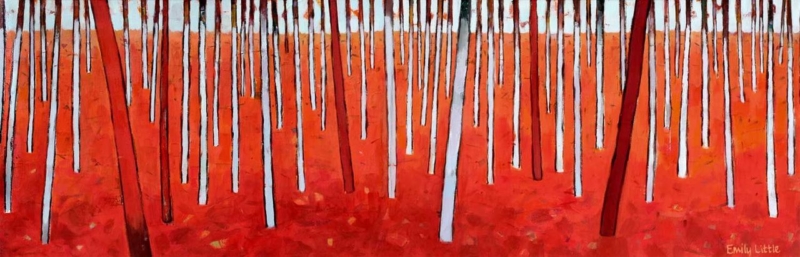
panoramic wall art above a bed can solve a familiar proportion problem. A bed creates a broad visual base, yet a standard upright picture may seem detached above it. Alberi II by Emily Little takes the opposite approach. Its very wide, shallow format follows the line of the headboard, while the repeated trunks and intense woodland floor create rhythm without requiring a group of separate frames.
Why panoramic wall art above a bed feels settled
The strongest bedroom arrangements connect the furniture and wall instead of treating them as separate layers. A horizontal image extends across the headboard area and gives the eye a clear line to follow. Because Alberi II is only 310 millimetres high at its largest print size, it adds presence without pushing too close to the ceiling.
The woodland subject supports that geometry. Slim vertical trunks rise through the composition, but their repeated spacing reads as one continuous band. That balance of horizontal format and vertical detail prevents the piece from looking like a decorative stripe. It remains an artwork with depth and movement.
Set the width in relation to the headboard
Begin with the bed, not the full wall. The framed picture should be clearly narrower than the headboard so the arrangement keeps a stable visual base. At the same time, it needs enough width to avoid floating as a small object over the pillows. Use masking tape to mark the proposed outer frame, then view it from the doorway and from the foot of the bed.
Measure the headboard. Record its full visible width after bedside furniture is in place.
Mark the frame outline. Include the moulding and any mount, not only the 900 x 310 or 560 x 180 millimetre print.
Check the gap below. Leave comfortable breathing space above the headboard rather than allowing the frame to appear perched on it.
Test the doorway view. Make sure the artwork centres on the bed, even if the bed is not centred on the whole wall.
The narrower print option can suit a single or double bed, depending on the finished frame. The larger version has the reach for a broader headboard. Exact proportions will vary with the mount and moulding, so a paper template gives a more dependable answer than a general percentage rule.
Use the red woodland without making the room restless
The red and orange ground gives the print real energy, but the pale trunks and disciplined repetition keep it controlled. Let that band of colour be the room’s main expressive feature. Bedding can stay quieter in stone, soft white, charcoal, or muted green. One rust or berry-coloured cushion is enough to connect the palette.
This restraint is particularly useful in a bedroom. Repeating every colour across curtains, lamps, throws, and rugs would make the scheme feel busy. A concentrated area of warm colour above the bed can create focus while the rest of the room remains restful.
Choose the frame and fixings as part of the plan
A dark, slim moulding can sharpen the tree trunks and suit black bedside lights or metal details. Pale timber may connect the woodland subject to oak furniture and soften the stronger red. Avoid an unnecessarily deep or ornate profile; the elongated format already provides a distinctive architectural line.
Anything positioned over a bed must be securely fixed for the wall type and finished frame weight. Use appropriate hardware and avoid relying on a loose picture ledge. First 4 Frames can advise on presentation and practical hanging considerations when the frame is specified.
A confident focal point with an in-house finish
First 4 Frames produces colour-managed Giclée prints and completes bespoke framing in-house at its Falkirk workshop. Careful production helps preserve the fine pale trunks, dark lines, and variation across the red woodland floor. The finished frame turns the unusual shape into a deliberate part of the bedroom architecture.
A gift for a flower arranger should recognise the recipient’s creative eye rather than simply repeat the materials they use. Flowers are beautiful, but a fresh bunch can feel predictable for someone who works with them every day. Antique Bouquet by David Short offers a more lasting connection. Its energetic stems, seed heads, berries, and graphic vase celebrate the choices that make an arrangement distinctive: colour, balance, line, and a willingness to combine unexpected forms.
Why art can be a better gift for a flower arranger
Experienced flower arrangers often have strong preferences about tools, vessels, and plant material. Buying specialist equipment without knowing their working methods can miss the mark. A framed print avoids that problem. It honours the same visual interests while giving them something to enjoy when no active arrangement is on the table.
This piece is especially apt because it does not present a formal, perfectly symmetrical bouquet. Marks cross, colours overlap, and individual shapes retain their character. That liveliness will appeal to someone who understands that the most memorable arrangements are rarely built by matching every stem. They come from rhythm, contrast, and confident editing.
Match the gift for a flower arranger to the occasion
Occasion
What the gift can acknowledge
What to add in the card
New studio or shop
A creative space of their own
A wish for the work and people it will welcome
Retirement
Years of skill, patience, and visual judgement
A specific arrangement or event people remember
Course completion
Growing confidence and a developing personal style
The progress you have noticed
Birthday
The pleasure their creativity brings to everyday life
Why the image made you think of them
The written message supplies the personal context. Avoid broad praise if you can name something real: their unusual colour combinations, calm work under pressure, or talent for making seasonal material feel fresh. The artwork then becomes a lasting reminder of a quality you genuinely value.
Choose a display place away from the working mess
A studio wall, shop consultation area, dining room, or creative home office can all suit Antique Bouquet. In a professional setting, place it where clients can enjoy it without crowding the workbench. At home, a wall near a table or sideboard allows the floral subject to connect naturally with real vessels and seasonal stems.
The portrait format is useful on a narrower wall. It can fit between a window and cabinet, beside shelving, or above a compact piece of furniture where a wide landscape would feel squeezed. Measure the finished framed size, not only the printed image, and leave enough clear wall for the irregular marks to remain legible.
Let the artwork lead the colour rather than matching it
The mint ground, dark vase, warm orange, purple, and fresh green create several possible links to a room. Only one or two are needed. A green wall may draw out the background, while timber furniture can support the warmer marks. Against a neutral wall, the picture can carry the colour on its own.
A simple dark moulding can connect with the vase and ink-like outlines. Natural timber offers a softer choice if the room already contains baskets, wood, or handmade ceramics. The frame should give the lively composition a clear boundary without trying to compete through ornate detail.
Presentation that respects a trained eye
First 4 Frames uses colour-managed Giclée production and completes bespoke framing in-house at its Falkirk workshop. That care matters for an image built from small shifts in texture and overlapping colour. The hand-finished result also gives the present the sense of permanence appropriate to a milestone or professional achievement.
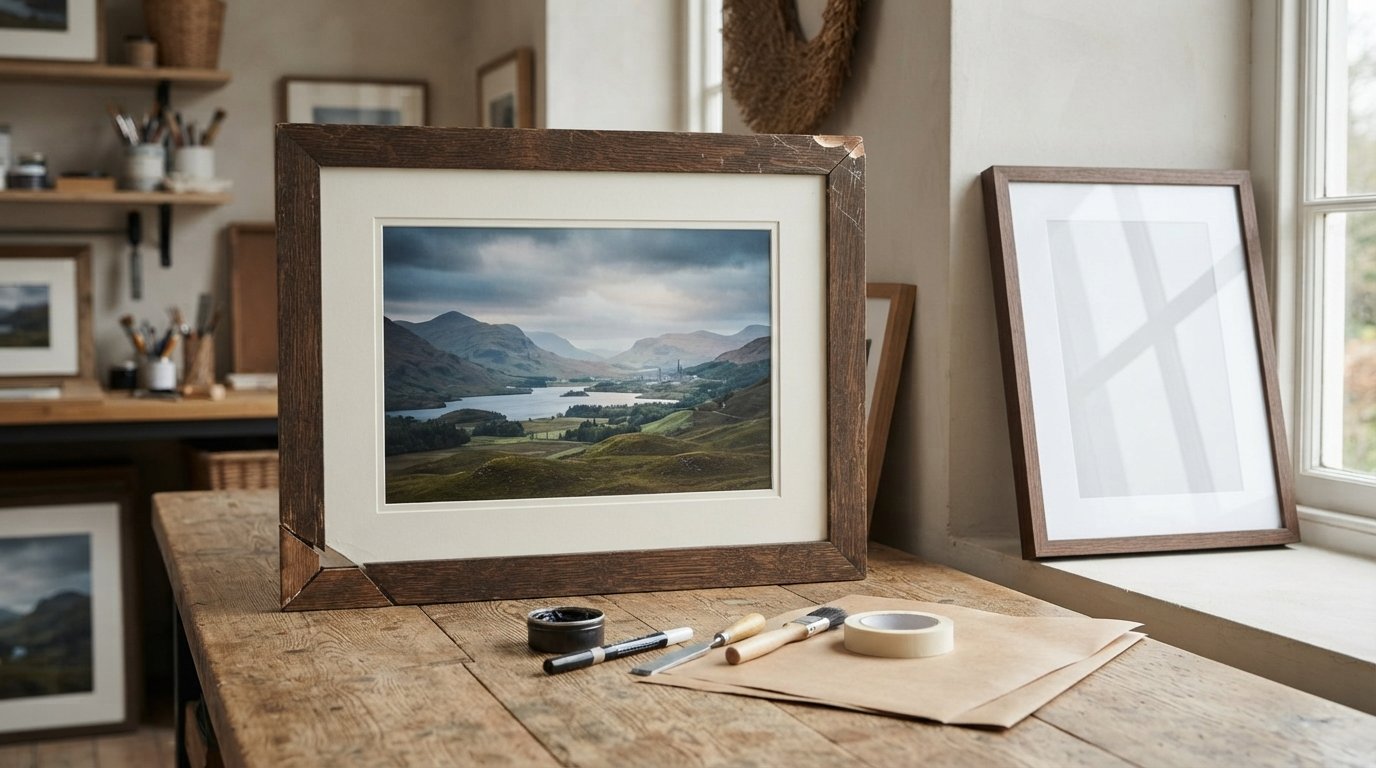
Imagine walking into your hallway and noticing that your favourite Scottish landscape print is hanging slightly askew. Upon closer inspection, you see a wobbly corner joint that looks like it might give way at any moment. Understanding when to replace a damaged picture frame is vital to protecting your collection, as it’s truly frustrating when a cherished piece starts to show its age or suffers an accidental knock.
You want to preserve the art inside, but you’re likely worried that a DIY fix might do more harm than good to a valuable Giclée print. A frame is a protective seal, and if that seal is broken, your art is at risk. We will help you distinguish between minor cosmetic chips you can fix at home and structural damage that requires a professional bespoke replacement.
This guide provides practical steps to address unsightly scratches while explaining how to spot serious safety hazards. You will gain the confidence to choose high-quality materials, like 2mm float glass, that offer the superior clarity and protection your fine art deserves.
Key Takeaways
Identify the difference between minor cosmetic marks and structural hazards, such as separating mitred corners, to ensure your artwork remains safe and secure.
Use our expert decision framework to understand exactly when to replace a damaged picture frame rather than attempting a home repair that could risk your Giclée prints.
Master simple at-home restoration techniques using wax filler sticks and furniture pens to seamlessly mask surface scratches and small chips on your wooden frames.
Discover why bespoke framing with 2mm float glass offers a superior, hand-made alternative to cheap Perspex options, providing lasting clarity for your favourite art.
The Anatomy of Damage: Assessing Your Picture Frame
Knowing when to replace a damaged picture frame starts with understanding picture frame construction and materials. You need to distinguish between a minor surface flaw and a structural failure. While a small chip is often just an eyesore, a separating mitred corner is a signal of instability. Cheap standard frames frequently fail at these joints because they’re mass-produced with inferior glues or staples. In contrast, a bespoke, hand-made frame is individually crafted for every order, ensuring a perfect fit and long-term durability.
Check your glazing carefully. Is it cracked, or perhaps it’s cheap Perspex that has yellowed and warped over time? We always recommend 2mm float glass for its superior clarity compared to plastic alternatives. Also, inspect the backing for “foxing” (brown spots) or moisture ingress. These signs indicate that the protective seal has failed, which can devastate fine art prints and delicate photography prints.
Surface Level: Scratches, Dents, and Chips
Scratches and dents often occur during house moves or cleaning accidents. In many Scottish homes, fluctuating humidity can also affect the wood’s finish. These blemishes are distracting. When light hits a deep scratch, it draws the eye away from the focal point of your contemporary art prints. It’s often at this point owners wonder when to replace a damaged picture frame to restore the piece’s visual impact and aesthetic perfection.
The Danger Zone: Structural Instability
A wobbly frame is a ticking time bomb. If the corners are separating, the 2mm float glass could slip, potentially slicing your artwork or falling entirely. This gap also lets in dust and pollutants. When the structural integrity is compromised, the frame is no longer a protective seal. At this stage, a bespoke replacement is the only way to ensure your artwork remains secure. You can use a wall art visualiser to see how a professional replacement transforms your space.
Repair vs. Replace: A Decision Framework for Art Lovers
Deciding when to replace a damaged picture frame involves weighing the value of your artwork against the condition of its housing. If your frame has minor corner chips or light surface scratches on dark wood, a simple home touch-up often restores its charm. However, warped wood, shattered glass, or acidic mount staining are clear signs that the frame’s life has ended. Following the Smithsonian guidelines for frame care and preservation is essential, as maintaining the physical integrity of the housing is critical for long-term art safety.
Investing in bespoke framed wall art ensures your Scottish landscape art or contemporary art prints are protected by high-quality materials. Cheap, standard frames often use acidic backings that cause “burn” marks on the paper over time. If you notice yellowing edges on your mount, it’s time to upgrade to a professional solution that preserves your investment.
The “Art First” Rule of Replacement
Protecting the print is always your priority. If damage allows air or moisture to bypass the seal, you must act quickly to prevent irreversible damage. Our guide on Mastering Custom Picture Framing explains how a bespoke fit creates a perfect environment for your art. Replacing a compromised frame with one featuring 2mm float glass provides the clarity and protection necessary for Giclée fine art prints.
Aesthetic Obsolescence: When Style No Longer Matches
Sometimes, damage is simply the push you need to refresh your home’s look. A frame that once suited your decor might now clash with a new colour scheme or a modern interior. Upgrading to a bespoke frame allows you to choose your frame online to find a style that truly complements your photography prints. You can even use a wall art visualiser to see how a new bespoke frame transforms your cherished piece before you commit.
How to Repair a Chipped or Scratched Frame at Home
Maintaining the aesthetic appeal of your collection doesn’t always require a full replacement. For minor cosmetic issues, a methodical home repair can breathe new life into your display. Start by cleaning the damaged area with a soft, lint-free cloth to remove any dust or old wax. This ensures your repair materials bond correctly to the surface.
Next, use wax filler sticks or furniture touch-up pens that match your frame colour exactly. For deeper chips that penetrate the finish, apply a small amount of wood filler. Once dry, sand the area lightly with fine-grit paper and apply a matching stain. Finally, buff the area gently to blend the repair with the original finish. This process works well for surface-level wear, but knowing when to replace a damaged picture frame is crucial if the damage is structural.
Fixing Scratched Glass or Perspex?
You might be tempted to polish out a scratch on the glazing, but you should never try this with glass. It creates distortion and risks breakage. Many high-street frames use cheap Perspex which scratches easily and loses its clarity. At First4Frames Gallery, we use 2mm float glass in our bespoke framing to provide a crystal-clear view of your art prints. If your glass is shattered or badly scratched, a professional replacement is the safest choice.
Re-securing Loose Backing and Hardware
Loose D-rings or slack wires can cause your frame to sit unevenly on the wall. Tighten these components carefully, ensuring you don’t strip the wood. However, if the frame feels wobbly at the corners, it indicates a failure in the original joinery. A professional framer in Falkirk can often re-join these mitres, but if the wood is split, it’s time to choose your frame online for a more reliable, hand-made solution.
Upgrading to Bespoke: Why a Professional Replacement Wins
Deciding when to replace a damaged picture frame is the perfect time to choose our professional art print framing service. Unlike mass-produced alternatives that often fail at the joints, our bespoke frames are individually crafted to the exact millimetre. We use 2mm float glass for all glazing because it offers superior clarity and protection compared to the Perspex used by many competitors. This standard ensures your Giclée prints remain vibrant and safe for years to come.
Our online picture framing platform allows you to create custom framed art prints from your own digital files or our extensive gallery. If your original artwork was damaged alongside the frame, our “print and frame” service refreshes your display with high-quality Giclée printing. We ensure every finished piece is fully packaged and shipped via professional couriers to prevent any new damage during transit.
Design Your Framed Artwork Online
Use the wall art visualiser to see artwork before you buy. This tool is perfect for matching styles like Coastal wall art, Scottish landscape art, or Contemporary art prints to your home decor. You can easily design your framed artwork and choose your frame online with absolute confidence.
The Value of Professional Curation
A high-quality frame acts as a style statement, turning a simple photography print into a “Best-selling” gallery piece. Whether you are searching for landscape wall art or works by famous artists, our collection offers endless inspiration. Use our tools to visualise art on your wall and ensure your new bespoke framed wall art perfectly complements your living space.
Give Your Artwork the Protection it Deserves
Your art is more than just a decoration; it’s a window into a creative moment that deserves a secure and beautiful home. By learning how to spot structural instability and the warning signs of moisture ingress, you now know exactly when to replace a damaged picture frame to prevent long-term damage. While minor scratches can be buffed away at home, a bespoke, hand-made replacement is the only way to ensure your Giclée prints stay protected behind 2mm float glass.
Every frame we create is hand-made in the UK, providing a snug fit that standard, mass-produced alternatives simply can’t match. We take the stress out of the process with safe courier delivery nationwide, ensuring your new display arrives in perfect condition. It’s time to give your Scottish landscape art or photography prints the high-quality finish they’ve been waiting for.
Yes, minor surface cracks can be filled with professional wax sticks to restore the finish. However, if the crack goes through the wood or causes the corner joints to separate, the frame’s structural integrity is gone. Knowing when to replace a damaged picture frame is vital here, as a failing structure can drop the glass or allow pollutants to reach your valuable artwork.
Is it cheaper to repair a frame or buy a new one?
Simple DIY fixes for surface scratches are inexpensive. Professional restoration for structural damage is often more costly than ordering a new hand-made frame. A bespoke replacement offers better value because it is individually crafted with high-quality materials like 2mm float glass. This ensures your artwork is properly protected, preventing the need for future repairs that often plague mass-produced, cheap standard frames found on the high street.
What is the best way to hide scratches on a black picture frame?
Use a specialised black furniture touch-up pen or wax filler stick to mask light surface marks. Apply the pigment carefully and buff the area with a soft cloth to blend the repair. If the damage is extensive, it is a clear indicator of when to replace a damaged picture frame. A fresh bespoke frame will restore the crisp, professional look that a scratched focal point piece has lost.
How do I know if my frame glass needs replacing?
Replace your glazing immediately if it shows any cracks, chips, or cloudiness. Many older frames use Perspex, which is prone to yellowing and scratching over time. Upgrading to 2mm float glass is a smart choice because it provides superior clarity and protection for your Giclée prints. If the glass no longer sits snugly against the mount, it’s failing to act as a proper protective seal for your artwork.
Will a damaged frame devalue my art print?
While the frame doesn’t dictate the print’s market value, its condition directly impacts the art’s physical state. A failing frame allows moisture and dust to enter, which causes irreversible damage like foxing or fading. By choosing a high-quality bespoke frame, you create a safe environment for your fine art prints. This preservation is vital for maintaining the longevity and visual fidelity of your contemporary art collection for years to come.
Artwork for property developers is most useful when it makes an interior feel connected to its location rather than dressed from a generic catalogue. Night view of the Clyde Arc shows Glasgow’s Clyde Arc at night, combining illuminated engineering, reflected light, and the River Clyde. It gives a reception, show apartment, or serviced residence a recognisable sense of place.
Specify artwork for property developers by space and sightline
Setting
Role for the Clyde Arc image
Entrance reception
Creates an immediate Glasgow reference with a polished evening atmosphere.
Show apartment
Adds local character without dictating a highly personal decorating style.
Corridor or lift lobby
Uses the bridge line to bring direction and energy to a transitional space.
Meeting room
Provides civic identity and structure without motivational wording.
Build a repeatable but varied scheme
For several rooms, repeat the framing specification rather than the identical picture everywhere. One consistent frame finish can connect Glasgow architecture, river views, and wider Scottish subjects while giving each space its own focal point.
Consider the final viewing distance before choosing dimensions. A reception wall can support a larger statement, while a corridor needs enough margin to protect the frame from feeling cramped. Reflections also matter in glazed commercial interiors, so test the intended wall under evening lighting.
Choose a recognisable location with architectural clarity.
Coordinate frame finishes across the development.
Vary subject matter to avoid repetition.
Plan scale, installation height, and lighting as one specification.
First 4 Frames supports commercial projects with in-house, colour-managed Giclée printing and bespoke framing from its Falkirk workshop. A consistent hand-finished specification helps multiple pieces feel coordinated while retaining individual subject matter.
As artwork for property developers, Night view of the Clyde Arc offers a strong Glasgow identity, clear architectural form, and the flexibility needed for polished shared or residential interiors.
The best wall art for plum walls often introduces contrast instead of searching for the same purple again. Northern lights and snowy mountains combines a dark sky with luminous green aurora, pale snow, and mountain silhouettes. Those cool highlights can lift a rich painted wall while preserving the enveloping mood that makes plum so effective.
Choose wall art for plum walls with one source of light
A rich wall colour needs artwork with clarity; luminosity is often more useful than another heavy pigment.
The aurora acts like light inside the image. It gives the eye a bright route across the dark sky, while snow creates a second, quieter highlight below. This makes the photograph suitable for a bedroom, snug, or cinema room where a pale daytime print could feel disconnected after dusk.
In daylight
Use a mount or slim light inner edge to separate the night sky from plum paint. Check that direct sun does not create distracting reflection.
After dark
Place a warm lamp elsewhere in the room. The contrast between warm ambient light and cool aurora colour helps both feel intentional.
Repeat the green only once, perhaps in a small cushion or glazed ceramic. Too many aurora colours would turn a sophisticated palette into a theme. Let the framed photograph remain the concentrated moment of brightness.
Subtle night gradients can be demanding to reproduce. First 4 Frames uses colour-managed Giclée printing to preserve the aurora, snow, and shadow detail, then hand-finishes the bespoke frame in its Falkirk workshop.
As wall art for plum walls, Northern lights and snowy mountains adds cool light, depth, and a sense of wonder while keeping the room composed and restful.
Large landscape prints earn their scale when the image contains enough depth to reward a longer look. Old Man of Storr layers foreground terrain, the distinctive rock formation, and an open Highland sky. That structure can anchor a broad living-room wall while still giving the room a sense of distance.
Size large landscape prints to the furniture below
Start with the wall, then test the view
Above a sofa or sideboard, the framed piece should relate clearly to the furniture width rather than floating as a small object. Mark the proposed outer dimensions with removable tape, then inspect them from the main seat and the doorway.
Leave enough clear wall for the silhouette to remain readable.
Keep tall lamps and plants away from the strongest rock formation.
Use a restrained frame so the landscape, not the border, carries the drama.
Avoid hanging too high; the terrain should connect comfortably with seated eye level.
The Storr has a naturally vertical landmark inside a wider landscape. That contrast gives the composition energy and makes it useful in rooms where low furniture dominates. It also offers recognisable Skye character without relying on a montage of smaller Scottish scenes.
Scale feels convincing when a landscape has foreground, middle distance, and a destination for the eye.
On a larger print, tonal separation and fine detail matter. First 4 Frames uses colour-managed Giclée production and hand-finishes the bespoke frame in Falkirk, helping rock, slope, and sky remain distinct at room scale.
Among large landscape prints, Old Man of Storr has the depth and strong natural structure needed to give a broad wall focus without filling it with clutter.
Art for maple furniture should relate to the timber without repeating one pale neutral across the whole room. Roe deer, capreolus capreolus, buck running on meadow sunlit by evening light in summer introduces a roe buck moving through a meadow in low summer light. The gold in the scene connects naturally with maple, while the animal and deeper grass tones stop the scheme becoming flat.
Balance art for maple furniture with warmth and movement
Room element
Useful connection
Pale maple grain
Pick up the photograph’s softer gold light rather than matching the wood exactly.
Cream upholstery
Use the meadow’s deeper greens to add contrast and keep the palette grounded.
Simple cabinetry
Let the moving deer introduce energy against clean, static lines.
Warm evening lamps
Position light nearby so it supports the sunset mood without shining on the glass.
A dark, narrow frame can define the photograph against pale timber furniture. Alternatively, a quiet natural finish can create a softer transition, provided it does not imitate the maple too closely. The aim is a related palette with enough separation to keep each material distinct.
Keep wildlife styling contemporary
Avoid adding antler motifs, checked accessories, or several woodland pictures. One sharply observed moment feels more modern and gives the animal genuine presence. It can work above a sideboard, opposite a desk, or on the calmer wall of a family room.
Colour-managed Giclée printing helps retain the transition from bright meadow light to the darker moving subject. First 4 Frames completes the bespoke framing in-house in Falkirk, giving the natural scene a polished rather than rustic finish.
As art for maple furniture, Roe deer, capreolus capreolus, buck running on meadow sunlit by evening light in summer links pale wood to golden light while adding movement, contrast, and a clear natural focal point.